Local Origin and Global Spread of Viruses. Possible Pathogenic Viruses Distribution
From an Example of Antarctic Study
Author’s Details:
Zinaida КLESTOVA1, Alexander MAKARENKO2, Yugeniy SAMORODOV2
1
State Scientific-Control Institute of Biotechnology and Strains of Microorganisms, Kyiv,Ukraine
2
Institute for Applied System Analysis of National Technical University of Ukraine “Igor Sikorsky Kyiv, Politechnikc Institute” Kyiv, Ukraine
Abstract
The growth of transport rates, external trade and touristic relations in the modern world for medicine rise new problems associated with the risk of proliferation of biological threats. However, in addition to this, other ways of their spread, such as wild fauna, water, air, etc., remain important factors in the transmission of dangerous pathogens. In addition to identifying pathways for the transmission of pathogens, an important factor is an identification of pathogen sources, their evolution, the ability to preserve infectious properties and persist with various environmental factors, including temperature factors, acidity, and salinity of the environment, and others.We raise in article the issue of epidemiology and biosecurity as - the possibility of the spread of dangerous viruses in the world from remote "intact" areas where they can persist for a long time, including in ancient ice arrays (for example, in the Antarctic); - the possible entry of pathogenic viruses into Ukraine (for example, through migratory routes of migratory birds), where their spread could threaten other European countries, given the armed conflict in the border areas with Russia (which at any time may occur the bioterorystic threat); - we offer a tool for predicting and monitoring viral diseases. Keywords: viruses, infections diseases, epidemiology, distribution way, biological hazard, animal, Antarctic, ice.
1. INTRODUCTION
Despite intensive research, significant prophylactic work, the world's still infectious viral diseases are very relevant, affecting millions of people and animals, and endanger the biological safety (biosecurity) system of many countries.
It should be recalled that the World Health Organization (WHO) has long recognized that security, especially biological, is an important international issue. Together with the World Organization for Animal Health (the International Office of Epizootics, OIE), both of these organizations have developed the One World-One Health Concept, which shows the link between animal and human health.
We want to expand this thesis and consider it in the light of the study of the potential for the spread of pathogens, pathogens of viral diseases both to humans and animals, and its forecasting with the use of mathematical modeling tools and geoinformation solutions (systems). In this article, we will try to look at one possible aspect of the circulation of viruses - for example, the role of Antarctica in the evolution and spread of pathogens.
To do this, first, we will return to some international terms, namely, recall the definition of biological safety, biological risk, management of biological risks:
• Biological safety - prevention of harm and achievement of the protection of personality, state, and society from potential and real biological threats.
• Biological risk - the combination of the probability of occurrence of harmful effects and the degree of harmful effects in cases where the source of such influence is the biological agent.
Management of biorisks - providing organizational management to minimize the risks posed by biological materials. The main focus of the practice of biological safety is precisely the assessment of risks. The process of assessment / risk management consists of risk perception, risk assessment, risk management. The levels of risk are different; these are local; regional; international ones. The main sources of biological danger are many factors, namely:
pathogenic microorganisms - pathogens of infectious diseases;
epidemics, epizootics, natural reservoirs of especially dangerous microorganisms;
accidents and sabotage on objects where work with pathogenic microorganisms is carried out;
biological terrorism in all its manifestations.
Since pathogenic viruses present a threat to their hosts, consider the topic of the spread of viruses on our planet. Viruses are the main factors of the genetic component of the universe. And although they are objects of rather a small size (nanoobjects), they are dynamic players in the ecology of the Earth. Each species, from bacteria to mammals, is exposed to viruses. They dominate the biosphere: there are about 10-100 viruses in each living cell. Viruses spread outside the species and have an impact on the climate, soil, oceans and fresh water.
Since the viruses are unique objects of the biosphere, which are on the border of living and nonliving (the controversy on this topic is still ongoing), for their systematics and classification, the International Committee for the Taxonomy of Viruses was created, the last (10th) report of which was published in 2017 year [1]. The first international organized attempts to bring order to the amazing variety of viruses were held at the International Congress of Microbiologists, held in Moscow in 1966. It created the Committee, later
called the International Committee on Virus Taxonomy (ICTV). Committee was charged with the creation
of a single, universal taxonomic scheme for all viruses that infect animals (vertebrates, invertebrates, and protozoa), plants (higher plants and algae), mushrooms, bacteria, and archeas. The taxonomy of viruses differs from other types of biological classification. ICTV Report formalized for the first time the concept of the virus species as the lowest taxon (group) in a branching hierarchy of viral taxa. As defined therein, “a virus species is a polythetic class of viruses that constitute a replicating lineage and occupy a particular ecological niche.” A “polythetic class” is one whose members have several properties in common, although they do not necessarily all share a single common defining property. In other words, the members of a virus species are defined collectively by a consensus group of properties. Virus species thus differ from the higher viral taxa, which are “universal” classes and as such are defined by properties that are necessary for membership.
ICTV not only regulates the nomenclature code but also considers and approves the creation of taxon
viruses. The hierarchy of recognized viral taxa is, therefore: (Order), Family, (Sub-family),Genus, Species.
Only the aforementioned taxa are recognized by the ICTV. Other groupings (from clade to super-family), may communicate useful descriptive information in some circumstances but they have no formally recognized taxonomic meaning. Similarly, the term “quasi-species,” although it captures an important concept, has no recognized taxonomic meaning. Descriptions of virus satellites, viroids and the agents of spongiform encephalopathies (prions) of humans and several animals and fungal species are included. The advent of nucleotide sequence determination has revolutionized biology and largely rationalized taxonomy, including that of viruses. The universal virus taxonomy provides a classification scheme that is supported by verifiable data and expert consensus. It is an indispensable framework both for further study of the currently recognized virus species and for the identification and characterization of newly emergent viruses, whether they result from natural, accidental, or deliberate dissemination. The current health of virus taxonomy is due to the efforts of hundreds of virologists from around the world, but more volunteers are always needed [1].
However, in recent years, the discovery of new and new viruses that were still unknown, therefore their taxonomy needs to be substantially changed. Previously, we analyzed the changes in the taxonomy of viruses that occurred [2]. For our further analytical studies, the prevalence of viruses in different environments is a very important issue. And so, analyzing the possible spread of viruses from the Antarctic continent, it is very important to imagine the possibility of their existence in different environments. Here we want to mention the discovery made in 1986 by Lita Proctor concerning the presence of viruses in seawater [3, 4]. Having seen in seawater a huge amount of viruses, L. Proctor estimated that in every liter of such water there are up to hundreds of billions of viruses. It is now known that 1 cm³ of seawater contains 106-109 viral particles. O. Berg et al. In 1989 also found a high concentration of aqueous viruses [5]. Before in Berg group studies it had been having suggested that the concentration of bacteriophages in natural unpolluted waters is low, and therefore they are environmentally unimportant. Using the new method of quantitative calculation, these scientists found in the natural waters from 1.5-2.54 106 to 2.5 108 particles of virus / cm³. These concentrations indicate that viral infection can be an important contributor to the ecological control of planktonic microorganisms and that viruses can mediate the genetic exchange between bacteria in natural aquatic environments. Previously, it was believed that in the water the vast majority make up the bacteria, but it turned out that when compared in the ratio of the number of virus / bacteria, this ratio in the coastal waters of the seas is 20, and in the oceanic - 3-5. The autochthonous viruses of aquatic ecosystems that are part of the plankton, epithelium, and benthos are important and most numerous components of microbial populations. The number of viruses exceeds all other inhabitants of the ocean. If you place all the ocean viruses on the scales, then they will weigh 75 million blue whales, and if you create a chain that is connected from the virus to the virus, then a tape that reaches 42 million light-years will be released [4]. But it should be noted that only a small part of the ocean viruses can infect a person. Some marine viruses infect fish and other marine animals. However, most of the targets of these viruses are bacteria and other single-celled organisms. Marine bacteriophages affect the ecology of the world's oceans, and they play an important role in the evolution of life over millions of years. In other words, they are a biological living matrix [4]. Marine viruses are powerful because they are infectious. They penetrate into new microbes - the hosts are ten trillion times per second, and they kill 15 to 40% of all bacteria in the world's oceans every day. By killing these hosts, they create new viral particles.
By killing bacteria that synthesize different substances, including those that synthesize CO2, viruses affect the change of atmosphere and the trophic chains, which is negative for those animals that feed on these bacteria. We will not here consider the issue of transferring genes from one organism to another by means of viruses. Realizing the number of viruses circulating in water, air, sensitive organisms (which are all biological objects), let's turn to the topic of our analysis.
Turning to Antarctic research in the Antarctic Lake Limnopolar it hab has been discovered a record number of viruses, which is not anywhere on the planet. Namely: ficodoviruses and a whole group of viruses that had single-stranded DNA. They infect eukaryotes, organisms that have cells in the nucleus. This is interesting because Antarctica is a separate continent with fairly harsh climatic conditions. We can assume that these viruses are the descendants of their providers, which existed in the separation of Antarctica (millions of years ago).
Antarctica is the highest continent that is covered by 99.5% of the surface with continental ice up to 4,776 m (average thickness 1880 m). Researchers from Princeton University have proven that the age of Antarctic ice samples is 2.7 million years - one and a half million years older than the oldest ice samples investigated before. Despite the adverse climatic conditions, Antarctic biota consists of numerous biological species, which are interconnected by trophic bonds. For example, it is phytoplankton, krill, squid, craboid seal, blue whale, adel penguin, fish, imperial penguin, sea birds, tubule, sea leopard, etc.
These trophic bonds of the Antarctic biota are important to humankind, as we prove the close contacts in which viruses can migrate from one host to another.
In light of the latest knowledge about the emergence and spread of reemergence infections, this is
are zoonoses. Recall what constitutes an emergency infection. By the definition of "International Animal Health Code-2006", the emergent infections are:
• new infections that are the result of the evolution or the variability of an existing pathogenic agent;
• known infections that spread to a new geographic area or population;
• the emergence of new, previously unknown agents or diseases that were first diagnosed, which have a significant impact on the health of animals or humans. There are several reasons for the occurrence of emergent infections, and all of them are important. This is the variability of viruses and their evolution, which are resulted:
1. Point mutations (“quasi-species”)
• Recombination;
• Reassortment;
• Adaptation;
• Constant evolution.
2. The activity of a person, namely:
• Globalization of trade, tourism, travel;
• Development of transport links;
• Biopreparations (vaccines);
• Change in industrial or conventional agroecosystems;
• Global projects on land reclamation, deforestation, etc.
3. Climatic and environmental changes:
• Changes in climate and global warming;
• Change in ecology;
• Expansion of the population of animals (especially flying).
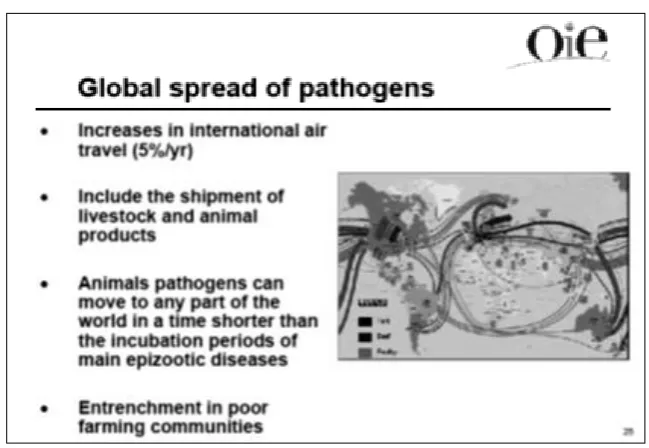
In fig. 1 are examples of trade and travel routes on the planet. Global pathways for the spread of pathogens are presented in Fig. 2 (OIE data).
Fig. 1. Intensity of modern transport routes
The prediction of the distribution of biorisks should be based only on an integrated approach that includes epidemic, epizootiological, statistical, retrospective, genetic analyzes, immunological (serological), molecular biological methods, bioinformatics data and mathematical modeling, which will improve the quality of the predictions for the spread and progress of the endangered viral animal diseases. For example, the spread of highly pathogenic avian influenza on the planet with a retrospective comparison is interesting in 2013 and 2017 (Fig. 3). In four years, the highly pathogenic influenza virus has spread to significantly larger areas than in 2013. But if in 2013 the outbreaks were noted in the south of the African continent and in Australia, then in 2017, they were not spotted in these areas, because the virus moved northward and
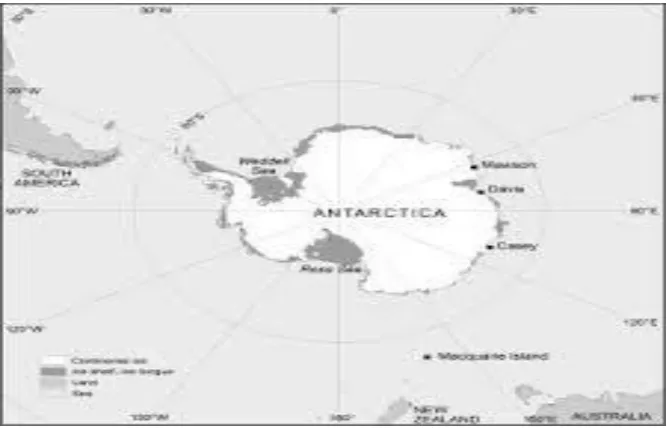
seized new territories.It is interesting to find out from what place the highly pathogenic avian influenza came to southern Africa and Australia. One of the presumable assumptions is to consider the contribution from Antarctica. To confirm our assumption of the possibility of spreading pathogens from Antarctica, we give some information about its location and distance to other continents. Antarctic to other continents: The shortest distance to South America through Drake is 820 km, to Australia 3,100 km, to 3980 km to Africa.
The continent of Antarctica makes up most of the Antarctic region. The Antarctic shores are washed by the
waters of the southern parts of the Pacific, Atlantic and Indian oceans. Together they are conventionally called the Southern Ocean (Fig. 4). Thus, there is a considerable distance across the water spaces from Antarctica to other nearby continents.
Fig. 4. The geographic location of Antarctica in relation to the nearest continents А B
The Antarctic Ice Sheet dominates the region. The ice surface dramatically grows in size from about 3 million square kilometers (1.2 million square miles) at the end of summer to about 19 million square kilometers (7.3 million square miles) by winter. Ice sheet growth mainly occurs at the coastal ice shelves, primarily the Ross Ice Shelf and the Ronne Ice Shelf. Ice shelves are floating sheets of ice that are connected to the continent. Glacial ice moves from the continent’s interior to these lower-elevation ice shelves at rates of 10 to 1,000 meters (33-32,808 feet) per year. Antarctica has a number of mountain summits, including the Transantarctic Mountains, which divide the continent into eastern and western regions. A few of these summits reach altitudes of more than 4,500 meters (14,764 feet). The elevation of the Antarctic Ice Sheet itself is about 2,000 meters (6,562 feet) and reaches 4,000 meters (13,123 feet) above sea level near the
center of the continent (by National Geographic:
https://www.nationalgeographic.org/encyclopedia/antarctica/) .
3. ANCTARCTIC BIOTA
Can Antarctic species conventionally infected with pathogens of human and animal viral diseases be overcome? At first glance, this seems impossible.
But we will analyze some data about the wildlife, for example, regarding Antarctica ornithofauna. We have found information on 11 species of birds, namely:
• Penguin Adele (Pygoscelis adeliae),
• Antarctic penguin (Pygoscelis Antarctica),
• Subantarctic penguin (Pygoscelis papua);
• Imperial penguin (Aptenodytes forsteri),
• Antarctic honeysuckle (Thalassoica Antarctica),
• Snow thistle (Pagodromanivea),
• Cape Crayfish (Daptiancapense),
• Southern giant petrel (Macronectes giganteus) and giant petrel (Macronectes halli),
• Sternopolar (Stercorarius maccormicki),
• Dwarfs (Wilsons storm),
• Arctic (polar) tusk (Sterna paradisaea).
pathogens, including viruses. Aboriginal avifauna, for example, penguins, overcome from 10-100 km depending on the state of surface-land, sea ice or open water during the breeding season.
Albatrosses move at a speed of 50 km / h. - They can reach Antarctica from South Africa and can reach from (and to) Australia for 3-7 days. Some of them live in the Southern Ocean (the islands of Chile - Diego Rameriez), can migrate (migrate up to 2000 km) to bring pathogens to Antarctica or on the contrary. Young specimens of the Southern Pole migrate much frequently and more far away (than adults) to the north and reach the shores of Alaska, Greenland, and the Japanese islands. Arctic boars migrate to Antarctica every year and are sometimes observed on land near the penguin colonies. As an example, in Fig. 5. the distribution of the petrel (Wilson` s storm petrel) is presented. Thus, some birds can overcome long distances and be a connecting link between the Antarctic and other parts of the world.
Consequently, the fact that Antarctica is a separate continent, located at a considerable distance from
other continents and is separated by water, is not the reason for its isolation from the point of view of the transfer to its territory and from it of various biological material, including viruses!
It is possible to assume that the active role of birds is the movement of pathogens into new territories and are introduced into new populations, which increases the risk of emergency. Thus, assuming such a scenario of the spread of pathogens, we analyzed the known data on the presence of viruses, pathogens of infectious diseases from representatives of the Antarctic fauna (Table 1 and Table 2).
Table 1. Viruses of marine Antarctic inhabitants
Seal viruses Mollusc viruses
Morbillivirus Herpesviruses
Avian influenza virus type A Iridoviruses
Herpesviruses (1st and 2nd types) Reoviruses
Parapoxvirus Paramyxoviruses
rabies virus Picornaviruses
Adenovirus
(causing of seals hepatitis)
Birnaviruses
Rotaviruses
Enteroviruses
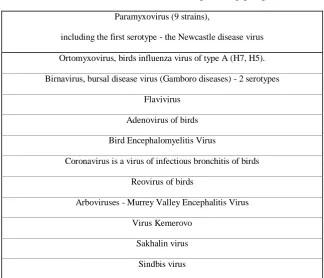
Thus, the data given in Table 1 show a wide range of viruses circulating among populations of both mollusks and seals. However, many of these viruses are pathogens for humans and cause disease. In addition to the indirect role of these animals in the spread of viruses, it should be noted that mollusks and sealed meat, other than animals, are also used by people who can drive him to infection. If we analyze the circulation of viruses among penguins, then again many of them are pathogenic to humans (Table 2).
Table 2. Viruses circulating among penguins
Paramyxovirus (9 strains),
including the first serotype - the Newcastle disease virus
Ortomyxovirus, birds influenza virus of type A (H7, H5).
Birnavirus, bursal disease virus (Gamboro diseases) - 2 serotypes
Flavivirus
Adenovirus of birds
Bird Encephalomyelitis Virus
Coronavirus is a virus of infectious bronchitis of birds
Reovirus of birds
Arboviruses - Murrey Valley Encephalitis Virus
Virus Kemerovo
Sakhalin virus
Sindbis virus
Thus, representatives of the Antarctic biota are active members of the circle of viruses. In addition, we must also keep in mind the viruses circulating in the ocean (ocean) water, among which there are also human and animal pathogens that can infect waterfowl and birds of the
Antarctic biota and transfer further over long distances. Let's consider now, for example, migrationroutes of migratory birds crossing the territory of Ukraine (shown in Figure 6).
Fig. 6 Bird migration routes through Ukraine
There are three main migration flows:
Polessky corridor
Azov-Black Sea corridor Dnieper
- Dniprovsky Corridor (from south to north);
- Azov-Black Sea Corridor (south-eastern direction);
- Polesie Corridor (from west to east).
Thus, a large mass of birds from different parts of the world migrate through the territory of Ukraine, and along with them, there may be pathogens of viral infections, including highly pathogenic influenza and others, including those that are not inherent to Ukraine. Therefore, in order to prevent new biorisks and to strengthen the biosecurity of Ukraine, it is necessary to forecast the emergence of possible risks.
4. GEOINFORMATION SYSTEMS AND MODELING FOR VIRUSES RESEARCH
An information system based on geographic information systems (GIS) and cloud technologies can be used as one of the tools [6]. It includes mathematical predictive models that need to be introduced to predict epizootics and zoonotic outbreaks. This information system includes both an informational and an analytical component for predicting the spread of dangerous pathogens. The main task of the information component is to provide the analytical block with as much data as possible from different sources. This requires the use of standardized data formats (for integration with European sources of information using the INSPIRE format) and standardized mechanisms for the exchange of information from other sources. Two-way data exchange is carried out using WMS and WFS web services.
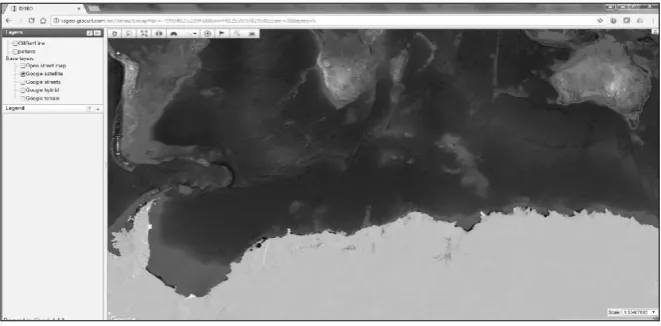
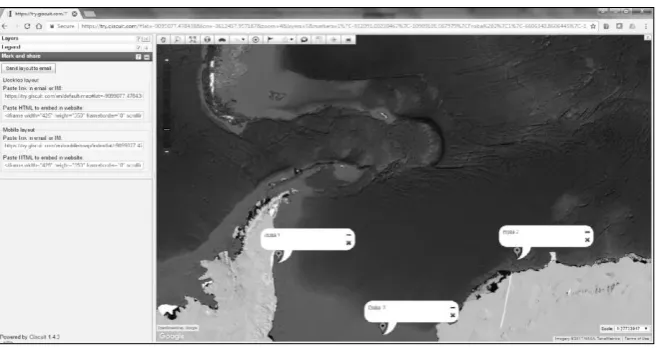
For the monitoring and forecasting of the risks of the spread of viral pathogens, an information environment is proposed that is implemented as an atlas solution. The interface includes a number of sections, such as a data archive, background information, different mapping bases. Information is provided in the form of cartographic layers (examples of such layers are shown in Figs. 7, 8). The following data set can be used for calculations:
• Locations of people settlements,
• Waste storage sites
• Territories visiting tourists,
• areas of residence and migration of animals,
• areas of habitat and migration of birds,
• data on the direction and wind power
• Cartograms of surface and deep water currents
• sampling points
• sample analysis
• Information on the spread of infections.
CONCLUSIONS
The above analysis of the situation associated with the preservation and spread of dangerous viruses from the territory of the Antarctic to other parts of the globe gives us the right to assume that ancient, dangerous viruses are preserved in other glacial massifs (and on the soils under them, as well as in the more deep layers of rocks under them), such as the Arctic ice and high mountain ice. A change (decrease) in the planet's ice cover due to global warming may lead to the release of viruses from ice and from under the ice and their spread with melt waters to nearby territories. And the way of their further migration on the planet, as we see, can exist everywhere. And only having the ability to process large amounts of data in real time with reference to specific conditions and territories (using mathematical analysis and geographic information systems with connection to cloud technologies) will lead to the adoption of the right management decisions to prevent the spread of viral infections.
Thus, we are shown the possibility of the spread of viruses that can cause the world's worst viral infections. On the Antarctic example, possible ways of origin and distribution of new types of infections are considered. The possibilities of the application of modern modeling and geoinformation technologies for prediction of the global spread of infections are considered.
REFERENCES
i. The Online 10th Report of ICTV (International Committee of Taxonomy of Viruses) //
https://talk.ictvonline.org/ictv-reports/ictv_online_report/.
ii. Klestova Z., Krasnobayev E., Zoz O. The peculiarities of recent change to the nomenclature of familiers and species of viruses// Veterinary Biotechnology. Bulletin of Institute of Veterinary Medicine of Ukraine. – Kyiv. – 2007. – № 10. – С. 52–60. (in Ukrainian)
iii. Lita M. Proctor& Jed A. Fuhrman. Viralmortality of marineb acteria and cyanobacteria // Naturе. – 1990. – 343. – P. 60–62.
iv. Carl Zimmer. A Planet of Viruses // The University of Chicago Press. – Second Ed.-2015. – 122 p.
v. Bergh O., Børsheim KY, Bratbak G, Heldal M. High abundance of viruses found in aquatic environments // Nature. – 1989 . – Aug 10. – 340 (6233): P. 46–78.
vi. Makarenko A., Samorodov E. Using GIS for the integration and visualization of local data for some Ukrainian problems. In: Digital Governance: From local data to European policies. Ed. I. Zalisova, Prague, 2013. 4 p.