Amirkabir University of Technology (Tehran Polytechnic)
Vol. 46, No. 1, Spring 2014, pp. 37- 47
Amirkabir International Journal of Science& Research (Electrical & Electronics Engineering)
AIJ-EEE) )
٭
IIR System Identification Using Improved Harmony
Search Algorithm with Chaos
M. Shafaati
1and H. Mojallali
2٭1- MSc. Student, Electrical Engineering Department, Faculty of Engineering, University of Guilan, Rasht, Iran 2- Assistant Professor, Electrical Engineering Department, Faculty of Engineering, University of Guilan, Rasht, Iran
ABSTRACT
Due to the fact that the error surface of adaptive infinite impulse response (IIR) systems is generally
nonlinear and multimodal, the conventional derivative based techniques fail when used in adaptive
identification of such systems. In this case, global optimization techniques are required in order to avoid the
local minima. Harmony search (HS), a musical inspired metaheuristic, is a recently introduced population
based algorithm that has been successfully applied to global optimization problems. In the present paper, the
system identification problem of IIR models is formulated as a nonlinear optimization problem and then an
improved version of harmony search incorporating chaotic search (CIHS), is introduced to solve the
identification problem of four benchmark IIR systems. Furthermore, the performance of the proposed
methodology is compared with HS and two well-known meta-heuristic algorithms, genetic algorithm (GA)
and particle swarm optimization (PSO) and a modified version of PSO called PSOW. The results
demonstrate that the proposed method has the superior performance over the other above mentioned
algorithms in terms of convergence speed and accuracy.
KEYWORDS
1-INTRODUCTION
Adaptive filtering techniques have been significantly advanced in recent years and have been successfully applied in a variety of fields in digital signal processing, communication and control. Adaptive Filtering when used for system identification tends to provide a model that represents the best fit to an unknown plant based on FIR or IIR structures. While theory and design of adaptive filters based on FIR filter structure is a well-developed subject, the same is not true for the linear infinite impulse response systems (IIR). This stems from the fact that IIR structures tend to produce multimodal error surfaces with respect to filter coefficients. This fact leads conventional derivative based learning algorithms such as least mean square to easily get stuck in local minima when solving such optimization problems. This is because they try to find the global minima by moving only in the direction of negative gradient. In this sense, each local minima becomes a potential trap that prevents algorithm from reaching the global extreme point. Classical recursive methods, in addition to convergence converge with the to local minimum, pose stability problem, slow convergence and also their performance substantially deteriorate when reduced order adaptive models are used [32]. On the other hand, an IIR structure due to having both poles and zeros can give a better approximation of real world systems. Besides, to achieve a particular level of performance, an IIR filter requires less number of coefficients than the FIR filter which corresponds to less computational burden. A number of classical adaptive system identification and filtering techniques have been reported in literature [36, 20, 24, 25 and 32]. Traditionally, least square techniques have been well studied for the identification of static and linear systems [41]. For nonlinear system identification, different algorithms have been used in the past including neural networks [19, 10 and 8] and gradient based search techniques such as least mean square [39]. In order to alleviate these deficiencies, population based search algorithms such as genetic algorithm has have also been used. But its effectiveness was affected by the convergence time. After that, population based stochastic optimization algorithms have been discussed in various literatures for design and identification of IIR filters which had the capability of faster convergence and global search of solution space in comparison to the conventional methods [5, 3, 1, and 2]. Application of PSO and its variants could be found in [26, 28, and 34]. Recently, a new approach based on artificial bee colony optimization for digital IIR system identification is proposed [21]. Seeker optimization, Cat swarm
optimization and Harmony Search have also been also proposed in [12, 35, and 37].
But, when the complexity of the problem increases or where the time allowed for convergence is limited (in dynamic systems), many of these algorithms tends tend to get stuck in the local minimum. In this these cases, hybrid algorithms are introduced to improve the performance by combining the best feature of each participating algorithms [26].
The goal of this paper is to introduce an enhanced HS algorithm by combining chaotic search and concepts from Swarm intelligence. Although, HS itself can produce good solutions at a reasonable time for a complex optimization problem, researchers are still trying in order to improve the fine-tuning characteristics and convergence rate of HS algorithm [27, 33, 40, and 18].
Chaos is one of the characteristics of nonlinear systems which include infinite non-periodic bounded motions. Nonlinear dynamic systems could be iteratively used to generate chaotic sequences of numbers. Many chaotic maps in the literature possess certainty, ergodicity and the stochastic property. As a novel optimization technique, chaos has gained much attention. For a given cost function, by following chaotic ergodic orbits chaotic dynamic system may eventually reach the global optimum or its good approximation. Recently, chaotic sequences have been adopted in place of random sequences [38, 16, and 7]. They also have also been
combined with some metaheuristic optimization
algorithms to improve performance of these algorithms by chaotic evolution of variables [6, 9 and 5]. This evolution includes two main steps: firstly, mapping from the chaotic space to solution space and then searching for the optimal regions using chaotic dynamics instead of random search [23].
In this paper, in order to enhance the global convergence of HS algorithm, firstly, we proposed a new variant of HS, called improved HS (IHS) by adopting
concepts from swarm intelligence. Furthermore,
The remaining of this paper is organized as follows. Section 2 considers the mathematical formulation of IIR system identification. Section 3 discusses the HS algorithm. The improved HS with chaos is introduced in section 4. The proposed CIHS based IIR system identification method is provided in section5. The Simulation results and discussions are given in section 6. The paper ends with conclusions in section 7.
2-IIRSYSTEMIDENTIFICATION
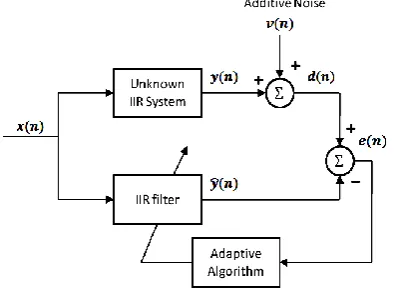
The problem of determining a mathematical model for an unknown system by monitoring its input-output data is known as the system identification [24-25]. The task of any given parametric system identification algorithm is to vary the model parameters until a pre-defined approximation criterion is satisfied. The block diagram of an arbitrary IIR system identification algorithm is shown in Fig. 1. The adaptive algorithm essays to tune the adaptive filter coefficients such that the error between the output of the unknown system and the estimated output is minimized.
Fig 1. Block diagram of an IIR system identification algorithm
An IIR system is described as:
(1) ( ) ( ) ( )
Wherein,
(2) ( )
is the IIR transfer function, ( ) is the z-transform of the output ( ), and ( ) denotes the z-transform of the input ( ). and are the feed-forward and feed-back coefficient coefficients of the IIR system, respectively. The IIR filter can be formulated as a difference equation
(3) ( ) ∑
( ) ∑
( )
As illustrated in Fig. 1, ( ) is the additive noise in the output of the system. Combining ( ) and ( ), we get the overall output of the system ( ). Additionally, for the same set of inputs, the adaptive IIR filter block produces ̂( ). The estimated transfer function can be represented as
(4) ̂( ) ̂ ̂ ̂ ̂
̂ ̂ ̂
Where ̂ and ̂ signify the approximated coefficients of the IIR system. In other words, the transfer function of the actual system is to be identified using the transfer function of the adaptive filter. The difference between ( ) and ̂( ) produces the input to the adaptive algorithm .The adaptive algorithm uses this residual to adjust the parameters of the IIR system. It can be concluded from the figure that
(5) ( ) ( ) ( )
(6) ( ) ( ) ̂( )
The cost function (mean square error) to be minimized by the adaptive identification algorithm is given by
(7)
[( ( ) ̂( )) ] ∑ ( )
Where, denotes the number of input samples and ( ) is the statistical expectation operator. The optimization algorithms employed in this paper search for the solution space to locate those values of parameters, which contribute to the minimization of (7).
3-HARMONY SEARCH OPTIMIZATION
TABLE 1. COMPARISON BETWEEN MUSIC IMPROVISATION AND OPTIMIZATION.
In order to explain the HS algorithm in more detail, it is required to idealize the improvisation process done by an expert musician. There are three possible choices for a musician, (1) to play any famous pitch from memory. (2) to execute a pitch adjacent to any other in his memory (3) execute a random pitch from the range of all possible pitches [43]. Geem et al. in 2010 formulized these three options to create a new metaheuristic [17]. The corresponding components of these options are memory consideration, pitch adjustment and randomness. Using harmony memory is important because it ensures that good solutions are considered as elements of new solutions. In order to use this memory effectively, a parameter called harmony memory consideration rate (HMCR) is introduced. If this parameter is too low, only few good solutions are selected and convergence may be slow. If this rate is extremely high, (close to 1) nearly all the memory values are used and other harmonies are not well explored, leading to potentially wrong solutions.
Therefore, typically, HMCR , - Pitch
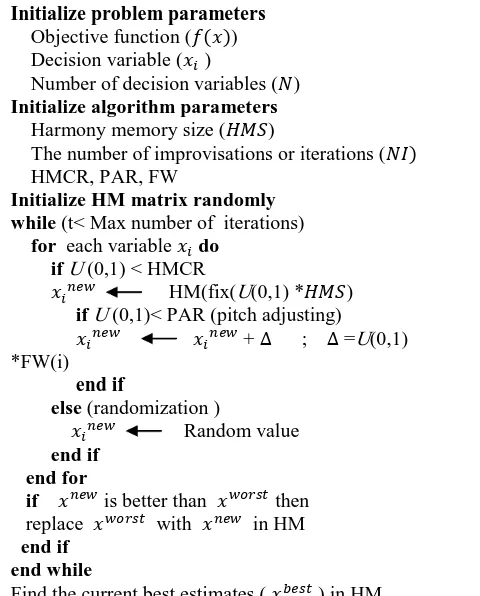
adjustment is similar to the mutation operation in GA. Pitch adjusting rate (PAR) and pitch range variability or fret width (FW) are two parameters of this component. A low value for PAR together with FW can result in a slow convergence and exploration being limited to a portion of the search space. On the other hand, a very high value for PAR and FW may cause the solutions to disperse around a few optimums as in random search and the algorithm may not converge at all. Hence, Usually PAR , - and FW is bounded 1% to 10% of all the range of variable values [43]. The last component is the randomization, which is to increase the diversity of the solutions. Although pitch adjusting has a similar rule, it is limited to a local search. The use of randomization can provide exploration of various regions so as to find the optimum through global search. The steps of the HS algorithm can be followed in Fig.2.
4-IMPROVED HS WITH CHAOS
In this section, the improved HS algorithm (IHS) will be introduced first, and then, after a brief description on
chaotic behavior, the proposed chaotic IHS algorithm will be discussed.
4-1- IMPROVED HARMONY SEARCH
Compared to the other metaheuristics like GA or PSO, HS has some advantageous advantages: It has fewer
mathematical requirements and thus easier
implementation. In addition, there is evidence to suggest that HS is less sensitive to its parameters than PSO [42]. Although the basic HS is efficient but, it is improvable; it can be seen from the simulation results that the solutions are still changing as the optima are approaching [37, 11 and 13].
Fig. 2. The pseudo-code of the HS algorithm
In order to improve the convergence of the HS , some works have been performed in [27, 33, 40 and 18]. In this paper, an improved HS (IHS) will be proposed which is inspired by the concept of global best in particle swarm optimization. We will modify the harmony memory consideration step such that the New Harmony can mimic the best harmony in HM. When using harmony memory, it is desirable to pick up the best harmony from the memory. This will happen with a probability of 1/ in the basic HS since a random selection is applied to choose the New Harmony from the HM. Our proposed HIS has exactly the same steps as the HS with the exception that Harmony Memory consideration step is replaced by HM (gbest) instead of HM (fix(U(0,1) Comparison factors
Music improvisation Optimization
Musical instrument Decision variable
Aesthetic Standard Objective Function
Pitch Range Value Range
Harmony Solution Vector
Practice Iteration
Experience Memory Matrix
Initialize problem parameters
Objective function (𝑓(𝑥)) Decision variable (𝑥𝑖 )
Number of decision variables (𝑁)
Initialize algorithm parameters
Harmony memory size (𝐻𝑀𝑆)
The number of improvisations or iterations (𝑁𝐼) HMCR, PAR, FW
Initialize HM matrix randomly while (t< Max number of iterations) for each variable 𝑥𝑖do
ifU (0,1) < HMCR
𝑥𝑖𝑛𝑒𝑤 HM(fix(U(0,1) *𝐻𝑀𝑆)
ifU (0,1)< PAR (pitch adjusting) 𝑥𝑖𝑛𝑒𝑤 𝑥𝑖𝑛𝑒𝑤+ ∆ ; ∆ =U(0,1) *FW(i)
end if
else (randomization)
𝑥𝑖𝑛𝑒𝑤 Random value
end if end for
if 𝑥𝑛𝑒𝑤 is better than 𝑥𝑤𝑜𝑟𝑠𝑡 then replace 𝑥𝑤𝑜𝑟𝑠𝑡 with 𝑥𝑛𝑒𝑤 in HM
end if
end while
* ). Where, gbest refers to the best harmony among all harmonies in terms of minimum fitness function.
4-2-CHAOS
Chaos is a deterministic, pseudorandom dynamic behavior in nonlinear dynamical systems that are non-periodic, non-converging & bounded. It exhibits
sensitivity dependence on initial conditions.
Mathematically, chaos is randomness of a simple deterministic dynamical system and chaotic system may be considered as a source of randomness [33, 40]. Although, it appears to be stochastic, it occurs in a deterministic nonlinear system under deterministic conditions. A chaotic map is a discrete-time dynamical system running in the chaotic state.
(8) ( )
The chaotic sequence * } can be used as spread-spectrum sequence and as a random number sequence. The logistic map, circle map, sinusoidal map are among the well-known one-dimensional maps used in the chaotic search. The logistic map is represented by the following equation [30].
(9) ( )
is the chaotic number, with denoting the iteration number and . Obviously, , - under the condition that the initial , - and that , -.
In recent years , chaos has been extended to various optimization areas like in [15,22]. In random search optimization algorithms, the method using chaotic variable variables instead of random variable variables are called chaotic optimization algorithms. In these algorithms , due to the non-repetition and ergodicity of chaos, it can carry out overall searches at higher speed than stochastic searches that depends depend on the probabilities [29].
4-3-CHAOTIC HARMONY SEARCH
It was mentioned in section 3 that one of the drawbacks of the HS is its premature convergence, especially while handling with more than one local optima. HCMR, PAR, FW and the initialization of HM are the key factors to affect the convergence of HS. In classical HS, the above mentioned parameters are adjusted as fixed values in the initialization step. In this method, the number of iterations plays an important role to find an optimal solution. For example, for a small PAR and large FW, much??? large numbers of iterations are required to find optimum solutions. Small FW values in final iterations increase the fine-tuning of solution vectors
by local exploitation and in early iterations, bigger FW value can increase the diversity of solutions vector for the global exploration [4]. In [27, 40] some efforts have been done made to dynamically update the PAR and FW. These parameters could be selected chaotically by using chaotic maps. In 2010, Alatas proposed different chaotic harmony search algorithms by applying different chaotic maps to the HMCR, PAR, FW and the initialization of HM [4]. In this paper , PAR and FW values have not been fixed and they have been modified as follows to improve the global convergence by escaping the local optima.
(10)
( ) ( ( )) ( )
(11)
( ) ( ( )) ( )
Where corresponds to the logistic map and denotes the iteration number.
Furthermore, the algorithm is hybridized with a chaotic local search (CLS). For this purpose, when the three steps of harmony search algorithm are performed, the top /5 of harmonies in the HM are passed through a chaotic map (logistic map in this paper). This step is performed by (1) mapping the top decision variables in solution space to chaotic variable in the interval (0,1), (2) determining the new chaotic variable for each of them using the logistic equation and (3) converting new chaotic variables to decision variables in the range of the solution space. Then the best harmony of this chaotic search is chosen and compared to the New Harmony resulted from the main algorithm and the new solution will be updated if the result of CLS is better.
5-CIHSBASEDIIRSYSTEMIDENTIFICATION
The identification algorithm can be summarized in the following steps:
1-
For a set of given input-output pairs * ( ) ( )+ , adjust HS fixed parameters. Construct a matrix HM of size , where represents the population size or the number of the harmonies and refers to the number of adaptive IIR model’s coefficients. Each component of is initialized randomly in the search space.2-
For input samples are passed through the adaptive model yield in ̂ ( ) , . Subsequently, the fitness associated with the ’th harmony is evaluated according to the following equationWhere, , ( ) ( ) ( )- , is the output of the plant contaminated by measurement noise, and ̂ , ̂ ( ) ̂ ( ) ̂ ( )- . Now, the objective is to minimize the ( ) . In this paper ,GA, PSO, and CIHS are used for this purpose.
3-
HS operators are applied to evolve a new harmony. In parallel, a chaotic search is performed on the top 1/5 of all harmonies. The best result is saved as the New Harmony.4-
If the New Harmony vector is better than existing harmony vectors in HM, HM will be updated.
5-
In each generation, the minimum MSE (MMSE) isplotted against the number of iterations.
6-
The learning process will stop when a predefined MSE level or the maximum number of generations is reached. The harmony (filter coefficients) that corresponds to the least fitness (best attainable match between the IIR model and the actual system in the sense of MSE) shows the estimated parameters.6-RESULTSANDDISCUSSIONS
In this section, three benchmark linear IIR and one nonlinear IIR systems are considered for the case study. Parameter Identification burden is carried out using a model having less order than of the actual system. These reduced order cases pose challenge to the optimization algorithm since they produce highly multimodal error surfaces. In addition, as the number of coefficients decreases, the degree of freedom reduces and it becomes more difficult to identify the actual system. In order to ensure the validity of the results, each experiment is repeated in 20 consecutive trials and the resultant (best, worst, standard deviation, and mean) values of the minimum MSE’s of each run, are given in corresponding tables. To provide a more comprehensive comparison, other than our proposed algorithm (CIHS), the same simulations are done with standard versions of GA, PSO and HS and a modified version of PSO named PSOW, as well. Each simulation is carried out in MATLAB v.7.5. In all cases, the population size is set to 50, the maximum number of iterations ( ) is set to 1000 and the input data is a Gaussian white noise with zero mean and unit variance. The output data is contaminated with a Gaussian random noise with zero mean and a variance of 0.001.Parameter adjustment is as the following: In CIHS and , the values are determined by a logistic map in each iteration and . In basic HS, the parameters are set as , , and is bounded to 1% of each variable range. In GA algorithm, the bit number is set to 16, mutation probability is 0.1, and crossover step is of single point
type with a probability of 0.6. In PSO, acceleration constants are set to 2 and inertia weight is linearly decreased from 0.9 to 0.4. In PSOW, the adaptive inertia weight factor is determined as follow follows:
max min min
min
min
max
(
)(
)
,
,
avg avg
avg
w
w
f
f
w
f
f
f
f
w
w
f
f
(13)
Where, and denote the maximum and minimum w, respectively. is the current objective function value of the particle, and are the
average and minimum objective values of all particles, respectively [23]. In this approach, is varied based on the objective function value so that particles with low objective values can be protected while particles with objective value greater than average will be disrupted. Hence, it provides a good way to maintain population diversity and sustain good convergence capacity. The Constant parameters for PSOW are: , and is limited to the 15% of the search space. In all algorithms, random numbers take values between 0 and 1.
Example 1. Consider the following IIR system
(14)
( )
System (14) is modeled using the following IIR structure
(15) ( )
The simulation results related to the reduced order model (15) are given in Fig. 3. The Analysis of the figure shows that the utilization of CIHS has resulted in greater estimation accuracy and higher convergence speed. HS converges to its minimum MSE level after about 700 numbers of iterations, which demonstrate its poor convergence speed. Table 2 Shows that the CIHS provides the best average result in terms of the MSE.
Fig. 3. Convergence characteristic for example-1 modeled using a 1st order IIR filter.
TABLE 2. ACHIEVED MSE VALUES FOR EXAMPLE 1 MODELED USING A 1stORDER IIR FILTER
MSE CIHS HS PSOW PSO GA
Best 0.0763 0.0878 0.1685 0.1927 0.1916 Average 0.0819 0.1053 0.1793 0.1939 0.1980 Worst 0.091 0.1530 0.1869 0.2210 0.2445 Std. Dev. 0.0032 0.0177 0.0110 0.0140 0.0265
TABLE 3. COMPUTATIONAL TIME (IN SECONDS) REQUIRED BY EACH ALGORITHM FOR EXAMPLE 1
MODELED USING A 1stORDER IIR FILTER
Example 2. The transfer function of the plant is given by the following equation
(16)
( )
This 3rd order plant is modeled using a second order IIR filter. Hence, the transfer function of the model is given by
(17)
( )
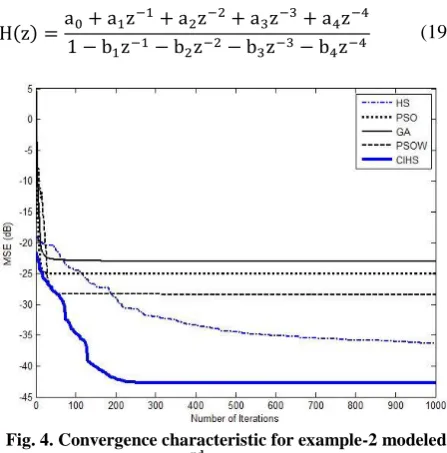
The convergence characteristic shown in Fig. 4 demonstrates that GA, PSO and PSOW converge to a suboptimal solution. However, HS and CHS do not stagnate and reach their minimum noise floor level. The CHS takes 250 generations to reach its minimum MSE level whereas HS takes 700 generations to reach its corresponding value. CHS outperforms the HS with higher convergence speed and lower MSE value. Table 4
shows that the CHS provides the best average result in terms of MSE. Table 5 indicates that CHS needs higher computation time than the HS. Hence, there is a trade-off between the quality of solution and computational time.
Example 3. The transfer function of the plant is given by the following equation
( )
(18)
The IIR structure used for the identification purpose is given below:
(19)
( )
Fig. 4. Convergence characteristic for example-2 modeled using a 2nd order IIR filter.
TABLE 4. ACHIEVED MSE VALUES FOR EXAMPLE 2
MODELED USING A 2ndORDER IIR FILTER
MSE CIHS HS PSOW PSO GA
Best 0.0065 0.0161 0.0123 0.0564 0.0704 Average 0.0073 0.0331 0.0456 0.0578 0.0753 Worst 0.0081 0.0637 0.1135 0.0804 0.1402 Std. Dev 6.618e-4 0.0276 0.0384 0.0176 0.0639 TABLE 5. COMPUTATIONAL TIME (IN SECONDS) REQUIRED BY EACH ALGORITHM FOR EXAMPLE 2
MODELED USING A 2ndORDER IIR FILTER
Time CIHS HS PSOW PSO GA Average 2.5882 0.0749 8.1638 6.2917 379.092
Best 2.5308 0.0703 7.6900 6.1290 365.597 Worst 2.6785 0.0802 8.5809 6.4578 397.524 Std. Dev 0.0526 0.0035 0.3263 0.0854 10.1545
Using equation (19), the same set of simulations have has been executed as in example 1 and 2.
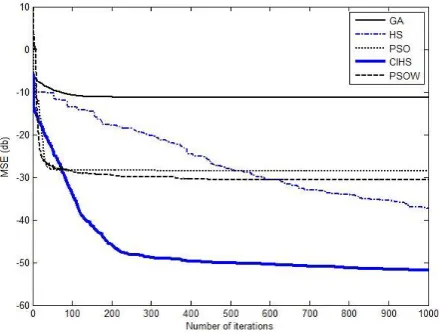
Fig.5 represents the average MSE graphs from 20 simulation tests. It is shown in Fig. 5 and table 6 that the
Time CIHS HS PSOW PSO GA
convergence speed of CIHS is much greater than HS and the minimum MSE level obtained using CIHS is much smaller than that of HS, PSO, PSOW and GA. The CHS takes 250 generations to reach its minimum MSE level whereas HS solutions are still changing as the number of generations reaches 1000. The respective computation time of the algorithms are listed in Table 7.
Fig. 5. Convergence characteristic for example-3 modeled using a 4th order IIR filter.
TABLE 6. ACHIEVED MSE VALUES FOR EXAMPLE 3 MODELED USING A 4thORDER IIR FILTER
MSE CIHS HS PSOW PSO GA
Best 6.517e-4 0.0075 0.0079 0.0177 0.0442 Average 0.0026 0.0135 0.0254 0.0354 0.2729 Worst 0.0067 0.0210 0.0321 0.1028 0.6907 Std.Dev 0.0020 0.0045 0.0064 0.0259 0.2631 TABLE 7. COMPUTATIONAL TIME (IN SECONDS)
REQUIRED BY EACH ALGORITHM FOR EXAMPLE 3 MODELED USING A 4thORDER IIR FILTER
Time CIHS HS PSOW PSO GA
Average 3.3312 0.1206 11.3490 9.3061 402.622 Best 3.2774 0.1123 11.7931 9.1386 400.452 Worst 3.4021 0.1391 12.8542 9.5138 404.825 Std.Dev 0.0490 0.0080 0.2110 0.1403 10.5326
Example 4. Consider considers the following nonlinear IIR system [46].
(20)
( ( ) ( ))
( ) ( ) ( ) ( )
System (20) is identified using the following structures:
(21) ( )
( ) ( )
In (21), a second order IIR structure is used to model the unknown nonlinear plant. The input ( )’s are i.i.d.
signals Identically Independently Distributed in [-1, 1] and the noise signal is an i.i.d uniformly distributed in [-0.05, 0.05]. The error graph is shown in Fig. 6. Performance measures are given in tables 8 and 9. GA gets stuck in a local minimum since its MSE value remains steady from the beginning. HS and CIHS outperform the other algorithms with smaller MSE average value and higher or equivalent convergence speed. Table 9 indicates that HS and CIHS need less computational time in comparison to PSO based and GA algorithms. In this study, the same as previous examples, CIHS shows superior performance in terms of model matching and convergence Accuracy.
Fig. 6. Convergence characteristic for example-4 modeled using a 2nd order IIR filter.
TABLE 8. ACHIEVED MSE VALUES FOR EXAMPLE 4
MODELED USING A 2ndORDER IIR FILTER
MSE CIHS HS PSOW PSO GA
Best 0.0258 0.0312 0.0280 0.0289 0.0374 Average 0.0289 0.0296 0.0291 0.0305 0.0615 Worst 0.0364 0.0409 0.0304 0.0326 0.0902 Std.Dev 0.0050 0.0085 0.0009 0.0012 0.0120 TABLE 9. COMPUTATIONAL TIME (IN SECONDS) FOR EXAMPLE 4 MODELED USING A 2ndORDER IIR
FILTER
Time CIHS HS PSOW PSO GA
Average 2.3472 0.1046 8.4828 6.7033 349.14 Best 3.2179 0.1013 7.4658 6.6034 340.89 Worst 3.4021 0.1253 8.7647 6.7986 351.56 Std.Dev 0.0530 0.0090 0.4635 0.0679 7.4158
identifications is formulated as a multi-objective optimization problem and is considered as the future research plan by the authors of this article.
The computational time of an adaptive filtering algorithm is a critical issue in real-time applications. The results demonstrate that HS based adaptive IIR filtering algorithms are much faster than the GA and PSO. Altogether, the simulation results given in this section reveals reveal that CIHS has minor chance of premature convergence and hence, it is a promising optimization tool in IIR adaptive filtering.
7-CONCLUSION
In this paper, a new version of Harmony Search algorithm (CIHS), is developed using social component of PSO and chaotic search combined to the original algorithm to enhance exploration and exploitation capability during the search. The new algorithm is outlined and has been applied to identification of four benchmark IIR plants. The performance assessment of the CIHS, in identifying an unknown system with a reduced order IIR model in comparison to those obtained by the HS, PSO, PSOW and GA clearly exhibits faster convergence and lower values of MSE for CIHS which makes it the best algorithm among the five ones, for adaptive system identification. In addition, it has been shown that HS based IIR system identification methods would result in a much less computational complexity. Therefore, the proposed method can be employed in real-time tasks. To confirm the robustness of the proposed algorithm, CIHS needs to be applied to more complex and real world optimization applications. For future work of the authors, investigating the result of various chaotic maps on the algorithm’s performance and real-time hardware implementation of the algorithm will be considered.
REFERENCES
[1] M. Abe and M. Kawamata, evolutionary digital filtering for iir adaptive digital filters based on the cloning and mating reproduction, IEICE Transactions on Fundamentals of electronics, Communications and computer science, E81-A(3), pp. 398-406, 1998.
[2] M. Abe, and M. Kawamata, A Single dsp implementation of evolutionary digital filters, In
Proceedings of the IEEE International
Workshop on Intelligent Signal Processing and Communication Systems, pp. 253-257, 1998.
[3] M. Abe, and M. Kawamata, Convergence
behavior of evolutionary digital filters and simple genetic algorithm based adaptive digital filters on a multiple-peak surface, In
Proceedings of the IEEE International
symposium on Circuits and Systems, Vol. 2, pp. 185-188, 1996.
[4] B. Alatas, Chaotic harmony search algorithms, Apppl,.Math. Comput. 216, pp.2687-2699, 2010.
[5] B. Alatas, Chaotic bee colony algorithms for global numerical optimization, Expert Syst. Appl., 2010.
[6] B. Alatas, E. Akin, B.Ozer, Chaos embedded particle swarm optimization algorithms, Chaos Solitons Fractals, 40(4), pp. 1715-1734, 2009.
[7] P. Arena, et al., Self-organization in non-recurrent complex systems, Int. J. Bifur. Chaos. 10(5), pp.1115-1125, 2000.
[8] G.G., Brouwn, A.J., Krijgsman, Hybrid neural networks for nonlinear system identification. IEEE International Conference on control, pp. 21-24, 1994.
[9] R. Caponetto, et al., Chaotic sequences to improve the performance of evolutionary algorithms, IEEE Trans. Evol. Comput., 7(3), pp. 289-304, 2003.
[10] J. R., Chen, P. Mars. The feasibility of using MLP networks for system identification Neural
Networks for Systems: Principles and
Applications, pp.31-33, 1991.
[11] P. Chakraborthy, et.al., An improved harmony search algorithm with differential mutation operator, IOS Press, Fundamental Informaticae, 95 (4) 2009, 401-426.
[12] C. Dai, W. Chen, Y. Zhu, Seeker optimization algorithm for digital iir filter design, IEEE transactions on industrial electronics, Vol.57, No.5, pp. 1710-1718, Nov., 2007.
[13] S.O. Degertekin, Optimum design of steel frames via harmony search algorithm, in: Z.W.Geem (Ed.), Harmony Search Algorithms for Structural Design Optimization, Springer, pp.51-78, 2009.
[14] H. Dong, Y. Bo, M. Gao, and T. Zhu, Improved harmony search for detection with photon density wave, Proc. SPIE, 2007.
[15] M.F. El-Santawy and A.N. Ahmed, The chaotic e-constraint approach, Journal of American Science, Vol. 7, No. 7, pp470-472, 2011.
[17] Z. W. Geem, J. H. Kim, and G. V. Loganathan, A new heuristic optimization algorithm:
Harmony search, Society of computer
Simulation, Vol. 76, No. 2, pp. 60-68, Feb., 2001.
[18] Z.W. Geem, W.E. Roper, Various continous harmony search algorithms for web-based hydrologic parameter optimization, Int. J. Math. Model. Numer.Optim. 1 (3), pp. 213-226, 2010.
[19] G., Hongwei, L., Yanchun, Identification for nonlinear systems basd on particle swarm optimization and recurrent neural network, [Ultrasonic motor control applications], Proceedings of International Conference on Communications, Circuits and Systems, Vol 2, May, 2005.
[20] C. R. Jr. Johnson, Adaptive iir filtering: Current results and open issues, IEEE Transactions on Information Theory, Vol. 30, pp.237-250, March., 1984.
[21] N. Karaboga, “A new design method based on artificial bee colony algorithm for digital iir filters,” Journal of the Franklin Institute, Vol. 346, pp. 328-348, 2009.
[22] B. Li and W.Jiang, Optimization of complex functions by chaos search, International Journal of cybernetics and Systems., Vol. 29, No. 4, pp. 409-419, 1998.
[23] Bo., Liu, L., Wang, Y.H., Jin, F., Tang, D.X., Huang, Improved particle swarm optimization with chaos. Chaos, Solitons & Fractals, pp. 1261-1271, 2005.
[24] L. Ljung and S. Gunnarsson, Adaptation and tracking in system identification- A Survey,
Automatica, Vol. 26, pp. 7-22, 1990.
[25] L. Ljung and S. Gunnarsson, Adaptation and tracking in system identification- A Survey,
Automatica, Vol. 26, pp. 7-22, 1990.
[26] B. Luitel, G. K. Venayagamoorthy, Particle swarm optimization with quantum infusion for system identification, Engineering applications of Artificial Intelligence, Vol. 23, No. 10, pp. 635-649, Aug., 2010.
[27] M. Mahdavi, M. Fesanghary, E.Damangir, An improved Harmony search algorithm for solving optimation problems, Apppl, Math, Comput. 188, 2007.
[28] B. Majhi, and G. Panda, Development of efficient identification scheme for nonlinear dynamic systems using swarm intelligence techniques, Expert Systems with Applications, Vol. 37, pp. 556-566, 2010.
[29] L.V.C Mariani, Use of chaotic sequences in a biologically inspired algorithm for engineering
design optimization, Expert Syst Appl
2008;34:pp. 1905-1913.
[30] R.M. May, Simple mathematical models with very complicated dynamics, Nature 261(1976) 459.
[31] C. Ng, S. H. Leung, C. Y. Chung, A. Luk, and W. H. Lau, The Genetic Search Approach, IEEE Signal Processing Magazine, Vol. 96, pp. 1053-1088, Nov., 1996.
[32] S.L., Netto, P.S.R., Diniz, P., Agathoklis, Adaptive IIR filtering algorithms for system identification: a general framework, IEEE Transaction on education 38, 54-66, 1995.
[33] M.G.H. Orman, M. Mahdavi, Global best harmony search, Apppl,.Math. Comput, 198, pp.643-656, 2008.
[34] G. Panda et al., Identification of nonlinear systems using particle swarm optimization technique, IEEE Conference on Evolutionary computation, pp.3253-3257, 2007.
[35] G. Panda, P.M. Pradhan, B. Majhi, IIR system identification using cat swarm optimization, Expert Systems with Applications, Vol. 38, No. 10, pp. 12671-12683, Sept., 2011.
[36] G J. J. Shynk, Adaptive iir filtering, IEEE ASSP Magazine, pp. 4-21, Apr., 1989.
[37] M. Shafaati, M.R. Ahmadi, H. Mojallali, IIR system identification using harmony search algorithm, The 2nd international conference on control, instrumentation and automation, 2011.
[38] M. Suneel, chaotic sequences for secure CDMA, Ramanujan Ins. Adv. Study Math. Pp. 1-4, 2006.
[39] J.J, Shynk, Adaptive iir filtering. IEEE Trans. on Acoustic Speech and Signal Processing, pp. 4-21, Apr, 1989a.
[40] N. Taherinejad, Highly reliable harmony search algorithm, Eur. Conf. Circuit Theory Des., pp. 818-822, 2009.
[41] B., Widrow, J.M, McCool, M.G, Larimore, C.R., Johnson., Stationary and nonstationary learning characteristics of the LMS adaptive filter, Proceedings of the IEEE, 64, pp.
1151-1162, 1976.
[43] X.S. Yang, Harmony Search as a metaheuristic algorithm, in: music-inspired harmony search: Theory and applications (Eds Z. W. Geem), Springer, pp.1-14, Jan. 2009.
[44] A. Zeblah, E. Chatelet, M. El Samrout, F. Yalaoui, Y. Massim, Series-parallel power system optimization using a harmony search algorithm, International Journal of Power and Energy Conversion, Vol. 1, No. 1, pp. 15-30, 2009.
[45] R. Zhang, L. Hanzo, Iterative multiuser detection and channel decoding for DS-CDMA using harmony search, Signal Processing Letters, IEEE, Vol. 16, No. 10, PP. 917-920, Oct. 2009.