Copyright © 2014 IJECCE, All right reserved 593
International Journal of Electronics Communication and Computer Engineering Volume 5, Issue 3, ISSN (Online): 2249–071X, ISSN (Print): 2278–4209
Efficient Data Mining in SAMS through Association
Rule
Mr. Rahul B. Diwate, Prof. Amit Sahu
Abstract – We propose a protocol for secure mining of association rules in distributed databases. Previous techniques all people deals with different database, now a day’s people also deals with the distributed database. Can we develop a kind of application in which the people can access the distributed data which is already store in remote location in encrypted format? This proposes system technique is used for efficient data mining in SAMS (Student Assessment Management System) through association rules in distributed databases. The current leading techniques are that of Kantarcioglu and Clifton. This proposed system is ready to implements two methods, one that computes the union of private subsets that each of the interacting users hold, and another that tests the inclusion of an element held by one user in a subset held by another .We propose a protocol for secure mining through association rule consist a different level of execution process to secure storage of data and access of data. This paper will focus on such process for secure storage plus secure access of data.
Keywords–Association Rule, Cache memory, Process Log, Cloud, Encryption.
I. I
NTRODUCTIONIn recent years the sizes of databases has increased rapidly. This has led to a growing interest in the development of tools capable in the automatic extraction of knowledge from data. The term Data Mining, or Knowledge Discovery in Databases, has been adopted for a field of research dealing with the automatic discovery of implicit information or knowledge within databases [2]. In Previous System, here the problem of data mining of association rules in partitioned databases. In that setting, there are several departments (or users) that hold homogeneous databases, i.e., databases that share the same schema but hold information on different entities. The goal is to find all association rules with support at least s and confidence at least c, for some given minimal support size s and confidence level c, that hold in the unified database, while minimizing the information disclosed about the private databases held by those users[1]. Consider the application SAMS in which the different databases are situated in each department, where the all data is stored semester wise. The main aim behind this propose system that the data should be stored in optimal (minimize) format with some secure techniques. In SAMS the data is used in large scale so, this propose system provide some technique for data mining with encryption /decryption techniques in private cloud. How SAMS worked?
II. P
ROCESS OFE
XECUTION First SAMS is one kind of web application which is used by a particular organization. Where the module are used by professors and admin.
Second, store data in separate file respect to branch and semester on cloud using encryption algorithm like AES Third, collect data for ex. Admin wants data of semester
3 of CSE branch then collect the data through association rule then id and name is taken from static database and only marks are collect from different file which is present on cloud.
Finally, shown the combine record of related semester and branch.
III. R
EVIEWL
ITERATUREThe existing system uses different techniques for data mining purpose like Apriori algorithm. The Fast Distributed Mining (FDM) algorithm of Cheung et al. [8], which is an unsecured distributed version of the Apriori algorithm.
Data mining is not particularly new statisticians have used similar manual approaches to review data and provide business evolutions for many years. Changes and updation in data mining techniques, however, have enabled organizations to collect, monitor, analyze, and access data in new ways. The first change occurred in the area of basic data collection. Before companies uses the transition from paper-based records to computer-based systems, managers had to wait for staff to give records of pieces together to know how well the business was performing or how current performance compared with previous. As all companies started collecting and saving basic data in computers, they were able to start quick answering detailed easily.
Now a day’s a third party is exist to provide a service for commercial company. The users could submitted to him their inputs and he would perform the function evaluation and send to them the resulting output. In the absence of such a trusted third party, it is needed to devise techniques that the users can run on their own in order to arrive at the required output y. The next aim is to secure the inputs of each user. if the both are combined together(data mining and Secure) the third party involvement is avoided Yao was the first to propose a generic solution for this problem in the case of two players. [3].
In our problem, the inputs are the partial databases, and the required output is the list of association rules that hold in the cache memory with support and confidence s and c, respectively. They can be applied only to small inputs and functions which are realizable by simple circuits. In more complex settings, such as ours, other methods are required for carrying out this computation.
Copyright © 2014 IJECCE, All right reserved 594
International Journal of Electronics Communication and Computer Engineering Volume 5, Issue 3, ISSN (Online): 2249–071X, ISSN (Print): 2278–4209
burger. Such information can be used as the basis for decisions about marketing activities such as, e.g., promotional pricing or product placements. In addition to the above example from market basket analysis association rules are employed today in many application areas including Web usage mining, intrusion detection and bioinformatics. Three parallel algorithms for mining association rules [12], an important data mining problem is formulated in this paper. These algorithms have been designed to investigate and understand the performance implications of a spectrum of trade-offs between computation, communication, memory usage, synchronization, and the use of problem-specific information in parallel data mining [13]. Fast Distributed Mining of association rules, which generates a small number of candidate sets and substantially reduces the number of messages to be passed at mining association rules [14].
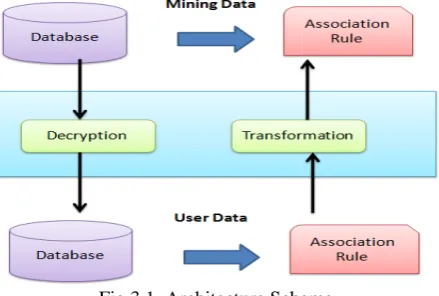
For mining of data and encryption/decryption different techniques are available. Like for data mining K-means algorithms, Apriori Algorithm. Fast Distributed Mining and for encryption/Decryption RSA, DES etc [10]. This paper proposes the Fp growth mining with AES algorithm to provide mining and encryption. Figure shows the architecture of scheme for SAMS.
Fig.3.1. Architecture Scheme
IV. M
ETHODOLOGYA. Mining Algorithm
Previously Apriori algorithm is used.It uses a generate and test approach generates candidate itemsets and tests if they are frequent [4]
Generation of candidate itemsets is expensive(in both space and time)
Support counting is expensive
oSubset checking (computationally expensive)
oMultiple Database scans (I/O)
For SAMS Apriori algorithm is not beneficial, one disadvantage is overcome by FP Growth algorithm. FP-Growth allows frequent itemset discovery without candidate itemset generation. Two step approach:
Step 1: Build a compact data structure called the FP-tree Step 2: Extracts frequent itemsets directly from the
FP-tree
Mining is preferably used for a large amount of data [8, 9] and related algorithms often require large data sets to create quality models [7]. The relationship between data mining and cloud is worth to discuss. Cloud providers use data mining to provide clients a better service [6].
B. AES algorithm
AES is asymmetric which is encrypted by different keys. Here in this paper the AES is used with different key length, different iteration and perform operation of different file size. The encryption is in fact not difficult to break if a dictionary of words with their expected frequencies is available [5] This will covered in Result analysis
C.
Cloud Interface
Cloud is used for only storage purpose, now a day there are two options available for storing data, first is server and second is cloud. for better security and larger space cloud is a better option. It is quite difficult to locate path of cloud where actual data is stored. In SAMS the files are encrypted using AES algorithm, The files are stored in
“SAMS” domain in cloud. The union of record is
performed by FP algorithm and data is return to the admin module. Cloud is also shows the message that how many space is used by user and show remaining space.
V. R
ESULTA
NALYSISThe result analysis is performed by the calculating the communication cost and combinational cost, with the encryption and decryption time. The readings are calculated by using different key length, file size and iterations.
All experiments were implemented in C# (.net 4) and were executed on an Intel(R) Core(TM) i3 personal computer with a 1.66GHz CPU, 8 GB of RAM, and the 32-bit operating system Windows 7 ultimate. Table 5.1 Shows the computational and combinational cost for 32 key length and different file size.
Table 5.1: Computational cost and Combinational cost with encryption and decryption time.
Copyright © 2014 IJECCE, All right reserved 594
International Journal of Electronics Communication and Computer Engineering Volume 5, Issue 3, ISSN (Online): 2249–071X, ISSN (Print): 2278–4209
burger. Such information can be used as the basis for decisions about marketing activities such as, e.g., promotional pricing or product placements. In addition to the above example from market basket analysis association rules are employed today in many application areas including Web usage mining, intrusion detection and bioinformatics. Three parallel algorithms for mining association rules [12], an important data mining problem is formulated in this paper. These algorithms have been designed to investigate and understand the performance implications of a spectrum of trade-offs between computation, communication, memory usage, synchronization, and the use of problem-specific information in parallel data mining [13]. Fast Distributed Mining of association rules, which generates a small number of candidate sets and substantially reduces the number of messages to be passed at mining association rules [14].
For mining of data and encryption/decryption different techniques are available. Like for data mining K-means algorithms, Apriori Algorithm. Fast Distributed Mining and for encryption/Decryption RSA, DES etc [10]. This paper proposes the Fp growth mining with AES algorithm to provide mining and encryption. Figure shows the architecture of scheme for SAMS.
Fig.3.1. Architecture Scheme
IV. M
ETHODOLOGYA. Mining Algorithm
Previously Apriori algorithm is used.It uses a generate and test approach generates candidate itemsets and tests if they are frequent [4]
Generation of candidate itemsets is expensive(in both space and time)
Support counting is expensive
o Subset checking (computationally expensive)
o Multiple Database scans (I/O)
For SAMS Apriori algorithm is not beneficial, one disadvantage is overcome by FP Growth algorithm. FP-Growth allows frequent itemset discovery without candidate itemset generation. Two step approach:
Step 1: Build a compact data structure called the FP-tree Step 2: Extracts frequent itemsets directly from the
FP-tree
Mining is preferably used for a large amount of data [8, 9] and related algorithms often require large data sets to create quality models [7]. The relationship between data mining and cloud is worth to discuss. Cloud providers use data mining to provide clients a better service [6].
B. AES algorithm
AES is asymmetric which is encrypted by different keys. Here in this paper the AES is used with different key length, different iteration and perform operation of different file size. The encryption is in fact not difficult to break if a dictionary of words with their expected frequencies is available [5] This will covered in Result analysis
C.
Cloud Interface
Cloud is used for only storage purpose, now a day there are two options available for storing data, first is server and second is cloud. for better security and larger space cloud is a better option. It is quite difficult to locate path of cloud where actual data is stored. In SAMS the files are encrypted using AES algorithm, The files are stored in
“SAMS” domain in cloud. The union of record is
performed by FP algorithm and data is return to the admin module. Cloud is also shows the message that how many space is used by user and show remaining space.
V. R
ESULTA
NALYSISThe result analysis is performed by the calculating the communication cost and combinational cost, with the encryption and decryption time. The readings are calculated by using different key length, file size and iterations.
All experiments were implemented in C# (.net 4) and were executed on an Intel(R) Core(TM) i3 personal computer with a 1.66GHz CPU, 8 GB of RAM, and the 32-bit operating system Windows 7 ultimate. Table 5.1 Shows the computational and combinational cost for 32 key length and different file size.
Table 5.1: Computational cost and Combinational cost with encryption and decryption time.
Copyright © 2014 IJECCE, All right reserved 594
International Journal of Electronics Communication and Computer Engineering Volume 5, Issue 3, ISSN (Online): 2249–071X, ISSN (Print): 2278–4209
burger. Such information can be used as the basis for decisions about marketing activities such as, e.g., promotional pricing or product placements. In addition to the above example from market basket analysis association rules are employed today in many application areas including Web usage mining, intrusion detection and bioinformatics. Three parallel algorithms for mining association rules [12], an important data mining problem is formulated in this paper. These algorithms have been designed to investigate and understand the performance implications of a spectrum of trade-offs between computation, communication, memory usage, synchronization, and the use of problem-specific information in parallel data mining [13]. Fast Distributed Mining of association rules, which generates a small number of candidate sets and substantially reduces the number of messages to be passed at mining association rules [14].
For mining of data and encryption/decryption different techniques are available. Like for data mining K-means algorithms, Apriori Algorithm. Fast Distributed Mining and for encryption/Decryption RSA, DES etc [10]. This paper proposes the Fp growth mining with AES algorithm to provide mining and encryption. Figure shows the architecture of scheme for SAMS.
Fig.3.1. Architecture Scheme
IV. M
ETHODOLOGYA. Mining Algorithm
Previously Apriori algorithm is used.It uses a generate and test approach generates candidate itemsets and tests if they are frequent [4]
Generation of candidate itemsets is expensive(in both space and time)
Support counting is expensive
o Subset checking (computationally expensive)
o Multiple Database scans (I/O)
For SAMS Apriori algorithm is not beneficial, one disadvantage is overcome by FP Growth algorithm. FP-Growth allows frequent itemset discovery without candidate itemset generation. Two step approach:
Step 1: Build a compact data structure called the FP-tree Step 2: Extracts frequent itemsets directly from the
FP-tree
Mining is preferably used for a large amount of data [8, 9] and related algorithms often require large data sets to create quality models [7]. The relationship between data mining and cloud is worth to discuss. Cloud providers use data mining to provide clients a better service [6].
B. AES algorithm
AES is asymmetric which is encrypted by different keys. Here in this paper the AES is used with different key length, different iteration and perform operation of different file size. The encryption is in fact not difficult to break if a dictionary of words with their expected frequencies is available [5] This will covered in Result analysis
C.
Cloud Interface
Cloud is used for only storage purpose, now a day there are two options available for storing data, first is server and second is cloud. for better security and larger space cloud is a better option. It is quite difficult to locate path of cloud where actual data is stored. In SAMS the files are encrypted using AES algorithm, The files are stored in
“SAMS” domain in cloud. The union of record is
performed by FP algorithm and data is return to the admin module. Cloud is also shows the message that how many space is used by user and show remaining space.
V. R
ESULTA
NALYSISThe result analysis is performed by the calculating the communication cost and combinational cost, with the encryption and decryption time. The readings are calculated by using different key length, file size and iterations.
All experiments were implemented in C# (.net 4) and were executed on an Intel(R) Core(TM) i3 personal computer with a 1.66GHz CPU, 8 GB of RAM, and the 32-bit operating system Windows 7 ultimate. Table 5.1 Shows the computational and combinational cost for 32 key length and different file size.
Copyright © 2014 IJECCE, All right reserved 595
International Journal of Electronics Communication and Computer Engineering Volume 5, Issue 3, ISSN (Online): 2249–071X, ISSN (Print): 2278–4209
Fig.5.1. Shows communication cost
Fig.5.2. Shows combinational cost
Fig.5.3. Shows Encryption Time
Fig.5.4. Shows Decryption Time
Example 2:
1) Fixed key length 16 key length , File Size 3293,5680,10440 KB, Iterations 2,4,8,12,16
Table 5.2: shows the Communication, Combinational cost with encryption and decryption time
Fig.5.5. Shows communication cost
Fig.5.6. Shows combinational cost 0
5 10 15 20 25
1 2 3 4 5 iterations 2 4 8 12 16 decrypt time 21 17 18 17 18
Decryption Time
Copyright © 2014 IJECCE, All right reserved 595
International Journal of Electronics Communication and Computer Engineering Volume 5, Issue 3, ISSN (Online): 2249–071X, ISSN (Print): 2278–4209
Fig.5.1. Shows communication cost
Fig.5.2. Shows combinational cost
Fig.5.3. Shows Encryption Time
Fig.5.4. Shows Decryption Time
Example 2:
1) Fixed key length 16 key length , File Size 3293,5680,10440 KB, Iterations 2,4,8,12,16
Table 5.2: shows the Communication, Combinational cost with encryption and decryption time
Fig.5.5. Shows communication cost
Fig.5.6. Shows combinational cost
Decryption Time
iterations decrypt time
Copyright © 2014 IJECCE, All right reserved 595
International Journal of Electronics Communication and Computer Engineering Volume 5, Issue 3, ISSN (Online): 2249–071X, ISSN (Print): 2278–4209
Fig.5.1. Shows communication cost
Fig.5.2. Shows combinational cost
Fig.5.3. Shows Encryption Time
Fig.5.4. Shows Decryption Time
Example 2:
1) Fixed key length 16 key length , File Size 3293,5680,10440 KB, Iterations 2,4,8,12,16
Table 5.2: shows the Communication, Combinational cost with encryption and decryption time
Fig.5.5. Shows communication cost
Copyright © 2014 IJECCE, All right reserved 596
International Journal of Electronics Communication and Computer Engineering Volume 5, Issue 3, ISSN (Online): 2249–071X, ISSN (Print): 2278–4209
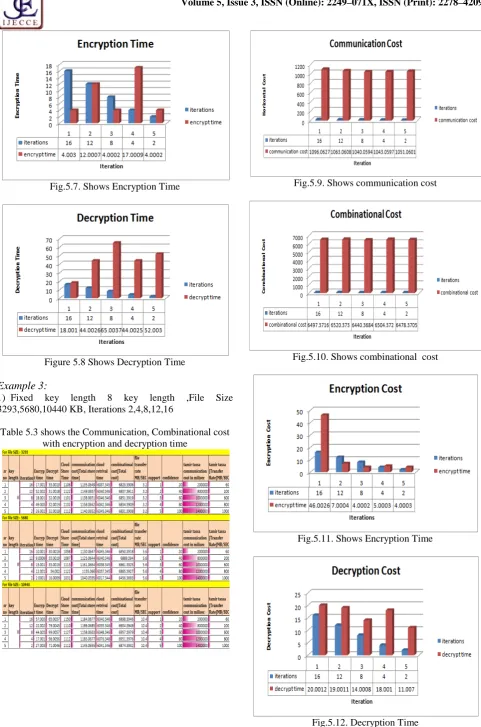
Fig.5.7. Shows Encryption Time
Figure 5.8 Shows Decryption Time
Example 3:
1) Fixed key length 8 key length ,File Size 3293,5680,10440 KB, Iterations 2,4,8,12,16
Table 5.3 shows the Communication, Combinational cost with encryption and decryption time
Fig.5.9. Shows communication cost
Fig.5.10. Shows combinational cost
Fig.5.11. Shows Encryption Time
Copyright © 2014 IJECCE, All right reserved 597
International Journal of Electronics Communication and Computer Engineering Volume 5, Issue 3, ISSN (Online): 2249–071X, ISSN (Print): 2278–4209
VI. C
ONCLUSIONFrom the above experimental setup, the communication cost and combinational cost is optimize in small data entries. To apply these techniques in lager database the Dynamic FP-Growth algorithm is beneficial for mining. It provides security with cloud storage and mining with FP-Growth algorithm. This experimental setup is applied for small database file size and is produced a optimize results.
F
UTUREW
ORKFor lager records, the dynamic FP-growth Algorithm is used for mining which overcome the limitation of Apriori and FP-Growth algorithm.
R
EFERENCES[1] Tamir Tassa. Secure Mining of Association Rules in Horizontally Distributed Databases. In Ieee Transactions On Knowledge And Data Engineering,
[2] U.M. Fayyad, et al.: “From Data Mining to Knowledge Discovery: An Overview“, Advances in Knowledge Discovery and Data Mining:1-34, AAAI Press/ MIT Press, 1996, ISBN 0-262-56097-6.
[3] A.C. Yao. Protocols for secure computation. In FOCS, pages 160–164, 1982.
[4] R. Fagin, M. Naor, and P. Winkler. Comparing Information Without Leaking It. Communications of the ACM, 39:77–85, 1996.
[5] J. Vaidya and C. Clifton, “Privacy preserving association rule mining in vertically partitioned data,” in The Eighth ACM SIGKDD International Conference on Knowledge Discovery and Data Mining, Edmonton, Alberta, Canada, July 23-26 2002, pp. 639–644. [Online]. Available: http://doi.acm.org/10.1145/ 775047.775142
[6] J. Wang, J. Wan, Z. Liu, and P. Wang. Data mining of mass storage based on cloud computing. In IEEE Computer Society, pages 426–431, 2010.
[7] Oracle data mining concepts 11g release 1 (11.1), may 2008. [8] L. Torgo. Data Mining with R: Learning with Case Studies.
Chapman & Hall/CRC, 2010.
[9] L. Van Wel and L. Royakkers. Ethical issues in web data mining. Ethics and Inf. Technol., 6:129–140, 2004.
[10] M. Kantardzic. Data Mining: Concepts, Models, Methods and Algorithms. John Wiley & Sons, Inc., 2002.
[11] Pallavi Dubey, “Association Rule Mining on Distributed Data”, International Journal of Scientific & Engineering Research, Volume 3, Issue 1, January-2012 1 ISSN 2229-5518
[12] M. H. Dunham.“Data Mining. Introductory and Advanced Topics,”Prentice Hall, 2003, ISBN 0-13-088892-3.
[13] A. Schuster and R.op Wolff , "Communication-Efficient Distributed Mining of Association Rules," Proc. ACM SIGMOD Int'l Conf. Management of Data, ACM Press, 2001,pp. 473-484. [14] D.W. Cheung, et al., "A Fast Dis Distributed Information
Systems,”IEEE CS Press, 1996,pp. 31
A
UTHOR’
SP
ROFILEMr. Rahul B. Diwate
pursuing M.E. in Computer Science & Engineering from G.H.R.C.E.M, Amravati, Amravati University, (M.H) India, and Research
Interest: Algorithms and Data mining.
Prof. Amit M. Sahu
M.E. in Information Technology, Amravati, Amravati University, (M.H) India, and Now He is working as Assistant Professor in CSE Department, G.H.R.C.E.M Amravati, Amravati University. Experience: Teaching 3 years, Other 2 years, Guiding 3 ME projects. Research