Privacy Protection of Data Using Chaos and Biometric
Template
Sonia Gupta
M.Tech. Scholar, IGIT, GGSIPU, Kashmere Gate Email: [email protected]
Dr. Amar Kumar Mohapatra
Asst. Professor IGIT, GGSIPU, Kashmere GateEmail: [email protected]
Abstract – The problem with traditional cryptography authentication is that the keys that are very long, difficult to memorize and can easily be attacked. Although it provides sample security but these algorithms are secure only when the key is secure. So instead of using conventional cryptographic approach for protecting or authenticating user data, biometric security techniques are used. In this paper the concept of bio-chaotic algorithm is proposed to generate a biometric chaotic -keys to encrypt and decrypt the data in cipher block chaining mode. The biometric template is first decomposed using discrete wavelet transform. The horizontal and vertical coefficients are processed to extract the features which generate the bio-chaotic keys on mixing with chaotic logistic function. The proposed bio-chaotic key based block encryption system provides two levels of security, which can be controlled through the random secret key and the biometric template as well. The experimental results of randomness, histogram distribution, mean value, correlation coefficient and entropy validate the high encryption performance of the proposed bio-chaotic block encryption algorithm.
Keywords –Authentication, Biometrics Template, Chaotic function, Wavelet Transformation.
I. I
NTRODUCTIONHistorically, cryptography arose as a means to enable parties to maintain privacy of the information they send to each other, even in the presence of an adversary with access to the communication channel. While providing privacy remains a central goal, the field has expanded to encompass many others, including not just other goals of communication security, such as guaranteeing integrity and authenticity of communications, but many more sophisticated and fascinating goals. Cryptography has been used almost since writing was invented. For the larger part of its history, cryptography remained an art, a game of ad hoc designs and attacks. As it is the general practice of user to choose shorter password in order to overcome the difficulty to memorize long password and to avoid the chance of forgetting the password. Such type of approach can easily be attacked by using brute force search or other techniques and suffer from key management problems. Another problem with the traditional cryptography is that they cannot be applied in case of large data size and high resolution images.
Current authentication system uses biometric which are basically the physiological and behavioral characteristics of a user like fingerprint, iris, palm print etc. Instead of using conventional cryptographic technique biometric authentication [13] is used as it overcomes the limitation of traditional cryptography. Using biometrics as key will
increase the security and reduces the mistakes done by human during identification. However the main concern in biometric system is the secure storage of biometric template because once the attacker interprets user biometric data he/she can use it for various illegal operations [8][9][10][11][12][13[15][16]. In order to overcome the privacy and security issues arise in biometric template chaos-based cryptosystems [2][4] [7][14] are used. In this case the keys that are used to encrypt the data are randomly generated and different keys are used for different session this make very difficult for the attacker to guess the key. Abdullah Sharaf et.al [1] proposed a Bio-Chaotic stream cipher algorithm (BCA) for image encryption to provide security of the images. They use iris feature extraction code to extract the feature of iris image and apply Hamming Distance Technique on the extracted feature to generate initial condition for secret key and then Xored it with extracted feature to generate biometric key and this key is used in chaotic function to generate biochaotic stream cipher.
To improve the security of images a new algorithm is proposed to overcome the problems occurred in conventional cryptographic algorithms. A biometric template is first decomposed using the discrete wavelet transform. The horizontal and vertical frequency coefficients are processed to extract the features which generate the bio-chaotic key with chaotic binary image [1][3]. The bio-chaotic key based block data cryptosystem provides two levels of security.
II. P
ROPOSEDA
LGORITHMFig-3 represents the block diagram of bio-chaotic key generation process used in the proposed algorithm. Basic steps of algorithm are as follows
1. Take a gray scale biometric template (Iris Image). 2. Take the 2-D DWT of this biometric template at
level = 1.
Fig.1. 2-D wavelet transform matrix
3. Consider the cH and cV coefficients of the wavelet matrix.
4. Evaluate the average of cH coefficient, let say cHavg. 5. Perform binarization of above calculated cH
coefficient.
BcH(i, j) = 1 if cH(i ,j)≥ cHavg 0 else
Copyright © 2013 IJECCE, All right reserved 6. Evaluate the average of cV coefficient, let say cVavg.
7. Perform binarization of above calculated cH coefficient.
BcV(i,j) = 1 if cV(i ,j)≥ cVavg 0 else
Call BcV(I,j) as the feature F2
8. Combine the Features F1 and F2 through XOR operation to generate the combined feature F as:
F(i,j) = BcH(i,j) XOR BcV(i,j)
9. Take a chaotic function to generate a random sequence
Fig.2. Chaotic function input/output diagram 10. Generate the permutation index vector u(k), k=1 ~
mn, from the above chaotic random sequence.
11. Scramble this feature F(I,j) using the permutation vector u(k)
12. Again iterate the chaotic map to generate sequence
x(mn+1)………….x(2m,n)
13. Binarized the this sequence, taking a threshold of 0.5,
into B (1), B (2)………B (m,n).
14. Transform B (i,j) which is a 1-D matrix into 2-D array of size mxn
15. Diffuse F(I,j) and B(I,j) sequence to generate bio-chaotic key BCKey (i) = F (i,j) XOR B(i,j) i = 1 ~ mn 16. Convert BCkey (i) of size 1 x mn into byte as
BCKey(i) = K1K2……….Kqwhere q=mn/8 17. Read the image P of size M x N, which to be encrypt
and transform this 2-D gray scale image matrix into 1-D matrix 1 x MN, let it be
P = P1 P2 ………Pk Pk+1 …………..PMN
18. Encrypt the first block of plain text image P of size k using the BCKey of same size i.e. k to get block of
cipher image C (C= C1 C2……….Ck) using
cipher block chaining mode as:
Cblock (t) = Pblock (t) Xor BCKey Xor Cblock (t-1) perform this for all blocks of P to encrypt the whole image, where t = 1 to MN/k.
Fig.3. Block diagram of bio-chaotic key generation process
III. E
XPERIMENTALA
NALYSISIn this paper we have analyzed the algorithm by taking a gray scale biometric iris template and calculate 2-D transform of this it. The cH and cV coefficient are used to extract 2 feature each of size mxn then using chaotic logistic map x(n +1) = λx(n).(1− x(n)) with x(0)= 0.49731 andλ=3.97 , a bio-chaotic key is generated which will be utilized to build a block cryptosystem using cipher block chaining mode. The simulation results of the work carried out so far are depicted in the following figures.
Fig.4. Original image Fig.5. Extracted Feature1 (F1)
Fig.6. Extracted feature 2(F2)
Fig.7. Combination of F1 & F2
Fig.8. Bio-chaotic Key
Technology (NIST) are performed [5]. The generated PN sequences go through the randomness Tests like Frequency, Block frequency, forward, Cusum-reverse, Runs, Longest runs, Rank, FFT, Linear complexity, Serial, and Overlapping template tests. These randomness tests are used to calculate a value. If a p-value for a test is determined to be equal to 1, then the sequence appears to have perfect randomness. A p-value of zero indicates that the sequence appears to be completely non-random. A significance level (α) can be chosen for the tests. If p-value ≥ α, then the sequence appears to be random. If p-value < α, then the sequence appears to be non-random. Typically, α is chosen in the range [0.001, 0.01]. An α = 0.01 indicates that one would expect 1 sequence in 100 sequences to be rejected. A p-value ≥ 0.01 would mean that the sequence would be
considered to be random with a confidence of 99%. A p-value < 0.01 would mean that the sequence is non-random with a confidence of 99%. The STS randomness tests are applied with α = 0.01. The randomness results of biochaotic binary keys generated by the proposed generator are listed in the Table 1. It is clear that the sequence under examination has passed all above mentioned randomness tests[6]. The p-value obtained in
each tests is extensively greater than chosen α=0.01, which
confirms the high randomness of the gene of rated bio encryption keys.
Table I: Randomness result for bio-chaotic keys using NIST sts1.6 tool
Randomness Test p-value Result
Frequency Test 0.634418 Pass
Block Frequency Test 0.081754 Pass
Cusum-Forward Test 0.775018 Pass
Cusum-Reverse Test 0.681685 Pass
Runs Test 0.366369 Pass
Longest Runs Test 0.295889 Pass
Rank Test 0.313674 Pass
FFT Test 0.232316 Pass
Linear Complexity Test 0.808827 Pass
Serial Test 1.000000 Pass
Overlapping Template 0.957612 Pass
IV. M
ATHEMATICALO
BSERVATION OF THEA
LGORITHMIn this section the mathematical observations like entropy, histogram equalization, mean and correlation of the proposed algorithm are mentioned for three different grayscale images
Fig.9. Baboon256gr.png Fig.10. Barbara256gr.png
Fig.11. Peppers256gr.png
Entropy, mean, correrelation coefficients
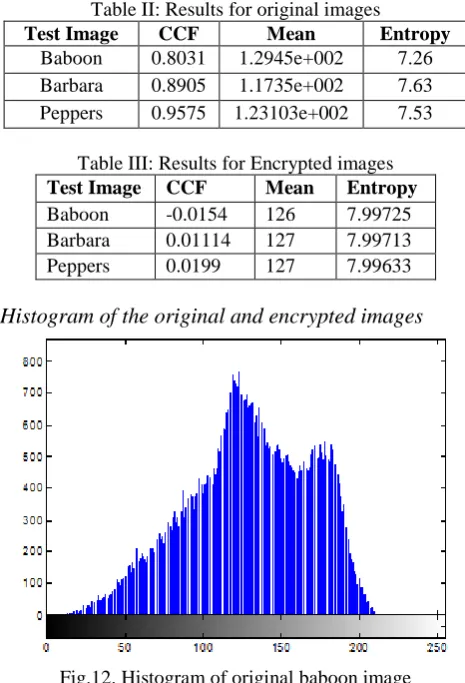
Table-2 and 3 shows the result correlation coefficients, mean and entropy of original and encrypted images respectively.
Table II: Results for original images
Test Image CCF Mean Entropy
Baboon 0.8031 1.2945e+002 7.26
Barbara 0.8905 1.1735e+002 7.63
Peppers 0.9575 1.23103e+002 7.53 Table III: Results for Encrypted images
Test Image CCF Mean Entropy
Baboon -0.0154 126 7.99725
Barbara 0.01114 127 7.99713
Peppers 0.0199 127 7.99633
Histogram of the original and encrypted images
Fig.12. Histogram of original baboon image
Copyright © 2013 IJECCE, All right reserved Fig.14. Histogram of Barbara image
Fig.15. Histogram of encrypted Barbara image
Fig.16. Histogram of peppers image
Fig.17. Histogram of encrypted peppers image
V. C
ONCLUSIONIn this paper, the features of biometric security and chaos-based cryptography are exploited to design a bio-chaotic block security system for overcoming the difficulties and vulnerabilities of conventional cryptographic authentication. The proposed algorithm makes use of discrete wavelet transform to extract the biometric keys, which are combined with chaos function to generate bio-chaotic keys. These keys are then used to encrypt the blocks of data in CBC mode of block ciphering. The experimental results of randomness, histogram distribution, mean value, correlation coefficient and entropy validate the high encryption performance of the proposed bio-chaotic block encryption algorithm.
R
EFERENCES[1] Abdullah Sharaf Alghamdi, Hanif Ullah, Maqsood Mahmud, Muhammad Khurram Khan“Bio-Chaotic Stream Cipher-Based
Iris Image Encryption” 2009 International Conference on
Computational Science & Engineering.
[2] Q.V. Lawande, B. R. Ivan and S. D. Dhodapkar BARC
newsletter no. 258 July 2005 “Chaos Based Cryptography: A New Approach To Secure Mmunications”
[3] PID-143_IMPACT-2011-Chaos Based PN Sequence Generator.pdf
[4] Q.V. Lawande, B. R. Ivan and S. D. Dhodapkar“Chaos Based Cryptography:A New Approach To Secure Communications”
Barc Newsletter No.258 July 2005 [5] NIST sts 1.6 tool.
[6] Shannon C, E,”A Mathematical Theory Of Communication”,
Bell System Technical Journal, July 1948p.623
[7] Haojiang Gao,Yisheng Zhang, ShuyumLiang , Dequn Li , “A new Chaotic Algorithm for image Encryption”, ELSEVIER, SCIENCE DIRECT, Aug 2005.
[8] NGUYEN Thi Hoang Lan , NGUYEN Thi Thu Hang” An
Approach to Protect Private Key using Fingerprint Biometric Encryption Key in BioPKI based Security System”2008 10th Intl. Conf. on Control, Automation, Robotics and Vision Hanoi, Vietnam, 17–20 December 2008.
[9] Sim Hiew Moi, Nazeema Binti Abdul Rahim, Puteh Saad, Pang
Li Sim, Zalmiyah Zakaria, Subariah Ibrahim “Iris Biometric
Cryptography for Identity Document” 2009 International
Conference of Soft Computing and Pattern Recognition [10] Umut Ulduag, Sharath Pankanti, Salil Prabhakar, Anil K.Jain
“Biometric Cryptosystem: Issues & Challenges” Proceeding Of
[11] Yao-Jen Chang, Wende Zhang, and Tsuhan Chen,”Biometrics
-Based Cryptography Key Generation”2004 IEEE, USA
[12] Christian Rathgeb, Andreas Uhl” A survey on biometric
cryptosystems and cancelable biometrics”EURASIP Journal on Information Security September 2011
[13] Christian Rathgeb, Andreas Uhl” Privacy Preserving Key
Generation for Iris Biometrics” Lecture Notes in Computer Science Volume 6109, 2010, pp 191-200
[14] Muhammad Khurram Khan, Jiashu Zhang, Xiaomin Wang”
Chaotic hash-based fingerprint biometric remote user
authentication scheme on mobile devices” Chaos, Solitons & Fractals Volume 35, Issue 3, February 2008, Pages 519–524 [15] Zia Saquib, Santosh Kumar Soni, Sweta Suhasaria, Anamika
Singh” Standardized Biometric Template in Indian Scenario: Interoperability Issues and Solutions” International Journal of Computer & communication Technology Volume-2 Issue-VIII, 2011
[16] Parvathi Ambalakat”Security of Biometrics Authentication System”21stComputer Science Seminar SAT-T1-1
A
UTHOR’
SP
ROFILESonia Gupta
iscurrently working as an Assistant Professor in the Department of Electronics and Communication at Sharda University, Greater Noida She has a work experience of 4.8 years. She received her B.Tech degree from Raj Kumar Goel Institute Of Technology, Ghaziabad in 2008.Email: [email protected]