Efficient Statistics-Based Algebraic Codebook Search Algorithms
Derived from RCM for an ACELP Speech Coder
Tzu-Hung Lin
1, Cheng-Yu Yeh
2,*, Shaw-Hwa Hwang
11 Department of Electrical Engineering, National Taipei University of Technology 1, Sec. 3, Chung-hsiao E. Rd., Taipei 10608, Taiwan, R.O.C.
e-mail: [email protected], [email protected]
2 Department of Electrical Engineering, National Chin-Yi University of Technology 57, Sec. 2, Zhongshan Rd., Taiping Dist., Taichung 41170, Taiwan, R.O.C.
e-mail: [email protected]
http://dx.doi.org/10.5755/j01.itc.44.4.9847
Abstract. Applied to an algebraic codebook search conducted on an algebraic code-excited linear-prediction (ACELP) speech coder, two improved versions of reduced candidate mechanism (RCM), designated as Fixed-G1-RCM and Fixed-2Track-Fixed-G1-RCM, are presented in this study for further search performance improvement. It is mainly derived from two major research findings in a piece of our prior work. The first finding is that a pulse with a high contribution in a track is more likely to serve as the optimal pulse in the optimal vector pertaining to the track, and the second is that the speech quality can be well maintained at a search accuracy above 50%. In this proposal, the trade off can be tuned between the search accuracy and the search complexity so as to reach a nearly consistent speech quality. With this presented search algorithm implemented on a G.729A speech codec, it is experimentally demonstrated that either Fixed-G1-RCM (N = 3), or Fixed-2Track-RCM (M = 2, N = 3, or M = 3, N = 4) can provide a highly superior search performance relative to a global pulse replacement method (iteration = 2) and an iteration-free pulse replacement method.
Keywords: speech codec; VoIP; algebraic code-excited linear-prediction (ACELP); algebraic codebook search; reduced candidate mechanism (RCM).
* Corresponding author
1. Introduction
An algebraic code-excited linear-prediction (ACELP) based speech coding technique [1-3] is the type of technique most widely applied to digital speech communication systems, and serves as a mainstream technique adopted in a great number of speech coding standards due to the double advantage of low bit rates and high speech quality. The main coding flow for an ACELP coding technique is to perform a linear predictive coding (LPC) on the input speech signal, and then perform an adaptive codebook (the long term prediction) as well as an algebraic codebook codings on the LPC residual signal.
However, the price paid is a high computational complexity requirement, particularly in an algebraic codebook search. The reason is quite simple that it necessitates a tremendous computational load when conducting a full search over the algebraic codebook to locate the optimal pulses. As suggested in [4], the
computational load is dominated by two parts, namely, the load in a search process, and the load during the algorithm initialization phase. The former and the latter, respectively, account for 74.9% and the remaining 25.1% of the entire computational load. Provided that there is a way to reduce the computational load to a great extent, an ACELP based coding technique can be extensively applied to an embedded system on a handheld device. In this way, a high performance embedded system is not seen as required, making electronic devices cost competitive. Moreover, due to a computational load reduction, the aim of energy saving is reached for an extended operation time period.
and the depth-first tree search in G.729A [11], among other approaches. In recent times, a number of studies on this issue [12-20] cover the candidate scheme [12], the least important pulse replacement [13], both the global pulse replacement (GPR) [14] and the iteration-free pulse replacement (IFPR) [15, 16], and the reduced candidate mechanism (RCM) approach [17], i.e. a piece of our prior work. An attempt in [12] is made to decrease the number of the candidate positions, the least significant pulse is replaced in an iterative manner in [13], and GPR and IFPR [14-16] are developed on the basis of [13]. In RCM, individual pulse contribution is evaluated in the associated track and sorted in descending order. Subsequently, a full search is performed on the sorted top N pulses treated as candidates. In this way, the optimal pulse combination is acquired following N4 searches, that is,
a significant reduction in search complexity is achieved.
A further investigation into RCM is made in this work based on the two findings as presented in [17]. Accordingly, two improved versions of RCM are proposed to reach the aim of search performance improvement, but without speech quality degradation. The proposed approaches for search performance improvement are implemented on a G.729A speech codec for performance comparison of this proposal versus existing approaches in the literature in terms of search complexity, speech quality, etc.
This paper is outlined as follows. The coding criterion of an algebraic codebook and various search methods are briefly reviewed in Section 2. Presented in Section 3 are two proposed approaches for the efficient complexity reduction. Experimental results are demonstrated and discussed in Section 4. This work is summarized at the end of this paper.
2. Algebraic codebook search
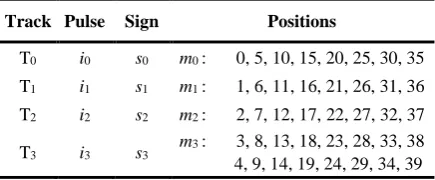
With the determination of an optimal codevector as the goal of the algebraic codebook search, the codebook in G.729 is configured as tabulated in Table 1, on the basis of which each codevector contains 4 nonzero pulses extracted out of associated track. Each pulse’s amplitude can be either +1 or -1.
Table 1. A structured algebraic codebook in G.729
Track Pulse Sign Positions
T0 i0 s0 m0 : 0, 5, 10, 15, 20, 25, 30, 35
T1 i1 s1 m1 : 1, 6, 11, 16, 21, 26, 31, 36
T2 i2 s2 m2 : 2, 7, 12, 17, 22, 27, 32, 37
T3 i3 s3 m3 : 3, 8, 13, 18, 23, 28, 33, 38
4, 9, 14, 19, 24, 29, 34, 39
The optimal codevector ck
ck(n)
is thus foundby minimizing the mean squared weighted error between the original and the synthesized speeches [2, 3], defined as
2 k
k
g
ε
x
Hc
(1)where
x
denotes the target vector, g a scaling gain factor, and H a lower triangular convolution matrix. Itcan be shown that the optimal codevector is the one maximizing the term
Q
k:
k k k k k k kQ
Φc
c
dc
Hc
H
c
Hc
x
T 2 T T 2 T
(2)where
d
x
TH
, the correlation function, is expressed as
1(
)
(
)
)
(
L n in
i
h
i
x
n
d
,0
n
L
1
(3)where L is the speech subframe size. The correlations of
h
(
n
)
are contained in the symmetric matrixH
H
Φ
T , where the entries are given by
1(
)
(
)
)
,
(
L j nj
n
h
i
n
h
j
i
,1
;
1
0
i
L
i
j
L
. (4) It takes a total of 8192 (8*8*8*16) searches, a tremendous computational load, to conduct a full search, i.e. repeated computations and comparisons in (2), for the identification of the optimal codevector. Therefore, a focused search method is adopted in G.729 to reduce the search times to below 1440. However, the number of searches is further reduced to 320, adopting a depth-first tree search method in G.729A. Besides, three existing methods, the GPR, IFPR, and RCM methods, will be discussed in this section.2.1. The GPR search method
The GPR method stems from the least important pulse replacement algorithm [13]. In order to prevent the termination of the pulse replacement procedure without finding the optimal codevector in the GPR algorithm, except for the only track that contains the least important pulse, all the tracks are searched for a new pulse. That is, the new pulse is sought by replacing each pulse in each track with a new one so that the Qk associated with a new codevector is maximized. On the ground that the variation in Qk is always maximized during the replacement procedure, the codevector approaches the optimal solution rapidly as this procedure is repeated. When the value of Qk once reaches the upper bound, the search procedure is then terminated.
new pulse during the first pulse replacement procedure, and requires an average of 27 during the second. Therefore, the overall search complexity is evaluated as 37+27*(R-1) for R1, where R is the number of iterations of the pulse replacement procedure.
Figure 1. A system flowchart of the global pulse replacement search
2.2. The IFPR search method
In the previously mentioned pulse replacement methods, [13] and [14], the computational load increases with the number of iterations of the replacement procedure. In the IFPR method, new pulses are sought by a number of pulse replacements at a time following pulse contributions evaluated for every track so as to maximize over all combinations a search criterion, which replaces the pulses pertaining to the initial codevector with the most significant pulses for every track.
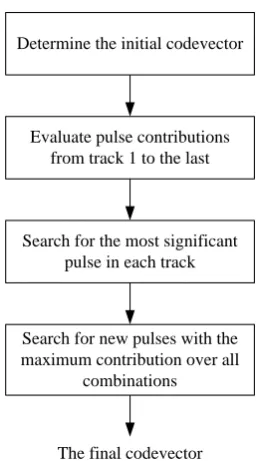
Presented in Fig. 2 is a system flowchart of the IFPR method. Applying IFPR method to G.729A at the first stage, the initial Qk is evaluated and the
initial codevector is then yielded with a search. At the second stage, a total of 36 searches are performed to measure the pulse contribution so as to sort out the most significant pulses in each track. In order to find the final codevector in the end, it requires a total of 11 searches for all combinations, i.e. the number required from 2 pulses replacement to 4 pulses replacement, to replace the pulses of the initial codevector with the most significant pulses for every track, that is, an overall search complexity of 48.
2.3. The RCM search method
Ahead of a search task, the number of candidate pulses in each track is reduced for the purpose of search complexity reduction. This is done in this work according to the contribution of individual pulses. It is that in each track a pulse sorting is made by the contribution thereof in descending order as the first step, and then the top N pulses are chosen as the candidate pulses for a full search. In this way, the search process needs to be performed for merely N4
number of times for the optimal pulse combination, and the search complexity is reduced remarkably in particular for low values of N.
Figure 2. A system flowchart of the iteration-free pulse replacement search
The contribution made by individual pulses is given as (2), that is, a higher value of Qk reflects a higher contribution. In consideration of merely a single pulse contribution, the number of nonzero pulses in the codevector
c
k of length 40 is reduced to 1 from 4. Therefore, (2) can be simplified into (5), where the numerator of (5) is derived from (2) and (3), and the denominator of (5) is derived from (2) and (4), respectively. Just as in (2), the contribution of the ith pulse is reflected by the value of ik
Q :
)
,
(
)
(
2
i
i
i
d
Q
ki
,0
i
L
1
. (5)In [17], it is verified that a single pulse with a higher contribution within each track is more likely to be the optimal pulse out of the optimal codevector within the associated track. Thus, the RCM approach is used to reduce the search complexity by the reduction in the number of candidate pulses in each track. This approach is decomposed into two stages as
Determine the initial codevector
The final codevector Evaluate pulse contributions
from track 1 to the last
Search for a new pulse with the maximum contribution
The last replacement?
Yes No
Determine the initial codevector
The final codevector Evaluate pulse contributions
from track 1 to the last
Search for the most significant pulse in each track
Search for new pulses with the maximum contribution over all
follows. The first is to evaluate individual pulse contribution with (5), which indicates that a higher value of i
k
Q denotes a higher pulse contribution.
Subsequently, the top N pulses, 1N8 , are
extracted out of the i k
Q sorting in each track as the
prerequisite of the second stage. Then, in the second stage, it is proven that the pulses combination with the highest value of Qk, as given in (2), is indeed the
optimal solution through a nest-loop search. Finally, this RCM approach is presented in an algorithmic form as follows.
Algorithm 1: The RCM search procedure.
Step 1. Sort the pulses in each track in a descending order by individual pulse contribution evaluated as (5).
Step 2. Specify the value of the parameter N, and select the top N pulses in each track as the candidate pulses.
Step 3. Search for the optimal pulses over all the combinations of the candidate pulses through a full search by means of (2).
Step 4. Terminate a searching task at the moment the combination of the optimal pulses is acquired.
3. Proposed approaches
The first finding in [17] indicates that a pulse with a high level of contribution in the associated track is more likely to serve as the optimal pulse in the optimal codevector, and the second reveals that the speech quality can be well maintained on a condition that the search accuracy exceeds a threshold, say 50% in [17]. Underlain by such findings, two improved versions of RCM, designated as Fixed-G1-RCM and Fixed-2Track-RCM, are presented to achieve the aim of search performance elevation in the absence of speech quality degradation.
Moreover, a hit probability
p
h(
T
t,
n
)
is defined as(6), where
NH
(
T
t,
n
)
denotes the number of timesthat the nth pulse, in terms of the contribution priority, within track Tt, hits the optimal codevector, TSF is the
total number of testing subframes, and NP is the number of pulses within track Tt:
TSF
n
NH
n
p
t t h)
,
T
(
)
,
T
(
,0
t
3
,NP
n
1
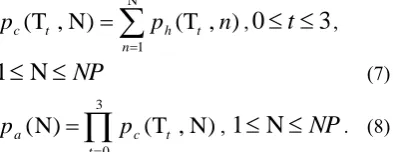
. (6)Subsequently, a cumulative probability
p
c(
T
t,
N
)
is defined as (7) to accumulate the previous N number of
p
h(
T
t,
n
)
, and an accuracy is defined as (8), thatis, the probability to successfully locate four intended pulses:
N 1)
,
T
(
)
N
,
T
(
n t h tc
p
n
p
,0
t
3
,NP
N
1
(7)
3 0)
N
,
T
(
)
N
(
t t c ap
p
,1
N
NP
. (8)Tabulated in Table 2 are the statistics made through (7) and (8) based on a speech database in Chinese language, containing 9,650 syllables out of 100 sentences for a duration over 41 minutes and 495,608 subframes, that is, TSF=495,608. Taking the case of N=2, the first two pulses in the i
k
Q sorting, as
an instance, the hit probabilities, in each search, of such first two pulses against the optimal codevector are 0.8571, 0.8417, 0.8519 and 0.8129, respectively. That is, the adoption of the top two pulses in the i
k
Q
sorting in each track causes a hit probability higher than 0.8. Likewise, an adoption of top four pulses leads to a hit probability above 0.9. Besides, the accuracy given by (8) is tabulated in Table 2, where a higher value of accuracy represents a search result closer to that by a full search.
3.1. The Fixed-G1-RCM approach
Based on two findings mentioned above, the first improved version of RCM, referred to as Fixed-G1-RCM approach, is presented in this study. As its name indicates, the top 1 pulse contribution in a global sorting, termed as G1 pulse, is presumed to be one of the four optimal pulses, following which the rest of optimal pulses are located over the remaining 3 tracks through RCM.
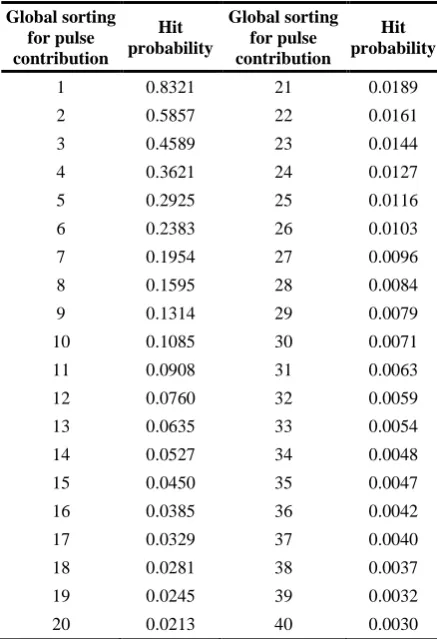
Thus, it is an issue of our interest whether there is a linkage between the top 1 pulse contribution and the possibility that such pulse is indeed the one of optimal pulses. Hence, over entire tracks, a hit probability in a global sorting
P
G,h(
n
)
is defined as (9), where NHG(n) denotes the number of times that the nth pulse, in terms of the contribution priority, hits the optimal codevector, and TSFG is the total number of testing subframes: G G h GTSF
n
NH
n
P
,(
)
(
)
,1
n
40
, (9)Table 2. Cumulative probability pertaining to each track
N
Cumulative probability of codebook track
Probability of locating 4 intended pulses
T0 T1 T2 T3
1 0.6698 0.6483 0.6630 0.6351 0.1828
2 0.8571 0.8417 0.8519 0.8129 0.4996
3 0.9278 0.9185 0.9249 0.8902 0.7016
4 0.9605 0.9539 0.9588 0.9282 0.8154
5 0.9778 0.9740 0.9769 0.9509 0.8847
6 0.9887 0.9863 0.9879 0.9648 0.9294
7 0.9955 0.9943 0.9952 0.9745 0.9600
8 1 1 1 0.9813 0.9813
The above analysis confirms that the top 1 pulse contribution in a global sorting has a highly hit probability that such pulse is indeed the one of optimal pulses. Thus, the Fixed-G1-RCM approach is presented in this study as an efficient way to further speed up the searching process. In this approach, the G1 pulse is presumed to be one of the four optimal pulses, following which the rest of optimal pulses are located over the remaining 3 tracks through RCM. In this context, the number of searches required is reduced to N3 for
N
2
. This proposal, as opposed toRCM, is developed in an attempt to considerably
Table 3. Hit probability of each pulse contribution in a global sorting
Global sorting for pulse contribution
Hit probability
Global sorting for pulse contribution
Hit probability
1 0.8321 21 0.0189
2 0.5857 22 0.0161
3 0.4589 23 0.0144
4 0.3621 24 0.0127
5 0.2925 25 0.0116
6 0.2383 26 0.0103
7 0.1954 27 0.0096
8 0.1595 28 0.0084
9 0.1314 29 0.0079
10 0.1085 30 0.0071
11 0.0908 31 0.0063
12 0.0760 32 0.0059
13 0.0635 33 0.0054
14 0.0527 34 0.0048
15 0.0450 35 0.0047
16 0.0385 36 0.0042
17 0.0329 37 0.0040
18 0.0281 38 0.0037
19 0.0245 39 0.0032
20 0.0213 40 0.0030
reduce the search load to N3 from N4 identical value of N. Furthermore, since the highest hit probability is as high as 0.8321, the search performance improvement can be made together with well maintained speech quality at a search accuracy of 50% approximately. Here, this search scheme is presented in an algorithmic form as follows, and is illustrated in Fig. 4.
Figure 3. Plot of the hit probability of each pulse contribution in a global sorting
Algorithm 2: The Fixed-G1-RCM search procedure.
Step 1. Individual pulse contribution is evaluated by (5), and a sorting is made by pulse contribution within the associated track.
Step 2. The one with the global maximum pulse contribution, named as G1, is located out of all the top 1 pulses among all the tracks.
Step 3. G1 is presumed to be one of four optimal pulses, and then the value of N is determined for the searching task conducted over the remaining three tracks through RCM.
Step 4. A searching task terminates at the moment the combination of the optimal pulses is acquired.
3.2. The Fixed-2Track-RCM approach
[17]. For this sake, such two pulses are presumed to be two of the optimal pulses, and then remaining two are located through RCM. In this manner, a high efficiency search algorithm is successfully developed to significantly reduce the search complexity as intended.
Subsequently, the first pulses in respective sortings are further sorted and designated as R1, R2, R3, R4,
where R1 is, in fact, the G1 pulse in the preceding
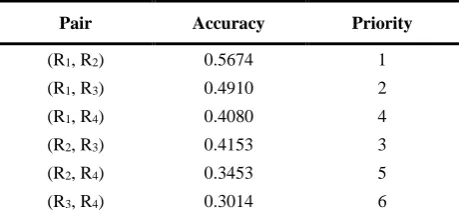
section. As tabulated in Table 4, the probabilities that pairs serve as the optimal pulses are evaluated and then treated as the priority when conducting a sequence of search tasks. The pairs are sorted by priority in descending order as (R1, R2), (R1, R3), (R2,
R3), (R1, R4), (R2, R4) and (R3, R4), and a point worthy
of mention is that a higher priority is exhibited in (R2,
R3) than in (R1, R4).
Table 4. Values of pair accuracy for Fixed-2Track-RCM
Due to the lack of high search accuracies among various pairings in Table 4, a multiple pairing strategy is adopted to elevate the search accuracy. For instance, the pair (R1, R2) is firstly taken for performing RCM
to find the highest Qk and locate the optimal pulse combination. Secondly, the same process is repeated on the pairs (R1, R3), (R1, R4), and so forth. In this
context, there is a maximum of 6 search tasks performed on sorted pairs by the priority thereof.
A further investigation into the search complexity is made as follows. With a single pair, the searching process is done following N2 searches. Yet, an
advantage gained is that the search complexity is a function of M, the number of pairings. Hence, the search number is expressed as (10), where the terms subtracted represent the number of repeated searches:
6 4 ) 1 )( 3 ( ) 1 (
3 1 ) 1 ( number
Search 2
2
M N
M N M MN
M N
M
MN (10)
Lastly, this proposed Fixed-2Track-RCM is presented in an algorithmic form as follows.
Algorithm 3: The Fixed-2Track-RCM search procedure.
Step 1. Specify the values of the parameters M and N.
Step 2. Pulses in each track are sorted by individual pulse contribution evaluated as (5).
Step 3. The No. 1 pulses in individual tracks are further sorted, and then designated as R1, R2,
R3, R4.
Step 4. Reference Table 4 in the determination of M value, and then perform the search tasks over the remaining two tracks through RCM by means of (2).
Step 5. The search process is repeated until the optimal pulse combination is found.
4. Experimental results
There are three experiments conducted in this work. The first is a search accuracy comparison between the full search and other search approaches. Subsequently, the second is a computational complexity comparison between the preceding search approaches. Lastly, the third is that various approaches are compared with ITU-T P.862 perceptual evaluation of speech quality (PESQ) [21] and ITU-T P.862.1 mean opinion score, listening quality objective (MOS-LQO) [22] as an objective measure of speech quality. The test objects are those selected out of a speech database in Chinese language, containing 9,650 syllables out of 100 sentences for a duration over 41 minutes and 495,608 subframes.
For the brevity of the following discussion, the RCM approach with N candidate pulses is abbreviated as RCM-N,
1
N
8
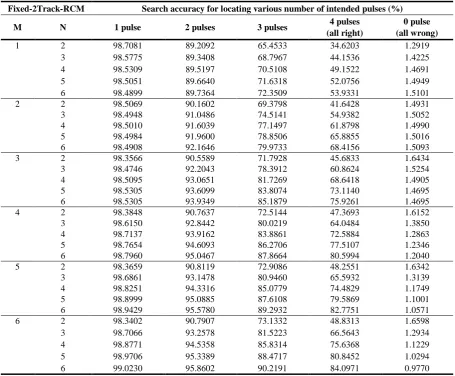
. For instance, RCM-1 symbolizes the one with merely a candidate pulse extracted out of each track. Similarly, the GPR approach with the number R of repetitions is designated as GPR-R.Tabulated in Table 5 is the search accuracy analysis between various approaches, that is, the hit probability of individual approach against the optimal pulse identified through a full search. During the search process, the best case is the one to successfully locate 4 intended pulses, the all right case, and the worst is to locate none, the all wrong case. As tabulated in Table 5, taking the all right case as an instance, the accuracies made by G.729A, GPR-2, IFPR and RCM-2 are 68.6438%, 76.1053%, 68.0824% and 50.3579%, respectively, while that by the proposed Fixed-G1-RCM method falls between 17.3353% (N=1) and 81.7921% (N=8). Likewise, the search accuracy for various combinations of (M, N) in Fixed-2Track-RCM is tabulated in Table 6. It is found that a search accuracy above 50% is exhibited in the cases of M >= 2 and N >= 3.
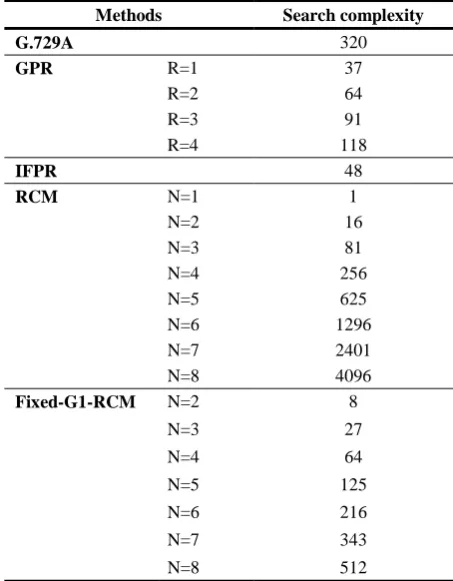
Listed in Table 7 is the comparison of the search complexity, that is, the number of searches performed and those required in the evaluation of Qk defined in (2). It is found that G.729A requires 320 searches, GPR-2 64, IFPR 48, RCM-2 16, and the proposed Fixed-G1-RCM method a number somewhere between 1 (N=1) and 512 (N=8). Accordingly, the
Pair Accuracy Priority
(R1, R2) 0.5674 1
(R1, R3) 0.4910 2
(R1, R4) 0.4080 4
(R2, R3) 0.4153 3
(R2, R4) 0.3453 5
Table 5. Comparison of the search accuracy among various methods
Methods
Search accuracy for locating various number of intended pulses (%)
1 pulse 2 pulses 3 pulses 4 pulses (all right)
0 pulse (all wrong)
G.729A 98.3475 92.1456 80.9918 68.6438 1.6525
GPR R=1 98.7032 90.7750 76.1053 55.0718 1.2968
R=2 98.4946 91.8335 80.4779 76.1053 1.5054
R=3 98.5246 92.1081 81.2227 80.4779 1.4754
R=4 98.5283 92.1547 81.3393 81.2227 1.4717
IFPR 98.6810 92.4963 80.0048 68.0824 1.3190
RCM N=1 99.3295 89.0873 55.8720 17.3353 0.6705
N=2 98.3009 90.8486 73.6532 50.3579 1.6991
N=3 98.8545 94.0394 83.5763 70.7329 1.1455
N=4 99.2014 95.9617 89.2187 81.8716 0.7986
N=5 99.4609 97.3146 92.9551 88.6031 0.5391
N=6 99.6489 98.2930 95.5634 92.9918 0.3511
N=7 99.7978 99.0166 97.4591 96.0049 0.2022
N=8 99.9011 99.5341 98.8319 98.1148 0.0989
Fixed-G1-RCM N=2 98.2054 89.8500 70.0755 44.0814 1.7946
N=3 98.2060 91.2376 76.7365 60.2498 1.7940
N=4 98.2369 92.1541 80.4684 69.0717 1.7631
N=5 98.2430 92.8193 82.9734 74.3685 1.7570
N=6 98.2472 93.3058 84.7438 77.8040 1.7528
N=7 98.2529 93.6545 86.0402 80.1414 1.7471
N=8 98.2531 93.9055 86.9845 81.7921 1.7469
Table 6. Comparison of the search accuracy for Fixed-2Track-RCM method
Fixed-2Track-RCM Search accuracy for locating various number of intended pulses (%)
M N 1 pulse 2 pulses 3 pulses 4 pulses
(all right)
0 pulse (all wrong)
1 2 98.7081 89.2092 65.4533 34.6203 1.2919
3 98.5775 89.3408 68.7967 44.1536 1.4225
4 98.5309 89.5197 70.5108 49.1522 1.4691
5 98.5051 89.6640 71.6318 52.0756 1.4949
6 98.4899 89.7364 72.3509 53.9331 1.5101
2 2 98.5069 90.1602 69.3798 41.6428 1.4931
3 98.4948 91.0486 74.5141 54.9382 1.5052
4 98.5010 91.6039 77.1497 61.8798 1.4990
5 98.4984 91.9600 78.8506 65.8855 1.5016
6 98.4908 92.1646 79.9733 68.4156 1.5093
3 2 98.3566 90.5589 71.7928 45.6833 1.6434
3 98.4746 92.2043 78.3912 60.8624 1.5254
4 98.5095 93.0651 81.7269 68.6418 1.4905
5 98.5305 93.6099 83.8074 73.1140 1.4695
6 98.5305 93.9349 85.1879 75.9261 1.4695
4 2 98.3848 90.7637 72.5144 47.3693 1.6152
3 98.6150 92.8442 80.0219 64.0484 1.3850
4 98.7137 93.9162 83.8861 72.5884 1.2863
5 98.7654 94.6093 86.2706 77.5107 1.2346
6 98.7960 95.0467 87.8664 80.5994 1.2040
5 2 98.3659 90.8119 72.9086 48.2551 1.6342
3 98.6861 93.1478 80.9460 65.5932 1.3139
4 98.8251 94.3316 85.0779 74.4829 1.1749
5 98.8999 95.0885 87.6108 79.5869 1.1001
6 98.9429 95.5780 89.2932 82.7751 1.0571
6 2 98.3402 90.7907 73.1332 48.8313 1.6598
3 98.7066 93.2578 81.5223 66.5643 1.2934
4 98.8771 94.5358 85.8314 75.6368 1.1229
5 98.9706 95.3389 88.4717 80.8452 1.0294
Table 7. Comparison of the search complexity among various methods
Methods Search complexity
G.729A 320
GPR R=1 37
R=2 64
R=3 91
R=4 118
IFPR 48
RCM N=1 1
N=2 16
N=3 81
N=4 256
N=5 625
N=6 1296
N=7 2401
N=8 4096
Fixed-G1-RCM N=2 8
N=3 27
N=4 64
N=5 125
N=6 216
N=7 343
N=8 512
search complexity is reduced as intended in comparison with the original RCM approach.
Similarly, tabulated in Table 8 is the search complexity given by (10) for various combinations of (M, N) in Fixed-2Track-RCM. It is noted that the search complexity increases more rapidly with N than with M. For instance, it requires 21 searches in the case of (M = 3, N = 3), while the number of searches is elevated to 40 in the case of (M = 3, N = 4), but reduced to merely 25 in the case of (M = 4, N = 3). In simple terms, the increase of M, as opposed to N, is found to be a superior way when dealing with the issue of speech quality improvement in the aspect of search complexity reduction.
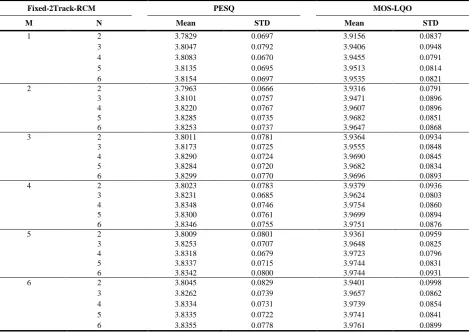
Tabulated in Tables 9 and 10 are the comparisons of both PESQ and MOS-LQO, each comprising the mean and the standard deviation (STD). In comparison with MOS-LQO, G.729A, all the approaches provide a comparable speech quality within a 1% deviation, except that RCM-1 exhibits a 3% drop. Furthermore, as suggested in [17], there is a nearly consistent subjective speech quality with listening test in the presence of 1% MOS-LQO deviation.
The analysis on the experimental results is summed up as follows. Firstly, with a marginal variation in MOS-LQO, a low search complexity reflects a high search performance. This proposal is validated as an efficient and tunable means to achieve the aim of search performance elevation. Taking Fixed-G1-RCM as an instance, the choice of N = 3 is
recommended with a 60.25% search accuracy, 3.9518 MOS-LQO and 27 searches, that is a figure 42.19% of GPR-2, 56.25% of IFPR and 33.33% of RCM-3.
Likewise, it is recommended in Fixed-2Track-RCM to choose (M = 2, N = 3) and (M = 3, N = 4) for a relatively low and a relatively high search accuracy, respectively. With a 54.94% search accuracy and a 3.9471 MOS-LQO, the case of (M = 2, N = 3) requires 15 searches, a number 23.44% of GPR-2 and 31.25% of IFPR, while the case of (M = 3, N = 4) demonstrates a 68.64% search accuracy, a 3.9690 MOS-LQO, and requires 40 searches, which is 62.5% of GPR-2 and 83.33% of IFPR.
Table 8. Comparison of the search complexity for Fixed-2Track-RCM method
Fixed-2Track-RCM
Search complexity
M N
1 2 4
3 9
4 16
5 25
6 36
2 2 6
3 15
4 28
5 45
6 66
3 2 8
3 21
4 40
5 65
6 96
4 2 9
3 25
4 49
5 81
6 121
5 2 10
3 29
4 58
5 97
6 146
6 2 11
3 33
4 67
5 113
6 171
5. Conclusion
Table 9. Comparison of the speech quality among various methods
Methods
PESQ MOS-LQO
Mean STD Mean STD
G.729A 3.8126 0.0838 3.9502 0.1026
GPR R=1 3.8145 0.0757 3.9521 0.0883
R=2 3.8324 0.0777 3.9725 0.0906
R=3 3.8376 0.0739 3.9786 0.0859
R=4 3.8382 0.0749 3.9793 0.0867
IFPR 3.8276 0.0761 3.9672 0.0884
RCM N=1 3.7083 0.0807 3.8250 0.1026
N=2 3.8064 0.0819 3.9423 0.0971
N=3 3.8256 0.0740 3.9651 0.0868
N=4 3.8331 0.0735 3.9735 0.0859
N=5 3.8393 0.0677 3.9810 0.0780
N=6 3.8457 0.0736 3.9877 0.0846
N=7 3.8466 0.0718 3.9888 0.0819
N=8 3.8446 0.0766 3.9863 0.0881
Fixed-G1-RCM N=2 3.7937 0.0775 3.9279 0.0927
N=3 3.8143 0.0766 3.9518 0.0906
N=4 3.8312 0.0682 3.9717 0.0791
N=5 3.8359 0.0733 3.9767 0.0840
N=6 3.8324 0.0687 3.9730 0.0795
N=7 3.8335 0.0724 3.9741 0.0840
N=8 3.8373 0.0720 3.9783 0.0825
Table 10. Comparison of the speech quality for Fixed-2Track-RCM method
Fixed-2Track-RCM PESQ MOS-LQO
M N Mean STD Mean STD
1 2 3.7829 0.0697 3.9156 0.0837
3 3.8047 0.0792 3.9406 0.0948
4 3.8083 0.0670 3.9455 0.0791
5 3.8135 0.0695 3.9513 0.0814
6 3.8154 0.0697 3.9535 0.0821
2 2 3.7963 0.0666 3.9316 0.0791
3 3.8101 0.0757 3.9471 0.0896
4 3.8220 0.0767 3.9607 0.0896
5 3.8285 0.0735 3.9682 0.0851
6 3.8253 0.0737 3.9647 0.0868
3 2 3.8011 0.0781 3.9364 0.0934
3 3.8173 0.0725 3.9555 0.0848
4 3.8290 0.0724 3.9690 0.0845
5 3.8284 0.0720 3.9682 0.0834
6 3.8299 0.0770 3.9696 0.0893
4 2 3.8023 0.0783 3.9379 0.0936
3 3.8231 0.0685 3.9624 0.0803
4 3.8348 0.0746 3.9754 0.0860
5 3.8300 0.0761 3.9699 0.0894
6 3.8346 0.0755 3.9751 0.0876
5 2 3.8009 0.0801 3.9361 0.0959
3 3.8253 0.0707 3.9648 0.0825
4 3.8318 0.0679 3.9723 0.0796
5 3.8337 0.0715 3.9744 0.0831
6 3.8342 0.0800 3.9744 0.0931
6 2 3.8045 0.0829 3.9401 0.0998
3 3.8262 0.0739 3.9657 0.0862
4 3.8334 0.0731 3.9739 0.0854
5 3.8335 0.0722 3.9741 0.0841
further search performance elevation. The trade off can be tuned between the search accuracy and the search complexity so as to achieve non degraded speech quality. Either Fixed-G1-RCM (N = 3) or Fixed-2Track-RCM (M = 2, N = 3, or M = 3, N = 4) is demonstrated as a highly superior candidate relative to GPR-2 and IFPR in terms of search complexity reduction. In addition, the proposed approaches can be implemented to other ACELP-based speech coders.
Furthermore, this improved G.729A speech codec can be utilized to improve the VoIP performance on a smart phone. As a consequence, the energy saving target is met for an extended operation time period due to computational load reduction.
Acknowledgment
This research was financially supported by the National Science Council under Grant No. NSC 102-2221-E-167-027, Taiwan, Republic of China.
References
[1] J. P. Adoul, P. Mabilleau, M. Delprat, S. Morissette. Fast CELP coding based on algebraic codes. In: Proc. IEEE International Conference on Acoustics, Speech, and Signal Processing, 1987, pp. 1957-1960.
[2] C. Laflamme, J. P. Adoul, R. Salami, S. Morissette, P. Mabilleau. 16 kbps wideband speech coding technique based on algebraic CELP. In: Proc. IEEE International Conference on Acoustics, Speech, and Signal Processing, 1991, pp. 13-16.
[3] R. Salami, C. Laflamme, J. P. Adoul, A. Kataoka, S. Hayashi, T. Moriya, C. Lamblin, D. Massaloux, S. Proust., P. Kroon, Y. Shoham. Design and description of CS-ACELP: A toll quality 8 kb/s speech coder. IEEE Trans. Speech and Audio Processing, 1998, Vol. 6, No. 2, 116-130.
[4] S. M. Tsai, J. F. Yang. Efficient algebraic code-excited linear predictive codebook search. IEE Proceedings Vision, Image and Signal Processing, 2006, Vol. 153, No. 6, 761-768.
[5] B. Goode. Voice over internet protocol (VoIP).
Proceedings of the IEEE, 2002, Vol. 90, No. 9, 14951517.
[6] T. Zourzouvillys, E.Rescorla. An Introduction to Standards-Based VoIP: SIP, RTP, and Friends. IEEE Internet Computing, 2010, Vol. 14, No. 2, 69-73. [7] A. E. Frey, G. J. Zenner. The Role of SIP in the
Migration of Service Provider Networks to VoIP. Bell Labs Technical Journal, 2004, Vol. 9, No. 3, 199-216.
[8] IETF RFC 3261. SIP: Session Initiation Protocol, 2002.
[9] IETF RFC 3515. The Session Initiation Protocol (SIP) refer method, 2003.
[10] IETF RFC 3665. Session Initiation Protocol (SIP) Basic Call Flow Examples, 2003.
[11] R. Salami, C. Laflamme, B. Bessette, J. P. Adoul. ITU-T G.729 Annex A: reduced complexity 8 kb/s CS-ACELP codec for digital simultaneous voice and data. IEEE Communications Magazine, 1997, Vol. 35, No. 9, 56-63.
[12] F. K. Chen, J. F. Yang, Y. L. Yan. Candidate scheme for fast ACELP search. In: IEE Proc. Vision, Image and Signal Processing, 2002, Vol. 149, No. 1, 10-16. [13] H. Park, Y. Choi, D. Lee. Efficient codebook search
method for ACELP speech codecs. In: Proc. IEEE Workshop on Speech Coding, 2002, pp. 17-19. [14] E. D. Lee, M. S. Lee, D. Y. Kim. Global pulse
repla-cement method for fixed codebook search of ACELP speech codec. In: Proc. Second IASTED International Conference on Communications, Internet, and Information Technology, 2003, pp. 372-375.
[15] E. D. Lee, S. H. Yun, S. I. Lee, J. M. Ahn. Iteration-free pulse replacement method for algebraic codebook search. Electronics Letters, 2007, Vol. 43, No. 1, 5960.
[16] E. D. Lee, J. M. Ahn. Efficient fixed codebook search method for ACELP speech codecs. Lecture Notes in Computer Science 4413, 2007, 178-187.
[17] C. Y. Yeh, Y. J. Su. Reduced candidate mechanism for an algebraic code-excited linear-prediction codebook search. IET Communications, 2012, Vol. 6, No. 17, 2864-2869.
[18] F. K. Chen, G. M. Chen, B. K. Su, Y. R. Tsai. Unified pulse-replacement search algorithms for algebra codebooks of speech coders. IET Signal Processing, 2010, Vol. 4, No. 6, 658-665.
[19] C. P. Chu, C. Y. Yeh, S. H. Hwang. An efficient search strategy for ACELP algebraic codebook by means of reduced candidate mechanism and iteration-free pulse replacement. Information Technology and Control, 2014, Vol. 43, No. 2, 183-187.
[20] L. Li, G. Chen. Study on fast fixed-codebook search algorithm in G.729 speech coding. In: Proc. IEEE International Workshop on Computer Science and Engineering, 2009, pp. 279-282.
[21] ITU-T Recommendation P.862. Perceptual evaluation of speech quality (PESQ): An objective method for end-to-end speech quality assessment of narrow-band telephone networks and speech codecs, 2001.
[22] ITU-T Recommendation P.862.1. Mapping function for transforming P.862 raw result scores to MOS-LQO, 2003.