On Packet Loss Ratio of IEEE 802.15.4 with Different
Sensor Motes for Wireless Sensor Networks
Sukhvinder S. Bamber
Department of Computer Science & Engineering, Panjab University SSG Regional Centre, Punjab, India
Email: [email protected]
Abstract – Packet Loss Ratio (PLR) is one of the key components for the performance enhancement of a Wireless Sensor Networks (WSNs). This paper investigates the PLR at radio receiver for the different current draw parameters: transmit mode, receive mode, sleep mode and idle mode keeping other parameters like: initial energy and power supply same for all motes. Finally this paper concludes that if the PLR is to be used for the performance enhancement then Z1 mote should be implemented in IEEE 802.15.4 WSNs.
Keywords – WSN, PLR, Telos, MICAz, Z1, Epic Core, Guaranteed Time Slot (GTS) End Device, Contention Access Period (CAP) End Device, Personal Area Network (PAN) Coordinator.
I. I
NTRODUCTIONWhen operating in beacon-enabled mode, i.e. beacon frames are transmitted periodically by a central node called PAN (Personal Area Network) Coordinator for synchronizing the network, The IEEE 802.15.4 protocol allows the allocation/deallocation of GTSs in a superframe for nodes that require real-time guarantees. Hence, the GTS mechanism provides a minimum service guarantee for the corresponding nodes and enables the prediction of the worst-case performance for each node’s application. IEEE 802.15.4 protocol provides real-time guarantees by using the Guaranteed Time Slot (GTS) mechanism, which is quite attractive for WSNs [1]. The IEEE 802.15.4 / ZigBee are designed for low-rate and small size Wireless Personal Area Networks (WPANs). The IEEE 802.15.4 Medium Access Control (MAC) protocol has the ability to provide very low duty cycles (from 100% to 0.1%), which is particularly interesting for WSN applications where energy consumption and network lifetime are main concerns [2]. In WSN deployments, reliably reporting data while consuming the least amount of power is the ultimate goal and the traditional IEEE 802.11 standard is developed with no energy minimization mechanisms which are necessary for those 802.15.4, designed for low-rate wireless applications [7].
IEEE 802.15.4 permits up to 10 meter communications with a transfer rate of 250 kbps, although this parameter can be decreased even more (down to 20 kbps in the 868/915 MHz band) to enable a lower power consumption in the ZigBee nodes. IEEE 802.15.4 – compliant transceivers, which operate in the Industrial, Scientific and Medical (ISM) radio bands are designed to be simpler and more economical than the modules from other WPAN standards like: Bluetooth. The main attractiveness and also the main challenge of IEEE 802.15.4 WSN is its potentiality to set up self-organizing networks capable of
adapting to diverse topologies, node connectivity and traffic conditions. Typical applications of 802.15.4 WSN usually consists of tens or hundreds of simple battery powered sensor nodes which periodically transmit their sensed data to one or several data sinks (PAN Coordinator).
IEEE 802.15.4 technology was conceived to minimize the power consumption of these sensor nodes. For this purpose, the activity of the nodes must be reduced up to a minimum so that they can remain most of the time in a sleep (low-power) state. Therefore, a node just has to be active in order to sense and transmit data for a small fraction of time. The general objective is to maximize the lifetime of the battery in nodes and consequently the lifetime of the sensor network. In order to predict the battery lifetime of the devices in a practical implementation of IEEE 802.15.4 WSN, we must characterize the current which is drained (consumed) from the battery during the different operations imposed by the dynamics of IEEE 802.15.4 communications, especially those which relates to the activation of radio transceiver.
In this paper we have simulated and presented the effects of varying the current consumption in WSN motes keeping all other parameters same in all scenarios except the current draw in a mote in each scenario. Comparing the results of different scenarios for different type of devices concludes that if PLR at any type of device is to taken into consideration for the performance improvement then Z1 mote must be implemented.
This paper is organized as follows: Section II reviews the existing literature on the characterization of IEEE 802.15.4. Section III gives the brief system description. Section IV presents and discusses the results. Finally, the Section V summarizes the main conclusions of the paper.
II. R
ELATEDW
ORKEver since the release of IEEE 802.15.4 in 2003, many researches have been done to evaluate its performance in different environments, including software, hardware and analytical analysis. Initially in [1] authors have proposed an accurate simulation model with focus on the implementation of GTS mechanism. Additionally and most importantly the authors have proposed a novel methodology to tune the protocol parameters so that better performance of the protocol can be guaranteed, both concerning maximizing the throughput of the allocated GTS as well as minimizing frame delay.
IEEE 802.15.4/ZigBee motes. This characterization is based on the measurement of the current that is drained from the power source under different 802.15.4 communication operations. The measurement permits the definition of an analytical model to predict the maximum, minimum and mean expected battery lifetime of a sensor networking application.
In [3] O. Landsiedel et al. predicts the accurate power consumption in wireless sensor networks. The authors [4] have empirically characterized the battery consumption in commericial 802.15.4/ZigBee and this characterization is based on the measurement of current that is drained out from the power source under different operations of 802.15.4 communications. In [5] authors have defined a duty cycle in order to allow the devices to achieve efficient energy consumption. The behaviour of 802.15.4 MAC, especially the performance of CSMA/CA algorithm, has been analytically modelled in different papers such as [6] – [7] for beacon – enabled and/or beaconless 802.15.4 networks. The accuracy of all these models, normally based on two – dimensional Markov chains, is evaluated by simulations. Authors [8] have implemented a decentralized power aware approach for data fusion application to increase the WSN lifetime. In [9] R. K. Panta et al. have presented a detailed study of the relationship caused by low power link layer duty cycling mechanism used in WSNs, additionally QuickMAC – a novel duty cycling protocol for WSNs has been implemented. The consumption in beaconed networks is also characterized in [10]; in this paper authors present their own measurements of power consumption of a CC2420 transceiver. The authors of [11] propose a method to tune the contention control of slotted CSMA/CA aiming at maximizing power saving and throughput; The study, which is evaluated by simulations utilizing the battery model of a commercial radio module, defines a specific metric to calibrate the battery efficiency; However, the model neglects the energy consumption that takes place for specific operations of radio module (e.g. in the backoff intervals). J.M. Cano-Garcia & E. Casilari have focused on the current demanded by a sensor node in a simple beaconless star topology when the CSMA contention algorithm introduces idle times in the activity of radio transceiver in [12]. The study in [13] suggests the use of battery state in the 802.15.4/ZigBee nodes as a metric for AODV (Ad Hoc on Demand Distance Vector) routing algorithm typically employed in ZigBee mesh topologies. The paper [14] investigates the effects of employing a cryptographic mechanism on the power consumption of beacon-enabled 802.15.4 networks. The mean energy consumption per transmitted byte is computed assuming that a battery mode of radio module [15] is not compatible with 802.15.4 standard.
In [16] W. Du et al. have implemented an energy model for WSNs which estimates the energy both for the hardware components of the individual nodes and whole of the sensor network. In [17] authors have proposed the comprehensive simulation study by addressing the impact of IEEE 802.15.4 MAC attributes (BO, SO and BE) on the performance of slotted CSMA/CA in terms of throughput,
average delay and success probability. Here the concept of utility, which is defined as a combination of two or more metrics, enables to determine the optimal offered load for achieving the best trade-off between all combined metrics. Koubaa et al. [18] have explored the most relevant characteristics of IEEE 802.15.4 protocol for WSNs and have presented the most important challenges regarding the time-sensitive applications and have also provided some timing performance analysis of the IEEE 802.15.4 that unveils some directions for resolving the previously mentioned paradoxes including power efficiency. Authors of [19] have presented a methodology that provides a Time Division Cluster Scheduling (TDCS) mechanism based on the cyclic extension of RCPS/TC (Resource Constrained Project Scheduling with Temporal Constraints) problem for a cluster-tree WSN, assuming bounded communication errors. Authors of [20] have proposed a power efficient superframe selection method that simultaneously reduces power consumption and enables to meet the delay requirements of real-time flows allocating GTSs. In [22] K. Witheephanich et al. have developed an explicit Generalized Predictive Control (GPC) strategy for WSN power control that addresses practical constraints typically posed by health care problems. In [23] –[26] datasheets of various motes have been accessed to compare their performances. S S Bamber et al. [27] proved that there is trade-off for the use of motes in IEEE 802.15.4 WSNs if battery energy consumed is to be taken into consideration.
In this paper, we have compared and characterized the PLR in IEEE 802.1.5.4 using different motes (like: Z1, Epic Core, MICAz and Telos) under the same set of operations. The ultimate goal is to prove simulatively that certain motes are better as compared to others when PLR is to be taken into consideration.
III. S
YSTEMD
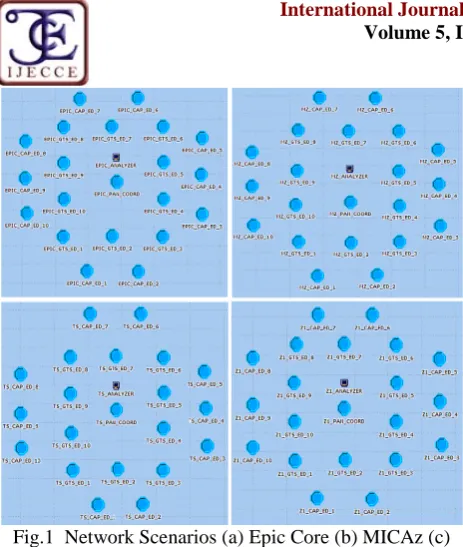
ESCRIPTIONOPNET® Modeler has been used for developing four variants of 802.15.4 i.e. Epic Core, MICAz, Telos and Z1. Each variant (scenario) contains ten GTS enabled nodes and ten non-GTS nodes. GTS nodes can handle only the acknowledged GTS traffic while the non-GTS nodes can handle unacknowledged non-GTS traffic. All four scenarios are same in each and every respect except for the battery parameters like: current draw, initial energy and power supply.
A. Scenarios
Fig. 1(a) shows the Epic Core scenario which contains one PAN Coordinator, one Analyzer and twenty end devices (ten GTS enabled and ten non-GTS enabled), similarly Fig. 1(b) shows MICAz scenario, Fig. 1(c) shows Telos scenario and Fig. 1(d) shows the Z1 scenario. PAN Coordinator is a Fully Functional Device (FFD) that can support three operation modes, serving as:
Fig.1 Network Scenarios (a) Epic Core (b) MICAz (c) .Telos (d) Z1
A Coordinator: provides synchronization services through the transmission of beacons. Such a coordinator must be associated to a PAN coordinator and does not create its own network.
A simple Device: a device which does not implement the previous functionalities.
End device is a Reduced Functional Device (RFD) operating with minimal implementation of IEEE 802.15.4 protocol. They do not need to send large amounts of data and associate with a single FFD at a time.
B. Battery Process Model
Fig. 2 explains the process model for the 802.15.4 battery and it consists of init and dissipation states. The state ‘init’ initializes the node ID and the parameters like: power supply, initial energy, receive mode, transmission mode, idle mode and sleep mode. The ‘dissipation’ state gets the information associated with the remote interrupt, computes packet size, energy consumed when transmitting/receiving a packet, computes the time spent and energy consumed by the node in idle state and finally updates the current energy level in transmit, receive, sleep and active periods.
Fig. 2: Battery Process Model
Above mentioned init and dissipation states of battery have been coded as follows:
/* init state */
static void wpan_battery_init() {
Objid current_draw_comp_id;
Objid current_draw_id; FIN(wpan_battery_init); battery.own_id = op_id_self ();
battery.parent_id = op_topo_parent (battery.own_id); op_ima_obj_attr_get (battery.parent_id, "Device Mode", &battery.Device_Mode);
op_ima_obj_attr_get (battery.own_id, "Power Supply", &battery.power_supply);
op_ima_obj_attr_get (battery.own_id, "Initial Energy", &battery.initial_energy);
op_ima_obj_attr_get (battery.own_id, "Current Draw", ¤t_draw_id);
current_draw_comp_id = op_topo_child (current_draw_id, OPC_OBJTYPE_GENERIC, 0);
op_ima_obj_attr_get (current_draw_comp_id, "Receive Mode", &battery.current_rx_mA);
op_ima_obj_attr_get (current_draw_comp_id, "Transmission Mode", &battery.current_tx_mA); op_ima_obj_attr_get (current_draw_comp_id, "Idle Mode", &battery.current_idle_microA);
op_ima_obj_attr_get (current_draw_comp_id, "Sleep Mode", &battery.current_sleep_microA);
battery.current_energy = battery.initial_energy; statistics.remaining_energy =
op_stat_reg("Battery.Remaining Energy (Joule)", OPC_STAT_INDEX_NONE, OPC_STAT_LOCAL); statistics.consumed_energy = op_stat_reg
("Battery.Consumed Energy (Joule)",
OPC_STAT_INDEX_NONE, OPC_STAT_LOCAL); statisticsG.consumed_energy = op_stat_reg
("Battery.Consumed Energy (Joule)",
OPC_STAT_INDEX_NONE, OPC_STAT_GLOBAL); op_stat_write(statistics.remaining_energy,battery.current_ energy);
op_stat_write(statistics.consumed_energy,0.0); op_stat_write(statisticsG.consumed_energy,0.0); activity.is_idle = OPC_TRUE;
activity.is_sleep = OPC_FALSE; activity.last_idle_time = 0.0; activity.sleeping_time = 0.0; FOUT;
}
/* dissipation state */
static void wpan_battery_update() {
Ici * iciptr; double tx_time; double rx_time; double pksize;
double wpan_data_rate; double consumed_energy; double idle_duration; double sleep_duration; FIN(wpan_battery_update);
if (op_intrpt_type() == OPC_INTRPT_REMOTE) { switch (op_intrpt_code()) {
iciptr = op_intrpt_ici();
op_ici_attr_get(iciptr, "Packet Size", &pksize);
op_ici_attr_get(iciptr, "WPAN DATA RATE", &wpan_data_rate);
op_ici_destroy(iciptr);
tx_time = pksize/wpan_data_rate;
consumed_energy= (battery.current_tx_mA * milli) * tx_time * battery.power_supply;
idle_duration = op_sim_time()-activity.last_idle_time;
consumed_energy= consumed_energy +
(battery.current_idle_microA * micro) * idle_duration * battery.power_supply;
battery.current_energy = battery.current_energy -consumed_energy;
activity.last_idle_time = op_sim_time()+tx_time;
op_stat_write(statistics.remaining_energy,battery.current_ energy);
op_stat_write(statistics.consumed_energy,battery.initial_e nergy - battery.current_energy);
op_stat_write(statisticsG.consumed_energy,consumed_en ergy);
break; }
case PACKET_RX_CODE : {
iciptr=op_intrpt_ici();
op_ici_attr_get(iciptr, "Packet Size",&pksize);
op_ici_attr_get(iciptr, "WPAN DATA RATE", &wpan_data_rate);
op_ici_destroy(iciptr);
rx_time = pksize/wpan_data_rate;
consumed_energy= (battery.current_rx_mA * milli) * rx_time * battery.power_supply;
idle_duration = op_sim_time()-activity.last_idle_time;
consumed_energy= consumed_energy +
(battery.current_idle_microA * micro) * idle_duration * battery.power_supply;
battery.current_energy = battery.current_energy -consumed_energy;
activity.last_idle_time = op_sim_time(); op_stat_write(statistics.remaining_energy, battery.current_energy);
op_stat_write(statistics.consumed_energy, battery.initial_energy - battery.current_energy); op_stat_write(statisticsG.consumed_energy, consumed_energy);
break; }
case END_OF_SLEEP_PERIOD :
{
sleep_duration = op_sim_time()-activity.sleeping_time; consumed_energy= (battery.current_sleep_microA * micro) * sleep_duration * battery.power_supply;
printf ("END_OF_SLEEP_PERIOD:
current_sleep_microA = %f, time in the sleep period = %f , consumed_energy = %f mJoule\n", battery.current_sleep_microA, sleep_duration, consumed_energy*1000);
battery.current_energy = battery.current_energy -consumed_energy;
op_stat_write(statistics.remaining_energy, battery.current_energy);
op_stat_write(statistics.consumed_energy, battery.initial_energy-battery.current_energy); op_stat_write(statisticsG.consumed_energy, consumed_energy);
activity.last_idle_time = op_sim_time(); activity.is_idle = OPC_TRUE;
activity.is_sleep = OPC_FALSE; break;
}
case END_OF_ACTIVE_PERIOD_CODE : {
idle_duration = op_sim_time()-activity.last_idle_time; consumed_energy= (battery.current_idle_microA * micro) * idle_duration * battery.power_supply;
battery.current_energy = battery.current_energy -consumed_energy;
op_stat_write(statistics.remaining_energy,battery.current_ energy);
op_stat_write(statistics.consumed_energy,battery.initial_ energy-battery.current_energy);
op_stat_write(statisticsG.consumed_energy,consumed_ energy);
activity.sleeping_time = op_sim_time(); activity.is_idle = OPC_FALSE; activity.is_sleep = OPC_TRUE; break; } default : {}; } } FOUT; }
C. Parametric Description
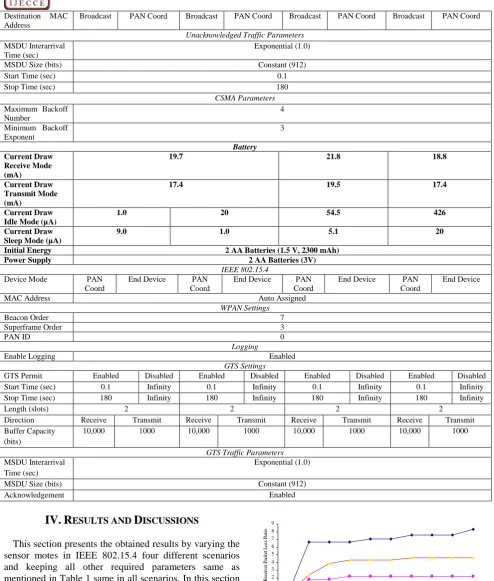
Parametric values for the different types of devices in all scenarios are same except for the battery parameters (as shown in the Table 1). E.g. parametric values of the PAN Coordinator acknowledged traffic like: MSDU Interarrival time, MSDU size, start time, stop time etc. are same in all four scenarios and the battery parameters like: current draw in ‘Idle mode’ (1.0, 20, 545 and 426) µA, is different for each scenario.
Table 1: Parametric values of PAN Coordinator, GTS and CAP devices in different scenarios.
Scenario Epic Core Micaz Telos Z1
Device Type / Parameter
PAN Coord
GTS CAP PAN
Coord
GTS CAP PAN
Coord
GTS CAP PAN
Coord
GTS CAP
Acknowledged Traffic Parameters MSDU Interarrival
Time (sec)
Exponential (1.0)
MSDU Size (bits) Constant (912)
Start Time (sec) 0.1
Destination MAC Address
Broadcast PAN Coord Broadcast PAN Coord Broadcast PAN Coord Broadcast PAN Coord
Unacknowledged Traffic Parameters MSDU Interarrival
Time (sec)
Exponential (1.0)
MSDU Size (bits) Constant (912)
Start Time (sec) 0.1
Stop Time (sec) 180
CSMA Parameters Maximum Backoff
Number
4
Minimum Backoff Exponent
3
Battery
Current Draw Receive Mode (mA)
19.7 21.8 18.8
Current Draw Transmit Mode (mA)
17.4 19.5 17.4
Current Draw Idle Mode (µA)
1.0 20 54.5 426
Current Draw Sleep Mode (µA)
9.0 1.0 5.1 20
Initial Energy 2 AA Batteries (1.5 V, 2300 mAh)
Power Supply 2 AA Batteries (3V)
IEEE 802.15.4
Device Mode PAN
Coord
End Device PAN
Coord
End Device PAN
Coord
End Device PAN
Coord
End Device
MAC Address Auto Assigned
WPAN Settings
Beacon Order 7
Superframe Order 3
PAN ID 0
Logging
Enable Logging Enabled
GTS Settings
GTS Permit Enabled Disabled Enabled Disabled Enabled Disabled Enabled Disabled
Start Time (sec) 0.1 Infinity 0.1 Infinity 0.1 Infinity 0.1 Infinity
Stop Time (sec) 180 Infinity 180 Infinity 180 Infinity 180 Infinity
Length (slots) 2 2 2 2
Direction Receive Transmit Receive Transmit Receive Transmit Receive Transmit
Buffer Capacity (bits)
10,000 1000 10,000 1000 10,000 1000 10,000 1000
GTS Traffic Parameters MSDU Interarrival
Time (sec)
Exponential (1.0)
MSDU Size (bits) Constant (912)
Acknowledgement Enabled
IV. R
ESULTS ANDD
ISCUSSIONSThis section presents the obtained results by varying the sensor motes in IEEE 802.15.4 four different scenarios and keeping all other required parameters same as mentioned in Table 1 same in all scenarios. In this section the results for Fully Functional Device (FFD) PAN Coordinator and Reduced Functional Devices (RFD) GTS and CAP are presented.
A. Radio Receiver Packet Loss Ratio at Fully
Functional Device (PAN Coordinator)
Fig. 3 below indicates that the packet loss ratio at the radio receiver of the PAN Coordinator is: 8.317857, 4.620984, 2.220238, and 0 for Epic Core, Telos, MICAz and Z1 motes respectively.
0 1 2 3 4 5 6 7 8 9
0 33 66 99 132 165 198 231 264 300 Time (sec)
R
ad
io
R
ec
ei
v
er
P
ac
k
et
L
o
ss
R
at
io
EPIC CORE MICAZ TELOS Z1
Fig.3. Radio Receiver Packet Loss Ratio at PAN Coordinator
/* Idle Mode*/
consumed_energy= (battery.current_idle_microA * micro) * idle_duration * battery.power_supply;
consumed energy α battery.current_idle_microA (1) where
battery.current_idle_microA is the current consumed by battery in idle mode (µ A).
Z1 mote has maximum current consumption in idle mode (Table 1) and it will consume maximum current while shifting from idle to transmit/receive mode (1) as a result of which its power level increases which in turn increases the power/bit as a result of which its BER decreases as:
BERα 1 / power level. (2)
and
Packet Loss Ratio (PLR) α BER (3)
Therefore PLR is minimum in case of Z1 mote as compared to other motes. Also it has been observed that PLR is maximum in case of Epic Core mote as BER is maximum in case of Epic Core mote (2, 3, Table 1).
B. Radio Receiver Packet Loss Ratio at Reduced
Functional Device (GTS End Device)
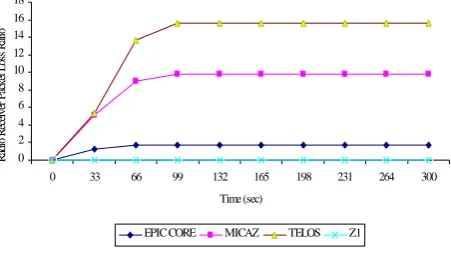
Fig. 4 indicates that the PLR at the radio receiver of GTS end device is: 15.62212, 9.796569, 1.732143 and 0 for Telos, MICAz, Epic Core and Z1 motes respectively.
0 2 4 6 8 10 12 14 16 18
0 33 66 99 132 165 198 231 264 300
Time (sec)
R
ad
io
R
ec
ei
ve
r
P
ac
ke
t L
os
s
R
at
io
EPIC CORE MICAZ TELOS Z1
Fig.4. Radio Receiver Packet Loss Ratio at CAP end device
It is observed that PLR is minimum in case of Z1 mote as compared to other motes because BER is minimum in Z1 mote (4.1), therefore PLR is also minimum (3) in Z1 mote at the GTS end device. Also it has been observed that PLR is maximum in case of Telos mote as BER is maximum because GTS end device reserves the bandwidth in advance to provide guarantee of service to a particular application, therefore long queues are formed at the GTS end device as the channel is occupied and also because of higher current consumption in transmit/receive mode as compared to other motes (Table 1) which increases the power/bit [27], data rate is more thus forming longer queues at the transmitter/receiver because of which BER increases in case of Telos mote., therefore PLR is also maximum (3).
C. Radio Receiver Packet Loss Ratio at Reduced Functional Device (CAP End Device)
Fig. 5 below indicates that Packet Loss Ratio at the radio receiver of CAP end device is: 9.537338, 2.101992,
0 and 0 for the Epic Core, MICAz, Telos and Z1 motes respectively.
0 2 4 6 8 10 12
0 33 66 99 132 165 198 231 264 300 Time (sec)
R
ad
io
R
ec
ei
v
er
P
ac
k
et
L
o
ss
R
at
io
EPIC CORE MICAZ TELOS Z1
Fig.5.Radio Receiver Packet Loss Ratio at CAP End Device
It is observed that PLR is minimum in case of Z1 mote as the BER is minimum (4.1), also PLR in case of Telos mote is equivalent to the Z1 mote as its (Telos) BER is also quite less (4.1), since BER is minimum PLR is also minimum (3) . It has also been observed that PLR maximum in case of Epic Core as BER in maximum (4.1), so is the PLR (3).
V. C
ONCLUSIONThis paper provides the simulative characterization of PLR at different types of devices in IEEE 802.15.4 WSNs. It has been observed that at the FFD: the PLR in case of Z1 mote is 0 (minimum) while in case of Epic Core mote is 8.317857 (maximum); thereby concluding that at the FFD if PLR is to be focused upon for improving the performance then Z1 mote must be preferred. Again, it has been observed that that at the RFD (GTS End Device) PLR is 0 (minimum) in case of Z1 mote while it is 15.62212 (maximum) in case of Telos, proving that at the RFD (GTS End Device) also the Z1 mote should be preferred. Finally, it has been observed that at the RFD (CAP End Device) PLR is minimum in case of Z1 and Telos motes (0 in both the cases) while it is 9.537338 (maximum) in case of Epic Core, concluding that at the RFD (CAP End Device) Z1 or Telos mote can be implemented if PLR is to be focused upon for the performance improvement. Overall, it can be concluded that if the PLR is to be minimized then Z1 mote must be implemented in IEEE 802.15.4 WSNs.
R
EFERENCES[1] P. Jurcik, A. Koubaa, M. Alves, E. Tovar, Z. Hanzalek, “A
Simulation Model for the IEEE 802.15.4 Protocol:
Delay/Throughput Evaluation of the GTS Mechanism”,
MASCOTS 2007, 15thInternational Symposium, 24–26 Oct.
2007.
[2] E. Casilari, J. M. Cano-Garcia, G. Campos-Garrido, “Modeling of Current Consumption in 802.15.4/Zigbee Sensor Motes”,
Sensors (ISSN 1424 - 8220), www.mdpi.com/journal/sensors, Basel, Switzerland, June2010.
[3] O. Landsiedel, K. Wehrle, S. Gotz, “Accurate Prediction of
Power Consumption in Sensor Networks”, Second IEEE
[4] E. Casilari, G. Campos-Garrido, J.M. Cano-Garcia,
“Characterization of Battery Consumption in 802.15.4/ZigBee
Sensor Motes”, IEEE, 2010.
[5] F. Despaux, Y. Song, A. Lahmadi, “Measurement based
Analysis of the effect of duty cycle in IEEE 802.15.4 MAC
performance”, IEEE International Conference on mobile Ad-hoc and Sensor Systems, 2013.
[6] C. Buratti, R. Verdone, “A Mathematical Model for Performance Analysis of IEEE 802.15.4 Non-beacon Enabled Mode”, 14th
European Wireless Conference (EW 2008), Prague, Czech Republic, 2008.
[7] Z. Chen, C. Lin, H. Wen, H. Yin, “An Analytical Model for
Evaluating IEEE 802.15.4 CSMA/CA Protocol for Low-Rate
Wireless Application”, 21st International Conference on
Advanced Information Networking and Applications Workshops
(AINAW ‘07), Niagara Falls, Canada, 2007.
[8] A. R. Pinto, C. Montez, “Decentralized Power Aware Approach
for Data Fusion in IEEE802.15.4 Wireless Sensor Networks”,
Second Brazalian Conference on Critical Embedded Systems, IEEE, 2012.
[9] R. K. Panta, J. A. Pelletier, G. Vesonder, “Efficient Asychronous Low Power Listening for Wireless Sensor Networks”, IEEE
International Symposium on Reliable Distributed Systems, 2012. [10] B. Bougard, F. Catthoor, D. C. Daly, A. Chandrakasan, W.
Dehaene, “Energy Efficiency of the IEEE 802.15.4 Standard in
Dense Wireless Microsensor Networks: Modelling and
Improvement Perspectives”, Design, Automation and Test in
Europe (DATE ‘05), Munich, Germany, 2005.
[11] Y. Zhang, P. Xu, G. Bi, F. S. Bao, “Analysis of Energy Efficiency and Power Saving in IEEE 802.15.4”, Wireless
Communications and Networking Conference (WCNC 2007), Hong Kong, China, March 2007.
[12] J. M. Cano-Garcia, E. Casilari, “An Empirical Evaluation of the
Consumption of 802.15.4/ZigBee Sensor Motes in Noisy
Environments”, International Conference on Networking,
Sensing and Control; Delft, Netherlands, 2011.
[13] F. Zhang, H. Zhou, X. Zhou, “A Routing Algorithmfor Zigbee Network Based on Dynamic Energy Consumption Decisive
Path”, International Conference on Computational Intelligence and Natural Computing (CINC ‘09), Wuhan, China, June 2009.
[14] J. Misic, “Traffic and Energy Consumption of an IEEE 802.15.4
Network in the Presence of Authenticated, ECC Diffie-Hellman
Ephemeral Key Exchange”, Computer Networks, 2008.
[15] D. Rohm, M. Goyal, H. Hosseini, A. Divjak, Y. Bahsir, “A
Simulation Based Analysis of the Impact of IEEE 802.15.4 MAC Parameters on the Performance under Different Traffic
Loads”, Mob. Info. Syst, 2009.
[16] W. Du, F. Mieyeville, D. Navarro, “Modeling of Energy Consumption of Wireless sensor Networks by System C”,
International Conference on Systems and Networks Communications, IEEE, 2010.
[17] A Koubaa, M. Alves, E.Tovar, “A Comprehensive Simulation
Study of Slotted CSMA/CA for IEEE 802.15.4 Wireless Sensor
Networks”, International Workshop on Factory Communication Systems (WFCS ‘06), IEEE, 2006.
[18] A Koubaa, M. Alves, E. Tovar, “IEEE 802.15.4: A Federating
Communication Protocol for Time-Sensitive Wireless Sensor
Networks”, TR –060202, www.hurray.isep.ipp.pt, Feb. 2006. [19] Z. Hanzalek, P. Jurcik, “Energy Efficient Scheduling for Cluster
-Tree Wireless Sensor Networks with Time-Bound Data Flows: Application to IEEE 802.15.4/Zigbee”, HURRAY – TR –
100501, www.hurray.isep.ipp.pt, May 2010.
[20] A Koubaa, M. Alves, E. Tovar, “Energy/Delay Trade-off of the GTS Allocation Mechanism in IEEE 802.15.4 for Wireless
Sensor Networks”, TR –061002, www.hurray.isep.ipp.pt, Oct. 2006.
[21] A Koubaa, M. Alves, “A Two –Tired Architecture for Real–
Time Communications in Large – Scale Wireless Sensor
Networks: Research Challenges”, TR –050701, July, 2005. [22] K. Witheephanich, J.M. Escano, M.J. Hayes, “Explicitly
Constrained Generalised Predictive Control Strategies for Power
Management in Ambulatory Wireless Sensor Network Systems”,
American Control Conference, USA, 2010.
[23] MICAz Datasheet, [Online] Available: www.memsic.com. [24] Epic Core Datasheet, [Online] Available: www.moteware.com.
[25] Z1 Datasheet, [Online] Available: www.zolertia.com.
[26] Crossbow Technology, [Online] Available:
http://www.xbow.com.
[27] S S Bamber and A K Sharma, “ Impact of Current Consumption
on Battery Energy in IEEE 802.15.4 for Wireless Sensor
Networks with different Sensor Motes”, Vol: 3(4), IJARCSSE, 2014, pp. 1-8.