© 2015 TALLA Emmanuel et al. This is an open access article distributed under the terms of the Creative Commons Attribution License -NonCommercial-ShareAlikeUnported License (http://creativecommons.org/licenses/by-nc-sa/3.0/).
Journal of Applied Pharmaceutical Science Vol. 5 (10), pp. 001-005, October, 2015 Available online at http://www.japsonline.com
DOI: 10.7324/JAPS.2015.501001 ISSN 2231-3354
Anti-convulsivant and sedative like-effect of Abyssinone V-4’ methyl
ether Isolated from
Erythrina droogmansiana
(Leguminosae)
TALLA Emmanuel
1*, NGATCHA Sidoine
2, NJAPDOUNKE Jacqueline
2, NKANTCHOUA Gisèle
2, YAYA Gbaweng
Abel Joël
3, NGO BUM Elisabeth
2, MBAFOR TANYI Joseph
4, NJINTANG YANOU Nicolas
21
Department of chemistry, Faculty of Sciences, University of Ngaoundere, POBOX 454, Ngaoundere, Cameroon . 2Département of biological Sciences,
Faculty of Sciences, University of Ngaoundere, POBOX 454, Ngaoundere, Cameroon. 3 Institute of Medical Research and Medicinal plants Studies
(IMPM), POBOX 6163, Yaounde, Cameroon. 4Department of Organic Chemistry, University of Yaounde 1, POBOX 812, Yaounde, Cameroon .
ARTICLE INFO ABSTRACT
Article history: Received on: 16/06/2015 Revised on: 03/07/2015 Accepted on: 02/08/2015
Available online: 28/10/2015
Erythrina droogmansiana is used in traditional medicine in Cameroon to treat epilepsy, insomnia and headaches. From this plant, many secondary metabolites are extracted including alcaloids, tannins, flavonoids, etc. Amongst the flavonoid, abyssinone V-4’ methyl ether is used in this manipulation. Animal models of epilepsy: pentylenetetrazol (PTZ), picrotoxine (PIC) and pilocarpine (PILO)-induced convulsions or turning behavior were used to evaluate anticonvulsant activity while diazepam-induced sleep test was used to evaluate sedative activity of the extract. Four doses of extracts were used for each group test (12.5, 25, 50 and 100 mg/kg). Abyss inone V-4' methyl ether protected 100% of mice against the convulsions induced by the pentylenetetrazole at the dose of 100 mg/kg. Abyssinone V-4’ methyl ether protected 100% of mice at the doses of 25 and 100 mg/kg and 80% at the doses of 12.5 and 50 mg/kg against generalized convulsions induced by picrotoxine. This flavonoid protected 100% of mice at the doses 25 and 50 mg/kg and 80% at the doses of 12.5 mg/kg against generalized convulsions induced by pilocarpine. Moreover, for the test of induction of convulsions by pilocarpine, Abyssinone V-4’ methyl ether protected 100% of mice at doses of 25 and 50 mg/kg and 71.43% at the doses of 12.5 and 100 mg/kg against death after 1h and 24h respectively. Abyssinone V-4’ methyl ether has anticonvulsivant properties and not sedative properties. These results explain the use of Erythrina droogmansiana to treat epilepsy.
Abbreviations: PTZ: Pentylenetetrazol, PIC: Picrotoxin, PILO: Pilocarpine, ED: Distilled water, Ip: Intraperitoneal.
Key words: Epilepsy, Insomnia, Traditional medicine, pilocarpine, abyssinone V-4’ methyl ether.
INTRODUCTION
Epilepsy is a disease that affects about 40 millions people worldwide (Njamshi et al., 2010). In 1968, the prevalence of epilepsy in Africa was about 4.8 to 40 ‰. In 1996, Diop and collaborators reported in Senegal a prevalence of epilepsy of 21 ‰ (Diop et al., 1996). In 2006, Ngounou and collaborators estimated the prevalence in sub-Saharian Africa to be two or three times higher than the rate in developed world (Ngounou et al., 2007). In Cameroon, some epidemiological studies on epilepsy have shown that the prevalence of epilepsy is estimated to vary from 5-136/1000. Thus, epilepsy is one of the major public health problems in Cameroon. In Africa and in Cameroon particularly, phytotherapy in traditional medicine still plays an important role in the management of diseases, mostly amongst
.
* Corresponding Author E-mail: [email protected]
populations with very low income (Geoffrey and Kirby, 1996). Phytotherapy relies on the use of a wide variety of plant species
including Erythrina droogmansiana. Abyssinone V-4’ methyl
ether is a prenylated flavonoid isolated from plant Erythrina
droogmansiana. 50 flavonoids have been obtained during the last
three decades from about 15 species of Erythrina genus (Kamat et al., 1981; Njamen et al., 2003; Kebenei et al., 2011; Mvondo et al., 2012), with prenylated flavonone, isoflavones and pterocarpans being the major non alkaloid secondary metabolites isolates so far (Mvondo et al., 2012; Wandji et al., 1994). Among these metabolites, there are abyssinones which are prenylated flavonoids isolated from Erythrina abyssinica (Kebenei et al., 2011).
These molecules have gained attention since abyssinone II was reported to show aromatase inhibitory activity (Maiti et al., 2007). The antioxidant and cytotoxic activities of abyssinone I, abyssinone II and related compounds have been reported (Rao GV
The anti-inflammatory and antioxidant activities of prenylflavanones isolated from Erythrina sigmoidea have been reported (Njamen et al., 2004). Some abyssionones especially abyssinone V have recently been reported to inhibit the activity of the protein tyrosine phosphatase-1B (PTP 1B), which is directly linked to type-2 diabetes and obesity therapy (Na MK et al., 2006; Kone et al., 2011) and to exhibit estrogenic properties (Mvondo et al., 2012). The anticonvulsivant and sedative property of abyssinone V-4- methyl ether has not yet been evaluated. Therefore, the present study was undertaken to investigate the anticonvulsivant and sedative effect of abyssinone V-4- methyl
ether, a prenylated flavonoid isolated from Erythrina
droogmansiana.
MATERIALS AND METHODS
Plant material
The root bark of E. droogmansiana T. Durand was collected from Nkomekoui, Yaounde-Cameroon in August 2010. Identification and authentication of the plant material was done at the National Herbarium Yaoundé, Cameroon, where a voucher specimen N°4261/SRFK has been deposited.
Extraction and isolation of the compound
Air-dried and pulverized root bark of E. droogmansiana (1.2 Kg) was extracted successively with ethyl acetate and methanol. The extract was filtered and the solvent evaporated under reduced pressure, 150 g of residue was obtained. This extract was subjected to chromatography over silica gel packed in n-hexane. Gradient elution was done using n-hexane, ethyl acetate and methanol in increasing polarity to give 7 series of fractions mixed on the basis of TLC. Repeated column chromatography with hexane-EtAOc (90:10) yielded YG4 and other compounds. The structures have been elucidated using spectral methods (MS, NMR, and element analysis).
O
O
CH3
C H3
CH3
CH3 OMe
O H
OH
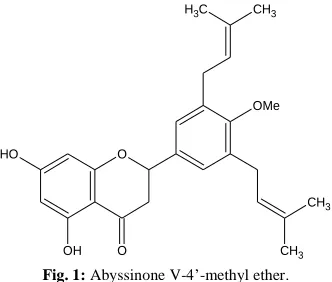
Fig. 1: Abyssinone V-4’-methyl ether.
The compound YD4 was obtained as a white powder (500 mg) and showed a [M]+at m/z 422.2094 corresponding to molecular formula (C26H30O5). This compound was identified
as abyssinone V-4’-methyl ether (Figure 1). The presence of a flavonone skeleton was evident from the 1HNMR spectra at 5.33 (1H, dd) and 2.76 (1H, 2q) corresponding to the H-2 and to
the H-3 proton of the C-ring of flavonones respectively. From the 13CNMR spectra, the presence of signal at 79.3 and 42.5 respectively indicated the C-2 and C-3 of the C-ring of flavonone. The 1H and 13CNMR spectra data of this compound were compared to those previously published (Yenesew et al., 1998). Other compounds obtained were droogmascarpine, phaseollidin, stigmasterol and β-sitosterol.cc All extract were prepared according to traditional healers and chemists, and were administered 1 hour before the tests at the following doses 12.5, 25, 50 and 100 mg/kg.
Animals and drug administration
Adult male mice: Musmusculus Swiss 22 ± 3 g, 2 months old and obtained from the animal laboratory of our University were used for this study. Abyssinone V-4'-methyl ether and distilled water were given orally to experimental animals after suspending in a mixture of distilled water and 0.5% dimethylsulfoxide (DMSO). The positive control groups received the same experimental handling as those of the test groups.
Pharmacological tests
Diazepam-induced sleep test
Mice were divided into five groups of 5 mice and received different treatments. Group I (negative control) was treated with distilled water. Groups II to V (test groups) were treated with 4 doses of Abyssinone. The sleep potentiating effects of the plant extracts were studied in mice that had received diazepam (ip) at a dose of 50 mg/kg 1 hour after treatment. The time taken from the loss of the straightening reflex to its regain gave the sleeping time (Ngo Bum et al., 2009a,b; Rakotonirina et al., 2001).
Pentylenetetrazol (PTZ) test
Mice were divided into six groups of 5 mice each and received different treatments. Group I (negative control) was treated with distilled water. Groups II to V (test groups) were treated with 4 doses of the abyssinone. Group VI clonazepam, 0.1 mg/kg ip, was used as positive control. Clonic seizures were induced in mice by the ip injection of 70 mg/kg PTZ. The protective effect of the different treatments given 1 h before PTZ injection was recorded. Animals that did not convulse within the 10 min of observation were qualified protected (Ngo Bum et al., 2010; Ngo Bum et al., 2001; Wamil et al., 1994.).
Picrotoxine (PIC) test
Pilocarpine (PILO) test
Mice were divided into six groups of 7 mice each and received different treatments. Group I (negative control) was treated with distilled water. Groups II to V (test groups) were treated with 4 doses of the abyssinone. Group VI Diazepam, 0.3 mg/kg ip, was used as positive control. Generalized convulsions were induced in mice by the ip injection of 375 mg/kg PILO. The scopolamine administered ip (1 mg/kg) 15 min after different treatments and 45 min before PILO injection was recorded. Animals that did not convulse and did not die within the following one to 24hours of observation were qualified protected (Ethel et al 2010; Henrik et al., 2003).
Chemicals
Clonazepam (Rivotril®, was from Roche Pharma,
ReinachSchweiz); Diazépam: (Valium®, was from Roche, Neuilly, France); scopolamine: (hyosinebutylbromude); pentylenetetrazol, picrotoxine: (Sigma Aldrich Inc., St Louis, MO, USA) and pilocarpine (isotopilocarpine).
Statistical analysis
Three parameters were measured: the protection against convulsion induced by PTZ, PIC and PILO, the latency and the sleeping time. The percentages of protected animals were analyzed using the Fisher Exact Test (two-tail). The Fischer Exact test was used to compare the percentage of protected mice. Data were p < 0.05 were qualified significant. The ED50 were determined with Statgraphics Plus (confident limits at 95%).
RESULTS
Effect of Abyssinone on diazepam-induced sleep in mice. Abyssinone V-4’ methyl ether protected mice for convulsions induced by chemically substances. In diazepam-induced sleep test, the abyssinone not increased sleeping time of the control group (fig.2).
Fig. 2: Effect of Abyssinone on diazepam-induced on sleep time in mice.
Effect of Abyssinone V-4’ methyl ether PTZ-induced convulsions in mice
Abyssinone at the dose of 100 mg/kg protected 100% of mice against PTZ-induced seizures (p < 0.001) (Fig.3).
Figure 3: Effect of abyssinone V-4’ methyl ether PTZ-induced on convulsions in mice.
Effect of Abyssinone V-4’ methyl etherPIC-induced convulsions in mice.
The doses of 25 and 100 mg/kg provided all protection against PIC-induced seizures (p < 0.001) and at a doses 12.5 and 50 mg/kg the extract protected 80% of mice (p < 0.001) (fig.4)
Fig. 4: Effect of abyssinone V-4’ methyl ether PIC-induced on convulsions in mice.
Effect of abyssinone V-4’ methyl etherPILO-induced convulsions in mice.
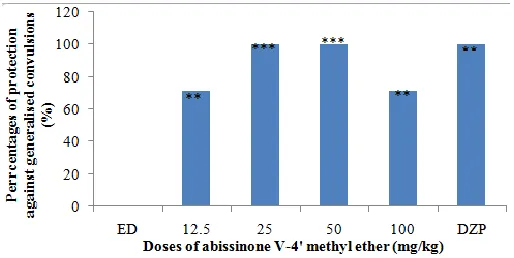
At doses of 25 and 50 mg/kg, Abyssinone completely protected mice against PILO-induced convulsions (p < 0.001) and (p < 0.01) at doses of 12.5 and 100 mg/kg, (Fig.5).
Fig. 5: Effect of abyssinone V-4’ methyl ether PILO-induced on convulsions in mice.
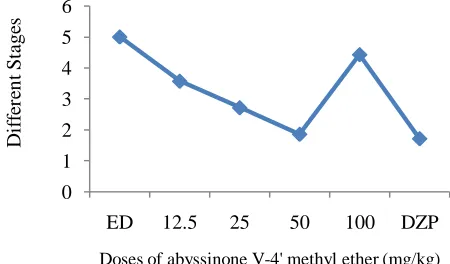
Figure 6 presents the different stages reached by mice after administration of the pilocarpine. At doses of 25 and 50
0 20 40 60 80 100 120 140
ED 12.5 25 50 100
S
le
ep
in
g
ti
m
e
(m
in
u
te
s)
Doses of abyssinone V'-4 methyl ether (mg/kg)
0 20 40 60 80 100 120
ED 12.5 25 50 100 Clonaz
Pr
o
te
c
tio
n
Pe
r
c
e
n
ta
g
e
s
(%
)
Doses of abyssinone V-4’ methyl ether (mg/kg)
*
*
**
mg/kg, Abyssinone protected the mice (p < 0.001) from dead one hour after the administration of PILO and protected the mice (p < 0.001) 24hours after the administering the dose 50 mg/kg of Abyssinone, that which is more that the anticonvulsant reference drug.(fig.7).
Fig. 6: Effect of abyssinone V-4’ methyl ether PILO- induced on the different stages in mice.
Fig. 7: Effect of abyssinone V-4’ methyl ether PILO- induced on the death of mice.
DISCUSSION
Abyssinone did not potentialise the sleep time. The sedative properties are absent in this extracts (Ngo Bum et al., 2009a; 2009b; Rakotonirina et al., 2001). This result could be related to the absence of some components in the extracts activating the benzodiazepine, barbiturate and/or GABA receptors in the GABAA receptor complex (Bonin and Orser, 2008; Olkkola
and Ahonen, 2008; Rang et al., 1999). While sodium thiopental that act on the barbiturate binding site directly gate the chloride ion channel of the GABAA receptor complex.
Abyssinone presents anticonvulsivant properties. This extract antagonizes the PTZ, PIC-and PILO-induced seizures, this suggests the interaction of these extract with the GABA-ergic neurotransmission (Salihand Mustafa, 2008; Perez-Saad and Buznego, 2008). GABA is the main inhibitory neurotransmitter substance in the brain and is widely implicated in epilepsy. Inhibition of GABA-ergic neurotransmission or activity has been shown to promote and facilitate seizures, while enhancement of GABA-ergic neurotransmission is known to inhibit or attenuate seizures (Li-Ping et al., 2008). Moreover, some studies showed
that PTZ diminishes the GABA-ergic tone (Ahmadiani, 2003), probably by a competitive antagonist action on the BZD receptors (Rehavi et al., 1982). Drugs that enhance GABAA-receptor
neurotransmission, such as BZDs (Ahmadiani et al., 2003; White, 1997) can block seizures induced by PTZ.
PIC is known to be a non competitive GABA antagonist exerting his effect by blocking the chloride channel in the GABAA
receptor complex. Isoniazide can enhance convulsions in patients with seizure disorders, and it is regarded as a GABA-synthesis inhibitor (Kale Shubhangi et al., 2010).
The antagonism of PILO -induced convulsions suggests the presence of anticonvulsant effect through in the limbic system, particularly in the hippocampus, entorhinal cortex and amygdala (Bartolomei et al., 2005). The subject of this review, the pilocarpine model, belongs to status Epileticus models. This model appears to be highly isomorphic with the human disease, so it has been used in many laboratories since its first description a quarter of a century ago (Turski et al., 1983a, b).
CONCLUSION
Abyssinone V-4’ methyl ether did not show sedative properties but instead showed very good anticonvulsant activities against PTZ, PIC or PILO- induced seizures. However,
Erythrina, medicinal plants could be used in the treatment of
epilepsy.
ACKNOWLEDGEMENTS
The authors thank the Faculty of Science, University of Ngaoundere, Cameroon, for providing the necessary support for this study.
REFERENCES
Ahmadiani, A.; Mandgory,A. and Sayyah, M.Anticonvulsivant
Effect of Flutamide on seizures induced by pentylenetetrazole, involvement of benzodiazepine receptors. Epilepsia, 2003; 44(5): 625-629. Bernasconi R., Klein M., Martin P., Christen P., Hahner T., Portet C., Schumtz M. Gamma-Vinyl GABA: Comparison of
neurochemical and anticonvulsivant effects in mice. Journal of neural
transmission, 1988; 7: 213-233.
Bartolomei F, Chauvel P, Wendling F. Spatio-temporal
dynamics of neuronal networks in partial epilepsy. Rev Neurol (Paris),
2005; 161: 767-80.
Bonin, R. P. and Orser, B.A. GABAA receptor subtypes
underlying general anesthesia. Pharmacology Biochemistry and behavior, 2008; 90(1): 105-112.
Ethel A., Wilhelm., Cristiano R., Jesse., Silvane S., Cristiani F.,
Bortolatto., Cristina W., Nogueira. Anticonvulsant effect of
(E)-2-benzylidene-4-phenyl-1,3-diselenole in a pilocarpine model in mice. Life
Sciences,2010; 87: 19-22.
Diop AG.,Ndiaye M, Thiam A., et al. Filière des soins
anti-épileptiques en Afrique. Epilepsies, 1996; 10: 115-121.
Geoffrey c andKirby M. Medicinal plants and the control of
protozoa disease with particular reference to malaria. Transaction of the
Royal Society of Tropical Medicine and Hygiène, 1996.
Henrik Klitgaard, Alain Matagne, Renee Grimee, Jocelyne Vanneste-Goemaere, Doru-Georg Margineanuel. Ectrophysiological, neurochemical and regional effects of levetiracetam in the rat pilocarpine
model of temporal lobe epilepsy. The journal of the British Epilepsy
Association,2003; 12(2): 92–100. 0
1 2 3 4 5 6
ED 12.5 25 50 100 DZP
D
if
fe
re
n
t
S
ta
ge
s
Doses of abyssinone V-4' methyl ether (mg/kg)
0 20 40 60 80 100 120
H20 12.5 25 50 100 DZP
P
ro
te
ct
io
n
p
erc
en
ta
g
e
s
(%
)
Doses of abyssinone V-4’ methyl ether (mg/kg) % protection 1h % protection 24h
*
*
*
*
*
*
Kale Shubhangi, S.; SheteRajkumar, V., Korekakasahed, J.;
PatilBhaskar, M., BhutadaRupesh, N., pattankudeVinod. Anticonvulsant
activity of Glycyrrhizic acid in mice. International Journal of
Pharmaceutical researches and development, 2010; l 2(2).
Kamat VS, Chuo FY, Kubo I, Nakanishi K. Anti-microbial
agents from an East-African medicinal plant, Erythrina abyssinica.
Heterocycles,1981; 15: 1163-1170.
Kebenei JS, Ndalut PK, Sabah AO. Synergism of artemisinin
with abyssinone–V from Erythrina abyssinica (Lam. ex) against
Plasmodium falciparum parasites: A potential anti-malarial combination therapy. Journal of Medicinal Plants Research, 2011; 5: 1355-1360.
Kone WM, Solange KN, Dosso M. Assessing sub-saharan
Erythrina for efficacy: traditional uses, biological activities and
phytochemistry. Pak j boil Sci,2011; 14(10): 560-71.
Lehmann J., Hutchison A., MCPherson S.E., Mondadori C., Schmutz M., Sinton C.M., Tsai C., Murphy D.E., Steel D.J., Williams M., Cheney D.L., Wood P.L. CGS 19755, a selective and competitive
N-methyl-D-aspartate excitatory amino acid receptor antagonist, Journal of
Pharmacology and Experimental Therapeutics,1988; 246: 65-75.
Li-Ping, G., Xian-Yu, S.; Guan-Rong, T.; Kyu-Yun, C. and Zheshan, Q.The Synthesis and Anticonvulsant Activity of 1 Substituted
-7- Methoxy -1,2,4- Triazolo [4, 3-a] Quinoline. Turkish Journal of
Chemistry, 2008; 32(2),: 181-189.
Maiti A, Cuendet M, Croy VL, Endringer DC, Pezzuto JM, CushmanM. Synthesis and biological evaluation of (+/-)-abyssinone II and its analogues as aromatase inhibitors for chemoprevention of breast cancer. J Med Chem, 2007; 50(12): 2799-806.
Mvondo MA, Njamen D, Fomum S, Wandji J. Effects of alpinumisoflavone and abyssinone V-4'-methyl ether derived from Erythrina lysistemon (Fabaceae) on the genital tract of ovariectomized
female Wistar rat. Phytotherapy Res,2012; 26(7): 1029-36.
Mustafa AMS, Ali AM. Substance in broad beans (Viciafaba) is protective against experimentally induced mice convulsions in mice. Epilepsy Behavior,2008; 12: 25-9.
Na MK, Jang JP, Njamen D, Mbafor JT, Fomum ZT, Kim BY,
Oh WK, Ahn JS. Protein Tyrosine Phosphate -1B Inhibitory Activity of
Isoprenylated Flavonoids isolated from Erythrina mildbraedii. J Nat Prod, 2006; 69(11): 1572-1576.
Ngounou EB., Quet F, Dubreuil CM, Marin B, Houinato D,
Nubukpo P, Dalmav F, Druet-Cabanac M and Preux PM.Epidémologie de
l’épilepsie en Afrique subsaharienne: une revue de la littérature. Cahiers
d’études et de recherche francophones/Santé,2007; 16(4) : 225-228.
Njamen D, Talla E, Mbafor JT, Fomum ZT, Kamanyi A, Mbanya JC, Cerda-Nicolas M, Giner MR, Recio CM, Rios JL.
Anti-inflammatory activity of erycristagallin, a pterocarpene from Erythrina
midbraedii. Eur J Pharmacol,2003 ; 468: 67-74.
Njamnshi A. K., Bissek A-C., Tabah E.N., Angwarfor S.A., Kuate C.T Déma F., Fonsaf T.Y., Acho A., Kepeden M-N.Z-K., Azinwi Y.H., Kuwoh P.B. Angwafor III F.F., Muna W.F.T. Community survey of Knowledge, perceptions, ad practice with respect to epilepsy among
traditional hearlers in the Batibo Health District, Cameroon. Epilepsy and
behavior, 2010; 17:95-102.
Ngo Bum E., Schmutz M., Meyer C., Rakotonirina A., Bopelet M., Portet C., Jeker A., Rakotonirina S.V., Olpe H.R., Herrling P.
Anticonvulsant properties of methanol extract of Cyperus articulatus
(cyperaceae). Journal of Ethno pharmacology,2001; 87: 27-34.
Ngo Bum E., Sidiki N., Taiwe G., Seke P. F., Maidawa F.,
Rakotonirina S. V., Rakotonnirina A. Sedative and anticonvulsant
properties of the decoction of Balanites aegyptica. Journal of Animal and Veterinary Advances,2005; 4:34-38.
Ngo Bum, E; Taiwe, G.S.; Nkaissa, L.A.; Moto, F.C.O.; Seke, E.P.F.; Hiana, I.R.; Bailabar, T.; Rouyatou; Seyni, P.; Rakotonirina,A and
Rakotonirina, S.V.Validation of anticonvulsivant and sedative activity of
six medicinal plants. Epilepsy and behavior,2009a; 14(3): 454-458.
Ngo Bum, E; Taiwe, G.S.; Moto, F.C.O.; Ngoupaye G.T.; Nkantchoua G. C.N.; Pelanken M.M.; Rakotonirina, S.V and
Rakotonirina, A. Anticonvulsivant, anxiolytic and sedative properties of
the roots of Nauclea latifolia Smith in mice. Epilepsy and behavior,
2009b; 15(4): 434-440.
Ngo Bum, G.N. Nkantchoua, N. Njikam, G.S. Taiwe, G.T. Ngoupaye, M.M.Pelanken, Nanga, F. Maidawa, A. Rakotonirina and S.V.
Rakotonirina. Anticonvulsivant and Sedative Activity of Leaves of Senna
spectabilis in Mice, International Journal of Pharmacology, 2010; 6 (2): 123-128.
Ngo Bum, M.M.Pelanken, N. Njikacvm, E Talla, G.S. Taiwe,
G.C.N. Nkantchoua, G.T. Ngoupaye. The Decoction of Leaves of
Phyllanthus discoideus Possesses anticonvulsant and sedative properties in
Mice. International Journal of Pharmacology,2009; 5(2): 168-172.
Olkkola, K.T. and Ahonen, J. 2008. Midazolam and other
benzodiazepines. Handbook of experimental Pharmacology. Pp. 335-360.
Perez-Saad, H. and M.T. Buznego. Behavioral and
antiepieleptic effects of acute administration of the extract of the plant Cestrium nocturmum Lin (Lady of the night). Epilepsy and behavior, 2008; 12(3): 366-372.
Rakotonirina, S.V; Ngo Bum E.;Rakotonirina, A. and Bopelet,
M. Sedative properties of the extract of the rhizome of Cyperus
articulatus. Fitoterapia, 2001; 72(1): 22-29.
Rang, H.P., Dale, M.M., Ritter, 1999. J.M. Pharmacology.
Churchill Livingstone. New York, USA.
Rao GV, Swamy BN, Chandregowda V, Reddy GC.Synthesis
of (+/-) Abyssinone 1 and related compounds: Their antioxidant and
cytotoxic activities. Eur J Med Chem, 2009;44(5): 2239-45.
Rehavi, M., Skolnick, P., and Paul, S.M. Effects of tetrazole
derivatives on [3H]-diazepam binding in vitro: correlation with convulsant potency. European Journal of Pharmacology, 1982; 78(3): 353-356.
Salih, M.A. and Mustafa, M.M. A substance in broad beans
(Victafaba) is protective against experimentally induced convulsions in mice. Epilepsy and behavior, 2008; 12(1): 25-29.
Turski WA, Cavalhero EA, Schwarz M, Czucwar SJ, Kleinrok Z and Turski L. Limbic seizures produced by pilocarpine in rats:
Behavioural, electroencephagraphic and neuropathological study. Behav
Brain Res,1983a; 9: 315-335.
Turski WA, Czucwar SJ, Cavalhero EA, Schwarz M, Turski L and Kleinrok Z. Acute and long-term effects of systemic pilocarpine en rats: spontaneous recurrent seizures as a possible model of temporal lobe
epilepsy. Naunyn-Schmiedeberg’s Arch Pharmacol,1983b; 324: 25R.
Wandji J, Fomum ZT, Tillequin F, Seguin E, Koch M. Erythrina studies: Part 24. Two isoflavones from Erythrina senegalensis. Phytochemistry,1994; 35: 245-248.
Wamil A.W., Schmutz M., Portet C., Feldman K.F., Michael J. Mcl. Effect of oxcarbamazepine and 10- hydrocarbamazepine on action
potential firing and genaralised seizure. E. J. of Pharmacolgy, 1994;271:
301-308.
White, H.S. 1997.New mechanisms of antiepileptic drugs, In:
Porter R., Chadwick D., (Ed):1-30, Butterworth Heinemann, Boston, USA.
Yenesew A, Midiwo JC, Heydenreich M, Peter MG. Two
prenylated flavonones from stem bark of Erythrina burttii.
Phytochemistry, 1998 ;48: 1439-1443.
How to cite this article:
TALLA Emmanuel, NGATCHA Sidoine, NJAPDOUNKE Jacqueline, NKANTCHOUA Gisèle, YAYA Gbaweng Abel Joël, NGO BUM Elisabeth, MBAFOR TANYI Joseph, NJINTANG YANOU Nicolas. Anticonvulsivant and sedative like-effect of Abyssinone V-4’ methyl
ether Isolated from Erythrina droogmansiana (Leguminosae). J App