
Emilia Mikołajewska
1, Dariusz Mikołajewski
2Neuroprostheses for Increasing Disabled Patients’
Mobility and Control
Neuroprotezy wykorzystywane do zwiększenia możliwości
osób niepełnosprawnych z zakresu mobilności i sterowania
1Rehabilitation Clinic, Military Clinical Hospital No. 10 and Polyclinic, Bydgoszcz, Poland
2Division of Applied Informatics, Department of Physics, Astronomy and Applied Informatics, Nicolaus Copernicus University in Toruń, Poland
Abstract
Neuroprostheses are electronic devices using electrophysiological signals to stimulate muscles, electronic/ mechanical devices such as substitutes for limbs or parts of limbs, or computers. The development of neuropros-theses was possible thanks to advances in understanding of the physiology of the human brain and in the capabili-ties of hardware and software. Recent progress in the area of neuroprosthetics may offer important breakthroughs in therapy and rehabilitation. New dedicated solutions for disabled people can lead to their increased participation in social, educational and professional areas. It is worth focussing particular attention on new solutions for people with paralysis, people with communication disorders and amputees. This article aims at investigating the extent to which the available opportunities are being exploited, including current and potential future applications of brain-computer interfaces (Adv Clin Exp Med 2012, 21, 2, 263–272).
Key words: rehabilitation,neuroprosthesis, brain-computer inteface, disabled people.
Streszczenie
Neuroproteza jest urządzeniem elektronicznym wykorzystującym sygnały elektrofizjologiczne do stymulacji efek-torów, takich jak mięśnie lub urządzenia elektroniczne i/lub mechaniczne, zastępujące kończyny lub ich części oraz sterowania komputerami i ich oprogramowaniem. Rozwój neuroprotez był możliwy dzięki postępowi w zrozu-mieniu neurofizjologii mózgu człowieka oraz zwiększeniu możliwości sprzętu komputerowego i oprogramowania. Postęp w omawianej dziedzinie może ustanowić nowe kamienie milowe w leczeniu i rehabilitacji. Nowe rozwią-zania dedykowane osobom niepełnosprawnym mogą spowodować wzrost ich uczestnictwa w różnych obszarach życia: od społecznego przez edukację aż po obszar zawodowy. Szczególną uwagę warto zwrócić na stworzenie nowych rozwiązań dla pacjentów z porażeniem, brakiem możliwości komunikacji werbalnej oraz osób po amputa-cjach. Artykuł jest próbą oceny, w jakim stopniu wykorzystuje się możliwości z omawianego zakresu, w tym obecne i potencjalne przyszłe zastosowania interfejsów mózg–komputer (Adv Clin Exp Med 2012, 21, 2, 263–272). Słowa kluczowe: rehabilitacja, neuroproteza, interfejs mózg–komputer, osoby niepełnosprawne.
Adv Clin Exp Med 2012, 21, 2, 263–272 ISSN 1899–5276
REvIEwS
© Copyright by wroclaw Medical University
Recent progress in neuroprosthetics may of-fer important breakthroughs in the rehabilitation of disabled people. Neuroprostheses are electron-ic develectron-ices that substitute motor, sensory or cogni-tive functions damaged as a result of an injury or a disease. In motor-disabled patients, neuropros-theses use electrophysiological signals to stimu-late effectors like muscles or mechanical devices (substitutes for limbs or parts of limbs, powered wheelchairs, exoskeletons, etc.). Neuroprostheses
can increase these individuals’ mobility and radi-cally improve their quality of life.
The development of neuroprostheses was pos-sible thanks to advances in understanding of the physiology of the human brain and in the capabili-ties of hardware and software. Particular attention has been paid to neuroprosteheses for patients with paralysis, those with communication disorders and amputees [1–3].
di-rectly associated with “prosthesis” in the sense of an artificial extension that replaces a missing body part. The meaning of “neuroprosthesis” is much wider.
Review
A critical appraisal of the publications listed in the PubMed database was made (Figure 1).
The keywords “neuroprosthesis” and “brain computer interface” do not appear in the MeSH thesaurus. In the PubMed database, starting in 2003a significant increase can be seen in the num-ber of articles with the keyword “brain computer interface” and a moderate increase of number of artticles with keyword “neuroprosthesis”, which indicates where research is concentrated now.
A brain-computer interface (BCI) records cor-tical signals with the objective of interaction with the surrounding world, for example to control an artificial limb, a robotic artifact or a user interface for communication purposes [6, 7]. A BCI is a key part of a neuroprosthesis. One kind of neuropros-thesis is designed to increase disabled patients’ mobility and control. Despite the rapid develop-ment of BCIs there can be problems with their use in neuroprostheses in clinical practice. Extracting reliable information from the available neural
sig-nals is very important, and the produced output signal has to be suitable for real-life applications.
Three main kinds of neuroprostheses for in-creasing disabled patients’ mobility and control can be distinguished (Figure 3a):
1. Neuroprostheses that control paralyzed muscles, substituting for injured parts of the ner-vous system. The neuroprosthesis assigns the role of the spinal cord’s motoneurons to neurons of the motor cortex in the selected area(s) [9]. Because this process of control differs from the physiologi-cal process, each user/patient has to learn it from the beginning, relying on the brain’s neuroplastic-ity. Thekey points in this relearning are training the user to imagine the accomplishment of a spe-cific motor activity, and the actual execution of the intent using the neuroprosthesis.
2. Neuroprostheses that control mechanical prostheses. These neuroprostheses can be useful for amputees whose spinal cord functions are pre-served. Electrophysiological signals representing the intent to perform a specific motor activity are used to control electromechanical robotic devices that replace the missing body parts. This type of neuroprosthesis also entails the patient learning new abilities.
3. Interfaces using electrophysiological signals to control devices (communication devices,
per-Frequency of specified keywords (from 1990 to 2010)
Częstotliwość występowania poszczególnych słów kluczowych (ostatnie 20 lat)
Total number of articles with the keyword “neuroprosthesis”: 217 Całkowita liczba artykułów ze słowem kluczowym “neuroprosthesis”: 217 Total number of articles with the keyword “brain computer interface”: 664 Całkowita liczba artykułów ze słowem kluczowym “brain computer interface”: 664
1990 year
rok number
of papers liczba artykułów
20 10
0
1991 1992 1993 1994 1995 1996 1997 1998 1999 2000 2001 2002 2003 2004 2005 2006 2007 2008 2009 2010
30 40 50 60 70 80 90 100 110
sonal computers and whole systems controlled by them, such as smart homes). This kind of neu-roprosthesis is designed for people with no or nearly no preserved motor functions. In this case electrophysiological signals are transformed into
commands for the controlled devices, allowing the user to:
− communicate using simple devices and/or software like word processors;
− control the environment: desk assistants, 1940s:
Concept of artificial electrical brain
stimulation
1961:
Melzack & Wall : Gate control theory
1961: Liberson: Functional Electrical Stimulation 1968: Brindley: Electordes implanted on the
visual cortical surface
1981:
Peripheral nerve bridge implanted into
spinal cord of rat
1982:
Brindley: Sacral anterior root stimulator for bladder
control in paraplegia
1988: Implanted lumbar anterior root stimulator 2002: Nicolelis: Succesful experiments with monkeys 2004: Successful experiments with “BrainGate” 2008: Moritz: University of Washington First spinal cord
prosthesis
1950 1960 1970 1980 1990 2000
1971: Shealy: Spinal cord stimulator (chronic pain) 1997: Neuroprostheses (1st generation) approved by FDA (USA)
1999: Birbaumer: “Spelling Device” 2010 1930 1870 –1890: Fritz, Hitzig, Bartholow: Electrical excitability
of the motor cortex
1957:
Djourno & Eyriès: First trials with cochlear implant – implanted hearing aid
1924:
Berger: First record an EEG from a human brain
1890 1940 2004: Wolpaw: Successful BCI EEG 2006: Kuiken: Targeted reinnervation
Fig. 2. Milestones in the history of brain-computer interfaces (BCIs) and neuroprostheses [4, 5]. Electrical brain stim-ulation in Parkinson’s disease, dystonia, chronic pain and other disorders was used before BCI development
Ryc. 2. Kamienie milowe w historii interefejsów mózg−komputer i wszystkich rodzajów neuroprotez [4, 5]. Elektryczna stymulacja mózgu w terapii pacjentów z chorobą Parkinsona, dystonią, chronicznym bólem itp. były używane przed rozwojem BCI
brain spinal cord effector (muscle) electrodes, sensors
BCI
SPINAL CORD INJURIES
SPINAL CORD INJURIES / LIMB AMPUTATION
CONTROL OF DEDICATED PCs/DEVICES
brain spinal cord effector (muscle) electrodes, sensors
BCI artificial organ
brain electrodes, sensors
BCI adapter device biofeedback biofeedback biofeedback gathered signal A/C BCI
- gathered signal processing - separation of control signal - feature extraction - feature classification - interpretation of control
signal controlled
device - neuroprostheses
- adapted exoskeletons, wheelchairs, etc. - rehabilitative robots
- adapted PCs
- whole systems/environments controlled by adapted PC (control center) USER/PATIENT
biofeedback, neurofeedback
provides ”closed loop”
Fig. 3. Conceptual schemafor a) common cases of neuroprostheses for mobility and control; and b) brain-computer interfaces [4, 5]
Ryc. 3. Idea: a) neuroprotez wykorzystywanych do zwiększenia możliwości osób niepełnosprawnych z zakresu mobilności i sterowania – najczęściej spotykane przypadki, b) interfejs mózg–komputer [4, 5]
smart home systems, i-wear systems, telemedical systems, robotic manipulators or other rehabilita-tive robots [10, 11];
− control other computer-run systems for increasing user mobility, such as powered wheel-chairs and exoskeletons.
Technical Solutions
The main element of all the neuroprostheses described above is the BCI (Figure 3b). The BCI is the “linking device” between the human brain and the computer: It records signals originating from the brain and transforms them into messages or commands for the controlled devices. Neuromus-cular activity is not used to carry the message/com-mands [1–3, 12]. The signals gathered by a BCI de-pend on the neuro-technical interface itself, which can be divided into:
− non-invasive electrodes placed on the scalp, mainly based on EEG P300, steady-state visual evoked potentials (SSvEP) or event-related desyn-chronization/synchronization (ERD/ERS);
− electrode arrays implanted directly in the brain [1, 9, 13].
A lot of of bioelectrical, magnetic, metabolic and other signals are generated during brain ac-tivity. Some of the main records of bioelectrical signals are electrocardiograms (ECG), electroen-cephalograms (EEG, including P300, SSvEP, ERD/ ERS), magnetoencephalograms (MEG), electro-corticograms (ECoG), electromyograms (EMG), averaged operant potentials (AOP), contingent negative variations (CNv), electroneurograms (ENG), electrooculograms (EOG), electroretino-grams (ERG), electrocochleoelectroretino-grams (ECochG), His bundle electrograms (HBE), surface His bundle electrograms (SHBE), visual evoked potentials (vEP/vER), auditory evoked responses (AER), ol-factory evoked responses (OER) and somatosen-sory evoked responses (SER). These techniques are used on different parts of the body and entail various different modes of signal gathering, am-plitude, frequency, duration, rhythm and other parameters, and are not always easy to interpret and to implement. In devices for practical use, the signal needs to be:
− easy to acquire (despite very low ampli-tudes, measured in μv, distortions, non-linearity and multistability);
− easy to implement in real-time device con-trol;
− insensitive to errors and distortions, includ-ing changes in the user's health or emotional state;
− in commercial solutions, it needs to be
simple, cheap and safe for common use – so far, computed tomography (CT), functional magnetic resonance imaging (fMRI) and positron emission tomography (PET) are too complicated, and the most promising solution seems to be the Near InfraRed Spectroscopy (NIRS) BCI.
The user’s adaptation to the BCI/neuropros-thesis entails at least two stages: the system learn-ing phase and the adjustment (finetunlearn-ing) of human-device interaction. Both stages can take a long time for unskilled users. Every user has to learn how to function with the BCI, providing ac-curate transmission of the intended meaning [1, 2, 9, 13, 14]. Another problem can be ensuring high effectivity of the whole system using low bit rates: 10–25 bits per minute in the case of EEGs [1]. On the other hand, BCIs based on EEGs are well known, safe and relatively cheap. In terms of transmission speed and time required for learning, a better alternative can be a MEG-based BCI. Ger-man research has shown a significant reduction in the time needed for the adjustment stage for new users: up to very good results in 32 minutes, while much worse results were obtained in the USA with an EEG-based BCI [15]. Artifacts in EEG signals make preliminary filtration and signal analysis necessary. These artifacts can distort the meaning of the EEG signal and decelerate the user’s learning process [16]. Speed and accuracy in using a BCI increases with the effort and time the user devotes to learning, and depends on the whole system be-ing adjusted to the particular user’s possibilities and preferences [17–19, 20].
Effective control of neuroprostheses usually requires multi-channel control and a higher bit rate than BCIs for communcation purposes. In terms of control, problems with using neuropros-theses include dispersion of motor control; and the fact that motor learning and the further use of mo-tor functions depends on the continuous adaptive neuroplasticity of the nervous system optimizing control of motoneurons in the spinal cord [13]. with a BCI, the control process can proceed in two possible ways:
− as process control: the BCI manages all the interactions connected with the execution of each move, but this can overload both the BCI and cere-bral cortex.
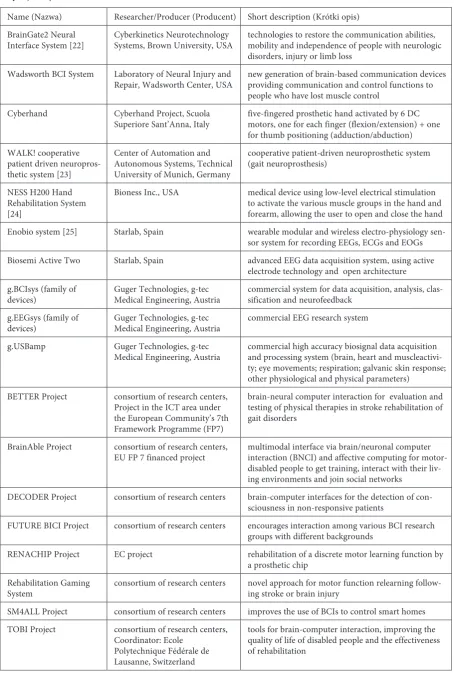
Table 1. Selected BCI and neuroprosthetic solutions currently being developed or easily adaptable for neuroprosthetic use
Tabela 1. wybrane rozwijane obecnie rozwiązania interfejsów mózg–komputer i neuroprotez lub mające możliwość łatwej adaptacji do tych zastosowań
Name (Nazwa) Researcher/Producer (Producent) Short description (Krótki opis) BrainGate2 Neural
Interface System [22] Cyberkinetics Neurotechnology Systems, Brown University, USA technologies to restore the communication abilities, mobility and independence of people with neurologic disorders, injury or limb loss
wadsworth BCI System Laboratory of Neural Injury and
Repair, wadsworth Center, USA new generation of brain-based communication devices providing communication and control functions to people who have lost muscle control
Cyberhand Cyberhand Project, Scuola
Superiore Sant’Anna, Italy five-fingered prosthetic hand activated by 6 DC motors, one for each finger (flexion/extension) + one for thumb positioning (adduction/abduction) wALK! cooperative
patient driven neuropros-thetic system [23]
Center of Automation and Autonomous Systems, Technical University of Munich, Germany
cooperative patient-driven neuroprosthetic system (gait neuroprosthesis)
NESS H200 Hand Rehabilitation System [24]
Bioness Inc., USA medical device using low-level electrical stimulation to activate the various muscle groups in the hand and forearm, allowing the user to open and close the hand Enobio system [25] Starlab, Spain wearable modular and wireless electro-physiology
sen-sor system for recording EEGs, ECGs and EOGs Biosemi Active Two Starlab, Spain advanced EEG data acquisition system, using active
electrode technology and open architecture g.BCIsys (family of
devices) Guger Technologies, g-tec Medical Engineering, Austria commercial system for data acquisition, analysis, clas-sification and neurofeedback g.EEGsys (family of
devices) Guger Technologies, g-tec Medical Engineering, Austria commercial EEG research system g.USBamp Guger Technologies, g-tec
Medical Engineering, Austria commercial high accuracy biosignal data acquisition and processing system (brain, heart and muscleactivi-ty; eye movements; respiration; galvanic skin response; other physiological and physical parameters)
BETTER Project consortium of research centers, Project in the ICT area under the European Community’s 7th Framework Programme (FP7)
brain-neural computer interaction for evaluation and testing of physical therapies in stroke rehabilitation of gait disorders
BrainAble Project consortium of research centers,
EU FP 7 financed project multimodal interface via brain/neuronal computer interaction (BNCI) and affective computing for motor-disabled people to get training, interact with their liv-ing environments and join social networks
DECODER Project consortium of research centers brain-computer interfaces for the detection of con-sciousness in non-responsive patients
FUTURE BICI Project consortium of research centers encourages interaction among various BCI research groups with different backgrounds
RENACHIP Project EC project rehabilitation of a discrete motor learning function by a prosthetic chip
Rehabilitation Gaming
System consortium of research centers novel approach for motor function relearning follow-ing stroke or brain injury SM4ALL Project consortium of research centers improves the use of BCIs to control smart homes TOBI Project consortium of research centers,
Coordinator: Ecole Polytechnique Fédérale de Lausanne, Switzerland
Table 1. Selected BCI and neuroprosthetic solutions currently being developed or easily adaptable for neuroprosthetic use – cont.
Tabela 1. wybrane rozwijane obecnie rozwiązania interfejsów mózg-komputer i neuroprotez lub mające możliwość łatwej adaptacji do tych zastosowań – cd.
Name (Nazwa) Researcher/Producer (Producent) Short description (Krótki opis)
Brainvision Brain Products GmBH, Germany family of BCI hardware, related software and acces-sories
Speech Restoration
Project Neural Signals Inc., USA invasive and non-invasive BCIs to restore speech
MindSet NeuroSky commercial BCI hardware and software, e.g. for game
control or device control (Mac OS, iPhone, iPad) Minball Game Interactive Productline game controlled by the players’ mental processes and
degree of relaxation
Research in the area of neuroprostheses and BCIs is interdisciplinary, involving the participa-tion of medical staff (neurologists, physiologists, physical therapists, occupational therapists), engi-neers, philosophers, psychologists and specialists in cognitive science.
Since 2001 institutions in Germany and the US have organized BCI Competitions to assess and compare research being carried out in these areas, The most recent competitions were in 2008, but the 2005 edition was the largest to date, receiving 99 submissions.–
Clinical Applications
It is possible to use BCIs and the types of neu-roprostheses described above in the therapy of traumatic brain injury or severe movement defi-cits of varying etiology (congenital, MS, etc.). The implantation of the interface is the beginning of the therapeutic process. Learning how to use the neuroprosthesis can be included among the reha-bilitation procedures in the therapy schedule, in one or more of rehabilitation sessions per day. The learning process is based on work with a simula-tor, similar to biofeedback technology. During the training the patient learns how to intentionally use the signals produced in his or her brain to achieve desired effects. The number of erroneous trials decreases during the training until the patient is able to deliver commands precisely when he/she intended to. This learning process can be long and arduous because of the required precision of con-trol (e.g., accuracy of motions), but basic function-al outcomes can be achieved after severfunction-al sessions. The main goal during the learning process is to control neural plasticity in way that achieves de-sired behavior within the brain-machine system.
BCI training is perceived by some researchers
as a form of therapy that can possibly be performed at the patient’s home [26], for example with an EEG-based wadsworth BCI system. Several visits are required to complete the patient’s and carers’ preparation, and after succesful completion of the process of choosing the BCI and training in its use, control visits are needed every 1–2 months. At pres-ent the number of possible patipres-ents who can receive BCI training at home is limited to those located near wadsworth Center (in Albany, New York, USA) and/or Helen Hayes Hospital (in west Haverstraw, New York, USA), which provide this service.
The whole process of BCI training calls for extensive knowledge, experience and cognizance among the members of a multidisciplinary team, especially physical therapists and occupational therapists. Ensuring that medical, paramedical and IT personnel are prepared to provide BCI train-ing will no doubt require changes in teachtrain-ing pro-grams.
The most important thing in the implementa-tion of neuroprostheses is user approval and joint goal-setting [2], which can help the patient and staff cooperate in the most efficient way during therapy in order to achieve the therapeutic goals. Other problems to solve in the implementation of neuroprostheses include:
− ethical implications of BCIs: procedures for the informed consent of the patient, personal and shared responsibility within the team, issues of alteration of patients' personality, the social con-sequences of “brain upgrading” (e.g. K. warwick's human enhancement [27]), finding a balance between complete control by the user and autono-my of the BCI and neuroprostheses (e.g. in emer-gency situations);
− establishing widely approved standards in the area [28];
− establishing clinical guidelines regarding indications(severe disability, inability to use con-ventional assistive communication devices, stable physical and social conditions, ability to under-stand and apply instructions, ability to use select-ed BCI instructions, imaging and biofeselect-edback) and contraindications (hypertension, tachycardia, tics);
− ensuring the bio-compatibility of implants (electrode arrays);
− developingcorrect and repetitive implanta-tion procedures, both surgical and non-surgical,
− developing guidelines and recommenda-tions for pre- and post-operative therapy and reha-bilitation, patient learning and re-learning, and co-operation within the multidisciplinary team,
− improving the size, shape and appearance of neuroprosthetic elements;
− reducing power consumption;
− improving data transmission, processing and analysis and data resistance to interference;
− improving security (called neurosecurity); − improving the convenience of neuropros-thetic use in everyday activities, including the co-ordination of natural and artificially-controlled movements, the smoothness and accuracy of move-ments, which affects the user's quality of life;
− developing a service and troubleshooting infrastructure for users and carers;
− increasing mobility and co-operation with other systems, such as Ambient Intelligence or a disabled person's integrated IT environment [21, 26, 27]. An integrated solution that is currently widely discussed involves the use of carbon nano-tubes (CNT) in BCIs and similar applications [29].
A very important factor in clinical practice can be resistance on the part of patients, especial-ly older ones, to a new technology, and patients' INTEGRATED
IT ENVIRONMENT FOR DISABLED
PEOPLE
Exoskeletons and walking assistive
devices as alternatives to wheelchairs
Intelligent multifunctional wheelchairs with GPS,
mobile phones, robots Smart homes
with intelligent equipment, i-wear, bedside robots, nursing
robots Nanomedical
systems (artificial agents) and other
future solutions
Neuroprostheses, Brain-Computer
Interfaces
E-health, telemedicine
(incl. telerehabilitation)
e-learning Car with
assistive devices
Computers for disabled people with
assistive devices
INTEGRATED ENVIRONMENT FOR DISABLED PEOPLE
BOTH INDOOR AND OUTDOOR OR OUTDOOR ONLY INDOOR
Fig. 4. Neuroprostheses within the concept of disabled people’s integrated IT environment [30–32]
concerns over the ethical issues of direct implanta-tion to the nervous system. It may be necessary to provide additional time for familiarizing these pa-tients and their families/carers with the concepts and issues. In some cases it can be useful to offer more than one option, e.g. with and without im-planted electrodes.
Clinical trials confirm the effectiveness of the clinical application of neuroprostheses [28, 30–34], but there is a need for further research in the area.One of the possible directions for the further development of BCIs is the simulation of processes in brain during brain-computer interac-tion to optimize it in all brain states. This research can contribute to the development of a common frame for several kinds of BCI, easy adjustable to particular patient needs [35]. Other directions for further studies include:
− the development of useful, simplier and user-friendly applications similar to natural inter-action (e.g. integrated analysis EEG/ENG [28], wireless technologies [36]);
− research on the long-term effects [22]; − the development of a family of simple, universal, accessible interfaces between BCIs and commonly-used devices: remote controls, mp3/ mp4 players, cell phones (see the MindSet family of products Table 1);
− technical development with easy technical support and troubleshooting;
− educating both biomedical (rehabilitative) engineers and medical staff to assistance with therapy using BCIs;
− integration with other solutions.
The European DECODER project (see Table 1) developing brain-computer interfaces for the de-tection of consciousness in non-responsive patients (in a vegetative state, minimally conscious state, locked-in syndrome, etc.) may be very important for clinical practice. The variability of conscious-ness disorders and a lack of precise definitions make proper diagnosis difficult. Assistive technol-ogy based on BCIs can help with the exact diag-nosis of these disorders and support the patients’ interaction with the environment. Then the most
appropriate rehabilitation strategy and the most effective supportive technology can be defined. There is great hope among both medical personnel and biomedical engineers that the ok DECODER project will lead to significant improvements in the quality of life of patients and their families/carers. The most important issues in the project are:
− overcoming the diagnostic gap, providing easy to use diagnostic tools;
− further developing and adapting existing BCI systems and applications for single-switch BCI (ssBCI) control purposes, because some patients with consciousness disorders cannot use multi-switch devices or hybrid BCIs, even after lengthy rehabilitation.
In the research area, the DECODER project is related to the TOBI and FutureBCI projects (see Table 1). Another development contributing to progress in BCIs may be simultaneous EEG-fMRI, combining the high spatial resolution of the fMRI with the high time resolution of the EEG. Such developments can contribute in a non-invasive way to the understanding of brain dysfunction.
Conclusions
The technology of neuroprostheses for mobil-ity and control is still in the early stages, but.BCIs and neuroprostheses are promising technologies that can significantly help restore the commmu-nication abilities, mobility and independence of disabled people, especially those with the big-gest limitations and deficits [30, 37–48]. These technologies can break down another barrier be-tween humans and computers, replacing some of the current adaptive devices for disabled people. Technical development in this area calls for close co-operation between scientists and medical staff in order to provide more clinical trials and experi-ence with BCIs and neuroprostheses. Further BCI and neuroprosthetic applications require clear and safe clinical procedures. All of this can significant-ly increase the effectiveness of contemporary and future rehabilitation.
References
[1] Wolpaw JR, Birbaumer N, McFarland DJ: Brain–computer interfaces for communication and control. Clin Neurophysiol 2002, 113(6), 767–791.
[2] Kübler A, Neumann N: Brain–computer interfaces – the key for the conscious brain locked into a paralyzed body. Prog Brain Res 2005, 150, 513–525.
[3] Dudek Z: Interfejs BCI – próba przełamania bariery pomiędzy człowiekiem a komputerem (article in Polish). Przegląd Telekomunikacyjny + wiadomości Telekomunikacyjne 2003, 7, 377–382.
[4] Mikołajewska E, Mikołajewski D: Neurorehabilitacja XXI wieku. Techniki teleinformatyczne (book in Polish). Impuls, Kraków 2011.
[6] Stieglitz T, Rubehn B, Henle C et al.: Brain–computer interfaces: an overview of the hardware to record neural signals from the cortex.Prog Brain Res 2009, 175, 297–315.
[7] Kipiński L, Maciejowski A: Analysis of brain evoked potentials based on digital registered single-trial responses. Adv Clin Exp Med 2010, 19, 3, 289–299.
[8] MEDLINE/PubMed(U.S. National Library of Medicine) http://www.ncbi.nlm.noh.gov/pubmed-access 05.05.2011. [9] Wolpaw JR: Brain–computer interfaces as new brain output pathways. J Physiol 2007, 579(3), 613–619. [10] Mikołajewska E, Mikołajewski D: Roboty rehabilitacyjne (article in Polish). Rehab Prakt 2010, 4, 49–53. [11] Kim HK, Park S, Srinivasan MA: Developments in brain–machine interfaces from the perspective of robotics.
Hum Mov Sci 2009, 28(2), 191–203.
[12] Moritz CT, Perlmutter SI, Fetz EE: Direct control of paralysed muscles by cortical neurons. Nature 2008, 456(7222), 639–642.
[13] Birbaumer N, Cohen LG: Brain–computer interfaces: communication and restoration of movement in paralysis. J Physiol 2007, 579(3), 621–636.
[14] Birbaumer N: Breaking the silence: brain–computer interfaces (BCI) for communication and motor control. Psychophysiology 2006, 43(6), 517–532.
[15] Mellinger J, Schalk G, Braun C et al.: An MEG-based brain–computer interface (BCI). Neuroimage 2007, 36(3), 581–593.
[16] McFarland DJ, Sarnacki WA, Vaughan TM et al.: Brain–computer interface (BCI) operation: signal and noise during early training sessions. Clin Neurophysiol 2005, 116(1), 56–62.
[17] McFarland DJ, Wolpaw JR: EEG-based communication and control: speed-accuracy relationships. Appl Psycho-physiol Biofeedback 2003, 28(3), 217–231.
[18] McFarland DJ, Sarnacki WA, Wolpaw JR: Brain–computer interface (BCI) operation: optimizing information transfer rates. Biol Psychol 2003, 63(3), 237–251.
[19] Mussa-Ivaldi FA, Miller LE: Brain–machine interfaces: computational demands and clinical needs meet basic neuroscience. Trends Neurosci 2003, 26(6), 329–335.
[20] Tecchio F, Porcaro C, Barbati G et al.: Functional source separation and hand cortical representation for a brain– computer interface feature extraction. J Physiol 2007, 580(3), 703–721.
[21] Durka PJ: Matching Pursuit and Unification in EEG Analysis. Artech House 2007.
[22] Simeral JD, Kim SP, Black MJ, Donoghue JP, Hochberg LR: Neural control of cursor trajectory and click by a human with tetraplegia 1000 days after implant of an intracortical microelectrode array. J Neural Eng 2011, 8(2), 025027.
[23] Fuhr T, Quintern J, Riener R, Schmidt G: walking with wALK! A cooperative, patient-driven neuroprosthetic system. IEEE Eng Med Biol Mag 2008, 27(1), 38–48.
[24] Alon G, Levitt AF, McCarthy PA: Functional electrical stimulation enhancement of upper extremity functional recovery during stroke rehabilitation: a pilot study. Neurorehabil Neur Repair 2007, 21(3), 207–215.
[25] Ruffini G, Dunne S, Farrés E et al: ENOBIO – First Tests of a Dry Electrophysiology Electrode using Carbon Nanotubes. Proceedings of 28th Annual International Conference of the IEEE. Aug. 2006, p. 1826–1829.
[26] Müller GR, Neuper C, Pfurtscheller G: Implementation of a telemonitoring system for the control of an EEG-based brain–computer interface. IEEE Trans Neural Syst Rehabil Eng 2003, 11(1), 54–59.
[27] Warwick K: I, cyborg. University of Illinois Press 2004.
[28] ANSI/AAMI/ISO 14708–3:2008 Implants for Surgery – Active implantable medical devices Part 3: Implantable neurostimulators.
[29] Voge ChM, Stegemann JP: Carbon nanotubes in neural interfacing applications. J Neural Eng 2011, 8(2), 011001.
[30] Mikołajewska E, Mikołajewski D: wheelchairs development from perspective of physical therapists and biomedi-cal engineers. Adv Clin Exp Med 2010, 19, 6, 771–776.
[31] Mikołajewska E, Mikołajewski D: Exoskeletons in Neurological Diseases – Current and Potential Future Ap-plications. Adv Clin Exp Med 2011, 20, 2, 227–233.
[32] Mikołajewska E, Mikołajewski D: E-learning in the education of people with disabilities. Adv Clin Exp Med 2011, 20, 1, 103–109.
[33] Neuper C, Müller GR, Kübler A etal.: Clinical application of an EEG-based brain–computer interface: a case study in a patient with severe motor impairment. Clin Neurophysiol 2003, 114(3), 399–409.
[34] Daly JJ, Wolpaw JR: Brain–computer interfaces in neurological rehabilitation. Lancet Neurol 2008, 7(11), 1032– 1043.
[35] Tavella M, Leeb R, Rupp R et al.: Towards natural non-invasive hand neuroprostheses for daily living. Conf Proc IEEE Eng Med Biol Soc 2010, 1, 126–129.
[36] Hill-Hermann V, Strasser A, Albers B et al.: Task-specific, patient-driven neuroprosthesis training in chronic stroke: results of a 3-week clinical study. Am J Occup Ther 2008, 62(4), 466–472.
[37] Laufer Y, Ring H, Sprecher E et al.: Gait in individuals with chronic hemiparesis: one-year follow-up of the effects of a neuroprosthesis that ameliorates foot drop. J Neurol Phys Ther 2009, 33(2), 104–110.
[38] Rossini L, Rossini PM: Combining ENG and EEG integrated analysis for better sensitivity and specificity of neu-roprosthesis operations. Conf Proc IEEE Eng Med Biol Soc 2010, 1, 134–137.
[40] Wheeler CA, Peckham PH: wireless wearable controller for upper-limb neuroprosthesis. J Rehabil Res Dev 2009, 46(2), 243–256.
[41] Brown-Triolo DL, Roach MJ, Nelson K et al.: Consumer perspectives on mobility: implications for neuropros-thesis design. J Rehabil Res Dev 2002, 39(6), 659–669.
[42] Szczepanek D: Neurochirurgia – postępy 2006 (article in Polish). Med Prakt Chir 2007, 2, 22–25.
[43] Leuthardt EC, Schalk G, Moran D et al.: The emerging world of motor neuroprosthetics: a neurosurgical per-spective. Neurosurgery 2006, 59(1), 1–14.
[44] Allison BZ, Wolpaw EW, Wolpaw JR: Brain–computer interface systems: progress and prospects. Expert Rev Med Devices 2007, 4(4), 463–474.
[45] Kübler A, Kotchoubey B: Brain–computer interfaces in the continuum of consciousness. Curr Opin Neurol 2007, 20(6), 643–649.
[46] Dornhege G, del R. Millán J, Hinterberger T et al. (eds.): Toward Brain–Computer Interfacing. MIT Press 2007. [47] Krusienski DJ, Grosse-Wentrup M, Galán F, Coyle D, Miller KJ, Forney E et al.: Critical issues in
state-of-the-art brain–computer interface signal processing. J Neural Eng 2011, 8(2), 025002.
[48] Zanter TO, Kothe Ch: Towards passive brain–computer interfaces: applying brain–computer interface technol-ogy to human–machine systems in general. J Neural Eng 2011, 8(2), 025005.
Address for correspondence:
Emilia MikołajewskaRehabilitation Clinic
Military Clinical Hospital No. 10 and Polyclinic Powstańców warszawy 5
85-681 Bydgoszcz Poland
e-mail: [email protected]
Conflict of interest: None declared
![Fig. 1. Results of the authors’ investigation of the PubMed database (U.S. National Library of Medicine) [8]](https://thumb-us.123doks.com/thumbv2/123dok_us/8770579.1756793/2.595.71.504.426.752/results-authors-investigation-pubmed-database-national-library-medicine.webp)
![Fig. 2. Milestones in the history of brain-computer interfaces (BCIs) and neuroprostheses [4, 5]](https://thumb-us.123doks.com/thumbv2/123dok_us/8770579.1756793/3.595.73.521.485.723/fig-milestones-history-brain-computer-interfaces-bcis-neuroprostheses.webp)
![Fig. 4. Neuroprostheses within the concept of disabled people’s integrated IT environment [30–32]](https://thumb-us.123doks.com/thumbv2/123dok_us/8770579.1756793/7.595.114.483.60.476/fig-neuroprostheses-concept-disabled-people-s-integrated-environment.webp)
