Mr. Samyak Chaudhuri
Bengal Institute of Pharmaceutical Sciences, Kalyani, Nadia- 741235, West Bengal, India
E-mail: [email protected]
Address for correspondence
Access this article online www.japer.in
Screening of
in-vitro
Antioxidant Profile of Different Extracts of
the Leaves of
Plumeria alba
Linn
INTRODUCTION
Reactive oxygen species [ROS], sometimes called as
active oxygen species, are various forms of activated
oxygen, which include free radicals such as superoxide
ions (O2-.) and hydroxyl radicals (OH.) as well as
non-free radical species such as hydrogen peroxide (H2O2)
[1]. These ROS play an important role in degenerative
or pathological processes, such as aging, cancers,
coronary heart diseases, Alzheimer’s disease,
neurodegenerative disorders, atherosclerosis,
cataracts and inflammations[2]. Living organisms have
antioxidant defence systems that protects against
oxidative damage by removal or repair of damaged
molecules[3]. The term ‘antioxidant’ refers to the
activity of numerous vitamins, minerals and
phytochemicals which provide protection against the
damage caused by ROS[4].
Antioxidants interfere with the oxidative processes by
scavenging free radicals, chelating free catalytic
metals and by acting as electron donors[5]. The
therapeutic effects of several medicinal plants are
usually attributed to their antioxidant phytochemicals.
It has been suggested that there is an inverse
relationship between dietary intake of antioxidant
rich foods and incidence of human diseases. The
antioxidants play a vital role in delaying, intercepting
or preventing oxidative reactions catalyzed by free
radical[6]. However, there have been concerns about
synthetic antioxidants such as butylated hydroxyl
anisole (BHA) and butylated hydroxyl toluene (BHT)
because of their possible activity as promoters of
carcinogenesis.
The natural antioxidant mechanisms maybe
insufficient in variety of conditions and hence dietary
intake of antioxidant compounds are important[7].
Plant based antioxidants are preferred to the synthetic
ones because of their multiple mechanisms of actions
and non-toxic nature. These facts have inspired
widespread screening of plants for possible medicinal
and antioxidant properties; the isolation and
characterization of diverse phytochemicals and the
utilization to antioxidants of natural origin to prevent
the diseases[8].
Plumeria alba Linn (Apocynaceae) commonly called
White Champa, a small laticiferous tree or shrub,
Re ReRe
Researchsearchsearchsearch ArticleArticleArticleArticle
Production of reactive oxygen species (ROS) causes various diseases and cellular anomalies in human beings. Antioxidants inhibit generation of reactive species by scavenging them. Plumeria alba Linn commonly known as White Champa (family: Apocynaceae). It is used to treat ulcers, herpes, scabies and seeds possess haemostatic properties. Till date no antioxidant activity had been reported on the leaves of Plumeria alba; therefore, my project work has been conceptualized on the free radical scavenging activity of the leaves of Plumeria alba. The present study assessed the phytochemical analysis mainly successive extractive values, thin layer chromatographic profile and phytochemical screening of petroleum ether, chloroform and methanol extracts of Plumeria alba leaves. The in vitro antioxidant potential by DPPH radical scavenging assay was also estimated for each of the extracts with the reference drug Ascorbic acid. Total chromatographic profile was obtained for each extracts. Presence of phytoconstituents such as flavonoids, polyphenols, terpenoids and glycoside in different extracts were found. The potent free radical scavenging activity was observed on DPPH radical scavenging assay. The different concentrations of all the extracts showed effective free radical scavenging activity on dose dependant manner.
Keywords: Antioxidant activity, reactive oxygen species, Plumeria alba, chromatographic profile
ABSTRACT ABSTRACT ABSTRACT ABSTRACT Samyak Chaudhuri*
Sudeshna Bakshi J. N. Pande Moulisha Biswas
Bengal Institute of Pharmaceutical Sciences, Kalyani, Nadia 741235, West Bengal, India
native of tropical America. It is 4.5m high, occasionally
grown in the gardens. The plant is mainly grown for
its ornamental and fragrant flowers. Leaves are
lanceolate to oblanceolate, flowers white, fragrant in
corymbose fascicles[9]. The fruit is edible, latex is
applied to ulcers, herpes and scabies and seeds
possess haemostatic properties. Moreover its bark is
bruised and applied as plaster over hard tumours[10,
11]. Whereas the latter taxon finds used as purgative,
cardiotonic, diuretic and hypotensive. Methanolic
extract showed antimicrobial activity against Bacillus
anthracis, Pseudomonas aeruginosa[12, 13]. The plant is
reported to contain amyrinacetate, mixture of
amyrins, ß-sitosterol, scopotetin, the iriddoids
isoplumericin, plumieride, plumieride coumerate and
plumieride coumerate glucoside [14].
MATERIALS AND METHODS
Plant material: The mature leaves of Plumeria alba L.
(Family: Apocynaceae) were collected during the
month of February 2015 from the fields near by the
Ganges at Sodepur, Kolkata, West Bengal, India. The
plant material was taxonomically identified by Dr. V.
P. Prasad of the Central National Herbarium, Botanical
Survey of India, Howrah, West Bengal, India. The
voucher specimen (CNH/Tech.II/2015/14/287) was
maintained in our research laboratory for future
reference. The plant material was shade-dried with
occasional shifting and then powdered with
mechanical grinder, passing through sieve no. 40, and
stored in an air-tight container.
Preparation of plant extracts: The dried powdered
material was first extracted (percolation) with
petroleum ether (60-80°C), the percentage extractive
value was 1.74% w/w. The marc thus obtained was
further extracted (percolation) successively with
chloroform and methanol for 72 h in a percolator. The
solvent was distilled off under reduced pressure
resulting in semisolid mass that was vacuum dried to
yield the dry extracts and the percentage extractive
values were accordingly 3.11 % w/w and 6.35% w/w
was performed on these three extracts to identify the
phytoconstituents present in the extracts[15].
Reagents and chemicals: L ascorbic acid (vitamin C)
and 1,1-diphenyl-2-picryl-hydrazil (DPPH) were
purchased from Sigma Chemical Co. Ltd. (St. Louis,
MO, USA). All other chemicals and reagents were of
analytical grade obtained commercially.
DPPH radical scavenging activity: The antioxidant
activity of the extracts was measured in terms of
hydrogen-donating or radical scavenging ability, using
the DPPH(1,1-diphenyl-2-picryl-hydrazil) method
with slight modification [16-18]. Briefly, an 0.1 mM
solution of DPPH in methanol was prepared, and 1 ml
of this solution was added to 3 ml of the all of the
extracts solution respectively in pet ether, chloroform
and methanol at different concentrations
(2,4,6,8,10,15 μg/ml). The reaction mixture were
shaken vigorously and incubated in the dark for 30
min. at room temperature. Then the absorbance of the
solution was measured at 517 nm using a UV-Visible
spectrophotometer (Genesys 10 UV: Thermo Electron
Corporation). Lower absorbance values of reaction
mixture indicate higher free radical scavenging
activity. Ascorbic acid at same concentrations was
used as reference. The radical scavenging activity was
measured as a decrease in the absorbance of DPPH
and was calculated using the following equation:
DPPH scavenging effect (%) = [(A0 – A1) / A0) × 100]
Where, A0 is the absorbance of the control reaction,
and A1 is the absorbance of presence of all of the
extract samples and standard. The results have been
stated in Table 2.
Results and Discussion
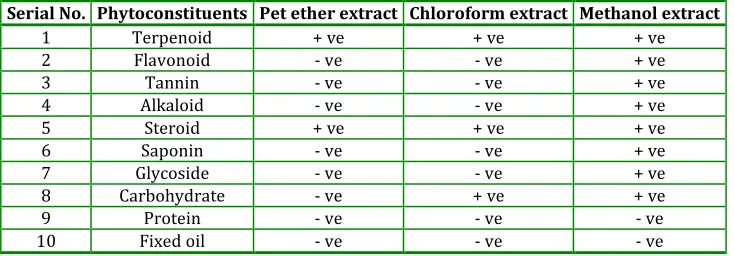
Preliminary phytochemical screening on the test
extracts revealed the presence of terpenoids, steroids
in pet ether extracts; terpenoids, steroids,
carbohydrate in the chloroform extracts; steroids,
terpenoids, carbohydrates, flavonoids, saponins,
glycosides, tannins and alkaloids in the methanol
The stable DPPH radical model is a widely used,
relatively quick and precise method for the evaluation
of free radical scavenging activity. The effects of
antioxidants on DPPH radical scavenging is thought to
be due to their hydrogen-donating ability. DPPH is a
stable free radical that accepts an electron or
hydrogen radical to become a stable diamagnetic
molecule. The absorption maximum of a stable DPPH
radical in methanol was 517 nm. The decrease in
absorbance of DPPH radical caused by antioxidants,
because of the reaction between antioxidant
molecules and radical progressed, results in the
scavenging of the radicals by hydrogen donation. It is
visually noticeable that as a change in color from
purple to yellow. Hence, DPPH is usually used as a
substrate to evaluate the antioxidant activity of
different antioxidants [19]. It has been reported that
oxidative stress, which occurs when free radical
formation exceeds the body’s ability to protect itself,
forms the biological basis of chronic disease
conditions such as arteriosclerosis [20].
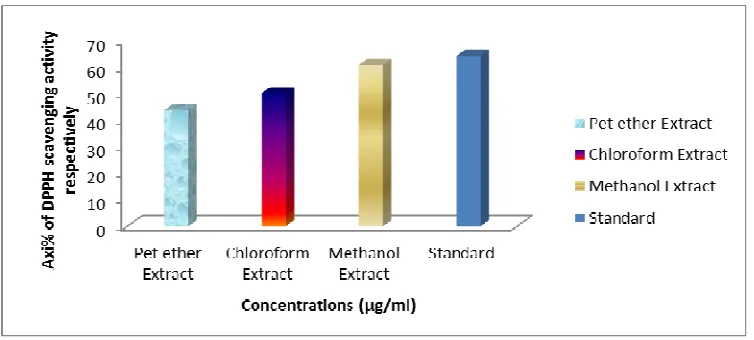
Based on the data obtained from the present study, all
the extracts were effective free radical inhibitor or
scavenger, as well as a primary antioxidant that reacts
with free radicals, which may limit free radical
damage occurring in the human body. Figure 1
illustrates a significant decrease in the concentration
of DPPH radicals due to the scavenging ability of the
extracts and standard. Free radical scavenging activity
also increased with increasing concentration in the
range of 2-15 μg/ml.
CONCLUSION
In conclusion, the results from this study further
support the view that all extracts of Plumeria alba L.
leaves were promising source of good natural
antioxidant against various antioxidant systems. From
the results, it can be concluded that the antioxidant
activity of all the extracts were concentration
dependent. The possible mechanism of antioxidant
activity of all the extracts include hydrogen-donating
ability and scavenging of the free radicals, which may
be due to the presence of phytoconstituents such as
flavonoids, polyphenols, terpenoids and glycoside
present in the pet ether, chloroform and methanol
extracts of the leaves of Plumeria alba showed the
antioxidant activity of the plants. The methanol
extract was found to demonstrate the most active free
radical scavenging potential even more than that of
ascorbic acid at the test concentration, followed by the
chloroform and petroleum ether extracts. The present
preliminary study confirms remarkable in vitro free
radical scavenging activity of Plumeria alba leaves
against DPPH. Further studies are required to identify
specific active principles of this plant for the
significant antioxidant effect.
ACKNOWLEDGEMENT
The authors are thankful to the authority of Bengal
Institute of Pharmaceutical Sciences, Kalyani, Nadia
741235, West Bengal, India for providing all the
facilities for the present study.
Table 1: Phytochemical test of different extracts of leaves of Plumeria alba L.
Serial No. Phytoconstituents Pet ether extract Chloroform extract Methanol extract
1 Terpenoid + ve + ve + ve
2 Flavonoid - ve - ve + ve
3 Tannin - ve - ve + ve
4 Alkaloid - ve - ve + ve
5 Steroid + ve + ve + ve
6 Saponin - ve - ve + ve
7 Glycoside - ve - ve + ve
8 Carbohydrate - ve + ve + ve
9 Protein - ve - ve - ve
Table 2: DPPH scavenging power of the different extracts of leaves of Plumeria alba
Extracts Concentrations (μg/ml)
% of DPPH scavenging activity
respectively Mean ± SEM
Petroleum ether 2, 4, 6, 8, 10, 15 25.18, 28.27, 33.82, 50.51, 57.81, 66.93 43.75 ± 4.34 Chloroform 2, 4, 6, 8, 10, 15 29.19, 35.62, 46.18, 54.69, 63.22, 72.18 50.18 ± 3.22 Methanol 2, 4, 6, 8, 10, 15 36.71, 45.29, 55.24, 62.29, 78.21, 87.32 60.84 ± 5.93 Vitamin C 2, 4, 6, 8, 10, 15 32.18, 43.18, 60.45, 77.54, 82.20, 90.23 64.29 ± 5.19
SEM - Standard error mean
Fig.1. Comparative graphical presentation of DPPH scavenging activity of different extracts of leaves of Plumeria alba
REFERENCES
1. Yildrim A, Oktay M, Bilaloglu V, The antioxidant activity of leaves of Cydonia vulgaris. Turkish Journal of Medical Science 2001; 31: 23-27
2. Huang D.H, Chen C, Lin C, Lin Y, Antioxidant and antiproliferative activities of water spinach (Ipomoea aquatica Forsk.) constituents. Botanical Bulletin of Academic Science 2005; 46: 99-106
3. Sun J, Chen Y, Li M, Ge Z. Role of antioxidant enzymes on ionizing radiation resistance. Free Radical Biology and Medicine 1998; 42: 586-592
4. Khilfi S, Hachimi E, Khalil A, Es-safi A, Tellal A, El Abboyui A. In-vitro antioxidant properties of Salvia
verbenaca L. Hydromethanolic extract. Indian
Journal of Pharmacology 2006; 38: 276-280.
5. Gulcin I, Alici H.A, Cesur M. Determination of in-vitro antioxidant and radical scavenging activities of propofol Pharmacology Bulletin 2005; 53: 281-285 6. Krishna Kumar HN, Navyashree SN, Rakshitha HR,
Chauhan JB. Studies on the free radical scavenging activity of Syagrus romanzoffiana. International Journal of Pharmaceutical and Biomedical Research 2012, 3(2): 81-84
lipid peroxidation in phospholipid bilayers. Archives of Biochemistry and Biophysics 1994; 308: 278-284 8. Akinmoladun A.C, Ibukun E.O, Afor E, Akinrinlola B.L,
Onibon T.R, Akinboboye A.O, Obutor E.M, Farombi E.O. Chemical constituents and antioxidant activity of
Alstonia boonei. African Journal of Biotechnology 2007; 6: 1197-1201
9. Henry A.N, Kumeri G.R, Chitra V. Flora of Tamil Nadu, India.1987; 78.
10. Chopra R.N, Nayar S.L, Chopra IL. Glossary of Medicinal Plants; C.S.I.R., New Delhi. 1956; 198. 11. Hartwell J.L. Plants used against cancer (A survey)
Quarterman Publications, Inc. Lawrence, Massachu setts. 1982: 408.
12. Asolkar L.V, Kakkar K.K, Chakre O.J. Second Supplement to Glossary of Indian medicinal plants with active principles.1992; 173.
13. Nargis A, Malik A, Saminanoor A. A New anti bacterial triterpenoid from Plumeria alba. Fitoterapia, 1993; 2: 162-166.
leaf extracts; Journal of Advanced Pharmacy Education & Research 2012; 2(4): 206-209.
16. Brand-Williams W, Cuvelier, ME, Berset C. Lebensm Wiss Technol1995; 28: 25-30.
17. Chen Y, Wang M.F, Rosen, R.T, Ho C.T. J Agr Food Chem1999; 47: 2226-2228.
18. Naik GH., Priyadarsini KI., Satav JG, Banavalicar MM., Sohoni PP, Biyani MK. Phytochemistry2003, 63: 97-104
19. Bardhan A, Mukhopadhyay R, Bhattachrya S, Biswas M, In vitro free radical scavenging activity of leaf extracts from Mimusops elengi, Journal of Advanced Pharmacy Education & Research 2014; 4(4): 426-429.
20. Fatimah ZI, Zaiton Z, Zamaludin M, Gaptor MT, Nafeeza ML, Khairul O. Effect on estrogen and palm vitamin F on malonaldehyde levels toward the development of arteriosclerosis in the New Zealand white rabbit. In: Packer L Ong SH. Eds. Biological Oxidants and nts: Molecular Mechanism and Health Effects. Champaign. IL; AOCS Press.1998; 22.
How to cite this article: Chaitanya Sucharitha Kolakaluri*, Anusha Goli,G. Saravanan,D. Visaga Perumal; Quantization of Metaxalone in Human Plasma using High - Performance Liquid Chromatography- Tandem Mass Spectroscopy; J. Adv. Pharm. Edu. & Res. 2015: 5(2): 98-102.