J. Math. Comput. Sci. 9 (2019), No. 1, 1-18 https://doi.org/10.28919/jmcs/3794 ISSN: 1927-5307
SINGLE AND MULTI-OBJECTIVE OPTIMIZATION - A COMPARATIVE ANALYSIS
Z.S. LIPCSEY∗, E.O. EFFANGA, C.A. OBIKWERE
Department of Mathematics, University of Calabar, Calabar, NIGERIA
Copyright c2019 the authors. This is an open access article distributed under the Creative Commons Attribution License, which permits
unrestricted use, distribution, and reproduction in any medium, provided the original work is properly cited.
Abstract.We compare the order relations used in single and in multi-objective optimization. The single objective optimization is based on a unique complete ordering. In multi-objective case there are infinite inequivalent partial orderings. The implications of these facts are analysed with examples. Some implications on Pareto techniques are also pointed out. A technique will be presented on the use of optimal frontier which synthesises it into a ”compiled” guide to control the system successfully. Some applications as examples are presented like economic planning strategies etc.
Keywords:multi-objective optimization; maximal and minimal optimum.
2010 AMS Subject Classification:49Q10, 49N20.
1. INTRODUCTION
The multi-objective optimization is very wide, it is not the purpose of this lecture to review
all. A comprehensive book on the different concepts and techniques of multi-objective
opti-mization is written by (Branke, Greco, Sowiski, and Zielniewicz, 2010). See also (18).
∗Corresponding author
E-mail address: [email protected] Received July 7, 2018
Some aspects of the linear optimization will be discussed. The history of linear optimization
goes back to 1827 when Fourier solved the problem of finding solution of a system of linear
inequalities. His method was based on elimination of variables and he made an3 algorithm to find a feasible point or states that there is no feasible point when there is no feasible solution to
the problem. This procedure was forgotten and rediscovered by Dines (1918) and by Motzkin
(1936). This algorithm became Motzkin algorithm which actually should be
Fourier-Dines-Motzkin and it is similar to Gaussian elimination (1800) (17). However, the algorithm
is slow compared to interior point techniques. This method remained important even after
the development of the simplex method since it is capable of stating the existence or
non-existence of a feasible point and also gives all the optimal solutions of a problem in integer
linear programming (2).
The linear programming and its solution techniques was first developed by L. Kantorovich in
1939 but it was used for military operations hence it was top secret. Similar approaches were
used in British and American armies. It was in 1947 that Dantzig was mandated to write his
paper about the formulation of simplex method (14). The simplex method in principle involves
the investigation of the existence of feasible points. However, the simplex method is a
semi-decisive algorithm since it can fall into infinite loop especially when there is no solution. The
complexity of this method is polynomial n4 however, the worst case scenario is exponential. Non-polynomial algorithms are non-tractable on digital computers which means that they work
for comparatively small number of variables only (4), (19).
N. Karmarkar published the interior point algorithm in 1984 (4). While the simplex method
moves on the vertices of the set of feasible points, this method is based on the interior points of
the set of feasible points. In his conference lecture, N. Karmarkar claimed that his algorithm has
a complexity of√n log n
ε
which is much better than simplex method. However, Denardo on
the cited book states that some of Karmarkars statements are difficult or cannot be reproduced
and also there are examples which show that the worst case scenario is similar to that of simplex
method. In conclusion, he says that simplex method and interior point algorithms have more or
less the same performance and behaviour. Denardos book contains interesting comparisons in
The formulation of multi-objective optimization started in economics and in parallel Borel,
Cantor, (11), (12) and others developed the mathematical background (10). The first paper in
this research area was published in 1881 by Edgeworth, an economist and a mathematician. He
formulated the idea of evaluating the economic problem in terms of more than one objective
function though he did not present this idea formally. He realized that one objective function
cannot cope with the complexity of evaluating the performance of a system of economy (5).
Along the same lines, another economist Vilfredo Pareto formulated the idea of evaluating a
multi-objective optimization problem in a formal way (16). Karush, Kuhn and Tucker worked
out the conditions for optimality. Originally, Karush had these conditions in his unpublished
thesis of 1939 but later published as (12) and the reference to Karush is made in (7). What is
often neglected in the literature of multi-objective optimization is that the presence of multiple
solutions is no solution at all if there is no instructional guide to give directives to the users of
such system. The main issue here is what to do with all the generated (maybe infinite) optimal
solutions.
A number of techniques have been developed to handle the problem of multi-objective
op-timization problems. Solution techniques are summarised for mathematics audience in (10),
engineers and economists in (Zhou, Qu, Li, Zhao, Suganthan, and Zhang, 2011), (13), (8). For
extensive reading on a number of classical solution techniques to solving multi-objective
prob-lems see (3).
Figure 1 shows the difference between single and multi-objective optimization. The single
objective optimization gives a global optimum, timeless, while the multi-objective optimization
gives a local type optimization valid within the positive cone.
2. SOLUTIONTECHNIQUES
Multi-objective optimization is classified into three major groups of methods according to
the phase when the decision maker chooses his preferences; Apriori, Interactive and Posteriori
methods (9). In the posteriori or generation method, all the solutions are generated and
pre-sented before the decision maker who will either take it or reject it (1). The various methods
global max max
Objective2 Objective1
f 0
Objective0
FEASIBLE ACTION SET
ϕ
SYSTEM STATE SPACE
f 0
Objective0
FEASIBLE ACTION SET
ϕ
SYSTEM STATE SPACE
max
C
FIGURE 1. Single and multi-objective optimums.
Scalarization methods, Weighting sum method, E-constraint method, Goal programming
method, Evolutionary algorithms, Direct search methods, Genetic algorithms,
Pareto optimality.
It took a long time until the concepts of single and multi-objective optimization crystallized.
The critical difference comes from the fact that in scalar optimization there is only one
or-der relation - the oror-der relation of numbers while in two or more dimensions there are infinite
inequivalent order relations. Hence defining the objective function does not determine the
opti-mization problem.
Pareto’s method: Among the first approaches to solve multi-objective optimization prob-lems, Pareto developed his Pareto optimality theory in 1910 and was published in (6). He
introduced the dominance relation between pairs of points ofRnas follows: Letx,y∈Rn. Then
xdominatesyifxj≥yj,∀1≤ j≤nand∃1≤i≤nsuch thatxi>yi, where x= (x1,x2, ...xn)
andy= (y1,y2, ...yn).
Let the order relationbe defined between the vectors ofRnas follows:
Definition 1. Ifx,y∈Rnandx= (x1,x2, ...xn)and y= (y1,y2, ...yn)thenxy⇔xj≥yj,∀1≤ j≤n.
Pareto actually introduced an order relation to find an optimal solution to a multi-objective
problem like in one dimension, the ordering of real numbers is used to find an optimal solution.
2.1. Single and multi-objective optimization - technical aspects. Optimization requires a means to compare any two entities to find out which one is better for our purpose than the other.
In this comparison qualities expressed in terms of scalar or vector values are compared and
order relations perform the comparisons.
Comparison of scalar values uses the usual order relation of numbers (single objective
op-timization) while comparing vectors uses order relation (reflexive, asymmetric and transitive
relation) on vectors (multi-objective optimization) carrying the basis of comparison needed by
the analyst. We formulate the order relation used in vector spaces.
Definition 2. LetHbe a set then a relationbetween the elements ofHis an order relation on H if it fulfils:
1. xx, ∀x∈H(reflexive);
2. xy&yx⇒x=y, ∀x,y∈H (asymmetric);
3. xy&yz⇒xz, ∀x,y,z∈H (transitive)
WhenH=V is a vector space then the order relationship is assumed to fulfil some
compat-ibility properties to make handling of expressions with vector operations combined with order
relations easier. This part of the paper draws from Jahn’s book (10) and related literature.
Definition 3. Let V be a vector space over R and letbe an order relation between the elements ofV. The order relation is compatible with the vector structure ofV if
1. ∀x,y,a∈V, xy⇒x+ay+a(additive translation invariance)
2. ∀x,y∈V &a∈R+, xy⇒x∗ay∗a(multiplicative translation invariance).
A vector space with an order relation compatible with the vector structure is an ordered vector
space and it has some important properties.
2.2. Implication of the translation invariance. An order relation compatible with the vector structure is translation invariant therefore it can be checked at the zero of the vector space.
a−b=0 :
a=b
C,1
x−y:xy
u−v:u≺v p and q are not
comparable
p−q
s−t:
s and t are not
comparable
FIGURE 2. Vector comparison:a≺bora=borb≺aor a and b are not comparable.
Theorem 1. Let V be a vector space and letbe an order relation on V compatible with the vector structure. If C :={0x}is the set of those vectors which are greater than or equal to
0 then from the compatibility conditions 1. and 2. follows that C is a convex cone with zero as
its tip and∀x,y∈V, xy⇔0y−x⇔y−x∈C.
The convexity ofC: Leta,b∈C ⇒0a& 0b then 0a⇒ba+b hence 0 b&ba+b⇒0a+bby transitivity. Applying this tocaand(1−c)bwithc∈[0,1]gives
the convexity.
Corollary 1. Inone dimensional vector spaceC= [0,∞)or C= (−∞,0]. We select the cone
that contains the non-negative numbers. Hence there is only one order relation compatible with
the vector structure in a one dimensional vector space.
In one dimensional vector space any two elements x,y∈V are comparable which means xy
or yx is true.
Intwo or more dimensional vector spacethere are infinite inequivalent order relations
compat-ible with the vector structure. In two or more dimensions in addition to x,y∈V⇒xy or yx
∂C,1
∂C,2
C
H
H1 0
0
maxH
minH min(H1)
{x≥max(H })
{x≤min(H })
{xmin(H1)}
H1
0 max(H1)
{xmax(H1)}
FIGURE 3. Strong multiobjective maximum and minimum like in single
objec-tive optimization.
2.3. Optimization concepts. The single objective function optimization mostly targets to find the best objective function value among all possible values (minimum or maximum). This value
is taken as a control action found by the optimization process. Precisely,
Definition 4. LetH⊂R. Then
max(H)∈H fulfilsx≤max(H), ∀x∈H;
min(H)∈H fulfilsx≥min(H), ∀x∈H;
Definition 5. LetH⊂Rpand letC be the positive cone of the order relation. Then
maxC(H)∈H fulfilsxmaxC(H), ∀x∈H;
minC(H)∈H fulfils minC(H)x, ∀x∈H;
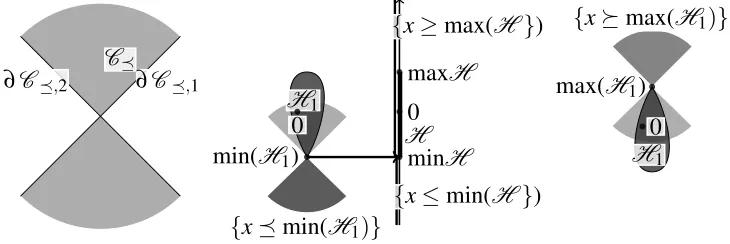
Figure 3 shows the practical appearance of multi-objective maximum/minimum. As
max-imum or minmax-imum must be the tip of the cone moreover, this maxmax-imum/minmax-imum must be
comparable with the whole set hence the whole set must be inside the cone. This gives a drop
shape to the set and strongly delimits range of usability of the multi-objective optimization.
2.3.1. Maximal and minimal optimum. The maximum or minimum solutions to single
objec-tive optimization problems give global solutions - a best choice against any other selection. We
will now investigate the case when a process under the control of a multi-objective optimal
solution drifts out to a state not comparable with the optimal solution in use.
The nature of non-comparable vectors. Let us consider the situation on figure 4 where a turning
vehicle’s movement is analysed. To cover the centripetal force from the static friction of the
r
Kin rF Csa f e
non-comparable
off the road
E>rF
rF safe
E<rF
FIGURE 4. Safe turning formulated with the kinetic energy and the turning radius.
Ff r. Using the formula for the needed force to turn at a radius r while having v speed gives us
Fcp=
mv2 r =
2Ekin
r <Ff r. This leads to the safety cone: The turning is safe ifEkin<r Ff r
2 =rF (F is a constant defined by the formula). As figure 4 shows, a non-comparable objective vector
leads to disaster. The car movement becomes independent from the intentions of the controller.
He/she has no effect on the movement of a car in such a situation since the brake, the accelerator
and the steering are all based on the friction force which is switched off. Many other examples
show the same situation. Therefore, we may conclude:
Conclusion 1. A selected optimal solution is valid only over the situations with dominated objective vectors. Hence each optimal solution has a domain where it acts. An attempt to use it
outside the domain may lead to a disaster.
Using the conclusion that the optimal solution controls dominated situations only we will
introduce maximal and minimal elements in an object space such that such elements are in the
domain and dominate all comparable elements in the domain.
Definition 6. Let H ⊂Rp and let C be the positive cone of the order relation. Then the
maximal and minimal elements are
maxw,C(H)∈H fulfilsxmaxw,C(H), ∀x∈H comparable with maxw,C(H);
minw,C(H)∈H fulfils minw,C(H)x, ∀x∈H comparable with minw,C(H);
Remark 1. As Figure 5 shows, H ∩ {x max(H )}= /0 which means there is no larger
element inH than the maximal element. Similarly,H ∩{min(H )x}=/0 which means that
0
C
H
max(H )
min(H) max(H )
min(H )
{x≺min(H )}
{xmax(H )}
{x≺min(H )}
{xmax(H)}
FIGURE 5. Multi-objective maximal and minimal solutions.
comparable with the maximal/minimal elements or elements less than or equal to the maximal
element or greater than or equal to the minimal element.
3. OPTIMALFRONTIER.
We essentially concluded in the previous sections that the maximal or minimal optimality
concepts suit more the multi-objective optimization because these concepts require to fulfil the
least conditions equivalent to the guarantee that there is no better option in the object space.
These solutions must be boundary points of the objective space since they themselves must
be in the objective space and any neighbourhood of them must contain points from outside the
objective space (see the reasoning in remark 1). Therefore, the objective space will be assumed
to be a closed set. It also follows from the discussion represented on figure 5 that there are many
minimal or maximal points to a problem.
Any two different optimal solutions may be either comparable or non-comparable. When
comparable, out of two maximal solutions the larger takes care of the smaller one and out of
two minimal solutions the smaller one takes care of the other one.
Definition 7. IfC is a positive cone on the objective space H ⊂Rp then ∀x,y∈H, Cx:=
x+C&Cy:=y+C are comparable ifx∈Cy∨y∈CxThe relationCx is comparable toCyis
denoted byCx∼cCy.
C
M1 M2
pvirtual
0
FIGURE 6. Two non-comparable Multi-objective maximums.
If we form the equivalence classes of all solution cones overH and form the union of cones
in each of the equivalence class, we get a system of optimal cones equivalent to the original
system of optimal solutions which are pairwise non-comparable. Hence comparable pairs of
solutions can be eliminated by selecting one out of any two. Therefore, we may assume that
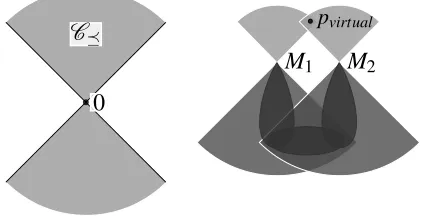
any two different optimal solutions are non-comparable. Example of non-comparable solutions
is shown on figure 6. Non-comparable maximal or minimal solutions occur when non of the
tips of such cones is in the other cone.
Definition 8. LetH ⊂Rp be the objective space and let C be the positive cone of the order
relation. Then the optimal frontierFopt,max(H):={maxw,C|maxw,C =u∈∂H}. Similarly,
Fopt,min(H):={minw,C|minw,C =u∈∂H}.
The concept originates from Pareto in optimality theory developed in 1910 and was published
in (6). His concept of dominating elements (definition 1) actually shows that his multi-objective
solutions dominate points other than the maximal/minimal solutions. However, Pareto’s order
relation is defined by the cone of positive quadrant (in p-dimensional caseCPareto;= n
∏
j=1[0,∞)j
which is a special selection of order relation.
To cover all points of an objective space with dominating cones requires to create optimal
strategy for all the border points in the direction. Such family of solutions is the optimal frontier.
Figure 7 shows the structure of optimal frontier.
Note that having an infinite system of optimal strategies does not make life easy because one
should be used at a time. This leads us to the problem of synthesis which offers an optimal
C
0
FIGURE7. Infinite number of multiobjective solutions.
4. SYNTHESIS OF OPTIMAL SOLUTIONS.
4.1. The switch cone. When a system is controlled by an optimal strategy this strategy has to be changed when the system movement reaches the boundary point of the domain of the optimal
control. If the state point of the system is close to the boundary of the domain of the newly
selected strategy then soon after switching one may expect another switching. Hence knowing
the position of the current state we should select a new optimal strategy where the current state
is relatively far from the boundary of the newly selected optimal behaviour. This requirement
for the selection is solved by introducing a switch-cone as shown on figure 8. Figure 9 shows
the use of switching cones on the optimal frontier.
4.2. Strategy on compact subsets of objective space. Any real system operates in a sub-optimal way and the strategy directs the process towards the sub-optimal operation. There are two
reasons for this: The information as basis of decisions is never complete and the operations
are always subject to random effects. In addition, having infinite set of strategies, at the border
points one has to change strategy for each change of working point which already and
impos-sible requirement from practical point of view. Therefore, we will assume that a system moves
within a compact subset of the object space at a distance from the boundary. This can be covered
by switching cones hence reaching the boundary of the domain of a strategy, there is a switching
cone containing the current state vector hence the system can switch to the new strategy. Figure
0 C
unit lenght HL,a KL,a K˜,
η
S
FIGURE 8. The definition of the switchcone.
C
0
FIGURE 9. Introduction of switching zones to select more lasting strategies.
∂C,1
∂C,2
C
0
FIGURE 10. Building the objective set from an increasing system of compact
sets, we can cover each set with finite system of switching cones. This gives a
C
0
c
α2=S(x2)
α1=S(x1)
α0=S(x0)
x0 x1
x2
α1
α0
α2
FIGURE11. The constructed synthesis function and its use.
4.3. The synthesis and its use. The interior of a closed set can be obtained as a countable union of ascending sequence of compact sets. If there is a member of such a sequence which
is needed for our operations, then there is a finite subset of the frontier points such that the
corresponding switching cones cover the selected compact set. These cones can be combined
into a finite pairwise disjoint covering of the selected compact set so that reaching the boundary
point of the domain of the currently used optimal strategy, there is a unique strategy to continue
with. The situation is shown on figure 11. This synthesis facilitates stability and asymptotic
analysis of the solution if a dynamical system (ordinary differential equations etc.) model is
created to describe the system’s operation.
5. SOLUTIONMETHODS.
An arsenal of methodologies and techniques has been developed to solve multi objective
optimization problems. We noted earlier in the statement of problem to this presentation that it
is very interesting to generate the local optimal solutions but to successfully give an instructional
guide on how to run a multi-objective system is much more complex than generating these
optimal solutions.
In this lecture we give a comparison among three methods: Scalarization, Pareto’s method
rela-Sc
C∗pareto
C∗,pareto
0 0 C
FIGURE 12. The tower shows four ordering cones: The positive coneC, outer
and inserted pareto conesCparet∗ ,C∗,paret and the scalar coneSc.
tion, Pareto and scalariztion methods.
In line with the multi-objective optimization, the existence of an order relation is defined in
terms of a convex positive coneC. It is known that a convex cone is intersection of hyperplanes
and any finite subsystem of these hyperplanes containsC. If we select n such hyperplanes,
their intersection is a cone spanned by a polygon the sides of this cone gives a pareto basis
(with axes not parallel with the original basis). Look at the cone C∗pareto ⊃C. Also, C
contains a polygon base coneC∗pareto⊂C. Finally all containsScstraight line which is a one
dimensional cone.
We state a lemma to show the relationship among the four cones on Figure 12.
Sc
C∗pareto
C∗,pareto
P1 C
Sc
C∗pareto
C∗,pareto
P2 C
Sc
C∗pareto
C∗,pareto
P3 C
FIGURE 13. The figure shows the relationship between the set of objective
val-ues and the existence of the various maximal points: One may notice that Sc
optimum always exists while the external pareto, the positive cone and the
inter-nal Pareto may not exist.
Sc
C∗pareto
C∗,pareto
0 0
FIGURE 14. In this case there is no multi-objective optimal solution, not even
forSc.
to C2;
2. If maxC2(H) is maximal and {maxC2(H)≺ x∈C1}= /0 then maxC2(H) is maximal with respect to C1. The same holds for minimal elements in the opposite direction.
Corollary 2. In the chain of positive cones a maximal element with respect to any positive cone is maximal with respect to Sc. The same holds for minimal elements.
The corollary states that scalarization gives solution to a maximisation/minimisation
prob-lem, but out of the scalarized solutions one has to select the maximal/minimal ones with respect
to the selected positive cone.
Figure 13 shows that the four positive cones represent different orderings, and on different
objective spaces they give different results. Figure 14 shows that there can be a case such that
there is no optimal solution inside an enclosed loop. Maximal solutions will exist if the tip of
the cone group goes on the top of the boundary points.
Conclusion 2. In this paper we pointed out that the significant differences between single and multi-objective optimizations originate from the existence of a unique complete ordering
com-patible with the vector structure in one dimension against the higher dimensional vector spaces,
infinite inequivalent partial orderings compatible with the vector structure. The existence of
non-comparable vectors in higher dimension lead to limited concept of maximum/minimum and
infinite non-comparable inequivalent optimal solutions to a problem. This leads to the necessity
of synthesis techniques for the creation of a practical control guide for the user.
Remark:
This paper is a summary of some of the results from the Ph.D. thesis (15) of Obikwere, Clare
A. supervised by Dr. Effanga, E. O. and Prof. Z. Lipcsey.
Conflict of Interests
The authors declare that there is no conflict of interests.
REFERENCES
[1] O. AUGUSTO, F. BENNIS, ANDS. CARO,A new method for decision making in
multiob-jective optimization problems, Pesquisa Operacional, 32 (2012), pp. 331–369.
[2] G. B. DANTZIG ANDB. C. EAVES,Fourier–motzkin elimination and it dual, Journal of
Combinatorial Theory, (A) (1973), pp. 288–297.
[3] K. DEB, Multi-objective Optimization using Evolutionary Algorithms, New York: Wiley,
[4] E. V. DENARDO,Linear Programming and Generalizations- A Problem-based
Introduc-tion with Spreadsheets, vol. 149, Springer Verlag, 2011.
[5] F. Y. EDGEWORTH, Mathemtical Physics: An Essay on the Application of Mathematics
to the Moral Sciences, C. Kegan and Paul and Co., 1881.
[6] M. EHRGOTT,Vilfredo pareto and multi-objective optimization, Documenta Mathematica,
(2010), pp. 447–453.
[7] G. GORDON AND R. TIBSHIRANI, Karush–kuhn–tucker conditions, Optimization,
(2014), pp. 10–36.
[8] W. J. GUTJAHR AND A. PICHLER,Stochastic multi-objective optimization: a survey on
non-scalarizing methods, Annals of Operations Research, Special volume (2013).
Au-thors: Department of Statistics and Operations Research University of Vienna, Austria
and Norwegian University of Science and Technology, Norway.
[9] C. L. HWANG AND A. S. MASUD, Multiple Objectives Decision Making?Methods and
Applications, Springer, 1979.
[10] J. JAHN,Vector Optimization, Springer Verlag, 2011.
[11] T. C. KOOPMANS,Analysis of production as an efficient combination of activities, 1951.
[12] H. W. KUHN ANDA. W. TUCKER,Nonlinear programming, in Second Berkeley
Sympo-sium Proceedings on mathematical Statistics and Probability, J. Ney-man, ed., University
of California Press, Berkeley, 1951, pp. 481–492. Princeton University and Stanford
Uni-versity.
[13] R. T. MARLER AND J. S. ARORA, Survey of multi–objective optimization methods for
engineering, Struct Multidisc Optim, 26 (2004), pp. 369–395.
[14] C. J. NASH, The (dantzig) simplex method for linear programming, in The (Dantzig)
Simplex Method for Linear Programming, no. 1521–9615/00/10.00 A9 2000 IEEE in The
Top Ten Algorithms, University of Ottawa, 2000.
[15] C. A. OBIKWERE, Tools and Alternative Solution Techniques for Multi-objective
Opti-mization, PhD thesis, University of Calabar, 2016.
[16] V. PARETO,Manuale di Economia Politica, Societa Editrice Libraria, Milano, Italy, 1906.
York. 1971.
[17] P. PARRILO AND S. LALL, Fourier-motzkin elimination, Stanford University, (2003),
pp. 1–29.
[18] V. TKINDT ANDJ. BILLAUT,Multicriteria Scheduling: Theory, Models and Application,
Springer-verlag, 2006.