A Multiple Instance Learning Strategy for Combating Good Word
Attacks on Spam Filters
Zach Jorgensen [email protected]
Yan Zhou [email protected]
Meador Inge [email protected]
School of Computer and Information Sciences University of South Alabama
Mobile, AL 36688, USA
Editor: Lyle Ungar
Abstract
Statistical spam filters are known to be vulnerable to adversarial attacks. One of the more common adversarial attacks, known as the good word attack, thwarts spam filters by appending to spam messages sets of “good” words, which are words that are common in legitimate email but rare in spam. We present a counterattack strategy that attempts to differentiate spam from legitimate email in the input space by transforming each email into a bag of multiple segments, and subsequently applying multiple instance logistic regression on the bags. We treat each segment in the bag as an instance. An email is classified as spam if at least one instance in the corresponding bag is spam, and as legitimate if all the instances in it are legitimate. We show that a classifier using our multiple instance counterattack strategy is more robust to good word attacks than its single instance counterpart and other single instance learners commonly used in the spam filtering domain.
Keywords: spam filtering, multiple instance learning, good word attack, adversarial learning
1. Introduction
It has been nearly thirty years since the first email spam appeared on the Arpanet. Today, to most end users, spam does not seem to be a serious threat due to the apparent effectiveness of current spam filters. Behind the scenes, however, is a seemingly never-ending battle between spammers and spam fighters. With millions of email users, profit-driven spammers have great incentives to spam. With as little as 0.001% response rate, a spammer could potentially profit $25,000 on a $50 product (Carpinter and Hunt, 2006). Over the years, spammers have grown in sophistication with cutting-edge technologies and have become more evasive. The best evidence of their growing effectiveness is a recent estimate of over US $10 billion worldwide spam-related cost (Jennings, 2005). In this paper, we target one of the adversarial techniques spammers often use to circumvent existing spam filters.
trained to account for such attacks. This paper presents a possible defense strategy using multiple instance learning that has shown promising results in our experiments.
Multiple instance (MI) learning (Dietterich et al., 1997) differs from single instance supervised learning in that an example is represented by a set, or bag, of instances rather than as just a single instance. The bag is assigned a class label (either positive or negative) based on the instances it contains; however, the instances within the bag are not necessarily labeled. Classic MI learning assumes that a bag is positive if at least one instance in the bag is positive, and negative if all instances are negative. Therefore, the goal of multiple instance learning is to learn a classification function that accurately maps a given bag to a class. Formally, let B={B1, . . . ,Bi, . . . ,Bm}be a set
of bags where Bi={X1i,X2i, . . . ,Xji}is the ithbag and X1i,X2i, . . . ,Xjiare the j instances contained
in bag Bi. If B is a training set, then every Bi∈B also has a class label ci∈C={positive,negative}
associated with it. The training process, using B as input, yields a binary classification function
f(Bi): B→C that maps a bag to a class label.
Our spam filtering strategy adopts the classical MI assumption, which states that a bag is positive if at least one of its instances is positive, and negative if all instances are negative. We treat each email as a bag of instances. Thus, an email is classified as spam if at least one instance in the corresponding bag is spam, and as legitimate if all the instances in it are legitimate. The idea is that by splitting an email into multiple instances, a multiple instance learner will be able to recognize the spam part of the message even if the message has been injected with good words. Our experimental results show that a multiple instance learner, combined with an appropriate technique for splitting emails into multiple instance bags, is more robust to good word attacks than its single instance counterpart and other single instance learners that are commonly used in the spam filtering domain. The remainder of this paper is organized as follows. First, we discuss recent research that has motivated our work. Next, we formalize the spam filtering problem as a multiple instance learning problem and explain our proposed counterattack strategy in more detail. Following that, we present our experimental results to demonstrate the effectiveness of our filtering strategy. Finally, we conclude our work and discuss future directions.
2. Related Work
Our work is primarily motivated by recent research on adversarial learning (Dalvi et al., 2004; Lowd and Meek, 2005a; Kolter and Maloof, 2005). Dalvi et al. (2004) consider classification to be a game between classifiers and adversaries in problem domains where adversarial attacks are expected. They model the computation of the adversary’s optimal strategy as a constrained opti-mization problem and approximate its solution based on dynamic programming. Subsequently, an optimal classifier is produced against the optimal adversarial strategy. Their experimental results demonstrate that their game-theoretic approach outperforms traditional classifiers in the spam filter-ing domain. However, in their adversarial classification framework, they assume both the classifier and the adversary have perfect knowledge of each other, which is unrealistic in practice.
Newsome et al. (2006) emphasize the point that the training data used to build classifiers for spam filtering and the similar problem of internet worm detection is, to a large extent, controlled by an adversary. They describe and demonstrate several attacks on the generators of such classifiers in which the adversary is able to significantly impair the learning of accurate classifiers by manip-ulating the training data, even while still providing correct labels for the training instances. The attacks involve inserting features, in a specific manner, into one or both classes of the training data and are specifically designed to cause a significant increase in false positives or false negatives for the resulting classifier. They conclude that the generation of classifiers for adversarial environments should take into account the fact that training data is controlled by an adversarial source in order to ensure the production of accurate classifiers.
Barreno et al. (2006) explore possible adversarial attacks on machine learning algorithms from multiple perspectives. They present a taxonomy of different types of attacks on machine learning systems. An attack is causative if it targets the training data, and is exploratory if it aims to discover information through, for example, offline analysis. An attack is targeted if it focuses on a small set of points, and is indiscriminate if it targets a general class of points. An integrity attack leads to false negatives, and an availability attack aims to cause (machine learning) system dysfunction by generating many false negatives and false positives. They also discuss several potential defenses against those attacks, and give a lower bound on the adversary’s effort in attacking a na¨ıve learning algorithm.
A practical example of adversarial learning is learning in the presence of the good word attack. Lowd and Meek (2005b) present and evaluate several variations of this type of attack on spam filters. They demonstrate two different ways to carry out the attack: passively and actively. Active good word attacks use feedback obtained by sending test messages to a spam filter in order to determine which words are “good”. The active attacks were found to be more effective than the passive attacks; however, active attacks are generally more difficult to perform than passive attacks because they require user-level access to the spam filter, which is not always possible. Passive good word attacks, on the other hand, do not involve any feedback from the spam filter, but rather, guesses are made as to which words are considered good. Three common ways for passively choosing good words are identified. First, dictionary attacks involve selecting random words from a large collection of words, such as a dictionary. In testing, this method did not prove to be effective; in fact, it actually increased the chances that the email would be classified as spam. Next, frequent
word attacks involve the selection of words that occur most often in legitimate messages, such as
news articles. This method was more effective than the previous one, but it still required as many as 1,000 good words to be added to the original message. Finally, frequency ratio attacks involve the selection of words that occur very often in legitimate messages but not in spam messages. The authors’ tests showed that this technique was quite effective, resulting in the average spam message being passed off as legitimate by adding as few as 150 good words to it. Preliminary results were also presented that suggested that frequent retraining on attacked messages may help reduce the effect of good word attacks on spam filters.
experimental results show that, on normal email, that is, email that has not been modified with good words, each of the filters is able to attain an accuracy as high as 98%. When testing on “camouflaged messages”, however, the accuracies of the filters drop to between 50% and 75%. In their experiments, spam emails were camouflaged by combining them with portions of legitimate messages. They experimented with camouflaged messages containing twice as much spam content as legitimate content, and vice versa. They also proposed and demonstrated a possible solution to the attack. By training on a collection of emails consisting of half normal and half camouflaged messages, and treating all camouflaged messages as spam, they were able to improve the accuracy of the filters when classifying camouflaged messages.
Our counterattack strategy against good word attacks is inspired by work in the field of multiple instance (MI) learning. The concept of MI learning was initially proposed by Dietterich et al. (1997) for predicting drug activities. The challenge of identifying a drug molecule that binds strongly to a target protein is that a drug molecule can have multiple conformations, or shapes. A molecule is positive if at least one of its conformations binds tightly to the target, and negative if none of its conformations bind well to the target. The problem was tackled with an MI model that aims to learn axis-parallel rectangles (APR). Later, learning APR in the multiple instance setting was further studied and proved to be NP-complete by several other researchers in the PAC-learning framework (Auer, 1997; Long and Tan, 1998; Blum and Kalai, 1998).
Several probabilistic models: Diverse Density (DD) (Maron and Lozano-P ´erez, 1998) and its variation EM-DD (Zhang and Goldman, 2002), and multiple instance logistic regression (MILR) (Ray and Craven, 2005), employ a maximum likelihood estimation to solve problems in the MI domain. The original DD algorithm searches for the target concept by finding an area in the feature space with maximum diverse density, that is, an area with a high density of positive points and a low density of negative points. The diverse density at a point in the feature space is defined to measure probabilistically how many different positive bags have instances near that point, and how far the negative instances are from that point. EM-DD combines EM with the DD algorithm to reduce the multiple instance learning problem to a single-instance setting. The algorithm uses EM to estimate the instance in each bag which is most likely to be the one responsible for the label of the bag. The MILR algorithm presented by Ray and Craven (2005) is designed to learn linear models in a multiple instance setting. Logistic regression is used to model the posterior probability of the label of each instance in a bag, and the bag level posterior probability is estimated by using softmax to combine the posterior probabilities over the instances of the bag. Similar approaches with different combining functions are presented by Xu and Frank (2004).
Many single-instance learning algorithms have been adapted to solve the multiple instance learn-ing problem. For example, Wang and Zucker (2000) propose the lazy MI learnlearn-ing algorithms, namely Bayesian-kNN and citation-kNN, which solve the multiple instance learning problem by us-ing the Hausdorff distance to measure the distance between two bags of points in the feature space. Chevaleyre and Zucker (2001) propose the multi-instance decision tree ID3-MI and decision rule learner RIPPER-MI by defining a new multiple instance entropy function and a multiple instance coverage function. Other algorithms that have been adapted to multiple instance learning include the neural network MI-NN (Ramon and Raedt, 2000), DD-SVM (Chen and Wang, 2004), MI-SVM and mi-SVM (Andrews et al., 2003), multi-instance kernels (G¨artner et al., 2002), MI-Ensemble (Zhou and Zhang, 2003), and MI-Boosting (Xu and Frank, 2004).
can be properly transformed into a bag of instances. We also explore several possible ways to transform emails into bags of instances. Our experiments also verify earlier observations, discussed in other works (Lowd and Meek, 2005b; Webb et al., 2005), that retraining on emails modified during adversarial attacks may improve the performance of the filters against the attack.
3. Problem Definition
Consider a standard supervised learning problem with a set of training data D={<X1,Y1>, . . . , <
Xm,Ym>}, where Xi is an instance represented as a single feature vector, Yi=C(Xi)is the target
value of Xi, where C is the target function. Normally, the task is to learn C given D. The learning
task becomes more difficult when there are adversaries who could alter some instance Xi so that Xi→Xi0 and cause Yi→Yi0, where Yi6=Yi0. Let∆Xi be the difference between Xi and Xi0, that is, Xi0=Xi+∆Xi. In the case of spam filtering, an adversary can modify spam emails by injecting them
with good words. So,∆Xirepresents a set of good words added to a spam message by the spammer.
There are two cases that need to be studied separately:
1. the filter is trained on normal emails, that is, emails that have not been injected with good words, and tested on emails which have been injected with good words;
2. both the training and testing sets contain emails injected with good words.
In the first case, the classifier is trained on a clean training set. Predictions made for the altered test instances are highly unreliable. In the second case, the classifier may capture some adversarial patterns as long as the adversaries consistently follow a particular pattern.
In both cases, the problem becomes trivial if we know exactly how the instances are altered; we could recover the original data and solve the problem as if no instances were altered by the adversary. In reality, knowing exactly how the instances are altered is impossible. Instead, we seek to approximately separate Xi and∆Xiand treat them as separate instances in a bag. We then apply
multiple instance learning to learn a hypothesis defined over a set of bags.
4. Multiple Instance Bag Creation
We now formulate the spam filtering problem as a multiple instance binary classification problem in the context of adversarial attacks. Note that the adversary is only interested in altering positive instances, that is, spam, by injecting sets of good words that are commonly encountered in negative instances, that is, legitimate emails, or ham. We propose four different approaches to creating multi-ple instance bags from emails. We call them split-half (split-H), split-term (split-T), split-projection (split-P), and split-subtraction (split-S). We will now discuss each of these splitting methods, in turn. Later, in Section 8, we investigate and discuss possible weaknesses of some of these splitting methods.
4.1 Split-H
The first and simplest splitting method that we considered, which we call split-half (split-H), in-volves splitting an email down the middle into approximately equal halves. Formally, let B=
the two instances in the ith bag created from the upper half and the lower half of the email respec-tively. This splitting approach is reasonable in practice because spammers usually append a section of good words to either the beginning or the end of an email to ensure the legibility of the spam message. As will be discussed in Section 8, this splitting method, because it relies on the positions of words in an email, could potentially be circumvented by the spammer. The next three splitting methods do not rely on the positions of the words and thus do not suffer from that problem.
4.2 Split-T
The second splitting method, split-term (split-T), partitions a message into three groups of words (terms) depending on whether the word is an indicator of spam, an indicator of ham, or neutral, that is, Bi={Xis,Xin,Xih}, where Xisis the spam-likely instance, Xin is the neutral instance, and Xih is
the ham-likely instance in bag Bi. The instance to which each word is assigned is based on a weight
generated for it during preprocessing. These weights are calculated using word frequencies obtained from the spam and legitimate messages in the training corpus. More specifically, the weight of a term W is given as follows:
weight(W) = p(W|Ds)
p(W |Ds) +p(W|Dh)
,
where Dsand Dhare the spam and ham emails in the training set respectively. When splitting an
email into instances we used two threshold values, threshsand thresh`, to determine which instance (spam-likely, ham-likely, or neutral) each word in the email should be assigned to, given its weight. We considered any word with a weight greater than threshsto be spammy, any word with a weight
less than thresh` to be legitimate, and any word with a weight in between to be neutral. In our experiments, reasonable threshold values were determined by using cross-validation on training emails. Given each training set, threshswas selected such that some fraction of the terms chosen
during attribute selection (discussed in Section 6.2) would have a weight greater than or equal to it.
thresh`was selected so that some other fraction of the terms would have a weight less than or equal
to it.
4.3 Split-P
The third splitting method, split-projection (split-P), transforms each message into a bag of two instances by projecting the message vector onto the spam and ham prototype vectors. The prototype vectors are computed using all the spam and ham messages in the training set. If we view the spam and ham messages in the training set as two clusters, then the prototypes are essentially the centroid of the two clusters. More specifically, let Cs be the set of emails that are spam and C` be the set of emails that are legitimate. The prototypes are computed using Rocchio’s algorithm (Rocchio Jr., 1971) as follows:
Ps=β·1/|Cs| ·
|Cs|
∑
i=1
Csi−γ·1/|C`| ·
|C`|
∑
i=1
C`i,
P`=β·1/|C`| ·
|C`|
∑
i=1
C`i−γ·1/|Cs| ·
|Cs|
∑
i=1
Csi
where Csi is the i
th spam message in C
sand C`i is the i
th ham message in C`,βis a fixed constant
instances, MSand M`, are formed by projecting M onto Psand P`:
Ms =
M·Ps
|Ps|2
Ps,
M` =
M·P`
|P`|2
P`.
The rationale of this splitting approach rests on the assumption that a message is close to the spam prototype in terms of cosine similarity if it is indeed spam, and a ham message is close to the ham prototype.
4.4 Split-S
The last splitting method, split-subtraction (split-S), like the former, uses prototype (centroid) vec-tors. In this method, however, the ham and spam prototypes are calculated by averaging the corre-sponding attribute values of all of the ham and spam emails, respectively:
Ps=1/|Cs| ·
|Cs|
∑
i=1
Csi,
P`=1/|C`| ·
|C`|
∑
i=1
C`i.
where Csis a set of spam and Csi is the i
th spam message in C
s; C` is a set of ham, and C`i is the
ith ham message in C`. A message can then be transformed from a single instance attribute vector
M into a bag of two instances by subtracting corresponding attribute values in the single instance
vector from the ham prototype and the spam prototype, yielding a legitimate instance M`=M−P` and a spam instance Ms=M−Ps, respectively (Zhang and Zhou, 2007).
Now that we have devised several techniques for creating multiple instance bags from email messages, we can transform the standard supervised learning problem of spam filtering into a mul-tiple instance learning problem under the standard MI assumption. In this paper, we adopt the multiple instance logistic regression (MILR) model to train a spam filter that is more robust to ad-versarial good word attacks than traditional spam filters based on single instance models. We chose to use the MILR classifier over other MI classifiers mainly because its single instance counter-part, logistic regression (LR), which has been shown to be very effective in the spam filtering domain (Yih et al., 2006), appeared to be the best among the single instance learners considered in our experiments. The next section outlines multiple instance logistic regression.
5. Multiple Instance Logistic Regression
Given a set of training bags
B={<B1,Y1>, . . . , <Bi,Yi>, . . . , <Bm,Ym>},
let Pr(Yi=1|Bi)be the probability that the ithbag is positive, and Pr(Yi=0|Bi)be the probability
that it is negative. Here Yiis a dichotomous outcome of the ithbag (for example, spam or legitimate).
L=
m
∑
i=1
[Yilog Pr(Yi=1|Bi) + (1−Yi)log Pr(Yi=0|Bi)].
In a single instance setting where logistic regression is used, given an example Xi, we model the
expected value of the dichotomous outcome of Xi with a sigmoidal response function, that is, Pr(Yi=1|Xi) =exp(p·Xi+b)/(1+exp(p·Xi+b)), then estimate the parameters p and b that
maximize the log-likelihood function. In a multiple instance setting, we do not have direct mea-sure of bag-level probabilities in the log-likelihood function. However, since individual instances in the bags can also be considered as binary response data, we estimate the instance-level class probabilities Pr(Yi j =1|Xi j)with a sigmoidal response function as follows:
Pr(Yi j=1|Xi j) =
exp(p·Xi j+b)
1+exp(p·Xi j+b)
,
where Xi jis the jthinstance in the ithbag, and p and b are the parameters that need to be estimated.
Thus Pr(Yi=0|Bi)with instance-level class probabilities can be computed as follows:
Pr(Yi j=0|Xi j) =
1
1+exp(p·Xi j+b)
.
Now we can compute the probability that a bag is negative as:
Pr(Yi=0|Bi) =
n
∏
j=1
Pr(Yi j=0|Xi j)
= exp(− n
∑
j=1
(log(1+exp(p·Xi j+b))))
where n is the number of instances in the ith bag. Note that this probability estimate encodes the multiple instance assumption, that is, a bag is negative if and only if every instance in the bag is negative, and thus the probability estimate
Pr(Yi=1|Bi) =1−Pr(Yi=0|Bi)
encodes that a bag is positive if at least one instance in the bag is positive. In our case, given a set of emails for training, Xi j is a vector of the frequency counts (or other variations such as a tf-idf
weight) of unique terms in each email. We can apply maximum likelihood estimation (MLE) to maximize the bag-level log-likelihood function, and estimate the parameters p and b that maximize the probability of observing the bags in B.
6. Experimental Setup
counterpart—logistic regression (LR)—and to the support vector machine (SVM) and the multino-mial na¨ıve Bayes (MNB) classifiers. Additionally, we tested a relatively new compression-based spam filter (Bratko and Filipiˇc, 2005) against the good word attack. The information in the next two subsections regarding corpus preprocessing and feature selection and weighting does not apply to the compression-based filter; it will be discussed separately in Section 7.3.
6.1 Experimental Data
Our experimental data consists of 36,674 spam and legitimate email messages from the 2006 TREC spam corpus. We preprocessed the entire corpus by stripping HTML and non-textual parts and applying stemming and stop-list to all terms. The to, from, cc, subject, and received headers were retained, while the rest of the headers were stripped. Messages that had an empty body after preprocessing were discarded. Tokenization was done by splitting on nonalphanumeric characters. We did not take any measures to counter obfuscated words in the spam messages, as that is out of the scope of this paper. Given that there are a large number of possible ways to disguise a word, most content-based spam filters will not be able to deobfuscate the text of a message efficiently (Carpinter and Hunt, 2006). Recently, an efficient complementary filter (Lee and Ng, 2005) has been demonstrated to be able to effectively deobfuscate text with high accuracy. In practice, this type of technique could be used during preprocessing.
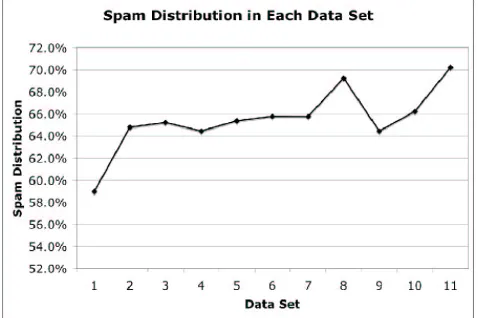
For our experiments we sorted the emails in the corpus chronologically by receiving date and evenly divided them into 11 subsets{D1, . . . ,D11}. In other words, the messages in subset n come chronologically before the messages in subset n+1. Experiments were run in an on-line fashion, that is, training on subset n and testing on subset n+1. Each subset contains approximately 3300 messages. The percentage of spam messages in each subset varies as in the operational setting (see Figure 1). We used the Multiple Instance Learning Tool Kit (MILK) (Xu, 2003) implementation of MILR and the Weka 3.4.7 (Witten and Frank, 2000) implementations of LR, SVM and multinomial na¨ıve Bayes, in our experiments. For the compression-based filter, we used the spam filter described in Bratko and Filipiˇc (2005), which uses the prediction by partial matching algorithm with escape method D (PPMD) and is available as part of the PSMSLib C++ library (Bratko, 2008).
6.2 Feature Selection and Weighting
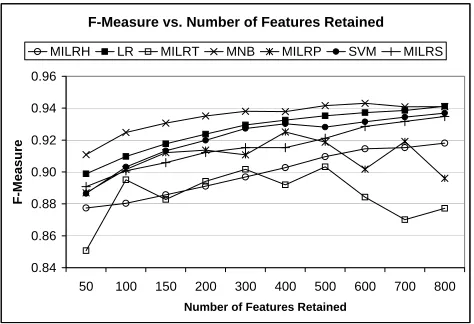
We reduced the feature space used to describe the emails in our experiments to the top 500 features ranked using information gain. Feature selection is necessary for reasons of efficiency and for avoiding the curse of dimensionality. It is also common practice in the spam filtering domain. In our experiments, retaining 500 features appeared to be the best compromise among the classifiers in terms of improved efficiency and impaired performance. Figure 2 shows how the performance of the classifiers varies as the number of retained features increases.
F-Measure vs. Number of Features Retained
0.84 0.86 0.88 0.90 0.92 0.94 0.96
50 100 150 200 300 400 500 600 700 800 Number of Features Retained
F
-M
e
a
s
u
re
MILRH LR MILRT MNB MILRP SVM MILRS
Figure 2: Effect of number of retained features on f-measure.
Attribute values for each email were calculated using the common tf-idf (term frequency inverse document frequency) weighting scheme. Under this weighting scheme, attributes are assigned a weight that corresponds to their importance to the email message in the corpus that contains them. The tf-idf weight for a given term in a given email is calculated as follows. Let f be the number of occurrences of the given term in the given email, the term frequency. We normalize f by dividing it by the maximum value of f for the given term over all emails in the corpus. Let t f be the normalized value of f . The inverse document frequency, id f , is log2(a
b)where a is the total number of emails in
the corpus and b is the number of emails in the corpus that contain the given term. Then the weight for the given term is w=t f×id f . Note that tf-idf weighting is widely used in information retrieval
and text mining, and has been shown to be able to greatly improve the performance of multinomial na¨ıve Bayes in several text categorization tasks (Kibriya et al., 2004).
6.3 Good Word List Creation
on the classification of messages that they are injected into. Such a list is more representative of the kind of list a spammer would be able to produce in practice, since the spammer would have no way of knowing the exact features used by the target filter. We noticed that in our experiments, only about 10% of the injected good words were actually retained in the feature vector, yet they had a significant impact on the classification. Nevertheless, we also tested the extreme case in which we assumed the adversary has perfect knowledge of the training set and the selected features. We created a local good word list from messages in each training set and kept only the words that are in the selected feature vector.
6.4 Threshold Values for Split-Term
The two threshold values, threshsand thresh`, must be determined for the splitting method split-term. As mentioned earlier, for each training set, threshs was selected such that some fraction of
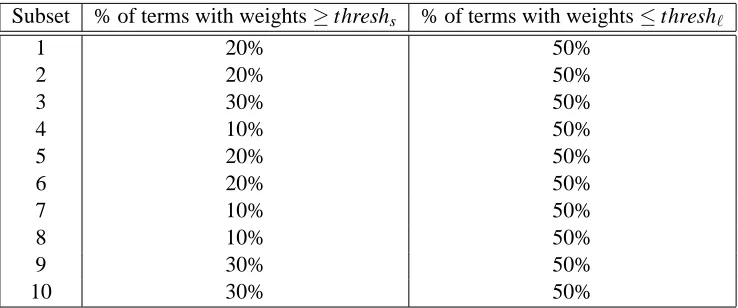
the terms chosen would have a weight greater than or equal to it. thresh`was selected so that some other fraction of the terms would have a weight less than or equal to it. For each of the ten training sets we selected, by using 5-fold cross validation, the best threshold values that divide the terms into three categories—spam, ham, and neutral.
The selected thresholds were used for testing on the test set. Table 1 lists the percentages of the terms divided by the thresholds selected for each training set.
Subset % of terms with weights≥threshs % of terms with weights≤thresh`
1 20% 50%
2 20% 50%
3 30% 50%
4 10% 50%
5 20% 50%
6 20% 50%
7 10% 50%
8 10% 50%
9 30% 50%
10 30% 50%
Table 1: Percentages of the terms divided by the MILRT threshold values selected for each training set.
7. Experimental Results
7.1 Experiment 1: Attacking the Test Set
In this experiment, we tested the ability of the MILR algorithm, using the four splitting methods introduced above, to classify email injected with good words. We also tested the single instance logistic regression (LR), support vector machine (SVM) and multinomial na¨ıve Bayes (MNB) clas-sifiers for comparison. The clasclas-sifiers were each trained and tested on the eleven chronologically sorted data sets in an on-line fashion. That is, all of the classifiers were trained on the same unal-tered data set Dn, and then tested on the data set Dn+1, for n=1...10. Fifteen variations of each test set were created to test the susceptibility of the classifiers to good word attacks of varying strengths. The first version of each test set was left unmodified, that is, no good words were injected. Half of the spam messages (selected at random) in each of the remaining 14 variations of each test set were injected with some quantity of random good words from our global good word list, beginning with 10 words. With each successive version of the test set, the quantity of good words injected into half of the spam messages was increased: first in increments of 10 words, up to 50, and then in incre-ments of 50 words up to 500. The injected words were randomly selected, without replacement, from our global good word list on a message by message basis. We chose to inject good words into only half of the messages in each test set because, in practice, spam messages injected with good words account for only a subset of the spam emails encountered by a given filter. The preci-sion of each classifier was fixed at 0.9 and the corresponding recall on each verpreci-sion of the test set for all 10 test sets was averaged and recorded for each classifier. In our results, we use “MILRH”, “MILRT”, “MILRP” and “MILRS” where split-H, split-T, split-P and split-S were used with MILR, respectively.
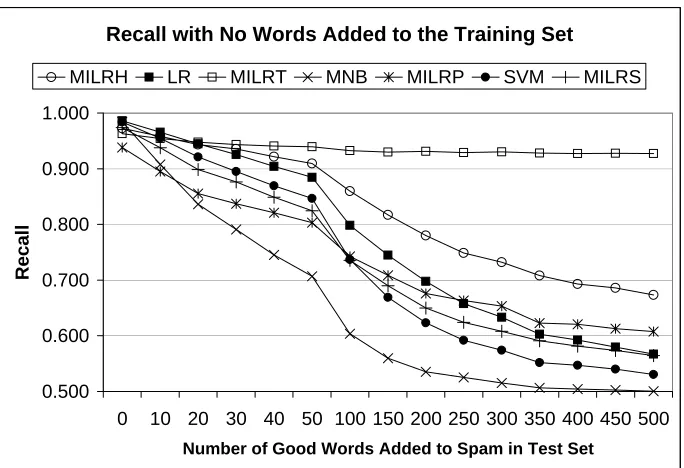
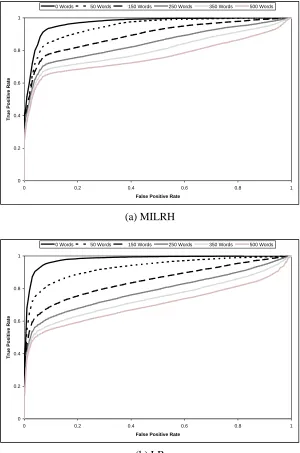
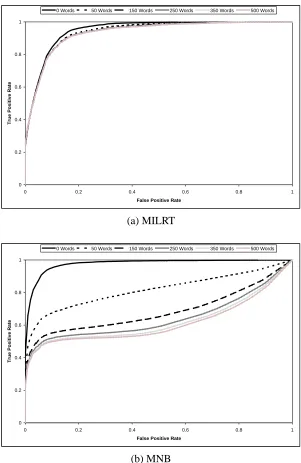
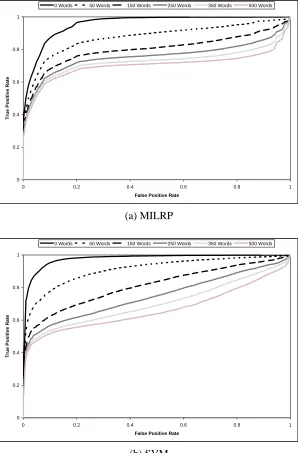
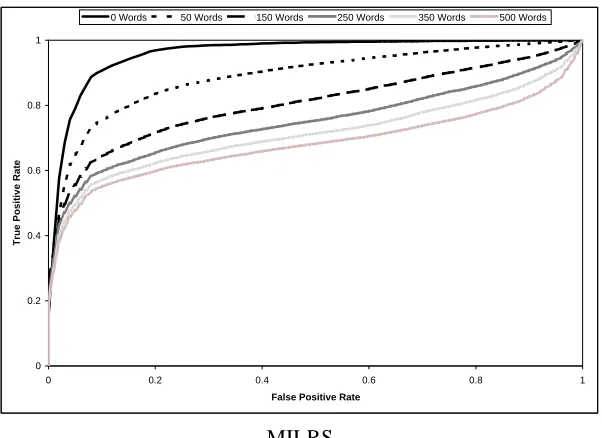
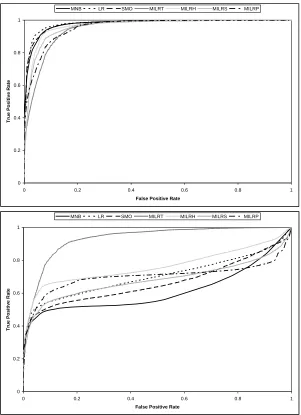
Figure 3 shows how the average recall of each classifier is affected as the good word attack increases in strength (that is, the quantity of good words injected into the spam emails increases). Figures 4-7 and Table 2 show the ROC curves and corresponding AUC values, respectively, for each classifier as the good words are injected. Each ROC graph contains six curves, each corresponding to a specific quantity of good words. We chose not to include curves for all quantities of good words in order to keep the graphs readable. To make comparison easier, Figure 8 shows two ROC graphs containing the ROC curves of all the classifiers when 0 words and 500 words are added to the test set respectively. ROC graphs show the tradeoffs between true positives and false positives and are commonly used to visualize the performance of classifiers (Fawcett, 2006). The total area under a ROC curve (AUC) is also commonly used as a metric to compare classifiers. The AUC of a spam classifier can be interpreted as the probability that the classifier will rate a randomly chosen spam email as more spammy than a randomly chosen legitimate email. In our results, each ROC curve shown is an average of the curves resulting from the ten subsets. The curves were averaged using the vertical averaging algorithm given by Fawcett (2006).
Recall with No Words Added to the Training Set
0.500 0.600 0.700 0.800 0.900 1.000
0 10 20 30 40 50 100 150 200 250 300 350 400 450 500
Number of Good Words Added to Spam in Test Set
R
e
c
a
ll
MILRH LR MILRT MNB MILRP SVM MILRS
Figure 3: The change in average recall, corresponding to a fixed precision of 0.9, as the quantity of good words injected into half of the spam messages in the test set increases; no good words were injected into the training set.
Words MILRT MILRH MILRS MILRP LR MNB SVM
0 0.946 0.966 0.962 0.957 0.981 0.976 0.979
10 0.945 0.962 0.944 0.934 0.968 0.935 0.961
20 0.943 0.956 0.928 0.914 0.958 0.898 0.946
30 0.941 0.953 0.917 0.901 0.948 0.871 0.933
40 0.941 0.949 0.903 0.888 0.939 0.842 0.921
50 0.940 0.943 0.889 0.875 0.928 0.816 0.910
100 0.937 0.919 0.838 0.831 0.883 0.730 0.855
150 0.935 0.893 0.804 0.800 0.845 0.684 0.810
200 0.935 0.868 0.775 0.774 0.813 0.656 0.774
250 0.934 0.844 0.749 0.756 0.785 0.642 0.745
300 0.934 0.825 0.730 0.741 0.764 0.631 0.725
350 0.933 0.803 0.712 0.726 0.742 0.622 0.702
400 0.933 0.786 0.699 0.714 0.727 0.617 0.689
450 0.933 0.775 0.688 0.710 0.712 0.614 0.675
500 0.933 0.762 0.681 0.702 0.702 0.611 0.664
Table 2: Area Under the ROC Curve as the Quantity of Injected Good Words is Increased.
0 0.2 0.4 0.6 0.8 1
0 0.2 0.4 0.6 0.8 1
False Positive Rate
T
ru
e
P
o
s
it
iv
e
R
a
te
0 Words 50 Words 150 Words 250 Words 350 Words 500 Words
(a) MILRH
0 0.2 0.4 0.6 0.8 1
0 0.2 0.4 0.6 0.8 1
False Positive Rate
T
ru
e
P
o
s
it
iv
e
R
a
te
0 Words 50 Words 150 Words 250 Words 350 Words 500 Words
(b) LR
0 0.2 0.4 0.6 0.8 1
0 0.2 0.4 0.6 0.8 1
False Positive Rate
T
ru
e
P
o
s
it
iv
e
R
a
te
0 Words 50 Words 150 Words 250 Words 350 Words 500 Words
(a) MILRT
0 0.2 0.4 0.6 0.8 1
0 0.2 0.4 0.6 0.8 1
False Positive Rate
T
ru
e
P
o
s
it
iv
e
R
a
te
0 Words 50 Words 150 Words 250 Words 350 Words 500 Words
(b) MNB
0 0.2 0.4 0.6 0.8 1
0 0.2 0.4 0.6 0.8 1
False Positive Rate
T
ru
e
P
o
s
it
iv
e
R
a
te
0 Words 50 Words 150 Words 250 Words 350 Words 500 Words
(a) MILRP
0 0.2 0.4 0.6 0.8 1
0 0.2 0.4 0.6 0.8 1
False Positive Rate
T
ru
e
P
o
s
it
iv
e
R
a
te
0 Words 50 Words 150 Words 250 Words 350 Words 500 Words
(b) SVM
0 0.2 0.4 0.6 0.8 1
0 0.2 0.4 0.6 0.8 1
False Positive Rate
T
ru
e
P
o
s
it
iv
e
R
a
te
0 Words 50 Words 150 Words 250 Words 350 Words 500 Words
MILRS
Figure 7: Average ROC curves of MILRS when specific quantities of good words are injected into half of the messages in the test set.
0.531) respectively. MILRS turned out to be nearly as vulnerable to the attack as the single instance classifiers, dropping by 42% (from 0.974 to 0.565) in average recall.
One thing that is clear from these results is that the effectiveness of our multiple instance coun-terattack strategy is very much dependent on the specific technique used to split emails into multiple instance bags. The success of the split-term method is due to the fact that the classifier is able to consider both spammy and legitimate terms independently, since they are placed into separate in-stances in the bag created from an email. Under the multiple instance assumption, if at least one instance in a bag is spammy, the entire bag is labeled as spammy. When good words are injected into a spam message they end up in the legitimate instance of the bag and have no effect on the spammy instance; thus the bag still contains a spammy instance and is classified correctly as spam. We verified this by running the experiment again on the following classifier configurations: MILR with no splitting (single instance bags), MILRT with the neutral and hammy instances discarded from each bag, and LR with spammy terms only (all legitimate terms were excluded from the fea-ture vector). We found that using MILR without any of the splitting methods (all bags contained a single instance), caused it to behave almost identically to the way LR behaved in experiment 1. We also found that discarding the neutral and hammy instances from the MILRT bags resulted in a classifier that was unaffected by the good word attack, but was only able to attain a maximum recall of 0.757 and a maximum precision of 0.906. Training LR on spammy terms only produced very similar results; it was unaffected by the good word attack, but only attained a maximum recall of 0.723 and a maximum precision of 0.931.
0 0.2 0.4 0.6 0.8 1
0 0.2 0.4 0.6 0.8 1
False Positive Rate
T
ru
e
P
o
s
it
iv
e
R
a
te
MNB LR SMO MILRT MILRH MILRS MILRP
0 0.2 0.4 0.6 0.8 1
0 0.2 0.4 0.6 0.8 1
False Positive Rate
T
ru
e
P
o
s
it
iv
e
R
a
te
MNB LR SMO MILRT MILRH MILRS MILRP
Figure 8: ROC curves for all classifiers when 0 words (top) and 500 words (bottom) have been injected into the test set.
Precision with No Words Added to the Training Set 0.463 0.607 0.402 0.772 0.113 0.276 0.071 0.000 0.200 0.400 0.600 0.800 1.000 P re c is io n
MILRH MILRP MILRS MILRT LR MNB SVM
Recall with No Words Added to the Training Set
0.416 0.466 0.348
0.743
0.057 0.055 0.034 0.000 0.200 0.400 0.600 0.800 1.000 R e c a ll
MILRH MILRP MILRS MILRT LR MNB SVM
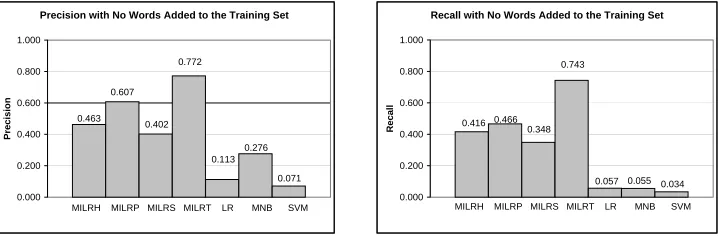
Figure 9: The average precision (left) and recall (right) of each classifier when injecting the entire local good word list into all of the spam messages in the test set.
7.2 Experiment 2: Training on Attacked Spam Messages
In the second experiment, our goal was to observe the effect that training on messages injected with good words has on the susceptibility of the classifiers to attacks on the test set. As in the previous experiment, we tested each of the classifiers on the eleven chronologically sorted data sets in an on-line fashion. This time, however, in addition to creating 15 versions of the test set injected with increasing quantities of good words, we also created 5 versions of the training set. We injected 10 good words into half of the spam messages (selected at random) in the first version of the training set and then increased the number of injected good words by 10 for each subsequent version, up to 50 good words for the fifth version. We also tried injecting larger numbers of good words, but after exceeding 50 words, the additional effect was minimal; therefore, those results are not shown here. For each version of the training set we tested the classifiers on the 15 versions of the corresponding test set. As before, good words were selected from our global good word list randomly and without replacement on a message by message basis. For all ten tests, the precision of each classifier was fixed at 0.9 and the corresponding recall values on each version of the test set were averaged and recorded, separately for each of the 5 versions of the training set. Figures 10– 14 show the change in average recall as the number of good words injected into the training set increased from 10 to 50. Figure 15 shows two graphs containing the ROC curves of all the classifiers when 0 good words and 500 good words are added to the test set respectively and 10 good words are added to the training set. Figure 16 shows the same curves after 50 good words have been added to the training set.
Injecting just 10 good words into half of the spam messages in the training set appeared to lessen the effect of the good word attack for almost all of the classifiers. In particular, the average recall of LR with 500 good words injected into half of the spam messages in the test set was 32.1% higher after 10 good words had been injected into the training set compared to when no good words had been injected into the training set (comparing Figures 3 and 10). Likewise, the average recall values of MNB, SVM, MILRH, MILRP and MILRS were 32.6% higher, 29.4% higher, 10.1% higher, 26.9% higher and 25.8% higher respectively. The average recall for MILRT was actually 5.5% lower even though it was still the best among all the classifiers.
Recall with 10 Words Added to the Training Set
0.650 0.700 0.750 0.800 0.850 0.900 0.950 1.000
0 10 20 30 40 50 100 150 200 250 300 350 400 450 500
Number of Good Words Added to Spam in Test Set
R
e
c
a
ll
MILRH LR MILRT MNB MILRP SVM MILRS
Figure 10: The change in average recall, corresponding to a fixed precision of 0.9, as the number of good words injected into half of the spam messages in the test set increases; 10 good words were also injected into half of the spam messages in the training set.
Recall with 20 Words Added to the Training Set
0.650 0.700 0.750 0.800 0.850 0.900 0.950 1.000
0 10 20 30 40 50 100 150 200 250 300 350 400 450 500
Number of Good Words Added to Spam in Test Set
R
e
c
a
ll
MILRH LR MILRT MNB MILRP SVM MILRS
Figure 11: The change in average recall, corresponding to a fixed precision of 0.9, as the number of good words injected into half of the spam messages in the test set increases; 20 good words were also injected into half of the spam messages in the training set.
attack. However, it is important to realize that this would only work in cases where the attacked messages being classified contained the same good words as the attacked messages that the spam filter was trained on. One of the major advantages of our proposed multiple instance strategy is that the spam filter need not be trained on attacked messages in order to be effective against attacks and further, that frequent retraining on attacked messages is not necessary for the strategy to maintain its effectiveness.
Recall with 30 Words Added to the Training Set
0.650 0.700 0.750 0.800 0.850 0.900 0.950 1.000
0 10 20 30 40 50 100 150 200 250 300 350 400 450 500
Number of Good Words Added to Spam in Test Set
R
e
c
a
ll
MILRH LR MILRT MNB MILRP SVM MILRS
Figure 12: The change in average recall, corresponding to a fixed precision of 0.9, as the number of good words injected into half of the spam messages in the test set increases; 30 good words were also injected into half of the spam messages in the training set.
To test the extreme case, in which an adversary has perfect knowledge of the training set and the selected features, we repeated the experiment using local good word lists for each training set. The words in each of the local good word lists were generated from the respective training set and were limited to only those good words that were in the selected feature vector for the training set. The entire contents of the local good word list were added to all of the spam messages in the corresponding training and test sets. Figure 17 shows the result of this attack on each of the classifiers in terms of precision and recall. Notice that for every classifier, with the exception of multinomial naive Bayes, the effects of the attack on the training set were completely countered by adding the same words to the spam messages in the training set; however, we should again point out that these results are possible only because the good words added to the spam messages in the training and test sets were the same. In practice, there is no such guarantee.
7.3 Attacking the Compression-Based Filter
Recall with 40 Words Added to the Training Set
0.650 0.700 0.750 0.800 0.850 0.900 0.950 1.000
0 10 20 30 40 50 100 150 200 250 300 350 400 450 500
Number of Good Words Added to Spam in Test Set
R
e
c
a
ll
MILRH LR MILRT MNB MILRP SVM MILRS
Figure 13: The change in average recall, corresponding to a fixed precision of 0.9, as the number of good words injected into half of the spam messages in the test set increases; 40 good words were also injected into half of the the spam messages in the training set.
Recall with 50 Words Added to the Training Set
0.650 0.700 0.750 0.800 0.850 0.900 0.950 1.000
0 10 20 30 40 50 100 150 200 250 300 350 400 450 500
Number of Good Words Added to Spam in Test Set
R
e
c
a
ll
MILRH LR MILRT MNB MILRP SVM MILRS
0 0.2 0.4 0.6 0.8 1
0 0.2 0.4 0.6 0.8 1
False Positive Rate
T
ru
e
P
o
s
it
iv
e
R
a
te
NBM LR SMO MILRT MILRH MILRS MILRP
0 0.2 0.4 0.6 0.8 1
0 0.2 0.4 0.6 0.8 1
False Positive Rate
T
ru
e
P
o
s
it
iv
e
R
a
te
NBM LR SMO MILRT MILRH MILRS MILRP
Figure 15: ROC curves for all classifiers when 0 good words (top) and 500 good words (bottom) have been injected into the test set and 10 good words have been injected into the training set.
0 0.2 0.4 0.6 0.8 1
0 0.2 0.4 0.6 0.8 1
False Positive Rate
T
ru
e
P
o
s
it
iv
e
R
a
te
NBM LR SMO MILRT MILRH MILRS MILRP
0 0.2 0.4 0.6 0.8 1
0 0.2 0.4 0.6 0.8 1
False Positive Rate
T
ru
e
P
o
s
it
iv
e
R
a
te
NBM LR SMO MILRT MILRH MILRS MILRP
Figure 16: ROC curves for all classifiers when 0 good words (top) and 500 good words (bottom) have been injected into the test set and 50 good words have been injected into the training set.
a word-level spam filter to misclassify emails containing such words unless extra care and effort are expended to detect and deal with these obfuscations. Bratko and Filipi ˇc (2005) implemented their compression-based spam filter using the prediction by partial matching algorithm with escape method D (PPMD). Their experiments for the Trec 2005 spam track showed promising results. They also demonstrated that their filter was indeed quite robust to obfuscation. To our knowledge, however, the effects of the good word attack on such filters have not yet been investigated.
Precision with All Words Added to the Training & Test Sets
0.994 0.999 0.992 0.978 1.000 0.986
0.730 0.000 0.100 0.200 0.300 0.400 0.500 0.600 0.700 0.800 0.900 1.000 P re c is io n
MILRH MILRP MILRS MILRT LR MNB SVM
Recall with All Words Added to the Training & Test Sets
1.000 0.882
1.000 1.000 1.000
0.642 0.901 0.000 0.100 0.200 0.300 0.400 0.500 0.600 0.700 0.800 0.900 1.000 R e c a ll
MILRH MILRP MILRS MILRT LR MNB SVM
Figure 17: The average precision (left) and recall (right) of each classifier when injecting the entire contents of each local good word list into all of the spam messages in the corresponding training and test sets.
for this type of filter, we ran the experiments using the raw version of the corpus. However, we also ran the two experiments using the preprocessed corpus in order to observe how well the filter stood up against the attack using the same data available to the other filters. Figure 18 shows the results of the first experiment with the PPMD filter on the raw (PPMD1) and preprocessed (PPMD2) corpora. The attack had no effect on the precision of the filter, regardless of which version of the corpus was used; it remained consistently at 0.999 and is not shown on the chart. On the other hand, the recall suffered as a result of the attack, on both corpora. The decrease in recall on the preprocessed corpus was comparable to that of the single instance algorithms. When the raw corpus was used, however, the effect was much less severe. The compression-based filter implementation discussed by Bratko and Filipiˇc (2005), which we used in these experiments, was set by default to truncate all messages to 2500 bytes, presumably for efficiency reasons. However, since our simulated attack appends good words to the bottom of the spam messages, it is possible that truncating the messages could result in some or all of the added good words being removed from spam messages that are longer than 2500 bytes. Therefore, we ran the experiment twice more, truncating at 5000 bytes and 10000 bytes. The result was a drop in average recall (when 500 good words are injected) to 0.702 when truncating at 5000 bytes and a drop to 0.627 when truncating at 10000 bytes, for PPMD1 (raw corpus) (see Figure 19). For PPMD2 (preprocessed corpus) the average recall dropped to 0.503 when truncating at 5000 bytes and dropped to 0.482 when truncating at 10000 bytes (see Figure 20). There was no additional drop in precision when truncating at 5000 or 10000 bytes.
Figure 21 shows the results of the second experiment on the PPMD filter, in terms of average recall, when 10 good words have been injected into the training set. Again, there was virtually no change in average precision so it is not shown on the charts. Apparently injecting 10 good words into the training set was enough to counter any number of good words in the test set. As figure 21 shows, the results of adding up to 50 good words to the training set are nearly identical.
PPMD with No Words Added to the Training Set
0.500 0.600 0.700 0.800 0.900 1.000
0 10 20 30 40
50 100 150 200 250 300 350 400 450 500
Number of Good Words Added to Spam in Test Set
R
e
c
a
ll
PPMD1 PPMD2
Figure 18: Effect of the good word attack on the PPMD algorithm as the number of good words added into half of the spam messages in the test set increases; no good words were added to the spam in the training set. Messages truncated at 2.5kB.
PPMD with No Words Added to the Training Set
0.450 0.550 0.650 0.750 0.850 0.950
0 10 20 30 40
50 100 150 200 250 300 350 400 450 500
Number of Good Words Added to Spam in Test Set
R
e
c
a
ll
PPMD1 PPMD2
Figure 19: Effect of the good word attack on the PPMD algorithm as the number of good words added into half of the spam messages in the test set increases; no good words were added to the spam in the training set. Messages truncated at 5kB.
8. Potential Attacks on the Splitting Methods
PPMD with No Words Added to the Training Set
0.450 0.550 0.650 0.750 0.850 0.950
0 10 20 30 40
50 100 150 200 250 300 350 400 450 500
Number of Good Words Added to Spam in Test Set
R
e
c
a
ll
PPMD1 PPMD2
Figure 20: Effect of the good word attack on the PPMD algorithm when half of the spam messages in the test set were altered. Messages truncated at 10kB.
PPMD with 10 Words Added to the Training Set
0.940 0.950 0.960 0.970 0.980 0.990 1.000
0 10 20 30 40 50 100 150 200 250 300 350 400 450 500
Number of Good Words Added to Spam in Test Set
R
e
c
a
ll
PPMD1 PPMD2
Figure 21: Effect of the good word attack on the PPMD algorithm when half of the spam in the training/test sets were altered; 10 words were added to the training spam.
PPMD with 50 Words Added to the Training Set
0.940 0.950 0.960 0.970 0.980 0.990 1.000
0 10 20 30 40 50 100 150 200 250 300 350 400 450 500
Number of Good Words Added to Spam in Test Set
R
e
c
a
ll
PPMD1 PPMD2
the attacked message is split, good words should outweigh spammy words in both instances. The example in Table 3 illustrates the idea.
From: [email protected] To: [email protected] Subject: meeting agenda
good words . . . low . . . good words good words . . . mortgage . . . good words good words . . . rate . . . good words
Table 3: Attacking split-H by fragmenting spam with injected good words.
We tested this attack by running MILRH (MILR with split-H) on the 11 data sets, with the test set at each iteration attacked with 500 good words in the following manner. 50% of the spam messages in each test set were selected at random to be attacked by inserting 3 random good words before and after every 6 words in the message. No more and no less than 500 words were inserted into any message, regardless of the length of the message. That is, in the case of short messages, after 3 good words were inserted before and after every 6 words of the message, words were added to the end of the message until a total of 500 words had been added. For long messages, once 500 words were added, the process was stopped. The good words were selected, without replacement, from the same global good word list used in the other experiments.
Figure 23 compares the effects of adding 500 good words to the messages in the manner just described to the effects of adding 500 good words by appending them to the end of the messages (as in experiment 1), in terms of the recall averaged over the ten tests (corresponding to a fixed pre-cision of 0.9). As the figure shows, attacking the messages in the manner described here drastically decreases the effectiveness of split-H, reducing the average recall of MILRH by 24.8% to 0.506 (compared to that of MILRH in experiment 1 with 500 good words added to the test set, which was 0.673). This attack had the same effect on the other splitting methods as did the attack in experiment 1 (Section 7.1) since the physical position of the words in the attacked messages has no influence on how they are split with those methods; thus, those results are not shown here.
A second way to defeat the split-H method is to append a very large block of good words to the spam messages, so that after the split, good words would still outweigh spammy words in both instances in the bag. In fact, we believe this is exactly what happened in experiment 1. Observe in Figure 3 that the average recall of MILRH did not really begin to drop significantly until after 50 good words had been injected into the spam messages in the test set. As even more good words were injected into the spam messages, the average recall continued to drop as the longer messages began to accumulate enough good words to outweigh the spammy words in both instances. In practice, depending on the length of the spam message, coming up with a large enough block of good words might prove difficult.
9. Conclusions and Future Work
Attack on Split-H
0.673
0.506 0.972
0.400 0.500 0.600 0.700 0.800 0.900 1.000
No Attack Split-H Attack Exp. 1 Attack Type of Attack
R
e
c
a
ll
Figure 23: A comparison of the effects of the split-H attack and the experiment 1 style attack, in terms of average recall, with precision fixed at 0.9.
instance bags and a logistic model at the instance level is learned indirectly by maximizing the bag-level binomial log-likelihood function. The proposed counterattack strategy has been demonstrated on good word attacks of varying strength and has been shown to be effective. Additionally, we have confirmed earlier reports that re-training on attacked as well as normal emails may strengthen a spam filter against good word attacks. One of the advantages of our proposed strategy, as demon-strated by our experiments, is that it is effective even when trained on normal email and that frequent re-training on attacked messages is not necessary to maintain that effectiveness. We presented sev-eral possible methods for creating multiple instance bags from emails. As was observed from our experimental results, the splitting method used ultimately determines how well the strategy per-forms. The splitting methods we presented here work fairly well, especially the split-term method, but there are possibly other, perhaps better, methods that could be used. We plan to investigate other possible splitting methods in the future.
Since it is an arms race between spammers and filter designers, we also plan to make our MI strategy adaptive as new spam techniques are devised, and on-line as the concept of spam drifts over time. In addition, we plan to investigate the possibility of extending the proposed multiple instance learning strategy to handle similar adversarial attacks in other domains.
References
S. Andrews, I. Tsochantaridis, and T. Hofmann. Support vector machines for multiple-instance learning. In NIPS 15, pages 561–568. MIT Press, 2003.
M. Barreno, B. Nelson, R. Sears, A. D. Joseph, and J. D. Tygar. Can machine learning be secure? In
ASIACCS ’06: Proceedings of the 2006 ACM Symposium on Information, computer and commu-nications security, pages 16–25, New York, NY, USA, 2006. ACM Press. ISBN 1-59593-272-0.
doi: http://doi.acm.org/10.1145/1128817.1128824.
A. Blum and A. Kalai. A note on learning from multiple-instance examples. Machine Learning, 30 (1):23–30, 1998.
A. Bratko. Probabilistic sequence modeling shared library.
http://ai.ijs.si/andrej/psmslib.html, 2008.
A. Bratko and B. Filipiˇc. Spam filtering using compression models. Technical Report IJS-DP-9227, Department of Intelligent Systems, Joˇzef Stefan Institute, Ljubljana, Slovenia, 2005.
J. Carpinter and R. Hunt. Tightening the net: A review of current and next generation spam filtering tools. Computers and Security, 25(8):566–578, 2006.
Y. Chen and J.Z. Wang. Image categorization by learning and reasoning with regions. Journal of
Machine Learning Research, 5:913–939, 2004.
Y. Chevaleyre and J.D. Zucker. Solving multiple-instance and multiple-part learning problems with decision trees and rule sets. application to the mutagenesis problem. In Proceedings of the 14th
Biennial Conference of the Canadian Society for Computational Studies of Intelligence, pages
204–214, 2001.
G. V. Cormack and T. R. Lynam. Spam track guidelines — TREC 2005-2007.
http://plg.uwaterloo.ca/ gvcormac/treccorpus06/, 2006.
N. Dalvi, P. Domingos, Mausam, S. Sanghai, and D. Verma. Adversarial classification. In
Proceed-ings of the 2004 ACM SIGKDD International Conference on Knowledge Discovery and Data Mining, pages 99–108. ACM Press, 2004.
T.G. Dietterich, R.H. Lathrop, and T. Lozano-P´erez. Solving the multiple-instance problem with axis-parallel rectangles. Artificial Intelligence Journal, 89(1-2):31–71, 1997.
T. Fawcett. An introduction to ROC analysis. Pattern Recognition Letters, 27:861–874, 2006.
T. G¨artner, P. Flach, A. Kowalczyk, and A. Smola. Multi-instance kernels. In Proceedings of the
19th International Conference on Machine Learning, pages 179–186, San Francisco, CA, 2002.
Morgan Kaufmann.
R. Jennings. The global economic impact of spam. Technical report, Ferris Research, 2005.
A.M. Kibriya, E. Frank, B. Pfahringer, and G. Holmes. Multinomila naive bayes for text categoriza-tion revisited. In Proceedings of the 17th Australian Joint Conference on Artificial Intelligence, pages 488–499. Springer, 2004.
J.Z. Kolter and M.A. Maloof. Using additive expert ensembles to cope with concept drift. In
Proceedings of the Twenty-second International Conference on Machine Learning, pages 449–
H. Lee and A. Ng. Spam deobfuscation using a hidden Markov model. In Proceedings of the Second
Conference on Email and Anti-Spam, 2005.
P. Long and L. Tan. PAC learning axis-aligned rectangles with respect to product distribution from multiple-instance examples. Machine Learning, 30(1):7–21, 1998.
D. Lowd and C. Meek. Adversarial learning. In Proceedings of the 2005 ACM SIGKDD
Inter-national Conference on Knowledge Discovery and Data Mining, pages 641–647. ACM Press,
2005a.
D. Lowd and C. Meek. Good word attacks on statistical spam filters. In Proceedings of the 2nd
Conference on Email and Anti-Spam, 2005b.
O. Maron and T. Lozano-P´erez. A framework for multiple-instance learning. Advances in Neural
Information Processing Systems, 10:570–576, 1998.
J. Newsome, B. Karp, and D. Song. Paragraph: Thwarting signature learning by training mali-ciously. In Recent Advances in Intrusion Detection: 9th International Symposium (RAID), pages 81–105, 2006.
J. Ramon and L.D. Raedt. Multi instance neural networks. In Proceedings of ICML-2000 workshop
on Attribute-Value and Relational Learning, 2000.
S. Ray and M. Craven. Supervised versus multiple instance learning: An empirical comparison. In
Proceedings of the 22nd International Conference on Machine Learning, pages 697–704, New
York, NY, 2005. ACM Press.
J. Rocchio Jr. Relevance feedback in information retrieval. In The SMART Retrieval System:
Ex-periments in Automatic Document Processing, pages 68–73. Prentice Hall, 1971.
J. Wang and J.D. Zucker. Solving the multiple-instance learning problem: A lazy learning approach. In Proceedings of the 17th International Conference on Machine Learning, pages 1119–1125, San Francisco, CA, 2000. Morgan Kaufmann.
S. Webb, S. Chitti, and C. Pu. An experimental evaluation of spam filter performance and robustness against attack. In The 1st International Conference on Collaborative Computing: Networking,
Applications and Worksharing, pages 19–21, 2005.
I.H. Witten and E. Frank. Data Mining: Practical Machine Learning Tools with Java
Implementa-tions. Morgan Kaufmann, San Francisco, CA, USA, 2000.
X. Xu. Statistical learning in multiple instance problems. Master’s thesis, University of Waikato, 2003.
X. Xu and E. Frank. Logistic regression and boosting for labeled bags of instances. In Proceedings
of the Pacific-Asian Conference on Knowledge discovery and data mining. Springer-Verlag, 2004.
W. Yih, J. Goodman, and G. Hulten. Learning at low false positive rates. In Proceedings of the
M.-L. Zhang and Z.-H. Zhou. Multi-label learning by instance differentiation. In The 22nd AAAI
Conference on Artificial Intelligence (AAAI’07), pages 669–674, Vancouver, Canada, 2007.
Q. Zhang and S. Goldman. EM-DD: An improved multiple-instance learning technique. In
Proceed-ings of the 2001 Neural Information Processing Systems (NIPS) Conference, pages 1073–1080,
Cambridge, MA, 2002. MIT Press.
Z.H. Zhou and M.L. Zhang. Ensembles of multi-instance learners. In ECML-03, 15th European