JOURNAL OF
INNOVATION IN
HEALTH INFORMATICS
The Heimdall framework for supporting
characterisation of learning health systems
Scott McLachlan
Queen Mary University of London, London, UK
Henry W. W. Potts
University College London, London, UK
Kudakwashe Dube
Massey University, Auckland, New Zealand
Derek Buchanan
Massey University, Auckland, New Zealand
Stephen Lean
Massey University, Auckland, New Zealand
Thomas Gallagher
University of Montana, Missoula, MT
Owen Johnson
University of Leeds, Leeds, UK
Bridget Daley
Blizzard Institute, Queen Mary University of London, London, UK
William Marsh
Queen Mary University of London, London, UK
Norman Fenton
Queen Mary University of London, London, UK
ABSTRACT
Background There are many proposed benefits of using learning health systems (LHSs), including improved patient outcomes. There has been little adoption of LHS in practice due to challenges and barriers that limit adoption of new data-driven technologies in healthcare. We have identified a more fundamental explanation: the majority of developments in LHS are not identified as LHS. The absence of a unifying namespace and framework brings a lack of consistency in how LHS is identified and classified. As a result, the LHS ‘community’ is fragmented, with groups working on similar systems being unaware of each other’s work. This leads to duplication and the lack of a critical mass of researchers necessary to address barriers to adoption.
Objective To find a way to support easy identification and classification of research works within the domain of LHS.
Method A qualitative meta-narrative study focusing on works that self-identified as LHS was used for two purposes. First, to find existing standard definitions and frameworks using these to create a new unifying framework. Second, seeking whether it was possible to classify those LHS solutions within the new framework. Results The study found that with apparently limited awareness, all current LHS works fall within nine primary archetypes. These findings were used to develop
Research article
Cite this article: McLachlan S, Potts H WW, Dube K, Buchanan D, Lean S, Gallagher T, Johnson O, Daley B, Marsh W, Fenton N. The Heimdall framework for supporting characterisation of learning health systems. J Innov Health Inform. 2018;25(2):77–87.
http://dx.doi.org/10.14236/jhi.v25i2.996
Copyright © 2018 The Author(s). Published by BCS, The Chartered Institute for IT under Creative Commons license http://creativecommons.org/licenses/by/4.0/
Author address for correspondence:
Scott McLachlan
Queen Mary University of London (QMUL) London E1 4FZ, UK
Email: [email protected]
Accepted May 2018
on September 12, 2020 by guest. Protected by copyright.
http://informatics.bmj.com/
McLachlan et al. The Heimdall framework for supporting characterisation of learning health systems 78
a unifying framework for LHS to classify works as LHS, and reduce diversity and fragmentation within the domain.
Conclusions Our finding brings clarification where there has been limited aware-ness for LHS among researchers. We believe our framework is simple and may help researchers to classify works in the LHS domain. This framework may enable realisation of the critical mass necessary to bring more substantial collaboration and funding to LHS. Ongoing research will seek to establish the framework’s effect on the LHS domain.
Keywords:electronic health records, learning health systems, learning healthcare systems, precision medicine
INTRODUCTION
Learning health systems (subsequently referred to as LHS) are defined by the Institute of Medicine (IoM) as systems in which alignment of scientific and cultural tools lead to knowledge generation to improve healthcare as a result of daily practice.1 Since LHS was conceptualised in 2007, they have been the focus of increasing research attention.2–6 The opportunity and promise of LHS have resulted in texts pre-senting collections of LHS-specific research1,7 creation of a new journal, Learning Health Systems,8 and new courses of academic study.9,10 We believe it could be the most signifi-cant development in healthcare since the advent of evidence based medicine (EBM) and electronic health records (EHRs) that support EBM.14–16 EHR has existed for more than 40 years11–13 and organisations that implemented EHR dis-covered reductions in costs, clinical testing and patterns of repeated and sometimes unneeded prescriptions. Enhanced co-ordination and communication between clinicians were seen to improve the quality of patient care.12,17–20
Despite the benefits, early EHR systems were considered expensive, focused on information gathering rather than improving healthcare.20 Development lacked clinical input, existed as multiple stand-alone systems, experienced slow adoption, suffered from trust and data quality issues, claims that systems increase or exacerbate risk for errors, and concerns over patient privacy and security.18,20 All of these issues are still seen as unresolved barriers to adoption of EHR.18,21–27 Despite this, EHRs are the foundation for LHS.
Efforts towards LHS, coupled with proposed changes to leg-islation, policy and the ethics of how clinicians engage with clinical datasets suggest an entirely new dimension to EHR. One in which they are used collectively as ‘big data’ and focused using individual patient’s attributes to identify causes and optimal treatments strategies for disease.
Descriptions developed in IoM reports are the basis of most author definitions and descriptions of LHS.28–33 Medical information systems that can be predictive, preventative, per-sonalised and participatory represent the core principles of 4P medicine.34 According to the IoM, these systems have the potential to identify groups at greatest risk of complications for purposes of targeting interventions.7 In parallel, maturing technologies such as large datasets, machine learning, and enhanced processing power further enable the concept of LHS.2,34,35
The IoM promoted EBM as the primary driver for LHS,7 yet their definition fails to describe LHS attributes which contrib-ute to quality, safety, efficiency and effectiveness of patient care.36 The four fundamental attributes37 listed in Figure 1 provide tangible metrics to compare and contrast LHS efforts. These attributes were not included in the IoM definition, but are widely found in LHS. They clarify the use of large EHR datasets as the source of knowledge for LHS achieving the goal of improving quality in individual patient care.
There are numerous examples of proposed benefits of LHS. For clinicians, these include assessing which laboratory or imaging tests may be more diagnostic given a patient’s presenting symptomology38; reducing risk from prescribing
1. An organizational architecture that facilitates formation of communities of patients, families, front-line clinicians, researchers and health system leaders who collaborate to produce and use big data;
2. Large electronic health and health care data sets (big data);
3. Quality improvement for each patient at the point of care brought about by the integration of relevant new knowledge generated through research; and
4. Observational research and clinical trials done in routine clinical care settings. Adapted from: [37]
Figure 1 Four elements of an LHS
on September 12, 2020 by guest. Protected by copyright.
http://informatics.bmj.com/
McLachlan et al. The Heimdall framework for supporting characterisation of learning health systems 79
errors31 and increasing awareness of pharmacogenetics.39 It is claimed that patients would benefit from advanced knowl-edge developed from the experiences and diagnoses of past patients, which saves time and reduces costs.38,40,41 A learn- ing healthcare organisation culture supports EBM, while suc-cessful integration of research into practice is what enables it.42 The ability to use technology to record, compare, contrast and present information in almost real-time enhances the input, analysis and decision phases of the learning lifecycle. Alternatively, it is said that the financial burden to implement and support health technology43–45 along with a persistent need for data and systems standardisation,45–48 interoper-ability46,49,50 and integration49,51 have all acted as barriers to broad LHS adoption.
In our group’s recent letter to the editor of this journal,52 we demonstrated the lack of awareness and barriers for researchers to appropriately identify their efforts as LHS solu-tions. We believe that this results from a number of significant problems in the domain. The lack of adequate classification and standardisation results in groups working on comparable systems not identifying their efforts as LHS, and may be the cause of unnecessary duplication of efforts and the observ- able lack of collaboration. The absence of a unifying frame-work means the domain is yet to generate a necessary critical mass, limiting efforts to resolve barriers and challenges to the adoption of LHS and constraining funding availability. We were only able to identify one primary article that attempted to consolidate and analyse the current state of knowledge in LHS.36 We extend that effort drawing on a larger collection of works to establish a unifying framework for LHS.
METHOD
Our study sought first to define a comprehensive framework and taxonomy for LHS, and then to demonstrate its applica-tion to self-identified literature from the LHS domain. The
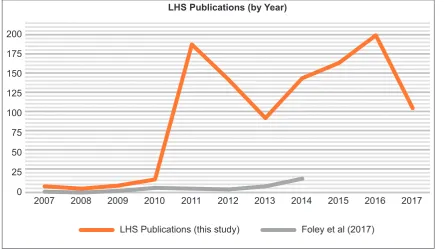
literature search used identical plain language search terms as Foley and Vale36: ‘LHS’ and ‘learning healthcare sys-tem’ drawing articles from Scopia, Science Direct, PubMed, EBSCOhost, DOAJ and Elsevier (n = 1083). These works were all authored in the decade since the IoM’s initial LHS report.7 Figure 2 shows this literature, by year, in orange (the drop in 2017 is due to reporting only up to July); con-trasted with literature identified by Foley and Vale36 shown in grey. The leap in publications in 2011 followed the first53 and second54 meetings of the Committee on the Learning Healthcare System in America, both proceedings published during 2011. More than 50% of LHS publications were gen-erated since 2013.
We undertook this review following the identification of seminal sources approach of meta-narrative reviewing.27,55 An initial read of abstracts was used to reject duplicates and papers not related to the central topic, including those using the search term in context of learning in the academic or edu-cation sense.56,57 This reduced the collection source pool (n = 542). Conclusions and methods were reviewed, seeking to reject papers that did not present or propose an LHS; for example, those exploring the medicolegal, ethical or societal aspects of LHS.31,58,59 The resulting core pool (n = 230) was then comprehensively reviewed. Of these, 53% proposed a potential solution compared to 47% that presented an exist-ing solution.
We used content and thematic analysis60 to recognise and classify LHS uses while also identifying common barriers and thematic concepts for investigation. Formal concept analy-sis61 was used to identify the frequency and interrelation-ships between the identified concepts. The elements of both analysis methods were identified inductively during the first full reading of the core pool of literature and used to develop spreadsheets for analysis. A second full reading was per-formed to data mine the literature and populate spreadsheets for further analysis during framework development. Table 1
LHS Publications (by Year)
2007 0 25 50 75 100 125 150 175 200
2008 2009 2010 2011 2012 2013 2014 2015 2016 2017
LHS Publications (this study) Foley et al (2017)
Figure 2 LHS publications by year
on September 12, 2020 by guest. Protected by copyright.
http://informatics.bmj.com/
McLachlan et al. The Heimdall framework for supporting characterisation of learning health systems 80
provides examples of attributes identified for the formal con-cept analysis.
RESULTS
Taxonomy for LHS
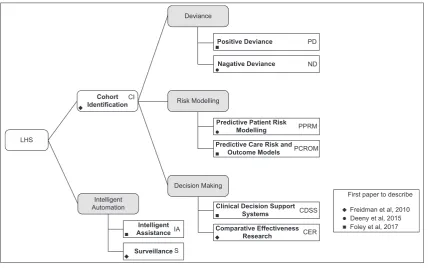
We found only three papers36,62,63 that proposed classifi-cation systems for LHS. Surveillance and Comparative Effectiveness Research were the only types common to all three. Figure 3 unifies the knowledge identified from all three papers into a taxonomy of nine LHS classification types, indicating abbreviations (initials) and the primary ref-erence for each.
Cohort identification (CI) seeks patients with similar attri- butes, used to determine the feasibility of studies and quan-tify numbers of potential patients that may be helped.62 CI is also the first operational step of most other LHS types.
Positive deviance (PD) uses outcome data to benchmark clinical care. PD identifies elements of safer, more effective, timely and patient-centred care, recognising beneficial behav-iours for incorporation into another clinician’s practice.64 PD can also identify common traits of patients benefiting from a treatment, using these to identify others who may benefit from the same intervention.62
Negative deviance (ND) identifies instances of sub-optimal care outcomes. ND presupposes some particular clinical behaviour negatively impacted patient care and the resulting outcome. The clinician critically evaluates the care provided, investigating causes for sub-optimal results.63
Predictive patient risk modelling (PPRM) uses patterns dis-covered in patient datasets to identify cohorts at higher risk for future adverse events. PPRM can use routine health data to identify ‘triple fail’ events; where treatment fails to improve patient care experiences, population health, or lower health-care costs.65
Predictive care risk and outcome model (PCROM) algo-rithms identify situations of high risk for ‘unsafe’, ‘delayed’ or ‘inefficient’ care, providing estimates of the effectiveness of different interventions.36 Geisinger Health Systems have incorporated PCROM approaches into clinical software, iden- tifying when spikes in hospital activity or patient non-atten-dance may occur.66
Clinical decision support systems (CDSSs) are active knowledge systems where two or more characteristics of the patient are matched to computerised knowledge bases with algorithms generating patient-specific treatment recommendations.67–69
Comparative effectiveness research (CER) compares interventions and outcomes within an EHR dataset to deter-mine the most effective treatment, using a method consid-ered more efficient than randomised control trials.36 CER isolates patients with similar attributes to the current patient, Table 1 LHS formal concept analysis attributes
Proposes LHS solution Presents LHS solution
Promotes LHS LHS related Law/Legislation/Policy
Ethics for LHS Patient engagement Clinician engagement Patient confidentiality
Privacy Security
Quality Improvement/Metrics Country
LHS type LHS project name
LHS
Intelligent Automation
Decision Making
Intelligent Assistance Cohort
Identification
Positive Deviance
Nagative Deviance
Predictive Patient Risk Modelling Predictive Care Risk and
Outcome Models
Surveillance
Clinical Decision Support Systems Comparative Effectiveness
Research
Risk Modelling CI
IA
S
CDSS PPRM ND PD
PCROM
CER Deviance
First paper to describe
Freidman et al, 2010 Deeny et al, 2015 Foley et al, 2017
Figure 3 LHS taxonomy
on September 12, 2020 by guest. Protected by copyright.
http://informatics.bmj.com/
McLachlan et al. The Heimdall framework for supporting characterisation of learning health systems 81
returning knowledge on treatments that deliver optimum health outcomes.70
Intelligent assistance (IA) uses data sources to automate routine processes such as prepopulating pathology orders and clinical notes, or summarising patient case notes prior to consultations.36
Surveillance (S) monitors EHR data for outbreaks of dis-ease (e.g., measles) or treatment issues (e.g., contaminated medicines or increased frequency for post-surgical infec-tions). Examples observed include health and demographic surveillance systems used in sub-Saharan Africa.71
The Heimdall-integrated LHS framework
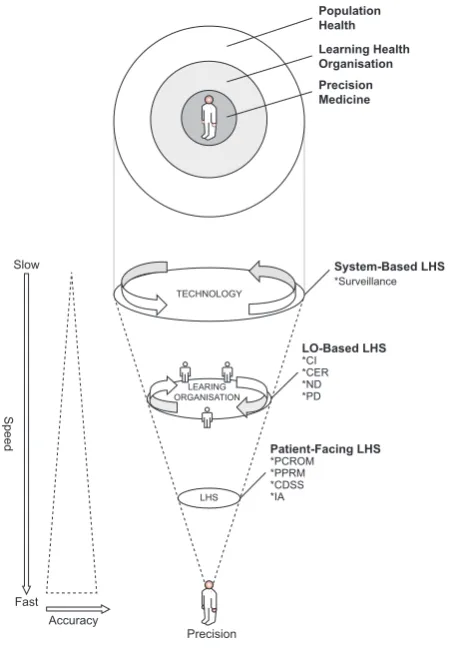
Just as the Norse God Heimdall was said to be the son of nine mothers, we started from our nine LHS classifications to develop the integrated LHS framework in Figure 4. The diagram’s conical structure demonstrates the use of technol-ogy (large datasets and processing systems) to record, store, index and present information that flows into and improves the learning processes used in EBM, focusing clinical prac-tice towards delivery of precision medicine (PM). This enables the learning healthcare organisation to engage in decisions individualised to match unique patient characteristics.PM results from enhancing the generalised population health approach using attributes in the EHR to constrain analysis for diagnosis and treatment options to cohort pre-dominately matching the presenting patient’s profile. As the clinician enters attributes about the current patient, the speed
and accuracy of decisions increase as illustrated by arrows in Figure 4. LHS draws knowledge from a reducing cohort whose attributes predominately match the current patient as illustrated by the circular design. In examining a cross-sec-tion of Figure 4, the larger white circle represents the entire population used to select the most effective common treat-ment. The light grey circle reduces that population to those who share some basic attributes with the patient that would normally be identified in the slower learning organisation approach of EBM. The inner dark circle further reduces the population to a significant cohort with clinical, genetic and socioeconomic attributes predominately matching the patient at the centre. The interrelationship between the Heimdall framework and our taxonomy is shown down the right side of the conical portion of the diagram. While LHS is technol-ogy solutions, the majority operate in the context of either the treatment provider’s learning organisation, or the clinician’s primary patient-facing role.
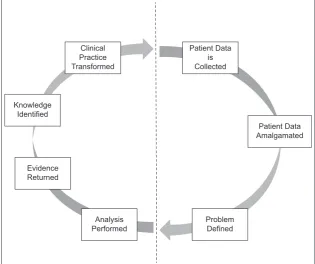
Within this framework, we incorporate the concept of a clinical lifecycle as shown in Figure 5 and adapted from mul-tiple works in this review.63,66,70 The right side of the diagram represents largely clinician-driven aspects, while the left side identifies those aspects where LHS technology delivers improvements. The more challenging barriers to LHS regard-ing data quality, interoperability and standardisation all result from activities on the right side of the lifecycle.
This cycle is repeated, both for surveilling the proposed transformation and to seek further items of knowledge.63,66,70 LHS engenders a close relationship between care, research and knowledge translation, aimed at providing a platform for integrating various data to better understand patients.72 LHS is commonly described using an iterative lifecycle similar to many other EBM processes where: (a) patient data is collected by clinicians; (b) aligned, transformed and amalgamated into larger data sets; (c) a problem is defined and (d) analysis per-formed; (e) with evidence data returned and (f) made into new knowledge, that is, (g) used to transform clinical practice.
The taxonomy and Heimdall framework provided a tool-kit for characterising LHS literature in terms of the following thematic and analytical aspects to assess whether the LHS demonstrates:
• Taxonomic consistency – conforms to the taxonomy. • Patient focused – ensures personalised health care,
known as PM.
• Technology usage – uses health IT with big data, machine learning algorithms and automation. • Decision support – near real-time support to
clinicians, bringing recent scientific advances, machine learning and EBM together at point-of-care. • Application of LHS – goes beyond selecting ‘most
likely treatment for a population’, to selecting the ‘most applicable treatment for an individual’.
• Barriers and further observations – challenges limiting implementation.
What follows is a survey and discussion using the Heimdall framework to identify and resolve key questions from within Population
Health Learning Health Organisation Precision Medicine
Slow
Fast Accuracy
Precision
LHS
LEARING ORGANISATION
TECHNOLOGY
System-Based LHS
LO-Based LHS
Patient-Facing LHS *Surveillance
*CI *CER *ND *PD
*PCROM *PPRM *CDSS *IA
Speed
Figure 4 The LHS unifying framework
on September 12, 2020 by guest. Protected by copyright.
http://informatics.bmj.com/
McLachlan et al. The Heimdall framework for supporting characterisation of learning health systems 82
the domain of LHS. Answers to these questions were resolved through applying the framework to the broader lit-erature cohort.
Validation of the LHS taxonomy
To validate our taxonomy, proposed or presented solutions were reviewed and classified using the taxonomic descrip-tions. Some proposed solutions were incompletely described, but we found that the intention of the authors was always clear from the information presented. All LHS solutions con-formed easily to one of our identified taxonomic types. We believe this validates the taxonomy as we have presented. Our validation of the taxonomy also found that CER were the most prevalent type of LHS presented in the literature, as identified in Table 2. CER was followed at some distance by stand-alone CI, although it should be noted that this clas-sification type had not been identified by either Deeny and Steventon63 or Foley and Vale36.
DISCUSSION
A number of themes emerged during this analysis and are discussed in the following section, which includes topical analysis to investigate their effect on the LHS domain.
Patient focused
While clinicians argue they always practiced patient-focused medicine, normal clinical practice follows population medi-cine-based EBM.73 PM extends diagnostic practices with pro-filing techniques and therapies tailored to the individual.74,75 Patient focus is a key dimension that LHS improve.36 PM approaches can be retrospective, as in CER, and prospective, when genotyping for treatment selection.74,75 Patient-centred
care encourages data use in optimising care for individuals.76 Aggregated patient records enable LHS to identify cohorts similar to the patient.77 LHS is an efficient tool for integrating PM into practice. As the clinician enters attributes about the patient, the LHS refines a cohort of prior similar patients. It assesses the treatments they received to recommend one most likely to produce an optimal outcome.
Technology usage
The focus for health IT has shifted from issues of adoption to identifying how to best use technology to improve healthcare delivery and outcomes.78 This shift is significant in creating LHS and elevates issues in EMR/EHR interoperability, data standardisation and quality that must be resolved if LHS is to be truly practical and ubiquitous.78–80 Health IT’s ability to improve healthcare service delivery quality and efficiency is recognised.81,82 Enabling necessary data flow and integration of data sources are key abilities technology can deliver, rep-resenting core requirements to enabling LHS.72,83 Integration of learning into technology is observed in every LHS solution
Patient Data is Collected
Patient Data Amalgamated
Problem Defined Analysis
Performed Evidence
Returned Knowledge
Identified
Clinical Practice Transformed
Figure 5 An example of the clinical lifecycle
Table 2 Distribution of LHS solutions (per 100 publications)
CER 44
CI 14
CDSS 13
PPRM 10
PD 8
IA 3
ND 3
S 3
PCROM 2
on September 12, 2020 by guest. Protected by copyright.
http://informatics.bmj.com/
McLachlan et al. The Heimdall framework for supporting characterisation of learning health systems 83
reviewed. Technology is fundamental to LHS. As EBM evolves from paper-based roots, clinicians and healthcare providers will realise benefits from coupling technology to Learning Health Organisations, thus realising LHS.79,84
Decision support
Healthcare providers evolved from considering health IT as a billing and documentation facilitator, to contemplating its active participation and capabilities to answer complex ques-tions in care delivery.85 LHS brings opportunities for improv-ing speed and efficiency of clinical decision support.83,85,86 LHS solutions are context-sensitive, incorporating CI and risk modelling in real time to identify interventions for improv-ing individual patient outcomes.87,88 LHS has potential to rapidly perform retrospective comparative effectiveness tri-als, evaluating treatment options against each other where they have been provided to similar patients.88,89 In contrast with randomised clinical trials, LHS is considered safer, and engenders greater confidence in accuracy of the treatment choice.88,89
Application of LHS
Clinical epidemiology is an example of learning healthcare. EBM evolved from clinical epidemiology: statistically identi-fying the optimal treatment which becomes best practice for that condition.90,91 Conversely, the focus for PM is select-ing from available interventions the treatment that will best serve the individual. The primary driver towards population medicine was economic: maximising benefit while minimising cost, harm and waste.90 While meant for benefiting the indi-vidual patient, population medicine has disadvantages in that the individual’s best interests may conflict with those of the population and it is difficult to reconcile the two.76,90 Individual patients may be denied higher priced precision interventions in favour of lower cost population-optimised interventions.90 The Heimdall framework demonstrates that LHS focus healthcare using population medicine and EBM directly onto the present-ing patient. While EBM selects one treatment for all patients, LHS produces a cohort with attributes similar to the presenting patient, identifying the treatment most likely to be effective for this individual patient. LHS in this way delivers PM.
Barriers and further observations
Most authors discuss barriers to implementation. The most common are cost,32,92,93 data interoperability and standardi-sation,94–96 poor data quality and integrity,63,97,98 informed consent and ethics review complications,99–101 privacy and security issues70,95 and slow technology adoption.95,102,103 These issues are seen in the same context for adopting
EHR/EMR. This suggests LHS is inheriting problems from the EHR/EMR on which they depend.
CONCLUSION
LHS represents a significant improvement on the present learning organisation, evidence-based practice and population medicine approaches. LHS improves the focus on the individ-ual patient, bringing efficient and expedient PM solutions. LHS is a significant evolution to EBM, and the natural next step in realising the benefits that were expected from implementing EHR/EMR. However, the lack of taxonomy for classifying and describing LHS may be a significant reason for fragmented and duplicated research and solutions in LHS that has impeded widespread adoption. Many authors presenting solutions fail to identify them as LHS. Our research has presented a taxonomy and framework to address this problem, and may help address the challenges in realising all that LHS promise.
Funding
Scott McLachlan, William Marsh and Norman Fenton acknowl-edge support from the EPSRC under project EP/P009964/1: PAMBAYESIAN: Patient Managed decision-support using Bayes Networks. Henry W. W. Potts has received consul-tancy fees from Crystallise and The HELP Trust, and funding from myownteam and Shift.ms. Owen Johnson was sup-ported by ClearPath Connected Health Cities Project.
Competing Interests
None of the authors identified a competing interest relevant to this research.
Contributors
William Marsh raised the topic, leading to Scott McLachlan performing the primary research and preparing the first draft of this paper. Kudakwashe Dube proposed formation of the framework, Owen Johnson developed the initial framework which was further enhanced by Derek Buchanan from the clinician’s perspective. Derek Buchanan and Bridget Daley provided review and input based on clinical experience. The initial method was proposed by Scott McLachlan, extended and significantly improved by Henry W. W. Potts, with Stephen Lean, Kudakwashe Dube and Thomas Gallagher providing input to the survey structure and framework. Thomas Gallagher, Kudakwashe Dube, Norman Fenton, Bridget Daley, Stephen Lean and Henry W. W. Potts provided editorial review. Norman Fenton and William Marsh super-vised the research. All authors commented on and approved the final draft.
REFERENCES
1. IoM. Digital Infrastructure for the Learning Health System: The Foundation for Continuous Improvement in Health and Health Care.Washington,DC: Institute of Medicine, 2011. Available from: https://www.ncbi.nlm.nih.gov/books/NBK83569/pdf/Bookshelf_ NBK83569.pdf.
2. Friedman C, Rubin J, Brown J, Buntin M, Corn M, Etheredge L, et al. Toward a science of learning systems: a research agenda for the high-functioning learning health system. Journal of American Medical Informatics Association
2015;22:43–50.
on September 12, 2020 by guest. Protected by copyright.
http://informatics.bmj.com/
McLachlan et al. The Heimdall framework for supporting characterisation of learning health systems 84
3. OECD. Data-Driven Innovation: Big Data for Growth and Well-Being. Paris, France: OECD Publishing, 2015.
4. Hanna N. Mastering Digital Transformation: Towards a Smarter Society, Economy, City and Nation. Bingley, UK: Emerald Group Publishing, 2016.
5. Rubin J and Friedman C. Weaving together a healthcare improvement tapestry: learning health system brings together health IT data stakeholders to share knowledge and improve health.Journal of AHIMA 2014;85(5):38–43.
6. Lim S, Keung C, Zhao L, Curcin V, Ethier J, Burgun A, et al. TRANSFoRm: Implementing a Learning Healthcare System in Europe through embedding clinical research into clinical prac-tice. International Conference on System Sciences (HICSS)
(Hawaii), 2015.
7. IoM. Foreward. In: Olsen L, Aisner D and McGinnis M (Eds.),
The Learning Healthcare System: Workshop Summary. Washington, DC: Institute of Medicine, 2007.
8. Wiley. Learning health systems. 2017. Available from: http:// onlinelibrary.wiley.com/journal/10.1002/. Accessed 13 September 2017.
9. UCLPartners. Learning health systems. 2016. Available from: https://uclpartners.com/events/learning-health-systems/. Accessed 13 September 2017.
10. UCL. Health informatics. 2017. Available from: http://www.ucl. ac.uk/health-informatics. Accessed 13 September 2017.
11. Basden A and Clark E. Data integrity in a general prac-tice computer system (CLINICS). International Journal Bio-Medical Computing 1980;11:511–9. Available from: https://doi. org/10.1016/0020-7101(80)90017-3.
12. Yucha C and Reigeluth C. The use of computers in nurs-ing education, practice and administration. Computer Education 1983;7(4):223–6. Available from: https://doi. org/10.1016/0360-1315(83)90011-8.
13. Sengstack P and Boicey C. Mastering Informatics: A Healthcare Handbook for Success. Indianapolis, IN: Sigma Theta Tau, 2015. PMid:25921891.
14. Sur R and Dahm P. History of evidence based medicine.
Indian Journal of Urology 2011;27(4):487–9. Available from: https://doi.org/10.4103/0970-1591.91438. PMid:22279315; PMCid:PMC3263217.
15. Smith G. Electronic Health Record. Los Angeles, CA: California Department of Alcohol and Drug Programs, 1980.
16. Gans D, Kralewski J, Hammons T and Dowd B. Medical groups’ adoption of of electronic health records and information sys-tems. Health Affairs 2005;24(5):1323–33. Available from: https://doi.org/10.1377/hlthaff.24.5.1323. PMid:16162580.
17. Rumball-Smith J, Shekelle P and Bates D. Using the Electronic Health record to understand and minimise overuse. Journal of the American Medical Association 2017;317(3):257–8. Available from: https://doi.org/10.1001/jama.2016.18609. PMid:28114561.
18. Hudis C. Comment on Health Care Competition. Alexandria, VA: American Society of Clinical Oncology, ASCO Website, 2014.
19. Klimt C, Becker S, Fox BS and Ensminger F. A transcribed emer-gency record at minimum cost. Annals of Emergency Medicine 1983;12(9):556–8. Available from: https://doi.org/10.1016/ S0196-0644(83)80297-2.
20. Wyatt J. Clinical data systems, part 1: data and medical records.The Lancet 1994;344:1543–7. Available from: https:// doi.org/10.1016/S0140-6736(94)90353-0.
21. Menachemi N and Collum T. Benefits and drawbacks of elec-tronic health record systems.Risk Management and Healthcare Policy 2011;4:47–55. Available from: https://doi.org/10.2147/ RMHP.S12985. PMid:22312227; PMCid:PMC3270933.
22. Cresswell K, Mozaffar H, Lee L, Williams R and Sheikh A. Safety risks associated with the lack of integration and inter-facing of hospital health information technologies: a qualitative study of hospital electronic prescribing systems in England. British Medical Journal of Quality and Safety 2017;26:530–41.
23. Furukawa M, King J, Patel V, Hsiao CJ, Adler-Milstein J and Jha AK. Despite substantial progress in EHR adoption, health information exchange and patient engagement remain low in office settings.Health Affairs 2014;33(9):1672–9. Available from: https://doi.org/10.1377/hlthaff.2014.0445. PMid:25104827.
24. Tange H. How to approach the structuring of the medical record? Towards a model for flexible access to free text medical data. International Journal of Biomedical Computing 1996;42:27–34. Available from: https://doi.org/10.1016/0020-7101(96)01178-6.
25. Roos L, Sharp S and Wadja A. Assessing data quality: a computer-ised approach.Social Science and Medicine 1989;28(2):175–82. Available from: https://doi.org/10.1016/0277-9536(89)90145-7.
26. Koppel R, Metlay JP, Cohen A, Abaluck B, Localio AR, Kimmel SE, et al. Role of computerized physician order entry systems in facilitating medication errors.Journal of the American Medical Association 2005;293(10):1197–203. Available from: https://doi. org/10.1001/jama.293.10.1197. PMid:15755942.
27. Greenhalgh T, Potts HW, Wong G, Bark P and Swinglehurst D. Tensions and paradoxes in electronic patient record research: a systematic literature review using the meta-narrative method.The Millbank Quarterly 2009;87(4):729–88. Available from: https:// doi.org/10.1111/j.1468-0009.2009.00578.x. PMid:20021585; PMCid:PMC2888022.
28. Grumbach K, Lucey C and Johnston C. Transforming from centres of learning to learning health systems: the challenge for academic health centres.Journal of the American Medical Association 2014;311(11):1109–10. Available from: https://doi. org/10.1001/jama.2014.705. PMid:24643597.
29. Bhandari R, Feinstein AB, Huestis SE, Krane EJ, Dunn AL, Cohen LL, et al. Pediatric-collaborative health out-comes information registry (Peds-CHOIR): a learning health system to guide pediatric pain research and treatment.
PAIN 2017;157(9):2033–44. Available from: https://doi. org/10.1097/j.pain.0000000000000609. PMid:27280328; PMCid:PMC4988911.
30. Crawford L, Matczak GJ, Moore EM, Haydar RA and Coderre PT. Patient-centered drug development and the Learning Health System. Learning Health Systems 2017;1(3):1–7.
31. Faden R, Kas NE, Goodman SN, Provost P, Tunis S and Beuchamp TL. An ethics framework for a Learning Health Care System: a departure from traditional research ethics and clini-cal ethics. Ethical Oversight of Learning Health Care Systems, Hastings Centre Report Special Report. 2013.
32. SCOAP Collaborative; Writing Group for the SCOAP Collaborative; Kwon S, Florence M, Grigas P, Horton M,
on September 12, 2020 by guest. Protected by copyright.
http://informatics.bmj.com/
McLachlan et al. The Heimdall framework for supporting characterisation of learning health systems 85 Horvath K, Johnson M, et al. Creating a learning healthcare
system in surgery: Washington State’s Surgical Care and Outcomes Assessment Program (SCOAP) at 5 years.Surgery
2011;151(2):146–52. PMCid:PMC4208432.
33. Gold M, Hossain M and Mangum A. Consumer engage-ment in Health IT: distinguishing rhetoric from reality.eGEMS
2015;3(1):1190. Available from: https://doi.org/10.13063/2327-9214.1190. PMid:26665120; PMCid:PMC4672873.
34. Flores M, Glusman G, Brogaard K, Price ND and Hood L. P4 Medicine: how systems medicine will transform the healthcare sector and society. Personalised Medicine
2013;10(6):565–76. Available from: https://doi.org/10.2217/ pme.13.57. PMid:25342952; PMCid:PMC4204402.
35. Friedman C, Allee NJ, Delaney BC, Flynn AJ, Silverstein JC, Sullivan K, et al. The science of learning health systems: foun-dations for a new journal.Learning Health Systems 2016;1.
36. Foley T and Vale L. What role for learning health systems in quality improvement within healthcare providers? Learning Health Systems 2017;1(4).
37. Forrest C, Margolis P, Seid M and Colletti RB. PEDSnet: how a prototype pediatric learning health system is being expanded into a national network. Health Affairs 2014;33(7):1171–7. Available from: https://doi.org/10.1377/hlthaff.2014.0127. PMid:25006143.
38. Everson J. The implications and impact of 3 approaches to health information exchange: community, enterprise, and ven-dor-mediated health information exchange. Learning Health Systems 2016;1:e10021.
39. Etheredge L. A rapid-learning health system. Health Affairs
2007;26(2):107–18. Available from: https://doi.org/10.1377/ hlthaff.26.2.w107. PMid:17259191.
40. Curcin V. Embedding data provenance into the learning health system to facilitate reproducible research. Learning Health Systems 2017;1(2):e10019.
41. Faden R, Kass N, Whicher D, Stewart W and Tunis S. Ethics and Informed Consent for Comparative Effectiveness Research with prospective electronic clinical data. Medical Care
2013;51(8):S53–7. Available from: https://doi.org/10.1097/ MLR.0b013e31829b1e4b.
42. Kitson A and Harvey G, McCormack B. Enabling the imple-mentation of evidence based practice: a conceptual frame-work. Quality in Health Care 1998;7:149–58. Available from: https://doi.org/10.1136/qshc.7.3.149. PMid:10185141; PMCid:PMC2483604.
43. Cherry B, Carter M, Owen D and Lockhart C. Factors affect-ing electronic health record adoption in long-term care facili-ties. Journal for Healthcare Quality 2008;30(2):37–47. Available from: https://doi.org/10.1111/j.1945-1474.2008.tb01133.x. PMid:18411891.
44. Jamoom E, Patel V, Furukawa MF and King J. EHR adopters vs. non-adopters: Impacts of, barriers to, and federal initiatives for EHR adoption. Healthcare Amsterdam 2014;2(1):33–9. Available from: https://doi.org/10.1016/j.hjdsi.2013.12.004. PMid:26250087; PMCid:PMC4878018.
45. Nguyen L, Bellucci E and Nguyen L. Electronic health records implementation: an evaluation of information system impact and
contingency factors. International Journal of Medical Informatics
2014;83:779–96. Available from: https://doi.org/10.1016/j. ijmedinf.2014.06.011.
46. Tang P, Ash JS, Bates DW, Overhage JM and Sands DZ. Personal health records: definitions, benefits and strategies for overcoming barriers to adoption. Journal of the American Medical Informatics Association 2006;13(2):121–6. Available from: https://doi.org/10.1197/jamia.M2025. PMid:16357345; PMCid:PMC1447551.
47. Schumaker R and Reganti K. Implementation of Electronic Health Record (EHR) system in the heathcare industry.
International Journal of Privacy and Health Information Management 2014;2(2):57–71. Available from: https://doi. org/10.4018/ijphim.2014070104.
48. Ludwick D and Doucette J. Adopting electronic medi-cal records in primary care: lessons learned from health information systems implementation experience in seven countries. International Journal of Medical Informatics
2009;78:22–31. Available from: https://doi.org/10.1016/j. ijmedinf.2008.06.005.
49. Kaye R, Kokia E, Shalev V, Idar D and Chinitz D. Barriers and success factors in health information technology: a practitio-ners perspective. Journal of Management and Marketing in Healthcare 2010;3(2):163–75. Available from: https://doi.org/1 0.1179/175330310X12736577732764.
50. McGinn C, Grenier S, Duplantie J, Shaw N, Sicotte C, Mathieu L, et al. Comparison of user groups’ perspectives of barriers and facilitators to implementing electronic health records: a sys-tematic review. BMC Medicine 2011;9(46):46. Available from: https://doi.org/10.1186/1741-7015-9-46.
51. Lluch M. Healthcare professionals’ organisational barriers to health information technologies: a literature review. International Journal of Medical Informatics 2011;80:849–62. Available from: https://doi.org/10.1016/j.ijmedinf.2011.09.005.
52. Mclachlan S, Dube K, Buchanan D, Lean S, Johnson O, Potts H, et al. Learning Health Systems: the research community aware-ness challenge. BCS Journal of Innovation in Health Informatics
2018;25(1):38–40. Available from: https://doi.org/10.14236/jhi. v25i1.981.
53. NASEM. The learning healthcare system in America. 2011. Available from: http://www.nationalacademies.org/hmd/ Activities/Quality/LearningHealthCare/2011-JAN-11.aspx. Accessed January 2011.
54. NASEM. The learning healthcare system in America. 2011. Available from: http://www.nationalacademies.org/hmd/ Activities/Quality/LearningHealthCare/2011-MAY-05.aspx. Accessed May 2011.
55. Wong G, Greenhalgh T, Westhorp G, Buckingham J and Pawson R. RAMESES publication standards: realist synthe-ses. BMC Medicine 2013;11(1):21. Available from: https:// doi.org/10.1111/jan.12095. Available from: https://doi. org/10.1186/1741-7015-11-21.
56. Bellack J. Creating a continuously learning health sys-tem through technology: a call to action. Journal of Nursing Education 2016;55(1):3–5. Available from: https://doi. org/10.3928/01484834-20151214-01. PMid:26812374.
on September 12, 2020 by guest. Protected by copyright.
http://informatics.bmj.com/
McLachlan et al. The Heimdall framework for supporting characterisation of learning health systems 86
57. Yoder-Wise P. The continuously learning health system: rec-ommendations for the Josiah Macy Jr. Foundation. Journal of Continuing Education in Nursing 2015;46(9):379–80. Available from: https://doi.org/10.3928/00220124-20150821-10. PMid:26352036.
58. Bernstein J, Friedman C, Jacobsen P and Rubin J. Ensuring public health’s future in a national-scale learning health system.
American Journal of Preventative Medicine 2015;48(4):480–7. Available from: https://doi.org/10.1016/j.amepre.2014.11.013. PMid:25700654.
59. Brody H and Miller F. The research-clinical practice distinc-tion, learning health system and relationships. Hastings Centre Report 2013;43(5):41–7. Available from: https://doi. org/10.1002/hast.199. PMid:24092591.
60. Vaismoradi M, Turunen H and Bondas T. Content analy-sis and thematic analysis: implications for conducting a qualitative descriptive study. Nursing and Health Sciences
2013;15(3):398–405. Available from: https://doi.org/10.1111/ nhs.12048. PMid:23480423.
61. Stumme G. Formal concept analysis. In: Staab S and Studer R (Eds.), Handbook on Ontologies. Berlin, Germany: Springer, 2009, pp. 177–99. Available from: https://doi. org/10.1007/978-3-540-92673-3_8.
62. Friedman C, Wong A and Blumenthal D. Achieving a nation-wide learning health system. Science Transitional Medicine
2010;2(57):1–3. Available from: https://doi.org/10.1126/ scitranslmed.3001456.
63. Deeny S and Steventon A. Making sense of the shadows: Priorities for creating a learning healthcare system based on routinely collected data. BMJ Quality Safety 2015;24:505–15. Available from: https://doi.org/10.1136/bmjqs-2015-004278. PMid:26065466; PMCid:PMC4515981.
64. Bradley E, Curry LA, Ramanadhan S, Rowe L, Nembhard IM and Krumholz HM. Research in action: using positive deviance to improve quality of health care. BMC Implementation Science
2009;4:25.
65. Lewis G, Kirkham H and Vaithianathan R. How health sys-tems could avert ‘triple fail’ events that are harmful, are costly, and result in poor patient satisfaction. Health Affairs
2013;32(4):669–76. Available from: https://doi.org/10.1377/ hlthaff.2012.1350. PMid:23569046.
66. Foley T and Fairmichael F. Site visit to Geisinger Health Systems.
The Learning Healthcare Project 2015. Available from: http:// www.learninghealthcareproject.org/publication/6/63/site-visit-to-geisinger-health-system. Accessed August 2017.
67. Garg A, Adhikari NK, Mcdonald H, Rosas-Arellano M, Devereaux PJ, Beyene J and Hayes RB. Effects of comput-erised clinical decision suport systems on practitioner perfor-mance and patient outcomes. Journal of the American Medical Association 2005;293(10):1223–38. Available from: https://doi. org/10.1001/jama.293.10.1223.
68. Wyatt J and Spiegelhalter D. Field trials of medical decision-aids: potential problems and solutions. Fifteenth Annual Symposium on Computer Applications in Medical Care. Washington, DC: American Medical Informatics Association, 1991.
69. Kawamoto K, Houlihan CA, Balas EA and Lobach DF. Improving clinical practice using clinical decision support systems: a
systematic review of trials to identify features critical to suc-cess. British Medical Journal 2005;330:765–8. Available from: https://doi.org/10.1136/bmj.38398.500764.8F. PMid:15767266; PMCid:PMC555881.
70. Abernethy A, Ahmad A, Zafar SY, Wheeler JL, Reese JB and Lyerly HK. Electronic patient-reported data capture as a foundation of rapid learning cancer care. Medical Care
2010;48(6):S32–8. Available from: https://doi.org/10.1097/ MLR.0b013e3181db53a4. PMid:20473201.
71. Ye Y, Wamukoya M, Ezeh A, Emina JB and Sankoh O. Health and Demographic Surveillance Systems: a step towards full civil registration and vital statistics in sub-Saharan Africa?
BMC Public Health 2012;12:741. Available from: https://doi. org/10.1186/1471-2458-12-741.
72. Ethier J. Integrating Resources for Translational Research: A Unified Approach for Learning Health Systems. Paris, France: Universite Pierre et Marie Curie, 2016.
73. Sacristan J. Patient-centered medicine and patient-oriented research: improving health outcomes for individual patients.
BMC Medical Informatics and Decision Making 2013;13:6. Available from: https://doi.org/10.1186/1472-6947-13-6.
74. Mirnezami R, Nicholson J and Darzi A. Preparing for precision medicine. New England Journal of Medicine
2012;366(6):489–91. Available from: https://doi.org/10.1056/ NEJMp1114866. PMid:22256780.
75. Jameson J and Longo D. Precision medicine—personalized, problematic and promising. New England Journal of Medicine
2015;372(23):2229–34. Available from: https://doi.org/10.1056/ NEJMsb1503104. PMid:26014593.
76. Harwood J, Butler C and Page A. Patient-centred care and population health: establishing their role in orthapaedic practice. The Journal of Bone and Joint Surgery
2016;98(10):e40. Available from: https://doi.org/10.2106/ JBJS.15.00752. PMid:27194502.
77. Yu P, Artz D and Warner J. Electronic health records (EHRs): supporting ASCO’s vision of cancer care. ASCO Educational Book 2014;2014:225–31.
78. Cresswell, Bates D and Sheikh A. Ten key considerations for the successful optimisation of large-scale health informa-tion technology. Journal of the American Medical Informatics Association 2017;24(1):182–7.
79. Rioth M, Warner J, Savani BN and Jagasia M Next genera-tion long term transplant clinics: improving resource utilisation and the wuality of care through health information technology.
Bone Marrow Transplantation 2016;51(1):34–40. Available from: https://doi.org/10.1038/bmt.2015.210. PMid:26367235; PMCid:PMC4915825.
80. Pritchard D, Moeckel F, Villa MS, Housman LT, McCarty CA and McLeod HL. Strategies for integrating personalised medicine into healthcare practice. Personalised Medicine
2017;14(2):141–52.
81. Chaudhry B, Wang J, Wu S, Maglione M, Mojica W, Roth E, et al. Systematic review: impact of health information tech-nology on quality, efficiency and cost of medical care. Annals of Internal Medicine 2006;144(10):742–52. Available from: https://doi.org/10.7326/0003-4819-144-10-200605160-00125. PMid:16702590.
on September 12, 2020 by guest. Protected by copyright.
http://informatics.bmj.com/
McLachlan et al. The Heimdall framework for supporting characterisation of learning health systems 87
82. Buntin M, Burke MF, Hoaglin MC and Blumenthal D. The ben-efits of health information technology: a review of the recent literature shows predominately positive results. Health Affairs
2011;30(3):464–71. Available from: https://doi.org/10.1377/ hlthaff.2011.0178. PMid:21383365.
83. Yu P. Knowledge bases, clinical decision support systems, and rapid learning in oncology. Journal of Oncology Practice
2015;11(2):e206–11. Available from: https://doi.org/10.1200/ JOP.2014.000620. PMid:25715002.
84. Zalon M. Technology and continuously learning health systems. The Journal of Continuing Education in Nursing 2016;47(6):243–5. Available from: https://doi. org/10.3928/00220124-20160518-01. PMid:27232218.
85. Chorpita B, Daleiden E and Bernstein A. At the intersection of Health Information Technology and Decision Support: mea-surement feedback systems... and beyond. Administration and Policy in Mental Health and Mental Health Services Research
2016;43(3):471–7. Available from: https://doi.org/10.1007/ s10488-015-0702-5. PMCid:PMC5300738.
86. Etheredge L. Rapid learning: a breakthrough Agenda. Health Affairs 2014;33(7):1155–62. Available from: https://doi. org/10.1377/hlthaff.2014.0043. PMid:25006141.
87. Fihn S, Francis J, Clancy C, Nielson C, Nelson K, Rumsfeld J, et al. Insights fron advanced analytics at the Veterans Affairs Health Administration. Health Affairs 2014;33(7):1203–11. Available from: https://doi.org/10.1377/hlthaff.2014.0054. PMid:25006147.
88. Angus D. Fusing randomised trials with big data: the key to self-learning health care systems. Journal of the American Medical Association 2015;314(8):767–8. Available from: https://doi. org/10.1001/jama.2015.7762. PMid:26305643.
89. Dreyer N. Making observational studies count: shaping the future of comparitive effectiveness research. Epidemiology
2011;22(3):295–7. Available from: https://doi.org/10.1097/ EDE.0b013e3182126569. PMid:21464648.
90. Muir Gray J. The shift in personalised and population medicine.
The Lancet 2013;382(9888):200–1.
91. LeFevre M. From authority- to evidence-based medicine: are clinical practice guidelines moving us forwards or backwards?
Annals of Family Medicine 2017;15(5):410–12. Available from: https://doi.org/10.1370/afm.2141. PMid:28893809.
92. Boonstra A and Broekhuis M. Barriers to the acceptance of elec-tronic medical records by physicians from systematic review to taxonomy and interventions. BMC Health Services Research
2010;10(1):231.
93. Hillstead R, Bigelow J, Bower A, Girosi F, Meili R, Scoville R, et al. Can electronic medical record systems transform health
care? Potential health benefits, savings and costs. Health Affairs
2005;24(5):1103–17. Available from: https://doi.org/10.1377/ hlthaff.24.5.1103. PMid:16162551.
94. AMA. Shared electronic medical records. 2016. Available from: https://myhealthrecord.gov.au/internet/mhr/publishing.nsf/con-tent/home. Accessed 3 September 2017.
95. Davidson A. Creating value: unifying silos into public health business intelligence. eGEMS 2015;2(4):1172.
96. Denaxas S, Friedman CP, Geissbuhler A, Hemingway H, Kalra D, Kimura M, et al. Discussion of “combining health data uses to ignite health system learning.” Methods of Information in Medicine 2015;54(6):488–99. Available from: https://doi. org/10.3414/ME15-12-0004. PMid:26538343.
97. Wilk A and Platt P. Measuring physicians’ trust: a scoping review with implications for public policy. Social Science and Medicine
2016;165:75–81. Available from: https://doi.org/10.1016/j.socs-cimed.2016.07.039. PMid:27497858.
98. Lean S, Guesgen HW, Hunter I and Tretiakov A. Working toward automated coding in general practice. Palmerston North, New Zealand: Massey University, 2016.
99. Faden R, Beauchamp T and Kass N. Informed consent, com-parative effectiveness, and learning health care. New England Medical Journal 2014;370(8):766–8.
100. Marsolo K, Margolis PA, Forrest CB, Colletti RB and Hutton JJ. A digital architecture for a network-based learning health sys-tem - Integrating chronic care management, quality improve-ment and research. eGEMS 2015;3(1):1168. Available from: https://doi.org/10.13063/2327-9214.1168. PMid:26357665; PMCid:PMC4562738.
101. Nishimura A, Carey J, Erwin PJ, Tilburt JC, Murad MH and McCormick JB. Improving understanding in the research informed consent process: a systematic review of 54 interventions tested in randomized control trials. BMC Medical Ethics 2013;14(28):28. Available from: https://doi. org/10.1186/1472-6939-14-28.
102. Feeley T, Sledge GW, Levit L and Ganz PA. Improving the qual- ity of cancer care in America through health information technol-ogy. Journal of the American Medical Informatics Association
2014;21:772–5. Available from: https://doi.org/10.1136/amia-jnl-2013-002346. PMid:24352553; PMCid:PMC4147622.
103. Hughes K, Ambinder EP, Hess GP, Yu PP, Bernstam EV, Routbort MJ, et al. Identifying health information technology needs of oncologists to facilitate the adoption of genomic medi- cine: recommendations from the 2016 American society of clini-cal oncology omics and precision oncology workshop. Journal of Clinical Oncology 2017;35:3153–9.
on September 12, 2020 by guest. Protected by copyright.
http://informatics.bmj.com/