What is
ephemera: theory & politics in organization
?
ephemera is an independent journal, founded in 2001. ephemera provides its content free of charge, and charges its readers only with free thought.
theory
ephemera encourages contributions that explicitly engage with theoretical and conceptual understandings of organizational issues, organizational processes and organizational life. This does not preclude empirical studies or commentaries on contemporary issues, but such contributions consider how theory and practice intersect in these cases. We especially publish articles that apply or develop theoretical insights that are not part of the established canon of organization studies. ephemera counters the current hegemonization of social theory and operates at the borders of organization studies in that it continuously seeks to question what organization studies is and what it can become.
politics
ephemera encourages the amplification of the political problematics of organization within academic debate, which today is being actively de-politized by the current organization of thought within and without universities and business schools. We welcome papers that engage the political in a variety of ways as required by the organizational forms being interrogated in a given instance.
organization
ephemera 18(1), Feb 2018
Intersectionality
Florence Villesèche, Sara Louise Muhr and
Martyna
Ś
liwa
Published by the ephemera editorial collective: Bent Meier Sørensen, Bernadette Loacker, Birke Otto, Christian Garmann Johnsen, Christos Giotitsas, Ekaterina Chertkovskaya, Emil Husted, Helen Delaney, Justine Grønbæk Pors, Katie Sullivan, Kenneth Weir, Konstantin Stoborod, Lena Olaison, Martyna Śliwa, Márton Rácz, Matthew Allen, Nick Butler, Ozan Nadir Alakavuklar, Randi Heinrichs, Rowland Curtis, Sara Louise Muhr, Stephen Dunne.
First published for free online at www.ephemerajournal.org and in print in association with MayFlyBooks (www.mayflybooks.org) in 2018.
ISSN (Online) 1473-2866 ISSN (Print) 2052-1499
ISBN (Print) 978-1-906948-40-5
Cover image by Florence Villesèche; mural “Woman with 24 problems” by John Kørner.
Table of Contents
Editorial
From radical black feminism to postfeminist hashtags:
Re-claiming intersectionality 1-16
Florence Villesèche, Sara Louise Muhr and Martyna Śliwa
Articles
Intersectionality at work:
The case of Ruth Bates Harris and NASA 17-49
Stefanie Ruel, Albert J. Mills and Janice L. Thomas
Intersectionality and professional work in the life sciences: Constructing identities on the basis of affirmation,
dis-identification, and professional distancing 51-79
Alexander Styhre
Re-radicalising intersectionality in organisation studies 81-101
Helena Liu
Queer organising and performativity: Towards a norm-critical
conceptualisation of organisational intersectionality 103-130
Jannick Friis Christensen
Notes
Diversity and difference research: a reflection on categories and
categorization 131-148
Annette Risberg and Katharina Pilhofer
Grindr culture: Intersectional and socio-sexual 149-161
White fantasy, white betrayals: On neoliberal ‘feminism’ in the US
presidential election process 163-181
Eda Ulus
Interview
Entitlement racism and its intersections:
An interview with Philomena Essed, social justice scholar 183-201 Philomena Essed and Sara Louise Muhr
Response
Speaker’s corner: A comment alongside Essed 203-208
Martin Parker
Reviews
The one and the many:
How threshold phenomena breach subject boundaries 209-221
Kirsty Janes
Education of and for the ‘post-apocalyptic’:
How Britain discarded women technologists and lost its
edge in computing 223-227
ISSN 1473-2866 (Online) ISSN 2052-1499 (Print) www.ephemerajournal.org volume 18(1): 1-16
From radical black feminism to postfeminist
hashtags: Re-claiming intersectionality
Florence Villesèche, Sara Louise Muhr and Martyna
Ś
liwa
Attend me, hold me in your muscular flowering arms, protect me from throwing any part of myself away.
Audre Lorde (1986/2009: 132)
Introduction
back from the late 1980s, intersectionality appears to be still, or even more in demand today. Crenshaw (2016) herself defends ‘the urgency of intersectionality’ in a recent Ted talk which has received nearly one million views.
Yet, how much of the existing body of work is true to the original concept of intersectionality? To what extent the original concept is of relevance beyond its original context is contentious. In recent months, the intersectionality of sex and power has been taking the front stage in public debate. The #metoo hashtag has been used millions of times across social media platforms, and the eponymous movement has been extensively documented in the news media. The online movement has also fed into a discussion of how the shared stories of sexual misconduct is not to be understood as cases of ‘women against men’, but rather as instances of privileged individuals exercising power over others in specific contexts. Still, in the wake of the ‘Black lives matter’ movement, the #metoo campaign has been criticized for being co-opted by white, privileged women who are able to speak, and who are able to be heard. On Instagram, a seemingly more frivolous outlet, the hashtag #intersectionalfeminism and close derivatives have been used over 300,000 times. However, many voices denounce the depoliticized, de-contextualized heralding of intersectionality or intersectional feminism. Such hashtagging trends could be seen as idiosyncratic, symptomatic of a postfeminist era in which theories and concepts can be used ad hoc as buzzwords or temporary signifiers before moving on to the next fleeting wave of (online) ‘activism’.
Contention points can also be identified in the academic realm. As a preamble, one can remark that scholarly work about intersectionality is still very much in its infancy. A rough analysis of data from Web of Science indicates that about 70% of articles on the topic of intersectionality were published in the last five years. It was only in the 2000s that reviews and classifications of early work about intersectionality, in particular the ones by McCall (2005) and Hancock (2007), helped develop the interest in the topic as both a theory and method. Such reviews show that already early on scholars have defined and applied intersectionality in varied ways, and that, whether as a political, theoretical, or methodological tool, intersectionality constitutes a fruitful heuristic for the social sciences at large. Furthermore, a recent special issue in Gender, Work and Organization (Rodriguez, Holvino, Fletcher, and Nkomo, 2016) testifies to the continued relevance of intersectionality for management and organization studies.
particular attention for management and organization studies scholars. To start with, the issue of translating the concept of intersectionality from its original legal setting to our areas of research is key. In addition, the possibility to not only focus on oppressed or dominated social groups, but also investigating intersections of power and domination, is also still open to debate. Second, as there is no unified approach to studying intersectionality empirically, there is a still unseized opportunity to experiment with and develop approaches that are suited to and fruitful for management and organization studies. Finally, we invited fellow researchers to consider intersectionality from an ethical and political standpoint, connecting the individual-level embodiment on intersectionality to more collective projects of emancipation and inclusion. In the following paragraphs, we will discuss how this special issue extends and resonates with both the academic and public debate about intersectionality, before turning to an outline of each contribution.
Intersectionality today: Where from, and where to?
As editors of this special issue, in line with other organization studies scholars (see e.g. Harding et al., 2013; Rodriguez et al., 2016), we consider the current interest in intersectionality as a positive sign that feminist-inspired scholarship still has something significant to offer, and that its political dimension lives on. Intersectionality has been seized either as a theoretical lens or methodological approach in a number of literature strands in management and organization studies, including conceptual work (Holvino, 2010), and empirical work on identity (Johansson and Śliwa, 2014; Atewologun et al., 2016), language (Johansson and Śliwa, 2016), entrepreneurship (Knights, 2016), diversity management (Zanoni and Janssens, 2007), or international business research (Zander et al., 2010). Furthermore, we envision the current problematization of intersectionality as a reaffirmation of the existence of constraint in an era where identity is sometimes portrayed as an individual, open choice between a multiplicity of available social identities; and as a reaffirmation of how these identities are traversed by power. Intersectionality makes us question research output and societies seemingly only able to consider one injustice at a time. In particular, intersectionality diverts from a single, dominant focus on gender, as well as from considering only binary variables.
Intersectionality promises almost everything: to provide complexity, overcome divisions and to serve as a critical tool. However, the expansion of the scope of intersectionality has created a consensus that conceals the fruitful and necessary conflicts within feminism. (Carbin and Edenheim, 2013: 233)
In their article, they further interrogate such conflictual aspects of intersectionality from a poststructuralist and postcolonial perspective. In line with this, drawing on critical realism and complexity theory, Walby et al. (2012) identified six dilemmas in the existing intersectionality literature. This special issue addresses a number of tensions echoing such critical reviews. We formulate them as follows: i. a tension between seeing intersectionality as a bounded vs. polymorphous concept; ii. a tension between intersections as stable vs. fluid; iii. a tension between intersectional thinking as a tool to apprehend embodied experiences vs. as a possible limitation to a universal democratic and emancipatory project. Again, the aim of our special issue is not to take sides in these ongoing discussions, but rather to see what intersectionality can ‘do’ for organization studies at large. Authors in this special issue address, at times passionately, one or the other side of these arguments. We now briefly discuss these tensions and connect them to contributions featured in this special issue.
Intersectionality as a bounded vs. polymorphous concept
Intersectionality, as defined by Crenshaw (1989), is arguably rooted in a structuralist perspective, and tied to the particular intersection of gender and race in the US legal context. Nevertheless, there have been debates both about the concept’s genealogy and elasticity. With regards to genealogy, there has been an ongoing discussion about how novel the idea of intersectionality actually was in 1989 – in which case this dating is rather one that signals crystallization of ideas that surfaced long before. For example, it can be contended that Marxist feminism or postcolonial feminism developed as a response to the insufficient discussion of gender in critical streams such as Marxist and postcolonial studies (Brah and Phoenix, 2004). In turn, such claims have been attacked as a typical attempt to deprive non-white feminists of voice, of their capacity to develop relevant and novel concepts and perspectives for feminist work (e.g. Crenshaw, 1992).
past iconic career trajectories with the notion of anchoring points (Ruel et al.), as well as to make sense of current socio-political debates in relation to (post)feminism by combining intersectionality with psychoanalytical tools (Ulus).
With regards to elasticity, scholars manifest both apprehension and enthusiasm regarding the possibility to use intersectionality outside of a structuralist perspective, as well as beyond the intersection of race and gender (Nash, 2016). In this issue, Liu denounces the liberal appropriation of and the ensuing de-radicalization of intersectionality in organization studies where there has been
[…] a tendency to engage superficially with intersectionality; focusing on identities and categories of difference, but overlooking processes of differentiation and systems of domination (Dhamoon, 2011). Perhaps even more problematic is a rising tendency to use intersectionality to showcase multiple identities like gender, race and class without any commitment to the social justice aims of intersectionality’s Black feminist roots. (p. 82)
In turn, proponents of a wider use of the concept argue that an exclusive focus on the intersection of discriminatory potencies can lead to the side-lining of agency, as well as overlooking potentially insightful intersections of oppression and privilege (Nash 2008). This broad use has led to a more general definition of intersectionality as the intersection of two or more categories; in this issue, Styhre argues that:
The general proposition of intersectionality theory, which holds that social identities and subjectivities are composed of heterogeneous and at times even contradictory and/or colliding elements, leading to fragmented yet coherent, or at least functional, subject-positions, is applicable to a broader set of actors and organizational settings. (p. 51)
Power and privilege need not be absent from such studies, however. For example, there is still a dearth of research at the intersection of exclusion and privilege, such as that experienced by women in managerial or leadership positions, and on how such individuals can coalesce around this intersectional identity in both formal and informal networks (Villesèche and Josserand, 2017). In addition, echoing the sociological principle known as the ‘Matthew effect’ (Merton, 1968; Rigney, 2010), that is the fact that certain individuals tend to experience cumulative privilege, researchers in organization studies could also pay more attention to the intersection of privileges so as to gain a deeper understanding of the dynamics of power and social-symbolic work, and how these are contingent to the socio-historical context of intersections.
attended to across contributions to this special issue, with authors adding to existing methodological insights by way of extension (Liu; Ruel et al.; Shield, this issue), combination (Ulus, this issue), or even dissolution (Christensen, this issue). They thus collectively pose the question of how to track and deconstruct discrimination through space and time. In line with this, further self-reflexivity and debates as to what we assume are the boundaries of intersectional research is needed, to ensure that the concept remains fruitful without being defused.
Intersections as stable vs. fluid
What does it mean to talk about race and gender as intersecting categories? This is another one of the questions that researchers have debated in relation to intersectionality. The tension, or even paradox, between stability and fluidity is present in the original conceptualization itself: the intersection of the prejudice affecting the category ‘black American’ with the one affecting the category ‘woman’ results cannot be adequately addressed by considering its components either in isolation or in addition. Does this mean that a given intersection could be considered a new, distinct category? Judith Butler notoriously critiqued this additive logic:
The theories of feminist identity that elaborate predicates of color, sexuality, ethnicity, class, and ablebodiedness invariably close with an embarrassed “etc.” at the end of the list. Through this horizontal trajectory of adjectives, these positions strive to encompass a situated subject, but invariably fail to be complete. This failure, however, is instructive: what political impetus is to be derived from the exasperated “etc.” that so often occurs at the end of such lines? This is a sign of exhaustion as well as of the illimitable process of signification itself. It is the supplement, the excess that necessarily accompanies any effort to posit identity once and for all. (Butler, 1990: 143)
constructed categories themselves could be argued to add to the ‘etc.’ type of list that Butler criticizes.
Moreover, the use of categories in intersectional research, regardless of whether their ‘diversity’ is developed in an etic or emic way, connects to a broader reflection on the connections between diversity and identity, and on identity as fixed or fleeting (Holck et al., 2016). Identities can be actual and projected (Beech, 2008); material and virtual (Schultze, 2014); past and present (Bardon et al., 2015). This poses the question of the way in which intersectionality can be addressed through space and time, and how loops of discrimination and privilege traverse individuals. In his note, Shield (this issue) draws attention to intersectionality in subcultures as expressed in virtual interactions when using the socio-sexual app Grindr. Specifically, he documents how discrimination takes place at the intersection of gay identity and other social categories, and comments on the affordances of app tools used to signify one’s socio-sexual preferences. In such a perspective, identity work is not only a function of individual agency and discursive opportunities but is also swayed by technological affordances. In her conclusion to Gender Trouble, Butler comments that:
This illimitable et cetera, however, offers itself as a new departure for feminist political theorizing. If identity is asserted through a process of signification, if identity is always already signified, and yet continues to signify as it circulates within various interlocking discourses, then the question of agency is not to be answered through recourse to an “I” that preexists signification. (Butler, 1990: 143-144)
Intersectional thinking: From the individual to the commons
Besides the above-mentioned debate about categories and categorization, the projects tied to specific intersections are also a point of controversy. Indeed, the multiplication of categories described above suggests that these identified social groups can be the basis for differentiated struggles for equality. A number of authors vigorously argue for the even consideration of all emancipatory projects, since not doing so would again verse into a logic of domination (e.g. Hancock, 2007). Yet, other scholars warn against the supposed equal, universal value of all intersections and the related power struggles. For example, Walby et al. (2012) contend that intersectional research tends to overlook the ontology of unequal social relations, and relatedly suggest that ‘some social relations of inequality are more important than others in structuring the environment which shapes these social relations’ (Walby et al., 2012: 234).
As a corollary to this debate around the hierarchy or equality of struggles, one has to consider the implications for change projects. Are particular forms of discrimination and prejudice better addressed at their exact intersection and location, or is a holistic approach more effective? In terms of theorization and illustration, there is little doubt of the interest to explore and expose the complex ways in which power is exercised. This question, however, is more disputed with regards to enacting and enforcing change in practice. Is a universal, democratic project unattainable? Are intersection-specific struggles fruitful? This is reminiscent of the critique of identity politics as fragmenting, as operating another kind of reification, a critique which has recently developed traction in the public debate (Lilla, 2017; Nash, 2016). Such voices criticize the lack of attention to ‘the commons’, to a democratic project that can only be jointly built, yet without acknowledging possible biases in defining what this project would encompass and who would lead it. The challenge is thus to find fertile ground for change between pointing out that public space is defined and governed by those in power and be tempted to withdrawing from this space, and a rather naïve idea that goodwill and the societal acknowledgement of the existence of inequality are sufficient to conduct inclusive work on a democratic project.
While Crenshaw (1989; 1991) separates the political and theoretical aspects of intersectionality, by discussing feminism and intersectionality in the context of the 2016 US presidential election, in her note for this special issue Ulus shows how they collide, are intertwined; one could be tempted to say: how they intersect. This colliding is, she argues, not only observed in deliberate acts, but also in fantasies:
connectivity for confronting the contested meanings of feminism in daily political practices. I contend that fantasies fuel the priorities that are given to specific feminist public enactments, for instance in mainstream, corporate-supported spaces, privileging some voices and attempting to smother others – with material consequences. (p. 165)
Other streams of the literature have focused more on how institutions produce these intersections. In that sense, individuals or groups are merely the sites in which we can empirically observe the intersections. In specific contexts, under specific institutional logics, specific intersections will be foregrounded, and some intersections – and the related change projects – will get more or less attention, constraining individuals’ and groups’ ability to act on discrimination. Aligned with such a perspective, in this issue Styhre experiments with intersectionality as a supplement to analyses grounded in institutional theory and its derivatives such as institutional logics, institutional entrepreneurship, or institutional work.
and crystallizes around the notion of national identity and its genealogical/genetic foundation.
Overall, this displacement of the focus from the individual to institutions offers fruitful avenues for future research as it deviates the ‘burden’ for action from affected individuals or groups. In the same vein as institutional racism, concepts such as patriarchy or ableism indirectly suggest that if individuals or groups can adopt and reproduce discriminatory behaviours or ideas, it is also because they are available and validated as a discourse in a given context. This is what Essed calls ‘entitlement racism’ (Essed and Muhr, this issue), a notion that undoubtedly deserves further scholarly attention. In addition, this calls for work paying close attention to institutional contexts when considering intersectionality as countries differ as to their institutional approach to constructing the racialized ‘other’ (Tatli et al., 2012; Wrench, 2012).
Introducing the papers
This special issue features four articles, three notes, as well as a commented interview; two book reviews end this issue to give us inspiration for more reading. We hereafter give the reader a brief overview of the different contributions.
To start with, Stefanie Ruel, Albert Mills and Janice Thomas address the challenge of using the concept of intersectionality throughout the research design rather than confining it to a theoretical frame. In their own words, they want to ‘put intersectionality to work’. They take a specific interest in the workplace marginalization experienced by Ruth Bates Harris, who was not only the first black senior manager ever hired by NASA but also the first woman. Her case is approached through a critical sensemaking framework, which is used both to reconstruct her story from archival data and to analyse it. Beyond intersecting social identities based on phenotypical traits, the authors exemplify that studying an organizational participant from an intersectional perspective also means studying their socio-historical situatedness and the related institutional and organisational discourses that shape identities.
capital to continue to innovate. An intersectional analysis of the material shows that these professionals both dissociate themselves from other actors in the field, yet are dependent on their norms, practices and resources. This undermines the possibility for a coherent self-identity and demands constant work with heterogeneous resources.
Helena Liu goes in a quite different direction in her methods-centred piece. Rather than arguing for the stretching of intersectionality, Liu pleads for its re-radicalisation; this re-radicalisation is necessary if organisation studies want to use intersectionality as more than a ‘totemic symbol’. In particular, Liu advocates for a more sensitive contextualisation of struggles and aligning of researcher and subject standpoints. Attention to biography and history are thus proposed as methodological remedies. Liu illustrates her argument with examples from a study of Chinese Australian leaders, as an oppressed yet relatively privileged group. Biography and history notably allow to create fruitful rapport with the interviewees and gather rich data about social identification processes and identity performance in complex systems of domination. More broadly, Liu’s contribution raises the complex question of who can speak about and research intersectionality.
Jannick Friis Christensen also has his core interest in methods with relations to intersectionality, although his proposition asks us to look beyond intersectionality in order to fruitfully deliver on the related aims of change and power-states disruption. Based on a joint reading of the literature about critical performativity and queer theory, Christensen proposes a norm-critical method that can be actioned in both research and practice. This method aims at overcoming the challenge of how to discuss categories without reifying them. Christensen details how this method is derived from intervention methods developed in practice by a non-profit association as well as by a collective of Danish trade unions and focuses on work related to the LGBT+ people. The detailed examples create a rich agenda for both academics and practitioners and pushes the agenda for intersectionality beyond identity politics by seeing equating queer performativity with ephemeral intersectionality.
In turn, they advocate for a use of categories that pays conscious attention to how and by whom they are developed, that is to say acknowledging power structures and power relations.
Andrew Shield addresses multiple intersections experienced by non-heterosexual immigrants and looks at such intersectionality in the context of virtual encounters facilitated through a popular socio-sexual mobile application called Grindr. Shield to consider this virtual space as a rich site for gaining new insights into the complexity of gay culture. Thanks to his online and face-to-face data collection, Shield unveils some of the interrelations of race, gender and sexual orientation that lead to complex patterns of inclusion and exclusion on Grindr, where oppressed sub-groups (e.g. Asians or Muslims) can themselves display discriminatory behaviour (e.g. towards ‘feminine’ or transgender users). In addition, the data analysis shows how app-specific affordances such as drop-down menus reinforce categorization. Yet, it is also highlighted that some users explicitly use an anti-discrimination discourse in their profiles, opening up research avenues about user-led remedial work.
Next, Eda Ulus’ note takes the form of an inflammatory essay on ‘white feminist fantasies’. In particular, Ulus denounces the continued exclusion from the political arena of women of colour, and by extension the exclusion of their struggles and societal projects. Ulus also extends the debate to contrasting intersectional feminism with neoliberal feminism, questioning the latter’s legitimacy as a form of feminism. These white fantasies are explained thanks to psychoanalytical tools such as narcissism as well as the Freudian concept of defence mechanisms, in which fantasies are a form of denial when individuals are faced with a threat to their beliefs. The essay’s red thread is the 2016 presidential election in the United States of America, and more specifically the case of Hillary Clinton, whose candidacy was repeatedly appraised as a triumph for women and for feminism. Ulus ends her piece with what could be seen as her personal intersectional feminist manifesto.
Martin Parker offers a comment on her reflections, based on this interview as well as on their previous interchange during a seminar held at Copenhagen Business School in 2017. Parker develops an analogy with the Speaker’s Corner in Hyde Park (London) and Oosterpark (Amsterdam) to reflect on who is granting the freedom to speak, in what institutional context, thus highlighting the relational dimension and situatedness not only of rights but also of the human condition.
Finally, this issue features two book reviews: Kirsty Janes considers subject boundaries and communication through her reading of Immaterial Bodies: Affect, Embodiment, Mediation by L. Blackman, and Toni Ruuska takes us into the ‘post-apocalyptic’ with her take on A. Allen’s The Cynical Educator.
We hope that the reader will share our proud sentiment that this special issue testifies to the vitality of research about intersectionality in and around organizations. Intersectionality came about as a necessary reaction to universalist and democratic projects built on systems of exclusion, including feminist ones, and which are not sufficiently questioned to this day. To contribute to more social justice in and around organizations, we thus want to end this introduction by encouraging you to engage scholarly with the research avenues and methodological tools authors proposed and debated in this special issue, and even more so to take a participatory, if not activist approach to intersectionality in order to ‘walk the talk’ (see also Ashcraft and Muhr, 2017; Contu, 2017; Just et al., 2017).
references
Acker, J. (2006) ‘Inequality regimes: Gender, class, and race in organizations’, Gender & Society, 20(4): 441-464.
Ashcraft, K. and S. L. Muhr (2017) ‘Coding military command as a promiscuous practice? Unsettling the gender binaries of leadership metaphors’, Human Relations, 71(2): 206-228.
Atewologun, D., R. Sealy and S. Vinnicombe (2016) ‘Revealing intersectional dynamics in organizations: Introducing ‘intersectional identity work’’, Gender, Work & Organization, 23(3): 223-247.
Bardon, T., E. Josserand and F. Villesèche (2015) ‘Beyond nostalgia: Identity work in corporate alumni networks’, Human Relations, 68(4): 583-606.
Beech, N. (2008) ‘On the nature of dialogic identity work’, Organization, 15(1): 51-74.
Butler, J. (1990) Gender trouble. New York, NY: Routledge.
Byrd, R. P., J. B. Cole and B. Guy-Sheftall (eds.) (2009) I am your sister: Collected and unpublished writings of Audre Lorde. New York, NY: Oxford University Press.
Carbin, M. and S. Edenheim (2013) ‘The intersectional turn in feminist theory: A dream of a common language?’, European Journal of Women's Studies, 20(3): 233-248.
Carmichael, S. [Ture, K.] and C. V. Hamilton (1967/1992) Black power: Politics of liberation in America. New York, NY: Vintage Books.
Contu, A. (2017) ‘‘… The point is to change it’ – Yes, but in what direction and how? Intellectual activism as a way of ‘walking the talk’ of critical work in business schools’, Organization, first published on-line November 16.
Crenshaw, K. (1989) ‘Demarginalizing the intersection of race and sex: A black feminist critique of antidiscrimination doctrine, feminist theory, and antiracist politics’, University of Chicago Legal Forum, 1989(1): 139-167.
Crenshaw, K. (1991) ‘Mapping the margins: Intersectionality, identity politics, and violence against women of color’, Stanford Law Review, 43(6): 1241-1299.
Crenshaw, K. (1992) ‘Whose story is it anyway? Feminist and antiracist appropriations of Anita Hill’, in T. Morrison (ed.), Race-ing justice, engendering power. New York, NY: Pantheon.
Crenshaw, K. (2016) ‘The urgency of intersectionality’. Ted Talk, available at [www.ted.com/talks/kimberle_crenshaw_the_urgency_of_intersectionality].
Dhamoon, R. K. (2011) ‘Considerations on mainstreaming intersectionality’, Political Research Quarterly, 64(1): 230-243.
Foucault, M. (1982) ‘The subject and power’, Critical Inquiry, 8(4): 777-795.
Foucault, M. (1997) ‘“Il faut défendre la société”. Cours au Collège de France. 1976, Collection “Hautes Études”’, in F. Ewald and A. Fontana (eds.). Paris: EHESS, Gallimard & Seuil.
Hancock, A. M. (2007) ‘When multiplication doesn’t equal quick addition’, Perspectives on Politics, 5(1): 63-79.
Harding, N., J. Ford and M. Fotaki (2013) ‘Is the ‘F’-word still dirty? A past, present and future of/for feminist and gender studies in Organization’, Organization, 20(1): 51-65.
Holvino, E. (2010) ‘Intersections: The simultaneity of race, gender and class in organization studies’, Gender, Work and Organization, 17(3): 248-77.
Just, S. N., S. L. Muhr and T. Burø (2017) ‘Queer matters: Reflections on the critical potential of affective organizing’, in A. Pullen, N. Harding and M. Phillips (eds.), Dialogues in critical management studies, Vol. 3. Bingley: Emerald Group Publishing Limited.
Johansson, M. and M. Śliwa (2014) ‘Gender, foreignness and academia: An intersectional analysis of the experiences of foreign women academics in UK business schools’, Gender, Work and Organization, 21(1): 18-36.
Johansson, M. and M. Śliwa, M (2016) ‘‘It is English and there is no Alternative’: Intersectionality, language and social/organizational differentiation of Polish migrants in the UK’, Gender, Work & Organization, 23(3): 296-309.
Knight, M. (2016) ‘Race-ing, classing and gendering racialized women’s participation in entrepreneurship’, Gender, Work & Organization, 23(3): 310-327.
Lilla, M. (2017) The once and future liberal: After identity politics. New York, NY: Harper Collins.
Lykke, N. (2010) Feminist studies. A guide to intersectional theory, methodology and writing. New York, NY: Routledge.
Marfelt, M. M. (2016) ‘Grounded intersectionality: Key tensions, a methodological framework, and implications for diversity research’, Equality, Diversity and Inclusion: An International Journal, 35(1): 31-47.
McCall, L. (2005) ‘The complexity of intersectionality’, Signs, 30(3): 1771-1800.
Merton, R. K. (1968) ‘The Matthew effect in science’, Science, 159(3810): 56-63.
Murji, K. and J. Solomos (eds.) (2005) Racialization: Studies in theory and practice. Oxford: Oxford University Press.
Nash, J. C. (2008) ‘Rethinking intersectionality’, Feminist Review, 89(1): 1-15.
Nash, J. C. (2016) ‘Feminist originalism: Intersectionality and the politics of reading’, Feminist Theory, 17(1): 3-20.
Rigney, D. (2010) The Matthew effect: How advantage begets further advantage. New York, NY: Columbia University Press.
Rodriguez, J. K., E. Holvino, J. K. Fletcher and S. M. Nkomo (2016) ‘The theory and praxis of intersectionality in work and organisations: Where do we go from here?’, Gender, Work & Organization, 23(3): 201-222.
Tatli, A. and M. Özbilgin (2012) ‘An emic approach to intersectional study of diversity at work: A Bourdieuan framing’, International Journal of Management Reviews, 14(2): 180-200.
Tatli, A., J. Vassilopoulou, A. Al Ariss and M. Özbilgin (2012) ‘The role of regulatory and temporal context in the construction of diversity discourses: The case of the UK, France and Germany’, European Journal of Industrial Relations, 18(4): 293-308.
Villesèche, F. and E. Josserand (2017) ‘Formal women-only networks: Literature review and propositions’, Personnel Review, 46(5): 1004-1018.
Walby, S., J. Armstrong and S. Strid (2012) ‘Intersectionality: Multiple inequalities in social theory’, Sociology, 46(2): 224-240.
Wrench, J. (2012) Diversity management and discrimination: Immigrants and ethnic minorities in the EU. New York, NY: Routledge.
Zanoni, P. and M. Janssens (2007) ‘Minority employees engaging with (diversity) management: An analysis of control, agency, and micro-emancipation’, Journal of Management Studies, 44(8): 1371-1397.
Zander, U., L. Zander, S. Gaffney and J. Olsson (2010) ‘Intersectionality as a new perspective in international business research’, Scandinavian Journal of Management, 26(4): 457-466.
the editors
Florence Villesèche is Assistant Professor at Copenhagen Business School. She holds a PhD and MSc in Business Administration from the University of Geneva (CH), as well as an MPhil and MA in Anglophone Studies from the University of Montpellier (F). She is a Marie Curie Fellow and received an Emerald/EFMD Highly Commended Award for outstanding doctoral research. Her published work includes book chapters for edited volumes as well as contributions to recognized outlets such as Human Relations, European Management Review, Personnel Review, and Equality, Diversity & Inclusion. Her main research interests are gender and diversity, identity, networks, and the corporate elite. Email: [email protected]
Sara Louise Muhr is a member of the editorial collective of ephemera.
Email: [email protected]
Martyna Śliwa is a member of the editorial collective of ephemera.
ISSN 1473-2866 (Online) ISSN 2052-1499 (Print) www.ephemerajournal.org volume 18(1): 17-49
Intersectionality at work: The case of Ruth Bates
Harris and NASA
∗Stefanie Ruel, Albert J. Mills and Janice L. Thomas
abstract
One challenge we face as diversity and gender scholars is how to apply intersectionality in organizational studies. We present one possible application of intersectionality to demonstrate that it can be put to work beyond the bounds of theorization alone. To achieve this goal, we focused on the organizational experiences of Ruth Bates Harris, the first woman and the first African American hired to a senior management position at the United States National Aeronautics and Space Administration (U.S. NASA). We recreated Bates Harris retrospectively, via a plausible story, by applying the critical sensemaking (CSM) framework. We then analyzed this story by applying once again the CSM framework with a focus on: (1) intersecting identity (micro) (re)constructions; (2) the rules surrounding NASA occupational roles, vague professional practices, and financial resources, and the influence of these rules on identity reconstructions; and, (3) two dominant social values in the Cold War-Civil Rights era, and their relationship to the marginalization of an individual. The analysis of the plausible story, resulting in the recreation of a complex individual via her range of anchor points and the influence of NASA’s rules, meta-rules and social values on her identities, contributes to our understanding of how to put intersectionality to work.
∗ The authors wish to thank the Rensselaer Polytechnic Institute Archivists John Dojka, Jenifer Monger, and Tammy Gobert for their tireless support and enthusiasm for this research.
Introduction
The application of intersectionality is not an easy notion to consider. Intersectionality can be defined along identity1 categories such as race2, gender3, ethnicity, etc., that are interdependent and that constitute each other (Crenshaw, 1989; 1991). This intersection of identity categories can position individuals in society, creating an order. Intersectionality scholarship provides a powerful framework for studying how individuals are ‘invariably multiply positioned through differences in gender, class, sexual orientation, ethnicity, national belonging and more’ (Davis, 2014: 17). How we apply these ideas within an empirical study remains a major issue however. Many have attempted to put intersectionality to work; some have been successful, while others have struggled to address the dual notions of intersecting identity categories and the attendant outcome of an order. We undertook this study to contribute to the strategic application of this intersectionality heuristic, to put intersectionality to work beyond the theoretical debates that have governed much of the literature (Hearn and Louvrier, 2015; Mercer et al., 2015). The research question that drove this strategic application was: how does an individual, who is discursively created and reproduced, come to be marginalized in the workplace? Our research objective was to demonstrate that intersectionality can be put to work with respect to reconstructing and representing an individual’s lived social reality.
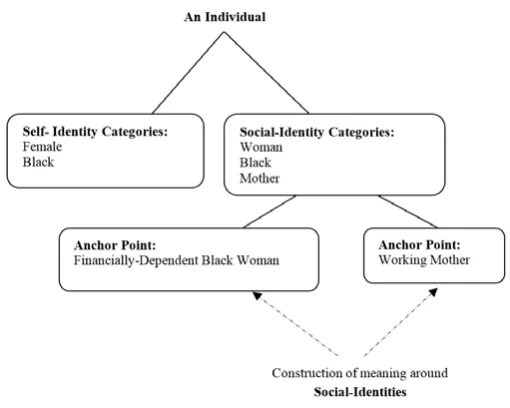
To achieve this research objective, we reconstructed the Glenn (2004) anchor points concept. Anchor points are intersecting identity categories that are discursively created and recreated. An anchor point secures meaning, for a brief, fleeting period of time, so that we may consider the order that is fashioned through this meaning. An anchor point mirrors Ibarra’s ‘provisional selves’ (1999: 765), where an individual may present themselves, or be created by others, as one self,
1 Identity, from a sociological perspective, is an amalgam of self-identity and social-identity. Self-identity is our own sense of self (Watson, 2008). Social-identity consists of inputs into our own self-identity (ibid.). These inputs are socially constructed and manifested in discourses via interactions with others. When we refer to identity in this paper, we are referring to social-identity specifically.
2 To recognize the socio-political characterizations of individuals (Weeks, 1989; Crenshaw, 1991; Acker, 2006), we capitalized the terms ‘White’ and ‘Black’ – where African American is used interchangeably with Black - to reflect ‘cultural allegiances’, (Ladson-Billings, 1998: 9). In direct quotes from this study’s protagonists, however, their own discursive uses reflect the source; so ‘black’, ‘colored’, ‘female’ may appear, and are italicized as shown here.
and then move to another self (re)creation. An individual4 clearly does not live in a vacuum, and so identity anchor points must be put in context. Context in this study was built from the workplace, not as a stable structure, but via changing organizational rules and meta-rules, and social values that can influence discourses and discursive practices. Finally, discourse is a concept constructed as sets of statements and practices that bring an individual, an object, or set of objects into being (Parker, 1992).
Drawing on postmodern archival research (Mills and Helms Mills, 2018), we studied the case of Ruth Bates Harris within the United States National Aeronautics and Space Administration (U.S. NASA). We traced her experience, as the first African American and the first woman hired as a senior manager, within the early 1970’s NASA. The discursive processes that (re)created Bates Harris, from her arrival within the NASA Equal Employment Opportunity (EEO) office in 1971, her dismissal in 1973, and her return to NASA in 1974, were compelling. Analysis of these discourses involved the critical sensemaking (CSM) framework by Helms Mills et al. (2010). The heuristic of CSM is comprised of a study of discourses (Foucault, 1980), of organizational rules (Mills and Murgatroyd, 1991), and of formative contexts or social values (Unger, 1987a; 1987b). We used CSM to first construct a plausible story of Ruth Bates Harris. Then we applied CSM, as an analytical framework, to this story. CSM provided us then with an avenue to focus on an organizational reality, and its impact on the (re)creation of an individual.
We begin this paper by presenting the application of intersectionality via anchor points. We follow this theoretical framework with our chosen methodology for this study. We then submit our plausible story of Ruth Bates Harris, and the results of our analysis of this story. We ask and answer the ever important ‘so what?’ question, framing our answers with an eye to what our contribution consists of with respect to the application of intersectionality.
Application of intersectionality via anchor points
As the editors of this special issue presented, Crenshaw (1989; 1991) introduced intersectionality as a lens built on the varied identity, and intersecting systems of power research (Collins, 2009). Crenshaw applied intersectionality to examine specifically the interaction of race and gender, and the resultant exclusion of Black women within the judiciary. There were also important influences to
4 The notion of an individual is influenced by Foucault’s technology of self where the
intersectionality scholarship from critical race studies (The Combahee River Collective, 1979; hooks, 1981; Hull et al., 1982; King, 1988) where the Black Woman was inserted as a theoretical wedge into traditional White feminist work (Nash, 2008). Crenshaw’s important legislative work, and the theoretical work of others in this field (for e.g. Staunæs, 2003; Glenn, 2004; Lykke, 2005; McCall, 2005; Collins, 2009; Cho et al., 2013; Moraga and Anzaldúa, 2015), led to a suite of empirical qualitative and quantitative studies on intersectionality in such areas as: feminist and postfeminist studies within the workplace (Coleman and Rippin, 2000; Ely and Meyerson, 2000; Meyerson and Kolb, 2000; Torres, 2012); studies of men (Hearn, 2014); ethics (Van Herk et al., 2011); educational studies (Naples, 2009); transnational/postcolonial studies (Mohanty, 1988; Calás et al., 2013); and, lesbian, gay, bisexual and transgender studies (Stone, 2006; Bowleg, 2008).The challenges that some of these intersectionality scholars (such as McCall, 2005; Bowleg, 2008) encountered with respect to the application of intersectionality led us to consider how we could apply intersectionality in such a way to increase its usability within organizational studies.
Glenn’s (2004) original work surrounding anchor points offered us one possible avenue to address this usability challenge. Anchor points are intersecting identity categories, that are discursively created and recreated. Anchor points also encompass the act of their creation, via power-relations among individuals, and these individuals’ own sensemaking processes. Power-relations, used here in the Foucauldian sense, exist locally in day-to-day interactions, are continuous, productive and are ‘capillary’ (Fraser, 1989: 22). Power-relations circulate throughout the entire social body, down to the smallest practice. Power-relations cannot be possessed but they can be deployed in discourses; thus, they can be disciplinary in nature, creating order and establishing boundaries (Talbot, 2010). Sensemaking, on the other hand, works hand-in-hand with power-relations, ‘unfold(ing) as a sequence in which people concerned with identity in the social context of other actors engage [in] ongoing circumstances from which they extract cues and make plausible sense retrospectively, while enacting more or less order into those ongoing circumstances’, (Weick et al., 2005: 409).
behind relationality is to remove the ‘either/or’ binary of studying individuals. In other words, we are urged to move away from men versus women, White versus Black, poor versus rich characterizations of a social order. This is done in such a way to move towards a study of interconnections (Collins and Bilge, 2016). Relationality is also, importantly, dependent on power-relations, in the day-to-day interactions among individuals, and can reflect both productive and disciplinary interconnections.
The anchor point concept was based on a construction of relationality whereby Glenn saw Black and woman as identities gaining meaning in relation to each other. This meaning was nebulous, depending on the power-relations that were at play. She also constructed the anchor point as being in hierarchal opposition: so White was the dominant category over Black, and Man was genderless in relation to Woman. Furthermore, her use of relationality included the bond of occupational identities that an individual may take on, such as housekeeper responsibilities. Creating an anchor point – a Black housekeeper woman – according to Glenn then secured meaning in such a way that we can consider the order that is (re)created through this meaning. Ultimately, the study of anchor points allowed Glenn to study the detrimental consequences of the lived experience of the Other.
This definition of anchor points, we contend, ignores the complexities of power-relations and of discourses. Glenn broke down interpower-relations among individuals to whether someone was White or someone was Black, whether someone was a Woman or a Man. This implied an additive nature to identity relationships, which ignored the fundamental idea behind intersectionality; namely, the very complexity of our intersecting identity categories, how they are interdependent, and how they constitute each other. By embracing Glenn’s treatment of relationality, we would be perpetuating the idea that one single identity category added to another was responsible for the ordering among individuals. If the anchor points concept was to realize its potential, reflecting a complex individual and their lived, ordered experience, this concept had to be reconstructed based on the very complexity of individuals, embracing intersectionality, and the context they find themselves in.
Reconstructing anchor points
similarly, limit and set boundaries on how individuals imagine what can be, and what can be done, within that social reality (Unger, 1987a, 1987b). Dominant social values paired with rules and meta-rules can be represented in symbols, metaphors, and narratives within institutionalized practices (Hartt et al, 2012).
Returning to the intersectionality, this heuristic includes the notion of boundaries and of limits. Specifically, the discursive reproduction of intersecting identities, and the sensemaking surrounding this reproduction, can result in the temporary movement to the periphery of an individual. For example, Monture (1986) provided a powerful story of her movement to the periphery within a conference setting which has its own rules and social values. This individual became the Other within that specific context. This movement can be referred to as marginalization, where there was ‘deficiency in the…political, and social resources used to guarantee access to the rights and privileges assumed by dominant group members’ (Cohen, 1999: 37-38). Intersecting identity categories along with discourses, power-relations, and sensemaking processes all captured within the reworked anchor points concept, can then be used ‘in tracing how certain people seem to get positioned as not only different but also troublesome and, in some instances, marginalized’ (Staunæs, 2003: 101). The act of ordering is then created/recreated via the discursive production of the anchor point, and the sensemaking of both the creator and the recipient of the anchor point.
Figure 1: Anchor Points Example
Methodology
We recognized that to bring into evidence this intersectionality theoretical framework, centered on anchor points, the methodology would need to support this initiative rather than hinder it. The chosen methodology would also have an important relationship with the nature of the data set collected. To elaborate on this point, we begin this section with a presentation of the archival data set. We follow this with a presentation of Helms Mills et al.’s (2010) CSM framework, which provided us with the appropriate ontological and epistemological support to analyze the data collected. We close this methodological section with how we applied this CSM heuristic first to create the Ruth Bates Harris plausible story, and then, second, to analyze this story.
Nature of the data set
including a document and photographic collection of one-hundred and seventy-two boxes, housed at Rensselaer Polytechnic Institute (RPI), were added to this data set. Numerous discussions with the extremely helpful, and competent, RPI archival staff facilitated the first author to gain a better understanding of the nature and the organization of the archival records that RPI housed. Following this experience at RPI, the data set grew to include various news media reports from the time period in question. These news media reports were available online, via an extensive U.S. database of local and national media outlets. The data set was deemed complete with the exciting discovery of an autographed copy of Bates Harris’ (1991) autobiography.
Throughout this process of collecting data, methodological standards were applied to ensure soundness, traceability, and evidentiary value in line with Mills and Helms Mills (2018) postmodern archival research guidelines. Specifically, a field research diary and a running database of known, and unknown, RPI box contents were maintained by the first author while at RPI. Subsequently, photocopies and notes (i.e. on the photocopies, emails, etc.) were maintained in hard copy format in a series of four binders. Finally, extensive communication among the authors was enacted throughout this research initiative.
Critical sensemaking framework
The CSM framework (Helms Mills et al., 2010) guided our analysis by helping us to focus on four heuristics that are intertwined. This framework is specifically shaped from the interaction of Weick’s (1995) sensemaking, Foucault’s (1978; 1980) discourses, Mills and Murgatroyd’s (1991) context of organizational rules, and Unger’s (1987a; 1987b) formative contexts. CSM goes in a different direction from Weickian sensemaking, where the four heuristics working together create an analysis framework for how people come to understand ‘things’, ‘objects’, etc. Furthermore, the interaction of these heuristics is the key idea here; there is no structural, or procedural, step-function among sensemaking, discourses, rules and meta-rules, and formative contexts.
Weickian sensemaking alone, but on critical sensemaking. Where Weickian sensemaking ‘starts’ out at a shock or crisis event, the heuristic of critical sensemaking does not need this shock to be able to study an organization (Helms Mills et al., 2010). This critical sensemaking, an analytical method that embraces power-relations and context, ‘looks at actions and beliefs as driven by plausibility not accuracy’ (Helms Mills et al., 2010: 189). Furthermore, critical sensemaking embraces Foucauldian discourses, and its influence on Weickian sensemaking.
With respect to these Foucauldian discourses, they and their processes are a way to bring an object into being. They also offer a way of structuring the social world into a useable and manageable pattern where we can make sense of events. Foucauldian discourse is related to mundane social life5 , and to social knowledge creation and recreation. Social life and social knowledge includes historical genealogies, as Foucault showed in his numerous works (e.g. Foucault, 1977; 2001). Social realities, viewed via interactions among individuals, cannot be understood without investigating those discourses that are present in that reality (Phillips and Hardy, 2002). Discursive processes similarly encompass ‘everyday attitudes and behavior, along with our perceptions of what we believe to be reality’ (Grant et al., 1998: 2). Discursive processes centered on identity, anchor points in our case, are made available to us as social constructions that impart knowledge. These processes ultimately constrain the sensemaker within a social reality ‘to seek out familiar solutions that have worked in the past…and [that] maintain the social status quo’ (Helms Mills and Mills, 2009: 175).
Discourses can also reproduce and reflect rules, meta-rules and formative contexts, providing a sense of order for individuals within a particular social reality. Just as sensemaking and discourses work together, so too Mills and Murgatroyd’s (1991) institutional rules and meta-rules work in concert with Unger’s (1987a; 1987b) formative contexts. Meta-rules are defined as system-wide rules such as globalization, economic systems, employment equity legislation within Canada or Affirmative Action legislation in the U.S. Demographics, an exercise in statistical structuring of individuals into groups of information, is another example of a meta-rule. Meta-rules are broad in scope and in application, and can ‘represent points of intersection between numbers of formative contexts’ (Helms Mills et al., 2010: 190).
With respect to organizational rules, Mills and Murgatroyd (1991) highlighted that organizational rules function as a pre-existing framework determining how ‘things get done’. This state of pre-existence does not imply that these rules are not
influenced by the agency of individuals; the issue is not that we are trying to identify rules creation, but that they exist and that we can ‘see’ them, and study their influence on the everyday activities of individuals. Rules are social constructions (Mills and Murgatroyd, 1991), and impose orderings in the power-regime that are organizations. Organizational rules may limit how individuals within an organization act thus constraining them in their mundane, daily existence within the organization.
Formative contexts reflect dominant assumptions captured within the idea of social values (Unger, 1987b). They bring together dominant social values with individual action (Helms Mills et al., 2010). Dominant assumptions, for example, in these social values can be produced, reproduced, and reflected in discourses. These formative contexts can limit and set boundaries on how individuals as sensemakers imagine what can be, and what can be done, within a social reality. In this process of imagining the possible, the power-relations that are at work among individuals, and the power-effects, can be examined via discursive processes. Specifically, individuals within an organization can express institutionally dominant social values through narratives and stories. These organizational narratives can capture the said and the unsaid. These organizational narratives are not necessarily presented in a constant stream of information but rather, can be characterized as interrupted evidence. The evidence ultimately must be constituted back together by the interpreter to be able to study this uncoordinated cluster of power-relations (Flyvbjerg, 2012). The interpreter’s responsibility is to tease out the underlying assumptions presented in these discourses. The challenge then becomes to analyze not only the narratives and stories themselves but to also look at what the discourses protect (ibid.).
The beauty of the CSM framework is its focus on discourses. Social realities cannot be understood without investigating discourses that are practiced, and that influence other discourses in that reality (Phillips and Hardy, 2002). Discourses centred on an individual’s identities reflect power-relations that flow through the social. They also give meaning to social life. Specifically, these identity discursive acts, working in tandem with sensemaking, constrain the individual ‘to seek out familiar solutions that have worked in the past…and [that] maintain the social status quo’ (Helms Mills and Mills, 2009: 175). These familiar solutions are influenced, in part, by institutional rules and meta-rules, and formative contexts. CSM therefore provides a framework to study discourses, weaving in an individual’s sensemaking, institutional rules and meta-rules, and formative contexts all together.
that individuals’ made sense of organizational change via many interconnected avenues, including the centrality of identity. Carroll et al.’s (2008) study of call centres, and their managers and employees, applied CSM to privilege plausible understanding of management relationships, power, and resistance. Hartt et al.’s (2012) dual ANTi-History and CSM framework, applied to archival materials, found that history is socially constructed storytelling with respect to gendered relations. Paludi and Helms Mills (2013) exploratory study into Latin American executive women found that navigating differences involved learning about the Other. Finally, Prasad’s (2014: 528) autoethnographic experience of Jerusalem framed within CSM analysis ‘brought to the level of consciousness my latent acceptance of prejudices that were engendered by a set of ethnocentric discourses’. There are then different possible applications for the CSM heuristic.
Data analysis
Given the extensive historically-based data set in front of us, we discussed how we could best recreate the past within an attainable device that would engage and not overwhelm. We, as postmodernist scholars, were also focused on ‘truth’ being presented as plausible versus a legitimate fact. To be clear, in the modernist tradition, a historian ‘factually’ retells the past. We were inspired by Clark and Rowlinson’s (2004: 331) ‘historic turn’ in organization studies to focus on what is plausible. To this end, we drew on the archival data to build a complex portrayal of Ruth Bates Harris via a story. The CSM framework helped us to recreate this individual (micro), the organizational rules and meta-rules (meso), and the formative (macro) contexts. In other words, we identified three key areas that would assist in recreating Ruth Bates Harris: discursively produced anchor points, NASA rules, and Civil Rights-Cold War values contexts.
Once our plausible story was created, we again reached to the CSM framework to analyze this story. We recognized that to understand a social reality we could not limit our analysis to ‘just’ an individual’s anchor points. Social reality is much too complex to only look at it in this way. Thus, with respect to individual (re)constructions, we began by analyzing the discursive processes involved in the (re)creation of Ruth Bates Harris’ anchor points. We analyzed the story with a focus on identity (re)construction to ensure that, first the individual was not ‘lost’, and second, that the anchor points’ relationship to power-relations was examined.
policy of equal employment opportunity and contract compliance throughout NASA. (U.S. Committee on Appropriations [USCA], 1974: 26)
In September 1971, Mrs. Ruth Bates Harris, a black female, was appointed as the director, NASA Equal Employment Opportunity. She brings to NASA a distinguished public service career. This change incorporates the EEO function with contract compliance function. Marriage of the two functions allows for greater latitude in operation. (USCA, 1974: 134)
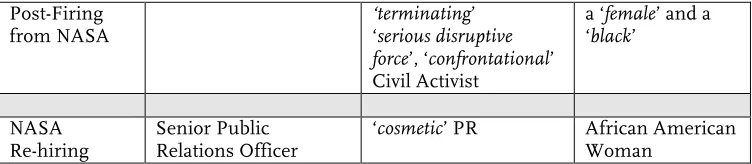
Bates Harris was initially given the job title of ‘Director of Equal Employment Opportunity and Contract Compliance’6. This job titled reflected an attributed occupational role of being a highly-experienced Civil-Rights and Public Servant management professional. She was also recognized as being a ‘revolutionary’ in this field of EEO, based on her past experience in training police forces in Washington, D.C., and in being part of Martin Luther King Jr.’s organization committee. In addition, this job title and the occupational role intersected with Bates Harris’ social-identities; notably, she was identified as being a ‘black female’. This social-identity categorization was both sex-based, and racially-based. Bates Harris was then reconstructed as a complex individual, with important tensions reflected in her reconstruction.
With respect to organizational rules, we again wanted to focus on the power-relations and the consequences of these power effects. We first examined the discursively produced rules centered on NASA occupational roles, vague professional practices, and financial resources. Second, we considered how these various rules imposed orderings within the organization. Finally, the analysis framework helped us to look at how this limited individual interactions within the particular NASA social reality. For example, looking at the discourses surrounding Bates Harris’ change in job title, and in her occupational role, we found underscored what we called the swipe of the pen rule:
For reasons never fully explained this completed action [of naming Bates Harris Director of EEO and Contract Compliance] was superceded [sic] on the recommendation of the Associate Administrator for Organization and Management [Bernard Moritz], signed by his deputy… Subsequently a Special Announcement was issued assigning the Director of Industrial Relations [Robert King] the additional duty of Director of Equal Employment Opportunity Office and the incoming Human Rights official [Bates Harris], Deputy Director…. The re-titled position was accepted by the candidate [Bates Harris] with great reluctance. (USCSCASS, 1973: 205)
Discourses surrounding the removal of ‘Contract Compliance’ and Bates Harris’ apparent demotion to Deputy Director doesn’t appear to be of much importance
6 Recall that text presented in single quotes and italics reflects the protagonist’s
since the ‘Contract Compliance’ part of the title and the associated role it imparted were taken away with a simple swipe of the pen by Moritz. It is important to recognize that Bates Harris hadn’t arrived in NASA yet when this demotion occurred. The resultant order, an African American woman ‘under’ a White man, a powerful visual and metaphorical representation of this swipe of the pen rule, was accomplished despite the NASA Executive Personnel Board’s approval of the original job title.
With respect to formative contexts, we focused on dominant social values as a context unto itself. These dominant social values were represented via the Civil Rights and the Cold War era symbol and metaphor. This analysis focus further addressed the possible power-relations at work within NASA. For example, the Nixon legislative framework change to Title VII, requiring all Federal EEO programs be adopted into the Equal Employment Opportunity Act, resulted in extensive back and forth discussions in the Low archival data set. We summarized the discourses in the plausible story, focusing on NASA Administrator Fletcher’s recurring and repeated ‘mistakes’ with respect to this legislation, and Bates Harris’ role in implementing this Act into the NASA context. We analyzed these discourses and found that the power-relations, in this web of interactions between Fletcher and Bates Harris, demonstrated that there existed limitations to Civil Rights as a social value within NASA. We deconstructed these discourses within a framework of macro concerns. Notably, the dominant assumption of Civil Rights was to correct wrongs in society. However, within NASA walls, this assumption could not transcend their own dominant social values. In other words, Fletcher through his repeated ‘mistakes’ and Bates Harris’ repeated calls to meet legislative requirements, and their back-and-forth discourses, that lasted months, resulted in imposing an order which Bates Harris’ would go to ‘war’ against. The impact of these macro Civil Rights NASA discourses on Bates Harris identity were then reflected in another one of her anchor points. She was branded with the anchor point of an ‘activist’, much to her frustration and in contrast to her professed self-identity: a self-described ‘teacher’ who ‘just [wanted] to set workshops and forums to help sensitize people and make them more responsive to others who are different’ (Bates Harris, 1991: 214).
Results
We now present the results of our study. We begin with the plausible story of Ruth Bates Harris. We follow with the CSM analysis of this plausible story.