© Strojniški vestnik (44) št. 3-4, str. 137-144, 1998 Tiskano v Sloveniji. Vse pravice pridržane. UDK 621.643/.644:532:697.3:519.61/.64 Strokovni članek
© Journal o f Mechanical Engineering (44) No. 3-4, pp. 137-144, 1998 Printed in Slovenia. All rights reserved. SV-0039-2480(98)2-R7 UDC 621,643/.644:532:697.3:519.61/.64
' Speciality paper
Načrtovanje drevesne poti in dimenzioniranje prenosnega cevnega omrežja
na podlagi najmanjših stroškov
Tree Path Design and Dimensioning of Transport Pipe Networks on the Basis
of Minimized Costs
ANDREJ KROPE - DARKO GORIČANEC - JURIJ KROPE
V prispevku je podan postopek za optimalno izbiro drevesne p o ti cevnega omrežja in dimenzioniranje cevovodov, ki se uporabljajo za transport nestisljive tekočine.
Matematični model sestavljajo nelinearna namenska funkcija in sistem neenačb hidravličnih omejitev, ki jih rešujemo implicitno z uporabo numerične metode Simpleks. Stroškovna primerjava je izvedena po metodi kapitaliziranih stroškov, ki vključujejo vrednost naložbe ter diskontirane stroške obnove, obratovanja in vzdrževanja.
Ključne besede: ogrevanje, optimiranje, metoda Simpleks, primerjave stroškov, software
In this paper the process is given fo r optimum design o f a network tree path and dimensioning o f pipes fo r the transport o f incompressible fluids.
The mathematical model is composed o f a nonlinear objective function and a system o f hy draulic restriction inequalities which are solved implicitly by the use o f a numeric Simplex method. The cost analysis is made according to the method o f capitalized costs which include the investment, oper ating and maintenance costs, taking into account the corresponding discount rate.
Keywords: heating, optimization, Simplex method, cost analysis, software
0 UVOD 0 INTRODUCTION
Zmanjšanje zalog goriv in s tem v zvezi varčevanje energije terja na področju toplotne tehnike iskanje novih tehnično znanstvenih spoznanj z uporabo različnih matematičnih metod za optimalno načrtovanje in dim enzioniranje cevnih omrežij daljinskega ogrevanja. Ker je transport tekočin povezan s stroški, ki so med drugim odvisni tudi od dimenzij in poteka drevesnega cevnega omrežja, je treba cevno omrežje optimalno načrtovati. Način načrtovanja je lahko običajen ali pa z uporabo operacijskih raziskav. Pri običajnem načrtovanju projektant določi dimenzije cevnega omrežja po praktičnih izkušnjah in priporočilih, nato pa z izračuni ugotovi, ali hidravlični parametri, npr.: padec tlaka, pretok in hitrost fluida, ne presegajo dovoljenih vrednosti. Pri načrtovanju z uporabo operacijskih raziskav opišemo zakonitosti dogodkov v izbranem cevnem omrežju matematično z namensko funkcijo in neenačbami hidravličnih omejitev. Z določitvijo minimuma namenske funkcije določimo optimalno drevesno pot omrežja.
M etode za dolo čan je m inim um a in maksimuma namenske funkcije so znane že dalj časa. Ne glede na to, te bistveno niso vplivale na postopke načrtovanja. Vzrok za to je bila omejitev uporabe v praksi. Prva ovira je bil dolg računski čas, druga om ejitev pa rešljivost samih problem ov. Npr. Lagrangeova metoda je uporabna, če so funkcije, ki jih vključujemo v matematični model, odvedljive.
Način načrtovanja cevnih omrežij se je korenito spremenil z uporabo računalnikov in operacijskih raziskav. Za optimalno načrtovanje cevnih omrežij so bili izdelani:
Reduction of energy supplies and conse quently the requirements for energy savings demand the introduction of new engineering and scientific know-how in the field of thermal technique, i.e. the use of different mathematical models for optimum design and dimensioning of district pipe heating. The pipe network should be optimally designed, as the transport of fluid induces costs which are, among other factors, dependent also on the dimensions and layout of the tree pipe network. The design can be either conventional or operational research based. In conventional design, the designer determines dimen sions of the pipe network by practical experience and accepted recommendations. He then finds out by cal culations if the hydraulic parameters such as pres sure drop, fluid flow and velocity do not exceed the allowed values. With operational research design, the lawfulness of events in a selected pipe network is described mathematically by the objective func tion and inequalities of hydraulic limitations. By determining the minimum of the objective function, we can determine the optimum tree path of the pipe network.
The methods for determining the minimum and maximum of the objective function have been known for quite a time. Nevertheless, they have not substantially influenced the design processes. The reason for this was the limitation o f the use in prac tical applications. The first limitation was the long calculating time, and the second the insolubility of the problems. The Lagrange method, for example, is usable, if functions included in the mathematical model are differentiable.
- Matematični model za optimalno načrtovanje cevnih omrežij z upoštevanjem perspektive širitve cevnega omrežja oziroma povečanja toplotnega odvzem a [9]. R ešitev tem elji na uporabi Fibonaccijeve metode.
- Matematični model za optimalno namestitev črpalk v različno oblikovana cevna omrežja [7], R ešitev tem elji na uporabi m ešanega celoštevilčnega nelinearnega optimiranja.
1 MODEL SOODVISNOSTI PRETOKA IN TLAKA
Mathematical model for optimum design of pipe networks with consideration of the future exten sion of the pipe network and increase of heat con sumption respectively [9]. The solution is based on the use of the Fibonacci’s method.
Mathematical model for optimum pump location in the pipe networks of different designs [7]. The solution is based on the use of mixed integer non linear programming.
1 FLOW - PRESSURE MODEL INTERDEPENDENCE
Pri prenosu tekočin v cevnih omrežjih se večkrat srečujemo z nepravilnostmi, katerih vzrok je napačna izbira elementov in naprav oziroma njihova napačna povezava, ki tem elji na nepoznavanju odvisnosti: pretok, tlak, upor, zmogljivost črpalk itn. Zato moramo med postopkom optimalne izbire drevesne poti izvajati tudi analizo medsebojnih vplivov med pretokom in tlakom [1] do [3]. Tlačne izgube pri pretoku nestisljive tekočine od vozlišča i do vozlišča j so funkcija premera cevi, pretoka, hrapavosti cevovoda, fizikalnih lastnosti tekočine ter lokalnih uporov in jih določimo z nelinearno Darcy-Weisbachovo enačbo [4] in [5].
Pri zasnovi modela soodvisnosti pretoka in tlaka moramo upoštevati:
- zveznost pretoka skozi vozlišče (vsota tokov, ki
pritekajo v vozlišče, mora biti enaka vsoti tokov, ki iz vozlišča odtekajo);
- ohranitev energije v sklenjeni zanki (vsota
padcev tlakov, v katerikoli sklenjeni zanki cevnega omrežja, mora biti enaka nič);
- zveznost pretoka v cevnem omrežju (vsota
tokov v cevno omrežje mora biti enaka vsoti tokov iz cevnega mrežja).
2 GOSPODARNOST TRANSPORTA FLUIDOV
2.1 Vrednost naložbe in stroški obratovanja
In fluid transport through pipe networks we are often faced with the incorrectness which is caused by wrong choice of elements or devices respectively, or their wrong connection based on unknown rela tionships: flow, pressure, friction, pump capacity, etc. This is the reason why we must perform flow-pres sure analysis during the process of optimum tree path choice [1] to [3], Pressure drops in the incompress ible fluid flow from node i to nodej are a function of the pipe diameter, flow, pipe roughness, physical properties of fluid, local friction, and are determined by the nonlinear Darcy-Weisbach equation [4] and [5],
In planning the flow - pressure model we must consider:
- continuity of node flows (the sum of flows which
flow into a node must be equal to the sum of those which flow out o f a node);
- preservation of energy around closed loop (the
sum of pressure drops in any closed loop of the pipe network must be equal to zero);
- continuity of the pipe network flow (the sum
of flows into the pipe network must be equal to the sum of those out o f the pipe network).
2 ECONOMICS OF FLUID TRANSPORT
2 .1 Investment expenditure and operating costs
Vrednost naložbe v cevno mrežo
Cena predizoliranih cevi na tekoči meter je funkcija premera cevi (d), določimo jo z zvezo v obliki polinoma druge stopnje [6] in [7]:
C, = A + B Vrednost naložbe v črpalke
Vrednost črpalk se veča s povečano močjo črpalk (P) in je odvisna od cene črpalk/W (Cp), prostorninskega pretoka (<yv), padca tlaka (Ap) in izkoristka črpalke ( rj) [7] :
C2 = CP-P =
Pipe network expenditure
The costs of preinsulated pipes per running metre of the pipe are a function of the pipe diameter (id) and can be defined by the pipe costs polynomial of second grade [6] and [7]:
d + C d 2 o».
Pump investment expenditure
The pump costs increase with the increas ing necessary pump power (P) and depend on pump price/W (Cp), flow volume (<yv), pressure drop (A/») and pump efficiency (1)) [7]:
qv-Ap
--- rj (\ 2).>
C,
Stroški črpanja
Stroški črpanja so odvisni od cene električne energije (C ), prostorninskega pretoka (qv), padca tlaka v cevnem omrežju (Ap), izkoristka črpalke (rj)
in časa obratovanja (t) [7]:
Pumping costs
C3 =
Ce -P- t = c e .q
- ^ - t
fiVrednost naložbe v gradbena dela
Vrednost gradbenih del na trasi, po kateri potekajo predizolirani cevovodi, je odvisna od premera cevi v določenem cevnem odseku in od sestave trase (asfalt, zelenica, pesek, kamenje itn). Določimo jo z enačbo:
( 3 ) .
Construction expenditure
The constructing costs of the preinsulated pipe network layout depend on the pipe diameter (d) in the fixed pipe section, and on layout specifics (as phalt, oasis, sand, rock, etc). They are calculated by the equation:
( 4 ) . C4 = D + E - d + F - d 2
2.2 Primerjava stroškov
Kadar je doba trajanja posameznih naprav, k ijih uporabljamo v prenosnem omrežju, različna, je za stroškovno primerjavo najprimernejša metoda kapitaliziranih stroškov [8]. Kapitalizirani stroški pomenijo sedanjo vrednost naložbe, ki jo ponavlja mo. Predstavljamo si jih lahko kot vsoto denarja, ki mora biti položena na računu na dan začetka projekta in obrestovana z obrestno mero, ki zagotavlja plačilo vseh stroškov, potrebnih za dobo obratovanja. Pri izračunu kapitaliziranih stroškov (CC) je treba upoštevati naložbo (B0) in vse stroške, ki nastanejo z obnovo (B0 - L0), obratovanjem in vzdrževanjem (C0) v obdobju obratovanja:
2.2 Cost comparison
When the service life of individual devices which are used in a transport pipe network is differ ent, the method of capitalized costs is the most ap propriate for cost comparison [8], Capitalized costs represent the present worth of costs for a period of infinite duration. They may be interpreted as the sum of money that must be deposited in a fund at the date of purchase at the stipulated interest rate just to pro vide all payments for perpetual service. In the calcu lation of capitalized costs (CC) we must consider all costs which arise with investment (BQ), renewal (B0 -
L0), operation and maintenance (C0) in an infinite period:
cc =
B0 + ( B 0 - L 0 ) (1 + 0 " - 1 3 MATEMATIČNI MODELi
3 MATHEMATICAL MODEL
(5).
Za rešitev matematičnega modela, ki določa optim alno drevesno pot cevnega om režja, so najprim ernejše num erične m etode linearnega optim iranja [9], med katerim i se najpogosteje uporablja metoda Simpleks. Geometrijski potek metode Simpleks prikazuje slika 1.
For the solution of the mathematical model which determines the optimum tree path of the pipe network the numeric methods of linear optimization are most appropriate [9], Generally the Simplex method is used. Geometric presentation of the Sim plex method is shown in figure 1.
Sl. 1. Geometrijski prikaz metode Simpleks
Linearne (Simpleks) omejitve možnega področja so v “n” dim enzionalnem prostoru. Postopek reševanja lahko začnemo na kateremkoli stičišču omejitev s postopnim izločanjem sosednjih stičišč in izboljševanjem vrednosti nam enske funkcije. Glede na sliko 1 se izračun začne v točki A in se nadaljuje skozi točko B do minimuma v točki C. Ker imajo linearne omejitve vedno končno število stičišč, definiranih z omejitvami brez lokalnega optimuma, dobimo rešitev po končnem številu iteracij.
Kapitalizirane stroške posamezne cevi (CC ) določimo s seštevanjem vrednosti naložbe ter diskontiranih obratovalnih in vzdrževalnih stroškov po metodi kapitaliziranih stroškov.
O ptim alno drevesno pot določim o z iskanjem minimuma nelinearne namenske funkcije kapitaliziranih stroškov:
m in C(qv )
ki je omejena z enačbami omejitev, te pomenijo zveznost pretoka skozi vozlišča:
M
j=i
M
j=i
qv..
K'J>0
(/ =
Linear (Simplex) restrictions of a possible field are in “n” dimensional space. The procedure of solving may be started at any contact o f restrictions with gradual elimination of the neighbouring con tacts and improvement o f the objective function value. According to figure 1 the calculation begins at point A and continues through point B to mini mum at point C. Because linear restrictions always have a finite number of contacts which are defined by restrictions without local optimum, we get the so lution after the finite number o f iterations.
The capitalized costs of an individual pipe (CC) are determined by summing up the discounted investment, operating and maintenance costs by the capitalized costs method.
The optimum tree path is determined by minimizing the nonlinear capitalized costs objective function:
M
-< ivj
(
6),
> i
by restriction equations which represent continuity of nodes flow:
■Qv, = o
(7).
Qv, = o
1, 2, 3, ...., N -l;y = 1, 2, 3, O ptim alne prem ere cevi določim o z
odvajanjem funkcije kapitaliziranih stroškov po
p ia n e m asv i <d) in enačenjem odvoda z nič za vsako cev posebej. Izračunani optimalni premer cevi (d)
primerjamo z najbližjim manjšim (d.) oziroma najbližjim večjim standardnim premerom cevi (rf+]). Izberemo standardni premer cevi, pri katerem je odvod d C C / dd manjši.
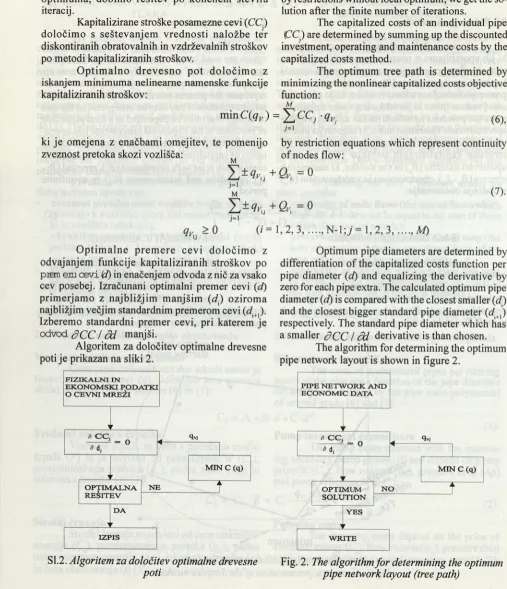
Algoritem za določitev optimalne drevesne poti je prikazan na sliki 2.
Sl.2. Algoritem za določitev optimalne drevesne poti
Optimum pipe diameters are determined by differentiation of the capitalized costs function per pipe diameter (d) and equalizing the derivative by zero for each pipe extra. The calculated optimum pipe diameter (d) is compared with the closest smaller (d.)
and the closest bigger standard pipe diameter (di+[)
respectively. The standard pipe diameter which has a smaller d C C / dd derivative is than chosen.
The algorithm for determining the optimum pipe network layout is shown in figure 2.
4 PRIMER 4 AN EXAMPLE
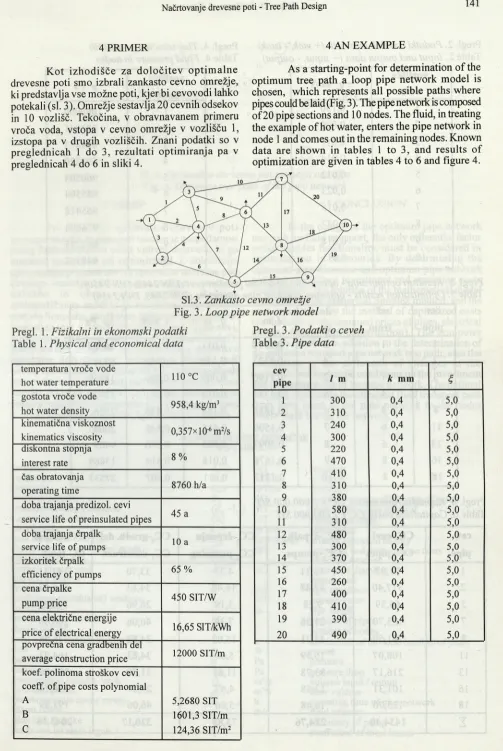
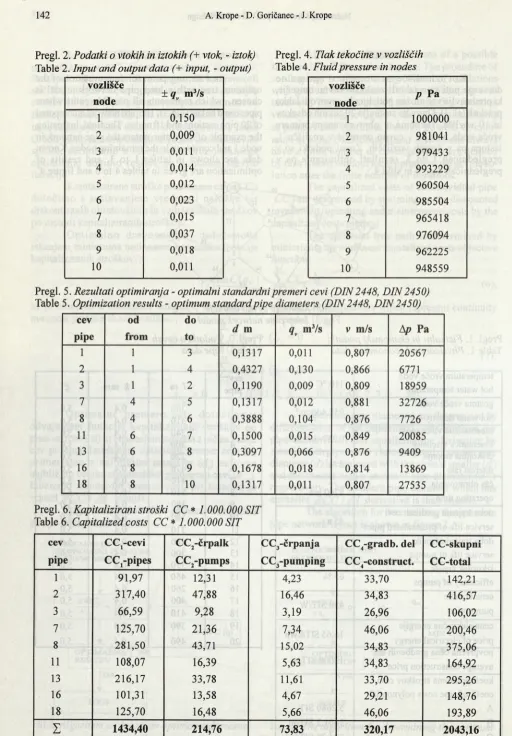
Kot izhodišče za določitev optim alne drevesne poti smo izbrali zankasto cevno omrežje, ki predstavlja vse možne poti, kjer bi cevovodi lahko potekali (sl. 3). Omrežje sestavlja 20 cevnih odsekov in 10 vozlišč. Tekočina, v obravnavanem primeru vroča voda, vstopa v cevno omrežje v vozlišču 1, izstopa pa v drugih vozliščih. Znani podatki so v preglednicah 1 do 3, rezultati optimiranja pa v preglednicah 4 do 6 in sliki 4.
As a starting-point for determination of the optimum tree path a loop pipe network model is chosen, which represents all possible paths where pipes could be laid (Fig. 3). The pipe network is composed of 20 pipe sections and 10 nodes. The fluid, in treating the example of hot water, enters the pipe network in node 1 and comes out in the remaining nodes. Known data are shown in tables 1 to 3, and results of optimization are given in tables 4 to 6 and figure 4.
Fig. 3. Loop pipe network model
Pregl. 1. Fizikalni in ekonomski podatki Pregl. 3. Podatki o ceveh
Table 1. Physical and economical data Table 3. Pipe data
cev
pipe / m k mm #
1 300 0,4 5,0 2 310 0,4 5,0 3 240 0,4 5,0 4 300 0,4 5,0 5 220 0,4 5,0 6 470 0,4 5,0 7 410 0,4 5,0 8 310 0,4 5,0 9 380 0,4 5,0 10 580 0,4 5,0 11 310 0,4 5,0 12 480 0,4 5,0 13 300 0,4 5,0 14 370 0,4 5,0 15 450 0,4 5,0 16 260 0,4 5,0 17 400 0,4 5,0 18 410 0,4 5,0 19 390 0,4 5,0
20 490 0,4 5,0 temperatura vroče vode
hot water temperature
110 °c
gostota vroče vodehot water density 958,4 kg/m3 kinematična viskoznost
kinematics viscosity 0,357* 10-6 m2/s diskontna stopnja
interest rate 8% čas obratovanja
operating time 8760 h/a doba trajanja predizol. cevi
service life o f preinsulated pipes 45 a doba trajanja črpalk
service life o f pumps 10 a izkoritek črpalk
efficiency o f pumps 65 % cena črpalke
pump price 450 SIT/W cena električne energije
price o f electrical energy 16,65 SIT/kWh povprečna cena gradbenih del
average construction price 12000 SIT/m koef. polinoma stroškov cevi
coeff. o f pipe costs polynomial
A 5,2680 SIT B 1601,3 SIT/m
Pregl. 2. Podatki o vtokih in iztokih (+ vtok, - iztok) Pregl. 4. Tlak tekočine v vozliščih
Table 2. Input and output data (+ input, - output) Table 4. Fluid pressure in nodes vozlišče
node p Pa
1 1000000
2 981041
3 979433
4 993229
5 960504
6 985504
7 965418
8 976094
9 962225
10 948559
vozlišče
node ± qvm3/s
1 0,150
2 0,009
3 0,011
4 0,014
5 0,012
6 0,023
7 0,015
8 0,037
9 0,018
10 0,011
Pregl. 5. Rezultati optimiranja - optimalni standardni premeri cevi (DIN 2448, DIN 2450)
Table 5. Optimization results - optimum standard pipe diameters (DIN 2448, DIN 2450) cev
pipe
od
from
do
to d m q m3/s v m/s Ap Pa
1 1 3 0,1317 0,011 0,807 20567
2 1 4 0,4327 0 130 0 866 6771
3 1 2 0,1190 0,009 0,809 18959
7 4 5 0,1317 0,012 0,881 32726
8 4 6 0,3888 0,104 0,876 7726
11 6 7 0,1500 0,015 0,849 20085
13 6 8 0,3097 0,066 0,876 9409
16 8 9 0,1678 0,018 0,814 13869
18 8 10 0,1317 0,011 0,807 27535
Pregl. 6. Kapitalizirani stroški CC * 1.000.000 SIT
Table 6. Capitalized costs CC * 1.000.000 SIT cev
pipe
CCj-cevi
CCj-pipes
CC2-črpaIk
CC2-pumps
CC3-črpanja
CC3-pumping
CC4-gradb. del
CC-construct.4
CC-skupni
CC-total
1 91,97 12,31 4,23 33,70 142,21
2 317,40 47,88 16,46 34,83 416,57
3 66,59 9,28 3,19 26,96 106,02
7 8
125,70 281 50
21,36 43,71
7,34 15,02
46,06 34,83
200,46 375,06
11 108,07 16,39 5,63 34,83 164,92
13 216,17 33,78 11,61 33,70 295,26
16 101,31 13,58 4,67 29,21 148,76
18 125,70 16,48 5,66 46,06 193,89
Sl. 4. Optimalna drevesna pot cevnega omrežja
Fig. 4. Optimum tree path o f the pipe network
5 SKLEP
Pri določitvi optim alne drevesne poti cevnega omrežja za transport tekočin je gospodarnost poleg funkcionalnosti edini vplivni dejavnik, ki ga moramo upoštevati pri optimiranju. Z določitvijo optimalnega premera cevi in optimalne drevesne poti cevnega omrežja lahko znatno znižamo vrednost naložbe in o b rato v aln e stroške. R ešitev matematičnega modela je izvedena z numerično metodo Simpleks, stroškovna primerjava pa z metodo kapitaliziranih stroškov (po načrtovanih cenah cevi, električne energije, črpalk in gradbenih del). Računalniški program omogoča poleg določitve optimalne drevesne poti prenosnega omrežja tudi oceno vpliva variacije ekonomskih in hidravličnih parametrov na vrednost naložbe in obratovalne stroške cevnega omrežja. Optimalna drevesna pot pomeni najcenejšo transportno pot tekočine od vtoka v cevno omrežje do vozlišč, kjer omrežje zapušča.
5 CONCLUSION
In the design of the optimum pipe network tree path for fluid transport, the only influential factor which besides functionality, must be considered in optim ization is econom ics. By determ ining the optimum pipe diameter and optimum pipe network path we can reduce investment and operating costs considerably. The solution of the mathematical model is realized by the numerical Simplex method, and the cost comparison by the method of capitalized costs (on the basis of the assumed prices of pipes, electrical energy, pumps and construction). The computer program enables, in addition to the determination of the optimum transport pipe network tree path, also the estim ation o f the influence o f changes in the economic and hydraulic conditions on the investment and operating costs of the pipe network. The optimal tree path represents the cheapest fluid transport path from flow input in the pipe network to the nodes where fluid leaves the network.
6 UPORABLJENE OZNAČBE 6 SYMBOLS
konstanti A, D SIT constants konstanti B,E SIT/m constants konstanti C, F SIT/m2 constants
vrednost naložbe B„ SIT investment costs (first costs o f asset) vrednost naložbe v obnovo ( 4 - Lo) SIT costs o f the assets renewal
kapitalizirani stroški CĆ SIT capitalized costs cena črpalke Cp SIT/W pump price
cena električne energije c SIT/(kWh) price o f electrical energy obratovalni in vzdrževalni stroški c; SIT operating and maintenance costs namenska funkcija C(qv) objective function
notranji premer cevi d m inner pipe diameter diskontna stopnja i interest rate hrapavost cevi k mm pipe roughness neodpisana (rezidualna) vrednost K SIT salvage value dolžina cevi i m pipe length število cevi M number o f pipes število vozlišč N number o f nodes
doba trajanja naprav, število let n a service life o f devices, number o f years
moč P W power
tlak fluida P Pa pressure tlačna izguba Ap Pa pressure drop prostominski vtok oz. iztok Q v m3/s volume input / output volumski pretok d v m3/s flow volume
čas obratovanja cevne mreže t h operating time o f pipe network hitrost fluida V m/s fluid velocity
indeks: vozlišče
cev J
index: node pipe
7 LITERATURA 7 REFERENCES
[1] Krope J., Goričanec D.: Analysis o f pipe networks including pumps, Energy build., 17 1991, 141 - 145.
[2] Krope J.: Analiza pretočne porazdelitve v omrežju daljinskega ogrevanja. Strojniški vestnik, Ljubljana, (29), 1983/ 1 - 3 , 15-18.
[3] Goričanec D., Krope J.: Pretočno - tlačna analiza procesnih omrežij v odvisnosti od stopnje odprtosti ventilov. Strojniški vestnik, Ljubljana, (3) 1987/10- 12, 179-180.
[4] Krope J., Goričanec D.: The dynamic characteristic o f non return valves, V: ESCAPE 2, Toulouse, France. Pergamon Press Oxford, 1992, 35 - 38.
[5] Goričanec D., Krope J.: Hydraulic analysis o f overhead steam transport, V: Proceedings o f the Sixth Asian Congress o f fluid mechanics, Singapore, Nanyang: Centre for Continuing Eduction, 1995/11, 1352 -1355.
[6] Peters M. S., Timm D.: Plant design and economics for chemical engineers. McGraw - Hill International Book Company, Tokyo, 1981.
[7] Goričanec D.: Optimalna namestitev črpalk v različno oblikovane cevne mreže. Tehniška fakulteta Maribor, 1992. [8] Kurtz M.: Handbook o f engineering economics. McGraw - Hill, 1984.
[9] Krope J., Goričanec D.: Optimal design o f processing networks. Hung. J. Ind. Chem., (23) 1995/3, 161 - 165.
Naslovi avtorjev: Andrej Krope, dipl. inž. Authors’ Addresses: Andrej Krope, Dipl. Ing. Fakulteta za strojništvo
Univerze v Mariboru Smetanova 17 2000 Maribor
Faculty o f Mechanical Engineering University o f Maribor
Smetanova 17
2000 Maribor, Slovenia
doc. dr. Darko Goričanec, dipl. inž. prof. dr. Jurij Krope, dipl. inž. Fakulteta za kemijo in kemijsko tehnologijo
Univerze v Mariboru Smetanova 17 2000 Maribor
Doc. Dr. Darko Goričanec, Dipl. Ing. Prof. Dr. Jurij Krope, Dipl. Ing. Faculty o f Chemistry and Chemical Technology
University o f Maribor Smetanova 17
2000 Maribor, Slovenia
Prejeto:
Received: 14.2.1997
Sprejeto: