Synthesis and Characterization of Nano-Size CaCO
3via
Thermal Treatment and Solid State Method
.M. Dadkhah a, M. Salavati-Niasari*,b,N. mir a
a
Department of Inorganic Chemistry, Faculty of Chemistry, University of Kashan, Kashan, P.O. Box 87317-51167, I. R. Iran
bInstitute of Nano Science and Nano Technology, University of Kashan, Kashan, P. O. Box. 87317–51167, Iran
Abstract
CaCO3 nanoparticles have been synthesized via heat-treatment of a new precursor and solid state reaction. Effect of calcinations temperature and quantity of surfactant on particle size has been investigated. The products were characterized by X-ray diffraction (XRD), scanning electron microscopy (SEM), transmission electron microscopy (TEM) and Fourier transform infrared (FT–IR) spectroscopy.
2012 JNS All rights reserved
Article history:
Received 9/11/2011 Accepted 18/1/2012 Published online 1/2/2012
Keywords:
Thermal treatment Solid state
Inorganic precursor CaCO3
Nanostructure
*Corresponding author:
E-mail address:
[email protected] Phone: +98 361 591 2383 Fax: +98 361 5552935
1. Introduction
The use of inorganic fillers has been a common practice in the plastics industry to improve the mechanical properties of thermoplastics. As an important inorganic filler or pigment, calcium carbonate (CaCO3) is used in many fields [l]. CaCO3
Calcite is thermodynamically the most stable phase, whereas vaterite is the least stable phase and it transforms into one of other two forms. Vaterite particles do not show well-defined morphologies, and usually aggregate into spherical particles. Nano-CaCO3 is the cheapest commercially available inorganic particle and although the surface of nano-CaCO3 particles is pretreated with different compounds such as stearic acid [2], phosphonate, and titanate to facilitate dispersion in the polymer matrix, the weak interface interaction and poor compatibility between those compounds and the polymer matrix will also prevent the enhancement of mechanical properties for the polymer/inorganic nanoparticle composites [3].
Thermal treatment method has some advantages such as simple process, low cost and easiness to obtain high purity products.Hence,this method is quite promising and facile route for industrial applications.
Solid-state decomposition is introduced as one type of the thermal decomposition processesin dry condition under air atmosphere. Hydrothermal, solvothermal andthermal decomposition usingorganic solvent or surfactantcarry out undervigorous controlledconditions but the choice ofsuitablemetal precursor and calcination temperature are known as key factors in solid-state decomposition.
In this work thermal treatment and solid state methods were applied to prepare nano-sized CaCO3. First, a new precursor was synthesized using phthalic acid in thermal treatment method and then was transformed to nano-sized CaCO3.
2 Experimental
2.1 Materials and characterization
All chemicals were of reagent grade and were used as received. XRD patterns were recorded by a Rigaku D-max C III, X-ray diffractometer using Ni-filtered Cu Kα radiation. Elemental analysis were obtained from Carlo ERBA Model EA 1108 analyzer. Scanning electron microscopy (SEM) images were obtained on Philips XL-30ESEM equipped with an energy dispersive X-ray spectroscopy. Transmission electron microscopy (TEM) images were obtained on a Philips EM208 transmission electron microscope with an accelerating voltage of 100 kV. Fourier transform infrared (FT-IR) spectra were recorded on Shimadzu Varian 4300 spectrophotometer in KBr pellets
2.2. Thermal treatment method
For synthesis of the precursor, calcium nitrate was dissolved in ethanol and phthalic acid was dissolved in ethanol too. Then dissolved phthalic acid was added to salt by dropping. After that sodium acetate was added to the mixture and then the mixture was refluxed. The complex was characterized by FT-IR. The synthesized complex was placed in furnace at different temperatures (300-700 oC). The results of XRD pattern and FT-IR spectroscopy showed that the optimum reaction temperature for the forming of CaCO3 via thermal treatment of precursor had been at 500 oC and nano-size CaCO
3 without any impurity was formed.
2.3. Solid state method
the optimum reaction temperature for the forming of CaCO3 had been at 550 oC. Also the results showed that the optimum molar ratio for the forming of CaCO3 had been at 1:2.
3. Results and discussion
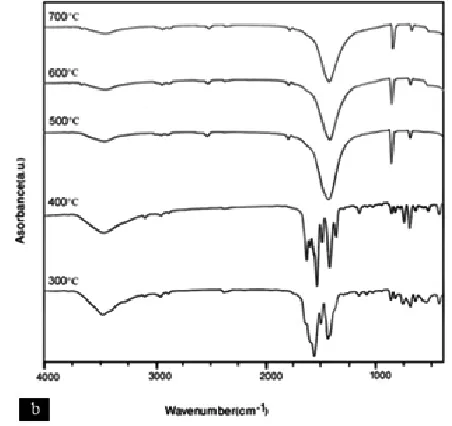
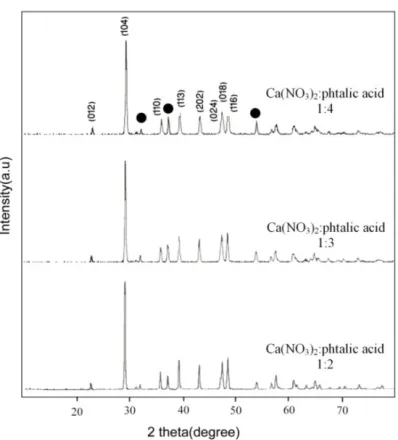
Fig. 1 show IR spectra of samples were formed via solid state method at 550 oC and Fig. 2 show IR spectra of samples were formed via thermal treatment method.
Fig. 1. IR spectra of samples were formed via solid state
method at 550 oC
In Fig. 1 we can see that CaCO3 was formed at 1:2 molar ratio. Also we can see the formation of CaCO3 at 500 oC via thermal treatment method. Fig. 2 at 500 oC show the IR spectrum of CaCO3 which represents the characteristic absorbance of our high purity nanoparticles. Isolated, planar CO32- anion has a D3h symmetry. The absorption bands attributed to the vibrations in CO32- anion are located within the 400–1800 cm− 1 region. The strong board absorption centered at about 1448 cm−1 is connected with the
asymmetric stretching vibrations, and a strong sharp absorption band at about 694 cm−1 and 856 cm−1 can be assigned to the bending out of plane vibrations and in plane vibrations, respectively. Also a weak sharp absorption band at about 1058 cm−1 owing to the symmetric stretching vibrations is observed [6].
Fig. 2.IR spectra of samples were formed via thermal
treatment method
Fig. 3. XRD pattern of CaCO3 Synthesis by solid state
Fig. 3 show XRD pattern of CaCO3 obtained by thermal treatment method. The results indicated that the crystal structure of CaCO3 is rhombohedral, similar to solid state method. There are not any impurity in CaCO3 obtained by thermal treatment method at 500 oC that shown in Fig. 3. The XRD patterns of CaCO3 at 600 oC and 700 C indicated the impurity of CaO in samples. Nano-size CaCO3 with an average size of 35, 46 nm was estimated by using the Debye-Scherrer formula at 500, 600 oC respectively that indicate the effect of temperature on particle size. Debye-Scherrer formula is:.
θ
β
λ
cos
K Dc =
where K is a constant (ca. 0.9); λ is the X-ray wavelength used in XRD (1.5418 Å); the Bragg angle; β is the pure diffraction broadening of a peak at half-height, that is, broadening due to the crystallite dimensions.
Fig. 4. XRD pattern of CaCO3 synthesis by Thermal Treatment.
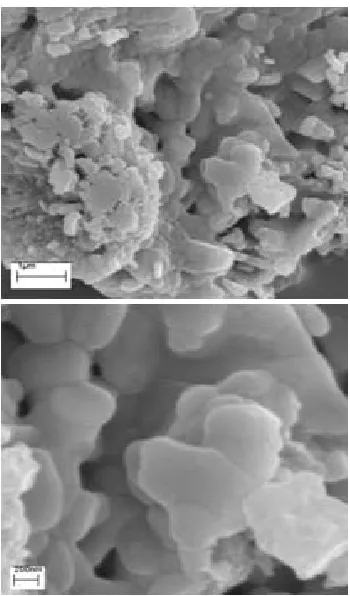
Fig. 5. SEM micrographs of products synthesis by solid
state method (a) 1:1. (b) 1:2. (c)1:3. (d) 1:4
Fig. 6. SEM micrographs of products synthesis by
Thermal Treatment at 500 C.
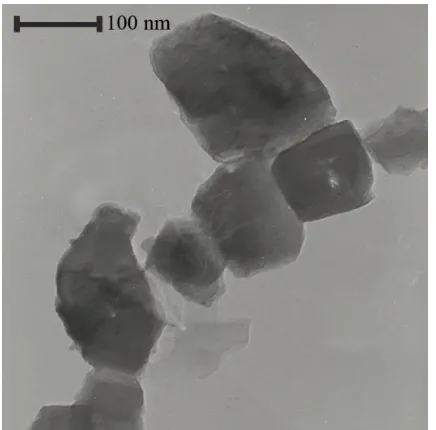
The typical SEM images of CaCO3 synthesis via thermal treatment at 500 C are shown in Fig. 6 In order to observe the morphological details of the CaCO3, TEM images of sample at 500 C were taken. Fig. 7. shows TEM micrograph of CaCO3 prepared at 500 C via thermal treatment method. The particle size of CaCO3 obtained at 500 ºC observes about 50-70 nm from TEM image. The morphology of CaCO3 obtained at 500 ºC is spherical
Fig. 7. TEM micrographs of CaCO3 synthesis by solid state method
Fig. 8. TEM micrographs of CaCO3 synthesis by solid state method
4. Conclusion
CaCO3 nanospherical have successfully been prepared via a simple thermal treatment of a new precursor. Also nanocubic structure of CaCO3 have been prepared via solid state method. FT-IR, XRD, SEM and TEM techniques have been used for characterization of the structure, morphology, and purity of CaCO3 products. Proposed solvent free and surfactant-free fabricating procedure was simple, cheap, and safe which maybe suitable for industrial production of high purity, nano-sized, pure CaCO3 crystallites.
Acknowledgements
Authors are grateful to council of University of Kashan for providing financial support to undertake this workwork.
References
[1] W. Wu and S.C. Lu; Powder Technol., 137(2003), 41-48.
[2] E. Papirer, J. Schultz, C. Turchi, Eur. Polym. J. 20 (1984) 1155–1158
[3] G. Li, K. Mai,K. Feng and Y. Huang, Polymer Int 55 (2006) 891–897.
[4] M. Run, C. Yao, Y. Wang and J. Gao, J Applied Polymer Sci,. 106 (2007) 1557–1567.
[5] G. Svetlana. Baca, Irina G. Filippova, P. Franz, Inorg Chimi Acta 358 (2005) 1762–1770. [6] G. Svetlana Baca, G. Irina Filippova, A. Olesea