Face Expression Matching using Static MSRCR
Face Images in MATLAB GUI
Sabith Sanal Renessh Zacharia
PG Student Assistant Professor
Electronics and Communication Department Electronics and Communication Department
Mangalam College of Engineering Mangalam College of Engineering
Abstract
The face expression matching follow the same concept used in face recognition system. This system requires various face expressed-images with less variation in illumination and color constancy. In order to overcome the variations in the image, the MSRCR algorithm is used. This algorithm provides good fidelity to the observer and system by eliminating the illumination variations and maintaining the color of the image. The MSRCR enhanced image is given to the face expression recognition system for matching purpose. This system comprises of face detection with skin color segmentation, Gabor filter, PCA and Euclidean Distance as a classifier. The design of the system is implemented in MATLAB GUI. The MSRCR enhanced image provides good recognition rate and therefore can be used as a good enhancement technique. The significance of MSRCR is studied by evaluating and comparing the contrast and luminance performance factor with histogram equalization.
Keywords: Multi-Scale Retinex Color Restoration (MSRCR), Face Expression System (FER), Face Detection System (FDR), Modified YUV color space model, Principal Component Analysis (PCA), Contrast and Luminance Factor, MATLAB GUI (Graphical User Interface)
___________________________________________________________________________________________________________
I.
I
NTRODUCTIONThe face expression is an automated system used to verify or recognize various face emotions expressed by an individual. The technique and design used in the system is similar to a typical face recognition system. The FER system acquires an image or video from a camera and analyses them to determine the expression. A lot of approaches have been categorized to determine face and its expressions such as skin color invariant, knowledge based, structural based, appearance based and other invariant methods [2]. Among these approaches, the appearance based approach provides good recognition rate. It comprises of Gabor filter and PCA [6] and [7] that helps to extract the features of the face. Most of the face images taken from camera or other sources may vary i n illumination and color constancy. This is would affect the recognition process of the system. The histogram equalization is a common enhancement technique used to boost up the clarity of the image. The main disadvantage of the technique is that it is unable to restore the color during enhancement.
In this paper, a MSRCR algorithm [1] is introduced to improve illumination and color constancy of the image. It provides good fidelity to the observer and the system. The degraded input static face image is given to the MSRCR algorithm for proper elimination and maintenance of excess illumination and color constancy respectively. This MSRCR enhanced image is given to a FER system that comprises of a face detection system, pre-processing stage, feature extraction with Gabor filter and PCA and a face expression classifier called Euclidean Distance [9]. The FDR system is used to extract the face region alone. It is the initial step of the system that is used to determine the location and size of the face. It is also used in many applications including facial expression. The method used in detecting the face is the skin color segmentation algorithm with modified YUV color space model [1]. The extracted face is pre-processed providing a standard static image for recognition. The feature extraction is used to collect or extract the necessary information of the image. The face expression classifier is used to classify the face expressed images. The classifier used is the Euclidean distance to determine minimum distance.
The remaining section of the paper is as follows: The related works of the FER system is described in section 2. The MSRCR algorithm is described in section 3. The FER system is described in section 4. The implementation process is described in section 5. The experimental result is described in section 6. The conclusion is described in section 7 followed by references.
II.
R
ELATED WORKSappearance-The PCA proposed by Kirby and Sirvoich [7] and Active Appearance Model [2] used high variance eigenfaces and active models to recognize face respectively. Another method of facial expression using Gabor filter and Linear Discriminant Analysis is proposed [2]. The Gabor filter is designed in banks comprising of various frequency and orientation parameters.
The proposed work in this paper explains a FER system comprising of a face detection system using skin color segmentation algorithm with modified YUV model, feature extraction stage using Gabor filter and PCA and a Euclidean distance classifier. The input given to this system is a MSRCR enhanced static face images.
III.
M
SRCRColor perception under different lighting conditions affects the recognition of the object to a great extent. There is a distinct discrepancy between the human vision and machine vision. Human vision system is able to adapt to drastic variations of the illumination and shadowing. Human vision system has the ability to view the object over wide range of vision where as in the case of machine vision, the range of view captured by the camera is much less than the normal vision range of the humans. Due to this, there is loss of essential features in the image captured by the camera.
The MSRCR [1] is an enhancement technique that is used to eliminate shadowing effects and illumination, maintain color constancy and restore the color from the degraded regions of the image. The image captured from camera or other source may result in degradation: forming dark and brighter regions on the image. This can be removed using MSRCR. It provides good fidelity to the observer [5] and [6]. It also maintains the dynamic compression of the image and color rendition. It provides a bridging gap between images and human observations from scenes [1]. It compensates blurring of the image and provides color constancy. It also provides fidelity to human observers. It also maintains dynamic range compression where the pixels of large values are not obscured with low values.
The MSRCR algorithm comprises of four important stages. The convolution of the image with a Gaussian surrounds function, single scale retinex, multi-scale retinex and color restoration factor. The concept of retinex which is a human based image processing algorithm provides good color constancy and dynamic range compression [6]. The color constancy appears as an important role in identifying or recognizing an object [3]. The steps of MSRCR algorithm is shown in Fig 1.
Fig.1. Steps For Msrcr Technique
ALGORITHM A.
Step 1: The degraded input image having varying illumination is passed to the MSRCR system.
Step 2: The color image is separated into channels as enhancement is applied on power color components of image. Step 3: Convolution is done using Gaussian Surround Functions [1]. The illumination component of image is estimated. Step 4: The Single Scale Retinex [1] is estimated by subtracting the original image with Gaussian Surround Function output
result.
Step 5: The Multi Scale Retinex is estimated by summing the single scale retinex. Step 6: The Multi Scale Retinex output is combined with color restoration block. Step 7: The enhanced image is obtained
The performance of the enhanced image is obtained by calculating the contrast performance and the luminance performance. The contrast performance reveals the contrast of the image making the dark portion of the image darker and the light portion of the image lighter. The luminance factor provides the necessary luminance obtained in the image.
The equation 1 and equation 2 are contrast performance and the luminance performance respectively
C
out
in
in
(1)Iin
Iin
Iout
L
/
(2)IV.
F
ER SYSTEMThe Face Recognition System comprises of the following blocks shown in fig 2.
Fig.2. Face Recognition System
FACE DETECTION USING SKIN COLOR SEGMENTATION WITH MODIFIED YUV A.
The face detection system is designed using skin color segmentation algorithm using modified YUV color space model [1]. The skin color segmentation algorithm requires less training and it provides easy implementation with less computational cost. The MSRCR static images are given to face detection system. These static face images are converted to a YUV color model for easy identification of skin pixels in the image. The skin pixels are identified based on the luma and chrominance components, otherwise known as the YUV model components. The luma components are taken into consideration as it plays a vital role in providing the variations of the image. Therefore, the Y component is normalized. Apart from YUV, the HSV and various color models can be used [3].
ALGORITHM
Step 1: The image is converted to YUV color model. The skin pixels are separated based on threshold U and V values. Step 2: The false representation of skin color object and holes are eliminated using morphological filtering.
Step 3: The skin pixel regions are connected and labeled. Step 4: The area of face is obtained.
Step 5: The background noise and skin region that is not likely to be a face is removed.= using area-based filtering Step 6: The face is located using a centroid
This approach provides an ease implementation step [1]. The skin color segmentation algorithm detects a face by segmenting the skin pixels of the image. The face detection system does not provide good detection rate for degraded images. The degraded image is enhanced using MSRCR and passed to a detection system for easy extraction of face.
PRE-PROCESSING STAGE B.
The pre-processing stage helps for face registration purpose. The various steps followed in the pre-processing stage are as follows:- The color image is converted to gray scale.
All the image dimensions are resized to a standard value.
The canny edge detection is used to highlight the edges of the image. The image brightness and contrast are adjusted.
The image can be cropped to a standard size. To remove noise of an image.
FEATURE EXTRACTION STAGE USING GABOR FILTER AND PCA C.
GABOR FILTER 1)
The Gabor Filter [7] and [9] are linear filters that is been used in image processing due to their significance and powerful property. It captures both orientation and frequency information of image; therefore it is characterized as a localized, orientation selective and frequency selective filter. A Gabor filter is defined as the product of Gabor filter frequency- orientation kernels with a sinusoidal plane wave. Thus, a 2D Gabor filter or a bi-dimensional Gabor filter constitutes a complex sinusoidal plane of particular frequency and orientation modulated with a Gaussian kernel. In this design, the real part of the Gabor filter is determined. The frequency and orientation selection is determined by assigning various values to it. Therefore a Gabor filter bank is designed with 8 orientation and 50 frequency values and convoluted with the image.
PCA 2)
called the image space. The individual coordinates of the point represent the intensity values of each pixel of the image. The majority of variation in pixels can be retained and the dimension reduction method can be done. The face expression matching method is extensively used in PCA. The steps of PCA is explained briefly and shown in fig.3.
Fig.3. Steps For Pca
PCA projects the data along the directions where variances in the data are high. The algorithm is follows as: Assume the m Gabor filtered images.
Calculate the average image, Ø, as: Ø = ∑ Al / M, where 1<L<M, each image will be a column vector the same size.
The covariance matrix is computed as by C = AT A where A = [O1 O2 O3…Om].
Calculate the eigenvalues of the covariance matrix C and keep only k largest eigenvalues for dimensionality reduction as
k= ∑mn-1(UkTOn).
Eigenfaces are the eigenvectors Uk of the covariance matrix C corresponding to the largest eigenvalues.
All the centered images are projected into face space on eigenface basis to compute the projections of the face images as feature vectors as: w=UTO= UT (Ai-Ø), where 1<i<M.
FACE RECOGNITION – EUCLIDEAN DISTANCE D.
The classifier is used to distinguish the various emotions expressed in the face. A test image with an expressed emotion is identified using the classifier. The classifier is implemented using the Euclidean distance. The Euclidean distance is a common distance metric used to calculate the distance between two images in the given face space. The distance is measured between a test image with each images present in a database. The minimum distance is considered as a positive result. In face recognition, the weights of the eigenface that is required to reconstruct the test image is computed and compared with the weights of each image in the database. The minimum distance is considered as the recognized image.
Min = min || - database ||
V.
I
MPLEMENTATION PROCESSThe implementation process of the proposed work is shown in fig.4
Fig.4. Implementation Process
In the proposed work, the input image captured from camera may result in variation in illumination and color constancy. These images are passed to a MSRCR block to tackle the variation in illumination and color constancy and provide a well-defined enhanced image. The enhanced image is passed to a face expression system block and the necessary expressions are recognized based on the test image given. This system is design in MATLAB GUI. The MSRCR parameters are independent for each image and are assigned accordingly. The various pushbuttons in the MSRCR GUI help to adjust the parameters to enhance the image. The face present in the image is extracted using the skin color segmentation with modified YUV. The threshold values for U and V components are adjusted image. The face extracted is pre-processed to provide a normalize form in size, contrast, luminance and noise. The feature values are extracted using Gabor filter and PCA. The Gabor filter provides frequency and orientation information. The dimensionality of Gabor filtered image can be reduced using PCA. From the PCA method, the weights of the obtained eigenface required to reconstruct various face-expressed images present in the database are computed. Similarly the weights of a test image are computed too. The distance between these weights are calculated. The minimum distance is considered as a recognized face.
VI.
S
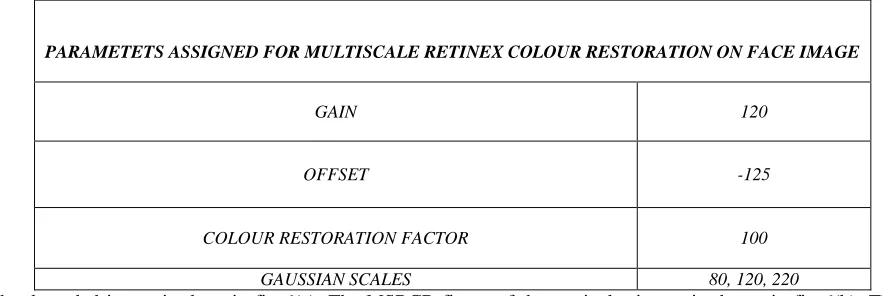
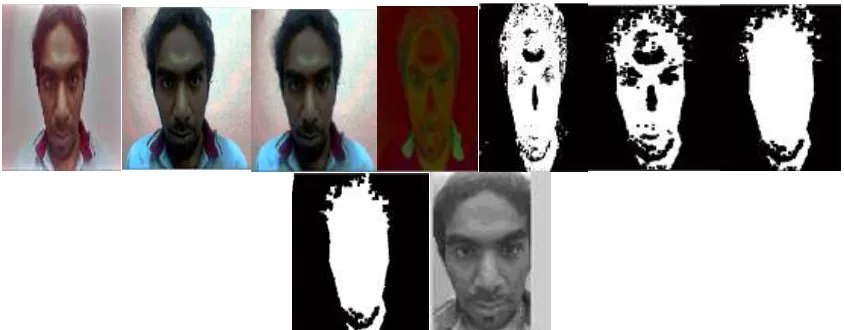
IMULATION RESULTSThe simulation is done in MATLAB GUI . A database of six unique face-expressed image of a common individual is considered. The images in the database are degraded. These particular images are passed to the MSRCR block for enhancement. The enhanced image is given to the FER system for identifying different emotions. The parameters used in MSRCR for each face image is given in Table 1
TABLE 1: PERFORMANCE EVALUATION
PARAMETETS ASSIGNED FOR MULTISCALE RETINEX COLOUR RESTORATION ON FACE IMAGE
GAIN 120
OFFSET -125
COLOUR RESTORATION FACTOR 100
GAUSSIAN SCALES 80, 120, 220
FROM LEFT TO RIGHT:- FIGURE 6(a) INPUT IMAGE 6(b) MSRCR IMAGE 6(c) HISTOGRAM IMAGE 6(d) MODIFIED YUV COLOR IMAGE 6(e) BINARY IMAGE 6(f) ERODED IMAGE 6(g) FILLED IMAGE 6(h) AREA BASED FILTERED IMAGE 6(i) FACE DETECTED IMAGE
The various face images are assigned with the parameter values given in Table 1. In order to avoid gray scale violation the image is adjusted with phase 45 and offset value 135. This helps to restore the color of the image without any glow. The performance evaluation of MSRCR and histogram of various face expressed image is tabulated in Table 2. The value indicates that the color constancy and luminance is maintained in MSRCR compared to histogram equalization.
Table 2: Performance Evaluation
PERFORMANCE EVALUATION
IMAGES
TECHNIQUE USED
MSRCR TECHNIQUE HISTOGRAM EQUALIZTION
CONTRAST LUMINANCE CONTRAST LUMINANCE
NEUTRAL -0.33852 -0.22609 0.48772 -0.27331
SAD -0.3429 -0.23041 0.48668 -0.28071
FEAR -0.31864 -0.22358 0.50721 -0.26941
HAPPY -0.32308 -0.21981 0.47453 -0.26090
SURPRISE -0.31018 -0.22280 0.54343 -0.26976
ANGRY -0.32660 -0.21567 0.48772 0.27331
The face images of size 50 X 50 present in database are passed to the feature extraction block. The Gabor filter and PCA extracts the information of features. The Real part of the Gabor filter having five frequencies and 8 orientation values are convoluted with image to produce 50 X 50 X 8 X 5 image. This resultant image is given to PCA and the necessary weights are computed. Thi s weight is compared with the test image weight and the Euclidean distance is calculated. The minimum distance is the recognized face. The test image and recognized image is shown in fig 7.
VII.
C
ONCLUSIONThe proposed work provides a face expression recognition system incorporated with a MSRCR block. The MSRCR block provides good fidelity to the users and provides good performance compared to normal histogram equalization. This image is passed to a face expression recognition system to identify various expressions. The face expression system comprises of the Face Detection, Gabor filter and PCA and Euclidean distance classifier. The combine process of Gabor filter and PCA results in good feature extracted information. This is due to the significant characteristics of Gabor filter and PCA. The combined effort along with the MSRCR provides good recognition rate.
R
EFERENCES[1] Sabith Sanal, Assist. Professor Reneesh Zacharia, Mangalam College of Engineering. “Face Detection Using Skin Color Segmentation Algorithm with MSRCR
in MATLAB GUI”, IJSETR, Vol 3, No 8, August 2014.
[2] Ming-Hausan Yang, Member, IEEE, David.J.Kriegman, Senior Member, IEEE, Narendra Ahuja, Fellow, IEEE, “ Detecting Faces in Images: A Survey”, IEEE
Transactions on Pattern Analysis and Machine Intelligence, Vol 24, No 1, January 2002.
[3] Jian Yang, Chengin Liu, Lei Zhang. “ Color Space Normalization: Enhancing the Discriminating Power of Colorspaces for Face Recognition”, Pattern
Recongition, 43 (2010) 1454-1466.
[4] R.I.Hsu, M.Abdel-Mottaleb, A.K.Jain. “Face detection in color images”, IEEE Transaction on Pattern Analysis and Machine Intelligence 25 (5) (2002) 696-706.
[5] Hanumantharaju M.C. Ravishankar.M, Rameshbabu D.R, Ramachandran .S, “Color Image Enhancement using Multiscale Retinex with Modified Color
Restoration Technique”, 2011 Second International Conference on Emerging Applications of Information Technology.
[6] Z.Rahman, D.Jobson and G.A Woodbell, “Multiscale Retines for Color Image Enhancement”, in Proceedings of the IEEE International Conference on Image
Processing, IEEE, 1996.
[7] Mohammed Javad, “Face Recognition using Gabor Fillter”, IJARCSSE, Vol 4, No 2, February 2014.
[8] A.S Sayed Navaz, T. Devi Sri, Pratap Mazumder, “Face Recognition Using PCA and Neural Networks, IJCMWMC, Vol 3, No 1, March 2013.
[9] Muhammed Sharif, Adeel Khalid, Mudassar Raza, Sajjad Mohsin, “Face recoggnition using Gabor Filters”, Journal of Applied Computer Science and
Mathematics, Vol 5, No 11, 2011.
[10] Prof. Ujval Chaudhry, Chakoli Mateen Mubarak, Abdhul Rehman, Ansari Riyaz, Shaikh Mazhar, “Face recognition using PCA-BPNN algorithm”; IJMER, Vol
2, No 3, May-June 2012.
[11] Sonia Chhetri, “Approach to Design and Develop Highly Efficient Face Detection System”, Internation Journal of Computer Science Trends and Technology,
Vol.2,No.2,March-April 2014.