PERFORMANCE AND EMISSIONS ANALYSIS OF
DIESEL BLENDED WITH NAHAR BIODIESEL BY
VARYING COMPRESSION RATIO OF CI ENGINE
Mr.R.G.Biradar
1, Dr. C. L. Prabhune
2, Dr. Supriya Bobade
31
Mechanical Engineering Department, NMIT, Pune, Maharashtra, India.
2
Mechanical Engineering Department, Zeal College of Engineering, Pune,
Maharashtra, India.
3
Indian Biodiesel Corporation, Baramati, Maharashtra, India.
Abstract:The present experimental investigation evaluates the effects of using blends of
diesel fuel with 18% concentrations of Ethyl Ester of Nahar biodiesel blended with various
compression ratios. The experiment was carried out with three different compression ratios.
Experimental Biodiesel was extracted from Nahar oil, 18% (B18) concentrations of oil in
diesel was found to be best blend ratios from the earlier experimental study. The engine was
maintained at various compression ratios i.e., 16, 17 and 18 respectively. It is found that, at
compression ratios of 18:1 for B18 blended fuel (Pure Diesel 82% + Nahar Biodiesel 18%)
shows better performance and lower emission level which is very close to neat diesel fuel. It
is also found that the increase of compression ratios increases the Brake Thermal Efficiency
and reduces Brake Specific Fuel Consumption and having lower emission without any
engine in design modifications.
Key words: Compression Ratio, Nahar Biodiesel, Engine Performance, Emissions.
1. INTRODUCTION
The aim of the study was to investigate the effect of Nahar oil biodiesel fuels on engine
performance. To investigate the effect of varying compression ratio in Nahar oil on engine
performance and emissions characteristics. A single cylinder, 4 stroke, compression ignition
direct injection diesel engine has been used to measure the emissions performance
characteristics of blends of biodiesel and Diesel.
Journal homepage: www.mjret.in
The world is confronted with the twin crises of fossil fuel depletion and environmental
degradation. The rapid extraction and consumption of fossil fuels have led to a reduction in
petroleum reserves [1]. Biodiesel is an alternative fuel for diesel engines that is produced by
chemically combining vegetable oils and animal fats with an alcohol to form alkyl esters.
Extensive research and demonstration projects have shown that it can be used pure or in
blends with conventional diesel fuel in unmodified diesel engines [3]. Interest in biodiesel
has been expanding recently due to government incentives and high petroleum prices.
While the current availability of vegetable oil limits the extent to which biodiesel can replace
petroleum to a few precent, new oil crops could allow biodiesel to make a major contribution
in the future.[2][5]
2. LITERATURE REVIEW
Pillai et al. [1] studied performance of DI compression ignition engine with blends of 5-carbon
alcohol, rubber seed biodiesel and diesel at various compression ratio viz.16: 1, 17: 1, 18: 1.
It proves that CR 17.5 is the best compression ratio for all the blends. The result shows that
the emission is reduced except for NOx when compared with the diesel fuel. Finally
concluded that emission was reduced in R10P10 blend at CR 17.5 and it is an eco friendly
alternative fuel.
Venkateswara et al. [2] performed experiment on tested in uneven firmness ratio engine
(VCR) with methyl ester of jatropha oil (MEOJ) and diesel. The compression ratio was varied
for 14, 16, 18 and 20. The BTE and BSFC were measured for performance parameter and
CO, CO2, HC, NOx and smoke for emission parameter. It was noticed that higher CR,
performance of engine increased apparently with less BSFC for biodiesel blends fuel. The
emission was higher for CO and CO2, HC, NOx and smoke density emission is lower when
CR is higher. The higher compression ratio of the combustion parameter is improved in
biodiesel blends.
Sejaj et al. [3] reveals the natural aspirated, various compression ratio engine with different
biodiesel blends (B10, B20, B30, B40, B60, B80 and B100). The test was conduct in no load
to full load in all blends. All emission parameter such as HC, CO, and NOx were measured.
The compression ratio was varied from 14 to 18 with equal interval of two. In higher
compression ratio 18 the BTE was increased and lower in SFC. The results shown B20
biodiesel was superior in both performance and emission parameter in higher compression
ratio of 18 compare to other compression ratio and other biodiesel blends.
Anand et al. [4] investigated about the methyl ester of cotton seed oil production by
by 5%. An experiment is studied at constant speed in 1500 rpm with variable compression
ratio (CR). The compression ratio of 15 and 17 were found better in performance
characteristics with 5% blends. The oxides of nitrogen emission are higher in compression
ratio 17 with B20 blend. Also reduction in carbon monoxide and smoke in all loads in higher
compression ratio of 17 with B20 blend. They concluded B20 with higher compression ratio
is suitable for diesel engine.
Metin et al. [5] stated that the Hydro Carbon emission for B20 blends of MEOJ and diesel at
variable compression ratio (CR). The HC emission increase or decrease is based on the CR
value. Normally if the CR value is increased, the HC emission reduced. At full load with the
CR of 17.5, the HC for B20 is 33ppm while compared to other compression ratio. During the
end of the compression stoke the air temperature gets higher, this enhance the complete
burning and reduction HC emission.
The review gives a thorough attitude toward the investigation of biodiesel creation, engine
examination utilizing biodiesel with mixes of diesel, impact of engine parameters on engine
examination and engine examination utilizing Nahar Oil mixes. The survey plainly
demonstrates that investigation of Variable Compression Ratio engine utilizing cottonseed oil
methyl ester as fuel is exceptionally restricted. In addition, the Nahar Oil mixes as fuel in
Variable Compression Ratio isn't finished by any scientist. Thus, in this work, an endeavor is
made to examine the execution, ignition and discharge qualities of Variable Compression
Ratio engine utilizing biodiesel and its mixes.
3. TRANSESTERIFICATION REACTION
The main components of animal fats and vegetable oils are Triglycerides. The vegetable oil
or animal fat is subjected to a chemical reaction called Transesterification to produce
biodiesel. The fatty acid triglycerides are esters of fatty acids and the chemical divides up of
the heavy molecules and forming simpler esters is termed as Transesterification. These
triglycerides are reacted with alcohol (Methyl, Ethyl, or others) in the presence of a catalyst
under a restricted temperature for a given length of time. The final products are Alkyl esters
and Glycerin. The Alkyl esters are having positive properties as fuels for use in CI engines,
Fig. 1 Transesterification reaction.
1. Filtering: The vegetable oil is first filtered to remove solid particles from it. It is to be
warmed up a bit first to get it to run freely; 35°C should be enough. A Cartridge filter
is used for the same.
2. Removing the Water: First the oil is heated to remove the water content. Vegetable
oil may contain water, which can slow down the reaction and causes saponification
(soap formation). Then the temperature is raised to 100°C, holding it and allows
water contents to boil off. Run the agitator to avoid steam pockets forming below the
oil and exploding, splashing hot oil puddles out from the bottom. When boiling slows,
the temperature is raised to 130°C for 10 minutes and allow cool to it.
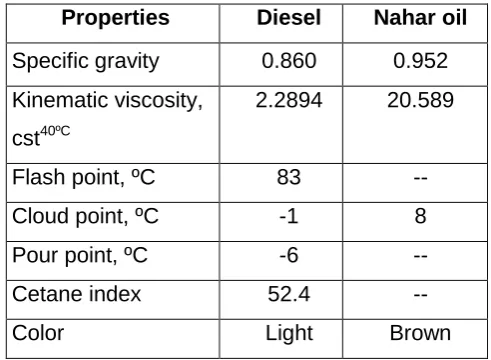
The physico-chemical properties of Hybrid biodiesel i.e. equal mixture of cotton-seed and
Eucalyptus oil biodiesel is given in the Table 1. The specific gravity, Kinematic Viscosity,
Flash Point, Cloud Point, Pour point, Cetane index and color are comparable with that of
diesel fuel.
Properties Diesel Nahar oil
Specific gravity 0.860 0.952
Kinematic viscosity,
cst40ºC
2.2894 20.589
Flash point, ºC 83 --
Cloud point, ºC -1 8
Pour point, ºC -6 --
Cetane index 52.4 --
Color Light Brown
Table 1 Tested Properties of Hybrid Biodiesel
4.
EXPERIMENTAL SET UP
The engine was started and allowed to run for 15-20 minutes to get stabilized using pure
performance parameters were noted using I.C. engine software. The exhaust gas emission
parameters like HC, NOx, CO2, CO were recorded by pelting the probe of AVL gas analyser
in the exhaust pipe. For noting the value of smoke (opacity) the exhaust gas was directed to
AVL smoke meter and the opacity was recorded.
Then the load on the engine was further increased from 0 kg, 3 kg, 6 kg, 9 kg, 12 kg and
15kg while keeping the fuel injector triggering pressure and fuel injection advance angle
unchanged. The engine was run for sufficient time duration to ensure that the diesel fuel
phase is over and the engine has started running with biodiesel as fuel. The entire process
was repeated while engine running with different blends of hybrid biodiesel i.e. B06, B12,
B18, B24, B30 and B36 as a fuel and various performance and emission parameters were
noted.
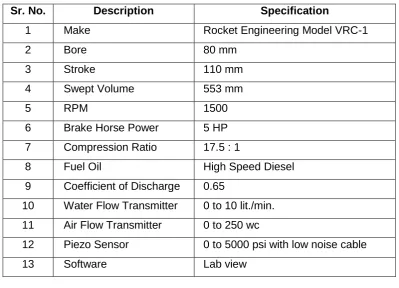
Sr. No. Description Specification
1 Make Rocket Engineering Model VRC-1
2 Bore 80 mm
3 Stroke 110 mm
4 Swept Volume 553 mm
5 RPM 1500
6 Brake Horse Power 5 HP
7 Compression Ratio 17.5 : 1
8 Fuel Oil High Speed Diesel
9 Coefficient of Discharge 0.65
10 Water Flow Transmitter 0 to 10 lit./min.
11 Air Flow Transmitter 0 to 250 wc
12 Piezo Sensor 0 to 5000 psi with low noise cable
13 Software Lab view
Table 2 Test Engine specifications
Sr. No. Description Specification
1 Make AVL
2 Type AVL Digas 444
3 Power supply 110V-220V 25 W
4 Warm up time 7 min.
5 Connector gas in 180 l/h, max. overpressure 450 hPa
7 Operating temperature 5 …45 C
8 Storage temperature 0…50 C
9 Dimension (w x d x h) 270 x 320 x 85 mm3
10 Weight 4.5 kg net weight without accessories
11 Interfaces RS 232 C, Pick up, Oil temperature
probe
Table 3 Specifications of AVL Gas Analyser.
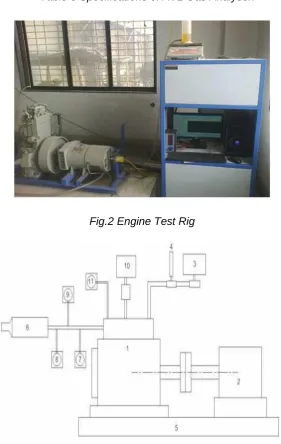
Fig.2 Engine Test Rig
Fig. 3 Experimental Engine Setup Arrangements
1. Test Engine 2. Hydraulic Dynamometer
5. Fuel Tank 4. Fuel Burette
6. Test Bed 6. Silencer
8. Exhaust Temp Indicator 09. Air Flow Meter
1. Stop Watch
5.
RESULTS AND DISCUSSION
5.1 Engine performance Analysis- The engine performance parameters such as Brake
Power, Specific Fuel Consumption, Brake Thermal Efficiency, and Brake Mean Effective
Pressure obtained with B18 at compression ratios of 16, 17 and 18 are discussed in the
following sections.
Fig.4: Load vs Brake Power
Fig. 4 depicts the variation of the Brake power for diesel at various conditions of load. The
BP increases with the increase in the compression ratio. Percentage increment in BP of B18
obtained at compression ratio, 16, 17 and 18 are 1.56, 1.52 and 1.77.
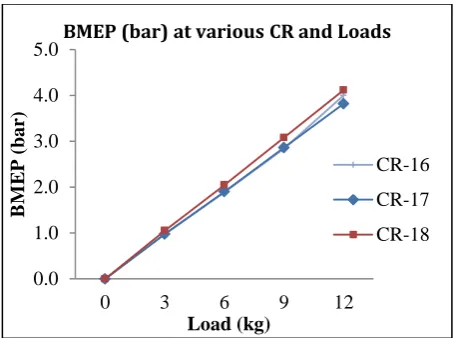
Fig.5 depicts the variation of the Brake mean effective pressure for diesel at various
conditions of load. The BMEP increases with the increase in the compression ratio.
Percentage decrement in BMEP of B00 obtained at compression ratio, 16, 17 and 18 are
1.94, 1.91 and 2.06.
Fig. 6 depicts the variation of the Brake thermal efficiency for diesel at various conditions of
load. The BTHE increases with the increase in the compression ratio. Percentage decrement
in BTHE of B18 obtained at compression ratio, 16, 17 and 18 are 12.59, 13.42.
0.0 0.5 1.0 1.5 2.0 2.5 3.0 3.5 4.0
0 3 6 9 12
B
P
(
k
W)
Load (kg)
BP at various CR and Loads
CR-16
CR-17
Fig 5: BMEP at various Compression Ratio and Loads
Fig.6: BTHE at various Compression Ratio and Loads
Fig.7: SFC at various Compression Ratio and Loads
Fig.7 depicts the variation of the Specific fuel consumption for diesel at various conditions of
load. The SFC decreases with the increase in the compression ratio. Percentage decrement
in SFC of B18 obtained at compression ratio, 16, 17 and 18 are 0.39, 0.40 and 0.42.
0.0 1.0 2.0 3.0 4.0 5.0
0 3 6 9 12
B M E P ( ba r) Load (kg)
BMEP (bar) at various CR and Loads
CR-16 CR-17 CR-18 0 5 10 15 20 25
0 3 6 9 12
BTHE
(%)
Load (kg)
BTHE (%) at various CR and Loads
CR-16 CR-17 CR-18 0.0 0.2 0.4 0.6 0.8 1.0
0 3 6 9 12
SFC (k g /k Wh) Load (kg)
SFC at various CR and Loads
5.1 Engine Exhaust Emission Analysis- The engine performance parameters such as BP,
SFC, Brake Thermal Efficiency, and Brake Mean Effective Pressure obtained with B18 at
compression ratios of 16, 17 and 18 are discussed in the following sections.
Fig.8: CO at various Compression Ratio and Loads
Fig.8 depicts the variation of the Carbon monoxides for diesel at various conditions of load.
The CO decreases with the increase in the compression ratio. Percentage decrement in CO
of B18 obtained at compression ratio, 16, 17 and 18 are 0.79, 0.77 and 0.76.
Fig.9: HC at various Compression Ratio and Loads
Fig.9 depicts the variation of the Hydrocarbons for diesel at various conditions of load. The
HC reduces with the increase in the compression ratio. Percentage decrement in HC of B00
obtained at compression ratio, 16, 17 and 18 are 152, 139 and 129. 0.0
0.5 1.0 1.5 2.0 2.5 3.0
0 3 6 9 12
CO
%
of
V
ol
Load (kg)
CO at various CR and Loads
CR-16 CR-17 CR-18
0 50 100 150 200 250 300 350
0 3 6 9 12
V
ol o
f HC
in
p
p
n
Load (kg)
HC at various CR and Loads
Fig.10: CO2 at various Compression Ratio and Loads
Fig.10 depicts the variation of the Carbon dioxides for diesel at various conditions of load.
The CO2 reduces with the increase in the compression ratio. Percentage decrement in CO2
of B18 obtained at compression ratio, 16, 17 and 18 are 4.18, 4.15 and 4.07.
Fig.11: NOx at various Compression Ratio and Loads
Fig.11 depicts the variation of the Carbon dioxides for diesel at various conditions of load.
The CO2 reduces with the increase in the compression ratio. Percentage decrement in CO2
of B18 obtained at compression ratio, 16, 17 and 18 are 116, 114.9 and 111.4.
6.
CONCLUSION
The Experimental work carried out in this study, and the conclusions made from above
discussions are as follow
1 The BP increases with the increase in the compression ratio. Percentage increment in BP of B18 obtained at compression ratio, 16, 17 and 18 are 1.56, 1.52 and 1.77.
2 The BMEP increases with the increase in the compression ratio. Percentage decrement in BMEP of B00 obtained at compression ratio, 16, 17 and 18 are 1.94, 1.91 and 2.06.
0 1 2 3 4 5 6 7 8
0 3 6 9 12
CO 2 % of V ol Load (kg)
CO2 at various CR and Loads
CR-16 CR-17 CR-18 0 50 100 150 200 250
0 3 6 9 12
N O x in p p m o f V ol Load (kg)
Nox at various CR and Loads
3 The BTHE increases with the increase in the compression ratio. Percentage decrement in BTHE of B18 obtained at compression ratio, 16, 17 and 18 are 12.59, 13.42.
4 The SFC decreases with the increase in the compression ratio. Percentage decrement in SFC of B18 obtained at compression ratio, 16, 17 and 18 are 0.39, 0.40 and 0.42.
5 The CO decreases with the increase in the compression ratio. Percentage decrement in CO of B18 obtained at compression ratio, 16, 17 and 18 are 0.79, 0.77 and 0.76.
6 The HC reduces with the increase in the compression ratio. Percentage decrement in HC of B00 obtained at compression ratio, 16, 17 and 18 are 152, 139 and 129.
7 The CO2 reduces with the increase in the compression ratio. Percentage decrement in
CO2 of B18 obtained at compression ratio, 16, 17 and 18 are 4.18, 4.15 and 4.07.
8 The CO2 reduces with the increase in the compression ratio. Percentage decrement in
CO2 of B18 obtained at compression ratio, 16, 17 and 18 are 116, 114.9 and 111.4.
The results concluded that the compression ratio 18 with B18 biodiesel blend is the best
compression ratio in terms of performance, emission characteristics of variable compression
diesel engine.
REFERENCES
[1]. Pillai N. Subramonia, Kannan P. Seeni, and Suresh S, 2016 Experimental Investigation on Emission
Characteristics of Variable Compression Ratio CI Engine Fuelled by Combined Biodiesel, Asian Journal
of Research in Social Sciences and Humanities, 6(9):1419-1429.
[2]. Venkateswara Rao P, 2015. Compression ratio effect on Diesel Engine working with Biodiesel (JOME)
Diesel blend as Fuel”, Research Journal of Chemical Sciences, 5(7):48-51
[3]. Sejal Narendra Patel and Ravindra Kirar, 2012. An Experimental Analysis of Diesel Engine Using
Biofuel at Varying Compression Ratio, International Journal of Emerging Technology and Advanced
Engineering, 2:385-391.
[4]. Anand R, Kannan G R, Rajasekhar Reddy K and Velmath S, 2009. The Performance and Emissions of
a Variable Compression Ratio Diesel Engine Fuelled With Bio-Diesel From Cotton Seed Oil, ARPN
Journal of Engineering and Applied Sciences, 4(9):72-87.
[5]. Metin Guru, Atilla Koca, Ozer Can, Can Cinar, and Fatih Sahin, 2010. Biodiesel production from waste
chicken fat based sources and evaluation with Mg based additive in a diesel engine, Renewable Energy