Vol. 1, 2013-14, 43-51
ISSN: 2349-0632 (P), 2349-0640 (online) Published on 1 October 2013
www.researchmathsci.org
Journal of
Detecting communities of directed networks via a local
algorithm
Shigang Liu
School of Information Technology, Deakin University Melbourne, Australia. Email: [email protected]
Received 30 June 2013; accepted 16 July 2013
Abstract. Targeted to the division of community structure in directed networks, this paper
gives a definition of the node strength. Based on the principle of the node strength, the division of the local community structure algorithm is proposed in directed and overlapping networks. The basic idea is to find an initial community from a node with maximal node strength and to expand the community by adding nodes. The algorithm only requires local information of nodes used, so the time complexity is very low, reaching a linear complexity. Finally, the algorithm is applied to the classic Zachary network to verify the validity of the algorithm.
Keywords:Directed network, Overlapping community, Node strength
1. Introduction
Various complex systems are described as graphs and networks [1-3] in nature. With the development of network in the field of physics and mathematics, the important property of the social network has been recognized—community structure [4]. That is to say, the whole network is made up of several groups and every vertex of the related group is linked to others tightly, while the link between group and group is very sparse. Therefore, research about complex network plays an important role in realizing that structure of the social network and analysis its property. Also community structure analysis is widely used in management, sociology, biology, physics and computer science and related area[5].
Palla et al. presented a clique percolation algorithm[11] which is good at dividing overlap networks.
Aimed at the community structure partitioning problem of the directed network, this paper first described the definition of node strength, neighbors. We will use the local community divide method into the directed network based on node strength. The main thought of this algorithm is begin with the largest node strength and then find an initial community, after that expanded the community by adding nodes. Finally, we use this approach into the classical Zachary network; the result shows this method good at processing overlapped community problems.
This paper is structured as follows. In section 2, we introduce several basic function and modularity function related to community structure partition. In section 3, we presented a local community partition algorithm based on node strength. In section 4 is devoted to an example that uses the classical Zachary network, in order to show the effectiveness of the proposed algorithm. Section 5 concludes.
2. Definitions and Modularity Function 2.1. Definitions
First of all, we will introduce some basic knowledge of network, suppose G=G V E
(
,)
is an undirected graph where V =
{
v v1, 2,⋯,vn}
is vertex set and( )
{
i, j i , j}
E= v v v ∈V v ∈V the set of directed edges. d v
( )
is the degree of v ingraph G, which is also regard as the neighbors of v. Suppose D=
(
V D( ) ( )
,E D)
is a directed graph and V D
( ) {
= v v1, 2⋯,vn}
is a vertex set. v vi, j∈V D( )
and( )
v vi, j ∈E. A directed edge from a vertex vi to a vertex vj is denoted by( )
v vi, j .Therefore,
( )
v vi, j and( )
v vj, i are to different edges. We say din( )
v and dout( )
vdenote the in-degree and out-degree of v inD. In the following part some definition about dividing the community structure of directed graph will be presented.
Definition 1. Suppose D=
(
V D( ) ( )
,E D)
is a directed graph, verticesv vi, j∈V D( )
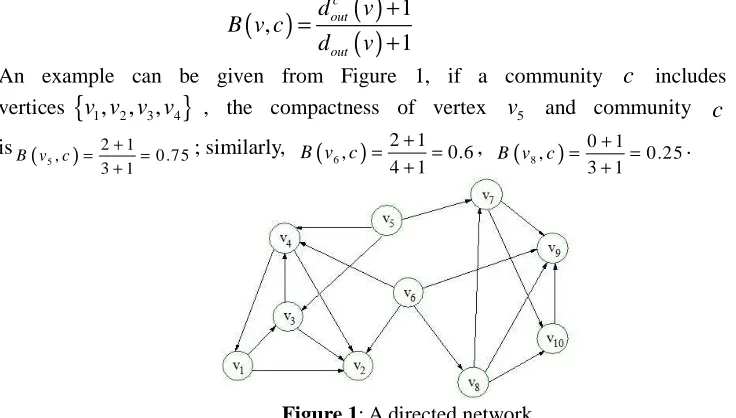
, where vi and vj are neighbors if there is an edge from vi to vj.For example, from figure 1 we can see there is an edge from v5 to v3, so v5 is
the neighbor of v3.
Definition 2. Suppose D=
(
V D( ) ( )
,E D)
is a directed graph, v V D∈( )
, the note strength of vertex vis the number of all the neighbors of v, which is the in-degree of vnote as din
( )
v .For example, let’s look at figure 1, the note strength of vertex v4 is 3, the note
Definition 3. Suppose D=
(
V D( ) ( )
,E D)
is a directed graph, v V D∈( )
, where the compactness of vertex v and communityc
is described as follows:
( )
( )
( )
1, 1 c out out d v
B v c
d v
+ =
+ (1)
An example can be given from Figure 1, if a community c includes
vertices
{
v v v v1, 2, ,3 4}
, the compactness of vertex v5 and community cis ( )
5
2 1
, 0 .75
3 1 B v c = + =
+ ; similarly,
(
6)
2 1
, 0.6
4 1
B v c = + =
+ ,
(
8)
0 1
, 0.25
3 1
B v c = + =
+ .
Figure 1: A directed network
2.2. Modularity Function
Girban and Newman have given the definition of modularity function in their papers, which is as follows:
2 1 ( ) k ii i i
Q e a
=
=
∑
− (2)Note that eiiis the percentage of the edges that connect to community ci divide all the edges, aiis the percentage of the edges that connect communities divide all the edges of the graph. We can generate a network by the related definition, and each community is not changed, the edges of vertex and vertex can join to each other freely, where the function Q is used to describe the level of divided community.
When the communities are known in the graph, cvis noted as the community of vertexv. The proportion of the edges that belongs to the community among all the edges in the network is:
(
)
, ,
1
2 u v
uv u v uv
uv c c uv
uv uv
A c c
A
A = m
δ
∑
∑
∑
(3)where Auv is a matrix that contains elements from network. For example, if there is an
edge between u and v, then , 1
u v
c c
δ
= , otherwise , 0u v
c c
δ
= ; mis the number ofbe expressed as
( ) ( )
2 d u d v
m , where d v
( )
is the degree of vertex v. Therefore theexpression of the modularity function is:
( ) ( )
,1
2 uv 2 c cu v
uv
d u d v
Q A
m m
δ
= −
∑
(4)Now we will talk about the modularity function in directed network [12]. Note that the community structure in directed network problems is also connected with the proportion of the related edges in all the edges and the proportion between communities. However, the difference is that the direction should be considered and the position of an edge is related to its direction. For example, there are verticesA B, , where vertex A has a high out-degree and low in-degree, meanwhile vertex Bis opposite. That is to say, the direction between A and B is more likely to be AtoB, rather than B toA. Therefore, if there is an edge from B toA, we should pay more attention. In other words, if we know all the in-degree and out-degree of the whole network and their connection structure, then the related structure model can be obtained. The probability
from u to v is din
( ) ( )
v dout um , where din
( )
v and dout( )
u denote the in-degreeand out-degree of vertex v and u, Auv is a matrix that contains elements from network, if uandv are neighbors thenAuv=1, otherwise Auv =0. And the related
modularity function is defined as following:
' 1
( ) ( )
.u v
in out
uv c c uv
d v d u
Q A
m m
δ
= −
∑
(5)3. Description of community structure partition algorithm based on note strength
Two steps are included in this algorithm: (1) find the initial community; (2) expand the community
3.1. Find the initial community
Given a directed networkD, first we calculate its vertex note strength and then begin to find the initial community from the largest note strength vertex; the process is detailed as following:
(1) With every v V D∈
( )
, calculate din( )
v ;(2) Choose max
{
din( )
v v V D, ∈( )
}
as vertex v and its neighbor N v( )
, thesevertices form a community c;
(3) Given vertex u∈c, if
( )
, CB u c ≤B ( we choose BC =0.5 ), delete vertex
u from community c;
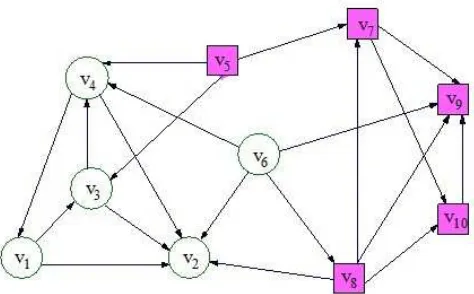
For example, figure 2 shows that after calculating the node strength of every vertex, v2 and its neighbors were chosen as a community
{
v v v v v v1, 2, ,3 4, 6, 8}
.For every vertex, after calculatingB
( )
⋅,c , v8 is deleted from the community,finally we get the initial community
{
v v v v v1, 2, ,3 4, 6}
.Figure 2: Find the initial community
3.2. Expand the community
First find out all the neighbors N c
( )
of communityc. If there existv∈N c( )
, suchthat B v c
( )
, >BC , we add vertex v into community c ; if for every vertexv∈N c( )
,B v c( )
, <BL, (BL =0.4), then we stop expanding the community; now we consider a kind of vertex v which meet the need of BL ≤B v c( )
, ≤BC, and we add this kind of vertex v into the community c, after that the modularity Q'become larger, finally the vertex v was added to the community c. The detailed expanded progress is as following:
(1) Find out all the neighbors N c
( )
of initial community c, for every node( )
v∈N c , calculate B v c
( )
, ;(2) Find out vertices which meet the need of B v c
( )
, >BCandBL≤B v c( )
, ≤BC,write as Nv =
{
v B v c|( )
, >BC}
and{
|( )
,}
L C
lv
N = v B ≤B v c ≤B ;
(3) If Nv >0, we add all the vertices of Nv into the community c which is larger than before, and we still write as c, back to step (1);
(4) If Nlv >0, we add all the vertices of Nlv into the community c which is larger than before, and we still write as c, back to step (1);
(5) If Nv =0 and Nlv =0, stop expanding the community, finally we obtain a
As shown in figure 2,
{
v v5, 8}
are the neighbors of initial community{
1, , , ,2 3 4 6}
c= v v v v v , then we get
(
5)
2 1, 0.75
3 1 B v c = + =
+ ,
(
8)
1 1
, 0.4
4 1 B v c = + =
+ . As we
said before, v5 can be added to community c which is larger than before, still denoted
as c. After v5 is added to the community, c has only one neighbor vertex v8,
because B v c
(
8,)
=0.4 and the modularity before adding v8 is Q'=3.25, afteradding v8 is Q'=2.25, that is to say modularity become small. Therefore vertex v8
cannot be added to the community; finally we get the ultimate communityc=
{
v v v v v v1, 2, ,3 4, ,5 6}
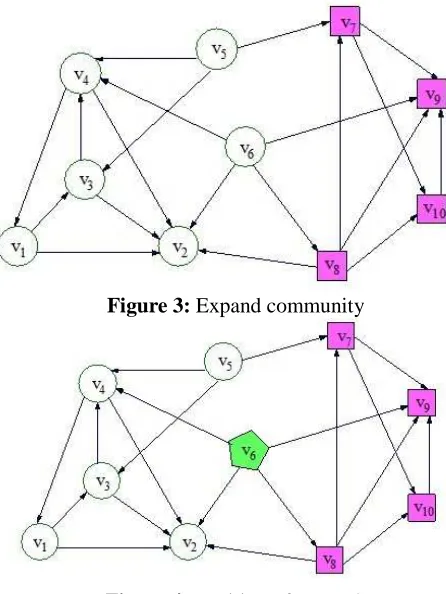
.Extract the communityc, the make note of every vertex of c with sign ‘T’, repeat process 3.1 and 3.2 until find out all the communities. As shown in figure 3, extract the first communityc=
{
v v v v v v1, 2, ,3 4, ,5 6}
, follow the algorithm we proposed above, wecan find out anther community
{
v v v v v6, 7, ,8 9, 10}
, as can be seen in figure 4, vertex v6is the common vertex of these two communities.
Figure 3: Expand community
Figure 4: partition of network 4. Application of the algorithm
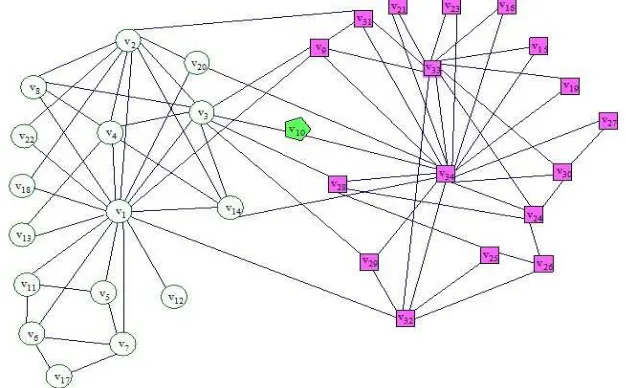
proposed algorithm which is a famous classic problem about social club network. In the early 1970s, it took two years for Zachary to observe the social relations among the Karate club members in one of American university and finally Zachary constructed the social network[13] among them. See figure 5. Interestingly, during his survey he found that the boss of the club and the supervisor has different opinion about whether charge more fees to the members of the club, thus the club become two communities under the leadership of boss and the supervisor. Zachary club social network has become a classical problem in complex network community structure and a standard in measuring whether a network structure partition is good or not.
Figure 5: Zachary social karate club network model and the relations
We will analysis the Zachary social network with the algorithm that proposed above. Zachary social network made up of 34 vertices and 78 edges. First of all, we will treat the network as two-way network, that is to say, the in-degree and out-degree of every vertex is equal to its vertex degree. Then we find that vertex v34and its 17 neighbors constitute
a community, after computingB
( )
⋅,c , v14 and v20 are deleted and form a newcommunity c which is made up of vertex v34 and others vertices without v14、v20.
Because the in-degree and out-degree of vertex v10 is equal, v10 is regard as the
common vertex of both communities. Furthermore, through add vertices and expand the community. We then find out the neighbors
{
v v v v1, 2, ,3 14,v20,v25,v26}
of communityc,computeB
( )
⋅,c , we find that the vertices compactness B( )
⋅,c of verticesv1,v2, v14and community care all smaller than 0.4, thus these vertices cannot be added to the community. While B
( )
⋅,c of vertices v25 , v26 and community c is 1, andverticesv25,v26 are added to the communityc. Meanwhile vertices v3 and v20 are all
included in Nlv, we can compare the Q' before and after adding the vertices, it is can
be calculated that Q' is become smaller, so v3 and v20 are not allowed to be added.
Stop expand and the ultimate community is obtained which is made up of vertex v34,
25
in figure 5. Then we can find the largest note strength, follow the above steps, we can obtain the roundness in figure 5. And vertex v10 is the common vertex between the two communities.
Figure 5: The result after using the proposed algorithm into Zachary
Zachary as a social network, when we study its structure, we didn’t consider the other effect factors from the outside. Moreover, in different social conditions, the partition of Zachary network has different results. Therefore, as long as the error is acceptable, we say the algorithm is accurate. Figure 6 also shows the results is good enough to meet the real world problem.
5. Conclusion
This paper introduces an algorithm about how to divide the local community structure of directed network, which is based on the note strength. Comparatively, the advantage of this algorithm is that we don’t have to know the whole network structure and the number of communities before we use the algorithm. And local information is enough for this approach. Therefore, this method is easy to use with low complexity. Moreover, this algorithm is also can be used to find the community structure of the whole network. Finally, after we use this approach into Zachary social network, a good result has been achieved.
REFERENCES
1. M.E.J.Newman, The structure and function of complex networks, SIAM Rev, 45 (2003) 167-256.
2. R.Albert and A.L.Barabási, Statistical mechanics of complex networks, Rev Modern Phys, 74(1) (2002) 47-97.
3. S.H.Strogatz, Exploring complex networks, Nature, 410 (2001) 268-276.
5. L.Wang and G.Z.Dai, Community finding in complex networks—theory and applications, Sci Tech Rev, 23(8) (2005) 62-66.
6. M.Fiedler, Algebraic connectivity of graphs,. Czech Math. J, 23(98) (1973) 298-305. 7. B.W.Kernighan and S.Lin, An efficient heuristic procedure for partition graphs, Bell
Sys Tech J., 49 (1970) 291-307.
8. M.E.J.Newman and M.Girvan, Finding and evaluating community structure in networks, Phys. Rev E, 69 (2004), p.026113.
9. M.E.J.Newman, Fast algorithm for detecting community structure in networks, Phys Rev E, 69(6) (2004) 1-5.
10. A.Clauset, Finding local community structure in networks, Phys Rev E, 72(2) (2005), p.026132.
11. G.Palla, I.Derenyi, I.Farkas I, et al., Uncovering the overlapping community structure of complex networks in nature and society, Nature, 435(7043) (2005) 814-818. 12. D.R.Lai, H.T.Lu and C.Nardini, Finding communities in directed networks by
PageRank random walk induced network embedding, Phys A, 389 (2010) 2443-2445. 13. W.Zachary, An information flow conflict and fission in small groups, J Ant Res, 33