doi: 10.15171/rdme.2018.010 http://journals.tbzmed.ac.ir/rdme
Content creation based learning: scholarship of teaching and learning
Hossein Karimi Moonaghi¹,2*ID, Khatereh Shariati²ID1Evidence-Based Caring Research Center, Department of Medical Surgical Nursing, School of Nursing and Midwifery, Mashhad
University of Medical Sciences, Mashhad, Iran
2Department of Medical Education, School of Medicine, Mashhad University of Medical Sciences, Mashhad, Iran
Introduction
Student learning is the ultimate goal of the educational system and the main task of teachers. Learning includes all skills, attitudes, knowledge and information that students gain during their study at university and in their life. Teaching is a purposeful and intellectual activity that leads to student learning.1
Academic performance of postgraduate students depends on a comprehensive combination of scientific and practical competencies which are acquired during their coursework.2 Promoting lifelong learning is one goal of
higher education, at the postgraduate level in particular. Universities seek to prepare students for both short-term academic achievement and professional success. In pursuit of these goals, universities must teach critical thinking and its main components: critical reading and
writing excellence.3 Ness believes that “innovation is the
engine of scientific progress, yet we do not train public health students to think creatively”.4 Over the years,
critical thinking has rarely been a central focus and often has not been taught.5
After graduation, students are expected to apply their knowledge in real-life situations and contexts.6 In addition,
it is important they be able to create new knowledge and content that is necessary to accomplish their duties based on evidence. For example, postgraduate students, instead of receiving food, must be taught to produce food. To extend this analogy, at the postgraduate level every student can aspire to be a master chef.3 But traditional teaching
and learning methods in higher education have not overtly addressed these skills.7 There are many dramatic changes
recently in teaching and learning methods, especially with
*Corresponding author: Hossein Karimi Moonaghi, Email: [email protected]
Publishing Group
TUOMS
Article Type: Original Research
Article History: Received: 25 Mar. 2017 Accepted: 7 June 2017 epublished: 30 June 2018
Keywords: Content creation Learning
Medical education Scholarship of teaching Pedagogy
Instructional design
Abstract
Background: The performance of postgraduate students depends on a comprehensive
combination of scientific and practical competencies acquired during their coursework. Identifying a teaching method that can promote learning outcomes, academic writing and, most importantly, content and knowledge creation will be valuable.
Methods: Content creation based learning (CCBL) was used for a course in instructional design for 40 master’s students in medical education. The project was implemented across four semesters over 2 years. Each semester included 17 two-hour sessions. CCBL includes the following steps: finding content about the subject of each session; summarizing, organizing and writing collected content; presenting content in classroom; receiving feedback from classmates and instructor; and revising the content produced.
Results: The results are summarized as follows: (1) At the end of the course, 16 chapters of a valid and reliable book about instructional design could be produced. (2) The mean scores of student learning were 16.78 ± 1.3 (of a possible 20 points). This is a desirable level of learning. (3) The majority of students (60%) were highly satisfied. (4) Students felt this course had positive effects of this course on their academic achievement.
Conclusion: The results of this scholarly activity revealed many practical issues in field of postgraduate education. Applying CCBL in postgraduate education is recommended. The researchers hope other studies about outcomes and efficacy of CCBL will provide more evidence.
Article info
the increased use of student-centered approaches.8
These factors require the development of a revised set of teaching methods to guide postgraduate education in the new millennium. Therefore, finding a teaching method that could promote learning outcomes, academic writing and most importantly content and knowledge creation will be valuable.
Content creation is the contribution of information to any media for an end-user/audience in specific contexts. Content is “something that is to be expressed through some medium, as speech, writing or any of various arts” for self-expression, distribution, marketing and/or publication.
The term content refers to the body of knowledge and information that teachers teach and that students are expected to learn in a given subject or content area.9 The
Pew Survey described content creation as the creation of “the material people contribute to the world”.10
The content creation based learning (CCBL) method is a completely student-centered approach. CCBL leads students to think critically and engage in classroom activities. In addition to content creation, students move toward independent learning. Updated content always is needed in any course. At postgraduate level this need is more dominant. CCBL is applicable to any course regardless of level.
Many years of experience in teaching guided this research in the examination and use of the CCBL method. Based on personal experience of the researchers, this method has many advantages, but these need to be confirmed. Previous experience relied primarily on anecdotal evidence but there is value in verifying this method and using it in a systematic way to assess its effects on student learning and satisfaction.
Materials and Methods
This study was based on the scholarship of teaching and learning approach. Therefore, Glasic’s six steps were followed.11 CCBL was used in the Instruction Design
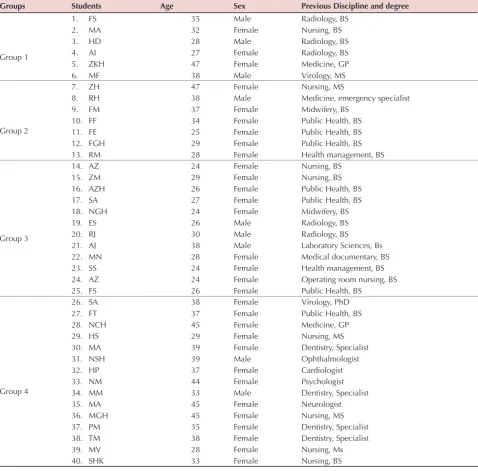
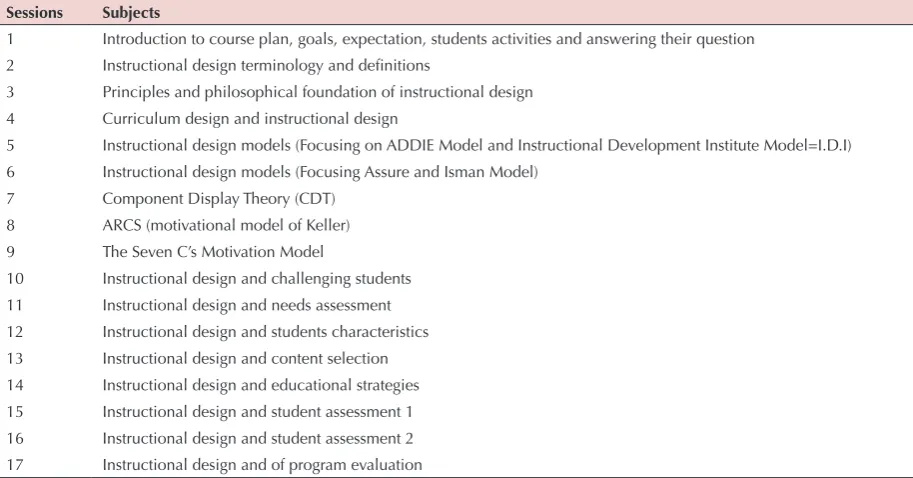
course for students in the master’s program for Medical Education. This course is taught in 17 sessions, each consisting of about 2 hours. Four groups of students participated in this course: six in group 1, 7 in group 2, 12 in group 3, and 15 in group 4 (Table 1). The project was implemented across four different semesters over 2 years (Table 2).
At the first session the course plan was reviewed, including time tables, CCBL and its outcomes for university and other students, and methods and process. After that, all students were consented and signed an informed consent form. In the first session all objectives and the syllabus were reviewed. At the end of this session, the topics of the next sessions were determined (Table 2). The students were told that the assessment would be based on their produced content (50%), engagement in classroom discussion (15%), and a final written examination (35%). The final examination included short answer questions
(SAQ) and multiple choice questions (MCQ). The validity of these examinations was based on the course objectives. Student scores were based on national scores system in Iran, which ranges from 0 to 20. The minimum pass level in the Iranian educational system for master’s students is 14.
Then students were asked to find content about the topic and write about 1000 (±200) words using at least five references. They had one week for searching and writing up their findings. They needed to consider that the references must be more recent, defined as less than 10 years old, except in some cases. Principles of good academic writing were emphasized.
At the second session, students presented their produced content and received feedback from classmates and teacher. Students noted the feedback and after considering the feedback, the final content would be delivered to teachers next week. The teacher scored students’ content based on three criteria: relevance, being up to date, editorial issues. Students’ engagement in classroom discussion also assessed by the instructor, based on their participation and the quality of their message. This was subjective. This process continued for the remaining 16 sessions. At the end of the course the total content was organized by the instructor and returned to students to give feedback, if there is any. This process completed by four groups. After that, all contents organized by the instructor and a draft of book (content) about the course were written. The draft of the book was returned to students to read and add their feedback. After considering student feedback, the researchers determined the validity of the content by asking 5 experts in the field.
Formative and summative assessments using valid and reliable tools were done to evaluate:
1) Created content and knowledge
2) Student learning (their produced content, engagement in the classroom, and final written examination)
3) Student satisfaction
4) Student experiences in academic writing and searching At the end of the course students were assessed using 10 SAQ and 20 MCQ. In addition, at the end of the course, students were asked about their total satisfaction with the course. Student satisfaction was scored by a rating scale as follows:
• I am not satisfied (0) • I am less satisfied (1)
• I am approximately satisfied (2) • I am completely satisfied (3) • I am highly satisfied (4)
and searching? The interviews were recorded and then reviewed by the instructor of the course (H.K.M). By listening to the interviews, the main ideas were extracted. The analysis was done based on Van Manen’s method.12
Results
Demographic information of participants is summarized in Table 1. In this study we followed 4 goals: (1) created content and knowledge (main objective), (2) students learning (content produced, engagement in the classroom, and final written examination), (3) student satisfaction, and (4) student experiences with academic writing and searching.
Created content and knowledge
At the end of the course, we could produce 16 chapters
(170 pages = 54 400 words) of content about the topic and objectives of the course (Table 2). Then the teacher (H.K.M.) carefully reviewed each chapter and filled in gaps of content based on his research, experiences and the literature. This increased the content to about 300 pages. Content was organized in book format: introduction, syllabus of content, objectives of each chapter added at the beginning of chapters, and references added at the end of chapters. The end of the book included indexes and vocabulary.
Five experts were asked to study the book to validate the content. All accepted and all valued the content very highly. They had some comments, including edits. All expert comments were considered. After completion, the book was among the candidates for publishing by Mashhad University of Medical Sciences, Vice Chancellor Table 1. Demographic information of participants
Groups Students Age Sex Previous Discipline and degree
Group 1
1. FS 35 Male Radiology, BS
2. MA 32 Female Nursing, BS
3. HD 28 Male Radiology, BS
4. AI 27 Female Radiology, BS
5. ZKH 47 Female Medicine, GP
6. MF 38 Male Virology, MS
Group 2
7. ZH 47 Female Nursing, MS
8. RH 38 Male Medicine, emergency specialist
9. FM 37 Female Midwifery, BS
10. FF 34 Female Public Health, BS
11. FE 25 Female Public Health, BS
12. FGH 29 Female Public Health, BS
13. RM 28 Female Health management, BS
Group 3
14. AZ 24 Female Nursing, BS
15. ZM 29 Female Nursing, BS
16. AZH 26 Female Public Health, BS
17. SA 27 Female Public Health, BS
18. NGH 24 Female Midwifery, BS
19. ES 26 Male Radiology, BS
20. RJ 30 Male Radiology, BS
21. AJ 38 Male Laboratory Sciences, Bs
22. MN 28 Female Medical documentary, BS
23. SS 24 Female Health management, BS
24. AZ 24 Female Operating room nursing, BS
25. FS 26 Female Public Health, BS
Group 4
26. SA 38 Female Virology, PhD
27. FT 37 Female Public Health, BS
28. NCH 45 Female Medicine, GP
29. HS 29 Female Nursing, MS
30. MA 39 Female Dentistry, Specialist
31. NSH 39 Male Ophthalmologist
32. HP 37 Female Cardiologist
33. NM 44 Female Psychologist
34. MM 33 Male Dentistry, Specialist
35. MA 45 Female Neurologist
36. MGH 45 Female Nursing, MS
37. PM 35 Female Dentistry, Specialist
38. TM 38 Female Dentistry, Specialist
39. MV 28 Female Nursing, Ms
for Research. The Vice Chancellor for Research has regulations around the acceptance of books for publication. First a research committee of faculty where the authors work must accept the quality and necessity of the book. After acceptance by this committee the book is sent to the Publishing Committee of the Vice Chancellor for Research. The book is sent to at least three reviewers to judge. Many criteria are used for the judgment of reviewers, including scientific value, being up to date, previous publications, needs of faculties and students, author research and specialization in this field, etc. If the reviewers accept the book it goes to the Publishing Committee of the Vice Chancellor for Research. This committee includes the Dean of the Vice Chancellor for Research, the Dean of Publishing Committee and about 10 members from all faculties of the university. Based on reviewer scores, this expert committee, after consideration and discussion, makes the final decision to publish, publish after correction or reject. Fortunately, this committee accepted this book for publication, and it is now ready for use by students, faculties and other readers.
Student learning
The mean scores of students’ learning were 16.78 ± 1.3. Only one student (2.5%) failed this exam. His score was 13 and this was the minimum score in the written exam. The median score was 17 and the highest was 19.
Student satisfaction
A majority of the students (60%) were highly satisfied, 30% were completely satisfied, 8% were approximately satisfied and only 2% of students were less satisfied. There were no unsatisfied students.
Student experiences with academic writing and searching:
Data analysis revealed 3 main themes: (1) learning by my own way, (2) there are many steps in the ladder, and (3) no pain, no gain.
Learning by my own way: Students explained that they
had learned the content of their course very deeply by this way. Learning by their own way is a basic need of students, especially at the postgraduate level. There are many advantages to CCBL for this aspect. First, students gain confidence and become less anxious. Secondly, students learn to produce understandable content and present it to others. Presenting and teaching others multiplies learning. Concentration to find content and then reading it makes students to think about content and criticize it. Thirdly, writing the selected content gives another opportunity for students to think and learn more and more. In addition, they have learnt how to write academically.
There are many steps in the ladder: Students explained
they can ascend the professional ladder. There are many opportunities for development. CCBL showed the students that they can access knowledge, attitudes and skills they need. CCLB decreases students’ dependence on teachers. They learn how to search and find suitable, reliable, and valid content.
No pain, no gain: Students usually do similar kinds of
activities in other courses, especially research projects. But it was not a team approach and differed in many ways. Students believed CCBL was not easy at the beginning. As they moved forward, they found it easier. They learned how to manage searching, writing and presenting.
Discussion
The results show that CCBL is an ideal approach in Table 2. Sessions and subjects
Sessions Subjects
1 Introduction to course plan, goals, expectation, students activities and answering their question 2 Instructional design terminology and definitions
3 Principles and philosophical foundation of instructional design 4 Curriculum design and instructional design
5 Instructional design models (Focusing on ADDIE Model and Instructional Development Institute Model=I.D.I) 6 Instructional design models (Focusing Assure and Isman Model)
7 Component Display Theory (CDT) 8 ARCS (motivational model of Keller) 9 The Seven C’s Motivation Model
postgraduate education with many useful outcomes. Implementation was easy and enjoyable for students. CCBL combines many approved teaching and learning methods in a systematic way. In CCBL students use inquiry-based learning, self-directed learning, learning by presenting, and learning through writing and reflection. These pedagogical approaches are relatively novel and are recommended by many experts and studies.
According to Karabay, during the process of text writing, thoughts have to be logically structured, justified and based on a scientific foundation. Writers need to know what they know about a subject, transform the knowledge s/he creates into an inner voice and image by reviewing it, organize the main ideas in logical sequence, find specific supports for the main ideas, and determine the important points to develop the content.13 Inquiry-based learning,
part of CCBL, is a creative approach which help students to learn process of knowledge creation.14
Bruner’s discovery learning theory generally encompasses an instructional model and strategies that focus on active, hands-on learning opportunities for students. Discovery learning creates student-driven knowledge, and helps students form new ideas based on existing knowledge.15 In
CCBL students must search to find resources and relevant content. This active learning process helps students to criticize content and develop their knowledge structure. In fact, students take an active role to create content to use individually and by others.
The motivation of postgraduate students may be different from that of general education students, because they are adult learners. Adult learners prefer content that is relevant to their jobs, and helps them to do their tasks in an acceptable way.16 CCBL provides an opportunity for
students freely looking and choosing necessary knowledge for their profession.
Developing good academic writing skills is one of the main aims of postgraduate education. Other study skills in higher education include styles for references and bibliographies, searching for and selecting information in libraries and using the internet, note taking from lectures, making presentations and reflection on their activities.17
Considering all activities of students based on CCBL, it becomes appear that students practice and learn all these skills.
Academic writing has many advantages beyond obtaining higher grades. It teaches students how to think critically and objectively while clearly conveying complex ideas in a well-structured, concise format. Academic writing is writing which produces or analyses knowledge. Scholars and postgraduate students, because of their research experience, are engaged in the production of knowledge. Postgraduate students need to develop the skills required to communicate their ideas and their knowledge to readers.18
Students in CCBL organize and write up materials they have found to present in the classroom. Engagement in the total process of learning has many advantages for
students, including learning deeply, writing academically, teaching other students by presenting their content, thinking critically, etc. Based on the learning pyramid, average retention rates for material taught by teaching others is 90%, the highest retention rate among different methods.19
CCBL applies the principles of collaborative learning. Collaborative learning brings many advantages for students. Collaboration is emphasized as a philosophy of education. In this approach, individuals are responsible for their actions, including learning and respecting the abilities and contributions of their peers. Collaboration is a promising mode of student engagement that has become a 21st-century trend. Collaboration is a basic need for thinking and working together on education.20
Content creation can be a daunting and laborious task. Content creation and writing, especially if a student is out of practice, is not fun. But if a systematic way can be used, as introduced earlier in the CCBL process, it is not hard to create valuable, relevant, and quality contents.
In CCBL students have been satisfied with the quality of education delivered by this method. Student satisfaction is a basic concern at universities, because students are essentially the clients of the university.21 Student
satisfaction is also a main criterion for measuring the quality of education. Therefore, teachers always seek to find methods to satisfy students and help them to learn.22
Another factor that is important in education is motivation of students. Motivation is subjective and focuses on the reasons behind one’s choices and actions. Motivation is unique in that the teacher must motivate students to take on the task of managing their own activities, and must then teach them to motivate themselves as an essential aspect of continuing self-direction and lifelong learning. It is also unique in its use with the target group of postgraduate students, a dynamic and sometimes troubled stage in students’ lives.23 Teachers always seek to find ways
to launch students’ own motivation for learning. In CCBL students are motivated in many ways including active engagement in all processes of learning. They are self-directed to learn. This study was conducted on master’s level medical students. Further research is recommended in other disciplines and other contents.
In this study, a new teaching approach was introduced and implemented. This approach has led to acceptable results which can be applied in other studies. Teachers can also use this approach in their teaching processes.
Conclusion
researchers hope further studies about the outcomes and efficacy of CCBL will provide more evidence.
Ethical approval
This study was approved by the Ethics Committee of Mashhad University of Medical Sciences with the code number 910436.
Competing interests
There is no conflict of interest to be declared.
Authors’ Contributions
HKM designed the study, collected and analyzed the data. HKM and KSH contributed to drafting the manuscript. Both authors read and approved the final manuscript.
Acknowledgements
This is an approved project (code no: 89011) by the Vice Chancellor for Research (VCR) at Mashhad University of Medical Sciences who supported this study. We thank VCR and all of the students who contributed to this research despite their lack of time.
References
1. Karimi Moonaghi H, Dabbaghi F, Oskouie F, Vehvilainen-Julkunen K, Binaghi T. Teaching style in clinical nursing education: a qualitative study of Iranian nursing teachers’ experiences. Nurse Educ Pract. 2010;10(1):8-12. doi: 10.1016/j.nepr.2009.01.016.
2. Ildarabadi E, Karimi Moonaghi H, Heydari A, Taghipour A. The process of community health nursing clinical clerkship: A grounded theory. Iran J Nurs Midwifery Res. 2013;18(6):457-62.
3. Eberly C, Trand PA. Teaching Students to” Cook”: Promoting Writing in the First Year Experience Course. Learning Assistance Review. 2010;15(1):9-22.
4. Ness RB. Promoting innovative thinking. Am J Public Health. 2015;105 Suppl 1:S114-8. doi: 10.2105/ ajph.2014.302365.
5. Karabulut US. How to Teach Critical-Thinking in Social Studies Education: An Examination of Three NCSS Journals. Eurasian Journal of Educational Research. 2012;12(49):197-214.
6. Ferris H, O’Flynn D. Assessment in Medical Education; What Are We Trying to Achieve Int J High Educ. 2015;4(2):139-44. doi: 10.5430/ijhe.v4n2p139.
7. Ahuna KH, Tinnesz CG, Kiener M. A new era of critical thinking in professional programs. Transformative Dialogues: Teaching & Learning Journal. 2014;7(3):1-9. 8. Bligh J, Prideaux D, Parsell G. PRISMS: new
educational strategies for medical education. Med Educ. 2001;35(6):520-1.
9. 9.Karimi Moonaghi H, Zhianifard A. Instructional design in medical sciences. Mashhad: Mashhad University of Medical Sciences; 2016.
10. Duggan M, Smith A. The Political Environment on Social Media. Available from: http://assets.pewresearch. org/wp-content/uploads/sites/14/2016/10/24160747/ PI_2016.10.25_Politics-and-Social-Media_FINAL.pdf. Accessed May 12, 2018.
11. Karimi Moonaghi H. New teaching approaches in higher education focusing on medical sciences education. Mashhad: Mashhad University of Medical Sciences; 2015. 12. van Manen M. Pedagogical text as method:
Phenomenological research as writing. Saybrook Review. 1989;7(2):23-45.
13. Karabay A. Evaluation of the Thesis Based on Critical Thinking Skill in Terms of Critical Writing Criteria. Journal of Theory and Practice in Education. 2015;11(3):1043-60. 14. Spronken-Smith R. Experiencing the process of knowledge
creation: The nature and use of inquiry-based learning in higher education (International Colloquium on Practices for Academic Inquiry). Otago New Zealand: University of Otago; 2012.
15. Castronova JA. Discovery learning for the 21st century: What is it and how does it compare to traditional learning in effectiveness in the 21st century. Action Research Exchange. 2002;1(1):1-12.
16. Kusurkar RA, Ten Cate TJ, van Asperen M, Croiset G. Motivation as an independent and a dependent variable in medical education: a review of the literature. Med Teach. 2011;33(5):e242-62. doi: 10.3109/0142159x.2011.558539. 17. Fry H, Ketteridge S, Marshall S. A handbook for teaching
and learning in higher education. London: Routledge; 2008. 18. Murphy A. Academic Writing and Publishing Matters for
the Scholar-Researcher. Dublin: DIT Dublin Institute of technology; 2010.
19. Bethel M. Learning Pyramid. Available from: https://www. fitnyc.edu/files/pdfs/CET_Pyramid.pdf. Accessed May 12, 2018.
20. Laal M, Ghodsi SM. Benefits of collaborative learning. Procedia Soc Behav Sci. 2012;31:486-90. doi: 10.1016/j. sbspro.2011.12.091.
21. Serban D, Gruiescu M, Mitrut C. Quantitative Study on Students Satisfaction Concerning Private Economics Universities in Romania. Procedia Soc Behav Sci. 2013;83:723-8. doi: 10.1016/j.sbspro.2013.06.136.
22. Webster RS. Challenging student satisfaction through the education of desires. Australian Journal of Teacher Education. 2012;37(9):81-92. doi: 10.14221/ ajte.2012v37n9.6.