Volume 6
Issue 3 Summer 2018 Article 9
July 2018
Increasing Competency for Parents of Adolescents with Executive
Increasing Competency for Parents of Adolescents with Executive
Functioning Deficits: Enhancing Occupational Performance with
Functioning Deficits: Enhancing Occupational Performance with
Mindfulness
Mindfulness
Kimberly S. Mollo
Thomas Jefferson University - USA, [email protected]
Bernardo A. Merizalde
Thomas Jefferson University - USA, [email protected]
Jennifer E. Lape
Chatham University - USA, [email protected]
Follow this and additional works at: https://scholarworks.wmich.edu/ojot
Part of the Occupational Therapy Commons
Recommended Citation Recommended Citation
Mollo, K. S., Merizalde, B. A., & Lape, J. E. (2018). Increasing Competency for Parents of Adolescents with Executive Functioning Deficits: Enhancing Occupational Performance with Mindfulness. The Open Journal of Occupational Therapy, 6(3). https://doi.org/10.15453/2168-6408.1445
This document has been accepted for inclusion in The Open Journal of Occupational Therapy by the editors. Free, open access is provided by ScholarWorks at WMU. For more information, please contact
Abstract Abstract
Background: Executive functions are higher order cognitive processes occurring in the frontal lobe that influence cognitive, emotional, and behavioral functions. Adolescents with executive functioning deficits are at risk for difficulties in all domains of occupational functioning. Parents of these adolescents often live in a persistent state of stress that leads to highly reactive exchanges with their children. Studies have shown that a mindful approach to parenting can enhance a parent’s caregiving ability and self-awareness in the family unit.
Methods: A pretest/posttest study evaluated the effectiveness of a 6-week mindful parenting program. Four parents of adolescents with executive function deficits participated in six consecutive group sessions for 1.5 hr each, one time per week, to learn mindful strategies.
Results: Although most results were not found to be statistically significant, findings demonstrated promising trends for three of the parents. Statistically significant results indicated that one parent experienced improved communication with his or her adolescent, two had fewer concerns at school for their adolescent, three showed increased ability to problem-solve, one decreased his or her perfectionistic parenting skills, and one was more likely to be in the middle between the other parent and their
adolescent.
Conclusions: Support for parents after program conclusion may be necessary to promote lasting change. Further research is needed with larger groups and longer periods to determine the effectiveness of mindfulness programs for parents with adolescents with executive functioning deficits.
Comments
This study was unfunded and completed in partial fulfillment for the requirements for the degree of occupational therapy doctorate at Chatham University, Pittsburgh, PA. IRB approval was obtained from Thomas Jefferson University, Philadelphia, PA
Disclosure statement: The authors report no conflicts of interest.
Keywords Keywords
mindfulness, mindful parenting, consistent parenting, adolescents, executive functioning, occupational therapy
Cover Page Footnote Cover Page Footnote
The authors would like to thank Arlene Lorch, OTD, OTR/L, CHES; Adel Herge, OTD, OTR/L, FAOTA; Kathryn Dent, BS; and Daniel Kipnis, MSI, for their gracious contributions toward this project.
Credentials Display
Kimberly S. Mollo, OTD, OTR/L; Bernardo A. Merizalde, MD, ABIHM, DHt; Jennifer Lape, OTD, OTR/L
Copyright transfer agreements are not obtained by The Open Journal of Occupational Therapy (OJOT). Reprint permission for this Applied Research should be obtained from the
Executive functions can be loosely defined as higher order cognitive processes occurring in the frontal lobes that “guide, direct, and manage cognitive, emotional, and behavioral functions, particularly during active, novel problem-solving” (Gioia, Isquith, Guy, & Kenworthy, 2000, p. 1). Executive functions begin to emerge and develop at different rates in early childhood. They improve significantly during the middle school years and mature through adolescence and young adulthood as occupational demands become increasingly complex (Tabor Connor & Maeir, 2011). Resulting executive skill development in typically developing adolescents is observed in the emerging levels of interdependence and independence in activities of daily living, instrumental activities of daily living, education, work, leisure, and social participation (Williamson Weiner, Toglia, & Berg, 2012).
Adolescents (aged 9 to 21 years) who are unable to function independently because of executive functioning deficits are at risk for difficulties in all domains of occupational functioning (Tabor Connor & Maeir, 2011). Williamson Weiner, Toglia, and Berg (2012) noted that an adolescent’s ability to execute goal-directed behaviors associated with executive functioning predicts success (or failure) in life management tasks required for future adulthood. Adolescents may experience decreased motivation to participate because of the inability to navigate complex tasks or make decisions. This can result in role restriction, limited independence, and decreased quality of life (Cramm, Krupa, Missiuna, Lysaght, & Parker, 2013).
Adolescence can be a particularly stressful time for parents. For parents of an adolescent with a disability, the experience can be compounded (Benn, Akiva, Arel, & Roeser, 2012). Parents of children with developmental disabilities often live in a persistent state of stress, which can cause them to revert to automatic, highly reactive exchanges with their children when pressed (Bögels, Hellemans, van
Deursen, Römer, & van der Meulen, 2014). For parents of an adolescent with executive dysfunction, there is an ongoing need to provide specific cues, repeated prompts, and clear structure and parameters in their environment to promote successful occupational engagement (McCloskey, Perkins, & Van Divner, 2009). Parents often need to provide occupational support to their adolescent, despite having little understanding of executive functioning or how to facilitate executive skill development effectively. A lack of awareness by parents as to what constitutes appropriate support can lead to parental
undercompensation or overcompensation for their adolescent as they participate in everyday tasks (Dawson & Guare, 2010).
One overarching metacognitive strategy that can enhance a parent’s caregiving ability while increasing self-awareness in the family unit is a mindful approach to parenting (Duncan, Douglas Coatsworth, & Greenberg, 2009a). Mindfulness can be defined as a way to focus attention in a nonjudgmental way on any experience occurring in the present moment (Kabat-Zinn, 1990). Mindful parenting techniques interrupt parenting stress and decrease parental preoccupation, negativity, and reactivity toward their adolescent (Duncan et al., 2009a). When engaging in mindfulness practice, parents learn to stop and shift their awareness in the larger context of the parent/child relationship, provide compassionate and kind support when attending to their adolescent’s executive functioning needs, and exercise self-regulation of and optimal choice in responses and cuing occurring in the present moment (Duncan et al., 2009a).
Engaging in mindfulness strategies, such as observing what is occurring in the present moment with nonjudgmental and compassionate awareness, helps parents to manage stress and anxiety and to cope more effectively while raising a child with a disability (Benn et al., 2012). Parents report that consistent engagement in mindfulness strategies decreases parental anxiety and stress and interrupts the
impulse to immediately interfere with their child’s natural occupational performance, thus providing the child with additional time to problem-solve and learn from his or her own actions (Bögels et al., 2014). With mindful parenting, automatic negative responses are reduced and competency in the parental role and supporting the family as a unit is increased (Bögels et al., 2014; Duncan, Douglas Coatsworth, & Greenberg, 2009b).
This study, which was conducted in a private integrative medical practice, implemented a 6-week evidence-based mindful parenting program for parents whose adolescents experienced elevated executive dysfunction as per scores on the Behavioral Rating Inventory of Executive Functioning (BRIEF) (Gioia et al., 2000). The authors wanted to learn whether the introduction of mindfulness strategies increased parental mindfulness and awareness around maladaptive parenting practices, decreased parent stress, improved parenting consistency, and increased awareness during parental cueing in adolescent occupational tasks.
Method Participants
The second author recruited seven parents through convenience sampling to participate in the mindful parenting intervention. Four of the parents agreed to participate and completed informed consent with the primary author as approved by the Institutional Review Board (IRB) at Thomas Jefferson University. The parents were then provided with intake assessments and asked to bring their completed assessments to the first session.
The parents included three mothers and one father. They ranged in age from 46 to 55 years. Three of the parents were married (two of the parents were married to each other) and one parent was divorced. The parents were well-educated (four-year college degree or above) and three of the four parents were employed outside of the home. Their adolescent children ranged in age from 11 to 19 years. Diagnoses included attention deficit hyperactivity disorder and nonverbal learning disabilities.
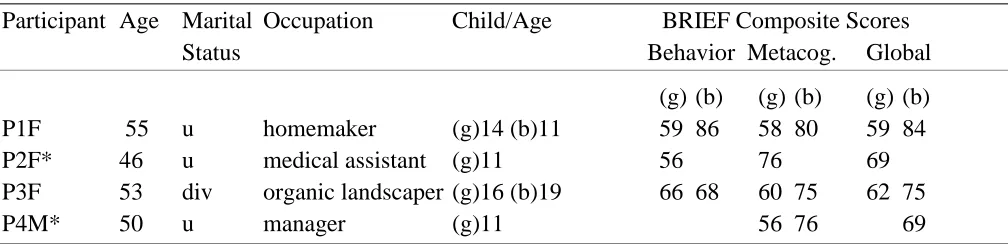
Since adolescent children were not included in the intervention or in IRB approval, their data was limited to the BRIEF individual domain and composite intake screening scores provided by the parents. The BRIEF is a standardized, 80-question self-reporting tool that measures different aspects of executive functioning in behavioral and metacognitive domains (Gioia et al., 2000). There are parent informant, teacher informant, and adolescent informant versions of the form. The participants answer questions by indicating never, sometimes, or often. The severity of the scores strongly correlate with levels of decreased functioning and behavioral issues in the child as well as levels of distress, perceived burden, and family dysfunction with parents (Mangeot, Armstrong, Colvin, Yeates, & Taylor, 2002). The participants and the composite adolescent scores from the BRIEF are listed in Table 1. T-scores > 65 are considered statistically elevated. Although all composite scores do not illustrate elevated dysfunction for each adolescent, the scores were statistically elevated in at least one individual BRIEF domain per adolescent in either the behavioral domains (inhibit, shift, and/or emotional control) or the metacognitive domains (working memory, plan/organize, organization of materials, and/or monitor), thus matching the inclusion criteria for parent participation.
2 https://scholarworks.wmich.edu/ojot/vol6/iss3/9
Table 1
Participant Profile and Composite Adolescent Scores From the BRIEF
Participant Age Marital Occupation Child/Age BRIEF Composite Scores Status Behavior Metacog. Global
(g) (b) (g) (b) (g) (b) P1F 55 u homemaker (g)14 (b)11 59 86 58 80 59 84 P2F* 46 u medical assistant (g)11 56 76 69 P3F 53 div organic landscaper (g)16 (b)19 66 68 60 75 62 75
P4M* 50 u manager (g)11 56 76 69
Note. *Spouses with one child. F = female; M = male; u = married; div = divorced; (g) = girl adolescent; (b) = boy adolescent; T-scores > 65 (+1.5 SD above the mean) are considered statistically elevated and indicate increased executive dysfunction.
Intervention Design
The mindful parenting intervention was adapted from Bögels and Restifo’s (2014) 8-week
mindful parenting program. The theme “parenting patterns and schemas” was eliminated, as the primary author lacked sufficient experience to deliver the module on this theme appropriately. The remaining themes were then shifted and condensed and select content was modified and/or eliminated to fit into a 6-week module format. Table 2 describes the program material for each of the 6 weeks.
Table 2
Mindful Parenting Intervention Week 1: Automatic Pilot Parenting
Automatic pilot parenting is defined as responding and reacting to a person or external event without full awareness; it is conceptualized as living in the “doing” mode rather than “being” present to what is happening in the moment. The session began with clarification of group norms. To improve awareness of the present moment, the parents were taught
diaphragmatic breathing. This entailed slowing down and lengthening the breath so that the exhalation phase became longer than the inhalation phase. The parents were also guided through a systematic body scan where they were encouraged to become aware of and feel sensations occurring in various points of their bodies. Mindful eating was explored using clementines and dark chocolate. The week concluded with an explanation of daily strategies to help the parents to increase awareness (internally and in the surrounding environment) during everyday events. Emphasis was placed on these basic awareness strategies, as they were repeatedly reintroduced and repackaged as the program progressed.
Week 2: Beginner’s Mind Parenting
Beginner’s mind parenting is defined as the ability to look at the adolescent (or a situation) from the outside,
nonjudgmentally, as if seeing him or her for the first time. The parents explored this concept via a “gratitude” practice and a “loving-kindness” practice surrounding self-care and experiencing oneself outside of parenting roles. The experience was then shifted toward a “parenting with compassion and gratitude” activity as a way of remaining present with thoughts and feelings before reacting when challenged by the adolescent. Executive functioning was defined and explained; individual domains were reviewed in relation to participants’ adolescents. A method for promoting metacognitive executive functioning skills—Goal (identify)/Plan (articulate)/Do (execution)/Check (evaluate outcome) (Polatajko, Mandich, & McEwen, 2011)—was presented, discussed, and applied to specific situations occurring with each adolescent in his or her specific routine.
Week 3: Reconnecting With Our Body as a Parent
Reconnecting with the body as a parent is defined as the ability to recognize, closely observe, and connect to inner experiences, emotions, and sensations occurring in the moment while parenting. Brief seated 1 to 2 min meditations were introduced and targeted to support formation of awareness of feelings and reactions in the body during stressful events. Emphasis was placed on reconnecting during or after uncomfortable experiences and bringing mindful awareness and compassion to the suffering that occurs when parenting in difficult moments. Standing yoga poses were used to increase the connection between sensation, movement, and breath. Daily occupational family routines were explored via
goal/plan/do/check; emphasis was placed on supporting adolescents through environmental supports and appropriate cuing methods.
Week 4: Responding versus Reacting to Parent Stress
Responding versus reacting to parent stress is defined as the ability to decrease maladaptive habitual responses during stressful situations. Formal seated silent meditation was introduced; the parents experienced 5 to 7 min meditations where they were directed to follow their natural breathing patterns. The experience of grasping (i.e., holding on too tightly to a desired outcome) and learning how to stay present and aware in difficult parenting situations was explored via the metaphor of waiting in line. The parents were also led through a guided visualization of a thunderstorm used as a symbol for the impermanence of all things. The parents expressed difficulty with using goal/plan/do/check strategies at home; tenets were shifted toward a self-exploration experience for the parent alone rather than a parent-child strategy. Week 5: Conflict and Parenting
Conflict occurs naturally in daily interactions between parents and adolescents. Seated meditations explored stress and reactivity around individual parent conflict triggers. The concept of “rupture” (argument or source of conflict) and “repair” (mending after a conflict occurs) was introduced and facilitated the awareness of the other’s (adolescent or spouse) experience during conflict situations. The parents also experienced walking meditation. Goal/plan/do/check was briefly investigated for personal daily occupations of the adolescent; emphasis remained on individual parent occupations. The parents were provided with postassessment forms and the program evaluation form and then asked to complete and return all paperwork by the final week.
Week 6: Love and Limits
The closing theme involved love and limit setting as a parent. Mindful limit setting as a parenting strategy was discussed, and a list of suggestions for everyday mindful parenting was reviewed. The parents were provided with a cumulative one-page list containing descriptions of mindfulness strategies and given the opportunity to reflect on what they experienced with the strategies and in the group. To conclude, the parents chose a personal “worry stone” as a future keepsake reminder. Postassessment paperwork and the program evaluation form were collected from the parents for analysis.
None of the parents had practiced mindfulness strategies prior to engaging in the study. Two separate mindful parenting groups were held. Each weekly session lasted 1.5 hr. A weeknight group was conducted for parents P1F and P3F in the private integrative medical practice’s conference room. A weekend morning group was conducted for parents P2F and P4M (spouses) in their home. The parents selected two to three mindfulness strategies to use at home and self-selected the amount of time they engaged in the strategies between sessions.
Each parent was provided with a personalized binder containing copies of the weekly
intervention materials, a 2-month calendar to track their progress, a copy of their child’s BRIEF scores, a description of the BRIEF domains, and a journal. The binder also included additional materials that supported each weekly theme but went considerably beyond what occurred in each session. The additional mindfulness strategies were provided to support and encourage parents to further explore the various strategies on their own and/or to tailor their individual strategy needs based on personal
preference or available time. To accommodate erratic work schedules, travel distance, and evening childcare needs, one group intervention was conducted in the home for two of the parents on weekends; the other group intervention was held for the two remaining parents on a weeknight at the clinic.
Instruments
Self-report questionnaires measured parental opinion on individual mindfulness, parent stress level, sense of parental competence, parenting style, and parent/adolescent relationship dynamic pre to postintervention. A demographics form generated by the first author was administered preintervention and a qualitative program evaluation form was administered at Week 6.
Mindfulness. The Five Facet Mindfulness Questionnaire (FFMQ) (Baer, Smith, Hopkins, Krietemeyer, & Toney, 2006) is a 39-question, 5-item Likert self-report inventory that measures various components of mindfulness. The instrument contains five domains: (a) observing: staying present with perceptions, thoughts, or feelings, even when painful; (b) describing: using words to explain beliefs, emotions, and expectations; (c) acting with awareness: staying present with actions without distractions; (d) nonjudgement: observing experiences in a neutral manner; and (e) nonreactivity: perceiving
4 https://scholarworks.wmich.edu/ojot/vol6/iss3/9
emotions without reacting. A score of 1 indicates less mindfulness, and a score of 5 indicates more mindfulness. The FFMQ demonstrated consistent findings for internal consistency and construct validity (Park, Reilly-Spong, & Gross, 2013). The instrument has been shown to be effective with mediators and nonmeditators alike (Baer, Samuel, & Lykins, 2011).
Parent stress. The Perceived Stress scale (P-Stress) (Cohen, 1994) is a public domain, 10-question, 5-item Likert self-report inventory that measures perception of stress levels. Norm mean for adults ages 45 to 55 years is 11.9 to 12.6; female norm mean is 13.7; and male norm mean is 12.1. Internal consistency, reliability, factorial validity, and hypothesis validity has been well-documented (Lee, 2012).
Parent competence. The Parenting Sense of Competence scale (PCOS) (Gibaud-Wallston & Wandersman, 1978) is a 16-question, 6-item Likert self-report inventory measuring parental satisfaction and efficacy when parenting. A higher score indicates a higher sense of competence. Normative data suggests significant small-to-moderate size correlations in satisfaction and efficacy and other measures of family functioning (Ohan, Leung, & Johnston, 2000).
Parenting style. The Parenting scale (P-scale) (Arnold, O’Leary, Wolff, & Acker, 1993) is a 30-question, 7-item Likert self-report measure of dysfunctional discipline parenting practices, including laxness and overreactivity. The categories are divided into laxness (permissive or inconsistent
discipline) and overreactivity (authoritarian discipline). Clinical cutoff scores for mothers are 3.6 for laxness and 4.9 for overreactivity. Clinical cutoff scores for fathers are 3.4 for laxness and 3.9 for overreactivity. The instrument demonstrates good reliability and correlates with child externalizing behaviors and couple relationship satisfaction (Lorber, Xu, Slep, Bulling, & O’Leary, 2014).
Parent relationship. The Parent Adolescent Relationship Questionnaire (PAR-Q) (Robin, Koepke, Moye, & Gerhardstein, 2009) is a 152-item true or false self-report inventory measuring the relationship between adolescents and parents by examining overt conflict skill deficits
(conventionalization, global distress, communication, problem-solving, school, sibling, eating conflicts), beliefs (malicious intent, perfectionism, ruination), family structure (coalitions between mother/father, parent/adolescent, spouse/adolescent, level of cohesion) and triangulation (who is in the “middle”). T-scores < 45 are considered below average, T-scores between 46 and 55 are considered average, T-scores between 56 and 65 are considered above average, and scores > 66 are statistically elevated. Scores demonstrating a decrease from pre to post indicate increased functioning, positive changes in belief patterns, and improved relationship dynamics. Good construct, convergent, and discriminant validity as well as internal consistency and test-retest reliability have been established (Pitzer, Fingerman, & Lefkowitz, 2011).
Results
Microsoft Excel and Statistical Package for the Social Sciences (Version 24.0) was used for quantitative data analysis. Parametric and nonparametric paired t-tests were performed. Possibly due to the small sample size, there were no statistical significant differences pre to postintervention with the exception of one instrument, the PAR-Q, which is designed to calculate statistical significance pre to postintervention for the user.
Quantitative Outcomes
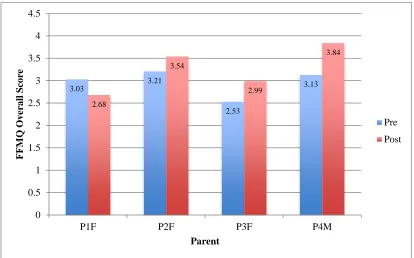
Mindfulness. Three parents (P2F, P3F, and P4M) reported increased mindfulness
postintervention. A paired samples t-test was calculated to compare the mean FFMQ total prescore to the mean FFMQ total postscore. The mean on the pretest was 2.9750 (SD = .30567) and the mean on
the posttest was 3.265 (SD = .52411). No significant difference from pre to postscore was found (t(3 [df value] = -1.268 [t value], p > .05). Figure 1 compares overall mindfulness scores for parents pre and postintervention.
Figure 1. THE FFMQ mindfulness scores: Overall mindfulness by parent.
Parent stress. All of the parents reported decreased stress levels postintervention. A
nonparametric t test was calculated to compare the mean perceived stress prescore to the mean perceived stress postscore. No significant difference from pre to post was found (z = -1.86, p > .05). Figure 2 compares stress scores for parents pre and postintervention.
Figure 2. Perceived stress scale scores pre and postintervention by parent. 3.03
3.21
2.53
3.13
2.68
3.54
2.99
3.84
0 0.5 1 1.5 2 2.5 3 3.5 4 4.5
P1F P2F P3F P4M
F
F
M
Q
O
v
er
a
ll
Sco
re
Parent
Pre
Post
29
23 23 23
28
17
19
14
0 5 10 15 20 25 30 35
P1F P2F P3F P4M
P
er
ce
iv
ed
Str
ess
Sco
re
s
Parent
Pre
Post
6 https://scholarworks.wmich.edu/ojot/vol6/iss3/9
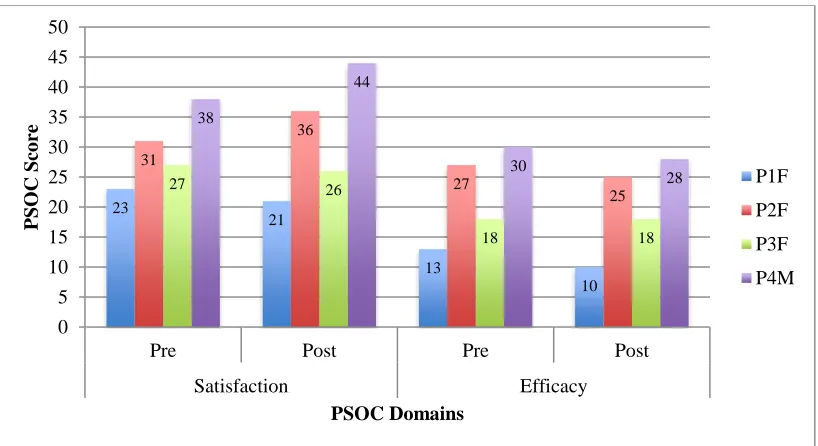
Parent competence. P1F reported a decrease in satisfaction and efficacy postintervention; P3F reported a decrease in satisfaction and remained the same in efficacy. P2F and P4M reported increases in satisfaction and decreases in efficacy. A paired samples t-test was calculated to compare the mean satisfaction and efficacy totals prescore to the mean satisfaction and efficacy totals postscore. For satisfaction, the mean on the pretest was 29.7500 (SD = 6.39661) and the mean on the posttest was 31.7500 (SD = 10.27538). No significant difference from pre to postscore was found (t(3 [df value] = -.980 [t value], p > .05). For efficacy, the mean on the pretest was 22.0000 (SD = 7.87401) and the mean on the posttest was 20.2500 (SD = 8.01561). No significant difference from pre to postscore was found (t(3 [df value] = 2.782 [t value], p > .05). Figure 3 compares satisfaction and efficacy scores between parents pre and postintervention.
Figure 3. Parenting competency scores pre and postintervention by domain.
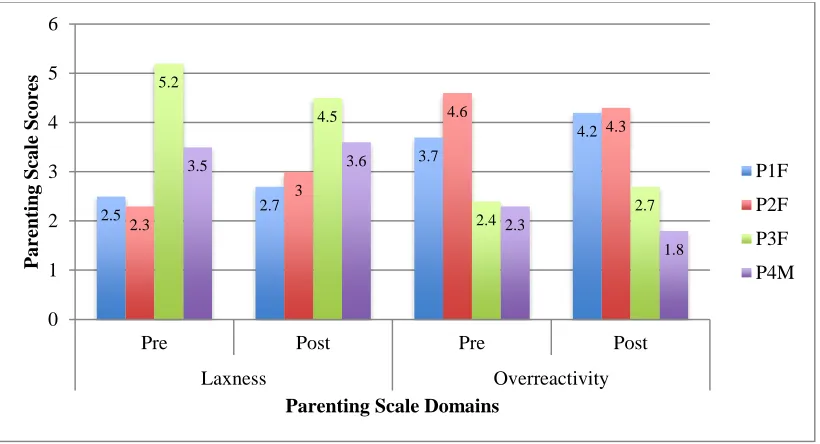
Parenting style. In laxness, P3F reported greater than mean typical parenting laxness pre and post. P4M’s scores remained unchanged pre to post. P1F and P2F reported increased laxness pre to post. In overreactivity, P2F reported greater than mean typical pre and post, P1F was typical pre and increased to greater than mean typical at post. P3F increased postintervention and P4M decreased; both pre and post overreactivity scores were below the typical parenting mean. A paired samples t-test was calculated to compare the mean laxness and overreactivity totals prescore to the mean laxness and overreactivity totals postscore. For laxness, the mean on the pretest was 3.3750 (SD = 1.32508) and the mean on the posttest was 3.4600 (SD = .79649). No significant difference from pre to postscore was found (t(3 [df value ]= -.980 [t value], p > .05). For overreactivity, the mean on the pretest was 3.2500 (SD = 1.10303) and the mean on the posttest was 3.2500 (SD = 1.21244). No significant difference from pre to postscore was found (t(3 [df value] = .75757 [t value], p > .05). Figure 4 compares laxness and overreactivity scores between parents pre and postintervention.
23
21
13
10 31
36
27
25
27 26
18 18
38
44
30
28
0 5 10 15 20 25 30 35 40 45 50
Pre Post Pre Post
Satisfaction Efficacy
P
SO
C
Sco
re
PSOC Domains
P1F
P2F
P3F
P4M
Figure 4. Parenting scale scores pre and postintervention by domain.
Parent relationship. For overt conflict/skill/deficits domains, statistically significant changes occurred pre to post in global distress. For distress, P3F decreased at p < .01, indicating less distress; for communication, P1F indicated improved communication, P4M decreased at p < .15, and P3F decreased at p < .05, indicating worse communication; for the ability to problem- solve, P1F and P2F decreased at
p < .05, P3F decreased at p < .15, and P4M decreased at p < .01, indicating improved ability to problem-solve; and for school conflict, P1F decreased at p < .05 and P2F increased at p < .01, indicating less concerns at school.
Beliefs domain score changes were nonsignificant pre to post for all but P3F (decreased in perfectionism at p < .15), indicating more flexibility in thought patterns. Family structure domain score changes were nonsignificant pre to post for all but P2F (decreased in mother/father coalition at p < .15), indicating less of an ability to work together as a couple. Triangulation domain scores were statistically significant pre to post for P1F (decreased at p < .15), P2F (increased at p < .01), and P4M (decreased at
p < .01). For adolescent in middle, P2F increased at p < .01 and P4M decreased at p < .15. For parent in middle, P2F increased at p < .05 and P4M decreased at p < .01. P3F did not complete the family structure or triangulation domains of the PAR-Q, since she is a single parent. An increased score indicates increased likeliness for two people to put the third family member in the middle.
Qualitative Outcomes
At the sixth session, the parents completed an evaluation form and were asked to reflect verbally on their personal experiences during the program. The following quotes and findings were obtained verbatim from the form or from verbal comments expressed at the final session.
Parents of the weeknight group, P1F and P3F, indicated positive feelings about attending the group, indicating that they felt “less alone” knowing there are other children out there that are “like mine.” The same parents indicated a desire to receive further instruction and requested to repeat the program because of the large volume of content presented and the limited amount of time available to practice. P3F indicated she would like continued support with using goal/plan/do/check beyond group, commenting, “I needed to change the wording of some of the strategies so that it didn’t sound like I was talking to a child because my kids are teenagers.” P2F and P4M indicated a desire for additional support
2.5 2.7
3.7
4.2
2.3
3
4.6
4.3 5.2
4.5
2.4 2.7
3.5 3.6
2.3
1.8
0 1 2 3 4 5 6
Pre Post Pre Post
Laxness Overreactivity
P
a
re
nting
Sca
le
Sco
re
s
Parenting Scale Domains
P1F
P2F
P3F
P4M
8 https://scholarworks.wmich.edu/ojot/vol6/iss3/9
with mindful eating, sitting meditation, yoga, concentration, and organizational skills. P1F indicated that she feels she needs continued support “in every area.”
In regard to consistent implementation of mindfulness strategies for self-care, P3F indicated increased awareness of automatic thoughts and strongly agreed that she had made positive changes in her daily routine. P3F described a change in her daily routine, stating, “I have made my breakfast a mindful, spiritual experience. I sit to meditate as often as I can and I observe my breath and what my body is doing almost every day.” P3F also noted that she became more aware of her own executive functioning deficits as the study progressed. At Week 4, she asked to be screened to determine her own deficits. P2F indicated using breath awareness daily. P4M noted practicing nonjudgement, breath awareness, and sitting meditation to relieve stress. P1F did not indicate daily changes and reported, “I didn’t [make any] yet, but I want to.” P2F and P4M both noted using yoga, breath awareness, and positive thinking with their adolescent in their weekly routine.
In ability to facilitate change in their adolescents’ daily routine or their own routine, P1F indicated that she was unable to support any changes with her adolescents but that she was trying. She indicated she was more aware of her automatic reactions and thoughts and felt less reactive but
disagreed that she had made positive changes in her daily routine. She reported she remained neutral on awareness of her adolescents’ needs, her ability to be present with her adolescents, and her ability to manage their executive dysfunction effectively; she felt she made positive changes when interacting with her adolescents. P3F felt more aware of her adolescents’ needs and less reactive toward her adolescents by the end of the study. However, she did not feel more capable in managing her
adolescents’ executive dysfunction. She noted, “Neither of my children were willing to cooperate with me at all on this. I hung up a family calendar in the kitchen that my daughter checks although I haven’t been successful getting her to write on it regularly.” P2F and P4M agreed they were more aware of their adolescent’s needs, more aware of their automatic thoughts and reactions, less reactive when in the presence of their adolescent, and more present since beginning the training. P2F and P4M indicated they felt better able to manage their adolescent’s executive functioning, which is different from P1F and P3F.
Strategies the participants felt most practical for implementation and most likely to be used posttraining included breath awareness, gratitude practice, mindful eating, and short sitting meditations. Yoga and rupture and repair were considered possibilities but were not as prominently ranked for ease or frequency of use. Walking meditation, body scan, and the use of the strategy goal/plan/do/check were considered too cumbersome to use outside of the group process.
Discussion
Evidence suggests that participation in mindfulness training results in more consistent parenting skills, increased mindfulness, decreased parenting stress, increased self-competency and confidence, and shifts in attitudes toward the adolescent, all of which improve the parent-child relationships (Benn et al., 2012; Bögels et al., 2014; Duncan et al., 2009b). Bögels Hellemans, van Deursen, Römer, and van der Meulen’s (2014) original 8-week mindful parenting protocol required extensive homework assignments for the participants between sessions. This protocol was deemed unrealistic for this study. Instead, the parents in this 6-week intervention were advised to choose two to three strategies to use per week, and they selected the amount of time that they engaged in each strategy between sessions. Parental self-report at the sixth session positively supported this modification to the Bögels et al. (2014) protocol.
Statistically significant results for the PAR-Q indicated that one parent experienced improved communication with her adolescent (P1F), two parents had fewer concerns at school for their adolescent (P1F and P2F), three parents showed increased ability to problem-solve (P1F, P2F, and P4M), one parent decreased her perfectionistic parenting skills (P3F), and one parent was more likely to be put in the middle between the other parent and their adolescent (P2F). These scores significantly supported the literature in several domains, indicating that engagement in mindful parenting allowed the parents to disrupt and/or circumvent negative engagement patterns with their adolescent and allowed for more caring and compassionate responses during conflicts (Duncan et al., 2009b; Singh et al., 2010).
Triangulation scores for P1F and P4M significantly decreased, indicating a more neutral family dynamic pre to post. However, P2F’s scores appear contrary to P4M’s (her spouse) postintervention scores, demonstrating a significant increase and indicating a less neutral family dynamic (stronger
father/daughter coalition). It is interesting that P2F also increased in overreactivity on the P-scale. It is unclear if that increase is related to the triangulation change and/or her FFMQ nonjudgement postscore, which also decreased (indicating less mindfulness). The PAR-Q scores also indicated the parents’ significant increase in their ability to positively manage maladaptive adolescent behaviors and skill deficits during daily self-selected occupations, thus supporting the findings of Benn, Akiva, Arel, and Roeser (2012) and Bögels et al. (2014), particularly in the assessment’s domains of global distress, communication, problem-solving, and school conflict.
Although most mindfulness findings were not statistically significant for this study’s duration, the frequency of and consistency in mindfulness strategy implementation outside of the training sessions can relate to positive change demonstrated in individual parent postscores for mindfulness and perceived stress (Benn et al., 2012; Bögels et al., 2014; Martin, Haskard-Zolnierek, & DiMatteo, 2010).
Specifically, P3F and P4M practiced most frequently and consistently; both demonstrated larger mindfulness score gains on the FFMQ. Three of the four parents (P2F, P3F, and P4M) demonstrated decreased stress scores on the P-Stress. Implementation of one particular mindfulness strategy over another appeared to be less of a factor, as all of the parents ranked different strategies as helpful. P1F was the only parent who missed a session (Week 2). She indicated not practicing at home after Week 1 because of a high level of crisis being experienced by both of her adolescents. Her scores reflect Bögels et al. (2014) findings surrounding inconsistent home practice; she demonstrated less mindfulness (less awareness) pre to post and a slight decrease in stress.
Benn et al. (2012) and Bögels et al. (2014) suggested that parents would experience increased satisfaction, competency, and confidence in their ability to positively manage maladaptive adolescent behaviors and skill deficits during daily self-selected occupations after training in mindfulness
strategies. Parents P1F and P3F decreased or remained at baseline in both satisfaction and efficacy categories, possibly due to their increased self-awareness surrounding parenting inconsistency or limitations in either awareness, time, skill, support, and/or motivation required to develop and implement necessary or desired changes during the limited 6-week intervention. P2F and P4M are spouses; both of their satisfaction scores increased, possibly due to positively influencing and supporting one another as they advanced through the study. For P1F, parenting P-scale overreactivity scores
increased, which may be related to the volatile circumstances reported at home and the lack of mindfulness strategy implementation. For P3F, P-scale postscores demonstrate laxness categories moving toward the typical mean (as her prescore was overly lax) and slight elevation in overreactivity (possibly accounting for less laxness post).
10 https://scholarworks.wmich.edu/ojot/vol6/iss3/9
Limitations
All of the parents appeared frustrated by their limitations in parental awareness, the lack of time available in their schedules to develop the necessary skills, a lack of support at home, and/or a lack of motivation required to practice and gain proficiency in the various mindfulness strategies presented. In addition, it is unclear how the two-parent per group enrollment limitation impacted parents’ feelings of support or the ability to learn from other’s parenting experiences. The programs reviewed in the
literature contained a similar amount of weekly content but a greater number of homework assignments than what this study provided. All of the parents in this study indicated that the amount of content presented during each group session was excessive for effective application in the given 6-week time frame. In addition, the implementation of goal/plan/do/check (the only occupational therapy-centric component taught during the program) was too difficult for the parents to use with their adolescents without the occupational therapist present in the home.
The small sample and the lack of a control group limits the generalizability of all findings. All assessments were self-report. This may have influenced responses, as the parents may not have understood the question or may have been uncomfortable answering truthfully based on question phrasing. Multiple therapies occurred simultaneously (i.e., occupational, psychiatric, and
psychotherapy); therefore, it is difficult to ascertain fully whether the improvements or changes were the direct result of the mindful parenting intervention or influenced by other mitigating factors.
There is a possibility of a Type II error in the statistical analysis. Because of the small sample size, a real difference might exist, but there may not have been enough power to find that difference. Although most of the findings were not statistically significant, three of the four participants noted many improvements. It is possible that the mindful parenting intervention acted as a supportive adjunct to the other therapies that were running concurrent to this 6-week study. Implementing lasting change for the parents likely requires a time span longer than the 6-week time frame allotted during this specific mindful parenting intervention.
Recommendations
Robin et al. (2009) suggests that families exhibiting rigid beliefs and/or heightened tensions and polarizations/triangulations in their dynamics often fail to benefit from parent trainings as continual internal family conflict prevents the members from developing cohesiveness to work as a unit to problem-solve issues. Therefore, it is critical for occupational therapy clinicians to acknowledge, and whenever possible address, ongoing tensions occurring in the family dynamics that may negatively impact the parents’ ability to work as a team to support treatment recommendations for their
adolescents. This can be achieved through ongoing consultation with the parents to provide direct cuing instruction, training, and referral (when necessary) for additional support for the family from a licensed marriage and family therapist, counselor, or psychotherapist to address concerns beyond occupational therapy’s scope of practice.
Paster, Brandenwin, and Walsh (2009) indicated that parents of children with disabilities exhibit different coping strategies than typical parents, including the use of escaping and avoiding techniques, seeking social support, using positive reappraisal, and focusing on personal growth. The parents
exhibited these tenets during various points in the mindful parenting intervention. P1F and P3F became aware of their own executive functioning deficits as the sessions progressed. P2F and P4M appeared unaware of and less open to feedback when mindful strategies did not deliver the intended results. P3F was motivated to actively facilitate self-change; she used the adult version of the BRIEF to self-identify
strengths and weaknesses and shared those findings with her private therapist. P1F stated that change was needed. However, a discrepancy was identified on her program evaluation form regarding readiness to change in self-identified areas of need. She indicated she was least likely to use the specific strategies that were best identified to implement behavior change. The stages of change as noted in the
Transtheoretical Model and a willingness to change are underlying components that determine
effectiveness in any health behavior change intervention (Martin et al., 2010). Occupational therapists working in mental health and conducting mindful parenting interventions need to first cultivate a mindful approach in their own clinical reasoning process (Reid, Farragher, & Ok, 2014), taking time to step back and consider whether a parent (a) understands what they were asked to do, (b) has the skills and the knowledge to perform recommendations, and (c) is willing to address barriers to treatment adherence (O’Donohue & Levensky, 2006). The mindful process outlined by Reid et al. (2014) asks the occupational therapist working in mental health use perspective by taking the client’s point of view in order to avoid bias and increase receptivity, employ active listening regularly during intervention, model by use of practice in his or her own personal life outside of the clinic, and establish boundaries to help monitor counter-transference. Occupational therapists can use motivational interviewing during mindful parenting sessions to help parents develop discrepancy, support self-efficacy, and manage resistance to the treatment process (Miller & Rollnick, 2013).
In addition, experiences from this specific 6-week study indicated that all of the parents required skilled one-to-one support to implement direct goal/plan/do/check strategies at home. Evaluating the level of executive dysfunction in a parent at the onset of a mindful parenting program can allow for better facilitation in grading and adjusting of content and may increase the level of adherence to
therapist recommendations. Helping parents find ongoing support after they conclude the program may increase adherence and promote lasting change in their lives through this promising mindful parenting intervention approach.
References
Arnold, D., O’Leary, S., Wolff, L., & Acker, M. (1993). The parenting scale: A measure of dysfunctional parenting in discipline situations. Psychological Assessment,
5(2), 137-144.
http://dx.doi.org/10.1037/1040-3590.5.2.137
Baer, R., Samuel, D., & Lykins, E. (2011). Differential item functioning on the five facet mindfulness questionnaire is minimal in demographically matched meditators and nonmeditators.
Assessment, 18(1), 3-10.
http://dx.doi.org/10.1177/107319111039 2498
Baer, R., Smith, G., Hopkins, J., Krietemeyer, J., & Toney, L. (2006). Using self-report assessment methods to explore facets of
mindfulness. Assessment, 13(1), 27-45. http://dx.doi.org/10.1177/107319110528 3504
Benn, R., Akiva, T., Arel, S., & Roeser, R. (2012). Mindfulness training effects for parents and educators of children with special needs. Developmental
Psychology, 48(5),1476-1487. http://dx.doi.org/10.1037/a0027537 Bögels, S., Hellemans, J., van Deursen, S., Römer, M., & van der Meulen, R. (2014). Mindful parenting in mental health care: Effects on parental and child psychopathology, parental stress,
parenting, co-parenting, and marital functioning. Mindfulness, 5(5),536-551. http://dx.doi.org/10.1007/s12671-013-0209-7
Bögels, S., & Restifo, K. (2014). Mindful
12 https://scholarworks.wmich.edu/ojot/vol6/iss3/9
parenting: A guide for mental health practitioners. New York, NY: Springer. Cohen, S. (1994). Perceived Stress scale. Menlo
Park, CA: Mind Garden, Inc.
Cramm, H., Krupa, T., Missiuna, A., Lysaght, R. M., & Parker, K. (2013). Executive functioning: A scoping review of the occupational therapy literature.
Canadian Journal of Occupational Therapy, 80(3),131-140.
http://dx.doi.org/10.1177/000841741349 6060
Dawson, P., & Guare, R. (2010). Executive skills in children and adolescents: A practical guide to assessment and intervention (2nd ed.). New York, NY: Guilford Press.
Duncan, L. G., Douglas Coatsworth, J., & Greenberg, M. T. (2009a). A model of mindful parenting: Implications for parent-child relationships and prevention research. Clinical Child and Family Psychology Review, 12(3),255-270.
http://dx.doi.org/10.1007/s10567-009-0046-3
Duncan, L. G., Douglas Coatsworth, J., & Greenberg, M. T. (2009b). Pilot study to gauge acceptability of a mindfulness-based, family focused preventative intervention. Journal of Primary Prevention, 30(5),605-618.
http://dx.doi.org/10.1007/s10935-009-0185-9
Gibaud-Wallston, J., & Wandersman, L. (1978).
Development and utility of the parenting sense of competence scale. Paper
presented at the Annual Meeting of the American Psychological Association, Toronto, Canada.
Gioia, G., Isquith, P., Guy, S., & Kenworthy, L. (2000). Behavioral rating inventory of executive function: Professional manual.
Lutz, FL: PAR Inc.
Kabat-Zinn, J. (1990). Full catastrophe living: Using the wisdom of your body and mind to face stress, pain, and illness. New York, NY: Delacone.
Lee, E.-H. (2012). Review of the psychometric evidence of the perceived stress scale.
Asian Nursing Research, 6(4),121-127. http://dx.doi.org/10.1016/j.anr.2012.08.0 04
Lorber, M., Xu, S., Slep, A., Bulling, L., & O’Leary, S. (2014). A new look at the psychometrics of the parenting scale through the lens of item response theory.
Journal of Clinical Child & Adolescent Psychology, 43(4),613-626.
http://dx.doi.org/10.1080/15374416.201 4.900717
Mangeot, S., Armstrong, K., Colvin, A., Yeates, K., & Taylor, H. (2002). Long-term executive function deficits in children with traumatic brain injuries:
Assessment using the behavior rating inventory of executive function
(BRIEF). Child Neuropsychology, 8(4), 271-84.
http://dx.doi.org/10.1076/chin.8.4.271.1 3503
Martin, L., Haskard-Zolnierek, K., & DiMatteo, M. (2010). Health behavior change and treatment adherence: Evidence-based guidelines for improving healthcare.
New York, NY: Oxford University Press.
McCloskey, G., Perkins, L., & Van Divner, B. (2009). Assessment and intervention for executive function difficulties. New York, NY: Routledge.
Miller, W., & Rollnick, S. (2013). Motivational interviewing: Helping people change.
New York, NY: The Guilford Press. O’Donohue, W., & Levensky, E. (2006).
Promoting treatment adherence: A practical handbook for healthcare providers. Thousand Oaks, CA: Sage Publications.
Ohan, J., Leung, D., & Johnston, C. (2000). The parenting sense of competence scale: Evidence of a stable factor structure and validity. Canadian Journal of
Behavioral Science, 32(4), 251-261. http://dx.doi.org/10.1037/h0087122 Park, T., Reilly-Spong, M., & Gross, C. (2013).
Mindfulness: A systematic review of instruments to measure an emergent patient-reported outcome (PRO). Quality
of Life Research, 22(10), 2639-2659. http://dx.doi.org/10.1007/s11136-013-0395-8
Paster, A., Brandwein, D., & Walsh, J. (2009). A comparison of coping strategies used by parents of children with disabilities and parents of children without
disabilities. Research in Developmental Disabilities, 30(6),1337-1342.
http://dx.doi.org/10.1016/j.ridd.2009.05. 010
Pitzer, L., Fingerman, K., & Lefkowitz, E. (2011). Development of the parent adult relationship questionnaire (PAR-Q).
International Journal of Aging and Human Development, 72(2), 111-135. http://dx.doi.org/10.2190/AG.72.2.b Polatajko, H. J., Mandich, A., & McEwen, S. E.
(2011). Cognitive orientation to daily occupational performance (CO-OP): A cognitive-based intervention for children and adults. In N. Katz (Ed.), Cognition, occupation, and participation across the life span (3rd ed., pp. 299-321).
Bethesda, MD: AOTA Press. Reid, D., Farragher, J., & Ok, C. (2013).
Exploring mindfulness with
occupational therapists practicing in mental health contexts. Occupational Therapy in Mental Health, 29(3), 279-292.
http://dx.doi.org/10.1080/0164212X.201 3.819727
Robin, A., Koepke, T., Moye, A., & Gerhardstein, R. (2009). Parent adolescent relationship questionnaire: Professional manual. Lutz, FL: PAR Inc.
Singh, N. N., Lancioni, G. E., Winton, A. S. W., Singh, J., Singh, A. N., Adkins, A. D., & Wahler, R. G. (2010). Training in
mindful caregiving transfers to parent-child interactions. Journal of Child and Family Studies, 19(2), 167-174.
http://dx.doi.org/10.1007/s10826-009-9267-9
Tabor Connor, L., & Maeir, A. (2011). Putting executive performance in a theoretical context. Occupation, Participation, and
Health, 31(1), s3-s7.
http://dx.doi.org/10.3928/15394492-20101108-02
Williamson Weiner, N., Toglia, J., & Berg, C. (2012). Weekly calendar planning activity (WCPA): A performance-based assessment of executive function piloted with at-risk adolescents. American Journal of Occupational Therapy, 66(6), 699-708.
http://dx.doi.org/10.5014/ajot.2012.0047 54
14 https://scholarworks.wmich.edu/ojot/vol6/iss3/9