w w w . i j m r e t . o r g I S S N : 2 4 5 6 - 5 6 2 8 Page 42
Comparative Analysis of High Speed Craft Hydrodynamic
Characterization Algorithms
Daniel Tamunodukobipi, Albert Akharele
1Department of Marine Engineering, Rivers State University, Port Harcourt, Nigeria
ABSTRACT :This work presents hydrodynamic characterization and comparative analysis of high speed crafts (HSCs). HSCs performance characterizing is a serious concern to Hydrodynamicists because of the wide variation of total resistance with hull-form, trim, draft and speed. Conversely, these parameters are not duly analyzed during design due to inadequate theories. Therefore, this research investigates total resistance, wetted surface and effective trim of four different HSC hull-forms. An interactive computer-program is developed based on Savitsky and CAHI algorithms, and the results compared against test-data. The analysis correctly predicts quantitatively the resistances of the four hull-forms at high speeds but with some discrepancies at speeds below 12 knots. The average standard-deviation for resistance predictions by CAHI = 4.69 kN and Savitsky= 6.13 KN. Also, the results indicate that the transition from bow-wetting to full-planing occurs at 12 knots, and beyond which the effective trim is fairly constant. Again, the wetted length-beam ratio (λm) drops rapidly from bow-wetting speeds to a plateau at speeds >12knot where hydrodynamic lift prevails. Standard-deviations of λm by Savitsky’s and CAHI are 1.07 and 1.41, respectively. In conclusion, model-predictors are reasonably in good agreement with measurement.
KEYWORDS –Craft, Hydrodynamic, Characterization, hull-form, resistance
I. Introduction
A high-speed craft is defined as a craft with maximum operating speed higher than 30 knots [1]. This definition is, however, inadequate because a large vessel at 30 knots may not be a HSC since
speed-to-length ratio is too small. Hence,
Hydrodynamicists define an HSC as any marine craft with maximum operating Froude number greater than 0.4, or having a design speed of above 3.7 1/6 (m/s) with the volume displacement ( ) expressed in m3 [2]. These marine crafts differ in their structural features and in the way their body weight is supported [3]. The vessel weight can be supported by
Submerged hulls
Hydrofoils
Air cushions
A combination of the above
High-speed marine vessels are mostly supported by buoyancy at low speed, but at high speed, they are raised mainly by hydrodynamic lift (planing crafts) or aerodynamic force (such as hovercrafts). This reduces their wetted surface area and resistance (Faltinsen, 2005). Partly submerged-hull HSCs are
available as semi-planing crafts and fully
hydrodynamic planing vehicles. They exist as monohulls (convex or concave) and multi-hull (catamaran or trimaran), and are widely applied for coastal transportation and offshore services because of their swiftness and good maneuverability. Their hull architecture is dependent on factors, such as: stability, sea-keeping performance; speed vs. resistance characteristic; resistance vs. powering; swiftness and energy efficiency; maneuverability and terrain constraints. These determine their hull
dimensions, underwater-body shape, deadrise
angles, number of chines, design trim, dead weight, and the nature of propulsor. Therefore, a proper design analysis hinged on test data is pertinent for reliable service performance [4].
w w w . i j m r e t . o r g I S S N : 2 4 5 6 - 5 6 2 8 Page 43 www.ijmret.org Volume 3 Issue 3 ǁ March 2018.
CAHI method have also shown to be veritable.
More importantly, these virtual tools are
implemented for optimizing hull designs and simulating their seakeeping performances [6].
1.1 High Speed Craft Hull Forms
1.1.1
CatamaransSome HSCs, such catamarans, have two relatively slender semi-submerged hulls which ensure good stability against roll motion but poor pitching characteristic as compared to conventional mono-hulls. Its performance is poor at low speeds and improves substantially at high speeds. Small Waterplane Area Twin Hull (SWATH), on the other hand, has two fully submerged hulls. Each is connected to an above-water deck (or hull) by one or more relatively thin struts. Its main advantages over catamaran are the excellent stability in waves due to the significantly reduced waterplane area, and the long natural pitching period [7]. Hydrofoil Crafthas two modes of operation: (i) the normal cruise-speed hull-borne mode, and (ii) the high-speed flying or foilborne mode. At hull-borne mode, small hydrofoil hulls behave more like a planing craft. Therefore, their hull forms need to be optimized to minimize resistance due to fluid-hull interaction [7]. Hydrofoils are generally stable particularly in foilborne mode.
A planing boat is a high-powered marine vehicle that develops sufficient hydrodynamic pressure wedge to support its weight, unlike displacement craft that are supported on hydrostatic buoyancy lift. The hydrodynamic lift, force is dependent on the relative vessel-speed, geometry of the wetted hull surface and the effective trim. For good stability and maneuverability, the deadrise of planing hulls diminishes from bow towards the stern. A typical planing craft has hard chine, and may have both longitudinal and transverse steps at intermediate positions over the wetted region. The planing craft is typically run with a small bow-up trim or attack angle [8]. This attack angle, along with the hull geometry, results in the development of high pressure on the bottom surface, which lifts the hull, thereby reducing the wetted surface, and the vessel resistance.
Planing craft have taken various forms, depending upon the design speed andintended operational profile. The hull forms addressed in
this paper are those designedfor high-speed operation under moderate to heavy loading conditions. The typicalbottom design for such craft include sharp comers at the chines and transom that ensuredistinct water flow separation to minimize hull side flow back into the hull. Without these sharp comers, the flow paths would be random,planing resistance would increase, and dynamic lift and stability would be compromised. Hullsbelonging to this family are known as "hard chine planing hulls."
Planing hulls are characterized by relatively flat bottoms (especially aft of amidships) that produce partial to nearly full dynamic support for small light craft at higher speeds. These crafts lift and skim the surface of the water causing the stern wake to break clean from the transom. The crafts are generally restricted in size and displacement because of the required power-to weight ratio and the structural stresses associated with traveling at high speed in wave. Most planing crafts are restricted to operate in reasonably calm water [7]. Characteristically, planing crafts are simple, economical, dynamically stable and excellent shallow-water performance. In contrast, planing hulls have poor performance in rough water. Consequently, this paper undertakes a critical evaluation of the sea-keeping performance of planing hulls and to characterize their hull-forms, expected added resistance, response motions and wave impact accelerations. Recommendations on hull-forms are made in terms of hydrodynamic
efficiency, structural robustness, transport
effectiveness and economic viability [9].
II. MATERIAL AND METHODS
2.1 Model Test Procedure
w w w . i j m r e t . o r g I S S N : 2 4 5 6 - 5 6 2 8 Page 44 range. Before the test, all measuring instruments are
recalibrated and wall interference avoid. Sufficient waiting time between consecutive runs is allowed to achieve similar conditions for consistency.
2.2 Determination of Resistance from Model Test
Ship resistance is the force required to tow the ship at a given speed in smooth water, assuming no interference from the towing ship. In simplified manner, it is usual to consider the total calm water resistance in terms of the frictional, air and residuary resistance components [10]. The total resistance coefficient of the model is
𝐶𝑇𝑀= 𝑅𝑇𝑀 1 2𝜌𝑆𝑀𝑉𝑀
2 (1)
where 𝑅𝑇𝑀is the measured model total resistance, 𝜌
is the density of fresh water, 𝑆𝑀 is the wetted
surface area of the model and 𝑉𝑀 is the towing
speed of the model [11]. The ITTC relation for obtaining the model frictional coefficient is
𝐶𝐹𝑀 =
0.075
𝑙𝑜𝑔10𝑅𝑒𝑀−2 2 (2)
where 𝑅𝑒𝑀=
𝑉𝑀𝐿𝑀
𝑣 is the model Reynolds number
The equation for computing the coefficient of residual resistance is given as
𝐶𝑅= 𝐶𝑇𝑀− 𝐶𝐹𝑀∙ 𝑆𝑀 𝑆0𝑀− 𝐶𝐴𝐴𝑀 (3)
where 𝐶𝐹𝑀 is the frictional coefficient of the model,
SMis the running wetted surface area, S0m is the
nominal wetted surface area and 𝐶𝐴𝐴𝑀 is the
coefficient of air drag resistance of the model.
The ship total resistance coefficient for HSMV is computed using the relation
𝐶𝑇𝑆= 𝐶𝑅+ 𝐶𝐹𝑆∙ 𝑆𝑆 𝑆0𝑆+ 𝐶𝐴𝐴𝑆 + 𝐶𝐴𝑝𝑝𝑆 + 𝐶𝐴
(4)
where 𝐶𝐹𝑆=
0.075
𝑙𝑜𝑔10𝑅𝑒𝑆−2 2 is the frictional
coefficient of the ship, 𝑅𝑒𝑆= 𝑉𝑆𝐿𝑆
𝑣 is the ship
Reynolds number, 𝐿𝑆 is the ship length, 𝑣 is the
kinetic viscosity of sea water, 𝑆𝑆is the running
wetted surface area of the ship, S0S is the nominal
wetted surface area of the ship, 𝐶𝐴𝐴𝑆 =
1.2 𝜌𝐴
𝜌𝑆
𝐴𝑇
𝑆𝑆
𝑉𝑅
𝑉𝑆
2
is the coefficient of air
resistance of the ship, 𝐶𝐴𝑝𝑝𝑆 is the appendage
resistance coefficient of the ship and CA is the
model-ship correlation coefficient. The wind
relative velocity ratio 𝑉𝑅
𝑉𝑆 , air density (ρA)=
1.223𝑘𝑔. 𝑚−3
, and projected transverse area of ship AT. The ship total resistance is computed using the
equation below;
𝑅𝑇𝑆= 1 2𝜌𝑆𝑆𝑠𝑉𝑆
2
(5)
Where seawater density 𝜌𝑆= 1025 𝑘𝑔/𝑚3
ship-to-model length ratio 𝜆 =𝐿𝑆
𝐿𝑀 ≈ 10, ship speed
𝑉𝑆= 𝑉𝑀 𝜆 = 𝑉𝑀 10
2.2.1 Savitsky Method for Planing Craft Hydrodynamic Characterization
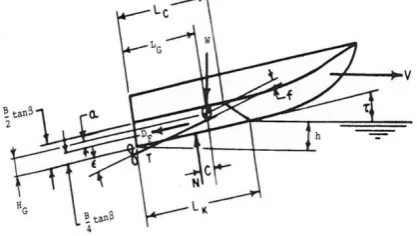
Savitsky [12] carried out a research on the „Hydrodynamic Design of Planing Hulls) and developed an empirical model. Key parameters for hull design and performance prediction are incorporated. The formulation balances propeller thrust with hull resistance; and gravity load with lift. The lift includes both hydrodynamic lift and upthrust on the underwater body of the hull. Figure 1 presents a planing hull with a positive trim under the influence of gravity and hydrodynamic forces (drag and lift).
Figure 1: Forces Experienced by Planing Hull Vessels
The mean wetted length – beam ratio (𝜆𝑚) which
defines the pressure area is expressed as
𝜆𝑚 =
𝑑 𝑠𝑖𝑛𝜏+
𝑏 2𝜋
𝑡𝑎𝑛𝛽 𝑡𝑎𝑛𝜏
𝑏 =
𝐿𝑘+𝐿𝑐
2𝑏 (6)
w w w . i j m r e t . o r g I S S N : 2 4 5 6 - 5 6 2 8 Page 45 www.ijmret.org Volume 3 Issue 3 ǁ March 2018.
the expression
𝜆𝑘= 𝜆𝑚− 0.03 + 0.5 0.57 + 𝛽
1000 𝑡𝑎𝑛𝛽
2𝑡𝑎𝑛𝜏 − 𝛽
167
(7)
Where: 𝛽 = angle of deadrise of planing surface
𝜏 = trim angle of planing area
The lift on a planing surface comprises of two parts: thehydrodynamic and hydrostatic lift forces. Their net effect on the wetted surface is logically the determinant for resistance quantification. The long-standing equations for predicting the lift developed by planing surfaces with varied deadrise are derived empirically from test data.The lift coefficient for finite deadrise 𝐶𝐿𝛽 can be calculated from:
𝐶𝐿𝛽 = 𝐶𝐿0− 0.0065𝛽(8)
Following flat plate tests, a relation is developed for the total lift (buoyancy and dynamic lift) acting on a flat surface. Savitsky obtained the empirical planing lift equation for a zero deadrise as
𝐶𝐿0= 𝜏1.1
10000 120𝜆
1/2+55𝜆5/2
𝐶𝑣2 (9)
Where 𝐶𝑣=
𝑉
𝑔𝑏 = speed coefficient
V = vessel speed
g = acceleration due to gravity
b = beam of planing surface
Equation (10) presents Savitsky‟s total resistance of a planing hull. The first quantity on the right-hand side is the gravity drag component; while the second is due to hydrodynamics
𝑅𝑇= 𝑊𝑡𝑎𝑛𝜏 +
𝜌𝑉2𝜆 𝑏2𝐶𝐹
2𝑐𝑜𝑠𝜏𝑐𝑜𝑠𝛽 (10)
which can be further simplified as
𝑅𝑇
𝑊 = 𝑡𝑎𝑛𝜏 +
𝑉1 𝑉 2
𝜆 𝐶𝐹
𝐶𝐿𝑂𝑐𝑜𝑠𝜏𝑐𝑜𝑠𝛽 (11)
Where 𝐶𝐿𝑂 =
𝜌𝑔 ∇
0.5𝜌𝑉2𝑏2=
𝑊
0.5𝜌𝑉2𝑏2
𝑊 = 0.5𝜌𝑉2𝑏2𝐶 𝐿𝑂
𝐶𝐹 =
0.075
𝑙𝑜𝑔𝑅 − 2 2+ ∆𝐶𝐹
∆𝐶𝐹 = 0.0004 , which obtained from ATTC
Standard Roughness and
𝑉1 is the average velocity, which less than the
forward planing velocity V owing to the fact that the planing bottom pressure is larger than the free free-stream pressure.
The ratio of the average velocity 𝑉1and forward
velocity V can be expressed as:
𝑉1
𝑉 = 1 −
0.0120 𝜏1.1
𝜆𝑐𝑜𝑠𝜏 𝑓(𝛽) (12)
Considering 𝑓(𝛽) to be unity, the non-dimensional resistance of a planing hull becomes
𝑅𝑇
𝑊 = 𝑡𝑎𝑛𝜏 + 𝜆 𝐶𝐹
𝐶𝐿𝑂𝑐𝑜𝑠𝜏𝑐𝑜𝑠𝛽 1 −
0.0120 𝜏1.1
𝜆𝑐𝑜𝑠𝜏 (13)
2.2.2 CAHI Method for Planing Craft Hydrodynamic Characterization
The CAHI method is similar to the Savitsky method. Details about CAHI method are presented inAlourdas [13]. In fact, regardless of the method used, as indicated in Eq. (13), the non-dimensional resistance for prismatic planing hulls is a function of the friction coefficient, lift coefficient, the positive trim, mean deadrise and the wetted length-beam ratio. However,for dimensioanl total resistance, Zhang et al. [14] identified variables such as: the speed V, displacement Δ, chine beam b, deadriseangle β, longitudinal center of gravity LCG, mean wetted length ratio , and the trim τ.
2.3 MATLAB Implementation of the Developed Algorithms
A resistance extrapolation program based on ITTC recommended procedure for extending model test result to full scale hull is developed. Savitsky and CAHI methods are incorporated in the analysis program. A robust numerical subroutine using Newton-Raphson‟s iteration is embedded and used for the determination of the lift coefficients: 𝐶𝐿0 and
𝐶𝐿𝛽 . Similarly, another subroutine titled
„LambdaCal‟ is implemented for evaluating the mean wetted length – beam ratio (𝜆𝑚). The latter
w w w . i j m r e t . o r g I S S N : 2 4 5 6 - 5 6 2 8 Page 46 the value of 𝜆𝑐, 𝜆𝑘 and 𝜆𝑚. The m-file created for
the hydrodynamic characterization will prompt the operator to choose either Savitsky or CAHI method. After selection, the program will prompt the console to enter the input parameters, i.e. the vessel displacement (∆), vessel speed (V), Longitudinal Center of Gravity (LCG), length overall (LOA), length on waterline (LWL), Breath overall (B), breadth on waterline (b), mean deadrise (𝛽)). The results of analysis are displayed both graphically and in tabular form.
2.4 Model Towing Tank Test Results
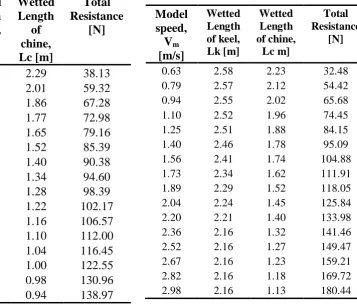
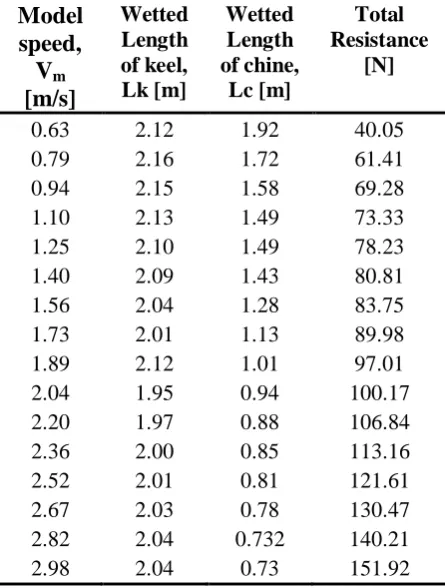
Test data for different planing hull models obtained from RSU Towing Tank, after correction, are presented in tables. They match the test results by Clement [15] for similar models at Davidson Laboratory. Table 1 shows the basic particulars of the four models under consideration. The towing tank resistance test results for each of the planing hull-forms are presented in Tables 2 to 5.
Table 1: Model Particulars
Model 𝑳𝒑[m] 𝑩𝒑𝒙[m] 𝑩𝑷𝑨[m] 𝑨𝒑[m2] 𝑨𝒑/𝛁𝟐/𝟑 𝑳𝒑/𝛁𝟏/𝟑 𝑳𝒑/𝑩𝑷𝑨 𝑳𝑪𝑮[m] 𝜷[°]
A 2.44 0.60 0.49 1.189 7 5.917 5 1.04 22
B 2.66 0.52 0.47 1.258 7 6.29 5.65 1.15 20
C 2.64 0.55 0.46 1.206 7 6.36 5.78 1.04 22
D 2.29 0.60 0.50 1.144 7 5.66 4.57 0.88 22
Table 2:Model Test Result for Model A
Model
speed,
Vm
[m/s]
Wetted
Length
of keel,
Lk [m]
Wetted
Length
of
chine,
Lc [m]
Total
Resistance
[N]
0.63
2.38
2.29
38.13
0.79
2.38
2.01
59.32
0.94
2.35
1.86
67.28
1.10
2.32
1.77
72.98
1.25
2.26
1.65
79.16
1.40
2.16
1.52
85.39
1.56
2.01
1.40
90.38
1.73
2.02
1.34
94.60
1.89
1.83
1.28
98.39
2.04
1.77
1.22
102.17
2.20
1.77
1.16
106.57
2.36
1.74
1.10
112.00
2.52
1.74
1.04
116.45
2.67
1.74
1.00
122.55
2.82
1.74
0.98
130.96
2.98
1.74
0.94
138.97
Table 3:Model Test Result for Model B
Model
speed,
Vm
[m/s]
Wetted Length of keel, Lk [m]
Wetted Length of chine,
Lc m]
Total Resistance
[N]
0.63 2.58 2.23 32.48
0.79 2.57 2.12 54.42
0.94 2.55 2.02 65.68
1.10 2.52 1.96 74.45
1.25 2.51 1.88 84.15
1.40 2.46 1.78 95.09
1.56 2.41 1.74 104.88
1.73 2.34 1.62 111.91
1.89 2.29 1.52 118.05
2.04 2.24 1.45 125.84
2.20 2.21 1.40 133.98
2.36 2.16 1.32 141.46
2.52 2.16 1.27 149.47
2.67 2.16 1.23 159.21
2.82 2.16 1.18 169.72
w w w . i j m r e t . o r g I S S N : 2 4 5 6 - 5 6 2 8 Page 47 www.ijmret.org Volume 3 Issue 3 ǁ March 2018.
Table 4:Model Test Result for Model C
Model
speed,
Vm
[m/s]
Wetted Length of keel, Lk [m]
Wetted Length of chine,
Lc [m]
Total Resistance
[N]
0.63 2.55 2.27 35.15
0.79 2.51 2.06 55.09
0.94 2.47 1.93 66.08
1.10 2.44 1.83 73.42
1.25 2.42 1.72 80.59
1.40 2.36 1.60 88.77
1.56 2.26 1.46 94.25
1.73 2.13 1.37 100.08
1.89 2.41 1.30 105.73
2.04 2.09 1.23 111.11
2.20 2.07 1.05 116.90
2.36 2.07 1.14 125.26
2.52 2.09 1.10 136.88
2.67 2.12 1.07 146.40
2.82 2.15 1.04 155.30
2.98 2.16 1.01 161.80
Table 5:Model Test Result for Model D
Model
speed,
Vm
[m/s]
Wetted Length of keel, Lk [m]
Wetted Length of chine,
Lc [m]
Total Resistance
[N]
0.63 2.12 1.92 40.05
0.79 2.16 1.72 61.41
0.94 2.15 1.58 69.28
1.10 2.13 1.49 73.33
1.25 2.10 1.49 78.23
1.40 2.09 1.43 80.81
1.56 2.04 1.28 83.75
1.73 2.01 1.13 89.98
1.89 2.12 1.01 97.01
2.04 1.95 0.94 100.17
2.20 1.97 0.88 106.84
2.36 2.00 0.85 113.16
2.52 2.01 0.81 121.61
2.67 2.03 0.78 130.47
2.82 2.04 0.732 140.21
2.98 2.04 0.73 151.92
III. RESULTS AND DISCUSSION
3.1 Comparison Resistance Test Data against Predictions by Savitsky and CAHI Methods
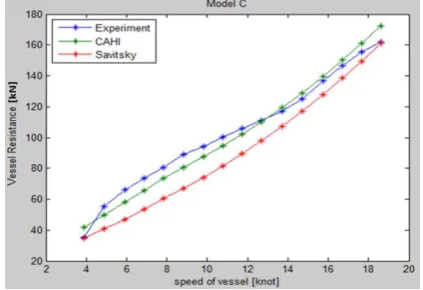
Thea analysis results of resistance for each model obtained by Savitsky and CAHI algorithms are plotted against test data on a resistance vs. velocity coordinate frame. Figures 2 to 5 show the
extrapolated resistance versus velocity
characteristics of the four-model hull-forms with similar principal dimensions. It can be seen from the graphs that, the resistance results computed from the two methods under consideration agree reasonably well with test results. The CAHI method tends to have higher degree of accuracy than that of the Savitsky method in most cases. The resistance test data for Model A ship at low speeds of less than 13.5 knot (VS< 6.9 m/s) is higher than predicted, but falls
lower at full planning speed. This phenomenal drop in resistance is due to a substantial reduction in the hull wetted surface as a result of hydrodynamic lift. However, Model B and C ships do not show any significant change in resistance even at high speed. This indicates that Model B and C ships are high-speed crafts with low hydrodynamic planing performance. Obviously, the total resistance of Model B at 19 knots is 180 kN as against 140 kN for Model A.
The resistance characteristics of Model D exhibit hydrodynamic planing effect but marginal reduction in resistance at high speed. This is because of an increase in form induced wave resistance. Therefore, the prismatic near flat-bottom hull form (Model A) has the best hydrodynamic efficiency. It is noted that Savitsky and CAHI predictive tools require some
modifications to enable them capture the
w w w . i j m r e t . o r g I S S N : 2 4 5 6 - 5 6 2 8 Page 48 Figure 2:Extrapolated boat resistance for
Model-A versus Speed (1 knot = 0.5144 m/s)
Figure 3:Extrapolated boat resistance for Model-B versus Speed (1 knot = 0.5144 m/s)
Figure 4:Extrapolated boat resistance for Model-C versus Speed (1 knot = 0.5144 m/s)
Figure 5:Extrapolated boat resistance for Model-D versus Speed (1 knot = 0.5144 m/s)
3.2 Test Data of Wetted Length-Beam Ratio Compared against Model Predictions
w w w . i j m r e t . o r g I S S N : 2 4 5 6 - 5 6 2 8 Page 49 www.ijmret.org Volume 3 Issue 3 ǁ March 2018.
Figure 6: Boat Wetted Length-Beam Ratiofor Model-A versus Speed (1 knot = 0.5144 m/s)
Figure 7: Boat Wetted Length-Beam Ratio for Model-B versus Speed (1 knot =
0.5144 m/s)
Figure 8:Boat Wetted Length-Beam Ratio for Model-C versus Speed (1 knot = 0.5144
m/s)
Figure 9:Boat Wetted Length-Beam Ratio for Model-D versus Speed (1 knot = 0.5144
m/s)
3.3 Test Data of Effective Trim Angle Compared against Model Predictions
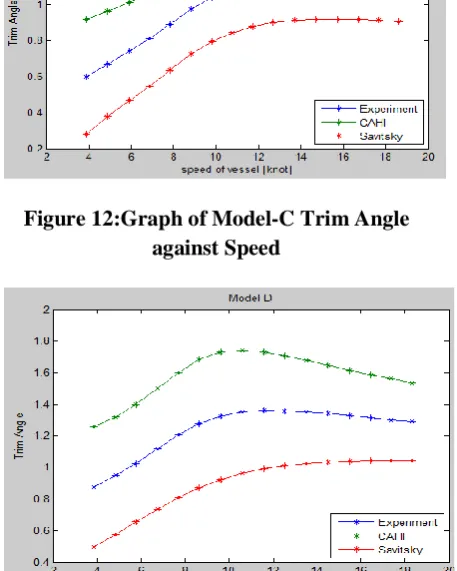
At this juncture, it is very pertinent to make similar comparative assessment of trim. Test data and model predictions of the effective trim angles for the different hull forms at various speeds are compared as shown in Figures 10 to 13. The test result for the trim angle lies between that of the Savitsky and
CAHI prediction curves. CAHI method
overestimates the angle of trim while that of the
Savitsky under-predicts the angle of trim.
Nevertheless, both predictors correctly represent the trend for the changing trim angle. They show the sharp trim angle at displacement phase; the transition detour and the characteristic constant trim at full planing.
w w w . i j m r e t . o r g I S S N : 2 4 5 6 - 5 6 2 8 Page 50 Figure 11:Graph of Model-B Trim Angle
against Speed
Figure 12:Graph of Model-C Trim Angle against Speed
Figure 13: Graph of Model-D Trim Angle against Speed
IV. CONCLUSISON
This work considers the analysis of the
hydrodynamic characteristics of high speed marine craft. Four different planing hull-forms are examined
in order to determine their respective total resistance, speed, trim angle and mean wetted length-beam ratio. Model predictors are formulated based on Savitsky and CAHI analyses for planing crafts.
Predictions are validated against veritable
experimental data. An interactive computer-aid modelling tool is developed in this work to enhance computational accuracy, swift comparisons of hull parameters and reproducibility.
The analyses correctly predict quantitatively the resistances of all the four models at high speeds. Average standard deviation (std) for CAHI method is 4.69 kN while Savitsky‟s method gives 6.13 KN. Although at speeds below 12 knots, particularly for Model A, reasonable discrepancies occur between predictions and test data because of the effects of waves, water spray and the rapidly changing trim are not adequately captured by the model predictors. These parameters are the main determinants of the wetted surface: hence, the total resistance. It is also found that for both test and analysis, the transition from bow-wetting to full-planing for the different hull forms occurs between 11 to 12.5 knots, and is characterized by a phenomenal bend of the trim curve. It is also established that during full planing, the trim hardly changes, and hence the total resistance becomes more or less a linear in nature. Conversely, the wetted length-beam ratio predicted by analysis shows the characteristic rapid reduction
of wetted length with increasing speed
(hydrodynamic lift) until at transition speed where it suddenly becomes a fairly constant value. The same slope pattern is exhibited by test data. In contrast, the quantitative comparison shows that Savitsky‟s method underestimates the HSC wetted length-beam ratio, with a mean std of 1.07, while CAHI method over-predicts by an average of 1.41. Nonetheless, the deviations can be minimized by introducing an appropriate correction factor. In conclusion, CAHI method produces better prediction for HSC total resistance while Savitsky method gives better results for mean wetted length-beam ratio and effective trim angle. Furthermore, according to Almeter and Eberhardt [6], theaccuracy of predictions depends mainly on the type of loading, effective trim, deadrise and operating speed. In view of this, research to optimize and correct the extant empirical
predictors for improved hydrodynamic
w w w . i j m r e t . o r g I S S N : 2 4 5 6 - 5 6 2 8 Page 51 www.ijmret.org Volume 3 Issue 3 ǁ March 2018.
CONFLICT OF INTEREST
There exists no conflict of interest among the authors of this research article.
REFERENCE
[1.] Baird, N. (1998). The World Fast Ferry
Market. Melbourne, Australia: Baird
Publications.
[2.] ITTC. (2008). ITTC Recommended
Procedures and Guidelines (Testing and Extrapolation Methods High Speed Marine Vehicles Resistance Test). Iternational Towing Tank Conference.
[3.] Faltinsen, O. M. (2005). Hydrodynamics of
High Speed Marine Vehicles.
NorweigenUniversity of Sciene and
Technology: Cambridge University Press.
[4.] Jeffrey, B., & Donald, L. (2012). Turning Characteristics and Capabilities of
High-Speed Monohulls. TheThird Chesapeake
Power Boat Symposium, (pp. 1-18). Virginia, USA.
[5.] Tamunodukobipi Daniel, Faango Ibelema,
Nitonye Samson, Ogbonnaya Ezenwa
(2017), Design, Fabrication and
Rotodynamic Performance Analysis of Airboat Propulsion System for application in
Amphibious Planing Crafts. Nigerian Oil
and Gas Industry Content (NOGIC) Research and Development Journal, Vol. 1, No1, 41-48. www.ncdmb.gov.ng
[6.] Almeter, J., & Eberhardt, D. (2010). Predicting The Impact of Design and Requirement Changes on High Performance
and Conventional Craft. Seventh
International Conference on High-Performance Marine Vehicles (pp. 1-15). Melbourne, Florida, USA: Florida Institute of Technology.
[7.] Anuar, B. B. (2009). Performance Prediction
for High Speed Craft. Universiti Teknologi Malaysia, Marine Technology, Skudai.
[8.] Dong, J. K., Sun, Y. K., Young, J. Y., Key, P. R., Seong, H. K., & Yeon, G. K. (2013). Design of High-Speed Planing Hulls for the
Improvement of Resistance and Seakeeping
Performance. International Journal Naval
Architect and Ocean Engineering, 5, 161-177.
[9.] Valdenazzi, F. (2001). Seakeeping
Optimisation of Fast Vessels by Means of
Parametric Modeling. Proceedings of the
International Symposium on Practical Design in Shipbuilding. Shanghai.
[10.]Emilia, S., & Jarosław, P. (2014). Methods of Calculating Ship Resistance on Limited Waterways. Polish Maritime Research, 12, 12-17.
[11.]Nitonye Samson and Sidum Adumene,
(2015). Comparative modeling of hull form resistance for three ocean going vessels
using methodical series, International
Journal of Engineering and Technology, (IJET) Germany, 4 (4), 489-496;doi: 10.14419/ijet.
v4i4.4948(http://www.sciencepubco/index.p hp/IJET.com).
[12.]Savitsky, D. (1964). Hydrodynamic Design
of Planing Hull. Journal of Marine
Technology,1(1), 71-95.
[13.]Alourdas, P. G. (2016). Planing Hull
Resistance Calculation (The CAHI Method). Society of Naval Architects and Marine Engineers Greek Section Meeting (pp. 1-16). Greese: Society of Naval Architects and Marine Engineers, Greese.
[14.]Zhang, Q., Yin, C., & Wu, K.-f. (2012). Comparison Between“ЦАГИ”Method and SIT Method for Resistance Prediction of Planing Crafts. Chinese Journal of Ship Research, 7(3), 25-29