Paper: AL
COLLECTION DEVELOPMENT IN AN ELECRONIC ERA
S. Seetharama & R. Ambuja , Dept. of Library and Information Science, University of Madras, Chennai 600 005
It has been quite a long since we traversed from library management to information management and information technology management. IT has made management of information a relatively easy task thus helping in quick and easy access to information. The growing impact of IT has somehow completed librarian to use IT effectively to render service and with the growing number of e-sources, it has become imperative for information professionals to redefine the process of collection development. This paper gives an overview of CD in electronic era pointing out some of the issues.
1. INTRODUCTION
While the need for effective information management is not new, two major trends, however, have come together to create an unprecedented awareness of the importance of information. Firstly, the growing complexity of organisational structures and operations, and Secondly, the impact of computing and communication technologies (collectively called IT) on work functions and patterns. Consequently, the managerial spotlight is now on information processing and information resources handling within the organisational framework.
1.1 Information technology
"Technology" tends to be a catch-all word for a number of developments that are taking place in recent times. However, to begin with, only a few specialists were aware of the value of Information Technologies for library and information center operations. But, this situation has changed considerably as is evidenced by the fact that a large amount of literature is being generated in recent times on the subject of "IT applications in libraries and information centers". But, much more needs to be done to fully exploit the advantage of IT in library applications.
opportunities to provide more and better services as another motivating factor (Wedgewroth). As a matter of fact, libraries overwhelmed with financial problems are trying to work out ways to leverage technology to help the crisis (Adams, 19997).
As a consequence, it may be said that "we are in a time when many people involved in the library community are uncertain about what their role and the role of others will be in the near and distant future. All libraries today will have to be flexible and understand the true nature of their existence, or their missions. Products and Services provided by all will have to change, but missions will stay the same" (Luigendigk, 1996).
In other words, the libraries need to realise that change is a fact of life and librarians, in their turn, should known or learn the basic skills concerning how to manage change, especially, management of change by IT. They can no longer treat IT trends like the "monster under the bed" and ignore it hoping that it will not have an impact (Snyder, 1996). At the same time, he concedes that keeping up with technology and resources is an overwhelming task and concluded by suggesting that the paradigm of thinking has been changed from viewing change as a threat to security to realising that there is no security without change.
2. COLLECTION DEVELOPMENT IN AN ELECTRONIC ENVIROUMENT
In this changing information environment, one of the questions for which an answer should be sought is: what does the future hold for Collection Development in libraries and information handling institutions? At this juncture, it would be appreciate to recall Cogswell's list of eight functions of Collection Management -- Planning and Policy making, Collection analysis, Materials selection, Collection Maintenance, Fiscal Management User Liaison, Resource Sharing and Programme Evaluation. That the electronic revolution affects the traditional role of the academic and research library as an institution that collects and stories information and makes it available to its users would be obvious and is indisputable. In the context of Collection Development/Management, the impact has been quite pronounced whether it relates to Collection Development Policy, Selection and Acquisition of information materials, Resource Sharing / Networking, Collection Evaluation, etc.
2.1 Collection Development Policy: Definition and Factors
Collection Development Policy is "a Communication tool for management, librarians, users and other libraries; a details outline of collecting levels; a description of collection development responsibilities; and a budgeting tool that helps librarians decide where to place resources. The two basic elements of a policy are:
1. An introduction, which describes the user group 2. General Policies covering:
• Technology-related factors like browsers, band-with, storage considerations, various forms of digital access (CD-ROMs, remote access, etc), response time, updating and users training.
• Budgeting and Cost Factors, including various pricing mechanisms, using library funds to purchase hardware and software, and locating funds to purchase electronic resources.
• Organisational Factors that include issues on human resources, job responsibilities and authority in terms of maintenance and monitoring of resources as well as selecting and acquiring materials.
• Licensing Factors covering questions on whether to sign license agreements with questionable restrictions and requirements regarding who has access, what one has to purchase (print and electronic), how data is made accessible, and whether one pays for beta tests and experiments, as well as questions about who can and who should sign and read licensing agreements.
• Preservation and Archival Factors that includes archival responsibilities of libraries, publishers, and vendors; the conversion of existing materials; and the development of original digital resources. In this context, some of the issues include: uniqueness of a resource, costs for ongoing conversion, users base, need or demand for a resource, provision of access, space limitations, funding sources, suitability of content, subject strengths, and currentness of information (Ferguson, 1996).
Thus, in an electronic or IT-based environment, the entire approach and philosophy of Collection needs to be changed as "simply duplicating the collection practices evolved for print materials in the new information (network) environment does not seem responsive to current needs or capabilities" Nevertheless, Collection Development whatever form it takes, still would require policies that would govern the acquisition of both electronic resources and traditional forms of documents. In this context, probably, the obvious challenge would be the problem of how to integrate both. In the context of changing Collection Development patterns, the key issues that have been identified for redefining a Collection Development Policy include:
• Balancing ownership and access • Cooperative efforts
• Evaluation
2.1.1 Ownership Vs Access
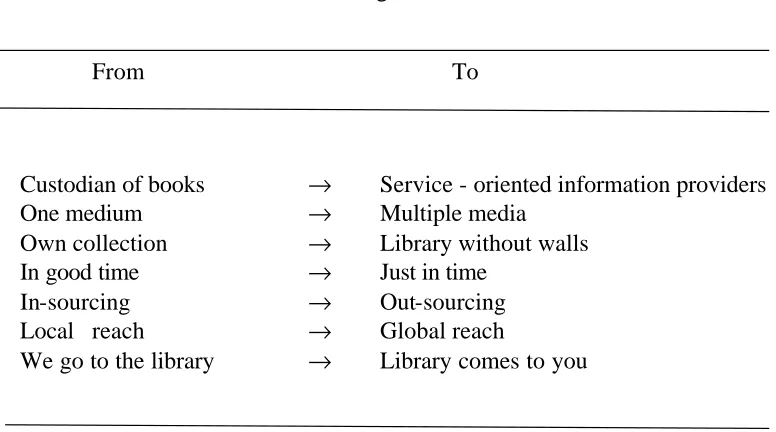
information centre will change. The major shifts (Sabaratnam, 1995) related to libraries have been succinctly summarised in the following table:
Table - 1
Paradigm Shifts in Libraries
From To
Custodian of books → Service - oriented information providers One medium → Multiple media
Own collection → Library without walls In good time → Just in time
In-sourcing → Out-sourcing Local reach → Global reach
We go to the library → Library comes to you
In other words, in recent years, there has been a perceptive shift that the libraries are making from "Library as a Storehouse Model" to Library as a Gateway Model". As has been rightly said by Line (1996) "Time, perhaps, has come that it has almost become established wisdom that the future for libraries lies in a policy of access rather than ownership, since, on the one hand, much if not most material will be ma de available in the future only in electronic form and, on the other, economic grounds force one to access rather than own". But then there would be the problem of browsing and serendipity in addition to the problem that for many documents, the day of routine online access is distant possibility. Further, Lancaster his identified the problems of electronic resources associated with access:
• Integration of electronic resources with traditional forms • Costs of Acquisition Vs Access
• Critical problem of determining what "Collection Development" really means in an electronic environment
• Inadequate or no bibliographical control of electronic resources
• No selection tools; nor there is a developed system of publication , distribution, and evaluation of electronic resources.
In such a situation, it becomes obvious that while there are merits and demerits both in ownership and access, a sensible approach would be to redefine Collection Development Policy which ensures on-the-spot access (through ownership) to current materials and remote access to older material leading to the concepts of Core Collection and Core Access respectively. By implication, it would mean the need for a policy for Weeding, Stock Relegation, which would lead to "Leaner, fitter libraries", which is the need of the hour.
Thus, achieving a balance between local collections of heavily used traditional and electronic resources and the provision of (network) access should be the goal of the library acquisition process in an electronic networked information environment. However, it needs to be mentioned here that a mechanism for document delivery should through of from the beginning.
2.1.2 Cooperative Efforts and Evaluation
In addition, CD Policies should cover the issue of cooperation and remote access. This, in effect suggests the planning for a resource sharing mechanism among participating libraries that would facilitate collective/ remote access to the entire clientele.
2.2 Use of Networks for Collection Development Activities
While selection and acquisition methods to be adopted for traditional / conventional materials are well known, what one is not familiar is the use of electronic facilities (including networks) for CD activities. The use of networks for CD related activities in libraries are given in the following table:
Table-2
Use of Networks for CD -related Activities • Receiving patron requirements for new books, journals and media • Requesting / providing ILL to other libraries
• Requesting/providing missing issues, duplicates, and exchange • Requesting/ordering library materials
• Identifying document sources • Getting quick copyright permission
• Communicating with vendors and customers • Subscribting to electronic publications • Searching remote catalogues and union lists • Searching online systems
• Scanning journals, tables of contents • Retrieving files via FTP
• Receiving technical documents and technical data • Searching files for acquisition lists and articles
A comprehensive treatment on the main uses of networks for CD work can be found in library literature and hence not discussed here. However, the arrival on the scene of INTERNET has completely revolutionised the entire gamut of activities that constitute Library Management (Chaudhry, 1996).
2.2.1 Internet-based Collection Development
According to McClure, a possible definition of Internet-based CD is "The identification, analysis, selection and organisation of information resources from the Internet which are made available to the library's clientele". Hence has cited the following as the factors affecting Internet-based CD:
Ø Need for short term planning (6 to 9 months) due to rapid changes in resources available and technologies
Ø Impermanence of resources
Ø Difficulty of determining author responsibility or reputation Ø Possible modification needed to make the resource accessible Ø Interactive nature of some criteria
Ø Evaluation of selection criteria
Ø Unpredictability of Collection maintenance Ø Difficulty or restrictions on archiving Ø Unknown application of copyright laws Ø Difficulty of guaranteeing security
Ø The demands access places upon computer technology and technical support Ø Broad and more complex nature of demand on staff
Ø Need for new models of collaborative funding
McClure then goes on to suggest six models of Internet-based Collection Development:
i) Ignore Internet-based resources, as the management of these resources is not the library's responsibility
ii) Provision of selective links on the library's homepage for finding guides or catalogs, not to individuals sources of information
iii) Integrate Internet resources into the OPAC, by creating hotlinks to the resources' URL addressed from the cataloging records.
iv) Vendor-supplied collections, wherein the library contracts with a vendor who develops and manages a Web-site created for the specific library according to a profile.
v) Collaborative collections, where libraries make cooperation CD agreements to outline specific subject areas on Internet-based CD and management.
Which of these models is suitable for a particular library is depend upon the library's information infrastructure, skills available among the staff, costs involved, methods of access within and outside the library, licensing and copyright issues, etc. But, one thing is certain; no library can afford to ignore these resources, but must plan for them. As rightly put by him, "The Ostrich approach will not work. When you have your head buried in the sand, other parts of your body are embarrassingly exposed".
2.2.1.1 Factors in the Selection of Internet Resources
The inclusion of Internet Resources into the collection of libraries is an evolving process. Weber (1999) has identified the following as factors to be considered in the selection:
PRICE of an electronic resource may have to be justified in order to be approved for purchase, as it may be greater than a comparable print resource. For example, it may provide advanced searching capabilities, better indexing, currency of information, it may serve a greater number of users simultaneously, 24 hour access, etc. However, concerns regarding purchase of additional hardware / software should be addressed when making selection decisions regarding Internet resources.
• CANCELLATION OF COMPARABLE RESOURCES / VERSIONS IN OTHER FORMATS (Print, CD-ROM), when they cannot provide the same capabilities as Internet Resources
• APPROPRIATENESS OF ELECTRONIC RESOURCE for the type of users it is intended to serve, ease of use by patrons, preference of users, potential usage by remote patrons.
• STABILITY OF INTERNET RESOURCES -- Vendor related issues of stability. (Reliability, Business record, commitment, 24p-hours access, etc.
• DUPLICATE COPIES OF INTERNET RESOURCES many be acquired when networking or other alternatives are not possible and additionally, when a library chooses to provide a product/serve in more than one format.
• LICENSING is a major consideration, since licensing requirements / restrictions govern access, copyright restrictions, access to information from previous releases, etc.
2.3 Collection Evaluation
performance measures. In the traditional library, the size and variety of its collections were the main measures of excellence of a library. Other measures used include exhaustively / completeness, quality, document availability, browsability, circulation and reference use, document exposure (house of use of a book by the reader), etc. Performance evaluation of collection can be determined through questionnaire surveys, interviewing, observation, library statistics, and other collection-centered and client-centered methods.
But, in the context of electronic resources, client-centered methods can be used keeping in view the two dimensions (of evaluation) of availability and accessibility. If they are not already there, there will be a need for newly developing them.
On the other hand, in evaluating traditional library collections, a host of evaluation methods, have been developed in recent times which include: Checklists approach, Comparative holdings statistics, availability studies, standards, formula, etc.
Whatever be the methods adopted, one should always keep in mind the ultimate objective or purpose of collection evaluation is to satisfy the needs of users. Some of the collection management performance indicators useful in this context are: Relevance, Delivery, Effectiveness (use satisfaction), Cheapness, Cost-efficiency and Staff efficiency.
3. ROLE OF LIBRARIES AND LIBRARIANS
In this changing scenario, libraries and librarians will continue to play an important role in handling conventional and electronic resources. Unless this is recognised and acted upon, other professionals will user up our roles and functions. A similar line of thinking can be seen in Alberico's comment that "if we don't become involved at all levels, there is a very real possibility that resources will shift to other segments of the economy that can handle and deliver the electronic services that academic and post - industrial organisations will need to survive".
Atkinson, however, believes that the role of the library in an electronic environment would be:
a) To identify resources that are likely to be of greatest interest locally and downloading these to a local database -- a kind of deferred CD operation (locating information sources as they are needed rather than to predict the needs in advance).
b) To become a publisher and disseminator of information by uploading rather than downloading.
On the role of librarians, Choudhry (1996) comments that "Librarians will have to initiate the transition to an access-based model of service based upon electronic networks that will provide bibliographic, numeric and full-text information to scholars and researchers. They will have to create an environment where access to collective scholarly and researchers. They will have to cerate an environment where access to collective scholarly resources supersedes the historic quest for the great comprehensive collections". Other roles identified are that of gate keeper -- one who identifies that portion of the universe of information resources that is likely to be of greatest value to a particular user or group of users. Whatever happens to the library as an institution, Shreeves believes that clearly gatekeepers of this type will still be needed in the future, and perhaps, will be even more important that they are today. In addition, librarians will have to involve thems elves in the access process and also in negotiating with publishers and vendors about site licenses and methods of royalty and copyright payments. Further, they have to be prospectors selecting and acquiring materials in the complex network environment.
4. CONCLUDING
From the foregoing discussion, it is clear that libraries and librarians have little choice but to adapt and adopt IT for library operations, especially CD activities and information services generation. Despite its enormous potential, IT is largely underused by libraries in India. Therefore, it is necessary that information professionals examine and design appropriate strategies in the selection and use of technologies so as to increase productivity in library operations like CD, and also in the enhancement of services to the users. In the context of Collection Development and Management, the information professional has to actively developed and maintain the management of a wide range of structured and organised knowledge resources by providing all type of access -- bibliographic access, physical access, intellectual access and networked access -- to resources. This necessarily has to be done in a cost-effective and user centered way. This then leads us to the question as to whether the modern day information professionals would be in a position to handle the challenges of traditional and electronic / digital librarianship. Probably, they can -- provided they improve their professional competencies in which scientific, research, methodological, managerial and economic skills are integrated with communicative, navigational, information seeking, retrieval, and analytic design knowledge. (Wormell 1996, Ingwersen 1994).
To conclude, the challenge we face is neither a "paperless society" nor the "electronic information center". The challenge is to maintain, nurture and optimise the resources of the library with the help of new technology. Hence, we must be ready emotionally, professionally and financially to accept and make good use of new technology.
5. BIBLIOGRAPHICAL REFERENCES
1. Adams(P). Is the Medium the Message: A report (Library Acquisitions. 21; 1997; 265-7) 2. Alberico (R) quoted in Lancaster (FW). Collection Development in the year 2025.
3. Atkinson (R). Text mutability and Collection Administration (Library Acquisitions: Practice and Theory. 14; 1990; 356).
5. Chaudhry (AS). Exploiting network information resources for Collection Development in Libraries (IFLA J. 22; 1996; 191-198)
6. Cogswell (J). The organisation of Collection Management functions in academic research libraries. (J Acad Librarianship 13; 1987; 268-76)
7. Dougherty (RM) and Hughes ( C ). Preferred Futures for Libraries. 1991 Research Libraries Group. Mountain View, California.
8. Dowlin (KE). "The Neographic Library" In libraries and the Future.
9. Dysart (JI) and Jones (RJ). Tools for the future: Recreating or "Renovating" Information Services using new technologies (Computers in Libraries 15; 1995; 16-19).
10.Earl(M). Emerging trends in managing new information technologies. (In Piercy (N), Ed. The management implications of new information technology. Croom Helm, 1984).
11.Ferguson (A). Electronic Resources Collection Development Policy (address to 1996 Charleston Conference).
12.Gaunt (MI). Machine-readable Literary Texts: Collection Development Issues.(Collection Management, 13; 1990; 89).
13.Ingwersen (P). Human Approach to Information Services and Management (J Inf. Sci. 20; 1994; 197-208).
14.Jenkins (C) and Morley (M). Collection Management in Academic Libraries 1996. First Jaico Impression. Jaico Publishing House, Bombay.
15.Johnson (M). Adding computer files to the Research Library: Issues in Collection Management and Development. (in Constance ( C), Ed. Computer files and the research library, 1990. Research Libraries Group. Mountain view, California)
16.Lancaster (FW). Collection Development in the year 2025.
17.Line (MB). Access Vs Ownership: How real an alternative is it (IFLA J 22; 1996; 35-41) 18.Luijendijk (W). Archiving Electronic Journals: The Serial Information Provider's
Perspective. (IFLA J 22; 1996; 209-210)
19.McClure (CR). Approaches to Internet-Based Collection Development. (Keynote Address to 1996 Charleston Conference).
20.Michalko (J). Quoted in Lancaster (FW). Collection Development in the year 2025.
21.Sabarathnam (DS). Transforming libraries to support chance and growth. (In Dempsey (L) and others. Networking and the Future of Libraries. 1995. Library Association. London). 22.Seetharama (S). Guidelines for Planning of Libraries and Information Centre 1990.
IASLIC, Calcutta.
23.Shreeves (E). Between the Visionaries and the Luddites: Collection Development and Electronic Resources in the Humanities (Lib Trends.40; 1992; 579).
24.Slamecka (V). Empirical issues in National Information System Design (paper presented at the International Symposium on Computerised Information Retrieval. Beijing 19985, 15-39).
25.Snyder (WT). Information technology Imperative for Higher Education (address to 1996 Charleston Conference).
26.Stoller (ME). Electronic Journals in the Humanities: A survey and critique (Lib. Trends 40; 1992; 647-666).
27.Summerhill (CA). Quoted in Lancaster (FW). Collection Development in the year 2025. 28.Weber (MB). Fastors to be considered in the selection and cataloging of Internet Resources.
(lib Hi Tech. 17; 1999; 298-303)