DEMOGRAPHIC RESEARCH
VOLUME 33, ARTICLE 45, PAGES 1257–1270
PUBLISHED 9 DECEMBER 2015
http://www.demographic-research.org/Volumes/Vol33/45/ DOI: 10.4054/DemRes.2015.33.45
Descriptive Finding
Unintended pregnancy and the changing
demography of American women, 1987–2008
Athena Tapales
Lawrence Finer
©2015Athena Tapales & Lawrence Finer.
This open-access work is published under the terms of the Creative Commons Attribution NonCommercial License 2.0 Germany, which permits use, reproduction & distribution in any medium for non-commercial purposes, provided the original author(s) and source are given credit.
1 Introduction 1258
2 Data and methods 1259
3 Results 1261
4 Discussion 1264
5 Acknowledgments 1265
Unintended pregnancy and the changing demography
of American women, 1987–2008
Athena Tapales1
Lawrence Finer2
Abstract
BACKGROUND
In 1987, the U.S. unintended pregnancy rate was 59 per 1,000 women aged 15–44; the rate fell to 54 in 2008. Over this period, American women experienced dramatic demographic shifts, including an aging population that was better educated and more racially and ethnically diverse.
OBJECTIVE
This study aims to explain trends in unintended pregnancy and understand what factors contributed most strongly to changes in rates over time, focusing on population composition and group-specific changes.
METHODS
We used the 1988 and 2006–10 waves of the National Survey of Family Growth and employed a decomposition approach, looking jointly at age, relationship status, and educational attainment.
RESULTS
When we decomposed by the demographic factors together, we found that changes in population composition contributed to an increase in the overall rate, but this was more than offset by group-specific rate declines, which had an impact nearly twice as great in the downward direction. Increases in the share of the population that was cohabiting and the share that was Hispanic were offset by declines in rates among married women. CONCLUSIONS
Our findings suggest that a combination of compositional shifts and changes in group-specific rates drove unintended pregnancy, sometimes acting as counterbalancing forces and at other times operating in tandem.
1 Guttmacher Institute, U.S.A. E-Mail: [email protected].
1. Introduction
The persistence of unintended pregnancy in the United States is a major public health concern. Births from unintended conceptions are associated with increased risk of many negative health and social outcomes, independently or because of their association with women’s disadvantaged social and economic status (Gipson, Koenig, and Hindin 2008).
Since surveillance efforts began about 25 years ago, about half of all U.S. pregnancies have been unintended. Most developed nations report much lower rates in comparison (Singh, Sedgh, and Hussain 2010). In addition, there is a great deal of variation by subgroup (Cubbin et al. 2002; Finer and Henshaw 2006; Finer and Zolna 2011; Forrest and Singh 1990; Forrest 1994; Williams 1991; Koren and Mawn 2010). Women aged 18–24, poor women, unmarried (and particularly cohabiting) women, and women of color report unintended pregnancy rates several times higher than the national rate (Finer and Zolna 2011).
Between 1987 and 2008, the U.S. unintended pregnancy rate declined from 59 to 54 per 1,000 women aged 15–44 (Guttmacher Institute 2013). Policymakers who hope to further reduce the unintended pregnancy rate may wish to better understand the factors that have contributed to this small but important decline. Efforts to understand disparities typically involve examining proximate determinants of fertility, specifically the biological and behavioral factors described by the Bongaarts (1978) framework (Forrest and Singh 1990; Forrest 1994; Frost, Singh, and Finer 2007; Schirm et al. 1982). More recent work focuses on the availability of contraceptives, the role of contraceptive use (Frost, Singh, and Finer 2007; Schirm et al. 1982; Westoff 1988), and the role of sexual partners in contraceptive use negotiation (Koren and Mawn 2010; Miller 1986).
continue unabated today (Kennedy and Bumpass 2013; Manning 2013). The rise in cohabitation continues to redefine family formation patterns, and unintended pregnancy is particularly high among cohabiting women. Increases in the proportion of women who are cohabiting could lead to an increase in the rate, even if behaviors of cohabiting women do not change.
The aim of our paper is to use decomposition techniques to describe the factors underlying the decline in the unintended pregnancy rate from 59 per 1,000 women aged 15–44 in 1987 to 54 in 2008. We examine how the dramatic changes in the educational attainment, marital status, and racial-ethnic composition of American women in the last two decades have affected unintended pregnancy rates.
2. Data and methods
We decomposed the overall rate simultaneously by multiple demographic characteristics, specifically race and ethnicity, relationship status, and educational attainment. For each demographic subgroup, we decomposed the rates to determine what caused the change between two time points. We used a decomposition tool proposed by Preston, Heuveline, and Guillot to identify how much of a change in a rate can be attributed to change in population composition and how much to changes in subgroup-specific rates (2001). Although there is no single standard for decomposition, these authors’ approach has the advantage of not having a residual or interaction term.
The difference between the two rates UPRt1 and UPRt2 is the change,
∆=𝑈𝑃𝑅𝑡2− 𝑈𝑃𝑅𝑡1=�(𝐶
𝑖𝑡2×𝑈𝑃𝑅𝑖𝑡2)− 𝛴(𝐶𝑖𝑡1×𝑈𝑃𝑅𝑖𝑡1) 𝑖
=�[(𝐶𝑖𝑡2− 𝐶𝑖𝑡1) × (𝑈𝑃𝑅𝑖𝑡1+𝑈𝑃𝑅𝑖𝑡2)/2] 𝑖
+�[(𝑈𝑃𝑅𝑖𝑡2− 𝑈𝑃𝑅𝑖𝑡1) × (𝐶𝑖𝑡1+𝐶𝑖𝑡2)/2] 𝑖
where UPR = unintended pregnancy rate, C = demographic composition, and i = demographic subgroup.
The results decompose the total difference into two parts. The first part, Σ [(Cit2− Cit1) × ([UPRit1 + UPRit2] / 2)], is the contribution of changes in population composition to the change in the overall rate. The second part, Σ [(UPRit2− UPRit1) × ([Cit1 + Cit2] / 2)], is the contribution of group-specific rate changes to the overall rate change.
decomposition in order to determine which subgroup combination had the most impact on the change in rates. However, calculating rates and proportions for every subgroup would be prohibitively difficult, for two reasons: first, very small sample sizes would result in each cell; and, second, data are not currently available for the years we are studying. However, if we limit ourselves to using a smaller number of demographic variables at once (say, three), and use a single data source that contains all these variables, it is possible to produce subgroup cells for which rates and population proportions can be calculated. The National Survey of Family Growth (NSFG) is one such dataset.
It is well established that abortions are substantially underreported in the NSFG. This means that the unintended pregnancy rate produced from such an analysis would be lower than the true rate because many abortions, which are typically unintended conceptions, are missing. However, we are primarily interested in the change in rates over time. If we assume that abortion underreporting does not change significantly over time (a reasonable assumption given published studies on this topic), we can perform a decomposition using these (artificially low) rates (Jones and Kost 2007; Fu et al. 1998). We refer to these rates as “pseudo-unintended pregnancy rates” because these are not actual rates for the population. With these “pseudo” rates we can decompose and analyze the effects of changes in rates and changes in population composition for smaller groups of women representing multiple demographic characteristics, because we can easily tabulate the NSFG dataset to create population subgroups.
For this analysis, we mainly use women’s reports of the intendedness of their pregnancies from two waves of the NSFG (U.S. Department of Health and Human Services, National Center for Health Statistics 1988, 2010). The only additional data we use to calculate the rates are population-level birth counts from the NCHS (U.S. Department of Health and Human Services, National Center for Health Statistics 2011) and total pregnancy counts, which are estimates based on data from several sources, including the NSFG and NCHS.
In order to examine one of our key variables of interest, cohabitation, we overcame a data limitation of Cycle 4 (1988) of the NSFG. Unlike more recent cycles, the 1988 cycle did not have a complete cohabitation history. However, Hayford and Morgan analyzed the quality of retrospective data on cohabitation and found that although Cycle 4 data were not as detailed as later cycles of the NSFG, reports within five years of interview were comparable (2008). From these variables we created a nearly complete marital status history that included the cohabitation experience of women and were thus able to determine cohabitation status at pregnancy outcome for almost all pregnancies.
inconsistent. We used Stata version 13 (StataCorp 2013) for data management and analysis.
3. Results
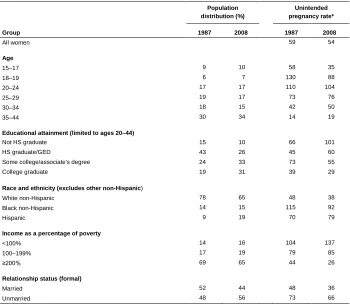
Before proceeding with our decomposition findings, we briefly discuss the population shifts during the period of our study. Table 1 shows large demographic shifts among American women. The female population aged 15–44 became slightly older, better educated, and more racially and ethnically diverse. The share of women 35 and older rose from 30% in 1987 to 34% in 2008. Compared to 1987, more and more women entered college and graduated in 2008. For instance, in 1987, 19% of women aged 20– 44 obtained a college education. By 2008, this had increased to 31%.
This increasingly diverse nation became more apparent with the continued rise in the Hispanic population, from 9% in 1987 to 19% in 2008, while the share of white women declined from 78% to 65%. The relative household income distribution of women aged 15–44, however, remained fairly stable, with a small increase in the proportion of women reporting incomes below 200% of poverty.
Although comprehensive cohabitation information at pregnancy outcome was not available in the NSFG prior to 2002, we found a sharp decline in the proportion of women currently married at the time of pregnancy outcome − 52% in 1987, declining to 44% by 2008. In summary, between 1987 and 2008, population composition (in terms of age, education, race and ethnicity, and relationship status) shifted dramatically.
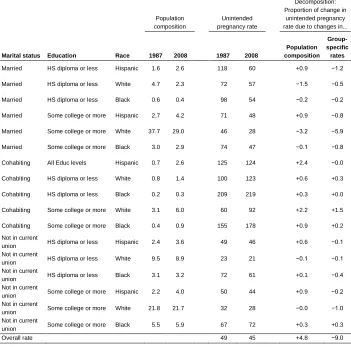
We now continue with the decomposition results (Table 2). The broadest finding is that changes in population composition contributed to an increase in the overall rate (total of +4.8), but this was more than offset by group-specific rate declines, which had an impact nearly twice as great in the downward direction (total of −9.0).
Table 1: Unintended pregnancy rates and population distribution
*Rate per 1,000 women in group aged15–44.
Population distribution (%)
Unintended pregnancy rate*
Group 1987 2008 1987 2008
All women 59 54
Age
15–17 9 10 58 35
18–19 6 7 130 88
20–24 17 17 110 104
25–29 19 17 73 76
30–34 18 15 42 50
35–44 30 34 14 19
Educational attainment (limited to ages 20–44)
Not HS graduate 15 10 66 101
HS graduate/GED 43 26 45 60
Some college/associate's degree 24 33 73 55
College graduate 19 31 39 29
Race and ethnicity (excludes other non-Hispanic)
White non-Hispanic 78 65 48 38
Black non-Hispanic 14 15 115 92
Hispanic 9 19 70 79
Income as a percentage of poverty
<100% 14 16 104 137
100–199% 17 19 79 85
≥200% 69 65 44 26
Relationship status (formal)
Married 52 44 48 36
Table 2: Decomposition by age, relationship status, and educational attainment Population composition Unintended pregnancy rate Decomposition: Proportion of change in
unintended pregnancy rate due to changes in...
Marital status Education Race 1987 2008 1987 2008
Population composition
Group-specific
rates
Married HS diploma or less Hispanic 1.6 2.6 118 60 +0.9 −1.2 Married HS diploma or less White 4.7 2.3 72 57 −1.5 −0.5 Married HS diploma or less Black 0.6 0.4 98 54 −0.2 −0.2 Married Some college or more Hispanic 2.7 4.2 71 48 +0.9 −0.8 Married Some college or more White 37.7 29.0 46 28 −3.2 −5.9 Married Some college or more Black 3.0 2.9 74 47 −0.1 −0.8 Cohabiting All Educ levels Hispanic 0.7 2.6 125 124 +2.4 −0.0 Cohabiting HS diploma or less White 0.8 1.4 100 123 +0.6 +0.3 Cohabiting HS diploma or less Black 0.2 0.3 209 219 +0.3 +0.0 Cohabiting Some college or more White 3.1 6.0 60 92 +2.2 +1.5 Cohabiting Some college or more Black 0.4 0.9 155 178 +0.9 +0.2 Not in current
union HS diploma or less Hispanic 2.4 3.6 49 46 +0.6 −0.1 Not in current
union HS diploma or less White 9.5 8.9 23 21 −0.1 −0.1 Not in current
union HS diploma or less Black 3.1 3.2 72 61 +0.1 −0.4 Not in current
union Some college or more Hispanic 2.2 4.0 50 44 +0.9 −0.2 Not in current
union Some college or more White 21.8 21.7 32 28 −0.0 −1.0 Not in current
union Some college or more Black 5.5 5.9 67 72 +0.3 +0.3
Overall rate 49 45 +4.8 −9.0
The overall increase in the Hispanic population, a group of women with relatively high rates of unintended pregnancy, also had a major upward effect on the overall rate. The five Hispanic rows (across education and marital groups) collectively contributed +5.7 to the overall rate.
with some college or more) contributed an additional −1.7 to the overall rate. Finally, the proportion of the population who were white, married, and with some college education declined substantially. The size of this subgroup’s population decline resulted in the group’s behavior playing a less important role in the overall rate.
4. Discussion
Our findings suggest that a combination of compositional shifts and changes in group-specific rates drove unintended pregnancy, sometimes acting as counterbalancing forces and at other times operating in tandem. Population composition was a force for change, separately from women’s reproductive behaviors.
We found that the population share of cohabiting women increased across all racial, ethnic, and education levels. Moreover, the unintended pregnancy rates of cohabiting women, which were already higher than those of married and unmarried women, increased between 1987 and 2008. However, this increase was more than offset by the decline in unintended pregnancy rates among all groups of married women. These major trends were the primary drivers of the overall decline in the rate. Hispanic women are the only group among married women whose population share is increasing, but their unintended pregnancy rates are declining. The unintended pregnancy rates of unmarried Hispanic women and more-educated black women are increasing, with a parallel increase in population share. These rates, however, are not as high as those of cohabiting women of the same education levels and race/ethnicity groups.
There are several limitations to the analysis presented. Because this is an aggregate-level analysis, we are not able to test if the differences between the components are statistically significant, which is also a limitation of other decomposition studies (Deleone, Lichter, and Strawderman 2009). Furthermore, for the 1988 dataset we were only able to create a relationship history for women who reported dates concerning their relationships, which might have resulted in an underestimation of cohabitation rates.
Although unintended pregnancy rates declined over the period we studied (1987 to 2008), rates increased between 2001 and 2008 (Finer and Zolna 2014), likely due to population composition changes that may be offsetting improvements in contraceptive use. However, new data on contraceptive use through 2011–2013 indicate significant increases in use of highly effective long-acting contraceptive methods such as the IUD (Daniels, Daugherty, and Jones 2014), and data through 2010 indicate declines in many U.S. states in unintended pregnancy (Kost 2015). Although our analysis showed that population composition changes are clearly having an impact, it is possible that future trends may be driven to a greater extent by changes in behavior. Further research at the national level would provide additional insight into the impact of long-acting contraceptive methods and other group behaviors relative to continuing changes in population composition. Population shifts toward groups with higher unintended pregnancy rates mean that we must redouble our efforts to decrease unintended pregnancy through improvements in the education of providers, women, and the general public; contraceptive method development and better utilization of currently available methods; and improvements in delivery approaches and funding for reproductive health services.
5. Acknowledgements
References
Bongaarts, J. (1978). A Framework for Analyzing the Proximate Determinants of Fertility. Population and Development Review 4: 105–132. doi:10.2307/197
2149.
Cherlin, A. (2010). Demographic trends in the United States: a review of research in the 2000s. Journal of Marriage and the Family 72: 403–419.
doi:10.1111/j.1741-3737.2010.00710.x.
Cubbin, C., Braveman, P.A., Marchi, K.S., Chavez, G.F., Santelli, J.S., and Colley Gilbert, B.J. (2002). Socioeconomic and Racial/Ethnic Disparities in Unintended Pregnancy Among Postpartum Women in California. Maternal and Child Health Journal 6: 237–246. doi:10.1023/A:1021158016268.
Daniels, K. Daugherty, J., and Jones, J. (2014). Current Contraceptive Status Among Women Aged 15–44: United States, 2011–2013. NCHS Data Brief, No. 173, http://www.cdc.gov/nchs/data/databriefs/db173.pdf.
Deleone, F., Lichter, D., and Strawderman, R. (2009). Decomposing trends in nonmarital fertility among Latinas. Perspectives on Sexual and Reproductive Health 41: 166–172. doi:10.1363/4116609.
Finer, L.B. and Henshaw, S. K. (2006). Disparities in Rates of Unintended Pregnancy in the United States, 1994 and 2001. Perspectives on Sexual and Reproductive Health 38: 90–96. doi:10.1363/3809006.
Finer, L.B. and Zolna, M.R. (2011). Unintended Pregnancy in the United States: Incidence and Disparities, 2006. Contraception 84: 478–485. doi:10.1016/j.
contraception.2011.07.013.
Finer, L.B. and Zolna, M. (2014). Shifts in intended and unintended pregnancies in the United States: 2001-2008. American Journal of Public Health 104: 43–48.
doi:10.2105/AJPH.2013.301416.
Forrest, J.D. (1994). Epidemiology of Unintended Pregnancy and Contraceptive Use.
American Journal of Obstetrics and Gynecology 170: 1485–1489. doi:10.1016/
S0002-9378(94)05008-8.
Forrest, J.D. and Singh, S. (1990). The Sexual and Reproductive Behavior of American Women, 1982-1988. Family Planning Perspectives 22: 206–214. doi:10.2307/
Frost, J.J., Singh, S., and Finer, L.B. (2007). Factors Associated with Contraceptive Use and Nonuse, United States, 2004. Perspectives on Sexual and Reproductive Health 39: 90–99. doi:10.1363/3909007.
Fu, H., Darroch, J.E., Henshaw S.K., and Kolb, E. (1998). Measuring the extent of abortion underreporting in the 1995 National Survey of Family Growth. Family Planning Perspectives, May–June: 128–133, doi:10.2307/2991627.
Gipson, J.D., Koenig, M.A., and Hindin, M.J. (2008). The Effects of Unintended Pregnancy on Infant , Child, and Parental Health: A Review of the Literature.
Studies in Family Planning 39: 18–38. doi:10.1111/j.1728-4465.2008.00148.x. Guttmacher Institute (2013). Unintended Pregnancy in the United States. Guttmacher
Institute [On-line]. Available:
http://www.guttmacher.org/pubs/FB-Unintended-Pregnancy-US.pdf.
Hayford, S. and Morgan, S. (2008). The quality of retrospective data on cohabitation.
Demography 45: 129–141. doi:10.1353/dem.2008.0005.
Jones, R.K. and Kost, K. (2007). Underreporting of induced and spontaneous abortion in the United States: an analysis of the 2002 National Survey of Family Growth.
Studies in Family Planning 38: 187–197. doi:10.1111/j.1728-4465.2007.
00130.x.
Kennedy, S. and Bumpass, L. (2013). Cohabitation and children's living arrangements: new estimates from the United States. Demographic Research 19: 1663–1692.
doi:10.4054/DemRes.2008.19.47.
Koren, A. and Mawn, B. (2010). The Conext of Unintended Pregnancy Among Married Women in the USA. Journal of Family Planning and Reproductive Health Care
36: 150–158. doi:10.1783/147118910791749380.
Kost, K. (2015). Unintended Pregnancy Rates at the State Level: Estimates for 2010 and Trends Since 2002. New York: Guttmacher Institute,
http://www.guttmacher.org/pubs/StateUP10.pdf.
Manning, W. (2013). Trends in cohabitation: twenty years of change, 1987-2008 (FP-10-07) National Center for Family & Marriage Research.
Miller, W.B. (1986). Why Some Women Fail to Use Their Contraceptive Method: A Psychological Investigation. Family Planning Perspectives 18: 27–32.
doi:10.2307/2135198.
Santelli, J., Abma, J., Ventura, S., Lindberg, L., Morrow, B., and Anderson, J. (2004). Can changes in sexual behaviors among high school students explain the decline in teen pregnancy rates in the 1990s? Journal of Adolescent Health 35: 80–90.
doi:10.1016/S1054-139X(04)00134-X.
Schirm, A.L., Trussell, J., Menken, J., and Grady, W.R. (1982). Contraceptive Failure in the United States: The Impact of Social, Economic and Demographic Factors.
Family Planning Perspectives 14: 68–75. doi:10.2307/2134816.
Singh, S., Sedgh, G., and Hussain, R. (2010). Unintended Pregnancy: Worldwide Levels, Trends, and Outcomes. Studies in Family Planning 41: 241–250.
doi:10.1111/j.1728-4465.2010.00250.x.
StataCorp (2013). Stata Statistical Software: Release 13. College Station, TX: StataCorp LP.
Teachman, J., Tedrow, L., and Crowder, K. (2000). The changing demography of America's families. Journal of Marriage and the Family 62: 1234–1246.
doi:10.1111/j.1741-3737.2000.01234.x.
U.S. Census Bureau, Population Division (2010). Resident population by sex and age: 1980 to 2010. U.S.Census Bureau, Population Division [On-line]. Available: http://www.census.gov/compendia/statab/2012/tables/12s0007.pdf
U.S. Department of Commerce Economics and Statistics Administration & Executive Office of the President Office of Management and Budget (2011). Women in America: indicators of social and economic well-being. White House Council on Women and Girls.
U.S. Department of Health and Human Services, National Center for Health Statistics (2011). Intercensal estimates of the resident population of the United States for July 1, 2000–July 1, 2009, by year, single-year of age (01,2,...,85 years and over), bridged race, Hispanic origin, and sex. Prepared under a collaborative arrangement with the U.S. Census Bureau. Centers for Disease Control and Prevention [On-line]. http://www.cdc.gov/nchs/nvss/bridged_race.htm.
U.S. Department of Health and Human Services, National Center for Health Statistics (2010). National Survey of Family Growth, 2006-2010. U.S. Department of Health and Human Services, National Center for Health Statistics [On-line]. Available: http://www.cdc.gov/nchs/nsfg/nsfg_2006_2010_puf.htm.
Westoff, C.F. (1988). Contraceptive Paths Toward the Reduction of Unintended Pregnancy and Abortion. Family Planning Perspectives 20: 4–13. doi:10.2307/
2135590.