DEMOGRAPHIC RESEARCH
VOLUME 33, ARTICLE 26, PAGES 733
−
764
PUBLISHED 6 OCTOBER 2015
http://www.demographic-research.org/Volumes/Vol33/26/ DOI: 10.4054/DemRes.2015.33.26
Research Article
Educational differences in timing and quantum
of childbearing in Britain: A study of cohorts
born 1940
−
1969
Ann Berrington
Juliet Stone
Eva Beaujouan
© 2015 Ann Berrington, Juliet Stone & Eva Beaujouan.
This open-access work is published under the terms of the Creative Commons Attribution NonCommercial License 2.0 Germany, which permits use, reproduction & distribution in any medium for non-commercial purposes, provided the original author(s) and source are given credit.
1 Introduction 734 2 Childbearing dynamics in the UK context 736 2.1 Timing of entry into motherhood 736 2.2 Recuperation of childbearing at older ages 737 2.3 Educational differentials in childlessness 738 2.4 Aim and research questions 739
3 Data and methods 740
3.1 Data 740
3.2 Contribution of childlessness to educational differences in Total Completed Family Size
744 3.3 Contribution of postponement to educational differences in
mothers’ completed family size
745
4 Results 746
4.1 Educational differences in childlessness and parity progression 746 4.2 Educational differentials in age at entry into motherhood 748 4.3 Relationship between age at entry into motherhood and completed
family size
750 4.4 Relative contributions of childlessness, age at first birth, and
fertility rates conditional upon age at first birth in explaining educational gradients in completed family size
752
5 Discussion 753
6 Acknowledgements 756
Educational differences in timing and quantum of childbearing in
Britain: A study of cohorts born 1940
−
1969
Ann Berrington1
Juliet Stone2
Eva Beaujouan3
Abstract
BACKGROUND
Increased postponement of fertility, especially among higher-educated women, means it is important to know whether women recuperate births at older ages, but evidence for the UK is lacking. The extent to which the timing and quantum of mothers’ fertility underlie the strong educational gradient in completed family size is also unclear.
OBJECTIVE
We investigate the relative contributions of childlessness, timing, and quantum to educational differences in completed fertility within cohorts born between 1940 and 1969.
METHODS
We analyse retrospective fertility histories from 44,351 women, born 1940−1969, interviewed in the British General Household Survey (1979−2009) and the UK Household Longitudinal Study (2009−2010). After describing educational differences in the timing of first birth and parity distributions, we quantify the relative contributions of childlessness, delayed entry into motherhood, and fertility rates conditional upon age at entry into motherhood, to educational differences in completed family size.
RESULTS
Within each cohort, the educational gradient in completed family size is explained, in demographic accounting terms, almost entirely by educational differences in the proportions remaining childless and the age distribution of mothers at entry into motherhood. Conditional upon age at entry into motherhood, subsequent fertility rates are similar across educational groups and across cohorts.
1 University of Southampton, U.K. E-Mail: [email protected]. 2 University of Southampton, U.K.
CONCLUSIONS
Unlike for some other European countries, the postponement of motherhood to later ages in Britain has not resulted in a significant increase in childbearing among more-educated women who enter motherhood at later ages. The stability of aggregate measures of completed fertility in Britain is not the result of a straightforward process of postponement followed by recuperation.
1. Introduction
Educational attainment is a strong predictor of fertility and, particularly given the expansion of higher education among post-war cohorts, the mechanisms underlying this educational differential are of significant interest in contemporary demography (Rindfuss, Bumpass, and John 1980; Axinn and Barber 2001; Hoem, Neyer, and Andersson 2006; Testa 2012; Wood, Neels, and Kil 2014). Increased education has an impact on childbearing through enrolment and human capital effects. Current enrolment in education is consistently associated with a decreased likelihood of childbearing (Blossfeld and Huinink 1991) and research has highlighted the importance of the increasing age at leaving education on the postponement of first births (Neels and De Wachter 2010; Ni Bhrolchaín and Beaujouan 2012). Increased educational attainment is generally assumed to exert a downward pressure on achieved fertility; for example, as a result of increased female emancipation and desire for personal fulfilment (Van de Kaa 1987, Kravdal 1992; Lesthaeghe 1998), and an increase in the economic opportunity costs of leaving the labour market to care for children (Becker and Lewis 1973; Becker 1981).
Despite only modest educational differences in mean intended family size, educational differences in achieved fertility in many developed countries are large, with completed family sizes for highly educated women far below intended levels (Quesnel-Vallee and Morgan 2003; Berrington and Pattaro 2011, 2014; Testa 2012). Whilst it is not possible to demonstrate causality, research from a number of European countries consistently shows that women who postpone entry into motherhood but who continue to desire children are less able to fulfil their intentions compared to young women (Ni Bhrolchaín, Beaujouan, and Berrington 2010; Harknett and Hartnett 2014). Harknett and Hartnett (2014) suggest that unrealized intentions of older women who have postponed fertility will reduce the quantum of childbearing, and not just change the tempo. Hence some of the gap between intentions and achieved fertility among highly educated women could result from a lack of recuperation of fertility among those who start childbearing later in their reproductive careers.
Educational gradients in completed family size can result from differences in the proportion that remain childless, and/or educational differences in the number of children born to those who become mothers. Educational differences in completed family size among mothers can vary by education independently of the level of childlessness, depending, for instance, on the age at which mothers started a family. Completed family size among degree-educated mothers will reflect the extent to which they recuperate their births at later ages. Few studies have examined, at the individual level, the relationship between childlessness, age at entry into motherhood, and completed family size, and how this differs by education, as noted by Sigle-Rushton (2008). This paper aims to fill this gap in our knowledge using data for the UK and a simple demographic decomposition technique. We quantify from a demographic accounting perspective the relative importance of childlessness, delay in entry into motherhood to later ages, and fertility rates conditional upon age at entry into motherhood in explaining overall differences in completed family size between the lowest- and highest-educated women for cohorts born between 1940 and 1969.
following section, the UK is an interesting case study for this analysis due to the parallel existence of relatively high overall levels of completed fertility with significant levels of childlessness and a late average age at entry into motherhood. The data and decomposition method are discussed in section 3, with the results and discussion in sections 4 and 5 respectively. First we review existing evidence for the UK, focusing initially on factors affecting the timing of entry into motherhood among women with different educational backgrounds, then on the contextual factors which influence the ability to recuperate births at older ages, and finally on circumstances associated with remaining childless.
2. Childbearing dynamics in the UK context
2.1 Timing of entry into motherhood
Not only has fertility been postponed more in the UK than in some other countries, but this postponement has also been concentrated in the most educated groups (Rendall et al. 2005; Kneale and Joshi 2008). Thus in the UK the timing of entry into motherhood is highly polarised according to education, similarly to the situation found in the US and Australia, but unlike the situation in Norway and France (Rendall et al. 2010). Underlying these cross-national differences are specific policy mechanisms that encourage or supress postponement of childbearing. In the UK the incentive to delay childbearing is weakened due to low opportunity costs for women whose alternative is to remain in low-paid employment (Schmitt 2012). This is compounded by the fact that government support for parents, including housing, is concentrated among low earners (Van Mechelen and Bradshaw 2013). In the UK the motivation to postpone parenthood is strongest for educated women with high earnings potential, for whom the opportunity costs of childbearing are greatest. By contrast, in the Nordic countries the earnings distribution among women is much narrower and the timing of childbearing is therefore less related to level of earnings and education (Sigle-Rushton 2008). The Nordic countries are also characterised by provision of generous work-related maternity benefits, providing an incentive for women to delay childbearing until they are established in the workplace, regardless of their income level (Hobcraft and Kiernan 1995).
the influence of cultural age timetables (Settersten and Hagestad 1996; Billari et al. 2010), and the downward adjustment with rising age of fertility intentions (Berrington 2004; Liefbroer 2009; Iacovou and Tavares 2011).
2.2 Recuperation of childbearing at older ages
If recent birth cohorts are recuperating their postponed births, it follows that women who have their first child later in life eventually achieve a higher completed family size than previous cohorts of women who had their first birth at the same age. Evidence in support of recuperation among recent cohorts has been found for Western Europe (Castro 2015), Norway, and Sweden (Andersson et al. 2009), where the late-starters in more recent cohorts achieved slightly more children than the late starters in the earlier cohorts. Cohort comparisons for the UK have hitherto not been possible due to a lack of data. Our aim in this paper will therefore be to fill this gap in our knowledge.
If higher-educated women who delay entry into motherhood have higher fertility rates at older ages compared to lower-educated women, then educational differences in completed family size for mothers will be reduced. Rendall and Smallwood (2003) found that for women born in 1954–1958, those with higher education were more likely to progress to further births. However, Jenkins (2011), using data from the 1958 and 1970 birth cohort studies, found that the speed of progression to second birth was similar across educational groups. Whilst past research has thus provided some (contradictory) indications for specific cohorts, there is a need for a systematic examination of the link between postponement and completed family size and how this varies by education for recent cohorts of British women.
was quite difficult. Given this context we might speculate that fertility recuperation for highly educated women may not be as easy in the UK as for more-educated women in the Nordic countries.
2.3 Educational differentials in childlessness
The proportion making the transition to parenthood increased to a peak for UK cohorts born around 1945, before declining steadily through to cohorts born in the early 1960s, and subsequently levelling off. Currently, the level of childlessness in the UK is relatively high, and educational differences in childlessness are large and stable by European standards (McAllister and Clarke 2000; Kneale and Joshi 2008; Berrington and Pattaro 2014; Wood, Neels, and Kil 2014). Survey data suggest that childlessness in the UK is largely involuntary since relatively few women (or indeed men) of any educational level report that they intend to have no children (Ni Bhrolchain, Beaujouan, and Berrington 2010; Berrington and Pattaro 2011; Berrington in press). The UK situation contrasts with the narrowing of educational differences in childlessness in other European countries, mostly due to an increase in levels of childlessness among lower-educated women (van Agtmaal-Wobma and van Huis 2008; Andersson et al. 2009; Neels and De Wachter 2010). Potential explanations for divergent patterns of childlessness by education across countries include the relative accessibility of career opportunities for women, policies facilitating the combination of work and family formation; contraceptive methods that provide an alternative to childbearing; differing educational trends in the timing of marriage and/or cohabitation between countries; and social attitudes towards childlessness (Hobcraft and Kiernan 1995, Sobotka 2012; Wood, Neels, and Kil 2014).
al. 2008; Matysiak and Vignoli 2008), the availability of reliable contraception (Murphy 1993), and increased partnership postponement and instability (Hobcraft and Kiernan 1995; Thomson et al. 2012). Underlying this is an enduring incompatibility in our cohorts between the demands of a high-level career and family life for women. The 1950s birth cohorts were undertaking childbearing during a period prior to the implementation of most policies subsequently enacted with the aim of helping to combine family and work. For example, provision of paid maternity leave was extremely limited prior to the 1999 Employment Relations Act, which specified that all mothers were entitled to 18 weeks' paid leave, regardless of the length of their prior period of employment. Furthermore, in the 1980s and 1990s there was insufficient provision of affordable childcare (especially prior to implementation of the National Childcare Strategy in 2000, which provided limited free childcare for pre-school aged children) (Joshi 2002; Lewis 2003). Thus the economic opportunity costs of childbearing for women born in the 1950s and early 1960s remained high. In addition, in the UK the persistent norms regarding gender roles that mean the mother is still regarded as a child’s primary carer may also reinforce the incompatibility of motherhood and career (Hochshild 1989; Torr and Short 2004; Sigle-Rushton 2008; Berrington and Pattaro 2014; O'Reilly, Nazio, and Roche 2014).
The UK is thus an interesting case study for analysis since it is characterised by a relatively high level of overall fertility co-existing with large educational differences in the timing of entry into motherhood and in the proportion that remain childless.
2.4 Aim and research questions
educational differences in fertility behaviour remains important, this paper does not attempt to distinguish the substantive reasons behind educational differences in the timing or quantum of fertility. Instead, we anticipate that our study will provide a valuable contribution to increasing understanding of how to interpret changing educational differentials in childbearing by disentangling the relative importance of quantum and timing in the UK context. We contribute to evidence on change over time in educational differentials more generally, on which there is currently limited research (Wood, Neels, and Kil 2014).
Our detailed research questions are: How have educational differences in childlessness and parity distributions among mothers changed over cohorts born 1940−1969? How have educational differentials in age at entry into motherhood changed for cohorts born 1940−1969? How does the relationship between age at entry into motherhood and completed family size differ by education? Has this relationship changed over cohorts born 1940−1969? What are the relative contributions of childlessness, age at first birth, and fertility rates conditional upon age at first birth to explaining the educational gradient in completed family size?
The first three of our research questions build up our understanding using descriptive analyses, and the fourth question is dealt with by a decomposition analysis whereby educational differences in completed family size within each cohort are divided into the proportions attributable to childlessness, postponement, and recuperation. The paper thus contributes to the literature both substantively and methodologically, since the decomposition technique can be used, for example, to examine cross-national differences in completed family size.
3. Data and methods
3.1 Data
The analyses are based primarily on retrospective fertility histories collected in repeated rounds (1979−2009) of a nationally representative cross-sectional survey of adults in Britain, the General Household Survey (GHS)4. A team of researchers at the ESRC Centre for Population Change has combined these retrospective histories to provide a unique data source to study family change in Britain (Beaujouan et al. 2014). The histories include information on the fertility experiences of more than 600,000 men and women across periods and cohorts and at different ages. Ni Bhrolchain and colleagues (2011) demonstrate that the retrospective reports of fertility for women aged under 50
are consistent with estimates from national birth registration, although there is some evidence of under-reporting of past childbearing among women aged over 50 (Ni Bhrolchain, Beaujouan, and Murphy 2011). Therefore the work reported here only uses retrospective reports from the GHS for women aged under-50 at interview. We assume that estimates of completed fertility based on women aged 40−49 are good approximations to ultimate fertility, since very few British women have children after the age of 40. For example, between 1955 and 2010 the proportion of all live births in England and Wales to mothers over the age of 40 years ranged between 1% and 4% (Office for National Statistics 2013). The following analyses are based on revised fertility histories from 31,583 women where retrospectively reported births are augmented with additional information on children living in the household. The data are weighted to take account of survey design and non-response (Beaujouan, Brown, and Ni Bhrolchaín 2011).
A limitation of the GHS data is that the sample sizes for more recent cohorts are smaller than for older cohorts because the fertility experience of younger cohorts of women is only captured in the most recent surveys among women who have recently reached age 40, whereas the experience of older cohorts is represented in the retrospective reporting of repeated survey rounds. The analysis of changes across cohorts therefore requires the use of an additional, more recent data source that is comparable to the GHS, to enhance the sample sizes in the younger cohorts. To this end, we supplement the GHS data using the UK Household Longitudinal Study, Understanding Society, a panel study of over 30,000 households in the UK (Mcfall 2013). Like the GHS, Understanding Society is a household-level survey that aims to be representative of the adult population in Britain residing in private households. We use data from Wave 1 of the panel in 2009−2010, at which point retrospective fertility histories were collected. We include 12,768 women aged 40−70 years at interview who completed a valid fertility history. The analyses are weighted using cross-sectional wave 1 weights, standardised to the sample size.
Before combining fertility histories from the two surveys we evaluated the consistency of key findings from the two data sources, such as completed family size and the age pattern of childbearing, and found them to be comparable to each other. For example, among women born in 1960−1964, the median age at first birth for women in the lowest (less than ordinary level) and highest (degree level) educational qualification categories was 23.0 and 28.3 respectively in the GHS sample, compared with 23.3 and 28.6 in the Understanding Society sample. Furthermore, completed parity distributions and age patterns of childbearing within both of the samples closely match national data from vital registration (Office for National Statistics 2014).
the GHS and Understanding Society datasets. We use four categories of education: Less than Ordinary (O) Level; Ordinary (O) level; Advanced (A) level; Degree or equivalent. Ordinary (O) level qualifications are equivalent to a school leaving qualification taken at age 16 years. Advanced (A) level qualifications are taken at age 18 years and are generally required in order to progress to a tertiary (university) educational setting. Since educational attainment is measured at the time of interview, some qualifications will be gained after a break from education (and possibly subsequent to entry into motherhood). A measure of women’s highest qualification on first leaving education (i.e., at the end of continuous education) may therefore give a more accurate indication of education prior to entry (or potential entry) into motherhood. We address this by taking women’s reported age at leaving full-time education into account when coding their educational attainment. Specifically, we seek to identify whether women with a degree or equivalent qualification are likely to have had a break in continuous education before attaining this higher qualification. We assume that this is the case if women report having a degree but left full-time education at age 18 or younger, or if they have a degree but report leaving education at age 28 or older. In both situations we recode their highest qualification as ‘A level’ to reflect their likely educational attainment at the time of exposure to the risk of childbearing5.
The interpretation of changing educational differentials in fertility over time is made complex by the changing composition of the British population by education. As shown in Figure 1, the proportion of the female population with either no qualifications or who fail to achieve any Ordinary Level (O Level) qualifications at the end of compulsory schooling (generally at age 16) decreases from 63% among women born 1940−1949 to just one fifth of women born 1960−1969. At the same time the proportion with a degree or other higher-level qualification increases from 9% to 24%. In terms of the impact of educational enrolment on postponement, we would argue that the effect of having degree-level qualifications will remain similar across cohorts. However, in terms of the impact of higher educational attainment on fertility behaviour, we cannot assume that the causal effect of having a degree will remain the same across cohorts. If incentives to postpone are linked to the earnings opportunities that accompany investments in education, more women with higher qualifications could result in more women with similarly strong incentives to postpone. However, female graduates among cohorts born in the 1940s and 1950s were a very select group of women who arguably were less family orientated, whereas today they form only a significant minority who could be select in terms of their attitudes to family and work.
We might therefore expect that the association between having higher-level qualifications and fertility behaviour might change across cohorts due to the widening pool of women who are part of this group. In parallel, the least educated group of women will have become more selected for poorer socio-economic characteristics, and hence this group may behave in a different way to previous cohorts. When interpreting our results we comment upon these compositional changes where appropriate and consider the importance of selection effects in the discussion.
Figure 1: Distribution of educational attainment among women aged 40–70 years by cohort
The first three research questions are addressed using descriptive statistics in Tables 1−3. In order to study research question 4 we focus on a comparison of women with the highest and lowest levels of education.6 Our aim is to demographically account for the absolute difference in completed family size for women with a degree versus those with less than Ordinary (O) level qualifications, within each cohort. This overall difference can be broken down into three components: 1) Differing levels of cohort
childlessness; 2) Timing of entry into motherhood (composition effect); 3) Fertility rates conditional upon age at first birth (rate effect). We assess the contribution of educational differences in childlessness to the differences in total completed family size on the one hand, and the contribution of differences in age at entry into parenthood and fertility rates conditional upon age at first birth to variation in completed fertility of mothers on the other hand. We base our calculations on a decomposition method introduced by Kitagawa over 50 years ago (Kitagawa 1955).7
3.2 Contribution of childlessness to educational differences in Total Completed Family Size
We utilise the fact that total completed family size (CFST) is equivalent to completed family size for mothers (CFSM) multiplied by the proportion of women who are mothers (pm) at the end of the reproductive period (Sobotka 2012). For each 10-year
birth cohort, we want to estimate the proportion of the total fertility differential between degree-educated (subscript H) and least-educated (subscript L) women that can be attributed to difference in childlessness. Kitagawa proposed a symmetric solution using the average motherhood share to weight the completed-family-size-of-mothers component, and the average completed family size of mothers over both educational groups to weight the motherhood-share component, reported in equation (1). This solution does not favour one educational group over the other in terms of the weights of the two components (Schempf and Becker 2006).8
𝐶𝐹𝑆𝑇
𝐻− 𝐶𝐹𝑆𝑇
𝐿=
�
𝑝𝑚𝐻+𝑝𝑚𝐿2
�
(𝐶𝐹𝑆𝑀
𝐻− 𝐶𝐹𝑆𝑀
𝐿) +
�
𝐶𝐹𝑆𝑀𝐻+𝐶𝐹𝑆𝑀𝐿
2
�
(𝑝
𝑚𝐻− 𝑝
𝑚𝐿)
(1)The second component of the equation reflects the contribution of childlessness to the difference, and we express it as a share of the overall difference.
7
Whilst we focus on decomposing educational differences within a cohort, this method could, in theory, also be applied to understanding cohort changes in completed family size within an educational group, or to international comparisons of completed family size.
3.3 Contribution of postponement to educational differences in mothers’ completed family size
We focus on differences in childbearing among women in the two selected educational groups who have had at least one child. Again, Kitagawa’s method can be used to decompose the difference between the completed family size for mothers (CFSM) in two sub-populations (educational groups) into two components. The first component reflects the distribution of women according to their age at entry into motherhood. The second component reflects fertility rates conditional upon age at first birth. In other words, we can break down the overall difference in completed family size for mothers into a composition effect (component one) and a rate effect (component two). The composition effect addresses the extent to which CFSM would change if the distribution of age at entry into motherhood changed but the fertility rates conditional upon age at first birth remained constant. The second component reflects the extent to which CFSM would change if age-specific fertility rates changed but the distribution of women at entry into motherhood remained constant. Kitagawa’s symmetric solution uses the average age composition to weight the age-specific completed family size component and the average age-specific family sizes to weight the composition component, as reported in equation (2).
𝐶𝐹𝑆𝑀𝐻− 𝐶𝐹𝑆𝑀𝐿=
∑ �𝑁++𝐻𝑁𝑖𝐻 +𝑁++𝐿𝑁𝑖𝐿
2 �(𝐶𝐹𝑆𝑀𝑖𝐻− 𝐶𝐹𝑆𝑀𝑖𝐿)
𝑖 +∑ �𝑖 𝐶𝐹𝑆𝑀𝑖𝐻+𝐶𝐹𝑆𝑀2 𝑖𝐿� �𝑁𝑁++𝐻𝑖𝐻 −𝑁𝑁++𝐿𝑖𝐿 �
(2)
where i=age in five-year age groups and NiL is the number of least-educated women in age group i and NiHis the number of highly educated women in age group i. CFSMiL and CFSMiHare the completed family size for low- and high-educated women who enter motherhood in the ith age group.
We express the rate effect and composition effect as proportions of the overall difference in CFSM. We apply these proportions to the remaining part of the overall difference in CFST that is not explained by differential childlessness. The analyses are repeated for different cohorts and findings shown in Table 49.
4. Results
4.1 Educational differences in childlessness and parity progression
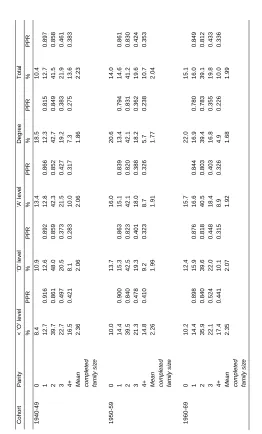
Table 1 shows that mean completed family size has reduced from 2.23 children per woman among women born in the 1940s (who were having their children at the height of the 1960s baby boom) to 1.99 among women born in the 1960s. Within each birth cohort, completed family size is larger for those with lower levels of education. Completed family size has remained stable across the cohorts for those with the lowest levels of education but has fallen for those with higher levels. Thus, educational differences in completed family size have widened for more recent birth cohorts. Among those born in the 1960s, completed family size was around 2.35 for those with no or below Ordinary (O) level qualifications, as compared to 1.68 for women with higher qualifications.
The parity distributions and parity progression ratios (PPRs) according to education within each birth cohort are also shown in Table 1. There is a persistent, positive educational gradient in childlessness. In all cohorts the proportion of degree-educated women who remain childless is more than double that for those with less than Ordinary (O) level qualifications (e.g., 22.0% vs 10.2% in the 1960−69 cohort). The overall percentage remaining childless has increased significantly (from 10.4% of the 1940−49 cohort to 15.1% of women born in 1960−1969). However, within each educational group the increase in the percentage childless across birth cohorts is less pronounced. For example, the proportion remaining childless rose from 18.5% to 22.0% among female graduates and from 8.4% to 10.2% among those with the lowest levels of education. Thus, to a large extent, increases in childlessness have been driven by the increasing number of women gaining higher-level qualifications (Figure 1).
Table 1: Educational gradient in parity distribution, parity progression ratios (PPR), and completed family size (all women). Britain, 1940–49, 1950–59, and 1960–69 cohorts
Examining the PPRs, also in Table 1, provides further clarification regarding the role of progression to higher-order births in contributing to educational differences in total number of children. As would be expected given the persistence of a ‘two-child norm’ in the UK, the PPRs for progression from first to second birth are consistently high across all educational groups and cohorts, with the total ranging from 0.858 in the 1940−45 cohort to 0.812 in the 1960−69 cohort. An exception is degree-educated women in the most recent cohort, for whom progression from first to second birth has declined, although the PPR remains relatively high at 0.783. However, there is a clear educational gradient in the rate of progression to third and fourth births, with women in lower educational groups much more likely to progress to these higher parities. Moreover, this difference has become more pronounced across cohorts as the PPRs have increased among women with the lowest levels of education, but decreased for degree-educated women. For example, the PPR for progression from two to three births increased from 0.497 in the 1940−44 cohort to 0.524 in the 1960−69 cohort for the least educated women, compared with a decrease from 0.383 to 0.355 for degree-educated women.
Taken together, these findings suggest that the educational gradient in completed family size is in part driven by differences at higher parities (and perhaps for the most recent cohort, progression to second births), in addition to the effect of differences in the prevalence of childlessness.
4.2 Educational differentials in age at entry into motherhood
Table 2 shows how the age schedules of entry into motherhood have changed over cohorts, and whether the schedule has shifted more for some educational groups than for others. Overall, the distribution of age at first birth has shifted to older ages across cohorts. For mothers born in 1940–1949, only around a third (35.8%) had their first birth at age 25 or older, compared with more than half (55.6%) of mothers in the 1960– 1969 cohort. The median age at entry into parenthood among mothers increased by around 3 years − from 23 years to 26 years − in the 1960−69 cohort versus the 1940−49 cohort.
minority transition in the last cohort, with only one quarter of women reporting a degree-level qualification. These results go hand in hand with Ni Bhrolchain and Beaujouan’s (2012) finding that in the period when these women were having their children, the waiting time to first birth after leaving school remained constant among early school leavers but increased steadily among late leavers.
For mothers with the lowest levels of education (i.e., no qualifications or less than Ordinary (O) Level qualifications) the median age at entry into motherhood has not changed over cohorts, remaining stable at about 23 years. Overall, the proportion of first births to teenage mothers has remained relatively stable across cohorts, with only a slight decline observed between the 1940−49 to 1960−69 cohorts (16.5% vs. 13.5%). However, there is in fact an increase in the proportion of mothers with the lowest levels of education (i.e., no qualifications or less than Ordinary (O) Level qualifications) who enter parenthood before the age of 20 years, rising from 20.9% of mothers in the 1940−49 cohort to 26.6% and 25.3% of mothers in the 1950−59 and 1960−69 cohorts, respectively. This is consistent with our existing knowledge about the persistence in the UK of early entry into motherhood for (generally more socio-economically disadvantaged) subgroups (Sigle-Rushton 2008; Rendall et al. 2010). It is also likely to reflect the fact that the least qualified have become a smaller and more select group, with teenage births increasingly concentrated in this sub-section of women, among whom lack of education has become an extreme marker of disadvantage.
Table 2: Weighted distribution and median age at first birth among women who ever had a child, by cohort and educational attainment
Cohort Age at first
birth
< O level O level A level Degree Total
% n % n % n % n % n
1940-49 <20 20.9 2,150 11.3 278 10.3 217 1.9 33 16.5 2,678
20-24 51.8 5,343 46.7 1,165 43.7 928 24.2 351 47.7 7,787
25-29 20.7 2,241 30.3 799 32.9 723 48.1 746 25.9 4,509
30-34 5.1 601 9.5 264 9.2 222 20.5 331 7.6 1,418
35+ 1.5 184 2.3 64 3.9 88 5.2 89 2.3 425
Median 22.5 24.2 24.6 27.3 23.3
1950-59 <20 26.6 1,388 16.5 468 13.4 378 1.6 40 17.5 2,274
20-24 41.8 2,080 37.2 997 36.5 968 15.4 320 35.4 4,365
25-29 21.6 1,163 30.0 824 30.7 848 43.8 920 29.0 3,755
30-34 7.6 440 11.7 359 14.0 435 28.5 628 13.3 1,862
35+ 2.4 144 4.6 151 5.5 181 10.6 258 4.9 734
Median 22.4 24.4 25.0 28.8 24.6
1960-69 <20 25.3 466 15.5 391 10.5 230 3.0 54 13.5 1,141
20-24 40.2 699 37.0 870 30.7 634 13.8 256 30.9 2,459
25-29 21.9 405 29.1 736 35.9 781 36.6 688 31.0 2,610
30-34 9.1 186 13.4 375 15.8 372 30.3 594 16.9 1,527
35+ 3.5 68 5.0 139 7.1 168 16.3 323 7.7 698
Median 22.8 24.6 26.2 29.6 25.8
4.3 Relationship between age at entry into motherhood and completed family size
Table 3: Mean number of children among mothers aged 40–49 (GHS) or 40–70 (USoc) by age at first birth, education, and cohort
Cohort Age at first birth
< O level O level A level Degree Total
Mean n Mean n Mean n Mean n Mean n
1940-49 <20 3.29 2,150 2.96 278 2.94 217 2.59 33 3.23 2,678
20-24 2.60 5,343 2.43 1,165 2.51 928 2.57 351 2.56 7,787
25-29 2.12 2,241 2.12 799 2.22 723 2.32 746 2.17 4,509
30-34 1.70 601 1.73 264 2.00 222 2.02 331 1.83 1,418
35-39 1.33 161 1.53 58 1.55 72 1.53 70 1.44 361
All ages 2.58 10,496 2.31 2,564 2.37 2,162 2.28 1,531 2.49 16,753
1950-59 <20 3.04 1,388 2.87 468 2.76 378 2.61 40 2.95 2,274
20-24 2.56 2,080 2.47 997 2.47 968 2.66 320 2.53 4,365
25-29 2.16 1,163 2.12 824 2.15 848 2.36 920 2.20 3,755
30-34 1.77 440 1.83 359 1.89 435 2.05 628 1.91 1,862
35-39 1.37 120 1.46 124 1.49 143 1.59 218 1.50 605
All ages 2.51 5,191 2.31 2,772 2.27 2,772 2.23 2,126 2.37 12,861
1960-69 <20 3.35 466 3.00 391 3.00 230 2.86 54 3.13 1,141
20-24 2.66 699 2.58 870 2.46 634 2.60 256 2.57 2,459
25-29 2.20 405 2.19 736 2.22 781 2.27 688 2.22 2,610
30-34 1.85 186 1.75 375 1.88 372 2.06 594 1.92 1,527
35-39 1.38 64 1.42 119 1.52 146 1.60 268 1.52 597
All ages 2.62 1,820 2.36 2,491 2.27 2,163 2.15 1,860 2.35 8,334
Within each educational group we see this negative relationship between age at first birth and completed family size.10 However, this gradient is less steep for those with higher levels of education, as compared with lower levels of education. In other words, degree-educated women who start their childbearing in their late twenties and early thirties tend to have a larger completed family size as compared to low-educated women who enter motherhood at later ages. For example, among women born in the 1960s who have their first birth aged 30-34, average completed family size is 2.06 for those with degrees, as compared with 1.85 for those with less than Ordinary (O) Level qualifications. This is what we would expect given selection mechanisms and the postponement and recuperation of childbearing among more-educated women (Rendall et al. 2010; Berrington and Pattaro 2014). What is perhaps more unexpected is the way in which these educational differences have remained relatively stable over the cohorts born over a 30 year period. There is only a slight increase in completed family size for women with degrees who have their first birth in their thirties (for example from 1.53 to 1.60 for those entering motherhood at age 35–39).
4.4 Relative contributions of childlessness, age at first birth, and fertility rates conditional upon age at first birth in explaining educational gradients in completed family size
The results from the decomposition analysis (Table 4) indicate that in all cohorts childlessness makes a substantial contribution to the difference in completed family size between those with the lowest and highest levels of education. In the first two cohorts the proportion of women with zero children accounts for around half of the difference in total completed fertility (CFST) between the educational groups, and in the 1960−69 cohort for 42% of the difference.11
Table 4: Childlessness and completed family size by educational attainment and relative contributions of childlessness, rate effect, and
composition effect to educational differences in completed family size, by cohort
Cohort % Childless CFSM CFST Contribution to educational differences in CFST (%)
<O Level Degree <O Level Degree <O Level Degree Childlessness Rate Composition
1940-49 8.4 18.5 2.58 2.28 2.36 1.86 48.9 (47.6;50.2) -4.4 (-13.5;4.3) 55.5 (48.1;63.2)
1950-59 10.0 20.6 2.51 2.23 2.26 1.77 51.8 (51.3;52.3) -16.6 (-24.9;-8.5) 64.8 (57.2;72.6)
1960-69 10.2 22.0 2.62 2.15 2.35 1.68 41.7 (41.2;42.2) 1.3 (-4.5; 6.9) 57.0 (51.9;62.3)
Notes: CFSM=Completed family size for mothers; CFST=Completed family size for all women
Values in parentheses indicate lower and upper estimates based on high and low limits of 95% confidence interval for age-specific CFST for samples where n<100
In parallel, the age composition effect largely predominates over the rate effect in explaining educational differences in completed fertility among mothers: in other words, the difference in the composition of age at first birth is much more important statistically than the subsequent fertility rates in contributing to the educational fertility differences. The contribution of the composition effect varies between 56% (in the 1940–49 cohort) and 64% (in the 1950−59 cohort). By contrast, the contribution of the age-specific rate is negative in the first two cohorts, with a stronger effect in the middle cohort (1950−1959) of -17%. This reflects that, given age at first birth, women with higher educational attainment actually have a higher completed family size than those with the lowest levels of education, particularly for older ages at first birth. This can be seen in Table 3 (discussed earlier), where, for example, among women in the 1950−59 cohort who enter motherhood at age 30−34, completed family size is just 1.77 for women with less than Ordinary (O) Level qualifications, compared with 2.05 for
women with degree-level qualifications12. In the most recent cohort the rate effect becomes positive but with a relative contribution of only 1%. In other words, the contribution of subsequent fertility conditional upon age at first birth to final parity is the same for low- and high-educated women.
Since a small number of estimates of completed family size by educational attainment and age at first birth were based on small sample sizes, we undertake a sensitivity analysis. For those sub-groups with a sample size of less than 100 observations we recalculate the decomposition by taking the lowest and highest limits of the confidence interval as test values. The contribution of childlessness shows minimal variation. However, the contribution of rates and structure varies by up to + or - 10 percentage points. Nevertheless, the essential pattern of contributions remains, with the composition effect making the strongest contribution and the rate effect having a negative or negligible positive contribution.
5. Discussion
In this paper we have provided evidence for increasing educational differences in both the timing and quantum of cohort fertility among British women born between 1940 and 1969. Postponement of entry into motherhood until ages in the late thirties has been particularly significant among women with higher levels of education. By contrast, teenage motherhood persists among the least-educated group, where one quarter of women born in 1960−1969 become a mother before age 20. Nevertheless, all educational groups have seen an increased dispersal in the age at entry into motherhood among more recent cohorts. The persistence of early motherhood among the least-educated women might be expected, on the basis that they are an increasingly select group with low opportunity costs to childbearing. However, the significant shift to higher ages at entry into motherhood among those with degree-level qualifications despite the broadening of this group to include a higher proportion of the female population, is striking.
In terms of quantum, women with degree-level qualifications have a smaller completed family size than those with low-level or no qualifications, and this difference has widened in more recent cohorts. We have identified the key demographic components underlying the educational gradient in fertility within each cohort and their relative importance. Firstly, completed family size is smaller for more-educated women in Britain because a higher proportion of degree-educated women remain childless.
Childlessness has increased for all educational groups, particularly for cohorts born in the 1950s compared with those born in the 1940s, but the educational differential remains large, unlike in other developed countries (van Agtmaal-Wobma and van Huis 2008; Andersson et al. 2009). For example, among the 1960−69 cohort, twice as many degree-educated women remained childless as compared to those with less than Ordinary (O) Level qualifications.
Secondly, degree-educated women who enter motherhood tend to have fewer children than less-educated women. Whilst the educational differential in progression to second birth is fairly small (at least in the earlier cohorts), there is a large, negative educational gradient in progression to third, and particularly to fourth births. In demographic terms, the smaller average family size among degree-educated mothers is associated with their later age at starting a family. There is a sharp decline in achieved fertility associated with older ages at entry into motherhood: mean completed family size for those who become teenage mothers (around 3 births) is twice as high as that for women who enter motherhood in their late thirties (around 1.5 births). The data suggest that this pattern has remained virtually unchanged across the cohorts 1940 to 1969.
This paper contributes to the literature by showing how a simple decomposition analysis can be used to quantify the relative contributions of childlessness, the distribution of age at first birth, and fertility rates conditional upon age at first birth when accounting for educational differences in completed family size. Within each cohort, this educational gradient in the quantum of fertility is explained, in demographic accounting terms, almost entirely by childlessness and the composition effect (i.e., educational differences in age at first birth), with the latter providing the greatest contribution. For example, in the 1960−69 cohort, childlessness accounts for 42% and the composition effect for 57% of the educational difference in completed family size.
Our findings from British data suggest that once women have entered motherhood at a given age, subsequent rates of childbearing are roughly similar across educational groups, with degree-educated women having only a slightly higher completed family size given age at entry into motherhood. We conclude that the smaller completed family size of degree-educated mothers is associated with their older age composition at entry into motherhood. It should be stressed, however, that this finding cannot establish a causal relationship between older entry into motherhood and smaller completed family sizes. Indeed, the correlation could simply reflect the effect of a third factor, such as high earnings and career opportunities, that independently stimulates both a delay in childbearing to later ages and a smaller completed family size.
increased recuperation of fertility at older ages among recent cohorts for other Western European countries (Castro 2015) and more-educated women (Rendall and Smallwood 2003). The fact that completed family size, conditional upon age at entry into motherhood, has not increased among younger cohorts puts into question more simplistic models of postponement and recuperation that do not decompose trends by parity. The classic model of postponement followed by recuperation suggests that stability in completed family size across cohorts is a result of subsequent cohorts of women delaying childbearing to later ages, but then catching up their births (Frejka and Calot 2001). However, the descriptive findings presented in this paper suggest that the overall relative stability in completed family size in the UK is the result of divergent childbearing trends within different educational groups. That is to say, increased childlessness and postponement with incomplete recuperation among higher-educated women is being partially offset in Britain by increased parity progression to higher order births among low-educated women.
Further research is required to understand why the negative relationship between age at first birth and number of children has not weakened (at least for cohorts born up to the late 1960s). One potential explanation relates to the relative selectivity of mothers within an educational group, and possibly to its changes over time. In general, low-educated women start having children much earlier than those with higher levels of education. Consequently, women with less than Ordinary (O) Level qualifications who start a family after age 30 might be specific (compared with the rest of their educational group), due to, for instance, being less inclined to have a family, fertility problems, or difficulties finding a partner. In the 1940s’ and 1950s’ birth cohorts, those with degrees who went on to become mothers would have been a particularly small and select group. Given the evidence on the selection effects of degree-educated women into motherhood (Kravdal 1992, 2001; Kreyenfeld 2002), we might expect highly educated women who chose to become mothers to be especially family-orientated and to tend to progress to higher parities. Degree-educated women born in the 1960s represented a larger and more socioeconomically heterogeneous proportion of the population, whose behaviours could be closer to that of the rest of the population, with somewhat lower fertility at higher ages. This weakening selection effect could in theory (partially) offset an increased tendency for recuperation among more recent birth cohorts. At younger ages, highly educated women who start having children very early might remain very select and more family-oriented than their high-educated peers, and this effect is continued.
(Sigle-Rushton and Waldfogel 2007). Whilst it is beyond the scope of this paper to identify what these barriers might be, previous research suggests that they could include the lack of acceptance in public attitudes of women with young children working full-time (O'Reilly, Nazio, and Roche 2014); the lack of family-friendly policies, especially for mothers working in the UK private sector (Adsera 2004); and high levels of part-time employment among working mothers in the UK, which limits access to professional careers that are less likely to accommodate flexible working arrangements (Joshi 2002). Many of the family-friendly policy reforms in the UK, such as the introduction of working family tax credits (Brewer, Ratcliffe, Smith 2012), provision of free early-years childcare (Lewis 2003), and entitlement to (limited) paid paternity leave for new fathers (Dex and Smith 2002) took place at the end of the 1990s and 2000s. Hence, even for women born in the late 1960s, such reforms will have come too late to influence decisions made during much of their reproductive years.
But what might we expect for cohorts born in the 1970s and subsequently? In the context of the significant expansion of the higher education sector in Britain in the late 1980s and 1990s, delayed childbearing persisted among more-educated women born in the 1970s (Ni Bhrolchaín and Beaujouan 2012), whilst early childbearing continued to be common among less-educated women (Berrington and Pattaro 2011). However, it is not necessarily the case that these large educational differentials in fertility will persist among the latest cohorts born in the 1980s and 1990s; in fact it is quite possible that among subsequent generations educational differences may narrow. This narrowing could either be the result of family-policy reforms and conditions of reconciliation of work and family experienced by highly qualified women, or as a result of behavioural change among lower-educated women; for example, in response to economic recession and welfare retrenchment. Teenage births rates in the UK dropped dramatically from 2008 onwards, whilst fertility rates of those in their early twenties declined dramatically from 2010 (Office for National Statistics 2015). These trends suggest that educational differentials in the timing and quantum of fertility in the UK could be quite different for women born in the 1980s and 1990s as compared to the cohorts studied in this paper.
6. Acknowledgements
References
Adsera, A. (2004). Changing fertility rates in developed countries. The impact of labor market institutions. Journal of Population Economics 17(1): 17–43. doi:10.1007/ s00148-003-0166-x.
Andersson, G., Ronsen, M., Knudsen, L.B., Lappegard, T., Neyer, G., Skrede, K., Teschner, K., and Vikat, A. (2009). Cohort fertility patterns in the Nordic countries. Demographic Research 20(14): 313–52. doi:10.4054/DemRes.2009. 20.14.
Axinn, W.G. and Barber, J.S. (2001). Mass Education and Fertility Transition.
American Sociological Review 66(4): 481–505. doi:10.2307/3088919.
Beaujouan, E., Berrington, A., Lyons-Amos, M., and Ni Bhrolchaín, M. (2014). User guide to the Centre for Population Change GHS database 1979–2009. UK: ESRC Centre for Population Change (CPC working paper 47).
Beaujouan, E., Brown, J., and Ni Bhrolchaín, M. (2011). Reweighting the General Household Survey, 1979–2007. Population Trends 145: 119–45. doi:10.1057/pt. 2011.21.
Becker, G.S. (1981). A Treatise on The Family. Cambridge, MA: Harvard University Press.
Becker, G.S. and Lewis, H.G. (1973). On the Interaction between the Quantity and Quality of Children. Journal of Political Economy 81(2): S279–S288.
doi:10.1086/260166.
Berrington, A.M. (2004). Perpetual postponers? Women's men's and couple's fertility intentions and subsequent fertility behaviour. Population Trends 117: 9–19. Berrington, A. (in press). Childlessness in the UK. In: Kreyenfeld, M. and Konietzkai,
D. (forthcoming) (eds.). Childlessness in Europe: Patterns, Causes and
Contexts. Berlin: Springer.
Berrington, A. and Pattaro, S. (2011). The Recuperation of Fertility at Older Ages: A Cross-Cohort Comparison of the Role of Fertility Intentions, Partnership and Employment Careers. Washington D.C.: Presented at Population Association of America Annual Conference.
Berrington, A. and Pattaro, S. (2014). Educational differences in fertility desires, intentions and behaviour: A life course perspective. Advances in Life Course
Billari, F.C. and Borgoni, R. (2005). Assessing the use of sample selection models in the estimation of fertility postponement effects. Statistical Methods and
Applications 14(3): 389–402. doi:10.1007/s10260-005-0122-x.
Billari, F.C., Goisis, A., Liefbroer, A.C., Settersten, R.A., Aassve, A., Hagestad, G., and Spoder, Z. (2010). Social age deadlines for the childbearing of women and men.
Human Reproduction 26(3): 616–622. doi:10.1093/humrep/deq360.
Billari, F.C., Kohler, H.-P., Andersson, G., and Lundstrom, H. (2007). Approaching the Limit: Long-Term Trends in Late and Very Late Fertility. Population and
Development Review 33(1): 149–70. doi:10.1111/j.1728-4457.2007.00162.x.
Blossfeld, H.P. and Huinink, J. (1991). Human-Capital Investments Or Norms of Role Transition – How Womens Schooling and Career Affect the Process of Family Formation. American Journal of Sociology 97(1): 143–68. doi:10.1086/229743. Brewer, M., Ratcliffe, A., and Smith, S. (2012). Does welfare reform affect fertility?
Evidence from the UK. Journal of Population Economics 25(1): 245–66.
doi:10.1007/s00148-010-0332-x.
Brzozowska, Z. (2014). Fertility and education in Poland during state socialism.
Demographic Research 31(12): 319–36. doi:10.4054/DemRes.2014.31.12.
Castro, R. (2015). Late-entry-into-motherhood women are responsible for fertility recuperation. Journal of Biosocial Science 47(2): 275–279. doi:10.1017/S002 1932014000121.
De Wachter, D. and Neels, K. (2012). Educational differentials in fertility intentions and outcomes: family formation in Flanders in the early 1990s. Vienna Yearbook
of Population Research 2011 9: 227–58. doi:10.1553/populationyearbook
2011s227.
Dex, S. and Smith, C. (2002). The nature and pattern of family-friendly employment
policies in Britain. Bristol: Policy Press.
Ellingsæter, A.L. (2009). Leave policy in the Nordic welfare states: a ‘recipe’ for high employment/high fertility? Community, Work & Family 12(1): 1–19.
doi:10.1080/13668800801890152.
Frejka, T. (2012). The role of contemporary childbearing postponement and recuperation in shaping period fertility trends. Comparative Population Studies
Frejka, T. and Calot, G. (2001). Cohort reproductive patterns in low-fertility countries.
Population and Development Review 27(1): 103. doi:10.1111/j.1728-4457.2001.
00103.x.
Harknett, K. and Hartnett, C.S. (2014). The gap between births intended and births achieved in 22 European countries, 2004–2007. Population Studies 68(3): 265– 282. doi:10.1080/00324728.2014.899612.
Hobcraft, J. and Kiernan, K. (1995). Becoming a parent in Europe. Welfare State Programme Discussion Papers, WSP 116. Centre for Analysis of Social Exclusion.
Hochshild, A.R. (1989). The Second Shift: Working parents and the revolution at home. New York: Viking.
Hoem, J.M., Neyer, G., and Andersson, G. (2006). Education and childlessness – The relationship between educational field, educational level, and childlessness among Swedish women born in 1955–59. Demographic Research 14(15): 331– 80. doi:10.4054/DemRes.2006.14.15.
Iacovou, M. and Tavares, L.P. (2011). Yearning, learning, and conceding: reasons men and women change their childbearing intentions. Population and Development
Review 37(1): 89–123. doi:10.1111/j.1728-4457.2011.00391.x.
Jenkins, A. (2011). Educational attainment, labour market conditions and the timing of births. Longitudinal and Life Course Studies 2(2): 202–227.
Joshi, H. (2002). Production, reproduction, and education: Women, children, and work in a British perspective. Population and Development Review 28(3): 445–74.
doi:10.1111/j.1728-4457.2002.00445.x.
Kitagawa, E.M. (1955). Components of a Difference Between Two Rates. Journal of
the American Statistical Association 50(272): 1168–94. doi:10.2307/2281213.
Kneale, D. and Joshi, H. (2008). Postponement and childlessness: Evidence from two British cohorts. Demographic Research 19(58): 1935–68. doi:10.4054/DemRes. 2008.19.58.
Kohler, H.-P., Billari, F.C., and Ortega, J.A. (2002). The emergence of lowest low fertility in Europe during the 1990s. Population and Development Review 28(4): 641–80. doi:10.1111/j.1728-4457.2002.00641.x.
Kotowska, I., Józwiak, J., Matysiak, A., and Baranowska, A. (2008). Poland: Fertility decline as a response to profound societal and labour market changes.
Kravdal, Ø. (1992). The emergence of a positive relation between education and 3rd birth-rates in Norway with supportive evidence from the United-States.
Population Studies 46(3): 459–75. doi:10.1080/0032472031000146456.
Kravdal, Ø. (2001). The high fertility of college educated women in Norway: An artefact of the separate modelling of each parity transition. Demographic
Research 5(6): 187–216. doi:10.4054/DemRes.2001.5.6.
Kreyenfeld, M. (2002). Time-squeeze, partner effect or self-selection? An investigation into the positive effect of women’s education on second birth risks in West Germany. Demographic Research 7(2): 15–48. doi:10.4054/DemRes.2002.7.2. Leridon, H. and Slama, R. (2008). The impact of a decline in fecundity and of
pregnancy postponement on final number of children and demand for assisted reproduction technology. Human Reproduction 23(6): 1312–9. doi:10.1093/ humrep/den106.
Lesthaeghe, R. (1998). On theory development: Applications to the study of family formation. Population and Development Review 24(1): 1–14. doi:10.2307/ 2808120.
Lewis, J. (2003). Developing early years childcare in England, 1997–2002: the choices for (working) mothers. Social Policy & Administration 37(3): 219–38.
doi:10.1111/1467-9515.00335.
Liefbroer, A.C. (2009). Changes in family size intentions across young adulthood: A life-course perspective. European Journal of Population 25(4): 363–86.
doi:10.1007/s10680-008-9173-7.
Luci-Greulich, A. and Thevenon, O. (2013). The impact of family policies on fertility trends in developed countries. European Journal of Population 29(4): 387–416.
doi:10.1007/s10680-013-9295-4.
Matysiak, A. and Vignoli, D. (2008). Fertility and Women's Employment: A Meta-analysis. European Journal of Population-Revue Européenne de Demographie
24(4): 363–84. doi:10.1007/s10680-007-9146-2.
McAllister, F. and Clarke, L. (2000). Voluntary childlessness: Trends and implications. In: Bentley, G.R. and Mascie-Taylor, C.G.N. (eds.). Infertility in the modern
world. Present and future prospects. Cambridge: Cambridge University Press:
189–237. doi:10.1017/cbo9780511613036.006.
Mcfall, S. (2013). Understanding Society – UK Household Longitudinal Study: Wave
Murphy, M. (1993). The contraceptive pill and women's employment as factors in fertility change in Britain 1963–1980: A challenge to the conventional view.
Population Studies 47(2): 221–43. doi:10.1080/0032472031000146986.
Neels, K. and De Wachter, D. (2010). Postponement and recuperation of Belgian fertility: how are they related to rising female educational attainment? Vienna
Yearbook of Population Research 10: 77–106. doi:10.1553/populationyear
book2010s77.
Ni Bhrolchaín, M. (1986). Women's paid work and the timing of births. European
Journal of Population 2(1): 43–70. doi:10.1007/BF01796880.
Ni Bhrolchaín, M. and Beaujouan, E. (2012). Fertility postponement is largely due to rising educational enrolment. Population Studies 66(3): 311–27. doi:10.1080/ 00324728.2012.697569.
Ni Bhrolchaín, M., Beaujouan, E., and Berrington, A.M. (2010). Stability and change in fertility intentions in Britain 1991–2007. Population Trends 141: 13–35. doi:10. 1057/pt.2010.19.
Ni Bhrolchaín, M., Beaujouan, E., and Murphy, M. (2011). Sources of error in reported childlessness in a continuous British household survey. Population Studies
65(3): 305–18. doi:10.1080/00324728.2011.607901.
O'Reilly, J., Nazio, T., and Roche, J.M. (2014). Compromising conventions: attitudes of dissonance and indifference towards full-time maternal employment in Denmark, Spain, Poland and the UK. Work Employment and Society 28(2): 168– 88. doi:10.1177/0950017013491307.
Office for National Statistics (2013). Live Births in England and Wales by Characteristics of Mother 1, 2012: Statistical bulletin. Office for National Statistics, Births in England and Wales.
Office for National Statistics (2014). Childbearing for Women Born in Different Years, England and Wales, 2013. http://www.ons.gov.uk/ons/rel/fertility-analysis/ childbearing-for-women-born-in-different-years/2013/stb-cohort-fertility-2013.html.
Office for National Statistics (2015). Births in England and Wales, 2014.
Quesnel-Vallee, A. and Morgan, S.P. (2003). Missing the target? Correspondence of fertility intentions and behavior in the US. Population Research and Policy
Review 22(5–6): 497–525. doi:10.1023/B:POPU.0000021074.33415.c1.
Rendall, M., Aracil, E., Bagavos, C., Couet, C., DeRose, A., DiGiulio, P., Lappegard, T., Robert-Bobee, I., Ronsen, M., Smallwood, S., and Verropoulou, G. (2010). Increasingly heterogeneous ages at first birth by education in Southern European and Anglo-American family-policy regimes: A seven-country comparison by birth cohort. Population Studies 64(3): 209–27. doi:10.1080/00324728.2010. 512392.
Rendall, M., Couer, C., Lappegard, T., Robert-Bobee, I., Ronsen, M., and Smallwood, S. (2005). First births by age and education in Britain, France and Norway.
Population Trends 121: 27–35.
Rendall, M.S. and Smallwood, S. (2003). Higher qualifications, first-birth timing, and further childbearing in England and Wales. Population Trends 111:18–26. Rindfuss, R.R., Bumpass, L., and John, C.S. (1980). Education and Fertility:
Implications for the Roles Women Occupy. American Sociological Review
45(3): 431–47. doi:10.2307/2095176.
Schempf, A. and Becker, S. (2006). On the application of decomposition methods.
American Journal of Public Health 96(11): 1899. doi:10.2105/AJPH.2006.094
789.
Schmidt, L., Sobotka, T., Bentzen, J.G., and Andersen, A.N. (2012). Demographic and medical consequences of the postponement of parenthood. Human Reproduction
Update 18(1): 29–43. doi:10.1093/humupd/dmr040.
Schmitt, C. (2012). Labour market integration, occupational uncertainty, and fertility choices in Germany and the UK. Demographic Research 26(12): 253–202.
doi:10.4054/DemRes.2012.26.12.
Settersten, R.A. and Hagestad, G.O. (1996). What's the latest? Cultural age deadlines for family transitions. The Gerontologist 36(2): 178–88. doi:10.1093/geront/ 36.2.178.
Sigle-Rushton, W. (2008). England and Wales: Stable fertility and pronounced social.
Demographic Research 19(15): 455–502. doi:10.4054/DemRes.2008.19.15.
Sigle-Rushton, W. and Waldfogel, J. (2007). The incomes of families with children: a cross-national comparison. Journal of European Social Policy 17(4): 299–318.
Sobotka, T. (2012). Fertility in Austria, Germany and Switzerland: Is there a Common Pattern? Comparative Population Studies 36(2–3): 268–304.
Sobotka, T. (2013). Pathways to Low Fertility: European Perspectives. United Nations Department for Economic Affairs (Expert paper 2013/8).
Testa, M.R. (2012). Women's fertility intentions and level of education: why are they positively correlated in Europe? Vienna: Vienna Institute of Demography of the Austrian Academy of Sciences (European Demographic Research Papers). Thomson, E., Winkler-Dworak, M., Spielauer, M., and Prskawetz, A. (2012). Union
instability as an engine of fertility? A microsimulation model for France.
Demography 49(1): 175–95. doi:10.1007/s13524-011-0085-5.
Torr, B.M. and Short, S.E. (2004). Second births and the second shift: A research note on gender equity and fertility. Population and Development Review 30(1): 109– 30. doi:10.1111/j.1728-4457.2004.00005.x.
van Agtmaal-Wobma, E. and van Huis, M. (2008). De relatie tussen vruchtbaarheid en opleidingsniveau van de vrouw [The relationship between fertility and educational level of women]. Bevolkingtrends 56(2): 32–41.
Van Bavel, J. (2014). The mid-twentieth century Baby Boom and the changing educational gradient in Belgian cohort fertility. Demographic Research 30(33): 925–62. doi:10.4054/DemRes.2014.30.33.
Van de Kaa, D.J. (1987). Europe's second demographic transition. Population Bulletin
42(1): n1.
Van Mechelen, N. and Bradshaw, J. (2013). Child Poverty as a Government Priority: Child Benefit Packages for Working Families, 1992–2009. In: Marx, I. and Nelson, K. (eds.) Minimum Income Protection in Flux. Basingstoke: Palgrave, Macmillian: 81–107.
Waldfogel, J., Higuchi, Y., and Abe, M. (1998). Maternity leave policies and women's employment after childbirth. London: School of Economics (Centre for Analysis of Social Exclusion Working Paper 3).
Wood, J., Neels, K., and Kil, T. (2014). The educational gradient of childlessness and cohort parity progression in 14 low fertility countries. Demographic Research
31(46): 1365–416. doi:10.4054/DemRes.2014.31.46.
Yoo, S.H. (2014). Educational differentials in cohort fertility during the fertility transition in South Korea. Demographic Research 30(53): 1463–94.