Full Length Research Paper
Review on matrimonial information systems and services –
an Indian perspective
Jiban K Pal
Library, Documentation & Information Science Division, Indian Statistical Institute,
203, B. T. Road, Kolkata - 700108, INDIA.
E-mail: [email protected]
Accepted 4 November, 2011
Marriage information has always been an integral part of the knowledge base in any civilized society. Usually some agencies and other de-institutionalized sources become operative in producing and transferring great variety of matrimonial information. In recent time, online matrimony portals accelerate the opportunities of providing newer matrimony services for sharing matrimonial information more comfortably and selectively, though often criticized in terms of adequacy and authenticity of such information. This paper aims to present a brief account on marriage information systems and services with reference to India, thus provide glimpses of popular matrimony sites emerged in last two decades. It evaluates the usefulness and web-metrics as well as popularity of broad-spectrum matrimony portals; those have become accessible to diverse Indian communities, and beyond the geographical boundaries. It emphasizes on proper coordination and standardization among the service portals toward developing a comprehensive information system for potential marriage-information seekers in national, regional, and local level. New policy initiatives and technological capabilities might provide more effective platform is suggested to reveal a new matrimony space in India.
Keywords: Social services information system – India, social practice, online matrimony, web-metrics.
INTRODUCTION
India, a secular democratic republic consisting of 28 states and 7 union territories, has great diversity to an extent perhaps incomparable to any other civilization of the world. It is the second most populous country having more than 1 billion people, 23 official languages with over a thousand dialects, and rich cultures for much of its long history (India, Ministry of I&B, 2009). Racial, ethnic, cultural, linguistic, and religious differences are remarkable where twenty religions flow together including Hinduism, Buddhism, Jainism, Sikhism, Christianity, and Islam. Though all these communities speak different languages, practice different cultures, and observe different social customs, still they pride themselves on being unlike members of the country (Singer & Cohn, 1968). Vast diversity in socioeconomic status pertaining to educational attainment, social power, gender inequality, urbanity, caste, etc. is also evident in India. Landless laborers to billionaire industrialists, tribal
activities. Thus, a number of computer-based information systems in different areas have been emerged in India for many years (Literature review, 1990). However the convergence of computer with Internet wrote a dramatic change in accessing effective information, thereby offer us a powerful means of managing information based society (Cronin, 1986). Since last decade, growing interest of social commons toward electronic services, stimulated information-brokers for hosting a number of online matrimony sites in India. Many of them are in operation, and varying in their scope based on vast diversity (viz. racial, ethnic, linguistic, cultural) in Indian society.
Marriage Trends In India
Since the beginning of fourth century, India has a rich tradition of arrange marriages that have been practiced mainly to establish a sacred bond between two families (Westermarck, 1894). Gradually it became into norms of the Indian culture. By tradition, caste members are expected to marry within the permissible community and follow the caste rules, perhaps to avoid ritual pollutions as well as to protect many other aspects of life (Gangopadhyay, 1964). Other marriage trends prevailed in India - such as child-marriage, baag-datta, sati-daha (self-immolation of the widow), etc. These are started since mediaeval times (Vidyasagara, 1976) and were common practice in conservative society during pre-liberalization period, but considered illegal today. However every religion has it’s definite set of wedding customs and each having unique way of celebration. Therefore, Hindu marriage is different from marriages of other religions in terms of rituals, customs, celebrations, and cultural makeup. In fact, a variety of marriages is shown within the same religion. Say, Hindu marriages can be categorized into eight types (as per Manu Smriti) viz. brahma, daiva, arsha, prajapatya, gandharva, asura, rakshasa, and paishacha marriage (India Wedding Planner). First-four of the above are religiously accepted but rests were condemned by early society. Apart from serious rituals and customs many other etiquettes or fun filled events have been practiced in varying degrees viz. engagement ring (sign of acceptance), wedding vows (seven rounds around holy fire), etc (Kapadia, 1955). Another common feature of weddings in India is excitement and enthusiasm accompanied by huge gathering of associates and relatives.
In recent time, marriages in India have undergone tremendous change with the changing trends of India society. Therefore, marriages are deviating mostly from arranged to marriage, arranged-love to love-arranged, intra-caste to inter-caste even inter-religion, social-marriage to court-marriage and seldom living
together (Henslin, 1985). Traditions and customs are greatly affected by the attitudes and beliefs of brides/grooms; ceremonies are not as long as they used to be, certain numbers of rituals loosing their relevance, unusual trend of marriages are evident, court marriages are gaining importance (Reddy, 1978), etc. Practically, global techno-culture is dominating on many social events, thereby enforcing young peoples to cross the boarders of social practices of Indian culture.
Vectors of Marriage Information
Social commons essentially seek for the matrimonial information. Many potential vectors (read as intermediaries) have become operative in transferring such information, i.e. various modes of information transfer take place. Here, vector is an agent used to carry or transmit the information from one into another causing marriage. Usually human-agents and other de-institutionalized vectors transmit a great variety of marriage related information to multifarious communities of the Indian society. Besides conventional means, certain class of peoples preferably uses printed or electronic media as their causative agent of marriage for faster dissemination to wider audience. Recently, online matrimony portals accelerate the opportunities of providing better matrimony services for sharing matrimonial information more comfortably and selectively. However, one can use a single or multiple vector(s) simultaneously to share such information depending upon the needs and desire of the individual concern. It is being observed that aspiring brides and grooms often interact among themselves (peer-to peer) in view of sharing matrimonial information of their own, but without any causative agent. In fact, gradual change of intermediaries has been taking place over time to meet up the changing requirements of marriage-information seekers in Indian society, which can be discussed under following sub-headings.
Kul-acharya
Ghatak
Literally it means one who makes things happen or a middleman, who takes part in transferring marriage related information between two parties. Usually they perform more efficiently by their linkage and experience. Some of them are purely professional and matchmaking is their source of livelihood. Generally, they used to be acknowledged from both the parties with attractive gifts and fees. Ghataks are disappearing gradually perhaps due to the changing requirements of marriage-information seekers for accessing information via multiple sources.
Newspaper
Last few decades, use of daily or weekly newspapers have become a poplar choice for transmitting matrimonial information in the form of classified advertisement. Using this vector, seekers can choose their desired matches silently and sharing of information happens to be done immediately (via phone or e-mail) investing optimum cost and effort. Almost all leading newspapers in India have their classified matrimonial column; even a common platform for online classified booking service is available (ReleaseMyAd, ©2007-2008).
Associates
Often close relatives, neighborhood natives, colleagues, and friends reliably transfer matrimonial information to settle the marriage among their aspiring young. Although sometimes they fear to communicate such information directly, as they feel, their help might be a lifelong embarrassment to them later, if anything happens unlikely. Still it is useful practice in finding a suitable match for many sections of Indian society.
Marriage-bureau
Some mediating agencies take part in transferring marriage information as demanded by localized peoples. Usually such bureaus are equipped with professional agents, consultants, counselors, and legal advisors. They provide SDI based personalized services only on payment basis to registered members using printed match list (readily available) or using in-house database. Marriage bureaus always hunt for new members to make their business and seldom unreliably transmit the information.
Online-matrimony
In recent times matrimony portals, social networking sites, community specific chat rooms are prevailing on the Internet. These can be treated as transmitting agent of first hand matrimonial information and gaining popularity with the increasing use of Internet in our country. Such interactive platforms offer attractive services to their registered members and facilities online searching (free or fee based) instantly and more comfortably.
Usefulness of Online Matrimony Service
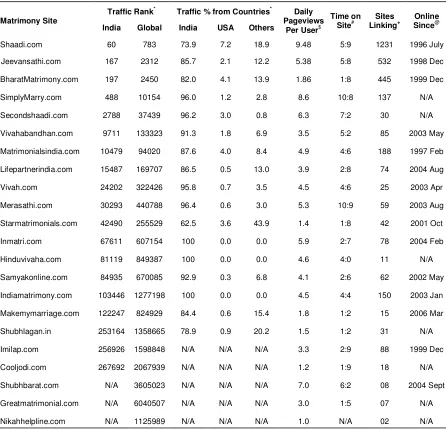
Table 1. Indian matrimony sites and their web-metrics (Source: Alexa.com Traffic Stats, December 4, 2009)
Matrimony Site
Traffic Rank* Traffic % from Countries* Daily Pageviews
Per User$
Time on Site#
Sites Linking+
Online Since@ India Global India USA Others
Shaadi.com 60 783 73.9 7.2 18.9 9.48 5:9 1231 1996 July
Jeevansathi.com 167 2312 85.7 2.1 12.2 5.38 5:8 532 1998 Dec
BharatMatrimony.com 197 2450 82.0 4.1 13.9 1.86 1:8 445 1999 Dec
SimplyMarry.com 488 10154 96.0 1.2 2.8 8.6 10:8 137 N/A
Secondshaadi.com 2788 37439 96.2 3.0 0.8 6.3 7:2 30 N/A
Vivahabandhan.com 9711 133323 91.3 1.8 6.9 3.5 5:2 85 2003 May
Matrimonialsindia.com 10479 94020 87.6 4.0 8.4 4.9 4:6 188 1997 Feb
Lifepartnerindia.com 15487 169707 86.5 0.5 13.0 3.9 2:8 74 2004 Aug
Vivah.com 24202 322426 95.8 0.7 3.5 4.5 4:6 25 2003 Apr
Merasathi.com 30293 440788 96.4 0.6 3.0 5.3 10:9 59 2003 Aug
Starmatrimonials.com 42490 255529 62.5 3.6 43.9 1.4 1:8 42 2001 Oct
Inmatri.com 67611 607154 100 0.0 0.0 5.9 2:7 78 2004 Feb
Hinduvivaha.com 81119 849387 100 0.0 0.0 4.6 4:0 11 N/A
Samyakonline.com 84935 670085 92.9 0.3 6.8 4.1 2:6 62 2002 May
Indiamatrimony.com 103446 1277198 100 0.0 0.0 4.5 4:4 150 2003 Jan
Makemymarriage.com 122247 824929 84.4 0.6 15.4 1.8 1:2 15 2006 Mar
Shubhlagan.in 253164 1358665 78.9 0.9 20.2 1.5 1:2 31 N/A
Imilap.com 256926 1598848 N/A N/A N/A 3.3 2:9 88 1999 Dec
Cooljodi.com 267692 2067939 N/A N/A N/A 1.2 1:9 18 N/A
Shubhbarat.com N/A 3605023 N/A N/A N/A 7.0 6:2 08 2004 Sept
Greatmatrimonial.com N/A 6040507 N/A N/A N/A 3.0 1:5 07 N/A
Nikahhelpline.com N/A 1125989 N/A N/A N/A 1.0 N/A 02 N/A
* Traffic Rank is a measure of website’s popularity. The rank is calculated using a combination of average daily visitors and page-views over the past 3 months. Traffic rank in a specific country can also be measured. Therefore, percentage of user comes from the countries to visit the site has stated.
$
Average numbers of unique pages viewed per user per day by the visitors to the site. Three months average has taken into account to determine the daily page-views per user.
+Sites linking meant for website’s reputation. The number of sites on the Internet linking to this site. Multiple links from the same site are only counted once.
#Daily average number of minutes per visit on the site and considered 90 days avg.
@
The date the domain was first registered.
- N/A = not available
prospective brides and grooms. Peoples of every sphere of the society have begun to observe its usefulness on various marital events. In India, online-matrimony market reveals 12 million users and gaining prominence during last few years (WATBlog.com). A recent study
Fig 1. Indian matrimony traffic comparison (Source: Alexa.com)
metro cities. In order to become more popular, Indian matrimony service providers are implementing newer matrimony tools to reap the benefits of web 2.0 technologies. Now members can share matrimonial information more comfortably in an interactive environment.
Matrimonial sites in india
Internet has become a universal source of information for millions of peoples. The growth of Internet usage seems incredibly fast. India had a total population of 1,156,897,766 people by the year 2009, out of which 81,000,000 people were using the Internet, which makes 7% penetration of the total population in India. Simply, user growth is increased by 1500% (in 2009) when compared to the Internet users (5,400,000 approx) of 2000 (Internet world stats, 2009). Now the country has 4.9% share of the total Internet users and ranked fourth in the world. This share comes around 11% in terms of Internet users from Asian countries. Again, matrimonial sites are now the 13th most popular mainstream online activity. Over 12 million Indians use online matrimony (WATBlog.com), which started with the hosting of shaadi.com (in 1996) and has now shifted to a new culture. Today, hundreds of matrimony sites have become operative in national and regional level to sustain the pressure of marriage information seekers. These sites provide interactive platform to communicate marriage related information. Potential users can choose any of the platforms, but they must evaluate these sites in terms of accessibility, cost, credibility, ease of use, functional tools, reliability, utility, visibility, presentation, etc. A list of
Indian matrimony sites along with their traffic ranks (indicates popularity), amount of links (reputation), daily page views, average stay on site and first registration date of the domain (site age) has been presented in Table-1. Few other sites just cross there infancy. Kolkata based media group Ananda Bazar Patrika (ABP) has explored possibilities of launching a matrimony portal, which is expected to offer extraordinary facilities, as said by Pramath Raj Sinha, MD & CEO of ABP (Mukherjee, 2007).
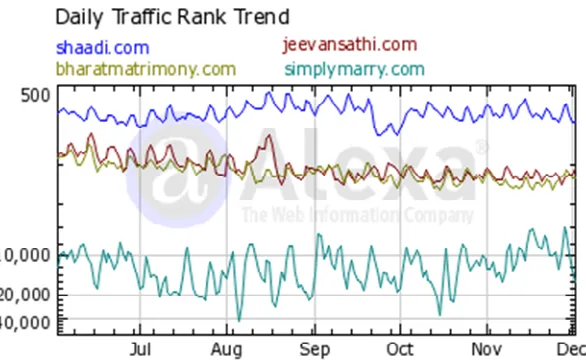
Let us have a close look at the daily traffic rank trends (a measure of website’s popularity) of these matrimony sites over a period of six month, as shown in Fig.1. Traffic rank is calculated using a combination of average daily visitors and page-views. The lesser the rank is of course better for a site in terms of popularity. Trend graph indicates daily traffic rank (charted over time), where shaadi.com leads currently and is quite consistent but simplymarry is having least popularity among these four. Jeevansathi and bharatmatrimony have almost similar trends (Alexa, 2009). Notably, shaadi seems to be the site receiving most page-views (9.48 pages) with optimum stay of visitors (5:9 minutes) on the site. Surprisingly, it has the largest NRI audience (26.1%) and maximum number of websites (1231) linking to this site. Jeevansathi beats Bharatmatrimony in terms of traffic rank (161), page-views, and number of users (85.7%) in the country. However, simplymarry site is commending over page-views (8.6 pages) and having maximum stay (10:8 minutes) on the site per visit. (Fig.1)
Fig 2. Major service portals in India
In no doubt, shaadi.com is a clear winner followed by jeevansathi, bharatmatrimony, simplymarry and others. Some of the popular matrimony sites of India featured in the Annexure-I. These sites are driving their focus more on newer technologies in order to increase the revenues. Such matrimony sites have revealed a completely new Indian culture in transforming matrimonial information.
Shaadi.Com
Shaadi.com, one of the India’s best-known brands and the world’s largest matrimonial service was founded by Anupam Mittal in 1996. The Peoples Interactive (I) Pvt Ltd company pioneered this online matrimonial with an objective to provide a superior matchmaking experience by expanding the opportunities available to meet potential life partners. It has established strong network deploying 400 employees across 250 centers in India and abroad. Shaadi.com has become most preferred matrimonial website for Indians and over 10 million members with 1.3 million matches founds available currently. A recent study has credited shaadi.com for being the most visited (by Ranking.com) and most user-friendly (by JuxtConsult) online matchmaking brand in India. Shaadi seems to be the site where registration is pretty simple, an array of regional options, and many other intelligent features (viz. smart search, astro search, shaadi messenger, voice SMS, shaadi ring tones) leads the way of matrimony services to diverse communities in India. However, the
superior technologies empowered by Matrimony 2.0 enables rich interface applications, improved algorithms, and nice privacy options to configure the user preferences. Superior services can be accomplished by e-Matchmaker, a sophisticated tool that runs automatically for potential compatibility and ensures higher degree of matrimonial success. This flagship brand is now on television (via Dish-TV) with the ShaadiActive service to find the perfect soulmate. It has to be noted that Star-Vivaah is an innovative matrimonial show and first of its’ kind on Indian Television solely organized by shaadi.com, happened every Monday to Friday at 2 PM only on STAR-Plus. Business Today magazine has recognized shaadi.com as one of the India’s top 10 marketers (Shaadi, 2009) (Fig.2).
Jeevansathi.Com
Contacts can be made through telephone, e-mail, online chat, and SMS. As per India Online 2008 Survey (conducted by JuxtConsult) Jeevansathi has gained 3% share of users to grow to 8% of the total market share. JeevanSathi.com has been doing really well and they get the sound traffic in India. Of course, there is scope for further improvement (Jeevansathi, 2009) (Fig.2).
BharatMatrimony.Com
It is one of the trusted matrimony portals in India since 1997, founded by Murugavel Janankiraman. This platform brings together all the young Indians living across the globe and provides comprehensive solution for marriage combining tradition and technology. It has setup a consortium of 15 regional portals across 22 states and over 100 major cities in India, thus committed to provide best class services with trust and confidence. BharatMatrimony has occupied an wide marketplace in India perhaps due to it’s community specific regional services in different fifteen languages viz. Bengali, Assamese, Gujrati, Hindi, Kannada, Malayalee, Marathi, Marwadi, Oriya, Parsi, Punjabi, Sindhi, Tamil, Telugu, and Urdu. This successful portal has found a place in the Limca Book of Records for facilitating a record number of marriages and about one crore verified profiles found available currently. It has been recognized as the best matrimony website in 2007 (as reported by PC World) and listed in the NASSCOM’s top 100 IT innovators. BharatMatrimony goes beyond matchmaking services by providing matrimony related services like wedding directory, pre-marital counseling, matrimony-xpress relationship blog as well as social initiatives like bharat eye-bank and blood-bank (Bharatmatrimony, 2009) (Fig.2).
SimplyMarry.Com
It is India’s premier matrimonial service portal, promoted by the Time of India group. SimplyMarry offers one stop platform for online matchmaking that allows prospective Indian brides and grooms to meet and communicate regarding matrimony. It uses the latest and most cutting edge technologies available in online environment to provide members with fast, relevant and best matching results in strict confidence. Despite the user-friendly interface and customer friendly tools, simplymarry has strict abuse prevention and reporting systems for the members accepted via screening system. However, the chat messenger having popup facility via chat-N-marry that enables contact instantly with online members those are approved for chat. Duration of membership varies from 3-12 months having multiple options via gold, diamond, and platinum or print-online combo packages By means of print advertisement in Times of India
newspaper. Benefits can be made through online chat, personal messages, profile links, text link in home page, highlighted profile in search results, and many others. This largest media and entertainment conglomerate has received a lot of criticism, but they are in a great position to be eventual leaders if they can utilize the newspaper matrimonial classifieds. (SimplyMarry, 2009) (Fig.2).
SecondShaadi.Com
It is highly focused matrimonial service exclusively for the individuals (divorced or widowed) seeking a new life through remarriage. Remarriage has always been a hidden and neglected issue in Indian society. This site attempts to eliminate all such biases and provides effective platform for individuals seeking contacts for remarriage. It has setup a strong network of like-minded peoples that allows in finding a perfect partner based on selected eighteen parameters. This remarriage service portal enables valuable features like online chat, discussion forum, counselling services, multiple photo upload, horoscope generation, etc. Duration of membership can be for fifteen days up to lifetime
depends on the fees paid by the member
(SecondShaadi, 2009).
LifepartnerIndia.Com
This is one of the best-in-class matrimonial services in India that provides multiple facilities for aspiring members of the country. Facilities include LPI account, personalized messages, saved searches, online chat, album creation, photo club, and many more. ‘eMatchFinder’ is an automated sophisticated tool for identifying best match based on partner expectations or preferences. Bold-listing highlights a profile with different background and bold texts, which gets special importance for perfect match. Privacy options are significant in this matrimony portal (LifepartnerIndia, 2009).
Vivah.Com
mission. Now it has strong network with trust among millions of peoples. This service portal is featured by secure email account using vivahmail, live conferencing, automatic blocking, privacy control, verified chat account, etc. (Vivah, 2009)
NikahHelpline.Com
This is widest Muslim matrimony in India. It brings a special focus on NRI/ NRPS worldwide and provids matrimonial services in different three languages viz. English, Arabic, and French. Primarily the profiles undergo for an approval and subsequently confirmed via email and phone call. Here registered members can avail many advance utilities like favorite watch, eNikahMaker notification, detailed profile statistics, wali supervision tool for women members, accept or decline interests, profile highlighting or hiding, etc. Favourite watch tool enable the members to become aware about the profiles favourite for them. Confirmed members can also have a look on the weekly report received by email using eNikahMaker notification tool. However, wali supervision is a great tool specially designed for women members to send a copy of all their correspondences to their ‘Wali’ in order to supervise the proposals. Wali is the represention or protecter or mediator or guardian for women seeking marriage. Notably, this service portal supports the members by extending prominent legal advises relating to their marriage in no cost (NikahHelpline, 2009).
CONCLUSION
Marriage information has always been an integral part of our society. Since last decade, matrimony service providers have been striving with stupendous efforts for the sustainable development of online marriage information systems and services in India. The impact of online matrimony so far has been encouraging. Four matrimony portals viz. shaadi, jeevansathi, bharatmatrimony, and simplymarry have been playing a significant role in satisfying the objectivity of marriage information seekers in the country. Matrimony service providers have started vigorous marketing efforts announcing the availability of reliable information against nominal fees. Even such agencies are now adopting user-orientation approach in disseminating marriage information via their portals. Reversibly online-matrimony has faced criticism with reference to adequacy and quality of information. Efficacy of an information system depends on the correct assessment of data requirements based on the demands made by individual users and on the methodologies adopted in the collection of data for dissemination (Nicholas, 1996). Therefore, information accumulation in any matrimonial database should be specified pertaining to the users consisting grooms and
brides of complementary nature, but not by the choice of service provider alone. Practically there would have some duplication of cost and effort in creating/accessing such databases unless there is a central coordinating agency to take care of these initiatives. Perhaps the complexity and vast diversity (racial, ethnic, cultural, and linguistic.) in Indian society creates a formidable hurdle towards developing a common platform for accessing the matrimonial information in an integrated manner.
Therefore, more attention needs to be taken to develop a comprehensive system in order to improve the reliability and coverage of matrimonial information. Joint initiative of matrimony service providers for building strong information network could bring a reasonable solution in providing effective marriage information services in India. Further assessment of matrimony sites in terms of visibility, relative importance as well as authenticity and commitment towards matrimonial information is always necessary. New policy initiatives should be taken care off in local, regional and national level. So web content analysis, web-metrics analysis, link analysis, cluster analysis, web impact factor (WIF), rich interface applications, improved search algorithms, web 2.0 compatibility, consortia based access mechanism would be a great frontier of marriage information research in the forcible future.
REFERENCES
Alexa – the web information company (2009)> Free web traffic metrics: traffic rank trends of Shaadi, BharatMatrimony, Jeevansathi, SimplyMarry sites, Available
at:http://www.alexa.com/siteinfo/shaadi.com+bharatmatrimony.com+je evansathi.com+simplymarry.com (accessed on 29th October 2009) Banglapedia – National Encyclopedia of Bangladesh (web version),
Asiatic Society of Bangladesh, © 2006, Available at: http://www.banglapedia.org/httpdocs/HT/G_0099.HTM (accessed on 12th June 2009).
BharatMatrimony.com (2009). Available at:
http://www.bharatmatrimony.com (accessed on 16th July 2009). Cronin B (1986). The information society, Aslib Proceedings, (38): 121-129.
Gangopadhyay B (1964).
Marriage regulations among certain castes of Bengal, Deccan College, Poona.
Henslin JM (1985). Marriage and family in a changing society (2nd ed.), Macmillan, New York.
India Wedding Planner, Types of Hindu marriages, Available at: http://www.indiaweddingplanner.com (accessed on 6th June 2009). India, Ministry of Information and Broadcasting (2009). India: a
reference annual, Govt. of India, New Delhi.
Internet World Stats (2009). Usage and population statistics – top 20 countries with highest number of Internet users, (©2009 Miniwatts Marketing Group) Available at:
http://www.internetworldstats.com/top20.htm (accessed on November 12, 2009).
Jeevansathi.com (2009). Available at: http://www.jeevansathi.com (accessed on 18th
July 2009).
JuxtConsult (2008). India online 2008 (main report), Available at: http://www.scribd.com/doc/18748302/JuxtConsult-India-Online-2008-Main-Report (accessed on 12th October 2009).
LifepartnerIndia (2009). Available at: http://www.lifepartnerindia.com (accessed on 24th October 2009)
Literature Review (1990). National information networks and systems in India: a review, World Patent Information, 12(4): 259.
Mahajan P (2009). Use of social networking in a linguistically and culturally rich India, The International Information & Library Review, 41(3): 129-136.
Mukherjee P (2007). ABP bets big on Internet business, Business Standard, Kolkata, March 30, 2007.
Nicholas D (1996). Information system vs information user, Managing Information, 3(6): 26, 31-33.
NikahHelpline.com (2009), Available at: http://www.nikahhelpline.com (accessed on 2nd October 2009)
Pal JK (2010). Social networks enabling matrimonial information services in India, 2(4): 54-64.
Reddy VNK (1978). Marriages in India: a psychosociological study, Academic Press, Gurgaon, New Delhi.
ReleaseMyAd – India’s simplest classified booking service for all leading Indian Newspapers, Indian Newspaper Society (INS), © (2007-2008). Available at: http://www.releasemyad.com (accessed on
16th
August 2009).
SecondShaadi.com (2009). Available at: http://www.secondshaadi.com
(accessed on 26th October 2009)
Shaadi.com, 2009, Available at: http://www.shaadi.com (accessed on 18th
July 2009).
Simkins MA (1983). The impact of new technology on the information processing, Aslib Proceedings, (35): 92-102.
SimplyMarry.com (2009). Available at: http://www.simplymarry.com (accessed on 21st August 2009).
Singer M, Cohn BS, (1968). Structure and change in Indian society, Aldine Pub, Chicago.
Singh DP (1980). Modern Indian society and culture, Meenakshi Prakashan, New Delhi.
Vidyasagara, Iswara C, (1976). Marriage of Hindu widows, K P Bagchi & Co., Calcutta.
Vivah.com (2009). Available at: http://www.vivah.com (accessed on 24th October 2009)
WATBlog.com, 2008, Online matrimony market statistics (message posted by Rajiv Dingra dated March 20, 2008), Available at: http://www.watblog.com/2008/03/20/online-matrimony-market-statistics-reveal-12-million-users (accessed on 12th October 2009). Westermarck E (1894). History of human marriage (2nd ed.), Macmillan,
ANNEXURE – I
(Quick Look on Popular Matrimony Portals in India)
Service Portal Membership plans & contact Special features and tools
- Free registration
- Platinum – INR 401 per month - Diamond – INR 551 per month - Gold – INR 734 per month Ph. 1860-500-3456 (Toll free)
- ISO 9001:2000 compliant - Live on chat & bold listing - Matrimony 2.0 enabled - ShaadiActive service
- e-Matchmaking tool - Shaadi Messanger - Free mobile service - Astro search facility
- Free registration. - Classic – INR 1990 for 3M - Classic Plus – INR 2590 for 3M - Classic Super- INR 2890 for 3M Ph. 1800-3000-1234(Toll free)
- Personal Matchmaker tool - Fast Track assistance - Accept/ decline interests - Personalized services
- Verified phone no’s - Horoscope matching
- Free registration
- eRishta – INR 1295 for 2M - eValue – INR 1700 for 2M Ph. 1800-419-6299 (Toll free)
- Online chat, Bold listing - Astro compatibility service - Expert profile writers
- Intelligent matching - Album creation, etc.
- Free registration - Gold – INR 1500 for 3M - Diamond – INR 2200 for 6M - Platinum – INR 3500 for 12M Ph. 1860-500-5500 (Local charge)
- Picture/featured profile link - Abuse prevention systems - Print & online combo pack - Highlighted search result
- Chat-n-Marry messenger - Text link on home page - SimplyMarryZine tool
- Free registration
- Bronze – INR 999 for 15 days - Silver – INR 1999 for 3M - Gold – INR 2999 for lifetime Ph. 012-4409-1157
- Remarriage portal - Horoscope matching - Counselling services - Online chat & SMS alerts
- Multiple photo upload - Discussion forum - Highlighted listing
- Free registration
- Premium – INR 750 for 3M - Premium – INR 1250 for 6M - Premium – INR 1950 for 12M Ph. 0-93410-41821 (10AM - 6PM)
- eMatchFinder tools enable - Personalized messages - Free LPI chat & video clip
- Free album creation - Bold listing facility
- Free registration
- Other options not traced
Ph. 022-3291-5044 (1 to 6 PM)
- Live video conferencing - Own e-mail service - Privacy control mechanism
- Verified phone/email ID - Auto-block facility
Free registration
Silver/ Gold – INR 1000 for 12M Not identified
- Muslim matrimonial service - Special focus on NRI/NRPs - eNikahMaker reporting tool