Doctor of Nursing Practice (DNP) Projects Theses, Dissertations, Capstones and Projects
Winter 12-13-2013
Improving Value Based Purchasing Through the
Implementation of the Clinical Nurse Leader Role:
The Chief Nursing Officer’s Case for Change
Leanne M. Hunstock
University of San Francisco, [email protected]
Follow this and additional works at:https://repository.usfca.edu/dnp Part of theNursing Administration Commons
This Project is brought to you for free and open access by the Theses, Dissertations, Capstones and Projects at USF Scholarship: a digital repository @ Gleeson Library | Geschke Center. It has been accepted for inclusion in Doctor of Nursing Practice (DNP) Projects by an authorized administrator of
USF Scholarship: a digital repository @ Gleeson Library | Geschke Center. For more information, please [email protected].
Recommended Citation
Hunstock, Leanne M., "Improving Value Based Purchasing Through the Implementation of the Clinical Nurse Leader Role: The Chief Nursing Officer’s Case for Change" (2013).Doctor of Nursing Practice (DNP) Projects. 21.
Improving Value Based Purchasing
Through the Implementation of the Clinical Nurse Leader Role:
The Chief Nursing Officer’s Case for Change
Leanne Hunstock, DNP (c), MA, MBA, RN, NEA-BC University of San Francisco
Committee Members
Table of Contents
SECTION I Title and Abstract
Title………..… 1
Abstract……… 4
SECTION II Introduction Background Knowledge..……… 6
Local Problem ……… 7
Intended Improvement and Purpose of Change……….…. 8
Review of the Evidence……….….… 11
Conceptual/Theoretical Framework……… 19
SECTION III Methods Ethical Issues ……….. 23
Setting……….. 24
Planning the Intervention………..…….. 27
Implementation of the Project……… 30
Planning the Study of the Implementation………. 30
Methods of Evaluation………..…….. 32
Analysis………...….. 32
SECTION IV Results Program Evaluation/ Outcomes………..….. 33
Relation to Other Evidence……….. 36
Barriers to Implementation /Limitations………..………... 37
Interpretation. ………. 37
Conclusions. ……… 38
SECTION VI Final Thoughts Financial ………..……….. 39
Funding ……….. 40
Value ……….. 40
SECTION VII References………. 42
Abstract
The healthcare industry is focused on the implementation of the Affordable Care Act, the payment reform package from Centers for Medicare and Medicaid Services and the
development of Accountable Care Organizations. The decisions, behaviors, and practices of medical and clinical staff directly impact patient care, quality, and subsequently cost and reimbursement. The imperative to balance quality and patient safety with cost effectiveness requires a complex orchestration of all the elements of care within the clinical microsystem. A priority is to support and enable bedside nurses’ daily practice, priorities, and decision-making. This can be accomplished through the implementation of the Clinical Nurse Leader. This Master’s prepared advanced generalist has been educated in healthcare reform and its impact on patient safety, quality, and the organization’s financial condition. An evidence-based business case will demonstrate the outcomes and a return on investment for the Clinical Nurse Leader role. The Chief Nursing Officer can employ transformational leadership skills to articulate the need and benefit of such a role, and influence an organization to invest in this valuable intervention.
Improving Value Based Purchasing Through the Implementation of the Clinical Nurse
Leader Role: The Chief Nursing Officer’s Case for Change
The healthcare industry in the midst of the most sweeping policy, reimbursement, and care delivery changes in history. In 2010, the Patient Portability and Affordable Care Act (ACA) identified new structures and mechanisms to reduce costs and increase quality. The shift by the Centers for Medicare and Medicaid Services (CMS) to incentive payments based on performance of quality and satisfaction outcomes have created even greater challenges for hospitals. Value Based Purchasing (VBP) was the first CMS program to render payment for services based on a hospital’s quality and patient satisfaction
performance. The intent of VBP is to incentivize organizations to deliver care through an integrated and coordinated system which would ultimately lower cost and increase quality as measured by performance on standard quality, satisfaction, and safety outcomes (Kaiser Family Foundation, 2013).
Background Knowledge
Healthcare reform has rewritten “the rules of the game” for healthcare in the United States (US). The new payment formulas based on performance expectations have created significant challenges for acute care hospitals as quality and patient satisfaction measures are now directly related to reimbursement. In 2013, 1% of each hospital’s Medicare payments were “taken back” and redistributed as incentive payments. Incentive payments were earned for improvement against a baseline period and the performance of other CMS hospitals between the 50th and 95th percentile nationally, based upon the Hospital
Consumer Assessment of Healthcare Providers and Systems (HCAHPS). For example, a hospital that did not meet the performance benchmarks in 2013 earned back only 0.2% of the withheld 1% incentive for a net reduction of 0.8%. Based on the CMS incentive
formula, the reduction will continue to increase up to 2% on HCAHPS and quality measures until 2017 (CMS, 2013b).
Every year the VBP performance bar will be raised. In 2013 ten previously tracked clinical quality measures were excluded because CMS concluded that these measures were “topped-out” signifying that nearly all hospitals have achieved a similar high level of performance. Thirteen new measures were selected. Concurrently, under payment reimbursements, fully integrated delivery systems are linking medical and institutional providers across all settings and service levels to manage the health of designated populations (CMS, 2013c).
national performance. According to the most recently published HCAHPS survey results of July 2013, California hospitals lag the nation in the “overall hospital rating” and
“recommend the hospital” rating. These were the two most important cumulative measures for impacting hospital VBP reimbursement under CMS (CMS, 2013d). The implementation of the ACA will emphasize cost and quality performance with the challenge of fewer
resources, decreasing inpatient volumes and revenues.
Nationally, individual and collective hospital performance has been monitored primarily at administrative levels. Due to the public availability of the quality and service performance data, a hospital can easily compare itself to any single hospital or group by consulting the CMS Hospital Compare Website (CMS 2012). This information has been accessible to the general public in a searchable website format and the data is normalized and updated at quarterly intervals. However, financial implications are not well understood by hospital staff. Most importantly, nurses and physicians need a clear understanding of the VBP and the impact of their practice on the hospitals’ performance.
Local Problem
It has been increasingly unacceptable for hospitals to perform poorly on both publicly reported clinical care process and HCAHPS measures. In 2013 CMS reimbursement changes became a reality, coupled with new clinical care measures,
CNOs from the hospitals in this project were interested in improving VBP scores. In particular, each of the hospitals’ HCAHPS performance created more pressure on the CNO and reflected negatively on nursing over the course of 2012 and 2013. CNOs reported that most measures had reached a plateau short of the benchmark, in spite of applying best practice interventions. Furthermore, CNOs felt the interventions lacked staff engagement and consistent follow through. They desired methods to engage and educate clinical nurses and managers in a participative understandable manner, consuming minimal time and resources.
Intended Improvement and Purpose of Change
Project evolution.
Initially, the project aim was to increase nurses’ knowledge about healthcare reform and to design an evidence-based resource bundle to improve performance on VBP metrics. The bundle was intended to be a collection and consolidation of applicable evidence-based practices (EBPs) to improve performance on VBP metrics. Evidenced-based toolkits and resources were becoming rapidly available in the literature and through professional sources and public agencies such as the Agency for Healthcare Research and Quality (AHRQ) (AHRQ, 2012). Through the process of developing this project, which included discussions with Doctorate of Nursing (DNP) students and CNOs, a critical theme emerged. The lack of a clinical mentor to identify, translate, and implement evidence-based knowledge into practice across multiple disciplines and in multiple settings became evident.
approaches to design, implement, and evaluate plans of care. The CNL is educationally prepared to provide quality, cost-effective care, to participate in the implementation of care in a variety of health care systems, and to assume a leadership role in managing fiscal and health care resources at the microsystem level. The role was also designed to facilitate the use of evidence-based interventions across care multiple settings and disciplines and break down silos through lateral integration of care processes to improve the financial and quality performance of an organization (AACN, 2007). Magg, Buccheri, Capella, and Jennings (2006) described the AACN’s concept of the CNL's preparation as being a joint venture between practice and education.
Through the course of the project, the focus of the project shifted from the VBP evidence-based toolkit content to the mechanism to bring knowledge to the point of care through the CNL role. At this point, the aim broadened from the education of the CNL to supporting the CNO’s broader leadership and practice strategy. Implementing the CNL role could enable the CNO to produce multiple integrated outcomes around quality, service, and economics and achieve success in a pay for performance environment. Although the role existed since 2007 (AACN, 2007) it has not been widely adopted. The question loomed, “Why wasn’t the CNL role more prevalent in the hospital setting?”
Although evidence of the CNL’s impact on quality and patient safety existed,
Intended improvement.
Hospitals have been searching for ways to connect clinicians to the financial and quality performance of the organization. The majority of the levers required for achieving and sustaining performance on VBP’s quality of care measures fall into the scope and accountability of the CNO. The CNO’s leadership imperative is to ensure that care is coordinated and quality and safety are achieved in a manner that contributes to the overall success of the organization. To do so requires the integration of medical and nursing practice with systems that support and facilitate safe and efficacious patient care delivery.
The introduction of CNLs into the clinical care team should be considered to accelerate and sustain this goal. The CNL is able to educate clinical nurses about the implications of healthcare reform, VBP and outcome based reimbursement. Building upon the clinical nurse’s understanding of healthcare reform, the CNL will impact care outcomes by translating clinical evidence into practice.
The purpose of the change.
activities, and the VBP presentation. The second component was an evidence-based business case for use by CNOs to propose the integration of the CNL role into their care delivery model to facilitate and sustain performance improvement.
There were two tests of change (TOC). A TOC supported each component of the bundle. The first TOC addressed the question: Will the class and VBP presentation effectively educate both graduate nursing students and hospital-based practicing RNs? A team approach for identifying an EBP change to improve quality performance was included in the VBP presentation for use by any group. The framework followed the Plan-Do-Study-Act (PDSA) rapid improvement cycle approach.
The second TOC evolved after initial interview meetings with the practicing CNOs. After discussion of the educational module and its applicability for the CNL in their
organizations, they shared that they did not have the role in their care delivery model but were interested if a justification could be articulated for proposal to the Board of Directors. Therefore, the second TOC was: Would the CNO use a sample evidence-based case
template to secure financial approval for a CNL pilot program?
Review of the Evidence
The project focus was improving performance of VBP elements through the CNL role and leveraging the transformational leadership skills of the CNO to make the case to the organization to implement the role. These areas were the focus of the evidence and
literature reviews.
The evidence supporting the impact of the CNL.
with the daily practice of the CNL. Understanding of VBP is critical to informing the nurses’ daily practice, priorities and decision-making in the hospital setting. Decisions made on a daily basis will impact outcomes of care and the hospital’s financial position. Establishing the value of the CNL role in this process is important and required a systematic review and rigorous search methodology to minimize bias. The process outlined by
Bettany-Saltikov (2010) was used as a guide for a systematic review.
An evidence question was formulated using the population, intervention,
comparative intervention, outcomes components, and time (PICOT) (Melnyk and Fineout-Overholt, 2011). The PICOT was as follows:
P = clinical nurse leader; I = role integration into the acute care microsystem; C = the acute care microsystem without CNL(s); O = patient quality outcomes, safety,
patient satisfaction, and return on investment; T = 2007-2013.
The search question was: What has been the impact of the CNL role in the acute care microsystem as measured by patient quality outcomes, safety, satisfaction and return on investment? Key words were: clinical nurse leader, CNL role implementation, quality, patient satisfaction, outcomes, patient safety, clinical microsystem, study, review,
evaluation, evidence, and return on investment. A search was conducted using CINAHL, Fusion and Cochrane library. Limiters were English peer reviewed nursing journals
Evidence of the impact of the CNL role on quality, patient safety, satisfaction and cost reduction produced positive findings, supported intuitive knowledge and demonstrated a strong return on investment (Porter-O'Grady, Clark, & Wiggins, 2010). Bender, Connelly, Glaser, and Brown (2012) demonstrated the positive impact of the CNL on patient
satisfaction, pre and post implementation of the role. A short interrupted time series design was used to measure patient satisfaction in multiple aspects of care 10 months before and 12 months after integration of the CNL role on a progressive care unit, compared with a control unit. Data were obtained from standardized patient satisfaction surveys and an analysis was completed for short time series data streams. Improvement was seen between the pre and post implementation time periods for the unit with the CNL while the control unit remained unchanged for both time periods (Bender, Connelly, Glaser, & Brown, 2012).
The Veterans Administration Medical Centers (VAMC) conducted a qualitative study following the implementation of the CNL role within the VAMC system. The data suggested that the CNL role positively affected the RN hours per patient day and quality indicators. Quality indicators that demonstrated improvements were a reduction in: (a) GI case cancellations, (b) sitter usage, (c) pressure ulcers, and (d) ventilator assisted
pneumonia. Additional findings were increases in: (a) restorative dining, (b) discharge teaching compliance, (c) patient satisfaction, and (d) innovation. The authors noted that integration of the role across all practice areas had potential to streamline and coordinate care (Ott et al., 2009).
Stanley et al. (2008) conducted a qualitative study using three case studies that
development of lateral team relationships, and patient relationships. Pre and post implementation outcome data were collected on: (a) clinical quality core measures, (b) patient satisfaction, (c) physician satisfaction, (e) customer loyalty, (f) employee engagement, (g) turnover, (f) vacancy rates, and (g) length of stay for their units. Improvement was seen in every indicator in each setting for the period compared to the immediate prior period. Although the authors could not conclude a direct relationship between the CNL role implementation and the changes in outcomes measures, there was a significant cost savings in very short periods of time and similar quality and outcomes have been reported across the country (Stanley et al., 2008).
Tachibana and Nelson-Peterson’s (2007) case study describing Virginia Mason’s implementation of the CNL role focused on the management of a complex patient population in the acute care setting. Benefits of reduced length of stay (7%), better
continuity and coordination, and higher patient satisfaction were reported for the population. In addition to the benefits above, the authors asserted that the CNL role successfully
addressed the gap for patients with complex care needs by providing a graduate level nurse who could articulate the plan of care across shifts and disciplines, improve patient outcomes and satisfaction, and provide resources and expertise to patients and staff (Tachibana & Nelson-Peterson, 2007).
demonstrated consistently across various patient populations. Cost savings in excess of $2.5 million were documented demonstrating CNLs’ attention to fiscal stewardship. For
example, over $793,000 was saved in one year on the prevention of catheter-associated blood stream infections, reduction of pressure ulcers, and avoiding the need for higher level of care in pediatric patients (Wilson et al., 2012).
Analysis of pre and post implementation scores on VBP measures can demonstrate a return on investment of the CNL role. Quantification of the value of the CNL can be
accomplished using an accepted method for identifying the cost of various clinical conditions and adverse events. Spetz, Brown, Aydin, and Donaldson (2013) illustrated a framework for costs analysis using AHRQ’s Quality Indicators Toolkit. Based on data from the Collaborative Alliance for Nursing Outcomes (CALNOC) the researchers quantified the monetary value of the cost of care and savings as a result of reducing hospital acquired pressure ulcers (Spetz, Brown, Aydin, & Donaldson, 2013).
The CNL’s impact on quality and safety has created increasing interest in
The degree of successful integration of the CNL into the clinical microsystem had a bearing on outcome performance. Moore and Leahy (2012) and Wilson et al. (2013) studied CNLs’ perceptions of their introduction into a hospital setting. These qualitative studies indicated that the CNO support and positioning was a critical element of the success or failure in the implementation of the CNLs’ role (Moore & Leahy, 2012; Wilson et al., 2013). Studies of barriers to success also indicated a lack of: (a) understanding about the role
throughout the organization, (b) an organized and systematic entry process, and (c) visible support from the CNO and nursing leadership (Bender et al., 2011; Bombard et al., 2010; Kitson et al., 2011).
Transformational leadership.
The second area of evidence centered on transformational leadership and the CNO. The CNO is required to plan, position, sell and support the new CNL role in the
organization. A literature search was also conducted on the topic. The PICOT was as follows:
P = Chief Nursing Officer; I = transformational leadership; C = the inability of the CNO to effect change; O = patient quality outcomes, safety patient satisfaction, and return on investment; T = 2008-2013.
relevant to the topic were critically appraised and entered into an evidence table (see Appendix C).
Bass and Avolio (1993) compared and contrasted transformational and transactional leadership styles and their impact on the organization. They asserted that organizations should move more toward transformational behaviors of influence, inspirational motivation, intellectual stimulation and individualized consideration in order to move the organization forward (Bass & Avolio, 1993).
A Meta analysis conducted by Yuki (2012) proposed a hierarchy of transformational leadership traits grouped into four categories: (a) task-oriented, (b) relations-oriented, (c) change-oriented, and (d) external behaviors. Bass and Bass (2008) explained three transformational leadership competencies with associated traits. The competencies are comprised of cognitive, social, and emotional competence. All competencies are positively supported by biophysical and character traits. In contrast, leadership effectiveness is negatively impacted by traits such as:(a) arrogance, (b) depression, (c) anxiety, (d) rigidity, and (e) lack of self-confidence, self-esteem, and self-efficacy (Bass, & Bass, 2008). The effective CNO must exhibit the positive competencies and behavior as evidenced in the transformational leader.
is able to develop a vision, and inspire others to commit to a shared vision and goals for an organization or unit, while challenging them to be innovative.
The ANCC’s Magnet Recognition Program (2008) described five components. First and foremost was transformational leadership. The ANCC asserts that in contrast to leading people where they want to go, the transformational leader must lead people where the need to go and be, in order to meet the demands of the future. Vision, influence, clinical
knowledge and expertise in relating to a professional practice are imperative. However, the CNO must understand that transformation may create turbulence and require atypical approaches. The transformational leader will enlighten the organization and stakeholders as to the need for change, then clarify and articulate each participant’s role in achieving
change. Along the way the leader must listen, challenge, influence, and affirm until the change takes root and the organization enlists and adapts (ANCC, 2008).
Clavelle, Drenkard, Tullai-McGuiness, and Fitzpatrick (2012) surveyed 384 CNOs of ANCC Magnet recognized hospitals. They found that as CNOs grew older and gained more experience they demonstrated an increase in transformational leadership attributes. They concluded that organizations should value and retain CNOs while supporting their advancement and development (Clavelle, Drenkard, Tullai-McGuiness, & Fitzpatrick, 2012).
Transformational leadership in nursing is a universal concept and more valued as leaders mature. A study conducted of Chinese nursing administrators in Director of Nursing (DON) and Chief Operating Officer (COO) roles gauged the importance of role
graduate education but more experience in their current role than the COOs. Both groups perceived structural empowerment to be important, however the DONs placed significantly greater importance on transformational leadership (Spicer et al., 2011).
Conceptual and Theoretical Frameworks
Several related theoretical and conceptual and frameworks informed this project: (a) transformational leadership theory, (b) the EBP model using the Plan-Do-Study-Act (PDSA) change model, and (c) a conceptual framework for CNL education.
Transformational leadership.
Transformational leadership is a management and communication style that can assist the CNO may to introduce new and innovative strategies to solve the most challenging situations and garner stakeholder support. The transformational CNO is aspirational and inspirational, creating and articulating a shared vision of goals and outcomes while using a transactional style to get things done. The CNO conducts himself/herself as a visible, present, genuine, and authentic leader with a style that personally inspires a team to remain focused and motivated while meeting challenges.
As performance expectations continue to rise, the CNO’s reliance on
transformational leadership skills increases. These skills enable the CNO to orchestrate, motivate, inspire, and challenge the organization with increasingly more complex
strategies to drive processes, using data and evidence to support the strategies. Ultimately, the successful CNO translates the strategies into tactics that stakeholders can harness.
Evidence-based practice.
The EBP model provides an approach for the improvement of patient care quality and safety outcomes. EBP is widely known to reduce morbidities, mortality, medical errors, and variation. However, clinicians do not consistently utilize it in healthcare systems across the US (Melnyk, Fineout-Overholt, Gallagher-Ford, & Kaplan, 2012).
A study of 1051 RNs, conducted by Melnyk et al., (2012) found that although nurses believe in EBP they had a lack of knowledge and skills. EBP was perceived to be
burdensome, time consuming, and not supported by the organizational culture. Factors found to facilitate EBP were: (a) strong beliefs that EBP improves care, (b) access to mentors, and (c) a supportive culture (Melnyk et al., 2012).
Given the chasm between theory and practice, a simple but effective performance improvement and change model was helpful and recommended. Johns Hopkins Nursing and the Institute for Healthcare Improvement (IHI) (2011) recommended the use of PDSA as the framework for working with clinicians to improve processes and accelerate change in conjunction with EBP (Newhouse, Dearholt, & Galleger-Ford, 2007; White & Poe, 2010; IHI, 2011).
complex levels of the problem (Seidl & Newhouse, 2012).
The PDSA framework has been very effective in managing iterative improvement and practice changes as part of an EBP project. The PDSA process builds on participation and empowerment strategies to engage teams. As a rapid cycle improvement model, it is effective with clinical staff and physicians who have: (a) limited time, (b) a high degree of investment in the interventions and the outcomes, and (c) considerable firsthand knowledge of the processes needing improvement (White & Poe, 2010).
The CNL role is a fundamental link to evidence-based knowledge and subsequent change in practice at the point of care. As a lateral integrator in the care delivery model, the CNL relies on educational preparation in EBP to interpret and spread knowledge in order to change practice. The EBP process enables the CNL to evaluate research and profound knowledge, with an understanding of patient preference, to create and implement
individualized nursing interventions (Magg et al., 2006). This patient-centered approach positively impacts quality and satisfaction outcomes.
Conceptual framework for CNL education.
Schumaker, 2000). The second was the Symptom Management Model (SMM), an evidenced-based framework capitalizing on the view of system interrelatedness (Dodd, 2001).
Leadership is a cornerstone and core competence of the CNL educational framework. The middle tier integrates the constructs of knowledge elements, nursing leadership and clinical outcomes management. At this level the CNL integrates clinical knowledge and leadership skills to implement EBP and influence clinical teams. The top tier is concerned with self–regulated learning and the interdependence of the elements of active learning, reflection and EBP. As an accountable and enthusiastic learner, the CNL actively plans, manages and assesses his/her own learning behaviors (Magg et al. 2006).
The CNL has an important role in care transformation by providing leadership in the clinical microsystem using personal knowledge and skills to advance practice and outcomes. The CNL works across all settings to provide oversight, judgment, and intervention in the planning and delivery of care. In this process the CNL is relying on a framework of leadership and EBP. Through modeling, directing, and enlistment, the CNL influences others constructively and ultimately patient care (Magg et al., 2006).
The three tiers are reflected in the educational module via the integration of information about VBP, evidenced-based interventions, and using personal leadership to teach, influence, model, and translate knowledge into practice through a self-directed and self-learning approach.
Methods
satisfaction with the hospital experience. Targeted groups were (a) DNP students, (b) CNL and Master’s of Science in Nursing (MSN) students, (d) hospital-based CNLs, educators,
and administrative nurse leaders; and (g) CNOs.
Each component was presented to and reviewed by the appropriate audience for relevancy and applicability. The reviewers, by virtue of their role, were considered qualified to evaluate the contents of each component for its applicability in their practice. The
implementation of the tools occurred in two rounds or cycles. The first round of evaluation covered the content for the education module components (class and presentation) by DNP students and USF nursing faculty and CNL/MSN students. The initial results of the reviews were positive overall and suggestions for modification were incorporated into subsequent versions and reviewed by the second round reviewers. The second round reviewers included hospital-based (a) clinical nurses, (b) administrative nurse leaders, and (c) CNOs.
Ethical issues
were able to participate in the evaluation process on the bundle and their feedback was incorporated into revisions.
Setting
The project provided an education module for CNL students intending to practice in the hospital setting in a position to influence clinicians at the point of care. The information focused on hospital-based payment programs under the ACA and healthcare reform
implementation.
The physical setting spanned three California acute care hospitals in large urban areas and two graduate nursing finance classes at USF. One hospital was a faith-based, not for profit, tertiary teaching hospital within a five-hospital health system. The second hospital was a tertiary acute care facility in a large national hospital system. The third hospital was a tertiary single hospital with a diverse patient population and staff. All of the CNOs had doctoral degrees. Two of the three hospitals were unionized.
Each CNO had responsibility for the improvement of quality measures in VBP. The hospitals put focused efforts into increasing the performance of both the clinical process of care and patient experience measures. Each performed better on the clinical process of care measures after employing evidenced based processes and best practices. Although steady progress had been made on quality and clinical process measures, the patient experience scores continued to lag indicating that interventions had reached their maximum benefit and subsequently plateaued.
loss avoidance. CNLs’ preparation for complex patient management, care coordination across disciplines and settings effect quality and patient satisfaction and make this intervention worthy of strong consideration.
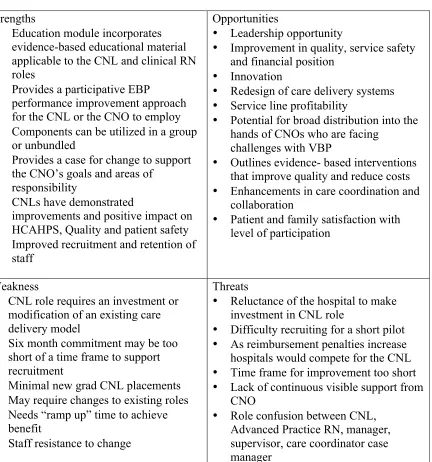
Table 1
Strengths, weaknesses, opportunities and threats (SWOT)
Strengths
• Education module incorporates
evidence-based educational material applicable to the CNL and clinical RN roles
• Provides a participative EBP
performance improvement approach for the CNL or the CNO to employ
• Components can be utilized in a group
or unbundled
• Provides a case for change to support
the CNO’s goals and areas of responsibility
• CNLs have demonstrated
improvements and positive impact on HCAHPS, Quality and patient safety
• Improved recruitment and retention of
staff
Opportunities
• Leadership opportunity
• Improvement in quality, service safety
and financial position
• Innovation
• Redesign of care delivery systems • Service line profitability
• Potential for broad distribution into the
hands of CNOs who are facing challenges with VBP
• Outlines evidence- based interventions
that improve quality and reduce costs
• Enhancements in care coordination and
collaboration
• Patient and family satisfaction with
level of participation
Weakness
• CNL role requires an investment or
modification of an existing care delivery model
• Six month commitment may be too
short of a time frame to support recruitment
• Minimal new grad CNL placements • May require changes to existing roles • Needs “ramp up” time to achieve
benefit
• Staff resistance to change
Threats
• Reluctance of the hospital to make
investment in CNL role
• Difficulty recruiting for a short pilot • As reimbursement penalties increase
hospitals would compete for the CNL
• Time frame for improvement too short • Lack of continuous visible support from
CNO
• Role confusion between CNL,
Advanced Practice RN, manager, supervisor, care coordinator case manager
A SWOT analysis for the CNL pilot program is also included in A Sample Evidence-Based Case for Clinical Nurse Leader Pilot in the appendices (see sample business case in
Planning the Intervention
The project implementation was divided into sequential components. As a performance improvement project, the PDSA cycle was used as the overall framework for the
improvements i.e., the education module and the business case for the CNL pilot program. The work plan activities included:
Plan:
• Collection of evidence for expert feedback and guidance • Design of the Bundle
Do:
• Implementation of the bundle
Study:
• Evaluation the bundle
Act:
• Modification of the bundle based on evaluation data • Dissemination of information
Educational module.
The educational module was designed to enable the CNL to understand and spread the knowledge on VBP within the practice setting using an EBP framework and the PDSA improvement process. The AACN’s objectives and competencies for the CNL role and curriculum design for the graduate nurse were reviewed. This framework guided the design of the education module incorporating a variety of means to understand the health reform and VBP. The module’s self-learning activities promoted the sourcing of evidence-based patient care interventions. Applicable course objectives were identified in the syllabus for USF N629, the Financial Resource Management Clinical Nurse Leader that were consistent with AACN learning objectives. The course objectives were to assess the flow of financial resources in nursing microsystems from changes to reimbursement and apply evidence-based practice to support the cost-effectiveness of nursing interventions (Maxworthy, 2012).
The educational module contents covered a flexible one to four-hour class including a syllabus, learning objectives, a presentation and PI process. Class materials were designed to begin with a brief overview of healthcare financing models focusing on the role of the US government and implications of the ACA. The material was evidence-based and future-focused; presented in the context of the interdependency of quality, cost, and the patient’s experience. A structured learning activity focused on the practical application of the content for the CNL role. A sample of evidence-based tools and interventions were included. The class contained Internet links to evidence-based resources, strategies, tools, and tactics for
raising performance on the VBP measures as a resource for use in the practice setting (see
The CNO’s case for change/business case for CNL role.
The CNOs confirmed findings in the literature relating that the use of CNLs in the hospital was absent due to lack of understanding and funding. Porter O’Grady et al. (2010) asserted that CNOs have had difficulty articulating, in consistent terms, the CNL’s
contribution to patient care, improved outcomes, and ROI. Furthermore, the CNL needs to be part of a change in delivery of care or practice model rather than be perceived as another layer or added cost (Porter O’Grady et al., 2010). The 2011 report on the Future of Nursing notes that the ACA provides opportunities for demonstration projects and pilot programs that could concurrently impact nursing elements but also patient safety and quality (IOM, 2011).
Porter O’Grady et al. (2010) recommended a selling process using stories, messaging terms and special language in the articulation of the CNL role and benefit to the
organization. Furthermore, it would be beneficial to the use a framework that reflects today’s realities to justify the development of the role. Points to cover would be: (a) the CNL role, (b) the ideal recruit, and (c) how the CNL contributes to improvements in quality, safety, patient satisfaction; (d) expertise, (e) cost and avoidance, and (f) nurse mentorship and retention (Porter O’Grady et al., 2010). A business case containing evidence of an ROI and quality improvement that the CNO could articulate in terms of the value proposition was needed.
existing indicators over the pilot year, measured quarterly and analyzed in comparison to performance of baseline or to the prior quarter. The evidence demonstrates that the CNL pilot could be self-funded through cost avoidance; savings and revenue enhancement due to improvements in care outcomes, patient satisfaction, and reduced length of stay.
The CNO’s case for change provided a sample business case for the approval and implementation of a CNL pilot program. The CNL proposal included the case for change, supporting evidence, analysis, budget, ROI and measures of success. A sample evidence-based case for a clinical nurse leader pilot was developed for CNO customization (see sample business case in Appendix G).
Implementation of the Project
In-person presentations of the educational module were delivered to all participants
by the author, a USF faculty member, or a CNO. The implementation of the project
encompassed the design, presentation, and expert evaluation of the bundled resources and tools. Three practicing CNOs received a copy of the educational module and the business case for the implementation of the CNL for their use and review. One CNO presented the
module to their nursing leadership team. USF professors also used the educational module
in nursing finance classes. These requests speak to the implementation of the material in the
classroom and hospital settings to nurses at all levels and its ease of presentation. Following
their review of all materials participants were requested to participate in an online
anonymous survey to evaluate the education module.
Planning the Study of the Intervention
and the CNO case for change for CNL implementation was evaluated by three practicing CNOs. A Gantt chart was developed as part of the CNL sample business case and described the one-year timeline of the CNL pilot program can be found in the appendices (see sample
business case in Appendix G).
CNL pilot cost benefit analysis.
The primary cost of the interventions is for education and the cost of employing CNLs in the hospital. The detail of a budget, which included education and employment, costs for CNLs and supervision and support time over the course of the pilot are detailed. The proposal also outlines the financial benefits and the ROI required to gain support from a Chief Financial Officer. The ROI ranges from breakeven to 8.6:1 based on a $300,000 investment and expense over the course of a year. The program would at least self-fund at 100% in the worst-case scenario. The cost benefit and return on investment of this project are illustrated in the sample scenario of the Sample Evidence-Based business Case for a Clinical Nurse Leader Pilot in the appendices (see sample business case in Appendix G).
Experts in each respective area evaluated components of the bundle. The questions answered were:
• Does the education module contribute to the educational preparation of the CNL? • Does the content contribute to understanding the objectives of the ACA, VBP
and the components that affect hospital practice settings?
• Will the CNL/MSN student understand VBP’s implication for practice?
• Could the educational module be used to increase knowledge and understanding
of the topic?
• Was the premise clear?
• Were the basic assumptions evidence-based? • Was the case for action persuasive?
• Did the case change your position on implementation of CNLs into your
hospital?
• Would the case persuade your Executive Team or Board of Directors? • Do you see the CNL role as part of a care delivery/practice model change? Methods of Evaluation
Online surveys were created for three target audiences: (a) DNP students and faculty, (b) CNL/MSN students, and (c) practicing CNOs. Survey participation was voluntary. Forty RNs participated in the class. Twenty-nine participants were invited to participate in an online survey and all did so. Seven DNP students, three USF faculty members, sixteen CNL/MSN students, and three practicing CNOs responded to the online survey. Eleven hospital-based nursing administrative leaders gave verbal feedback to their CNO, because the education was provided by the CNO who completed the online survey.
Analysis
open-ended questions in the CNO questionnaire. Tabulated survey results are available in the appendices (see evaluation results in Appendices H, I, J and K).
Results
Program Evaluation/Outcomes
The settings spanned the USF CNL/MSN course N629 Financial Resource
Management, the USF DNP course N764 Advanced Financial Management and three acute care hospital settings described in earlier. As noted earlier, the initial plan was to contribute to the educational preparation of the CNL by developing an education module for CNLs that could transfer to the practice setting. Through this development and feedback from CNOs, the aim grew from the education of the CNL and use of the CNL to apply evidence–based interventions to supporting the CNO’s broader leadership and practice strategy to improve outcomes for quality, service, and economics. The improvement plan evolved over the course of an iterative PDSA cycle in the design of the educational module.
The change in improvement plan required the two main components of the project to be implemented sequentially. The education module was designed, delivered and evaluated iteratively, soliciting feedback through the evaluation survey after delivery in each setting. Modifications were suggested through each groups’ rounds of feedback. The overall evaluation of the education module was measured at the 90% - 100% range of overall score out of a possible 100%. The average break down by group and topic was:
Educational Module:
• DNP students and faculty: 97.6% • CNOs: 96.8%
CNL Business Case:
• CNOs: 98.4%
The break down of comment themes by group and topic was:
Education Module:
DNP students and faculty:
• Well done
• Excellent presentation • Modify slide density
• HCAHPS focus on same challenge in responders hospital CNL/MSN students:
• No comments CNOs:
• Well done
• Like the interactive links to resources CNO Review of the CNL Business Case:
• Well done • Educational
• Need selling strategy – case for change • ROI helpful for justification
Further improvements to the deliverables for consideration are an expansion of the educational module to include a more online links on the change process and EBP.
of transformational leadership skills and strategies would lay the groundwork in the organization to integrate the CNL into the care delivery model.
Discussion
Summary
Key difficulties of implementation came midway through the project causing a shift in focus and expansion of the aim, content and deliverables. These changes required new directions in terms of the topics, deliverables, and consideration of the targeted participants. A key finding was that the CNOs wanted a business case that proposed integrating CNLs into their care delivery models. The addition of the CNL business case to the project objectives placed a higher than anticipated emphasis on the CNOs’ input, validation and leadership requirements. The business case for the CNL pilot was met with a positive response from the CNOs.
Transformational leaders create environments for innovation, foster continuous improvement and inquiry, support knowledge development and translate that knowledge into the practice setting White and Poe (2010). The second component of the bundle enables the CNO to articulate, position, justify, and lead a new care model that is evidenced to not only improve quality, safety, and patient satisfaction but also fund itself while
improving the financial status of the hospital.
Although the employment changes of two of the three participating CNOs prior to their proposals for the CNL pilot in their organization limited the testing of the business case to one CNO and one hospital. A business case was put forward by the third CNO and plans are under consideration to include a pilot in the next fiscal year budget.
Relation to Other Evidence
Evidence was sought to gain a full understanding regarding how the CNL role was being implemented across the country and the benefits to increasing quality and lowering costs. None of the hospitals participating in this project had implemented the CNL role or a similar scope under a different title. The main barrier expressed by the CNOs in this project was the need for an articulated value proposition that could be provided to an organization to fund such roles. With hospitals’ focus on expenses to balance changing reimbursement, most of the indirect nursing roles have been eliminated.
knowledge and expertise in a specialty area of clinical practice while the CNL focuses on care coordination, quality, and safety outside of a particular area of clinical practice. The CNS functions primarily at the mesosystem and macrosystem levels. The CNL practices primarily at the microsystem level of care in any type of health-care setting. The CNS focuses on issues across the system and supports the CNL in overseeing patient care and identifying gaps in staff expertise at the unit level (Harris, Stanley, & Rosseter, 2011).
Barriers to Implementation/Limitations
The noted barriers to implementation of both the educational module by the CNL and the CNL pilot program are: (a) the degree to which the CNO is convinced of the intervention, (b) the strength of the evidence, (c) the confidence in the projected return on investment, and (d) the amount of power and influence the CNO enjoys within the
organization. The educational module is limited in terms of the timeliness of the
information. Information will require updating within one to two years as the actual VBP metrics and HCAHPS change or the benchmarks are modified by CMS.
Due to constraints in many hospitals’ ability to implement the role as a supplement to the clinical nurse assignment, some considerations exist. Initially, the CNL role can be reserved for those patients whose complex course of care challenges the organization’s quality, safety, and financial performance. Positioning the role as a focused interventionist will provide the opportunity to demonstrate the value in the most difficult intractable conditions thereby solidifying the role’s value and future while making it more affordable.
Interpretation
enhancement of the material or the content was on target and capitalized on early feedback about the materials. The lack of narrative responses from the CNL/MSN is difficult to interpret because the scores are still high. Students represented an acceptance of the material as helpful on the concepts. Real time feedback during class presentation was positive and prompted lively discussion. The scores were clustered at the high end of the scale averaging 4.5 on a 5-point scale. More divergence between the scores was expected. A broader range of responses was expected. Perhaps the material was ready for primetime use. The participants appreciated the content outline with the Internet links and were very complimentary about the presentation.
There was less enthusiasm about the PDSA Tune Up process. It could be used in a participative manner to design, test, and implement team supported interventions to address gaps in performance. This particular area needs more explanation and time or perhaps more examples or an actual video example of the process. The educational modules and materials are best delivered over a four hour period to allow adequate time to work through an
example of the process with evidence- based change example.
Conclusions
Based upon the response from the participants both components of the bundle were useful. The educational module alone has been and could be delivered in a lecture format in one-hour class aimed at both CNL/MSN students in the classroom setting and practicing nurse leaders, clinical nurses or other clinicians.
practitioners will, in large part, influence the outcome of that pay and the financial viability of the organization. This major disruptive intervention to the industry is a “game changer”. Many healthcare leaders will need to shift in their relationship with nurses and providers who are now in powerful positions in the organizational dynamics. Hierarchical leadership styles will become less effective and more inspirational and collaborative management styles will prevail. The transformational CNOs will be recognized for their ability to plan, position, sell, and orchestrate complex organizational systems that produce economic value through high quality, safe, evidence-based care. They will lead organizations to successful performance with an educated and committed workforce. Organizations that have placed profit before patient quality or managed in a top down unilateral style will need to enlist and engage the employees in a partnership. Nurses will truly have the opportunity to change how care is delivered from the bedside. Improvements will flow from the microsystem to the mesosystem and macrosystem in a simultaneous, multidirectional, networked fashion.
Final Thoughts
Financial
Funding
The costs to fund the implementation and evaluation of the project were budgeted at $1,000.00 to cover general expenditures and travel expenses to deliver the class to the CNL students and meet with CNOs in person. The final costs were $1,690.00 due to change in transportation costs and for additional meetings with CNOs. The author provided all funding. The participating organizations did not incur any additional cost to their operations. The final cost is outlined in (see project budget in Appendix L).
Value
The high value deliverable for this project is the articulation of a strong business case and ROI to support the implementation of the hospital-based CNL role. Although not an initial objective, it was developed after CNOs expressed the desire for an intervention to build a sustainable mechanism to provide high quality, safe patient care. The CNOs sought a method to achieve performance metrics, preserve quality and actually demonstrate
improvement in practice that translated to financial, quality and satisfaction benefits. It became clear that the business case could be of benefit to many CNOs and as it was packaged, could be marketed directly to CNOs through professional organizations and conferences. It is original in design, using evidence-based outcomes supported in the literature and demonstrating the financial and quality based benefits.
Increasing the value requires spreading the knowledge to other CNL faculty and to CNLs and CNOs in practice. The contents of the bundle will support leadership competence at all organizational levels from the clinical nurse to the executive level CNO. These
resources and tools can be utilized for education in the practice setting or the classroom and
References
Agency for Healthcare Research and Quality. (AHRQ). (2012). AHRQ Quality Indicators Toolkit for Hospitals. Rockville, MD: Agency for Healthcare Research and Quality; Retrieved from
http://www.ahrq.gov/professionals/systems/hospital/qitoolkit/qitoolkit-allfiles.pdf. Accessed November 23, 2012.
American Association of Colleges of Nursing. (AACN). (2007). AACN white paper on the education and role of the clinical nurse leader. Retrieved from
http://www.aacn.nche.edu/Publications/WhitePapers/ClinicalNurseLeader.htm. Accessed November 15, 2012.
American Nurses Credentialing Center. (ANCC). (2008). A new model for ANCC’s Magnet Recognition Program. Retrieved from
http://www.nursecredentialing.org/Documents/Magnet /NewModelBrochure.pdf. Accessed September 13, 2012.
Bass, B. M., & Avolio, B. J. (1993). Transformational leadership and organizational culture.
Public Administration Quarterly, (1), 112.doi:10.2307/40862298. Accessed October 5, 2013.
Bass, B. M., & Bass, B. M. (2008). The bass handbook of leadership: Theory, research, and managerial applications. New York: Free Press, 2008; 4th ed. Retrieved from
Bass, B. M., Jung, D. I., Avolio, B. J., & Berson, Y. (2003). Predicting unit performance by assessing transformational and transactional leadership. Journal of Applied
Psychology, 88(2), 207-218.doi:10.1037/0021-9010.88.2.207. Accessed October 5, 2013.
Bass, B. M., & Riggio, R. E. (2006). Transformational leadership. Mahwah, N.J.: Lawrence Erlbaum Associates, 2006; 2nd ed. Retrieved from
http://0-search.ebscohost.com.ignacio.usfca.edu/login.aspx?direct=true&db=edshlc&AN=ed shlc.009853241-3&site=eds-live&scope=site. Accessed October 5, 2013.
Bender, M., Connelly, C. D., Glaser, D., & Brown, C. (2012). Clinical nurse leader impact on microsystem care quality. Nursing Research, 61(5),
326-332.doi:10.1097/NNR.0b013e318265a5b6. Accessed April 10, 2013. Bender, M., Mann, L., & Olsen, J. (2011). Clinical nurse leader. Leading transformation:
Implementing the clinical nurse leader role. Journal of Nursing Administration, 41(7), 296-298.doi:10.1097/NNA.0b013e3182250905. Accessed October 16, 2012. Bettany-Saltikov, J. (2010). Learning how to undertake a systematic review: Part 2. Nursing
Standard, 24(51), 47-56. Retrieved from
http://0-search.ebscohost.com.ignacio.usfca.edu/login.aspx?direct=true&db=ccm&AN=2010 759253&site=eds-live&scope=site. Accessed September 12, 2012.
Centers for Medicare & Medicaid Services. (CMS). (2012). Fact sheet details for: CMS proposals to improve quality of care during hospital inpatient stays. Retrieved from http://www.cms.gov/apps/media/press/factsheet.asp?Counter=
46&intNumPerPage=10&checkDate=&checkKey=&srchType=1&numDays=3500& srchOpt=0&srchData=&keywordType=All&chkNewsType=6&intPage=&showAll= &pYear=&year=&desc=false&cboOrder=date. Accessed August 15, 2012.
Centers for Medicare & Medicaid Services. (CMS). (2013a). Summary of HCAHPS survey results. Hcahpsonline.org/HCAHPS_ExecutiveInsight.October 2011 to September 2012 Discharges. Retrieved from
http://hcahpsonline.org/files/Report_HEI_July_2013_States.pdf. Accessed September 15, 2013.
Centers for Medicare & Medicaid Services. (CMS). (2013b). Frequently asked questions hospital value-based purchasing program. Updated March 9, 2012. Retrieved from
http://www.cms.gov/Medicare/Quality-Initiatives-Patient-Assessment- Instruments/hospital-value-based-purchasing/Downloads/FY-2013-Program-Frequently-Asked-Questions-about-Hospital-VBP-3-9-12.pdf.Accessed May 16, 2013.
Centers for Medicare & Medicaid Services. (CMS). (2013c). CMS bundled payment fact sheet. Retrieved from http://www.cms.gov/Newsroom/MediaReleaseDatabase/Fact-Sheets/2013-Fact-Sheets-Items/2013-01-31.html. Accessed May 16, 2013. Centers for Medicare & Medicaid Services. (CMS). (2013d). CMS HCAHPS fact sheet.
Clavelle, J. T., Drenkard, K., Tullai-McGuinness, S., & Fitzpatrick, J. J. (2012). Transformational leadership practices of chief nursing officers in magnet® organizations. Journal of Nursing Administration, 42,
S3-S9.doi:10.1097/01.NNA.0000420389.87789.b1. Accessed October 25, 2013. Clavelle, J. T. (2012). Transformational leadership: Visibility, accessibility, and
communication. Journal of Nursing Administration, 42(7-8), 345-346. Accessed October 22, 2013.
Dodd, M., Janson, S., Facione, N., Faucett, J., Froelicher, E. S., Humphreys, J., et al. (2001). Advancing the science of symptom management. Journal of Advanced Nursing, 33(5), 668-676.doi:10.1046/j.1365-2648.2001.01697.x. Accessed October 10, 2013. Harris, J. L., Stanley, J., & Rosseter, R. (2011). The clinical nurse leader: Addressing
health-care challenges through partnerships and innovation. Journal of Nursing Regulation, 2(2), 40-46. Retrieved from
http://0-search.ebscohost.com.ignacio.usfca.edu/login.aspx?direct=true&db=ccm&AN=2011 225483&site=eds-live&scope=site. Accessed April 26, 2013.
Institute for Healthcare Improvement. (IHI). (2011). Plan-Do-Study-Act (PDSA) worksheet (IHI
tool). Retrieved from http://www.ihi.org/knowledge/Pages/Tools/PlanDoStudyAct Worksheet.aspx. Accessed July 22, 2013.
Institute of Medicine. (IOM). (2011). The Future of Nursing: Leading Change, Advancing Health. Retrieved from http://www.nap.edu/catalog.php?record_id=12956
Washington, DC: The National Academies Press. Accessed October 31, 2012. Kaiser Family Foundation (2013). Focus on healthcare reform, summary of the affordable
http://kaiserfamilyfoundation.files.wordpress.com/2011/04/8061-021.pdf. Accessed September 25, 2013.
Kitson, A., Silverston, H., Wiechula, R., Zeitz, K., Marcoionni, D., & Page, T. (2011). Clinical nursing leaders', team members' and service managers' experiences of implementing evidence at a local level. Journal of Nursing Management, 19(4), 542-555.doi:10.1111/j.1365-2834.2011.01258.x . Accessed April 16, 2013.
Lipshutz, A., Fee, C., Schell, H., Campbell, L., Taylor, J., Sharpe, B. A., Nguyen, J., &
Gropper, M. A. (2008). Strategies for success: A PDSA analysis of three QI initiatives in critical care. Joint Commission Journal on Quality & Patient Safety, 34(8), 435-444. Retrieved from
http://0-search.ebscohost.com.ignacio.usfca.edu/login.aspx?direct=true&db=ccm&AN=2009 992997&site=eds-live&scope=site. Accessed September 25, 2013.
Maag, M. M., Buccheri, R., Capella, E., & Jennings, D. L. (2006). A conceptual framework for a clinical nurse leader program. Journal of Professional Nursing, 22(6), 367-372. Retrieved from
http://0-search.ebscohost.com.ignacio.usfca.edu/login.aspx?direct=true &db=ccm &AN=2009371297&site=eds-live&scope=site
.
Accessed September 25, 2013. Maxworthy, J. (2012). Syllabus N629. Financial resource management: clinical nurse leader.University of San Francisco. Accessed November 8, 2013.
Meleis, A. I., Sawyer, L. M., Im, E., Messias, D. K., & Schumacher, K. (2000).
Experiencing transitions: An emerging middle-range theory. Advances in Nursing Science, 23(1), 12-28. Retrieved from
elc.2-52.0-0034268664&site=eds-live&scope=site. Accessed October 10, 2013. Melnyk, B. M., Fineout-Overholt, E., Gallagher-Ford, L., & Kaplan, L. (2012). The state of
evidence-based practice in US nurses: Critical implications for nurse leaders and educators. The Journal of Nursing Administration, 42(9), 410-417. Retrieved from http://0-search.ebscohost.com.ignacio.usfca.edu/login.aspx?direct=true
&db=cmedm&AN=22922750&site=eds-live&scope=site. Accessed October 26, 2013.
Moore, L. M. & Leahy, C. (2012). Original article: Implementing the new clinical nurse leader role while gleaning insights from the past. Journal of Professional Nursing, 28, 139-146.doi:10.1016/j.profnurs.2011.11.010. Accessed October 2, 2013. Newhouse, R. P., Dearholt, S. L., & Poe, S. S. (2007). Johns Hopkins Nursing
Evidence-Based Practice Model and Guidelines. Indianapolis, IN: Sigma Theta Tau International. Retrieved from
http://0site.ebrary.com.ignacio.usfca.edu/lib/usflibrary/Doc?id=10404978. Accessed July 22, 2013.
Ott, K. M., Haddock, K. S., Fox, S. E., Shinn, J. K., Walters, S. E., Hardin, J. W., Harris, J. L. (2009). The clinical nurse leader (SM): Impact on practice outcomes in the veteran’s health administration. Nursing Economic$, 27(6), 363. Retrieved
Porter-O'Grady, T., Clark, J. S., & Wiggins, M. S. (2010). The case for clinical nurse leaders: Guiding nursing practice into the 21st century. Nurse Leader, 8, 37-41. doi:10.1016/j.mnl.2009.11.002. Accessed August 23, 2013.
Reid, K. B., & Dennison, P. (2011). The clinical nurse leader (CNL): point of care safety clinician. Online Journal of Issues in Nursing, 16(3),
1-1.doi:10.3912/OJIN.Vol16No03Man0410502469&site=eds-live&scope=site. Accessed April 10, 2013.
Seidl, K., & Newhouse, R. (2012). The intersection of evidence-based practice with 5 quality improvement methodologies. The Journal Of Nursing Administration, 42(6), 299-304.doi:10.1097/NNA.0b013e31824ccdc9. Accessed October 6, 2013.
Sherman, R. O. (2008). Factors influencing organizational participation in the clinical nurse leader project. Nursing Economic$, 26(4), 236. Retrieved from
http://0-search.ebscohost.com.ignacio.usfca.edu/login.aspx?direct=true&db=rzh&AN=20099 95705&site=eds-live&scope=site. Accessed June 16, 2013.
Spetz, J., Brown, D.S., Aydin, C., & Donaldson, N. (2013). The value of reducing hospital-acquired pressure ulcer prevalence: An illustrative analysis. Journal of Nursing Administration, 43(4), 235-241.doi:10.1097/NNA.0b013e3182895a3c. Accessed October 11, 2013.
Stanley, J. M., Gannon, J., Gabuat, J., Hartranft, S., Adams, N., Mayes, C., Shouse, G. M., Edwards. B. A., & Burch, D. (2008). The clinical nurse leader: A catalyst for improving quality and patient safety. Journal of Nursing Management, 16(5), 614-622.doi:10.1111/j.1365-2834.2008.00899.x. Accessed April 10, 2013. Tachibana, C., & Nelson-Peterson, D. (2007). Clinical nurse leader: Evolution of a
revolution. implementing the clinical nurse leader role using the virginia mason production system. Journal of Nursing Administration, 37(11), 477-479. Retrieved from
http://0-search.ebscohost.com.ignacio.usfca.edu/login.aspx?direct=true&db=rzh&AN=20097 26495&site=ehost-live&scope=site. Accessed April 10, 2013.
White, K. M., & Poe, S. (2010). Johns hopkins nursing evidence-based practice [electronic resource]: Implementation and translation. Indianapolis, IN: Sigma Theta Tau International, c2010. Retrieved from http://0-search.ebscohost.com.ignacio.usfca.edu
/login.aspx?direct=true&db=cat00548a&AN=iusf.b1947088&site=eds-live&scope=site;
http://0-site.ebrary.com.ignacio.usfca.edu/lib/usflibrary/Doc?id=10404979. Accessed June 16, 2013.
Wilson, L., Orff, S., Gerry, T., Shirley, B. R., Tabor, D., Caiazzo, K., & Rouleau, D. (2012). Evolution of an innovative role: The clinical nurse leader. Journal of Nursing
Management, doi:10.1111/j.1365-2834.2012.01454.x. Accessed June 26, 2013. Yuki, G. (2012). Effective leadership behavior: What we know and what questions need
Appendix A
Evidence Rating Scales
Level I Experimental study/randomized controlled trial (RCT) or meta analysis of RCT Level II Quasi-experimental study
Level III Non-experimental study, qualitative study, or meta-synthesis.
Level IV Opinion of nationally recognized experts based on research evidence or expert consensus panel (systematic review, clinical practice guidelines)
Level V Opinion of individual expert based on non-research evidence. (Includes case studies; literature review; organizational experience e.g., quality improvement and financial data; clinical expertise, or personal experience)
Level I Experimental study/randomized controlled trial (RCT) or meta analysis of RCT Level II Quasi-experimental study
A High Research
Consistent results with sufficient sample size, adequate control, and definitive conclusions; consistent recommendations based on extensive literature review that includes thoughtful reference to scientific evidence.
Summative reviews
Well-defined, reproducible search strategies; consistent results with sufficient numbers of well defined studies; criteria-based evaluation of overall scientific strength and quality of included studies; definitive conclusions.
Organizational Well-defined methods using a rigorous approach; consistent results with sufficient sample size; use of reliable and valid measures
Expert Opinion Expertise has been clearly evident
B Good Research Reasonably consistent results, sufficient sample size, some control, with fairly definitive conclusions reasonably consistent recommendations based on fairly comprehensive literature review that includes some reference to scientific evidence.
Summative reviews
Reasonably thorough and appropriate search; reasonably consistent results with sufficient numbers of well-defined studies; evaluation of strengths and limitations of included studies; fairly definitive conclusions.
Organizational Well-defined methods; reasonably consistent results with sufficient numbers; use of reliable and valid measures; reasonably consistent recommendations
Expert Opinion Expertise has been clearly evident C
Low quality or major flaws
Research Little evidence with inconsistent results, insufficient sample size, conclusions cannot be drawn undefined, poorly defined, or limited search strategies; insufficient evidence with inconsistent results; conclusions cannot be drawn.
Summative reviews Organizational
Undefined, or poorly defined methods; insufficient sample size; inconsistent results; undefined, poorly defined or measures that lack adequate reliability or validity
Expert Opinion Expertise has been not discernable or has been dubious.
Appendix B
Evidence Table: The Impact of the Clinical Nurse Leader Author/ Article Study Design
(Validity/ Methods)
Study Results Study Conclusions Pertinent Findings (Strength/limitations) Relevance to Care (Significance) Evidence Rating
Evidence Table: The Impact of the Clinical Nurse Leader Bender, M., et
al. (2012) Clinical Nurse Leader Impact on Microsystem Care Quality Nursing Research Quasi-experimental A short interrupted time series design was used to measure patient satisfaction with multiple aspects of care 10 months before and 12 months after integration of the CNL role on a
progressive care unit, compared with a control unit. Data were obtained from Press Ganey surveys, and analysis was completed using a publicly available program for Clinical nurse leader implementatio n was correlated with significantly improved patient satisfaction with admission processes (r = + .63, p = .02) and nursing care (r =+ .75, p = .004),
including skill level (r = .83, p = .003) and keeping patients informed (r = .70, p = .003). There was no significant correlation with improved patient satisfaction with physician care The positive correlation between CNL-mediated collaborative care processes and improvements in patient satisfaction with care quality provides empirical evidence of outcomes achievable through CNL implementation. Research has been needed to explore the full range of achievable outcomes and to determine the specific processes by which these outcomes were realized. No RCT. Evidence has been limited to patient
The aim of this study was to assess the impact of CNL
Author/ Article Study Design (Validity/ Methods)
Study Results Study Conclusions Pertinent Findings (Strength/limitations) Relevance to Care (Significance) Evidence Rating short time series data streams.
(r = .31, p = .14) or discharge processes(r = .33, p = .23) post implementatio n. Control data showed no significant changes in patient satisfaction measures throughout the study time frame.
satisfaction.
Bender, M., et al. (2011) Leading transformatio n Implementing the Clinical Nurse Leader Role Journal of Nursing Administra-tion Qualitative, descriptive Non experimental Staff RNs were surveyed about satisfaction with the role, and the majority agreed that there was more support for patient care and care planning than before. Press Ganey scores measuring nurse-sensitive indicators demonstrated immediate, During this pilot, the CNL role improved patient
outcomes by creating a collaborative culture at the bedside with efficient use of resources. The role also supported career advancement opportunities for nursing staff that want to develop their bedside careers. Limitations: It was important to continue to