University of New Orleans University of New Orleans
ScholarWorks@UNO
ScholarWorks@UNO
University of New Orleans Theses and
Dissertations Dissertations and Theses
Spring 5-13-2016
Individual Differences in Adolescents’ Driving Practice during the
Individual Differences in Adolescents’ Driving Practice during the
Learner Stage
Learner Stage
Yinan Zhao
University of New Orleans, [email protected]
Follow this and additional works at: https://scholarworks.uno.edu/td
Part of the Applied Behavior Analysis Commons, and the Personality and Social Contexts Commons
Recommended Citation Recommended Citation
Zhao, Yinan, "Individual Differences in Adolescents’ Driving Practice during the Learner Stage" (2016). University of New Orleans Theses and Dissertations. 2209.
https://scholarworks.uno.edu/td/2209
This Thesis is protected by copyright and/or related rights. It has been brought to you by ScholarWorks@UNO with permission from the rights-holder(s). You are free to use this Thesis in any way that is permitted by the copyright and related rights legislation that applies to your use. For other uses you need to obtain permission from the rights-holder(s) directly, unless additional rights are indicated by a Creative Commons license in the record and/or on the work itself.
Individual Differences in Adolescents’ Driving Practice during the Learner Stage
A Thesis
Submitted to the Graduate Faculty of the University of New Orleans in partial fulfillment of the requirements for the degree of
Master of Science in
Psychology
by
Yinan Zhao
B.A. Mississippi State University, 2013
ii
Acknowledgement
I would like to express my sincere appreciation to my committee members Dr. Robert Laird, Dr. Laura Scaramella, and Dr. Connie Lamm for helping me and encouraging me during the time since I came to the University of New Orleans (UNO).
To my mentor, Dr. Laird, I would like to express my sincere gratitude to you for taking such great efforts helping me to improve since I came to UNO. During the time of being your graduate student and research assistant, you teach me, train me, and help me to be on track of a qualified researcher. Additionally, I really appreciate that you took a huge amount of time helping me with the thesis project. You are always patient to answer all my concerns and to provide insightful comments about my thesis project. Without your help, I cannot stand here to present my thesis project.
To Dr. Scaramella, thank you so much for making the department of psychology like a family. I still remember that when I came to UNO for interview, you held a reception for all the graduate students and interviewees. During the interview, I was kind of shy and nervous. However, the reception really made me relaxed, and I started to open more about myself to professors and colleagues. Additionally, I really appreciate your help with my academic writing and enriching my knowledge of developmental theories and ethics by taking your classes. Thank you so much for answering all my questions with your patience and consideration. I am so lucky to be a member of the department of psychology.
iii
Table of Contents
List of Figures……….iv
List of Tables………...v
Abstract……….……….vi
Introduction………...1
Method………..10
Results………...……….15
Discussion………..25
References………...….….33
iv
List of Figures
v List of Tables
vi Abstract
The implementation of Graduated Driver Licensing (GDL) policies has reduced the rate of
car crashes among adolescents. However, limited research has focused on adolescents’
supervised driving during the learner permit stage of GDL. The study aimed to describe
supervised driving practice during the learner permit stage and to test predictors of individual
differences in the amount and the quality of supervised driving. 183 adolescents (M age = 16.4
years, 54.1% female) and their parents (84.1% mothers) participated. Adolescents reported
driving an average of 25 minutes per day. Adolescents living in single-parent households, with
less family income, and with a stronger motivation to drive reported more daily driving.
Adolescents with a stronger motivation to drive reported driving in more settings. Discussion
focuses on implications for developing effective driving-specific parenting strategies and helping
to enrich adolescents’ supervised driving experiences.
1
Individual Differences in Adolescents’ Driving Practice during the Learner Stage
Injuries and deaths of teenagers due to car crashes is a serious issue in the United States. In
2011, nearly 2,000 adolescent drivers lost their lives due to motor vehicle crashes, and an
additional 180,000 adolescents suffered injuries from motor vehicle crashes (National Highway
Traffic Safety Administration, 2013). In the United States, teenagers are allowed to drive a
vehicle as early as age 15 (Insurance Institute for Highway Safety [IIHS] 2010). A lack of
driving skills and experience is a major risk factor for adolescent car crashes (Williams, Preusser,
Ulmer, & Weinstein, 1995). More specifically, inexperience is linked to inappropriate speed
control and insensitivity to the potential dangers of the driving situations (Mueller & Trick,
2012). Compared with experienced adult drivers, adolescent drivers are five times more likely to
be involved in risky driving behaviors and car crashes (Simons-Morton, et al., 2011). Research
based on adolescents’ driving habits shows that compared to experienced drivers, adolescents are
less likely to identify driving hazards and are more likely to focus on the road in front of them
without being aware of the conditions besides or behind their vehicles (Masten, 2004).
Because of the high rate of car crashes, injuries, and fatalities among the adolescent drivers,
policies have been implemented to provide adolescents with more driving experience and with
more opportunities to improve driving skills. Graduated Driver Licensing (GDL) is a general
policy approach that provides a series of graduated licenses. GDL policies are designed to
protect novice drivers from driving risks by extending the learner’s permit period, setting
minimum amounts of supervised driving practice, and restricting driving privileges under risky
environments (Simpson, 2003). Each level in the graduated licensing process provides
adolescents with more opportunity and responsibility.
Even though the basic idea of GDL was proposed in early as 1970s, the US government
2
became the first state in the United States to adopt GDL system (Simpson, 2003). By 2014, GDL
policies had been put in places in all 50 states and the District of Columbia (IIHS, 2014).
Typically, GDL policies specify three progressive stages (IIHS, 2014). The first mandatory
stage of GDL is a learner stage. During the learner stage, novice drivers acquire driving
experience by driving under the supervision of a licensed adult, typically for six to twelve
months, varying by state and age of the adolescents (IIHS, 2010). GDL policies often formalize
expectations for driving practice during the learner stage (Garay & Benavente, 2004). Parents are
expected to coordinate and supervise their teenagers’ driving practice. During the learner stage of
GDL, teenagers are expected to gradually gain driving experience through regular practice.
Most state-level GDL policies specify that drivers need to practice driving during both
daytime and nighttime for a certain minimum amount of time to satisfy the requirements of the
learner stage, although states vary in the amount of time required as well as in terms of how
experience is documented (IIHS, 2014). In addition to specifying an overall minimum amount of
driving time, the majority of states also require a minimum of 10 hours of nighttime driving
during the learner stage (IIHS, 2014). Driving at night is more challenging than driving during
the day, and more car crashes occur at night (Williams & Preusser, 1997). While only 15% of
adolescent drivers drive at night, 40% of the nighttime fatal car crashes involve adolescents 16 to
19 years old (Lin & Fearn, 2003). Without sufficient experience and a strong awareness of
nighttime driving difficulty, adolescents face a great challenge when driving at night. The GDL
requirement of nighttime practice is intended to help adolescents acquire a better appreciation for
nighttime driving risks and to provide opportunities to improve nighttime driving skills.
After holding a learner’s permit for the required amount of time and with completion of
3
intermediate license stage. Adolescents are allowed to drive independently during the
intermediate license stage, but there are restrictions on driving. The majority of states restrict
unsupervised nighttime driving and many state policies also place restrictions on the number of
adolescent passengers permitted in a vehicle when the driver has an intermediate license (IIHS,
2014). After successfully completing the requirements of the learner stage and intermediate stage,
a full unrestricted driver’s license will be issued providing the teenager with the same rights and
responsibilities as licensed adults.
Multiple studies conclude that the implementation of GDL policies has reduced the rate of
both fatal and non-fatal car crashes among adolescents (Simpson, 2003; Shope & Molnar, 2003).
GDL policies are thought to reduce crash risk by delaying independent driving (McKnight &
Peck, 2003). The delay functions to both extend the period of supervised driving and to increase
the age at which adolescents are permitted to drive independently. However, the rate of car
crashes for novice drivers age 16-19 is higher than those age 20 with similar driving experience
(Mayhew, Simpson, & Pak, 2003). This finding suggests that crash risk may decrease with age
and maturity independently of driving experience and suggests that the functional increase in
driving age may be partially responsible for the reductions in crash risk following the
implementation of GDL policies. However, an extended learner’s phase is assumed to increase
adolescents’ driving practice (Williams, 2003; Williams, 2007; Shope & Molnar, 2003), which is
also believed to help adolescent drivers improve their sense of safety and judgment of traffic
patterns (Beck, Hartos, & Simons-Morton, 2002). Moreover, an evaluation of the imposition of
an extended learner period to older novice drivers showed that the extended learner period
4
period contribute to safer driving above and beyond the effect of delaying licensure to later ages
(Mayhew, Williams, & Pashley, 2014).
GDL policies typically specify that adolescent drivers need to practice driving under
supervision for 30 to 50 hours and that the practice should include driving both during the day
and at night (IIHS, 2014). However, the requirements for documenting supervised driving
experience are often minimal. Thus, we know very little about the amount and quality of driving
opportunities provided during the learner’s phase of the graduated licensing process. Thus, the
first purpose of this study is to describe the supervised driving experiences of a sample of novice
adolescent drivers. In addition to considering the amount of time spent driving, State Farm
Insurance Company (2014) recommends that parents require teenagers to practice in a variety of
settings. Research also indicates that practice in different settings predicts better driving
performance for teenagers (Mirman, et al., 2014). Once a novice driver is able to handle a
vehicle safely and effectively in a residential area without complicated traffic patterns, parents
should encourage the teenager to practice in relatively more complicated driving situations to
enrich their driving skills and experiences. With the improvement of driving skills during the
learner’s permit stage, novice drivers should be provided with opportunities to practice driving
on different road types (e.g., low speed residential streets, busy urban surface streets with
complicated lights and turning lanes, high speed highways and interstates), in different traffic
patterns (e.g., light weekend morning traffic, rush hour traffic), and in different weather
conditions (e.g., bright sunny days, rainy days, snow). In the current study, in addition to the
overall amount of time spent driving, we assessed the extent to which the novice driver was
5
The second purpose of the study is to consider predictors of individual variability in
driving practice during the learner’s permit stage. Four groups of predictors are considered in the
current study. The most distal group includes adolescent and family background. The next group
includes parent-child relationship qualities, followed by adolescents’ and parents’ beliefs about
the riskiness of driving. The last group is the combination of adolescents’ motivation to drive and
parents’ willingness to supervise driving.
Adolescent and family background factors that may be linked with supervised driving
experiences include adolescent age and gender, family structure, and household income. In the
state of Louisiana, GDL specifies that the minimum age for obtaining a learner’s permit license
is 15. A novice driver is required to hold a learner permit for at least 6 months and complete 50
hours of supervised practice including 15 hours nighttime practice. However, a learner cannot
proceed into intermediate stage until age 16. Thus, older drivers are required to hold a learner’s
permit for shorter minimum time period than younger drivers. Older drivers should drive more
hours per day than younger drivers during the learner stage to get the same total amount of
practice. Therefore, older drivers are expected to practice more in an average day and to be
exposed to more distinct settings than younger drivers during the learner permit phase.
Gender differences have been commonly reported across a broad range of adolescent risk
behaviors including driving-specific activities (William, 2003). The rate of adolescent fatal
crashes is much higher among males than females (IIHS 2013), which may due to the fact that
male drivers perceive driving as a less risky activity than female drivers do (Rhodes & Pivik,
2011). With relatively lower risk perceptions, male adolescents may be more confident about
their driving skills (Laapotti, 2005), which may mean that males believe they need less
6
in supervised driving practice, but based on risk perceptions and presumed confidence, male
adolescent drivers are expected to practice less and to be exposed to fewer distinct driving
conditions than female adolescent drivers during the learner stage.
Multiple studies of parenting practices suggest that parental involvement in children’s
daily lives is associated with family structure. Specifically, children from two-parent families
report more parental involvement in their activities than children from single-parent families
(Astone & McLanahan, 1991; Kohl, Lengue, & McMahon, 2000; Weinraub & Wolf, 1983).
Compared with married individuals, single parents report a greater number of working hours and
more stressful life events (Weinraub & Wolf, 1983), which may restrict parental involvement in
children’s activities in single parent families. Family structure may have a similar impact on
parental involvement in adolescent driving practice in the learner stage. Adolescents from
single-parent families may need to drive more than adolescents from two-parent families after
obtaining an unrestricted license, but adolescents from single-parent families may not obtain
more supervised practice during the learner stage. Parents in two-parent households may provide
more opportunities for driving practice and greater exposure to different driving conditions for
their adolescents during the learner permit stage.
In addition to family structure, household income also may be linked with adolescent
driving practice. The high costs of driving, such as insurance and gas, were reported as obstacles
to effective driving practice and licensure (Tefft, Williams, & Grabowski, 2013). Even though no
studies have tested whether household income is associated with the amount of driving practice,
household income is associated with the timing of licensure (Tefft, et al., 2013). Specifically,
after obtaining a learner’s permit, adolescents with higher family incomes acquire licenses more
7
the costs of driving are linked to delayed licensure and less effective driving practice, lower
family income is expected to be associated with less supervised driving practice and with
exposure to fewer distinct driving conditions during the learner stage.
The second group of predictors is parent-child relationship qualities including an aspect of
parenting style and dyadic feelings during supervised driving sessions. Autonomy support can
serve as an index of parenting style that captures facets of parenting particularly relevant during
middle adolescence (Grolnick, 2003). Autonomy is the extent that individuals are able to think,
act, and make decisions on their own without being coerced (Grolnick, 2003). The effects of
parental autonomy support have been largely studied in educational settings. Higher levels of
autonomy support are associated with more positive feelings towards homework (Froiland, 2011),
better academic achievement, and stronger intrinsic motivation to learn (Bronstein, Ginsburg, &
Herrera, 2005). A highly autonomy supportive environment also benefits children in developing
age-appropriate social adjustment, problem solving skills, and well-being (Grolnick, 2003).
These empirical findings are expected to apply to adolescents’ driving practice. Adolescent
drivers with highly autonomy supportive parents may have more freedom to decide when and
where to drive. Living with highly autonomy supportive parents, adolescents may develop more
positive feelings toward supervised driving and a stronger intrinsic motivation to drive, which
may contribute to more practice during the learner permit stage. Thus, higher levels of parental
autonomy support are expected to be linked with more supervised driving and more distinct
settings.
Taubman-Ben-Ari (2010) designed a measure to assess a variety of dyadic feelings
experienced by parents and adolescents during supervised driving sessions. The measure
8
teenage driver and a supervisor), relatedness (i.e., the feeling of closeness between a teenage
driver and a supervisor), avoidance (i.e., the tendency to avoid supervised driving), disapproval
(i.e., the level of criticism between a teenage driver and a supervisor), and anxiety (i.e., the level
of anxiety felt during supervised practice). In a sample of young Israeli drivers (ages 17 to 22),
stronger feelings of tension, avoidance, disapproval, and anxiety were associated with stronger
reckless driving attitudes, lower perceptions of driving as a pleasurable experience, and a poorer
sense of control. Building upon the study from Taubman-Ben-Ari (2010), the current study will
test whether the five feelings experienced by parents and adolescents during the supervised
driving sessions are associated with the amount of driving and the range of settings. For both
parents and adolescents, lower levels of relatedness and higher levels of tension, avoidance,
disapproval, and anxiety are expected to be associated with less supervised practice and with
exposure to fewer settings because such feelings convey a sense that supervised driving is not
enjoyable for parents or adolescents.
The third group of predictors is made up of parents’ and adolescents’ beliefs about the
riskiness of driving for adolescents. Parents’ beliefs about the riskiness of adolescent driving
may predict the amount and the variety of driving practice provided by parents. With a greater
sensitivity to potential driving risks, parents are more likely to enforce high levels of control of
adolescent driving and to be more engaged in adolescent driving behaviors (Williams, Leaf,
Simons-Morton, & Hartos, 2006), which may result in a greater amounts of supervised driving
practice and exposure to a wider range of settings. The current study will test whether greater
parental perceptions of driving risks are associated with more driving practice and to exposure to
9
Parents’ risk perceptions may also influence children’s beliefs about the riskiness of
driving. During the supervised practice, parents can convey the importance of driving safety to
novice adolescent drivers, which may strengthen adolescents’ awareness of driving risks
(Simons-Morton & Ouimet, 2006). With elevated perceptions of driving risks, adolescents report
less risky driving behaviors (Brown, 2010). Adolescents with higher risk perceptions may
believe that they need more practice to adeptly handle a vehicle. The current study will test the
association between adolescent drivers’ perceptions of driving risks and their individual
differences in supervised driving. Adolescents who perceive driving as a more risky and
challenging behavior are expected to report more supervised practice and exposure to more
distinct settings than those with lower risk perceptions.
The fourth group of predictors combines adolescents’ motivation to drive and parental
willingness to supervise driving during the learner permit stage. From the adolescents’
perspective, the motivation to drive may be strong determinant of the amount of driving practice
one obtains. When people are highly motivated, they may have a strong desire to be engaged in
certain activities and to reach their expected goals (Tamir, Bigman, Rhodes, Salerno, & Schreier,
2015). With a stronger motivation to drive, adolescents may be willing to put more effort into
driving practice, which may be linked with more practice. Thus, an adolescent driver with a
stronger motivation to drive is expected to drive more and to be exposed to more distinct settings.
Adolescents with a learner’s permit can only drive under the supervision of a licensed
adult (IIHS, 2010). Thus, parental availability is a necessary condition for driving practice.
Therefore, an adolescent driver is expected to have more opportunities to practice when parents
are more willing to supervise driving. Greater parental willingness is expected to be linked with
10
In summary, the current study has two aims. The first aim is to describe mean levels and
variability in supervised driving practice. The second aim is to test whether family background
(age, gender, family structure, income), parental autonomy support, dyadic feelings (tension,
relatedness, avoidance, disapproval, and anxiety) in supervised driving sessions, parents’ and
adolescents’ beliefs about riskiness of driving, adolescents’ motivation to drive, and parents’
willingness to supervise driving are associated with individual differences in driving practice.
More specifically: (1) Adolescent drivers from two-parent households, with higher family
incomes, and who are female and older were expected to report more daily driving and more
distinct settings of driving than adolescent drivers from single-parent households, with relatively
lower family incomes, and who are male and younger. (2) Adolescent drivers with higher levels
of parental autonomy support were expected to report more daily driving and exposure to more
distinct settings. Adolescents and their parents who report stronger feelings of relatedness and
weaker feelings of tension, avoidance, disapproval, disapproval, and anxiety were expected to
report more driving and exposure to more distinct settings. (3) Adolescents with parents who
have greater perceptions of driving risks and who perceive driving as a riskier activity were
expected to report more daily driving and exposure to more distinct settings. (4) Adolescent
drivers with a stronger motivation to drive and with parents who show more willingness to
supervise driving were expected to report more daily driving and exposure to more distinct
settings.
Method
Participants
The adolescent driving project initially recruited 242 adolescents and 276 parents.
11
during the learner permit period and their parents (n = 200) were included in the current analyses.
The range of adolescent age was from 14 to 19 years (M = 16.4 years, SD = .68), and an
approximately equal number of female (54.1%) and male adolescents participated. The
adolescent participants were ethnically diverse: White (50.5%), Hispanic (15.4%), African
American (17%), or of another ethnicity (17%). All parents living in the home were invited to
participate, but only 1 parent in each family was required to participate. In most families, only
one parent participated (84.1% mothers). In 14.8% of the families, two parents participated. Most
of the parents were in their first marriage (55.7%), had been remarried (15.3%), or were living
together (1.1%). Median annual family income was in the $40-60,000 range with 7.5% of
families reporting annual income of $20, 000 or less and 36% of families reporting annual
incomes in excess of $100,000.
Procedure
Following IRB approval, adolescent participants, who were not yet driving, and their
parents were recruited from two driver’s training programs in Jefferson Parish (i.e., county),
Louisiana in the United States. Jefferson Parish is adjacent to, and includes many suburbs of,
New Orleans. Participants were recruited between June and October, 2012. As part of the
graduated licensing regulations in effect at the time, all individuals 16 years or younger (through
July 31, 2012) or 17 years or younger (beginning August 1, 2012) were required to complete a
drivers’ training program that included 30 hours of classroom instruction and 8 hours behind the
wheel prior to obtaining a learner’s permit or intermediate license. Therefore, driver’s training
programs served as the entry point into the licensing process for adolescent drivers. Families
were compensated $50 for completing the questionnaires. In addition, adolescent participants
12
at least eight invitations. In the driving logs, adolescent participants were asked to report their
current licensure status, and only logs for which “learner’s permit” was reported as the current
status were used in the analysis. Participants were paid $20 for each completed driving log.
Parents and adolescents were asked to complete a second questionnaire shortly after the
adolescents obtained his or her intermediate license.
Measures
Average amount of daily driving. The amount of daily driving during the learner stage
was estimated using driving logs completed online by adolescent participants. The amount of
time driving each day for the past 7 days was documented. All responses were scored using a
four-point scale (0 = none, 1 = less than 30 minutes, 2 = 30-60 minutes, 3 = more than an hour)
with an intraclass correlation coefficient (ICC) of .53. First, the number of learner’s permit logs
completed and the amount of practice reported in each log was calculated. After taking the mean
of daily driving from each log, the overall daily amount of practice across all learner permit logs
for each person was obtained. Finally, the total amount of daily driving across all learner permit
logs was divided by the number of completed learner’s permit logs to obtain the average amount
of daily driving reported per log.
Settings. The number of driving settings also was derived from the driving logs. For each
of the 10 settings (e.g., “in the rain” “in the afternoon” “on roads that you had not driven on
before” etc.), the adolescent participants reported the frequency of driving in each settings during
the past 7 days. The frequency of driving in each setting was scored as: 0 = never, 1 = 1 time, 2
times, or 3 more times. Across all completed logs, the number of distinct settings in which the
13
Parental autonomy support. Adolescents’ perceptions of parental autonomy support
were assessed using ten items (e.g., “I am able to tell my parents when I disagree with their rules”
“My opinion counts in decisions when my parents and I are in conflict” “When my parents have
rules, I have opinions for how I can follow them”) developed from the open-ended coding
system used by Farkas and Grolnick (2010). Participants responded to each item using a
four-point scale (1 = “Not at all True”, 2 = “Not Very True”, 3 = “Sort of True”, 4 = “Very True”).
The mean of the adolescents’ responses was computed to index autonomy support (α = .82).
Scores index the adolescents’ perception of parental autonomy support with higher scores
indicating greater levels of parental autonomy support.
Dyadic feelings in supervised driving sessions. Parents’ and adolescents’ dyadic feelings
during supervised driving practice were assessed using 23 items developed by Taubman-Ben-Ari
(2010). Separate scores were computed for tension (conflicts and stress in supervised driving; 10
items, e.g., “For us, accompanied driving is a battle.”), relatedness (emotional bond between
parents and adolescents in supervised driving; 2 items, e.g., “Accompanied driving generated a
sense of closeness between me and my accompanying driver.”), avoidance (the tendency to
avoid supervised driving; 3 items, e.g., “Overall, I tended to avoid driving during the
accompanied driving period.”), disapproval (disagreement and criticism in supervised driving; 4
items, e.g., “Accompanied driving widened the gaps between me and my accompanying driver.”),
and anxiety (feelings of anxiety and fear in supervised driving; 4 items, e.g., “Most of the time I
preferred to keep quiet during accompanied driving.”). Parents and adolescents were asked to
rate each item using a five-point scale, ranging from 1 (“not at all”) to 5 (“very much”). Score
14
tension (α = .88 & .90, for parents & adolescents, respectively), relatedness (r = .69 & .69),
avoidance (α = .66 & .74), disapproval (α = .67 & .66), and anxiety (α = .61 & .72).
Beliefs about riskiness of driving. Parent and adolescent participants were asked to rate
the level of risk when a novice adolescent driver was engaged in 36 driving behaviors or
situations (e.g., in bad weather, nighttime driving, drugs or alcohol usage, not wearing seatbelt)
adapted from Williams et al., (2006). Each behavior or situation was rated using a 5-point scale
(0= “no risk”, 4 = “extreme risk”). Separate scores were computed for parents and adolescents as
the mean of the 36 items, both αs = .95. Scores index perceptions of driving risks with higher
scores indicating greater perceived risk.
Adolescents’ motivation to drive. The extent to which adolescents wanted to drive and
enjoyed driving was assessed in each driving log. Two items, “When I drove in the past week, it
was because I wanted to drive” and “I enjoyed driving when I drove in the past week,” were
scored using a five-point scale, ranging from 1(strongly disagree) to 5 (strongly agree). The
correlation between the two items was moderately high, r = .60, as was the intra-class correlation
across logs, .40. The mean score of the scale across all logs indexes adolescents’ motivation to
drive.
Parental willingness to supervise driving. The extent to which parents were available to
supervise driving was reported by adolescents in each driving log. Two items, “When I wanted
to drive in the past week, it was hard to get a parent to supervise my driving” and “I would have
driven more often in the past week if my parents would have let me,” were scored using a
five-point scale, ranging from 1 (“strongly disagree”) to 5 (“strongly agree”). The correlation
15
across logs, .44. The mean score of the scale across all logs was computed to index parents’
willingness to supervise driving.
Results
The data analysis involved three stages. In the first stage, means, standard deviations, and
frequencies for the amount of daily driving, the range of settings, and the number of logs
completed were calculated. Each individual’s amount of daily driving and experienced settings
was obtained from reports of driving logs. The number of logs completed was included as an
outcome variable in the analyses to evaluate whether the reports of daily driving and the range of
settings were biased due to individual variability in the number of logs completed. In the second
stage, bivariate associations and multivariate regression analyses were computed to determine
whether each group of predictors (i.e., family background, parent-child relationship qualities,
parents’ and adolescents’ beliefs about the riskiness of driving, and the combination of
adolescents’ motivation to drive and parental willingness to supervise driving) was significantly
and uniquely associated with the amount of daily driving, the range of settings experienced, and
the number of logs completed by adolescents. Finally, simultaneous regression analyses were
computed to determine whether each predictive variable significantly and uniquely predicted the
amount of daily driving, the range of settings experienced, and the number of logs completed by
adolescents.
Descriptive statistics
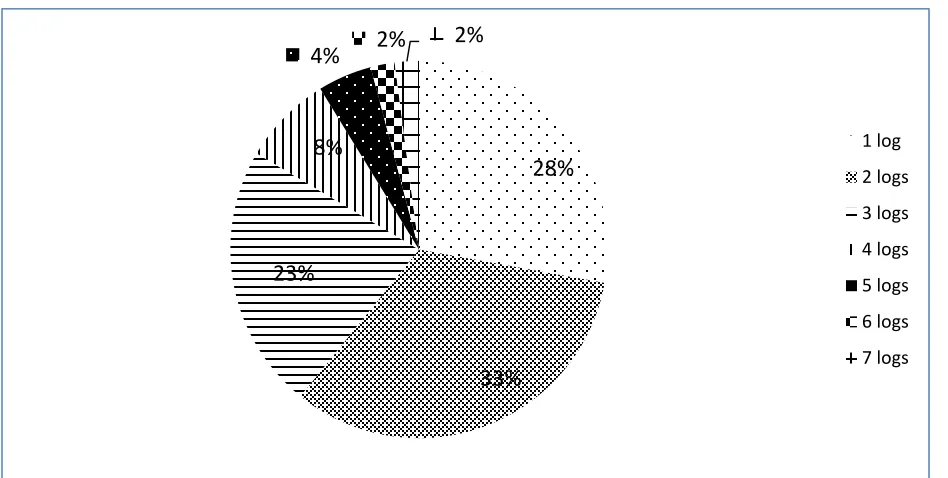
Adolescent participants were invited to complete 8 logs. The distribution of the number of
logs is presented in Figure 1. 218 adolescents completed at least one log (Median = 5 logs).
Among all completed logs, an average of 2.5 (SD = 1.37) logs were completed by adolescents
16
settings on each day for the past 7 days. The distribution of the daily driving frequency is
presented in Figure 2. The mean score of daily driving is .83 (SD = .61), which corresponds to
the response option “less than 30 minutes”. Based on the assumption that adolescents who were
scored 1 equals 30 minutes daily driving, the estimated average daily driving was obtained by
looking at the fraction of mean score (.83) in score of 1 corresponding to the fraction of
estimated average of daily driving in 30 minutes, which was approximate 25 minutes. In terms of
the distribution of daily driving, 5% of the adolescents reported not driving at all. 68.5% of the
adolescents reported driving less than minutes per day, and 26.5% of the adolescents reported
driving more than 30 minutes per day during the learner permit stage. The percentage of
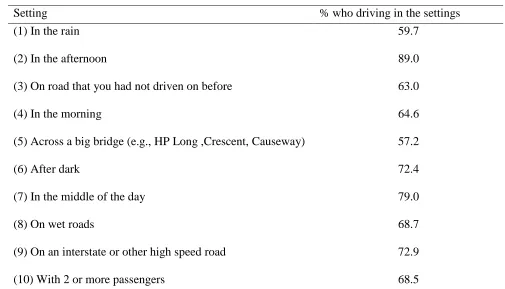
adolescents who reported driving in each setting is presented in Table 1. Adolescents reported
driving an average of 6.88 (SD = 2.96) distinct settings during the learner permit stage. Among
all of the settings, adolescents reported driving most frequently “in the afternoon” and “in the
17 Figure 1. Distribution of learner permit logs
Figure 2. Distribution of daily driving
28%
33% 23%
8%
4% 2% 2%
1 log 2 logs 3 logs 4 logs 5 logs 6 logs 7 logs
5%
68.50% 21.50%
5%
None
Less than 30 minutes 30-60 minutes
18
Table 1.
Range of distinct settings
Setting % who driving in the settings
(1) In the rain 59.7
(2) In the afternoon 89.0
(3) On road that you had not driven on before 63.0
(4) In the morning 64.6
(5) Across a big bridge (e.g., HP Long ,Crescent, Causeway) 57.2
(6) After dark 72.4
(7) In the middle of the day 79.0
(8) On wet roads 68.7
(9) On an interstate or other high speed road 72.9
(10) With 2 or more passengers 68.5
Predictors of individual differences in supervised driving
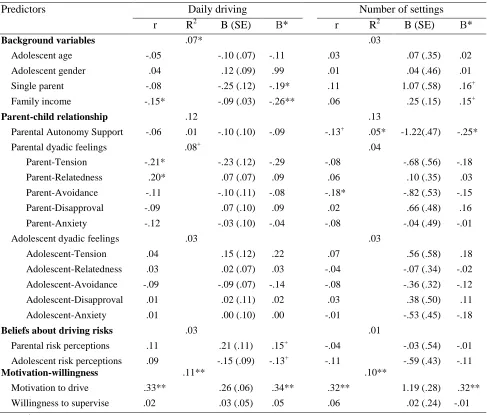
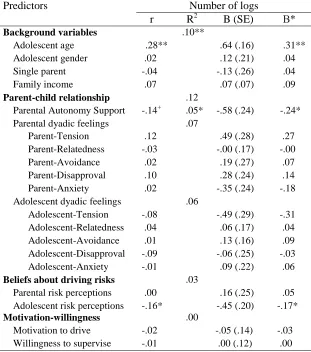
In the second stage, bivariate associations and multivariate regression analyses were
computed to test whether the four individual groups of variables predicted the amount of daily
driving, the range of distinct settings, and the number of logs completed (see Table 2). The four
groups of variables include (1) family background (i.e., adolescent age, gender, family structure,
and household income), (2) parent-child relationship qualities (i.e., parental autonomy support
and dyadic feelings of tension, relatedness, avoidance, disapproval, and anxiety in supervised
driving sessions), (3) parents’ and adolescents’ beliefs about the riskiness of driving, and (4) the
combination of adolescents’ motivation to drive and parental willingness to supervise driving.
Family Background. According to bivariate correlation analyses, less family income was
19
None of other family background variables were bivariately associated with daily driving, the
range of settings, and the number of logs completed.
Multivariate regression analyses indicated that family background variables significantly
accounted for 7.0% and 9.8% of the variance in daily driving and the number of logs completed,
respectively. However, family background variables did not account for significant variance in
settings. Specifically, living in two-parent families and having less family incomes were
uniquely associated with more daily driving. Adolescent age was the only unique predictor of log
completion. Adolescent gender did not significantly predict daily driving, the range of settings,
or the number of logs completed.
Parent-child relationship qualities. Bivariate correlation analyses showed that less
intense parental dyadic feelings of tension and stronger parental dyadic feelings of relatedness
were associated with more daily driving. Less intense parental feelings of avoidance were
associated with more settings experienced. None of other parents’ or adolescents’ dyadic
feelings were bivariate associated with daily driving, the range of settings, and the number of
logs completed. In consideration of bivariate associations between parental autonomy support
and individual differences in supervised driving, lower levels of autonomy support were
significantly associated with more logs completed and were marginally associated with more
settings experienced.
The group of parent-child relationship qualities did not significantly account for variance
in daily driving, the range of settings, or the number of logs. The sub-group of parental dyadic
feelings accounted for a marginally significantly 8.3% of the variance in daily driving but was
not significantly associated with the range of settings or the number of logs completed. Upon
20
significantly predicted daily driving, the range of settings, or the number of logs completed.
Adolescent dyadic feelings did not account for significant variance in daily driving, the range of
settings, or the number of logs completed. When controlling for both parental and adolescent
dyadic feelings, parental autonomy support significantly accounted for 4.9% and 4.5% of the
variance in the range of settings and the number of logs completed, respectively. Specifically, at
higher levels of autonomy support, adolescents reported fewer distinct settings and completed
fewer driving logs. Parental autonomy support did not significantly predict the amount of daily
driving.
Beliefs about the riskiness of driving. Bivariate correlation analyses indicated that only
stronger adolescents’ perceptions of driving risks were associated with more logs completed.
Neither adolescents’ risk perceptions nor parents’ risk perceptions were bivariate associated with
daily driving and the range of settings.
In multivariate analyses, parents’ and adolescents’ beliefs about the riskiness of driving
were marginally significantly associated with the amount of daily driving. Adolescents reported
more daily driving when they had lower perceptions of driving risks and had parents with higher
perceptions of driving risks. Adolescents with higher perceptions of driving risks completed
fewer logs. Adolescents’ perceptions of driving risks were not associated with distinct settings.
Parents’ perceptions of driving risks did not predict distinct settings or number of logs completed.
Motivation and willingness. Bivariate correlation analyses showed that
adolescents ’stronger motivation to drive was associated with more daily driving and settings.
Parental willingness to supervise driving was not associated with daily driving and the range of
settings. Neither adolescents’ motivation to drive nor parental willingness to supervise driving
21
The combination of adolescents’ motivation to drive and parents’ willingness to
supervise driving accounted for 11.0% and 9.9% of the variance in daily driving and distinct
settings, respectively. However, adolescents’ motivation to drive was the only unique predictor
of daily driving and the range of settings. Adolescents with a stronger motivation to drive
reported more daily driving and more distinct settings. When controlling for adolescents’
motivation to drive, parents’ willingness to supervise driving did not significantly predict daily
driving or distinct settings. Additionally, neither adolescents’ motivation to drive nor parents’
willingness to supervise driving predicted the number of logs completed.
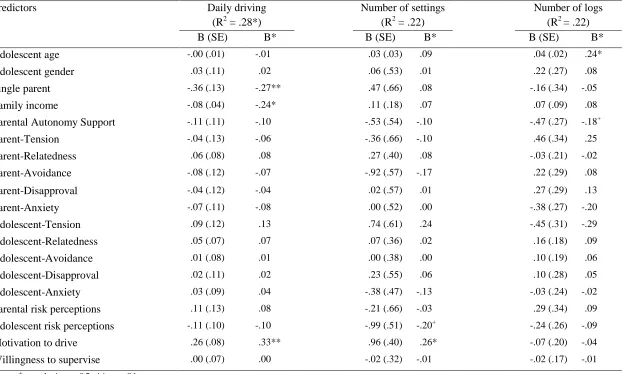
Simultaneous linear regression analyses
Finally, simultaneous linear regression analyses were computed to test whether each
variable predicted the amount of daily driving, the range of settings, and the number of logs
completed. As shown in Table 3, adolescents’ motivation to drive predicted both daily driving
and the range of settings. Adolescents with a stronger motivation to drive reported more daily
driving and drove in more distinct settings. Additionally, adolescents from two-parent
households and with relatively lower household income reported more daily driving. Adolescent
age was the only unique predictor of the number of logs completed. Older adolescents completed
more logs than younger adolescents. None of any other variables uniquely predicted daily
22
Table 2.
Summary of multivariate regression models predicting daily driving, number of settings, and number of logs.
Predictors Daily driving Number of settings r R2 B (SE) Β* r R2 B (SE) Β*
Background variables .07* .03
Adolescent age -.05 -.10 (.07) -.11 .03 .07 (.35) .02
Adolescent gender .04 .12 (.09) .99 .01 .04 (.46) .01
Single parent -.08 -.25 (.12) -.19* .11 1.07 (.58) .16+
Family income -.15* -.09 (.03) -.26** .06 .25 (.15) .15+
Parent-child relationship .12 .13
Parental Autonomy Support -.06 .01 -.10 (.10) -.09 -.13+ .05* -1.22(.47) -.25*
Parental dyadic feelings .08+ .04
Parent-Tension -.21* -.23 (.12) -.29 -.08 -.68 (.56) -.18
Parent-Relatedness .20* .07 (.07) .09 .06 .10 (.35) .03
Parent-Avoidance -.11 -.10 (.11) -.08 -.18* -.82 (.53) -.15
Parent-Disapproval -.09 .07 (.10) .09 .02 .66 (.48) .16
Parent-Anxiety -.12 -.03 (.10) -.04 -.08 -.04 (.49) -.01
Adolescent dyadic feelings .03 .03
Adolescent-Tension .04 .15 (.12) .22 .07 .56 (.58) .18
Adolescent-Relatedness .03 .02 (.07) .03 -.04 -.07 (.34) -.02
Adolescent-Avoidance -.09 -.09 (.07) -.14 -.08 -.36 (.32) -.12
Adolescent-Disapproval .01 .02 (.11) .02 .03 .38 (.50) .11
Adolescent-Anxiety .01 .00 (.10) .00 -.01 -.53 (.45) -.18
Beliefs about driving risks .03 .01
Parental risk perceptions .11 .21 (.11) .15+ -.04 -.03 (.54) -.01
Adolescent risk perceptions .09 -.15 (.09) -.13+ -.11 -.59 (.43) -.11
Motivation-willingness .11** .10**
Motivation to drive .33** .26 (.06) .34** .32** 1.19 (.28) .32**
Willingness to supervise .02 .03 (.05) .05 .06 .02 (.24) -.01
23
Table 2 (Continued)
Predictors Number of logs
r R2 B (SE) Β*
Background variables .10**
Adolescent age .28** .64 (.16) .31** Adolescent gender .02 .12 (.21) .04 Single parent -.04 -.13 (.26) .04
Family income .07 .07 (.07) .09
Parent-child relationship .12
Parental Autonomy Support -.14+ .05* -.58 (.24) -.24* Parental dyadic feelings .07
Parent-Tension .12 .49 (.28) .27 Parent-Relatedness -.03 -.00 (.17) -.00 Parent-Avoidance .02 .19 (.27) .07 Parent-Disapproval .10 .28 (.24) .14 Parent-Anxiety .02 -.35 (.24) -.18 Adolescent dyadic feelings .06
Adolescent-Tension -.08 -.49 (.29) -.31 Adolescent-Relatedness .04 .06 (.17) .04 Adolescent-Avoidance .01 .13 (.16) .09 Adolescent-Disapproval -.09 -.06 (.25) -.03 Adolescent-Anxiety -.01 .09 (.22) .06
Beliefs about driving risks .03
Parental risk perceptions .00 .16 (.25) .05 Adolescent risk perceptions -.16* -.45 (.20) -.17*
Motivation-willingness .00
Motivation to drive -.02 -.05 (.14) -.03 Willingness to supervise -.01 .00 (.12) .00
24
Table 3.
Summary of simultaneous regression models predicting daily driving, number of settings, and number of logs.
Predictors Daily driving (R2 = .28*)
Number of settings (R2 = .22)
Number of logs (R2 = .22) B (SE) B* B (SE) B* B (SE) B* Adolescent age -.00 (.01) -.01 .03 (.03) .09 .04 (.02) .24*
Adolescent gender .03 (.11) .02 .06 (.53) .01 .22 (.27) .08
Single parent -.36 (.13) -.27** .47 (.66) .08 -.16 (.34) -.05
Family income -.08 (.04) -.24* .11 (.18) .07 .07 (.09) .08
Parental Autonomy Support -.11 (.11) -.10 -.53 (.54) -.10 -.47 (.27) -.18+
Parent-Tension -.04 (.13) -.06 -.36 (.66) -.10 .46 (.34) .25
Parent-Relatedness .06 (.08) .08 .27 (.40) .08 -.03 (.21) -.02
Parent-Avoidance -.08 (.12) -.07 -.92 (.57) -.17 .22 (.29) .08
Parent-Disapproval -.04 (.12) -.04 .02 (.57) .01 .27 (.29) .13
Parent-Anxiety -.07 (.11) -.08 .00 (.52) .00 -.38 (.27) -.20
Adolescent-Tension .09 (.12) .13 .74 (.61) .24 -.45 (.31) -.29
Adolescent-Relatedness .05 (.07) .07 .07 (.36) .02 .16 (.18) .09
Adolescent-Avoidance .01 (.08) .01 .00 (.38) .00 .10 (.19) .06
Adolescent-Disapproval .02 (.11) .02 .23 (.55) .06 .10 (.28) .05
Adolescent-Anxiety .03 (.09) .04 -.38 (.47) -.13 -.03 (.24) -.02
Parental risk perceptions .11 (.13) .08 -.21 (.66) -.03 .29 (.34) .09
Adolescent risk perceptions -.11 (.10) -.10 -.99 (.51) -.20+ -.24 (.26) -.09
Motivation to drive .26 (.08) .33** .96 (.40) .26* -.07 (.20) -.04
Willingness to supervise .00 (.07) .00 -.02 (.32) -.01 -.02 (.17) -.01
25 Discussion
Little previous research has focused on adolescents’ driving activities during the learner
permit stage. This study aimed to fill in this gap by describing adolescents’ supervised driving
experience and investigating predictors of individual variability in supervised driving sessions.
The supervised driving experiences were measured as adolescents’ average amount of daily
driving and the range of distinct settings experienced during the learner permit phase. Four
groups of variables (i.e., family background, parent-child relationship qualities, parental and
adolescents’ beliefs about riskiness of driving, the combination of adolescents’ motivation to
drive and parental willingness to supervise driving) were tested as predictors of daily driving and
setting exposure.
Individual differences in supervised driving
Amount of daily driving. Adolescents reported driving an average of 25 minutes per day.
Five percent of the adolescents did not drive at all; 68.5% of the adolescents drove less than 30
minutes per day; 26.5% of the adolescents reported driving more than 30 minutes per day (see
Figure 2). The estimated mean amount of supervised driving over a six-month period was
estimated from responses as 25 (minutes) x 180 (days) = 4500 (minutes), which equals to 75
hours. According to the policies of GDL in the state of Louisiana, adolescents are required to
complete 50 hours of supervised practice (including 15 hours of nighttime driving). In this
sample, the estimated mean amount of daily driving over a six-month period exceeds the
required 50 hours of supervised driving. Since the current study measured adolescents’ daily
driving as time ranges, the specific amount of adolescents who drove over 50 hours during the
learner permit stage is unknown. However, 26.5% of the adolescents who reported daily driving
that fell in the ranges of “30 – 60 minutes” and “more than an hour” appear to be exceeding the
26
adolescents who reported not driving at all were not on track to satisfy the GDL requirements.
Thus, at least 26.5% of the adolescent participants were on track to satisfy the GDL requirement
of the amount of supervised driving practice.
Range of settings. Adolescents reported experiencing an average of 6.88 distinct settings,
and they drove most frequently in the settings of “in the afternoon” and “in the middle of the
day.” Compared with rush hour traffic in the morning and in the evening, the traffic is relatively
light in the afternoon and in the middle of the day. Thus, it may be easier for novice drivers to
practice under light traffic conditions, which results in a higher rate of practice in the afternoon
and in the middle of the day. Perhaps adolescents and their parents are in a hurry to go to school
or go to work in the morning, so they may have more free time to drive or to supervise driving in
the afternoon or in the middle of the day.
The settings of “driving in the rain” and “across a big bridge” were reported least by
adolescents. Driving in the rain is relatively challenging for novice drivers. A driver’s visibility
is usually reduced in the rain (Hautiere, Dumont, Bremond, & Ledoux, 2009), and more traffic
crashes occur during adverse weather conditions (Qiu & Nixon, 2008). Thus, the low frequency
of reported driving in the rain suggests that adolescents and parents may have realized the
potential dangers of driving in the rain, and they may try to avoid risking driving or supervising
driving during rainy days. It is also possible that it does not always rain in Louisiana, which may
result in relatively fewer opportunities to drive during rainy days.
In the city of New Orleans, LA, family’s routine driving may not be require driving on big
bridges on regular basis because most big bridges are not within the Great New Orleans Region.
However, the low frequency of driving in big bridges implies that adolescents’ driving on the
27
cross one or more bridges. Avoiding driving in the rain or driving across big bridges may prevent
adolescent drivers experiencing risky traffic conditions. However, parents should gradually
expose adolescents to complicated driving settings to enrich their driving experiences.
Driving logs completion. In order to examine the effect of variability of log completion
on reports of daily driving and the range of settings, we included number of logs as an outcome
variable in the analyses. Only adolescent age was found to be associated with the number of logs,
suggesting that variation in log completion likely did not bias other results.
Predictors of individual differences in supervised driving
Family background. Family background variables accounted for a significant amount of
variance in adolescents’ daily driving. As hypothesized, adolescents from two-parent
households reported more daily driving than adolescents from single-parent households,
suggesting that higher levels of driving-specific parental involvement in two-parent households
may provide adolescents more driving opportunities. This finding is consistent with previous
research showing that parents are more involvement in daily activities in two-parent households
than in single-parent households (Astone & McLanahan, 1991; Kohl, Lengue, & McMahon,
2000; Weinraub & Wolf, 1983). Contradictory to the original hypothesis, results show that
adolescents with less household income reported more daily driving than adolescents with higher
household income. Perhaps parents with less household income may need to work more hours in
order to support family. Under such condition, children may need to drive independently as
early as they can to share parents’ burden at home, such as helping with grocery and picking up
younger siblings. The sooner these adolescents obtain an intermediate license, the sooner they
can help to share parents’ burden at home, explaining why adolescents from low-income families
28
Adolescents’ age and gender did not significantly predict individual variability in daily
driving or settings. Age may be an indicator of the length of learner permit phase, because
adolescents must hold a learner’s permit until age 16. However, the length of learner permit
phase does not appear to be linked with the amount of supervised driving. Younger adolescents,
even though they already completed 50 hours of supervised driving within 6 months, have to
wait until age 16 to transfer into the intermediate stage. During the waiting period, adolescents
may either keep practicing regularly or may not drive, which could result in lack of consistent
association between adolescents’ age and individual differences in supervised driving. We
hypothesized that female adolescents were expected to drive more and to be exposed to more
settings than male adolescents, because males are found to be more confident than females in
driving (Laapotti, 2005), which may result in less supervised practice for male adolescents.
However, the results were in the opposite direction to what was hypothesized. Male adolescents
reported more daily driving than females adolescents did. Perhaps with more confidence, male
adolescents may be more willing to drive and are brave enough to take on new settings that they
have never driven in before. On the contrary, with less confidence, female adolescents may
choose to avoid driving in unfamiliar settings or even not to drive at all, resulting in less daily
driving and exposure to fewer distinct settings.
Parental-child relationship qualities. The group of parent-child relationship qualities
includes parental autonomy support and parental and adolescents’ dyadic feelings during
supervised driving sessions. Higher levels of parental autonomy support were expected to be
linked with more daily driving and more distinct settings. The bivariate correlations and
simultaneous regression analyses did identify a significant association between autonomy
29
multivariate regression analyses showed that higher levels of parental autonomy support were
associated with fewer reported settings and fewer driving logs completed when controlling for
parental and adolescent dyadic feelings. This situation may suggest that the association between
autonomy support and adolescents’ engagement of driving may be biased by adolescents’ and/or
parents’ dyadic feelings toward supervised driving. On the one hand, adolescents with high
levels of autonomy support may choose to drive more if they consider supervised driving as
enjoyable and relaxed. On the other hand, adolescents with high levels of autonomy support may
choose to not drive if they perceive supervised driving as anxious. Thus, high levels of
autonomy support, accompanied by a relatively happy and relaxed atmosphere during supervised
driving may help to increase adolescents’ daily driving and the range of settings.
Bivariate correlations indicated that more daily driving was associated with less intense
parental feelings of tension and stronger parental feelings of relatedness during the supervised
driving, suggesting that adolescents may be more likely to drive under relaxed parent-child
interactive styles and when the parents and adolescents established a strong emotional bond.
Thus, in order to encourage adolescents drive more, parents should avoid conflict, which may
reduce adolescents’ motivation to drive. Parents are highly encouraged to develop emotional
bond with children during supervised driving practice, which may bring enjoyable atmosphere
and facilitate adolescents practice more.
Beliefs about the riskiness of driving. Stronger parental and adolescent beliefs about the
riskiness of driving were expected to predict more daily driving and more distinct settings. The
association between parental and adolescents’ beliefs about riskiness of driving and the amount
of daily driving were marginally significant. Specifically, more daily driving was reported by
30
perceive driving as more risky reported less daily driving. One may expect that parents with
greater risk perceptions are more likely to be engaged in adolescents’ driving activities (Williams
et al., 2006), which may bring adolescents more supervised driving opportunities. Additionally,
parents with greater risk perceptions may help to strengthen adolescents’ awareness of driving
risks by conveying their concerns about driving safety (Simons-Morton & Ouimet, 2006). Thus,
adolescents who perceive driving as riskier may believe that they need to practice more to
improve their driving skills. However, adolescents who perceived driving as riskier were found
to report less driving per day, suggesting that they may avoid driving anxiety by minimizing the
amount of driving. It is also possible that they may choose to drive less per day but prolong the
duration of the learner permit phase, which may help to make a progress gradually. Both
possibilities may lead to reduction of the average amount of daily driving.
Motivation and willingness. As anticipated, the combination of adolescents’ motivation
to drive and parents’ willingness to supervise driving uniquely and significantly accounted for
the variance in daily driving and the range of settings. Bivariate correlation analyses and
simultaneous regression analyses showed that adolescents’ motivation significantly predicted
both daily driving and distinct settings. Similar to the association between stronger motivation to
learn and more positive feelings toward homework (Froiland, 2011), adolescents with a strong
motivation to drive may perceive driving as enjoyable and useful, which could result in more
daily driving and distinct settings. This finding suggests that parents should explore effective
parenting strategies that help to develop adolescents’ motivation to drive. For instance, parents
and adolescents should communicate with each other about supervised driving. By exchanging
thoughts and feelings, the two parties may have a better understanding about mutual expectations
31
adolescents’ motivation to drive. Furthermore, parents should respect adolescents’ willingness
to drive, because adolescents’ motivation is likely to be strengthened when they receive high
levels of respect and support from parents. However, forcing adolescents to drive may weaken
their motivation, because a coercive parent-child interactive style may undermine the
effectiveness of driving-specific parenting and may bring adolescent drivers feelings of tension
and anxiety.
When controlling for adolescents motivation, parents’ willingness to supervise driving did
not significantly predict daily driving and the range of settings. On the one hand, adolescents
with a learner permit license can only drive accompanied by a parent. Under this condition,
parental stronger willingness to supervise may bring adolescents more opportunities to drive
during the learner permit phase. On the other hand, although parents are willing to supervise
driving, adolescents without a strong motivation may not engage in driving. It is likely that
parents’ willingness to supervise is a necessary, but not a sufficient condition for driving practice.
Thus, in order to help adolescents to drive more, parents should not only highly engage in
driving supervision, but also create a relaxed and supportive parent-child interactive atmosphere
during driving practice, which may strengthen adolescents’ motivation to drive.
Strengths, limitations, and future research directions.
Strengths of this study include a specific concentration on adolescents’ driving during the
learner permit stage, which has been under-studied. The study did not only measure the quantity
of adolescents’ driving practice (i.e. daily driving), but also measured quality of driving (i.e.
settings). By looking at both the amount of daily driving and the range of settings, the analyses
32
However, there are several limitations of the study. First, we only measured adolescents’
and parents’ self-reports of driving-specific parenting. The information provided was based on
participants’ subjective interpretation, which may be different from objective assessment in real
settings. Furthermore, the study was not able to obtain the exact amount of supervised practice
during the learner permit stage for each adolescent. Average daily driving was estimated from
reports of driving logs. However, there was substantial variability in the number of logs
completed. Thus, it was not possible to calculate the exact hours of supervised driving for each
adolescent. Finally, although the sample exhibited gender and ethnic diversity, adolescent drivers
from the Great New Orleans Region may develop unique driving habits due to the local traffic
patterns and weather conditions. Thus, the findings may not apply to adolescent drivers from
other states or countries.
In conclusion, the findings provide valuable implications for developing effective
driving-specific parenting strategies for parents of adolescents holding a learner permit. Parents are
recommended to be highly engaged in adolescents’ driving practice and to encourage adolescents
to gradually practice driving in different road types, traffic patterns, and weather conditions.
Parents should also create a relaxed and respective atmosphere during supervised driving and
help to strengthen adolescents’ motivation to drive. Building upon this study, future research
directions may include testing individual differences in supervised driving as a predictor of
driving success when adolescent drivers proceed into the intermediate and unrestrictive licensing
stages.
33 References
Astone, N. M., & McLanahan, S. S. (1991). Family structure, parental practices and high school completion. American sociological review, 309-320.
Beck, K. H., Hartos, J., & Simons-Morton, B. (2002). Teen driving risk: The promise of parental influence and public policy. Health Education & Behavior, 29(1), 73-84.
Bronstein, P., Ginsburg, G. S., & Herrera, I. S. (2005). Parental predictors of motivational orientation in early adolescence: A longitudinal study. Journal of Youth and Adolescence, 34(6), 559-575.
Brown, S. L. (2010). Changes in risk perceptions prospectively predict changes in self‐
reported speeding. Risk Analysis, 30(7), 1092-1098.
Farkas, M. S., & Grolnick, W. S. (2010). Examining the components and concomitants of parental structure in the academic domain. Motivation and Emotion, 34(3), 266-279. Froiland, J. M. (2011). Parental autonomy support and student learning goals: A preliminary examination of an intrinsic motivation intervention. In Child & Youth Care Forum (Vol. 40, No. 2, pp. 135-149). Springer US.
Garay, L., & Benavente, M. (2004). Graduated driving licensing.
Grolnick, W. S., (2003). They psychology of parental control: how well-meant parenting backfires. Erlbaum, Mahwah. NJ.
Hautiere, N., Dumont, E., Bremond, R., & Ledoux, V. (2009). Review of the
mechanisms of visibility reduction by rain and wet road. In 8th International Symposium on Automotive Lighting. München: Herbert Utz Verlag.
Insurance Institute for Highway Safety (IIHS) (2010). Licensing ages and graduated licensing systems, August 2010.
Insurance Institute for Highway Safety (IIHS), (2013). General statistics: fatality facts. 2013. Insurance Institute for Highway Safety (IIHS), (2014). Effective dates of graduated licensing laws. May 2014
Kohl, G. O., Lengua, L. J., & McMahon, R. J. (2000). Parent involvement in school
conceptualizing multiple dimensions and their relations with family and demographic risk factors. Journal of school psychology, 38(6), 501-523.
Laapotti, S. (2005). What are young female drivers made of?. Research on Women’s Issues in
Transportation, 148.
Lin, M. L., & Fearn, K. T. (2003). The provisional license: nighttime and passenger restrictions—a literature review. Journal of Safety Research, 34(1), 51-61.
Masten, S. V. (2004). Teenage driver risks and interventions (No. CAL-DMV-RSS-04-207). Department of Motor Vehicles.
Mayhew, D. R., Simpson, H. M., & Pak, A. (2003). Changes in collision rates among novice drivers during the first months of driving. Accident Analysis & Prevention, 35(5), 683-691. Mayhew, D., Williams, A., & Pashley, C., (2014). A new GDL framework: evidence base to integrate novice driver strategies. Traffic Injury Research Foundation, ISBN:978-1- 926857-57-2
McKnight, A. J., & Peck, R. C. (2003). Graduated driver licensing and safer driving. Journal of Safety Research, 34(1), 85-89.