Open Access
Research article
Prostate-specific antigen at or before age 50 as a predictor of
advanced prostate cancer diagnosed up to 25 years later: A
case-control study
David Ulmert
1, Angel M Cronin
2, Thomas Björk
1, Matthew F O'Brien
2,
Peter T Scardino
2, James A Eastham
2, Charlotte Becker
1, Göran Berglund
1,
Andrew J Vickers
2and Hans Lilja*
1,2Address: 1Departments of Laboratory Medicine and Clinical Sciences in Malmö, Lund University, University Hospital UMAS, Malmö, Sweden and 2Departments of Surgery (Urology), Clinical Laboratories, Medicine (GU-Oncology), Epidemiology and Biostatistics, Memorial Sloan-Kettering
Cancer Center, 1275 York Avenue, New York, NY 10021, USA
Email: David Ulmert - [email protected]; Angel M Cronin - [email protected]; Thomas Björk - [email protected]; Matthew F O'Brien - [email protected]; Peter T Scardino - [email protected]; James A Eastham - [email protected]; Charlotte Becker - [email protected]; Göran Berglund - [email protected]; Andrew J Vickers - [email protected]; Hans Lilja* - [email protected]
* Corresponding author
Abstract
Background: Based on a large, representative unscreened cohort from Malmö, Sweden, we have recently reported that a single prostate-specific antigen (PSA) measurement at or before age 50 is a strong predictor of prostate cancer occurring up to 25 years subsequently. We aimed to determine whether this association holds for advanced cancers, defined as clinical stage T3 or higher, or skeletal metastasis at the time of the cancer diagnosis.
Methods: In 1974–1986 blood samples were obtained from a cohort of 21,277 men aged up to 50. Through 1999, 498 men were diagnosed with prostate cancer, and of these 161 had locally advanced or metastatic prostate cancers. Three controls, matched for age and date of venipuncture, were selected for each case. Conditional logistic regression was used to test associations between molecular markers and advanced cancer.
Results: Median time from venipuncture to diagnosis was 17 years. Levels of all PSA forms and hK2 were associated with case status. Total PSA was a strong and statistically significant predictor of subsequent advanced cancer (area under the curve 0.791; p < 0.0005). Two-thirds of the advanced cancer cases occurred in men with the top 20% of PSA levels (0.9 ng/ml or higher).
Conclusion: A single PSA test taken at or before age 50 is a very strong predictor of advanced prostate cancer diagnosed up to 25 years later. This suggests the possibility of using an early PSA test to risk-stratify patients so that men at highest risk are the focus of the most intensive screening efforts.
Published: 15 February 2008
BMC Medicine 2008, 6:6 doi:10.1186/1741-7015-6-6
Received: 10 October 2007 Accepted: 15 February 2008
This article is available from: http://www.biomedcentral.com/1741-7015/6/6
© 2008 Ulmert et al; licensee BioMed Central Ltd.
Background
We have previously shown that a single prostate-specific antigen (PSA) measurement taken at age 50 or younger is a strong predictor of prostate cancer diagnosed up to 25 years subsequently [1]. Our study cohort was obtained from the Malmö Preventive Medicine Study, a large, rep-resentative, population-based study on cardiovascular risk factors that took place in Malmö, Sweden from 1974 to 1986. Using a case-control design, we found that PSA lev-els in the archived blood plasma taken during 1974–1986 were significantly higher in men subsequently diagnosed with prostate cancer compared with matched controls. As the rate of PSA screening in Sweden during the study period was very low [2], the study constitutes a 'natural experiment' to test hypotheses about the development of prostate cancer.
Our finding has several implications, most notably that a single PSA test at age 45–50 could risk-stratify the popula-tion for the intensity of subsequent screening. However, as is well known, more men die with prostate cancer than from prostate cancer, and many prostate cancers affect neither the length nor the quality of a man's life. For example, autopsy studies of men who die from causes other than prostate cancer have found cancer in the pros-tates of approximately 20% of men at age 60 and approx-imately 40% at age 70 [3,4]; this sharply contrasts with the low lifetime risk of dying from this disease. Moreover, in contrast to the very marked country-to-country differences in prostate cancer incidence, there is relatively minor var-iation in prostate cancer mortality rates [5]. These obser-vations raise the possibility that the sort of cancers predicted by an early elevation of PSA might have little clinical relevance.
Accordingly, we decided to reanalyze our data to focus on an endpoint of unquestionable clinical significance: locally advanced or metastatic disease at the time of pros-tate cancer diagnosis. Skeletal metastases cause symp-toms, such as pain, and most men with metastases die of their disease [6,7]; as regards clinical stage T3, cancer that has demonstrably grown outside the confines of the pros-tate will, if left untreated, inevitably lead to severe disease symptoms (e.g. local obstruction) or prostate cancer metastasis [8]. In this study, we aimed to determine whether levels of prostate-specific kallikreins (total PSA, free PSA and hK2) measured in anti-coagulated plasma samples could predict locally advanced or metastatic pros-tate cancer up to 25 years before diagnosis. We also inves-tigated whether combining different markers into a single multivariable model could improve our ability to predict compared to use of total PSA alone.
Methods
Study cohort and controls
Subjects, matching and analytical methods of the Malmö Preventive Medicine study have been thoroughly described in previous reports [1]. The Malmö Preventive Medicine study was approved by the Ethics Committee at Lund University and was, in brief, conducted from 1974 to 1986 by inviting men born between 1926 and 1949 to participate in a study intended to primarily investigate risk factors for major cardiovascular and metabolic diseases [9]. EDTA-anticoagulated blood plasma samples were archived at -20° and never thawed until the recent analy-sis. Our analysis focused on those participants aged 33–50 at baseline, totaling 21,277 (74% of men invited). According to the Swedish Cancer Registry, 498 (2.3%) of these men were diagnosed with prostate cancer up to 31 December 1999. Blood samples were available and ana-lyzable for 462 of these men (93%). In a majority of the cases sextant biopsies were performed and evaluated according to the Gleason system, but some were graded according to World Health Organization (WHO) criteria. Therefore, to obtain a homogenous description of our cohort, we translated all tumor grades into the WHO sys-tem. Data on bone scans at the time of diagnosis were available for 370 (80%) of 462 men; clinical stage data were available for 398 (86%).
We used a case-control study design nested within the Malmö Preventive Project cohort. Participants without a prostate cancer diagnosis at the study close date were matched with cases for age and date of baseline venipunc-ture (± 3 months for both factors for ~95% of controls). Controls were then randomly selected from matches. The present investigation included only those cases with advanced prostate cancer and their respective controls. Advanced prostate cancer was defined as metastases veri-fied by bone scan or clinical stage at least T3 at the time of prostate cancer diagnosis.
There were 161 cases in the study. Although three controls were initially matched for each case, we later found that 47 controls were not followed until diagnosis of the matched case, usually because of early death, leaving 436 controls. Most cases had either two (24%) or three (73%) matched controls; four cases (3%) had one control. Almost all cases (152, 94%) were ages 40–50 at venipunc-ture. The remaining nine cases were aged less than 40: the ages of each of these patients at venipuncture and at diag-nosis were 33/49, 35/53, 35/54, 36/51, 37/57, 37/57, 39/ 53, 39/59 and 39/59. As age was a matching criterion, the age distribution in controls was very similar.
PSA measurements
PSA, in serum are labile in some storage conditions, we previously showed that the levels of both total PSA and free PSA in anticoagulated plasma are unaffected by long-term storage at -20°C [10]. The levels of total PSA, free PSA and hK2 were measured in archived plasma from cases and controls as described previously [1]. Levels of complexed PSA were calculated as total PSA minus free PSA. Total PSA measured by the assay used, Prostatus Free/Total PSA assay (Perkin-Elmer Life Sciences Turku, Finland), differs by 13% from WHO calibration standards [11].
Statistical analysis
For our main analysis we defined an event as metastases or clinical stage at least T3 at the time of prostate cancer diagnosis. We conducted conditional logistic regression based on matching for age and date of venipuncture to determine associations between molecular markers and the event. To calculate predicted probability of the event among Swedish men for a given PSA level, we entered PSA in a logistic model using restricted cubic splines with knots at the tertiles. Owing to the 3:1 matched case-con-trol design, the incidence of advanced cancer in our study was close to 25%. To correct the incidence to the expected probability at age 75, we adjusted the probabilities by adding a constant (a Bayes factor) to the linear prediction. The expected probability of advanced cancer at age 75 was derived by taking the estimated probability of prostate cancer by age 75 in Swedish men (10%) [12], and multi-plying by the proportion of advancer cancer cases that were observed in this cohort (i.e. number of advanced prostate cancer cases/number of total prostate cancer cases). These probabilities were determined among men aged 44–50 at baseline, as this is just before the age at which men are typically recommended to initiate prostate cancer screening. All statistical tests were two-sided. All analyses were conducted using Stata 9.2 (Stata Corp., Col-lege Station, TX).
Results
There were 161 patients matching the criteria for advanced prostate cancer for our main analysis, 62 with
skeletal metastases and 149 with clinical stage at least T3 at the time of prostate cancer diagnosis. Fifty patients had both metastases and clinical stage at least T3. The median time from baseline venipuncture to diagnosis was 17 years (interquartile range 15, 19), with median age at diagnosis 64 years (interquartile range 60, 67). Eighteen patients (11%) had WHO grade I disease, 73 patients (45%) grade II and 69 patients (43%) grade III, with WHO grade missing for one patient. Five (3%) patients were clinically judged to have stage T1 disease, 7 patients (4%) T2 and 149 patients (93%) T3–T4. Twelve (7%) patients had lymph node metastases, 57 (35%) patients did not and 92 patients were not evaluated for nodal sta-tus.
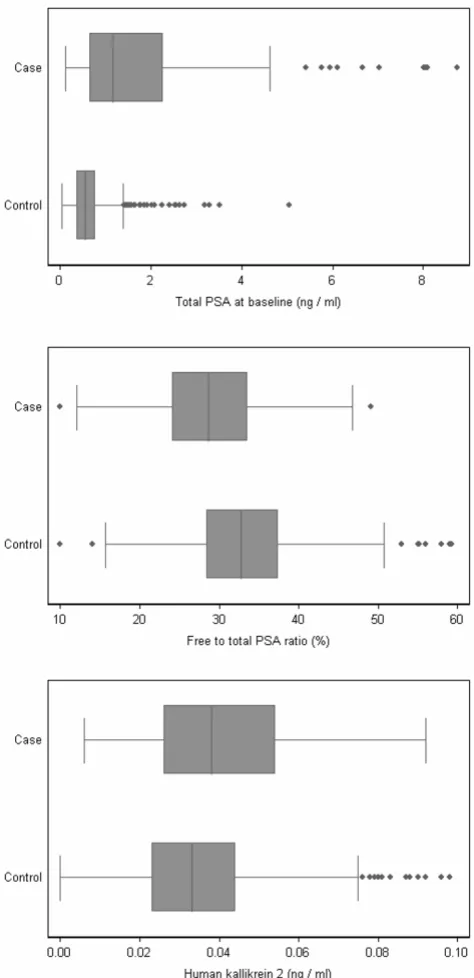
Prostate-specific kallikrein measurements are reported in Table 1 and illustrated in Figure 1. In the anti-coagulated plasma collected at baseline, median levels of total PSA, complexed PSA, free PSA and hK2 were higher, and median free-to-total PSA ratio lower, for men who were found to have skeletal metastases or clinical stage at least T3 at the time of prostate cancer diagnosis, compared with men not diagnosed with prostate cancer.
Table 2 shows the utility of various PSA forms to predict risk of skeletal metastases or clinically advanced disease at the time of prostate cancer diagnosis by univariate analy-sis. All of the prostate-specific kallikreins were associated with case status (all p < 0.0005). An increase of 1 ng/ml in total PSA was associated with an odds ratio for advanced cancer of 4.29 (95% confidence interval (CI) 2.98, 6.18). Odds ratios from the multivariable model are not pre-sented here because of high collinearity between the markers: for example, the correlation between free and total PSA was 0.963. To assess whether markers other than total PSA could aid in discrimination of advanced cancer (skeletal metastases or clinical stage at least T3 at diagno-sis) from no cancer diagnosis, we calculated the area under the curve (AUC) for all markers alone using ten-fold cross-validation. Total PSA (AUC 0.791) and com-plexed PSA (AUC 0.793) discriminated advanced cancer from no cancer most strongly. We then fitted a
multivari-Table 1: Plasma levels of total PSA, PSA subforms and hK2 in cases and controls at baseline venipuncture. Data are given as median (interquartile range). For illustrative purposes, we show data for cases known to be less than T3 and M0 at diagnosis (88 cases had data missing for either stage or metastases and were not T3, T4 or M+). As would be expected, controls matched with non-advanced cancers had almost identical markers levels to the controls matched with advanced cases (data not shown).
Marker Advanced cancer n = 161 Controls (matched with advanced cases) n = 436
Non-advanced cancer n = 213
Total PSA (ng/ml) 1.22 (0.67, 2.42) 0.54 (0.36, 0.78) 0.98 (0.61, 1.56)
Free PSA (ng/ml) 0.35 (0.22, 0.67) 0.18 (0.12, 0.26) 0.30 (0.19, 0.45)
Complexed PSA (ng/ml) 0.81 (0.41, 1.64) 0.32 (0.20, 0.51) 0.62 (0.38, 1.04)
Free to total PSA ratio (%) 29.0 (24.2, 33.7) 32.7 (28.3, 37.2) 30.5 (26.2, 33.7)
able model consisting of total PSA, free PSA, free-to-total PSA ratio and hK2; the AUC for this model was 0.785. Hence, there was no evidence that the additional markers added discriminative accuracy above that of total PSA alone. We therefore focused on total PSA for the remain-ing analyses.
Small increases in total PSA markedly increased the risk of a subsequent diagnosis of advanced prostate cancer (Table 3). For example, a modestly increased total PSA level of 1.01–2 ng/ml raised the odds more than seven-fold com-pared with a total PSA of 0.5 ng/ml or less, and the odds increased 22-fold for a total PSA 2.01–3 ng/ml. To ensure that our results are not explained purely by events occur-ring shortly after venipuncture, we performed additional analyses in subgroups based on time from venipuncture to diagnosis (Table 4). Total PSA was a predictor of advanced disease among men diagnosed 16–19 and 20 years or more following venipuncture (both p < 0.0005). There was an apparent increase in odds ratio for diagnosis after 20 years. We believe that this is a chance finding related to chance differences in controls; the mean total PSA in controls for patients diagnosed more than 20 years following venipuncture was 0.56 ng/ml compared with 0.69 ng/ml in controls for patients diagnosed less than 20 years after venipuncture. Hence, although our data sup-port the hypothesis that total PSA can predict advanced prostate cancer at the time of diagnosis up to 25 years later, we do not believe they can be used to suggest that total PSA predicts later cancers more effectively than ear-lier cancers.
Similar results were found for the other kallikreins: all but hK2 (p = 0.06) remained statistically significant predictors of advanced prostate cancer among men diagnosed at least 20 years after venipuncture.
Table 3: Odds of advanced cancer at the time of diagnosis related to different levels of total PSA
Total PSA (ng/ml) Cases Controls Odds ratio 95% CI
0.00–0.50 22 204 Reference
-0.51–1.00 42 165 2.37 1.33, 4.23
1.01–2.00 45 55 7.25 3.89, 13.5
2.01–3.00 25 10 21.5 8.58, 53.8
3.01+ 27 2 120 26.0, 557
Box plot of total PSA, free-to-total PSA ratio and hK2 levels separately for cases of advanced cancer and controls Figure 1
Box plot of total PSA, free-to-total PSA ratio and hK2 levels separately for cases of advanced cancer and controls.
Table 2: Univariate associations between molecular markers and advanced prostate cancer at the time of diagnosis. Advanced cancer was defined as skeletal metastases or clinical stage ≥ T3. Predictive accuracy of each marker is given as AUC. To facilitate comparisons between markers, the odds ratios are for an increase of one-quarter of a standard deviation.
Marker Odds ratio 95% CI AUC
Total PSA 3.19 2.38, 4.27 0.791
Free PSA 3.06 2.30, 4.08 0.776
Complexed PSA 3.11 2.33, 4.16 0.793
Percent free to total PSA 0.85 0.80, 0.90 0.641
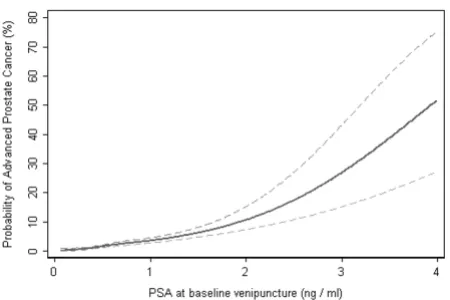
Using the Bayesian approach described above, we esti-mated the probability of advanced prostate cancer at the time of diagnosis for different levels of total PSA in the plasma obtained from the 142 cases (88%) and 382 con-trols who were ages 44–50 at baseline venipuncture (Fig-ures 2 and 3). For those with total PSA 0.5–1 ng/ml, the risk of advanced prostate cancer was 2–4%, close to the population mean risk of 3.5%. Subjects with a total PSA of 2 ng/ml had a risk of advanced prostate cancer of 12%, more than three times the population mean. Sixty-nine (49%) of advanced cancers occurred among the 10% of subjects with the highest PSA levels (total PSA at least 1.2 ng/ml), while 94 (66%) occurred among the top 20% (total PSA at least 0.9 ng/ml).
Our results were based on the pre-specified definition of advanced prostate cancer (skeletal metastasis or clinical stage at least T3 at the time of prostate cancer diagnosis). To check whether our results were sensitive to the defini-tion of advanced cancer used, we performed addidefini-tional analyses with two different definitions. The first was more inclusive, defining advanced prostate cancer as any of skeletal metastasis, clinical stage at least T3, lymph node involvement or WHO grade III at the time of prostate can-cer diagnosis. The second was less inclusive and
consid-ered only presence of skeletal metastasis at diagnosis. This did not have a major effect on any of the results: some key statistics are shown in Table 5 for each definition of advanced prostate cancer.
Discussion
The Malmö Preventive Medicine cohort was enrolled before the PSA era, and there was no subsequent recom-mendation for prostate cancer screening in this region. The rate of PSA testing has accordingly remained very low up to our current study endpoint [2]. Furthermore, the participation rate (74%) was high and case ascertainment was complete owing to the excellent coverage of the Swed-ish National Cancer Registry [13]. Our study is therefore not subject to the sort of verification and selection biases commonly associated with prostate cancer studies and provides a 'natural experiment' to test hypotheses con-cerning the long-term prediction of prostate cancer.
Our results describe the relationship between prostate kal-likreins in blood plasma obtained at a single occasion at age 50 or below and the diagnosis of advanced prostate cancer up to 25 years later. We found that prostate-specific kallikreins were significantly increased decades before the clinical manifestation of advanced disease. The predictive accuracy of total PSA was very high (AUC 0.791). Mod-estly increased levels of total PSA in the ranges of 1.01–2 ng/ml and 2.01–3 ng/ml were associated with 7- and 22-fold elevated odds of advanced prostate cancer, respec-tively. The majority of advanced cancers (66%) occurred in the 20% of the population with the highest PSA levels. It is also noteworthy that our study of archived blood samples is taken from a highly representative, population-based sample. There was no selection population-based on test results
Predicted probability of advanced prostate cancer by popula-tion-based centiles of PSA measured at age 44–50
Figure 3
Predicted probability of advanced prostate cancer by popula-tion-based centiles of PSA measured at age 44–50. Dashed lines indicate the 95% CIs.
Table 4: Odds ratio for advanced prostate cancer diagnosis, calculated according to delay from baseline venipuncture to diagnosis. Odds ratios are for each 1 ng/ml increase in PSA.
Delay to diagnosis Cases Odds ratio 95% CI p-value
≤15 years 59 4.30 2.40, 7.72 <0.0005
16–19 years 63 3.05 1.85, 5.04 <0.0005
≥20 years 39 11.0 3.09, 38.9 <0.0005
All 161 4.29 2.98, 6.18 <0.0005
Predicted probability of advanced prostate cancer by the total PSA level in anti-coagulated plasma measured at age 44– 50
Figure 2
(indeed, this would not have been possible, as the PSA test was not available during the period when bloods were drawn). As such, we can be confident that our reported test characteristics reflect those of the population to which we would like to apply our results.
These results confirm our previous finding of an associa-tion between PSA levels and subsequent prostate cancer, and suggest that this association is not restricted to cancers unlikely to affect a man's survival or quality of life. Indeed, we found total PSA to be more strongly predictive of subsequent advanced prostate cancer (AUC 0.791) than of any prostate cancer (AUC 0.762). This illustrates the rule of thumb that it is easier to predict more extreme medical events. Free-to-total PSA ratio and hK2, two markers associated more specifically with malignancy, were far less predictive than total PSA, a marker associated with both benign and malignant prostate conditions. This suggests that PSA elevations in cases below or at age 50 may be related to a premalignant state, or to a carcino-genic process, rather than the presence of malignant cells in the prostate.
A possible limitation of our study is that any definition of clinically significant prostate cancer is open to question. However, we repeated our analysis altering our definition of advanced cancer to be more restrictive (only patients with skeletal metastases at diagnosis) or more inclusive (skeletal metastases or clinical stage al least T3 or positive lymph nodes or grade III at time of diagnosis) and found no important differences in our results. It might also be argued that death from prostate cancer would be the most appropriate endpoint, but owing to a small number of events in our current study cohort, statistical analysis would have been underpowered. Future studies will address the relationship between kallikreins and death from prostate cancer as the cohort matures.
Previously, both our group and other investigators have studied the association between PSA level in the blood and the long-term risk of being diagnosed with any stage
of prostate cancer, but did not specifically address whether these findings were applicable to diagnosis of advanced tumors [1,14-16]. Our findings reconfirm previ-ous analyses suggesting that prostate cancer can be pre-dicted many years before it is diagnosed and that we might therefore reduce prostate cancer mortality by inter-vening at an early stage when curative treatment is still possible.
Current US prostate screening guidelines recommend that all men over age 50 who have a life expectancy of at least 10 years should have an annual digital examination and PSA test. Results from ongoing screening trials show that these recommendations result in diagnosis and over-treatment. For example, the Rotterdam section of the European Randomized Screening Study for Prostate Can-cer have shown that almost 50% of screen-detected can-cers are indolent (organ-confined, Gleason 6 or less, and 0.5 cc or less in volume) and thus unlikely to affect a man's survival or quality of life [17]. Over-treatment is associated not only with high morbidity, such as poor erectile, bowel and urinary function resulting from sur-gery or radiotherapy, but also high healthcare costs. A screening program that focused on those at highest risk of prostate cancer morbidity or mortality might well have a superior benefit-to-harm ratio compared with the current approach of screening all men. One scenario might be to make exceptional efforts to ensure that all men obtain a PSA test in their mid to late forties. Although a man with a PSA elevated above the threshold for biopsy (e.g. 3 ng/ ml) could be referred for immediate biopsy, this would be very rare (~1–2% in the current data set); the primary pur-pose of the early PSA test would be to determine which men should be invited back for regular screening at age 50 and which men advised that PSA screening is unlikely to benefit them.
This study is based on a previously published case-control study in which we attempted to predict the occurrence of prostate cancer at any stage. We did not re-match for this study and hence patients with a prostate cancer diagnosis
Table 5: Sensitivity analyses
Univariate odds ratio (95% CI) Predictive accuracy (AUC)
Definition of advanced cancer
Number of cases/controls
Total PSA (ng/ml)
Free to total PSA (%)
Total PSA (ng/ml)
Free to total PSA (%)
Multivariable model
Metastases or ≥ T3
161/436 4.29 (2.98, 6.18) 0.92 (0.89, 0.95) 0.791 0.641 0.785
Less inclusive* 62/163 3.02 (1.87, 4.90) 0.90 (0.84, 0.95) 0.762 0.674 0.751
More inclusive† 190/512 4.05 (2.89, 5.67) 0.92 (0.89, 0.95) 0.782 0.645 0.780
* Presence of skeletal metastases at time of diagnosis.
were not included in the sample from which controls were selected. We note that kallikrein levels of these 301 partic-ipants are likely to be higher than those of Malmö Preven-tive Medicine participants not diagnosed with prostate cancer, thus inflating differences between cases and con-trols in our current analysis. However, the original Malmö Preventive Medicine cohort contains approximately 21,270 participants who could act as controls, from whom 436 controls were randomly chosen to be included in our current analysis. As there were 462 prostate cancer cases, we would expect prostate cancer patients to com-prise approximately 2% of the control group. Therefore, we conclude that our failure to sample from non-advanced prostate cancer cases is unlikely to have any major effect on the current results.
Conclusion
A PSA level measured at a single occasion in blood drawn at age up to 50 is a very strong predictor of being diag-nosed with advanced prostate cancer up to 25 years later. This raises the possibility that screening for prostate can-cer could be risk-stratified so that men at highest risk are the focus of the most intensive screening efforts.
Abbreviations
AUC, area under the receiver operating characteristic curve; EDTA, ethylenediamine tetraacetic acid; PSA, pros-tate-specific antigen; WHO, World Health Organization
Competing interests
Dr Hans Lilja holds patents for free PSA and hK2 assays.
Authors' contributions
HL is the principal investigator and was responsible for the study design had full access to all data and data anal-yses, and had final responsibility for the decision to sub-mit the manuscript. GB was mainly responsible for the study cohort, the case-control design nested within the study cohort. DU, CB and HL were responsible for meas-uring PSA forms and hK2. DU and TB were responsible for reviewing the patient medical records. AMC and AJV were responsible for all biostatistical analyses and workup. MFO, JAE and PTS actively contributed to all elements of the study. All authors read and approved the final manu-script.
Acknowledgements
We thank Janet Novak, PhD, of Helix Editing for substantive editing of the manuscript. Dr Novak was paid for her work by Memorial Sloan-Kettering Cancer Center. AJV's work on this research was funded by a P50-CA92629 SPORE from the National Cancer Institute. HL was funded by P50-CA92629 SPORE Pilot Project 7 from the National Cancer Institute, Swed-ish Cancer Society project no. 3555, European Union 6th Framework con-tract LSHC-CT-2004-503011 (P-Mark) and Fundacion Federico SA. The funding organizations had no role in study design; in the collection, analysis,
or interpretation of data; in the writing of the manuscript; or in the decision to submit the manuscript for publication.
References
1. Lilja H, Ulmert D, Bjork T, Becker C, Serio AM, Nilsson JA, Abraham-sson PA, Vickers AJ, Berglund G: Long-term prediction of pros-tate cancer up to 25 years before diagnosis of prospros-tate cancer using prostate kallikreins measured at age 44 to 50 years. J Clin Oncol 2007, 25:431-436.
2. Stattin P, Johansson R, Damber JE, Hellstrom M, Hugosson J, Lund-gren R, Varenhorst E, Johansson JE: Non-systematic screening for prostate cancer in Sweden – survey from the National Pros-tate Cancer Registry. Scand J Urol Nephrol 2003, 37:461-465. 3. Haas GP, Barry-Delongchamps N, Jones RF, Chandan V, Serio AM,
Vickers AJ, Jumbelic M, Threatte G, Korets R, Lilja H, de la Roza G: Needle Biopsies on Autopsy Prostates: Sensitivity of Cancer Detection Based on True Prevalence. J Natl Cancer Inst 2007, 99:1484-1489.
4. Sakr WA, Haas GP, Cassin BF, Pontes JE, Crissman JD: The fre-quency of carcinoma and intraepithelial neoplasia of the prostate in young male patients. J Urol 1993, 150:379-385. 5. Quinn M, Babb P: Patterns and trends in prostate cancer
inci-dence, survival, prevalence and mortality. Part I: interna-tional comparisons. BJU Int 2002, 90:162-173.
6. Chodak GW, Vogelzang NJ, Caplan RJ, Soloway M, Smith JA: Inde-pendent prognostic factors in patients with metastatic (stage D2) prostate cancer. The Zoladex Study Group. JAMA
1991, 265:618-621.
7. Varenhorst E, Garmo H, Holmberg L, Adolfsson J, Damber JE, Hell-strom M, Hugosson J, Lundgren R, Stattin P, Tornblom M, Johansson JE: The National Prostate Cancer Register in Sweden 1998– 2002: trends in incidence, treatment and survival. Scand J Urol Nephrol 2005, 39:117-123.
8. The Medical Research Council Prostate Cancer Working Party Inves-tigators Group: Immediate versus deferred treatment for advanced prostatic cancer: initial results of the Medical Research Council Trial. Br J Urol 1997, 79:235-246.
9. Berglund G, Nilsson P, Eriksson KF, Nilsson JA, Hedblad B, Kristen-son H, Lindgarde F: Long-term outcome of the Malmo preven-tive project: mortality and cardiovascular morbidity. J Intern Med 2000, 247:19-29.
10. Ulmert D, Becker C, Nilsson JA, Piironen T, Bjork T, Hugosson J, Ber-glund G, Lilja H: Reproducibility and accuracy of measure-ments of free and total prostate-specific antigen in serum vs plasma after long-term storage at -20 degrees C. Clin Chem
2006, 52:235-239.
11. Rafferty B, Rigsby P, Rose M, Stamey T, Gaines Das R: Reference reagents for prostate-specific antigen (PSA): establishment of the first international standards for free PSA and PSA (90:10). Clin Chem 2000, 46:1310-1317.
12. National Board of Health and Welfare: Cancer Incidence in Sweden 2000 National Board of Health and Welfare, Centre for Epidemiol-ogy; 2002.
13. Mattsson B, Wallgren A: Completeness of the Swedish Cancer Register. Non-notified cancer cases recorded on death cer-tificates in 1978. Acta Radiol Oncol 1984, 23:305-313.
14. Fang J, Metter EJ, Landis P, Chan DW, Morrell CH, Carter HB: Low levels of prostate-specific antigen predict long-term risk of prostate cancer: results from the Baltimore Longitudinal Study of Aging. Urology 2001, 58:411-416.
15. Loeb S, Roehl KA, Antenor JA, Catalona WJ, Suarez BK, Nadler RB: Baseline prostate-specific antigen compared with median prostate-specific antigen for age group as predictor of pros-tate cancer risk in men younger than 60 years old. Urology
2006, 67:316-320.
16. Whittemore AS, Cirillo PM, Feldman D, Cohn BA: Prostate specific antigen levels in young adulthood predict prostate cancer risk: results from a cohort of Black and White Americans. J Urol 2005, 174:872-876. discussion 876.
17. Steyerberg EW, Roobol MJ, Kattan MW, van der Kwast TH, de Kon-ing HJ, Schroder FH: Prediction of indolent prostate cancer: validation and updating of a prognostic nomogram. J Urol
Publish with BioMed Central and every scientist can read your work free of charge "BioMed Central will be the most significant development for disseminating the results of biomedical researc h in our lifetime."
Sir Paul Nurse, Cancer Research UK
Your research papers will be:
available free of charge to the entire biomedical community
peer reviewed and published immediately upon acceptance
cited in PubMed and archived on PubMed Central
yours — you keep the copyright
Submit your manuscript here:
http://www.biomedcentral.com/info/publishing_adv.asp
BioMedcentral
Pre-publication history
The pre-publication history for this paper can be accessed here: