RESEARCH ARTICLE
Tissue-specific chemical profiling
and quantitative analysis of bioactive
components of
Cinnamomum cassia
by combining laser-microdissection
with UPLC-Q/TOF–MS
Wenwen Zhou
1,2, Zhitao Liang
2, Ping Li
1, Zhongzhen Zhao
2*and Jun Chen
1*Abstract
Background: Cinnamomi Cortex, the dried stem bark of Cinnamomum cassia Presl (Rougui in Chinese) has been widely used in traditional Chinese medicine, cooking and perfumery for thousands of years. Traditionally, the Cin-namomi Cortex of thick size is considered to be of good quality; however, there is no scientific data to support this point. Considering that essential oils are the main bioactive components, Cinnamomi Cortex of greater variety and amount essential oils is thought to be of better quality. In this study, laser microdissection coupled with ultra-high performance liquid chromatography-quadrupole/time-of-flight-mass spectrometry (UPLC-Q/TOF–MS) was applied to profile the essential oils in different tissues of Cinnamomi Cortex and to determine if there is a correlation between the essential oil content and the stem bark thickness.
Results: We report the tissue-specific metabolic profiles of different grades of Cinnamomi Cortex. Nineteen chemi-cal components were unequivochemi-cally or tentatively identified in the chromatogram of the test samples. The results indicate that the bioactive components, the essential oils, were mainly present in the phloem.
Conclusion: Phloem thickness is the key character for evaluating the quality of Cinnamomi Cortex. Our results can be of great importance in improving the cultivation, harvesting, and processing of Cinnamomi Cortex, as well as enhancing its effects in clinical applications.
Keywords: Essential oils, Cinnamomum cassia Presl, LMD, UPLC-Q/TOF–MS
© The Author(s) 2018. This article is distributed under the terms of the Creative Commons Attribution 4.0 International License (http://creat iveco mmons .org/licen ses/by/4.0/), which permits unrestricted use, distribution, and reproduction in any medium, provided you give appropriate credit to the original author(s) and the source, provide a link to the Creative Commons license, and indicate if changes were made. The Creative Commons Public Domain Dedication waiver (http://creat iveco mmons .org/ publi cdoma in/zero/1.0/) applies to the data made available in this article, unless otherwise stated.
Background
Cinnamomi Cortex, is the dried stem bark of Cin-namomum cassia Presl, known as Rougui in Chinese. It has been widely cultivated in Southeast Asia and is commonly used in pharmaceuticals, cooking and cos-metics. Essential oils have been proven to be the main active components of Cinnamomi Cortex [1], with
cinnamaldehyde making up between 17.1 and 87.23% of these oils [2]. Coumarin, cinnamyl alcohol, cinnamic acid and 2-methoxycinnamaldehyde also comprise significant proportions of the essential oils [3]. Previous pharmaco-logical studies have demonstrated that the essential oils of Cinnamomi Cortex have antioxidant, antidiabetic, anti-platelet aggregation and antifungal activities [4–7]. Thus, in this study, five compounds, namely coumarin, cinnamyl alcohol, cinnamic acid, cinnamaldehyde and 2-methoxycinnamaldehyde, were selected as chemical markers for determination.
Currently various specifications of different grades of Cinnamomi Cortex have been found in the herbal market,
Open Access
such as Zhong tong (cylindric as sample RGgxdxzt),
Ban gui (plate-like as sample RGgxpnbg), and Guan gui
(scroll-like or groove shape as sample RGgxpngg). In clinical applications, they are typically used without dis-crimination, but is there a clinical difference? Comparing the chemical composition of different grades will enable us to determine the difference between grades and will help us evaluate whether these differences are significant in terms of applications. Modern laboratory studies have focused on HPLC-based fingerprint chromatography and determination of characteristic components [8–10]. However, evaluating the quality of Cinnamomi Cortex by modern instruments is time-consuming and inconven-ient. Traditionally, the Cinnamomi Cortex of thick size is thought to be of good quality; but there is no scien-tific evidence to support this point. In the present study, various samples of Cinnamomi Cortex of different grades were collected for tissue-specific chemical analysis com-bining laser micro-dissected system (LMD) with ultra-performance liquid chromatography quadrupole time of flight mass spectrometry (UPLC-Q/TOF–MS). Through this study, the relationship between microscopic features and active components can be established; this relation-ship will enable people to evaluate pharmaceutical qual-ity of Cinnamomi Cortex by appearance. The research also provides helpful information that can guide the cul-tivating, collecting and processing of Cinnamomi Cortex for maximum quality in applications.
Experiment section
Plant materials
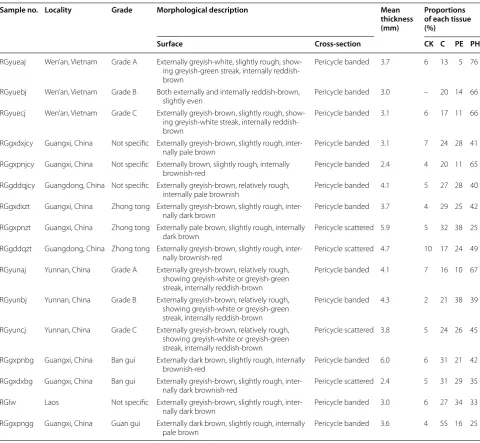
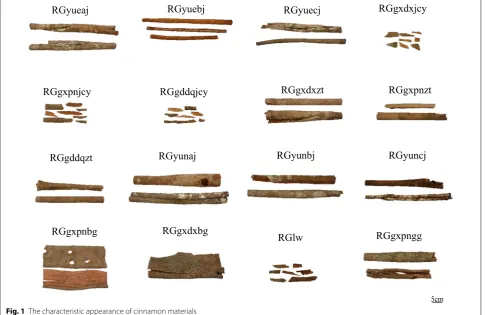
The plant materials were collected from six major culti-vation areas. Table 1 shows the details including sources and morphological descriptions for each sample. Figure 1
shows the characteristic appearance of a sample. All the plant materials were identified by Prof. Zhongzhen Zhao, School of Chinese Medicine, Hong Kong Baptist Univer-sity. The voucher specimens are deposited in the Bank of China (Hong Kong) Chinese Medicines Centre of Hong Kong Baptist University.
Chemicals and reagents
Chemical standards including coumarin, cinnamyl alco-hol, cinnamic acid, cinnamaldehyde and 2-methoxy-cinnamaldehyde were purchased from Shanghai Tauto Biotech Company (Shanghai, China). The purity of each standard was over 98%. Acetonitrile and methanol of HPLC grade were from E. Merck (Darmstadt, Germany), and formic acid of HPLC grade was from Tedia (Fairfield, USA). Water was purified using a Milli-Q water system (Millipore; Bedford, MA, USA).
Materials and instruments
Leica Laser microdissection 7000 system (Leica, Ben-shein, Germany), Agilent 6540 ultra-performance liquid chromatography quadrupole time of flight spectrometer equipped with a mass hunter workstation software (Agi-lent version B.06.00 series, Agi(Agi-lent Technologies, USA), Cryotome (Thermo Shandon As620 Cryotome, Chesh-ire, UK), Ultrasonic instrument (CREST 1875HTAG Ultrasonic Processor, CREST, Trenton, NJ), Centrifuge (Centrifuge 5417R, Eppendorf, Hamburg, Germany), Electronic balance (Mettler Toledo MT5 style), Nonflu-orescent polyethylene terephthalate (PET) microscope steel frame slide (76 × 26 mm, 1.4 μm, Leica
Microsys-tems, Bensheim, Germany), Centrifuge tube (500 μL, 1.5 mL, Leica), HPLC grade vial (1.5 mL, Grace, Hong Kong), glass insert with plastic bottom spring (400 μL, Grace, Hong Kong), Acquity UPLC BEH C18 column (2.1 × 100 mm, 1.7 μm, Waters, USA), C18 pre-column (2.1 × 5 mm, 1.7 μm, Waters, USA).
Sample solution preparations
The dried medicinal materials were firstly softened by infiltrating with water-soaked paper. The softened Cin-namomi Cortex was cut into small sections, fixed by cry-ogen, and then frozen on a − 20 °C cryobar. Serial slices of 40 μm in thickness were cut at − 10 °C. Each cross-sec-tion of tissue was mounted directly to a non-fluorescent polyethylene terephthalate. The slide was exposed under a Leica LMD 7000 microscopic system. Microdissection was conducted by a DPSS laser beam at 349 nm wave-length, aperture of 30, speed of 3, power of 50 μJ and pulse frequency of 1695 Hz under a Leica LMD system at 6.3 × magnification. Four different target tissues, approxi-mately 1 × 106 μm2 per each, were individually separated. The microdissected tissues fell into caps of 500 μL micro centrifuge tubes by gravity. Lastly, the separated tissue part in each cap was transferred to the bottom of the tube by centrifuging for 10 min (12,000 rpm, 17 °C). 100 μL methanol was added into each micro centrifuge tube. The tube was sonicated for 60 min and then centrifuged again for 10 min (12,000 rpm, 17 °C). 90 μL of the supernatant was transferred into a glass insert with plastic bottom spring in a 1.5 mL brown HPLC grade vial and stored at 4 °C before analysis.
Standard solution preparation
cinnamaldehyde, 157.6 μg/mL of 2-methoxycinnamalde-hyde. A series of mixed standard solutions was prepared by dilution with methanol.
Method of UPLC‑Q/TOF–MS
The UPLC-Q/TOF–MS analysis was conducted at room temperature (20 °C). The mobile phase consisted of 0.1% formic acid–water (A) and 0.1% formic acid-acetonitrile (B). The gradient program was optimized as follows: 0–8 min, 5–35%B; 8–21 min, 35–65%B; 21–27 min, 65–100%B; 27–31 min, 100%B; 31–31.1 min, 100–5%B; 31.1–35 min, 5%B. The injection volume was 3 μL for each sample. The flow rate was set at 0.4 mL/min. The
mass spectra was acquired in positive mode with mass to charge ratio (m/z) ranging from 100 to 1700. The opera-tion parameters of the mass spectrometer were set as fol-lows: dry gas temperature, 300 °C; dry gas (N2) flow rate, 8.0 L/min; nebulizer pressure, 40 psi; capillary voltage, 3500 V; nozzle voltage, 500 V; and fragmentor voltage, 120 V. The energies for collision-induced dissociation (CID) for fragmentation were set at 20 and 35 eV.
Method validation
Linearity, limits of detection (LODs), limits of quantifica-tion (LOQs), repeatability, stability, intra-day precision and inter-day precision were assessed. A series of diluted
Table 1 Sample information of Cinnamomum cassia materials
Sample no. Locality Grade Morphological description Mean
thickness (mm)
Proportions of each tissue (%)
Surface Cross‑section CK C PE PH
RGyueaj Wen’an, Vietnam Grade A Externally greyish-white, slightly rough, show-ing greyish-green streak, internally reddish-brown
Pericycle banded 3.7 6 13 5 76
RGyuebj Wen’an, Vietnam Grade B Both externally and internally reddish-brown,
slightly even Pericycle banded 3.0 – 20 14 66
RGyuecj Wen’an, Vietnam Grade C Externally greyish-brown, slightly rough, show-ing greyish-white streak, internally reddish-brown
Pericycle banded 3.1 6 17 11 66
RGgxdxjcy Guangxi, China Not specific Externally greyish-brown, slightly rough,
inter-nally pale brown Pericycle banded 3.1 7 24 28 41
RGgxpnjcy Guangxi, China Not specific Externally brown, slightly rough, internally
brownish-red Pericycle banded 2.4 4 20 11 65
RGgddqjcy Guangdong, China Not specific Externally greyish-brown, relatively rough,
internally pale brownish Pericycle banded 4.1 5 27 28 40
RGgxdxzt Guangxi, China Zhong tong Externally greyish-brown, slightly rough,
inter-nally dark brown Pericycle banded 3.7 4 29 25 42
RGgxpnzt Guangxi, China Zhong tong Externally pale brown, slightly rough, internally
dark brown Pericycle scattered 5.9 5 32 38 25
RGgddqzt Guangdong, China Zhong tong Externally greyish-brown, slightly rough,
inter-nally brownish-red Pericycle scattered 4.7 10 17 24 49
RGyunaj Yunnan, China Grade A Externally greyish-brown, relatively rough, showing greyish-white or greyish-green streak, internally reddish-brown
Pericycle banded 4.1 7 16 10 67
RGyunbj Yunnan, China Grade B Externally greyish-brown, relatively rough, showing greyish-white or greyish-green streak, internally reddish-brown
Pericycle banded 4.3 2 21 38 39
RGyuncj Yunnan, China Grade C Externally greyish-brown, relatively rough, showing greyish-white or greyish-green streak, internally reddish-brown
Pericycle scattered 3.8 5 24 26 45
RGgxpnbg Guangxi, China Ban gui Externally dark brown, slightly rough, internally
brownish-red Pericycle banded 6.0 6 31 21 42
RGgxdxbg Guangxi, China Ban gui Externally greyish-brown, slightly rough,
inter-nally dark brownish-red Pericycle scattered 2.4 5 31 29 35
RGlw Laos Not specific Externally greyish-brown, slightly rough,
inter-nally dark brown Pericycle banded 3.0 6 27 34 33
RGgxpngg Guangxi, China Guan gui Externally dark brown, slightly rough, internally
mixed standard solutions was analyzed subsequently from low to high concentration for linearity, LODs and LOQs. The phloem of RGyueaj was selected for validating the method’s repeatability and stability. Repeatability was evaluated by six replicated analyses of the phloem at the similar locations in six tissue slices. Stability was tested on one sample solution at 0, 12, 24, 36, 48 h. Intra-day precision was performed by analyzing five replications of the mixed standard solution in 1 day while inter-day pre-cision was examined by analyzing three replications of the solution in three consecutive days.
Results and discussion
Microscopic examination and dissection by LMD
As shown under the normal light and fluorescence mode (Fig. 2), the transverse section of Cinnamomi Cortex could be divided into four portions: cork (CK), cortex (C), pericycle (PE) and phloem (PH). Cork consists of several layers of cells and emits bluish-grey fluorescence. Cortex has a scattering of stone cells. Dark brown fluo-rescence was emitted from cortex to phloem, while a bright blue color was emitted from the pericycle. Peri-cycle was arranged in an interrupted ring. Phloem was broad with rays 1–2 rows of cells wide. Since different
tissues possessed various features and could be distin-guished under fluorescence mode, each separated tissue was dissected at the size of about 1,000,000 μm2 by LMD.
5cm
RGyueaj RGyuebj RGyuecj RGgxdxjcy
RGgxpnjcy RGgddqjcy RGgxdxzt RGgxpnzt
RGgddqzt RGyunaj RGyunbj RGyuncj
RGgxpnbg RGgxdxbg RGlw RGgxpngg
Fig. 1 The characteristic appearance of cinnamon materials
200μm
Cortex
Phloem Pericycle Cork
a b
Tissue‑specific chemical profiling
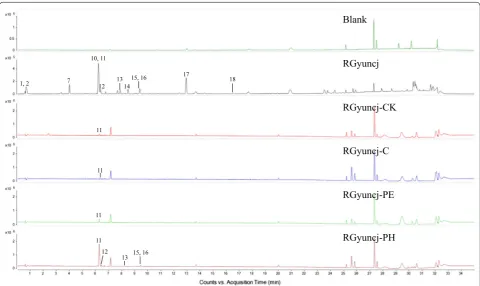
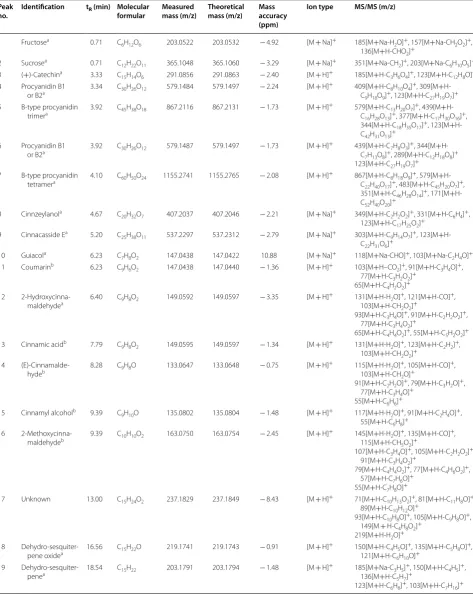
Tissue-specific chemical profiles were obtained as base peak chromatograms by UPLC-Q/TOF–MS (repre-sentative chromatograms are showed in Fig. 3). A total of 19 peaks were unequivocally or tentatively identi-fied in the chromatogram of the medicinal material sample RGyuncj by comparing their retention times, m/z of molecular ions and/or fragment ions with stand-ards or reported references [2, 11–16]. Five peaks were positively identified. Peaks 11, 13, 14, 15 and 16 were unambiguously identified as coumarin (147.0438 m/z, [M + H]+), cinnamic acid (149.0595 m/z, [M + H]+),
cinnamaldehyde (133.0647 m/z, [M + H]+), cinnamyl
alcohol (135.0802 m/z, [M + H]+) and
2-methoxycin-namaldehyde (163.0750 m/z, [M + H]+), respectively. 13
peaks were tentatively identified by comparison of their molecular ions of [M + H]+ or [M + Na]+ from literature
reports. The detailed results are shown in Table 2.
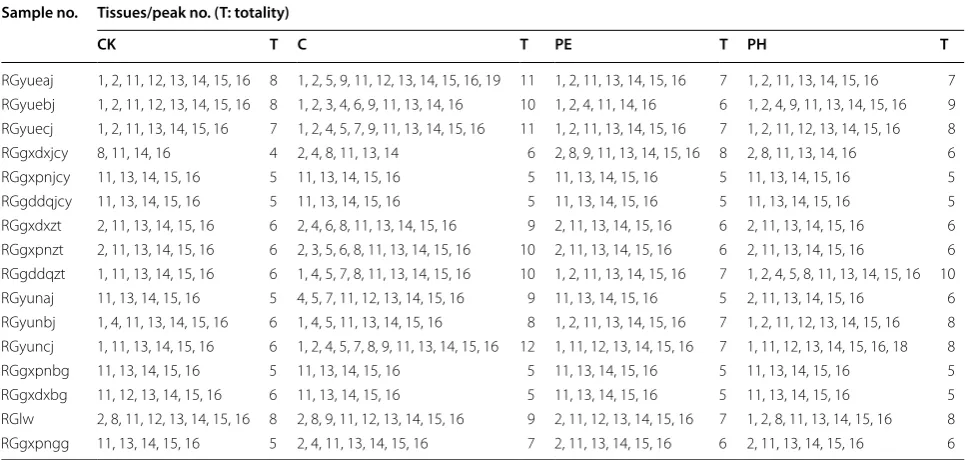
As seen from Table 3, peak 10 couldn’t be detected in any tissue of any sample. It can be assumed that the content of peak 10 is below LOD in herbal tissues. The totality of chemicals in cortex (5–12 peaks) and phloem (5–10 peaks) was slightly greater than those in cork (4–8 peaks) and pericycle (5–8 peaks). Peaks 11, 13, 14, 15, 16, namely coumarin, cinnamic acid, cinnamaldehyde, cin-namyl alcohol and 2-methoxycinnamaldehyde, could be
detected in almost every tissue. Distinctly, the areas of these peaks were larger than those of other chemicals. Therefore, further quantitative analysis of them was car-ried out.
Quantification of essential oils in various tissues
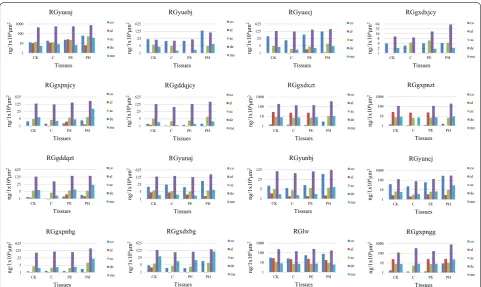
The results of method validation are presented in Table 4. The regression equation for each compound was calcu-lated in the form of y = ax + b, where y and x were peak area and amount of compound injected, respectively. Each calibration curve possessed good linearity with correlation coefficients (r2) ≥ 0.9953 within the selected range. The LODs and LOQs were determined at sig-nal-to-noise (S/N) ratios of 3 and 10, respectively. The repeatability ranged from 5.34 to 27.56%. The RSD value of stability was less than 11.66%, indicating that the sta-bility of current method in this study was acceptable. The above assay results indicate that this developed method is reproducible, precise and sensitive enough for tissue-spe-cific determination of five analytes in Cinnamomi Cortex. The results of quantitative analysis (Additional file 1: Table S1 and Fig. 4) demonstrated that the content of cin-namaldehyde was much higher than other chemicals. Cinnamaldehyde was concentrated in phloem except for sample RGlw, where it was most abundant in the pericy-cle. 2-methoxycinnamaldehyde showed the same pattern
Blank
RGyuncj
RGyuncj-CK
RGyuncj-C
RGyuncj-PE
RGyuncj-PH
11
11
11 12
13 15, 16 11
10, 11
15, 16
7 13
1, 2 12 14 18
17
Table 2 Chemical characterization of medicinal material sample of RGyuncj by UPLC-Q/TOF–MS
Peak
no. Identification tR (min) Molecular formular Measured mass (m/z) Theoretical mass (m/z) Mass accuracy (ppm)
Ion type MS/MS (m/z)
1 Fructosea 0.71 C
6H12O6 203.0522 203.0532 − 4.92 [M + Na]+ 185[M+Na-H2O]+, 157[M+Na-CH2O2]+, 136[M+H-CHO2]+
2 Sucrosea 0.71 C
12H22O11 365.1048 365.1060 − 3.29 [M + Na]+ 351[M+Na-CH2]+, 203[M+Na-C6H10O5]+ 3 (+)-Catechina 3.33 C
15H14O6 291.0856 291.0863 − 2.40 [M + H]+ 185[M+H-C3H6O4]+, 123[M+H-C12H8O]+ 4 Procyanidin B1
or B2a 3.34 C30H26O12 579.1484 579.1497 − 2.24 [M + H]
+ 409[M+H-C
8H10O4]+, 309[M+ H-C9H18O9]+, 123[M+H-C27H19O7]+ 5 B-type procyanidin
trimera 3.92 C45H38O18 867.2116 867.2131 − 1.73 [M + H]
+ 579[M+H-C
13H20O7]+, 439[M+ H-C16H28O13]+, 377[M+H-C17H30O16]+, 344[M+H-C18H35O17]+, 123[M+ H-C42H31O13]+
6 Procyanidin B1
or B2a 3.92 C30H26O12 579.1487 579.1497 − 1.73 [M + H]
+ 439[M+H-C
7H8O3]+, 344[M+ H-C7H13O8]+, 289[M+H-C12H18O8]+ 123[M+H-C27H19O7]+
7 B-type procyanidin
tetramera 4.10 C60H50O24 1155.2741 1155.2765 − 2.08 [M + H]
+ 867[M+H-C
8H18O9]+, 579[M+ H-C22H40O17]+, 483[M+H-C45H20O7]+, 351[M+H-C46H28O14]+, 171[M+ H-C52H40O20]+
8 Cinnzeylanola 4.67 C
20H32O7 407.2037 407.2046 − 2.21 [M + Na]+ 349[M+H-C2H2O2]+, 331[M+H-C6H4]+, 123[M+H-C17H25O2]+
9 Cinnacasside Ea 5.20 C
25H38O11 537.2297 537.2312 − 2.79 [M + Na]+ 303[M+H-C9H14O7]+, 123[M+ H-C22H31O6]+
10 Guiacola 6.23 C
7H8O2 147.0438 147.0422 10.88 [M + Na]+ 118[M+Na-CHO]+, 103[M+Na-C2H4O]+
11 Coumarinb 6.23 C
9H6O2 147.0438 147.0440 − 1.36 [M + H]+ 103[M+H–CO2]+, 91[M+H-C3H4O]+, 77[M+H-C3H2O2]+
65[M+H-C4H2O2]+ 12
2-Hydroxycinna-maldehydea 6.40 C9H8O2 149.0592 149.0597 − 3.35 [M + H]
+ 131[M+H-H
2O]+, 121[M+H-CO]+, 103[M+H-CH2O2]+
93[M+H-C3H4O]+, 91[M+H-C2H2O2]+, 77[M+H-C3H4O2]+
65[M+H-C4H4O2]+, 55[M+H-C5H2O2]+ 13 Cinnamic acidb 7.79 C
9H8O2 149.0595 149.0597 − 1.34 [M + H]+ 131[M+H-H2O]+, 123[M+H-C2H2]+, 103[M+H-CH2O2]+
14
(E)-Cinnamalde-hydeb 8.28 C9H8O 133.0647 133.0648 − 0.75 [M + H]
+ 115[M+H-H
2O]+, 105[M+H-CO]+, 103[M+H-CH2O]+
91[M+H-C2H2O]+, 79[M+H-C3H2O]+, 77[M+H-C3H4O]+
55[M+H-C6H6]+ 15 Cinnamyl alcoholb 9.39 C
9H10O 135.0802 135.0804 − 1.48 [M + H]+ 117[M+H-H2O]+, 91[M+H-C2H4O]+, 55[M+H-C6H8]+
16
2-Methoxycinna-maldehydeb 9.39 C10H10O2 163.0750 163.0754 − 2.45 [M + H]
+ 145[M+H-H
2O]+, 135[M+H-CO]+, 115[M+H-CH5O2]+
107[M+H-C3H4O]+, 105[M+H-C2H2O2]+, 91[M+H-C3H4O2]+
79[M+H-C4H4O2]+, 77[M+H-C4H6O2]+, 57[M+H-C7H6O]+
55[M+H-C7H8O]+
17 Unknown 13.00 C15H24O2 237.1829 237.1849 − 8.43 [M + H]+ 71[M+H-C10H13O2]+, 81[M+H-C11H8O]+, 89[M+H-C10H12O]+
93[M+H-C10H8O]+, 105[M+H-C9H8O]+, 149[M + H-C4H8O2]+
219[M+H-H2O]+ 18
Dehydro-sesquiter-pene oxidea 16.56 C15H22O 219.1741 219.1743 − 0.91 [M + H]
+ 150[M+H-C
4H5O]+, 135[M+H-C5H8O]+, 121[M+H-C6H10O]+
19
Dehydro-sesquiter-penea 18.54 C15H22 203.1791 203.1794 − 1.48 [M + H]
+ 185[M+Na-C
3H5]+, 150[M+H-C4H5]+, 136[M+H-C5H7]+
123[M+H-C6H8]+, 103[M+H-C7H16]+
a Identified by previous literature reports
of occurrence as cinnamaldehyde. Cinnamic acid was enriched in pericycle of sample RGgxdxjcy and in cork of samples RGgxpnzt and RGlw as well as in phloem of other samples. For all samples, phloem contained the highest amount of coumarin. Cinnamyl alcohol showed the high-est content in phloem of one sample, in pericycle of six samples and in cork of others; thus, for this component, the pattern of distribution was difficult to determine. The
irregularity may be due to its low content and/or its ten-dence to esterify easily.
Conclusions
In the present study, an approach using LMD combined with UPLC-Q/TOF–MS was established to map the dis-tribution of essential oils in tissues of various specifica-tions of Cinnamomi Cortex. It is the first report with
Table 3 The chromatographic peaks found in the chromatograms of each tissue in different specifications of cinnamon
Sample no. Tissues/peak no. (T: totality)
CK T C T PE T PH T
RGyueaj 1, 2, 11, 12, 13, 14, 15, 16 8 1, 2, 5, 9, 11, 12, 13, 14, 15, 16, 19 11 1, 2, 11, 13, 14, 15, 16 7 1, 2, 11, 13, 14, 15, 16 7 RGyuebj 1, 2, 11, 12, 13, 14, 15, 16 8 1, 2, 3, 4, 6, 9, 11, 13, 14, 16 10 1, 2, 4, 11, 14, 16 6 1, 2, 4, 9, 11, 13, 14, 15, 16 9 RGyuecj 1, 2, 11, 13, 14, 15, 16 7 1, 2, 4, 5, 7, 9, 11, 13, 14, 15, 16 11 1, 2, 11, 13, 14, 15, 16 7 1, 2, 11, 12, 13, 14, 15, 16 8
RGgxdxjcy 8, 11, 14, 16 4 2, 4, 8, 11, 13, 14 6 2, 8, 9, 11, 13, 14, 15, 16 8 2, 8, 11, 13, 14, 16 6
RGgxpnjcy 11, 13, 14, 15, 16 5 11, 13, 14, 15, 16 5 11, 13, 14, 15, 16 5 11, 13, 14, 15, 16 5
RGgddqjcy 11, 13, 14, 15, 16 5 11, 13, 14, 15, 16 5 11, 13, 14, 15, 16 5 11, 13, 14, 15, 16 5
RGgxdxzt 2, 11, 13, 14, 15, 16 6 2, 4, 6, 8, 11, 13, 14, 15, 16 9 2, 11, 13, 14, 15, 16 6 2, 11, 13, 14, 15, 16 6 RGgxpnzt 2, 11, 13, 14, 15, 16 6 2, 3, 5, 6, 8, 11, 13, 14, 15, 16 10 2, 11, 13, 14, 15, 16 6 2, 11, 13, 14, 15, 16 6 RGgddqzt 1, 11, 13, 14, 15, 16 6 1, 4, 5, 7, 8, 11, 13, 14, 15, 16 10 1, 2, 11, 13, 14, 15, 16 7 1, 2, 4, 5, 8, 11, 13, 14, 15, 16 10
RGyunaj 11, 13, 14, 15, 16 5 4, 5, 7, 11, 12, 13, 14, 15, 16 9 11, 13, 14, 15, 16 5 2, 11, 13, 14, 15, 16 6
RGyunbj 1, 4, 11, 13, 14, 15, 16 6 1, 4, 5, 11, 13, 14, 15, 16 8 1, 2, 11, 13, 14, 15, 16 7 1, 2, 11, 12, 13, 14, 15, 16 8 RGyuncj 1, 11, 13, 14, 15, 16 6 1, 2, 4, 5, 7, 8, 9, 11, 13, 14, 15, 16 12 1, 11, 12, 13, 14, 15, 16 7 1, 11, 12, 13, 14, 15, 16, 18 8
RGgxpnbg 11, 13, 14, 15, 16 5 11, 13, 14, 15, 16 5 11, 13, 14, 15, 16 5 11, 13, 14, 15, 16 5
RGgxdxbg 11, 12, 13, 14, 15, 16 6 11, 13, 14, 15, 16 5 11, 13, 14, 15, 16 5 11, 13, 14, 15, 16 5
RGlw 2, 8, 11, 12, 13, 14, 15, 16 8 2, 8, 9, 11, 12, 13, 14, 15, 16 9 2, 11, 12, 13, 14, 15, 16 7 1, 2, 8, 11, 13, 14, 15, 16 8
RGgxpngg 11, 13, 14, 15, 16 5 2, 4, 11, 13, 14, 15, 16 7 2, 11, 13, 14, 15, 16 6 2, 11, 13, 14, 15, 16 6
Table 4 Method validation results
Analyte Calibration curve Linear range
(ng/mL) r
2 LODs (ng/
mL) LOQs (ng/mL) Repeatability(n = 6, RSD, %) Stability (n = 5, RSD, %)
Precision RSD (%)
Intra‑day
(n = 5) Inter‑day (n = 3)
Coumarin y = 905852x − 26008 51.525–1030.5 0.9981 19.1 56.1 17.43 5.99 3.17 2.81
Cinnamyl
alcohol y = 1486.4x − 350.23 267.6–11339 0.9970 29.0 147.3 27.56 2.03 6.13 32.66
Cinnamic acid y = 66690x − 2038 66.35–1327 0.9982 159.3 334.2 5.34 7.34 4.31 5.27
Cinnamalde-hyde y = 539.3x + 833.7 2615.6–111058 0.9996 513.2 1053.0 10.37 3.40 2.45 30.50
2-Methoxycin-namaldehyde y = 1*10
respect to tissue-specific metabolites in the cortex of an herb. This histochemical study identified Cinnamomi Cortex phloem as the tissue richest in essential oils. Thus, it would be logical to deduce that Cinnamomi Cortex with thick phloem is of better quality as it con-tains more active constituents. In fact, this is consistent with the traditional processing method of removing the outer bark. Our analytical method provides references for evaluating the quality and classifying the grades of Cinnamomi Cortex by thickness of phloem. Further studies can be conducted to explore the factors affect-ing phloem thickness. Therefore, this research can be of great importance in the cultivation, harvesting, process-ing and clinical application of Cinnamomi Cortex.
Authors’ contributions
WZ and ZL initiated and all authors designed the study. WZ carried out the histochemical experiment and drafted the manuscript. PL and ZZ provided technical support. All authors contributed to the data analysis and to finalizing the manuscript. ZZ has made his intellectual contributions in authenticating
Additional file
Additional file 1: Table s1. Contents of essential oils in various tissues of the samples.
the materials. JC contributed her intellectual content for revising the manu-script. All authors read and approved the final manumanu-script.
Acknowledgements
This work was supported by the National Natural Science Foundation of China (NSFC) (Project No. 11475248). We acknowledge Mr. Alan Ho from the School of Chinese Medicine, Hong Kong Baptist University, for his technical assistance. We also acknowledge Shenzhen Tsumura Co. Ltd for the help in sample collection.
Competing interests
The authors declare that they have no competing interests.
Ethics approval and consent to participate
Not applicable.
Publisher’s Note
Springer Nature remains neutral with regard to jurisdictional claims in pub-lished maps and institutional affiliations.
Received: 21 June 2017 Accepted: 5 June 2018
References
1. Zhang GZ, Zhang SN, Meng QH, Wang XD (2009) GC-MS analysis on chemical components of Cortex Cinnamomi and Guipi. Chin J Pharm Anal 29:1256–1259
1 10 100 1000
CK C PE PH
ng/1x1 0 6μm 2 Tissues RGgxpngg co al ac de me 1 10 100 1000
CK C PE PH
ng/1x1 0 6μm 2 Tissues RGlw co al ac de me 1 5 25 125 625
CK C PE PH
ng/1x1 0 6μm 2 Tissues RGgxpnbg co al ac de me 1 5 25 125 625
CK C PE PH
ng/1x1 0 6μm 2 Tissues RGgxdxbg co al ac de me 1 10 100 1000
CK C PE PH
ng/1x1 0 6μm 2 Tissues RGyueaj co al ac de me 1 2 4 8 16 32 64
CK C PE PH
ng/1x1 0 6μm 2 Tissues RGgxdxjcy co al ac de me 1 5 25 125 625
CK C PE PH
ng/1x1 0 6μm 2 Tissues RGyuecj co al ac de me 1 5 25 125 625
CK C PE PH
ng/1x1 0 6μm 2 Tissues RGyuebj co al ac de me 1 5 25 125 625
CK C PE PH
ng/1x1 0 6μm 2 Tissues RGgxpnjcy co al ac de me 1 5 25 125 625
CK C PE PH
ng/1x1 0 6μm 2 Tissues RGgddqjcy co al ac de me 1 10 100 1000
CK C PE PH
ng/1x1 0 6μm 2 Tissues RGgxdxzt co al ac de me 1 10 100 1000
CK C PE PH
ng/1x1 0 6μm 2 Tissues RGgxpnzt co al ac de me 1 5 25 125 625
CK C PE PH
ng/1x1 0 6μm 2 Tissues RGgddqzt co al ac de me 1 5 25 125 625
CK C PE PH
ng/1x1 0 6μm 2 Tissues RGyunaj co al ac de me 1 5 25 125
CK C PE PH
ng/1x1 0 6μm 2 Tissues RGyunbj co al ac de me 1 10 100 1000
CK C PE PH
ng/1x1 0 6μm 2 Tissues RGyuncj co al ac de me
2. Chen PY, Yu JW, Lu FL, Lin MC, Cheng HF (2016) Differentiating parts of Cinnamomum cassia using LC-qTOF-MS in conjunction with principal components analysis. Biomed Chromatogr 30:1449–1457
3. Yuan PF, Shang MY, Cai SQ (2012) Study on fingerprints of chemical constituents of Cinnamomi ramulus and Cinnamomi cortex. Chin J Chin Mater Med 37:2917–2921
4. Mathew S, Abraham TE (2006) Studies on the antioxidant activities of cinnamon (Cinnamonum verum) bark extracts, through various in vitro models. Food Chem 94:520–528
5. Subash Babu P, Prabuseenivasan S, Ignacimuthu S (2007) Cinnamalde-hyde: a potential antidiabetic agent. Phymed 14:15–22
6. An FL, Zhang Z, Xiang CK, Kang LF (2009) Component analysis of essential oils from Cinnamon and their inhibition action against platelet aggregation. Chin Pharm 18:25–27
7. Giordani R, Regli P, Kaloustian J, Portugal H (2006) Potentiation of antifun-gal activity of amphotericin B by essential oil from Cinnamomum cassia. Phytother Res 20:58–61
8. Ding Y, Wu EQ, Liang C, Chen JB, Tran MN, Hong CH, Jang Y, Park KL, Bae K, Kim YH, Kang JS (2011) Discrimination of cinnamon bark and cinnamon twig samples sourced from various countries using HPLC-based finger-print analysis. Food Chem 127:755–760
9. He ZD, Qiao CF, Han QB, Cheng CL, Xu HX, Jiang RW, But PH, Shaw PC (2005) Authentication and quantitative analysis on the chemical profile of cassia bark (Cortex Cinnamomi) by high-pressure liquid chromatography. J Agric Food Chem 53:2424–2428
10. Huang YT, Pan T, Wen J, Tang XY, Sun YS, Chi L, Peng P, Shi RB (2015) Quality representation and correlation analysis of the characteristic spectrum of Rougui based on drug system. J Beijing Univ Tradit Chin Med 38:344–350
11. Wei L, Song YL, Guo XY, Tu PF, Jiang Y (2014) Habitat differentiation and degradation characterization of Cinnamomi Cortex by 1H NMR spectroscopy coupled with multivariate statistical analysis. Food Res Int 67:155–162
12. Shan B, Cai YZ, Brooks JD, Corke H (2007) Antibacterial properties and major bioactive components of Cinnamon Stick (Cinnamomum burman-nii): activity against foodborne pathogenic bacteria. J Agric Food Chem 55:5484–5490
13. Chen P, Sun JH, Ford P (2014) Differentiation of the four major species of cinnamons (C. burmannii, C. verum, C. cassia, and C. loureiroi) using a flow injection mass spectrometric (FIMS) fingerprinting method. J Agric Food Chem 62:2516–2521
14. Liao SG, Yuan T, Zhang C, Yang SP, Wu Y, Yue JM (2009) Cinnacassides A-E, five geranylphenylacetate glycosides from Cinnamomum cassia. Tetrahe-dron 65:883–887
15. Anderson RA, Broadhurst CL, Polansky MM, Schmidt WF, Khan A, Flanagan VP, Schoene NW, Graves DJ (2004) isolation and characterization of polyphenol type-A polymers from cinnamon with insulin-like biological activity. J Agric Food Chem 52:65–70