International Journal of Green Pharmacy • Jul-Sep 2017 (Suppl) • 11 (3) | S502
Comparative characteristics of
productivity elements among film and
huskless forms of oat
Magharamov Bashir Gadisovich
1, K. U. Kurkiev
2, M. G. Muslimov
3,
N. S. Taimazova
3, G. I. Arnautova
31Department of Exploitation, Repair of Machinery and Mechanization of Animal Husbandry, Dagestan State Agrarian University named after M.M. Dzhambulatov, Makhachkala, Republic of Dagestan, Russia, 2Department of Biological Sciences, Genetic Resource Laboratory, Triticale, Barley and Oats of the Dagestan VIR Experimental Station, Vavilovo Settlement, Derbensky 368600, Republic of Dagestan, Russia, 3Department of Botany, Genetics and Selection, Dagestan State Agrarian University named after M.M. Dzhambulatov, Makhachkala, Republic of Dagestan, Russia
Abstract
Background and Objective: The study of comparative agrobiological characteristics of productivity elements and their conjugation among various sort samples of huskless and filmed forms of oats were carried out under the conditions of the Republic of Dagestan. In the Republic of Dagestan, oat is one of the promising grain fodder and fodder crops. The interest in this culture is explained by high feed qualities of grain, vegetative mass, and protein content. Besides, oat grain is an indispensable food for most types of farm animals and poultry. A particular importance is given to the huskless forms since their grain has great prospects during the production of mixed fodders, dietary, and baby food. Methods: A comparative study of film and huskless forms of oats according to the structural elements that determine the productivity of heads revealed an actual homogeneity according to these indices, which indicates the selection potential of huskless forms. The revealed lag by the weight of 1000 grains points to the need for further study of huskless forms diversity to identify large-grain donors. Results: The study of correlation links showed that the main structural elements of head productivity, of which the final result is developed, that is, a crop, closely interact with each other positively. The revealed negative interrelationships of 1000 grain weight with the head length and the number of grains among huskless oats confirm our conclusion about the expediency of breeding-valuable genotypes search and selection according to this feature. Conclusion: AS-7 was revealed among the studied varieties of oats and among film forms in terms of productivity, and Aldan among huskless forms, both from Kemerovo region.
Key words: Correlation, filminess, naked grain sort, oats, productivity
Address for correspondence: Magharamov Bashir Gadisovich,
Department of Exploitation, Repair of Machinery and Mechanization of Animal Husbandry, Dagestan State Agrarian University named after M.M. Dzhambulatov, 180, M. Hajiyeva Street, Makhachkala, Republic of Dagestan, Russia. Tel.: 89285856659.
Е-mail: [email protected]
Received: 04-07-2017
Revised: 02-08-2017
Accepted: 11-08-2017
INTRODUCTION
I
n the past, oats were mainly forage crops. However, since the end of the last century, this grain culture obtains a new application in world agriculture and becomes more and more food one. This reorientation is conditioned by a high quality of oat grain, high protein content, and a high content of essential amino acids. Oats are practically the only ones from the grain culture, the grain of which contains oil (fat), which gives it a high nutritional value.[1-3]In the Republic of Dagestan, oat is one of the promising grain fodder and fodder crops. The interest in this culture is explained by high
feed quality of grain, vegetative mass, and protein content. Besides, the grain of oats is an indispensable food for most types of farm animals and poultry. A particular importance
ORIGINAL
AR
is given to the huskless forms since their grain has great prospects during the production of mixed fodder, dietary, and baby food.[4]
Huskless oat is a new biologically and energetically valuable product and forage food. Food concentrates made from huskless oats reduce the cost of finished product output and simplify production processes.[5] Along with the traditional
use of huskless oat grain for horse feed, concentrated feeds made from it are used for cattle, pigs, sheep, and birds fattening. Such a concentrate is highly nutritious one and has a high energy value.[6]
However, in terms of yield, huskless oats are inferior to the filmy ones, but since it is believed that low yields are not related to the morphology of a flower and huskless grain genes, it is possible to isolate selection-valuable genotypes that can serve as the basis for crop variety creation.[7,8]
For any agricultural crop, the main cultivation criterion is the yield increase. This problem is solved in two ways. The first one is the creation of varieties with a high potential for productivity and the maximum degree of its implementation, regardless of environment limiting factors. The second way is the improvement of cultivation technologies.[9]
In our republic, the works are performed to study the cultural types of oats comprehensively, most of which are devoted to the study of film forms.[10-14] In this regard, they studied
the comparative agrobiological characteristics concerning the elements of productivity and their conjugation among different sorts of huskless and film oat grain samples in the Republic of Dagestan.
METHODS
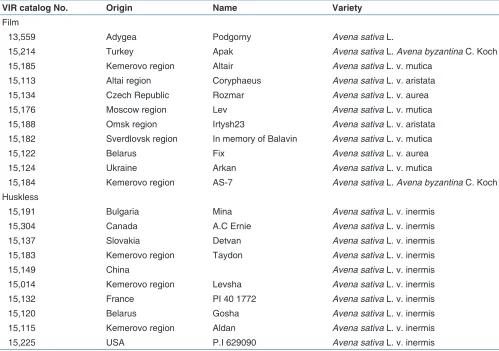
The work was carried out on the experimental field of the Dagestan SAU training farm (2013-2015) within the conditions of irrigated agriculture and the autumn sowing season. The material of research was represented by the varieties of Avena sativa L. oat from the world collection of Vavilov Research Institute of Plant Industry (VIR). A total of 22 varieties of different ecological and geographical origin were studied [Table 1]. Podgorny variety (Л-13559, Adygea), which was distributed over the North Caucasus region, was used by us as a reference one. The laying of field experiments and laboratory - field assessment was carried out in accordance with the methodological instructions of VIR.[15]
The varieties attracted in the study were studied according to the following features: A head length, the number of spikelets in a head, the weight of grains in a head, the weight of grain from a head, and the weight of 1000 grains. They applied the descriptive statistical methods for the mathematical processing of obtained experimental data.[16] The statistical
processing of the experimental data was carried out using the package of statistical programs (MS Excel).
RESULTS
Productivity is a complex integral indicator, formed from a whole set of characteristics. The most important indicators are the following elements of a crop structure: Productive business, the number of spikelets and grains in a head, the weight of grain from a head, and the weight of 1000 grains. Integration, or the combination of selective-valuable feature data, manifested in a genotype to the maximum is an important selection problem. The successful solution of this problem makes it necessary to have the data on the boundaries of trait variability that participate in the creation of genotypes with the desired properties, for certain agroecological conditions. The main resultant complex sign of oats is a head, consisting of a main stem and lateral branches. Productivity does not depend on a head stem length, however, the shape and the location of all organs developing in a head depend on the degree of this characteristic manifestation.
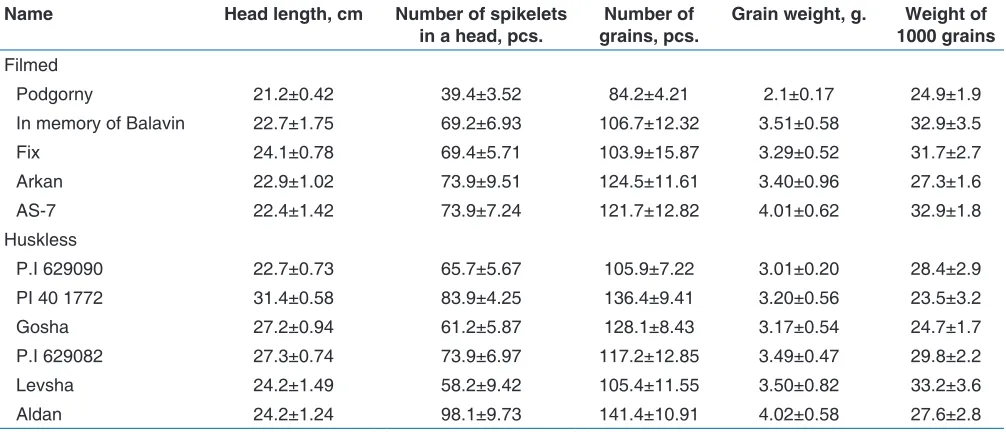
According to our data, an average head length among huskless forms of oats is longer as compared with the film forms of 23.2 and 24.5 cm, respectively, but this difference is insignificant (t-criterion = 1.89). The amplitude of variation in the film forms makes 21.2-25.9 cm, and it is larger among huskless one - 19.4-31.4 [Table 2]. The maximum value of a head length (25.9 cm) among the film forms was represented in the sample of sowing oat Lev from the Moscow region, and the maximum value of a head length among huskless forms was represented by PI 40 1772 from France [Table 3]. The number of spikelets in a head of film samples varied from 33.5 to 76.2 pieces, with the values of this index 44.2-98.1 among huskless oats. On average, the varieties of both groups under study did not differ significantly: 60.7 versus 62.5 pieces (t-criterion = 0.27) [Table 2]. The maximum value of spikelet number among filmed samples was the sample from the Czech Republic Rozmar A. and Aldan from Kemerovo region among huskless ones.
The number of grains in a head among the filmed varieties varies from 44.8 to 124.5 pieces, and the number of huskless oats varies from 62.8 to 151.4, which indicates a strong variability of this feature. The mean values of graininess among huskless grains are higher - 107.2 versus 91.9 units [Table 2]. However, these differences are unreliable (t-criterion = 1.37). The maximum number of grains among film forms was noted in the specimen Arkan from Ukraine, and Aldan from Kemerovo region was revealed among huskless ones.
International Journal of Green Pharmacy • Jul-Sep 2017 (Suppl) • 11 (3) | S504 study are practically the same ones - 2.9 and 3.0 g [Table 2].
The maximum weight of film forms was noted among AS-7 variety from Kemerovo region, whereas Aldan from Kemerovo region stood out among huskless samples.
The weight of 1000 grains among huskless oats is the indicator determining the seed and food significance of a variety. It is an important qualitative indicator of the variety that determines the supply of nutrients, the germination and viability of seeds, food and fodder advantages. In production conditions, the preference is given to the varieties with large or medium grains.[17] The weight index of 1000 grains characterizes the
grain size, as well as its density: The larger the grain and the denser it is, the greater its weight.[18] The increased grain
size is not always associated with higher productivity as a whole.[19] The coarse granulation of huskless oats varies
greatly both inside a spikelet and inside a head, which is more influenced by weather conditions of cultivation, as well as varietal determinism.
The weight of 1000 grains among filmy forms of oats varies from 24.8 to 38.5 g, whereas the weight of huskless forms makes 22.0-33.2 g. On the average, the film forms had a significantly larger grain of 32.0 versus 27.3 (t-criteria = 2.80). The largest grain among the film forms was represented by
Lev sample from Moscow region, in the case of huskless ones it was represented by Levsha from Kemerovo region [Table 3].
As can be seen from the data, there is almost no statistically significant differences between the structural features of a head of different form samples, with the exception of 1000 grain weight. Summarizing the obtained data on the variability of the studied head features, it should be noted that irrespective of the oat species belonging to one form or another, the most variable characteristics were the number of spikelets and grains in a head, as well as the weight of grains from a head. Relatively less volatile indicators - the length of a head and the weight of 1000 grains.
Thus, the actual homogeneity is demonstrated in the structural elements determining the productivity of a head between the studied types of oats which indicates the available selection potential among huskless forms.
The creation of highly productive varieties with a good quality is the ultimate goal of the selection work with all crops including oats. The basis of selection is a sufficiently well-studied genetic material, which includes various variants of all breeding-valuable traits phenotypic manifestations.
Table 1: Varieties of filmy and huskless species of oat involved in the study
VIR catalog No. Origin Name Variety
Film
13,559 Adygea Podgorny Avena sativa L.
15,214 Turkey Apak Avena sativa L. Avena byzantina C. Koch
15,185 Kemerovo region Altair Avena sativa L. v. mutica
15,113 Altai region Coryphaeus Avena sativa L. v. aristata
15,134 Czech Republic Rozmar Avena sativa L. v. aurea
15,176 Moscow region Lev Avena sativa L. v. mutica
15,188 Omsk region Irtysh23 Avena sativa L. v. aristata
15,182 Sverdlovsk region In memory of Balavin Avena sativa L. v. mutica
15,122 Belarus Fix Avena sativa L. v. aurea
15,124 Ukraine Arkan Avena sativa L. v. mutica
15,184 Kemerovo region AS‑7 Avena sativa L. Avena byzantina C. Koch
Huskless
15,191 Bulgaria Mina Avena sativa L. v. inermis
15,304 Canada A.C Ernie Avena sativa L. v. inermis
15,137 Slovakia Detvan Avena sativa L. v. inermis
15,183 Kemerovo region Taydon Avena sativa L. v. inermis
15,149 China Avena sativa L. v. inermis
15,014 Kemerovo region Levsha Avena sativa L. v. inermis
15,132 France PI 40 1772 Avena sativa L. v. inermis
15,120 Belarus Gosha Avena sativa L. v. inermis
15,115 Kemerovo region Aldan Avena sativa L. v. inermis
Virtually, all morphological biological features and properties are significant ones, but a breeder is initially limited by the most important, visually observable characteristics from which a crop is developed, and he subjects the final material to deeper physiological, biochemical, technological, and immunological analysis during the selection and determination of outstanding lines to isolate highly productive adaptive genotypes of good quality. An important
place in a breeder’s work is occupied by the identification of conjugated relationships between yield generating and adaptive traits that ensure the best adaptability to specific agricultural, ecological conditions.
This approach allows to identify a certain group of basic features, the nature of the variability of which is significantly modified by others in a positive or a negative way. The
Table 3: Characteristics of oat varieties stood out by productivity
Name Head length, cm Number of spikelets
in a head, pcs. grains, pcs.Number of Grain weight, g. 1000 grainsWeight of
Filmed
Podgorny 21.2±0.42 39.4±3.52 84.2±4.21 2.1±0.17 24.9±1.9
In memory of Balavin 22.7±1.75 69.2±6.93 106.7±12.32 3.51±0.58 32.9±3.5
Fix 24.1±0.78 69.4±5.71 103.9±15.87 3.29±0.52 31.7±2.7
Arkan 22.9±1.02 73.9±9.51 124.5±11.61 3.40±0.96 27.3±1.6
AS‑7 22.4±1.42 73.9±7.24 121.7±12.82 4.01±0.62 32.9±1.8
Huskless
P.I 629090 22.7±0.73 65.7±5.67 105.9±7.22 3.01±0.20 28.4±2.9
PI 40 1772 31.4±0.58 83.9±4.25 136.4±9.41 3.20±0.56 23.5±3.2
Gosha 27.2±0.94 61.2±5.87 128.1±8.43 3.17±0.54 24.7±1.7
P.I 629082 27.3±0.74 73.9±6.97 117.2±12.85 3.49±0.47 29.8±2.2
Levsha 24.2±1.49 58.2±9.42 105.4±11.55 3.50±0.82 33.2±3.6
Aldan 24.2±1.24 98.1±9.73 141.4±10.91 4.02±0.58 27.6±2.8
Table 2: Comparative characteristics of productivity elements among film and huskless forms of oats
Indicators Head
length, cm spikelets in Amount of a head, pcs.
Amount of grains
in a head, pcs. from a head, gGrain weight 1000 grains, gWeight of
Film
Score 11 11 11 11 11
Average 23.2 60.7 91.9 3.0 3.0
Standard error 0.43 4.25 7.57 0.26 1.32
Standard deviation 1.43 14.11 25.11 0.87 4.37
Minimum 21.2 33.5 44.8 1.4 24.8
Maximum 25.9 76.2 124.5 4.01 38.5
Reliability level (95.0%) 0.96 9.48 16.87 0.58 2.93
Huskless
Score 11 11 11 11 11
Average 25.4 62.5 107.2 2.9 27.3
Standard error 1.08 5.16 8.24 0.20 1.04
Standard deviation 3.60 17.10 27.34 0.67 3.45
Minimum 19.4 44.2 62.8 1.97 22.0
Maximum 31.4 98.1 141.4 4.02 33.2
Reliability level (95.0%) 2.42 11.49 18.37 0.45 2.32
t‑criterion between huskless and film forms at
t‑criterion0.05=2.01
International Journal of Green Pharmacy • Jul-Sep 2017 (Suppl) • 11 (3) | S506 degree of their conjugation and their successful combination
determine the final result. A considerable assistance to breeders can be provided by the source material presented to them with already well-known characteristics of signs about the degree of their connections, that is, the knowledge of characteristic conjugation nature and the peculiarities of their influence on the development of the grain yield allow to perform a more rapid work on the cultivation of new highly productive varieties.
The study of interrelationships between different characteristics of oats is described in the works of a number of researchers,[20-22] where they showed that the number of
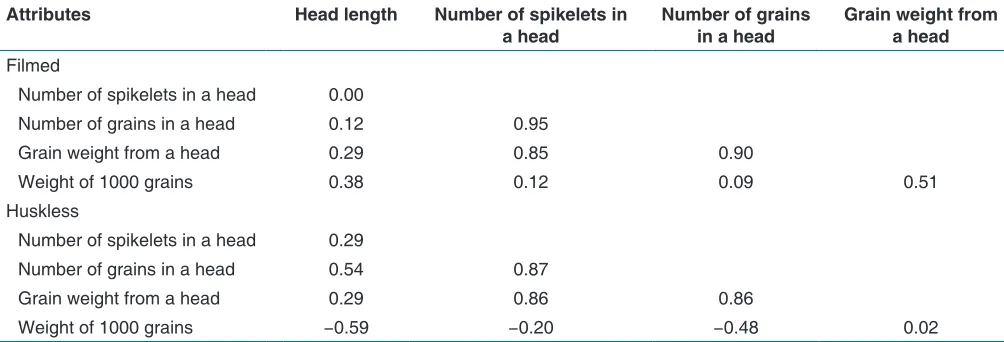
grains is closely related to the number of spikes, and the weight of a grain, as well as with a head productivity. The film and huskless forms of sowing oats were studied in respect of correlation links by the signs of productivity [Table 4]. As can be seen from the data, the positive correlations among film forms (r = 0.38-0.95) are found between a head length and the weight of 1000 grains; the number of spikelets in a head with the number of grains and the weight of grains from a head; The number of grains and the weight of grain from a head; and the weight of grain and coarse grain.
The huskless forms of oats have positive interrelations (r = 0.54-0.87) between the length of a head and the number of grains; the number of spikelets with the number and weight of grain; number of grains with grain weight. Besides, the negative correlations of coarse grain were revealed in this group with a head length (r = −0.59) and the number of grains (r = −0.48).
Thus, the obtained information indicates that if there is a definite relationship between all attributes of oat plants, as well as of any living organism, the degree of their conjugation is different. The main structural elements of a head productivity (of which the final developed result is the yield) are closely correlated positively with each other, which
indicates a sufficiently good study by breeders in terms of selection according to these characteristics, that is, the severity increase of one of which leads to an associated increase of another valuable characteristic. The signs according to which negative correlations are found deserve the same attention. This indicates the necessary ways of a selection work to find and identify valuable genotypes, not burdened by negative dependencies.
CONCLUSION
According to the foregoing, it can be concluded that if there is a definite relationship between all attributes of oat plants, as well as of any living organism, the degree of their conjugation is different. The main structural elements of a head productivity, from which the final result is formed, that is, the yield, are closely correlated positively, which indicates that breeders studied sufficiently well in terms of these characteristics selection, that is, the severity increase of one of which leads to an associated increase of another valuable characteristic. The signs according to which negative correlations are found deserve the same attention which indicates the necessary ways of selection work to search for and identify the valuable genotypes not burdened with negative dependencies.
SUMMARY
Thus, a comparative study of film and huskless forms of oats according to the structural elements that determine the productivity of a head showed an actual homogeneity in terms of these indicators, which indicates the selection potential of the huskless forms. The revealed lag in terms of 1000 grain weight indicates the need for the further study of huskless forms diversity to identify large-grain donors.
The study of correlation links showed that the main structural elements of a head productivity, from which the final result
Table 4: Correlation links of productivity elements among filmed and huskless forms of oats
Attributes Head length Number of spikelets in
a head Number of grains in a head Grain weight from a head
Filmed
Number of spikelets in a head 0.00
Number of grains in a head 0.12 0.95
Grain weight from a head 0.29 0.85 0.90
Weight of 1000 grains 0.38 0.12 0.09 0.51
Huskless
Number of spikelets in a head 0.29
Number of grains in a head 0.54 0.87
Grain weight from a head 0.29 0.86 0.86
was developed, that is, a crop interact with each other closely. The revealed negative interrelationships of 1000 grain weight with the length of a head and the number of grains among huskless oats confirm our conclusion about the expediency of breeding-valuable genotype search and selection according to this feature.
The filmy AC-7 and the huskless Aldan (both from Kemerovo region), which stand out among studied oat varieties by productivity, are of interest both for breeding and for direct introduction into production.
REFERENCES
1. Batalova GA, Moshanova ES. The Influence of Sort Technology Elements on the Yield and Quality of oat Grain, Scientific Support of Agroindustrial Complex Adaptive Intensification Strategy in the North-East of the Non-Chernozem Zone of Russian Federation: Scientific-Practical Conference; 2007. p. 98-101.
2. Frey KJ. Protein in oats. Z. Pflan-zenzuchtung; 1977;78:185-215.
3. Clamont G. In Seed Protein Improv, Cereals and Grain Legumes. Vol. 2. Neuherberg, Vienna: Proceedings of the International Symposium; 1978, 1979. p. 345-56. 4. Khaletsky SP, Soroka SV, Kovtun VM, Soroka LI.
The technology of oat high yield obtaining, Modern resource-saving technologies for the production of crops in Belarus: Collection of scientific materials. Minsk: ICC of the Ministry of Finance; 2007. p. 448.
5. Rodionova NA, Soldatov VN, Khalikov AS, Airapetov GA. The quality problem of huskless oats in breeding. In: Proceedings on Applied Botanics, Genetics and Selection. Vol. 63; 1978. p. 170-2.
6. Peltonen-Sainio P, Kirkkary AM, Jauhianen L. Characterising strengths, weakness, opportunities and threats in producing naked oat as a novel crop for northern growing conditions. Agric Food Sci 2004;13:212-28. 7. Čermak B, Moudry J. Comparison of grain yield and
nutritive value of naked and husked oats. Agricultural 1998;66:90-8.
8. Burrows VD, Molnar SJ, Tinker NA, Marder T, Butler G, Lybaert A. Groat yield of naked and covered oat. Can J Plant Sci 2001;81:727-9.
9. Romanenko AA, Bespalova LA, Kudryashov IN, Ablova IB. New Varietal Policy and Varietal Agricultural Technology of Winter Wheat. Krasnodar; 2005. p. 224.
10. Akhadova ET, Batasheva BA, Kurkiev KU. The stability of oat samples to salt stress. Agrar Russ 2016;5:16-9. 11. Akhadova ET, Kurkiev KU. Perspectives of oat cultural
species cultivation during winter sowing in the South Plain Zone of the Republic of Dagestan. Agroindustrial Complex Dev Issues Reg 2016;26:11-5.
12. Akhadova ET, Kurkiev KU. Winter hardiness of oat cultivated species during the cultivation in Southern Dagestan. Bull Russ Agric Sci 2016;4:31-2.
13. Alderov AA, Magaramov BG. Intraspecific diversity and selection value of oat cultivated species Avena sativa L., Avena byzantin and C. Koch according to vegetation period duration. Russ Agric Sci 2005;6:3-4.
14. Alderov AA, Magaramov BG. Intraspecific diversity of cultivated oat species according to the resistance to powdery mildew, crown rust and lodging. Russ Agric Sci 2004;6:13-4.
15. Lukyanova MV, Rodionova NA, Ya TA. Methodical instructions for the study of the world collection of barley and oats. SPB; 2012. p. 31.
16. Dospekhov BA. Methodology of Field Experience. Moscow: Kolos; 1973. p. 336.
17. Pakul VN, Kozyrenko MA. The development of oat yield in the forest-steppe zone of Western Siberia. Achiev AIC Sci Technol 2009;9:14-5.
18. Dmitriev VE. Main indicators of spring wheat grain technological qualities. Krasnoyarsk: Technological and Seed Quality of Spring Wheat in Krasnoyarsk Territory; 2006. p. 206.
19. Batalova GA, Soldatov VN, Rusakova II. Selection-genetic assessment of oat varieties according to a number of quantitative features. Proceedings of Applied Botany, Genetics and Selection. Vol. 162. SPB, VIR; 2006. p. 115-8.
20. Bogachkov VI, Smishuk NG. Productivity of VIR oat collection samples in the conditions of Western Siberia. Proceedings of Applied Botany, Genetics and Selection. Vol. 129. L. VIR; 1989. p. 121-9.
21. Batalova GA. Oats, technology of cultivation and breeding. Kirov. 2000. p. 205.
22. Lyzlov EB, Magurov PF, Titova KD. The study of oat collection as the initial material for breeding. Moscow: Selection, Seed-Growing and Accelerated Reproduction of Cereals in the Central Regions of Non-Black Earth Region; 1981. p. 192-6.