ISSN 2324-805X E-ISSN 2324-8068 Published by Redfame Publishing URL: http://jets.redfame.com
The Effect of In-service Training of Computer Science Teachers on
Scratch Programming Language Skills Using an Electronic Learning
Platform on Programming Skills and the Attitudes towards Teaching
Programming
Ahmed Alkaria1, Riyadh Alhassan2
1
Ministry of Education, Saudi Arabia
2
College of Education, King Saud University, Saudi Arabia
Correspondence: Riyadh Alhassan, College of Education, King Saud University, Saudi Arabia.
Received: August 20, 2017 Accepted: September 19, 2017 Online Published: September 20, 2017
doi:10.11114/jets.v5i11.2608 URL: https://doi.org/10.11114/jets.v5i11.2608
Abstract
This study was conducted to examine the effect of in-service training of computer science teachers in Scratch language using an electronic learning platform on acquiring programming skills and attitudes towards teaching programming. The sample of this study consisted of 40 middle school computer science teachers. They were assigned into two groups; 20 teachers were in the control group and 20 teachers in the experimental group. The study tools consist of an achievement test in Scratch programming language and a measure of attitudes toward programming instruction. After the experimental treatment at the end of the second semester, the teachers were examined and the results showed that there were statistically significant differences between the achievement test mean scores in favor of the experimental group that trained using an electronic training platform. The results also showed a positive effect on attitudes toward teaching programming for the experimental group.
Keywords: online training, computer science, scratch, electronic learning platform, attitudes
1. Introduction
E-learning is one of the most effective indirect means of education. It is a method of education that enables a teacher or a trainee to obtain the information he/she needs at any time or place (Hamida, 2015). Al-Amriti (2012) and Omran (2012) highlighted the importance of e-learning as it is believed to help to develop various skills among teachers, especially problem-solving skills. E-learning has facilitated communication among different individuals within different communities and cultures and helped students access information at anytime and anywhere (Omran, 2012).
Al-Said (2016) points out that e-learning platforms are based on the use of web technology. They combine e-content management systems with social networking and are designed to help teachers disseminate lessons, objectives, and assignments as well as to implement educational activities. Through various technologies, these platforms also play a leading role in enabling teachers to conduct electronic tests, divide students and distribute grades, and create great opportunities for interaction between students and teachers, as well as allowing parents to see the results of their children (Hamida, 2015).
Due to scientific and technological developments, which led to the emergence of advanced computers and the Internet, it was necessary to simplify the use of computers which, in turn, led to the advent of programming languages. A programming language is a software that helps in coding data to be dealt with in a simplified and an uncomplicated way. Programming languages are those applications or software that help the user create programs for himself through one of the computer languages (Abed, 2007).
the importance of programming languages in that they provide several applications that help a user to see all the details that are related to different programs to input, output and code objects.
There is no doubt that the programming languages of all types and characteristics are the backbone of all computer systems and software, which made the computer software valuable in many areas. Thus, Al-Rashidi, Al-Rashidi, and Al-Maamari (2015) stressed the importance of introducing Scratch programming language in education as it helps to teach beginners the principles of programming in a fast and enjoyable way. It also gives learners great ease in the creation of interactive stories, entertaining games, in addition to the design of animation. As noted by Abu-Naba (2013), Scratch is a language of graphical interface that is based on blocks. This language has been designed so that it can be grouped into configurations that prevent the emergence of programming errors.
Aubari (2014) and Maloney, et al. (2010) assured that the scripting language Scratch has helped develop many innovations and creativity skills. It also encouraged the design of various computer projects to be employed in the real world. Furthermore, it helped to promote problem-solving not only in programming, but in various areas of life, as it helps to verify the learner's logic quickly and easily, and helps the visual structure to refine the process of thinking.
With the great scientific progress witnessed in the present era, the importance of e-learning has emerged. Therefore, computer-related courses have been included in pre-university curricula in many countries of the world. As knowledge and technology have doubled in the era of the information revolution, in-service training has become necessary, by training teachers to choose modern strategies in teaching (Allam, 2012).
1.1 Problem of the Study
There is no doubt that the teacher is the main element of the educational process, and therefore must be prepared well before and during service. To be skillful ones, teachers must be trained on the technological and scientific development in the field of teaching, which necessitates the need to train teachers during the service on the use of technology which provides an educational environment that helps to increase the effectiveness of the educational process. This is suggested by many studies that pointed to the importance of in-service teacher training. Mohammed (2012) emphasized that in-service teacher training is of immense importance as it works to develop the entrepreneurial spirit and independence of teachers, in addition to helping the teacher acquire and reproduce information. It also helps teachers improve their teaching performance by employing modern technology in the field of teaching. Moreover, Abdul-Rahman (2009) emphasized that training teachers in using various computer skills helps teachers greatly in the educational process by increasing their experience considering their learning needs in the field of teaching. Khan (2009) stated that in-service training helps teachers get the necessary information that helps them to take their responsibilities and helps them achieve social and professional integration with faculty as well as developing their professional and academic skills. Abdul-Kader (2011) stressed that in-service teacher training in Saudi Arabia has received remarkable attention in the recent period because of its importance in enriching the teaching process, and playing a significant role in achieving educational goals.
Programming is one of the fundamental sciences in the educational process, especially with the huge technological advances. Learning various programming languages is important in the educational process. According to Al-Jarrah, Al-Mafleh, Al-Rabee'a, and Gwaneh (2014), programming languages are the main bases of computer use in the educational process. It is a set of intangible logical components that are presented in the form of various educational materials that are computer-generated, and interact with the learner and the teacher, thus providing immediate feedback to achieve specific goals. Al-Omrani (2009) emphasizes the need to train in-service teachers on the skills and design of different software and learning programming languages because they leave a positive impact on the performance of the teacher in the use of the different software.
Yusuf, Khalifa, and Ghanaim (2010) indicated that there are many difficulties for students to understand modern programming languages, so it is necessary to learn simplified languages, as this will help to prepare the next generation for the next stage. Al-Tayeb (2008) and Al-Beitar (2013) believe that there is a need to re-evaluate the teachers ' qualification and retraining them on the modern technological systems so that they will be able to keep up with the information revolution. Computer science teachers should also be trained to learn modern programming languages, which is a course that has recently been introduced into the middle school curriculum. However, there are some difficulties that impede the teaching of this course such as the lack of training of teachers in modern programming languages in teacher preparation programs, and there is a number of teachers living in areas far from the training centers. Thus, there is a need to conduct this study, which aims to explore the impact of e-learning across learning platforms on acquiring Scratch language programming skills.
1.2 Objectives of the Study
programming language skills using an electronic learning platform to provide programming skills and attitudes towards teaching Scratch language programming.
1.3Study Questions
The study sought to answer the following questions:
1- What is the effect of in-service training for computer science teachers in the Scratch programming language skills using an electronic learning platform to acquire the theoretical and practical programming skills?
2- What is the effect of in-service training for computer science teachers in the Scratch programming language skills using an electronic learning platform to acquire the theoretical knowledge of programming?
3- What is the impact of the in-service training for computer teachers in the skills of Scratch programming language using an electronic learning platform on their attitudes towards teaching Scratch programming language?
1.4 Significance of the Study
The present study was conducted to address the latest trends in the training of computer science teachers on the Scratch programming language using electronic platforms. In addition, the results of this study will be useful to those who oversee training computer science teachers in raising their efficiency and improving their performance. The findings of this study may assist policy makers, and education officials in the Ministry of Education, such as educational supervisors and curriculum developers, in planning and developing training programs for computer science teachers in the applications of electronic platforms. Moreover, this study could encourage further studies in the future as there is a tendency to gradually spread the technology of electronic platforms in the training programs of educational institutions.
1.5 Definition of Terms
The study included specific terms that were defined as follows:
- In-service Training: Hammad and Al-Bahbahani (2011) define in-service training as "training programs that include several methods aimed at updating teachers' knowledge by introducing them to the latest educational methods and teaching aids." The researchers, on the other hand, present a procedural definition of the in-service training as a program to provide and train computer teachers in public schools on the skills of Scratch programming language to raise the efficiency of teachers in computer curricula.
- Scratch Programming Language: Al-Attas (2014) defines Scratch programming language as one of the interactive web platforms that employ Web technology. The programming language is known as the programming language that computer teachers are trained in using an electronic learning platform.
- Attitudes: A set of beliefs, feelings and desires that are formed in the individual as a result of different factors that direct the behavior negatively or positively toward something (Abu-Jado, 2014). It is defined procedurally as a relatively stable acquired readiness of teachers in the public schools that makes them respond positively or negatively to the programming language, and is measured in terms of the degree achieved by the teacher by responding to the standard items prepared for the purposes of this study.
1.6 Limitations of the Study
The application of this study was limited to the following:
1 - The study was limited to an educational unit in the current computer science course for the middle school third-grade.
2 - The study was conducted with computer teachers in the Northern Border area, Saud Arabia.
3 - The study was implemented during the second semester of the academic year 2016.
2. Theoretical Framework
2.1 In-Service Training
to the changing circumstances imposed by the quick and multiple scientific and cognitive developments, in addition to the teachers’ educational role expected by the community.
2.2 The Need for Training
The need for in-service teacher training is recognized by Kilab (2016) in that in-service training provides the teacher with the opportunity to acquire the knowledge and new skills in her/his field. In-service training helps to change attitudes and gain positive attitudes towards the profession, leading to increased morale and productivity at work. In addition to informing the trainees about everything that is new in the field of professional performance, it increases the sense of belonging of trainees towards their institutions which is the most important element in the development of productivity. In-service training provides the trainee with new horizons in the field of practicing the profession, by highlighting the problems of the profession and its challenges and how to get rid of them or reduce the effects on the performance of work.
Sharif and Sultan (2014) set goals for in-service training for teachers, including training of education professionals in accordance with the standards and rules planned by responsible training agencies. One of the goals is the rehabilitation of those who joined the profession of education and hold scientific qualifications spent in training skills and educational foundations. Another goal of in-service training is the development of sound attitudes of the individuals towards the assessment of the value of educational and administrative work. The continuous training of teachers, managers, and all professionals is consistent with the concept of sustainable education and is developed by means of self and group, research practice and the contribution to educational workshops, seminars, field studies, and others. The training also envisages teachers and managers with the problems of the existing educational system, clarifying the problems of school and classrooms, and ways of solving them and informing teachers of their roles that contribute to that solution.
The Arab Bureau of Education for the Gulf states (2011) emphasized that the objectives of in-service teacher training are classified in two forms: First, the skill objectives: which are related to the teacher's acquisition of the knowledge, values, and attitudes necessary to develop their performance within the classroom. Second, the technical objectives which are related to the practical performance of teachers to reach the desired levels of performance for various tasks.
It can be said that the goal of in-service training is to raise the adequacy of teachers to ensure the teachers keep abreast of the latest ideas and methods related to the content of the profession.
2.3 Scratch Software
Scratch is a simple programming environment designed primarily for beginners and developed by the Lifelong Kindergarten group at the Massachusetts Institute of Technology's Media Lab. It aims at developing creativity and innovation for children and adults who are not experienced in this field. Scratch allows its users to create their own games and interactive stories through a simple open source non-commercial scripting language that uses graphical objects instead of the complex codes that are commonly used in other programming languages. This language is more like the game programming language (Yusuf, et al., 2010).
The importance of Scratch exists in its ability to overcome the difficulties posed by other programming languages, which make most people avoid using them despite their importance; thus, Scratch develops the creativity and innovation for beginners and encourages them to design their own projects without facing a technical obstacle. In addition, the early and simplified learning of this type of programming will prepare students for the secondary stages to understand programming, especially object-oriented programming, which most of them find great difficulties in understanding (Al-Khabaz, Al-Fawzan, Issa, Shaltout, & Suleiman, 2011).
On the other hand, Scratch language helps students acquire basic programming concepts such as loops and conditional statements as well as more complex concepts such as objects and blocks, as well as important mathematical concepts such as coordinates, variables, and random numbers, in an interesting way. In addition, Scratch gives learners the basic skills of analysis, communication, collaboration and lifelong learning, which are the essential skills for future success and in response to the requirements of a knowledge economy (Yousif et al., 2010).
2.4 Applications of Scratch in the Educational Process
The project was transferred to the Arabic language by a team from the College of Information Technology at the University of the United Arab Emirates, in cooperation with a group of specialists in the Syrian Information Olympiad. Thus, it has become possible to change the language of program sections in the program into Arabic. It also has a website that fully supports Arabic (Al-Khabaz et al., 2011).
2.5 E-Learning Platforms
E-learning refers to the reliance on modern technologies to provide the educational content to students in an effective manner. E-learning is characterized by efficiency, economic cost and its great potential to enhance the learning of students, in addition to providing an exciting and interactive educational environment for each of the teachers. Furthermore, students are eliminated from the determinants of time and space and allowed to learn considering their abilities and cognitive levels (Abedi Kargiban & Kaffash, 2011).
The rapid developments in the field of computers and communications have contributed to changing the visions of educational institutions regarding educational programs. These developments came at a time when traditional programs were unable to meet market demands of new and overlapping disciplines. Such disciplines require qualified educational and support staff that are difficult to provide. Similarly, the high cost of education has become an obstacle for many who wish to complete their education, especially those with low income. This has encouraged many educational institutions to create online e-learning programs that allow students to complete their studies at their spare time and from anywhere connected to the global network (Al-Salloum & Radwan, 2011).
In addition, E-learning refers to a wide range of processes and applications designed to deliver learning through electronic means, from the Internet and video conferencing, and may be implemented synchronously in the sense that there is a specific time to broadcast the learning material where students must be online at the same time or as an asynchronous process that allows students to choose the right time to access the network to interact with the learning material and the activities that the teacher publishes online (Edwina, 2013).
According to Bani-Hamad (2016), e-learning is based on providing interactive learning content to the learner. The learner's electronic content is presented through a range of multimedia such as written and spoken texts, written drawings, still images, animations, and sound effects. The content is designed in the form of digital objects. These objects together form the subject matter (lesson). The role of the multimedia is not simply to provide content to the learner interactively, but also to play a role in giving learners the opportunity to choose what they want to learn at the time they want.
3. Previous Studies
One of the previous studies in this field was the Lambert, Gong, and Cuper’s, (2015) study that aimed to identify the impact of a course in technological education designed according to ISTE NETS-T standards to recognize trainees who are trained in their ability to use technology education and their attitudes towards it. It also investigated the effect of the academic level in the college and the level of experience in the use of technology in their attitudes toward technological education. The study sample consisted of 62 students from four departments and different educational levels in the program. They were divided into two groups according to their personal assessment of their experiences in technological education. The study used a 17-item measure aimed at measuring the extent to which the trainees were trained for ISTE general preparation competencies and an attitude scale. The results showed that there were no differences in the attitudes of the trainees towards the technological education due to the variance in the level of study or the field of teaching. However, the results showed a significant relationship between the estimations of the trainees of their experiences in computer usage and their attitudes towards it. The trainee teachers who gave themselves high assessments in technology skills showed low anxiety about technology and a higher level of confidence and desire to use it.
In the same line, the study of Ogilive (2015) aimed to evaluate the programs of secondary school teachers on teaching skills. The study used the descriptive method through a 44-item questionnaire distributed to a sample of 66 teachers from secondary schools in the United States of America. The results showed that the assessment of the members of the study sample regarding the evaluation of the training programs was high.
The purpose of Sharon's study (2014) was to identify teachers’ attitudes towards the need for online training programs. The study followed the descriptive method as well, by preparing a 45-item questionnaire distributed to a sample of 211 teachers. This study showed a high degree of need for in-service e-training programs from the point of view of teachers. The results of this study showed that the majority of teachers want to be trained in order to provide assistance and meet the needs of students without any statistical differences exist between them, according to gender, specialization and scientific qualification.
Technology (ICT) in teaching processes and to investigate its impact on reducing teaching loads. The researchers explained that the teaching load of the teachers is part of the main interest in the educational process for a number of years. The study used the descriptive method through the distribution of a questionnaire consisting of 28 items among a sample of 127 male and female teachers. The researchers found that one of the important solutions that played a significant role in reducing teachers' loads was the greater use of information and communication technology (ICT) in education. The research’s data confirmed that changing attitudes and convictions of teachers about the use of information and communication technology (ICT), and training in the use of information and communication technology (ICT), has clearly reduced the teaching load, made teachers more productive, increased daily use of ICT at home and school, and enhanced the time management in schools.
In an experimental study, the study of Banks (2014) aimed at designing and implementing a competency-based learning model to train in-service high school teachers. The sample consisted of twenty teachers from eleven educational districts in the United States of America. The duration of their teaching experience ranged from one to thirty years. All trainees received the same guidance and teaching materials. The researcher asked the participants to re-study the parts that they failed in until they succeed. It was noted that 80% of the trainees had successfully completed the program. Most of those who completed the program felt that the independent study method was better than or equivalent to the in-service one.
The study of Mutiso (2013) aimed at designing and developing a video program for the future in-service training of teachers from Kenya. The researcher used a questionnaire in addition to formal interviews to gather the data. The study followed descriptive and qualitative approaches. The sample consisted of 79 teachers. It concluded that teachers used the recommended strategies and that both students and teachers were enthusiastic about the training program. This study is different from the previous studies in terms of tools and the difference in the sample. It focused on the impact of in-service training of computer teachers in the skills of Scratch programming language, using an electronic learning platform to acquire programming skills and attitudes towards Scratch programming language. Reviewing the previous studies can help in the formation of a clear conception of the methodology of the study, the formulation of objectives, the construction of the theoretical framework, and the selection of appropriate statistical methods for data processing.
4. Method
The study adopted a quasi-experimental method to identify the effect of the independent variable (training in the Scratch programming language skills using an electronic learning platform) on the dependent variables (acquisition of Scratch language programming skills and attitudes towards Scratch language programming). The pretest-posttest design was used for the control and experimental groups. The experimental group was trained on the of Scratch language programming skills using an electronic learning platform, while the control group was trained in the traditional way.
4.1 Participants & Sampling Procedures
The sample of the study was every member of the population of the study which consisted of all the computer science teachers in the intermediate public schools in the second semester of the academic year 2016. They were 40 computer teachers selected and divided into two groups. The teachers in the control group were 20 teachers selected from the city of Arar as there is the largest number of computer teachers at the intermediate stage and the capability of training them using the traditional method as there is the training center of the Ministry of Education. In contrast, the experimental group was 20 teachers selected from the regions of Tarif, Rafha and Al Awayleh, and were trained in the skills of Scratch programming language using an electronic teaching platform as there is a possibility of communicating with them remotely and providing them with lessons without having to meet them.
4.2 Study Tools
The study tools consisted of a test in the acquisition of Scratch programming skills and a measure of the attitudes towards Scratch programming instruction.
First: Testing the Acquisition of Scratch Programming Skills:
The test of programming skills has been developed to be in two parts: the first part is a theoretical one and used as a pretest administered to both groups. The second part consists of the theoretical and practical test, and worked as a post test for the two groups. The tests were developed based on the educational objectives and the specifications table of the course. The test consists of 15 questions of multiple choice type, and true/ false questions related to Scratch language programming skills.
Second: The Scale of the Attitude towards Scratch Language Programming Instruction
4.2.1 Instructions for the Tools
A page of instructions has been prepared in the introduction of each tool to clarify the nature of the tool and how to answer the theoretical and practical parts of the test and the attitudes’ scale. These instructions were clear and precise so that each teacher can implement what is required of him/her without any ambiguity or confusion.
4.2.2 Pilot Experiment of the Tools
The test of the acquisition of programming skills in both theoretical and practical methods and the attitudes scale were conducted on a sample of five teachers who were not from the experimental or the control groups. The aim of the pilot experiment was for the following reasons:
1-Test time: The average time taken to answer every tool was counted by calculating the delivery time of the first teacher and the last teacher (test time = fastest teacher’s time + slowest teacher’s time / 2). The time required to respond to the test of the acquisition of programming skills was 90 minutes, and the time for the attitudes scale was ten minutes.
2-The reliability of the tools: The reliability coefficient for the tools were calculated and the Alpha Cronbach Coefficient were 812 and 0.913 for the programming skills test and the attitudes’ scale respectively, which are viewed as indications of reliable tools
3-The validity of the tools: The external validity was checked by asking a group of teachers from the field of computer education to view the tools, and give their opinion about them. The internal consistency of the test of language programming skills was measured by calculating the correlation coefficients between the test’ items and the total test score. The correlation coefficients ranged between 0.651 and 0.732. All the coefficients were statistically significant at 0.05, indicating a consistency between the test items.
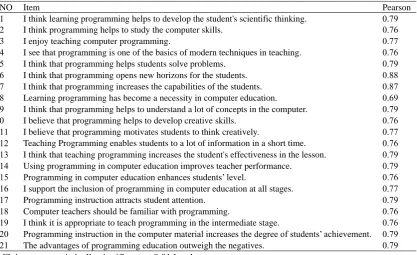
The validity of the internal consistency of the attitudes’ scale was also checked by calculating the correlation coefficients between the scales. Table 1 shows the correlation coefficients of every item in the scale and the total.
Table 1. Correlation coefficients of attitudes’ scale
Pearson Item
NO
0.79 I think learning programming helps to develop the student's scientific thinking.
1
0.76 I think programming helps to study the computer skills.
2
0.77 I enjoy teaching computer programming.
3
0.76 I see that programming is one of the basics of modern techniques in teaching.
4
0.79 I think that programming helps students solve problems.
5
0.88 I think that programming opens new horizons for the students.
6
0.87 I think that programming increases the capabilities of the students.
7
0.69 Learning programming has become a necessity in computer education.
8
0.79 I think that programming helps to understand a lot of concepts in the computer.
9
0.76 I believe that programming helps to develop creative skills.
0
0.77 I believe that programming motivates students to think creatively.
11
0.76 Teaching Programming enables students to a lot of information in a short time.
short time. 12
0.79 I think that teaching programming increases the student's effectiveness in the lesson.
13
0.79 Using programming in computer education improves teacher performance.
14
0.76 Programming in computer education enhances students’ level.
15
0.77 I support the inclusion of programming in computer education at all stages.
16
0.79 Programming instruction attracts student attention.
17
0.76 Computer teachers should be familiar with programming.
18
0.76 I think it is appropriate to teach programming in the intermediate stage.
19
0.79 Programming instruction in the computer material increases the degree of students’ achievement. 20
0.79 The advantages of programming education outweigh the negatives.
21
*The coefficients are statistically significant at 0.01 level.
From table 1, it can be seen that the correlation coefficients of the attitude’s scale items are high, which means that there is consistency between the items of the scale.
4.3 Experimental Treatment
One of the researchers visited the computer science teachers in the control group in the city of Arar to explain the procedures to be followed. The researchers then contacted the middle school principals, in which the computer teachers in the experimental group in the regions of Tarif, Rafhaa and Al Awaileh, in order to clarify the purpose of the study and the mechanism of work and answer any questions.
computer teachers in the experimental group were then trained on the skills of the Scratch programming language using an electronic learning platform. The target unit was determined in the computer curriculum for the third intermediate class and their objectives in the teacher guide were approved. The suitable videos were selected and presented to a group of raters to check their suitability for the syllables and their use in the experiment. After that, an account was created in the Ted educational platform: https://ed.ted.com
While the teachers of the control group were trained in an ordinary way by meeting them at the computer labs in the training center of the Department of Education to give the lecture and using the PowerPoint presentation and the practical application. Later, the theoretical and practical test and the attitude scale were applied as a post-completion measurement of training in the experimental and control groups. The results were then coded by using the appropriate statistic for each question.
5. Results
The first question of the study was, "What is the impact of the in-service training for computer teachers on the Scratch programming language skills using an electronic learning platform to acquire the theoretical and practical programming skills?" To answer this question, the means, standard deviations and the effect size of the scores of the subjects were calculated on the test of the programming skills as shown in Table 2.
Table 2. Means, standard deviations, and the effect size of the experimental and control groups on programming skills
Sig. Effect Size "d" t-Value Difference Between Means Std. Deviation Mean Number Group 0.029 0.737 2.274 3.3 5.226 42.5 20 Experimental 3.847 39.20 20 Control
Table 2 shows that that the t value of the test was 2.274, which is statistically significant at the level of 0.05 as sig equals 0.029. This means that there are statistically significant differences between the mean scores of the theoretical and practical achievement tests in favor of the experimental group. As shown in Table 2, there is an intermediate effect of in-service training of the computer teachers in the programming language skills using an electronic learning platform to acquire programming skills. The effect size is viewed weak when it equals 0.2, average when it is 0.5, and high when it is equal to or greater than 0.8 (Al-Barqi, 2012). Based on the findings, the Null Hypothesis, there are no statistically significant differences (at the α= 0.05 level) in the mean score of the Scratch language achievement test among the experimental group and the control group, is rejected.
To answer the second question, “What is the impact of the in-service training for computer teachers in the Scratch programming language skills using an electronic learning platform to acquire the theoretical knowledge of programming?”, the means, standard deviations and the effect size of the scores of the subjects were calculated on the test of the programming knowledge as shown in Table 3.
Table 3. Means, standard deviations, and the effect size of the experimental and control groups on the theoretical knowledge of programming skills
Sig. Effect Size "d" t-Value Difference Between Means Std. Deviation Mean N Group 0.838 0.066 0.206 0.1 1.701 12.05 20 Experimental 1.356 11.95 20 Control
As could be seen in Table 3 that the t-value of the test is 0.206 which is statistically insignificant at the significance level of 0.838, which means that there are no statistically significant differences between the mean scores of the achievement test in the theoretical part of the test between the experimental and the control groups. Similarly, the calculated effect size was 0,066 indicating that there is a weak impact of in-service training of computer teachers in the theoretical knowledge of programming skills.
The results of the practical knowledge of programming are presented in table 4.
Table 4. Means, standard deviations, and the effect size of the experimental and control groups on the practical knowledge of programming skills
Sig. Effect Size t-Value Difference Between Means Std. Deviation Mean NE Group 0.015 0.823 2.537 3.2 4.43 30.45 20 Experimental 3.492 27.25 20 Control
0.823 indicating that there is a strong impact of in-service training of computer teachers in the practical knowledge of programming skills.
Regarding the third question “What is the impact of the in-service training for computer teachers in the skills of Scratch programming language using an electronic learning platform on their attitudes towards teaching Scratch programming language?”, the means, standard deviations and the effect size of the scores of the subjects were calculated on the attitudes’ scale as shown in Table 5.
Table 5. Means, standard deviations, and the effect size of the experimental and control groups on the attitudes towards teaching Scratch programming language
Sig. Effect Size t-Value
Difference Between Means Std.
Deviation Mean
N Group
0.002 1.799
5.547 7.25
2.438 76.55
20 Experimental
5.312 69.30
20 Control
Table 5 shows that there are statistically significant differences between the means of the experimental and the control groups in the attitude’s scale favoring the experimental group. As could be seen in the above table, there is a strong (d=1.799) impact for the in-service training of computer teachers in their attitudes towards teaching Scratch programming language. This indicates that the in-service training could have a strong impact on the teachers’ attitudes towards teaching programming language.
6. Discussion
The results of the present study showed there is a positive effect of in-service training of computer science teachers on the Scratch programming language skills, using an electronic learning platform. The results showed that there were statistically significant differences at the level of 0.05 in the total scores between the mean test scores, both in the theoretical and practical parts, of the experimental and the control groups in favor of the experimental group. In addition, there was an obvious impact of in-service training of computer science teachers in the Scratch programming language skills on their attitudes towards teaching Scratch programming language skills. The results of this study are consistent with the results of a number of studies that have confirmed the positive impact of e-training (Lambert, Gong, & Cuper, 2015). The findings are also in line with Ogilive's study (2015) that reported a positive impact of in-service training on the preparation of secondary school teachers on teaching skills. Similarly, the results support that of Sharon's study (2014) on the positive impact of in-service e-training of teachers.
However, the results indicated that there were no differences between the experimental and control group means in the theoretical part of the test. On the other hand, the results indicated that there is an effect of in-service training on the computer teachers’ practical knowledge of the Scratch programming language. This may be due to the fact that members of the experimental group and the control group have the same skills in the theoretical part, which is often based on the lower thinking skills, and the accumulation of theoretical experiences. On the other hand, the Scratch programming language skills focus on higher thinking skills such as analysis, synthesis, and evaluation, the results on the practical knowledge for the experimental group that trained in the programming language through e-learning platforms, which gave the sample a number of features that showed an obvious impact on the results.
The effectiveness of in-service training in the programming language skills may be attributed to the use of an electronic learning platform to acquire programming skills and its features- it has multimedia content: audio, graphics, animations, still images, and video clips. The instructional content is designed as small learning units or sections of knowledge and skills that can be learned in the amount of time usually ranges from two to fifteen minutes. Besides, each unit constitutes one main idea, and all the units work together to form the electronic content of the lesson. The use of e-learning platforms provides an interactive learning environment between the teacher and the learners themselves. It also provides an element of enjoyment and motivation, where learning is no longer static or presented in one way because it emphasizes the variety of stimuli leading to learning. The use of e-learning platforms depends on the learner's efforts to teach him/herself through self-learning, or with the participation of colleagues in learning through collaborative learning (Hassouna, 2013). Furthermore, this impact can be attributed to the fact that the use of e-learning platforms is flexible, as it provides an opportunity for the learner to often learn at the time she/he wants, in the place that she/he prefers and at the speed that suits her/his learning abilities, meaning that the learner can get knowledge from anywhere in the world and in any time. In addition, Al-Salloum and Radwan (2011) emphasized several features of e-learning, including the possibility of using these training courses as educational video in an innovative manner; it includes formal and informal courses and uses participatory learning methods with the use of advanced interactive software; it allows peer work and peer assessment, thereby increasing communication between trainee teachers.
not a recipient of information as she/he interacts, and learns according to her/his ability. Learning through an e-learning platform is a new way for middle school computer science teachers in the northern border schools, which has raised their interest and increased their motivation for learning, which what exactly the researchers have noted in their interaction with the members of the experimental group and their reactions to the training using the e-learning platform. The e-learning platform is rich with multiple examples and exercises which, in turn, may enhance the programming language skills of computer science teachers. Teachers can learn more than one example which facilitates the acquisition of the concepts within the structure of knowledge, and this may increase their accumulation.
6.1 Recommendations
Based on the findings of this study, the following recommendations could be made:
1. There is a need to employ e-learning platforms in the training of Scratch programming language in the in-service training of computer teachers, especially those teachers who live in areas far from the training centers.
2. It is highly recommended to provide various e-training programs for computer teachers science through which electronic platforms are used to teach various programs.
3. Further studies should be conducted to explore the effectiveness of e-learning platforms in teaching different computer topics, for computer teachers of other grades, for a longer period of time and measure its effectiveness.
References
Abdul-Kader, M. (2011). The role of electronic media in the training of teachers in the Kingdom of Saudi Arabia field study in Mecca. Faculty of Education. Omdurman Islamic University. Sudan.
Abdul-Rahman, M. (2009). The effectiveness of a proposed training program for the development of computer concepts and teaching skills using social studies teachers in light of their needs. Faculty of Education. Al Azhar university.
Abed, A. (2007). The effectiveness of a proposed program to develop the skill of programming among the teachers of technology in Gaza. Department of Curriculum and Educational Technology. Faculty of Education. Islamic University of Gaza. Retrieved from: http://library.iugaza.edu.ps/thesis/111637.pdf
Abedi Kargiban, Z., & Kaffash, H. (2011). The effect of e-learning on foreign language students using the student’s attitudes. Middle East Journal of Scientific Research, 10(3).
Abu-Jado, S. (2014). Socialization. 4th ed., Amman: Dar Wael Publishing.
Abu-Naba, A. (2013). Scratch to teach programming and gaming programming to kids. Training Manual: Al-Tawin Foundation.
Al-Amriti, I. (2012). The importance of using e-learning in the system of affiliation developed from the point of view of female students at Taif University. Arabic Studies in Education and Psychology. Saudi Arabia, 22.
Al-Attas, O. (2014). Scratch programming language in education. Al-Marfa Journal, retrieved on June 2016, at: http://www.almarefh.net/show_content_sub.php?CUV=429&SubModel=162&ID=2320
Al-Barqi, T. (2012). The reality of statistical significance and the practical significance of the research published in Umm Al Qura University Journal of Educational, Social and Human Sciences in the period 1425-1430 AH.
(Unpublished Master's Thesis), Umm Al-Qura University, Faculty of Education, Saudi Arabia.
Al-Beitar, H. (2013). Computer skills and anxiety towards secondary industrial education teachers during service.
Journal of Faculty of Education, Assiut. Egypt. 29 (1).
Al-Dwairi, K. (2015). Evaluation of the training programs provided to the teachers of art education for girls in Jeddah, Saudi Arabia. (Unpublished Master's Thesis), Umm Al Qura University, Makkah Al Mukarramah, Saudi Arabia.
Al-Jarrah, A., Al-Mafleh, M., Al-Rabee'a, F., & Gwaneh, M. (2014). The impact of teaching using educational software in improving the motivation of learning mathematics among second grade students in Jordan. Jordanian Journal of Educational Sciences, 10 (3).
Al-Khabaz, M., Al-Fawzan, A., Issa, A., Shaltout, M., & Suleiman, A. (2011). Informatics and Scratch Program.
Kuwait: Ministry of Education.
Allam, A. (2012). An electronic program to train teachers of social studies during service on the use of cognitive strategies and its impact in the development of their awareness and direction towards training. Journal of the Social Education Association, 45.
Islamic University.
Al-Rashidi, I., Al-Rashidi, S., & Al-Maamari, T. (2015). Mastering Scratch in 10 days. Engineering Village for Electronics and Mechanics.
Al-Said, A. (2016). Educational Platforms A futuristic vision for social e-learning environments. E - Learning Journal. Retrieved from: http://emag.mans.edu.eg/index.php?page=news&task=show&id=513
Al-Salloum, O., & Radwan, M. (2011). A proposed template for the creation of interactive courses according to the Board of Learning Management System at King Saud University in Saudi Arabia. Risalat Al-Khalij Journal, 3(4).
Al-Tayeb, M. (2008). The effectiveness of the training and rehabilitation courses on the computer to develop the performance of teachers of the intermediate stage in the Libyan Arab Jamahiriya. The First Scientific Conference of the Faculty of Educational Sciences at Jerash University.
Arab Bureau of Education for the Gulf (2011). Vocational training of the theoretical framework teacher. Arab Bureau of Education for the Gulf States, Riyadh, Saudi Arabia.
Aubari, A. (2014). What is Scratch? What are its educational uses? Talim Jadid Journal. Retrieved on May 2016 at http://www.new-educ.com/scratch
Bani-Hamad, F. (2016). Computer use and its impact on children's education. Amman: Al Ansar for Publishing and Distribution.
Banks, S. (2014). Design and implementation of an educational model based on presentation skills to train secondary school teachers in-service. Journal of in service Education, 24(2).
Edwina, S. (2013). Five obstacles to technology integration at a Small Liberal Arts University. The Higher Education Journal, 30(8).
Hamida, Z. (2015). E-Learning. Journal of Law and Human Sciences, (23).
Hammad, H., & Al-Behbehani, S. (2011). The attitudes of public schools’ teachers toward in-service training courses.
Islamic University Journal, 19(2).
Hassouna, I. (2013). Open wide online courses. Journal of Excellence and E – education, 3(1).
Jumah, Z. (2011). Using of Vision Programming Language in solving some Doolittle applications. Journal of Economic Sciences. Iraq. P.
Khan, O. (2009). In-service teacher training. Journal of Faculty of Education. Mustansiriya University. Iraq. P.
Kilab, S. (2016). E – Learning: The Future of Non - Traditional Education. Amman: Osama Publishing House.
Lambert, J., Gong, Y., & Cuper, P. (2008). Technology, Transfer and Teaching: The Impact of a Single Technology Course on Preservice Teachers’ Computer Attitudes and Ability. Journal of Technology and Teacher Education, 16(4), 385-410. Chesapeake, VA: Society for Information Technology & Teacher Education. Retrieved August 17, 2017 from https://www.learntechlib.org/p/26064/
Maloney, J., Resnik, M., Rusk, N., & Silverman, B. (2010). The Scratch Programming Language and Environment.
ACM Transactions on Computing Education, 10(4), 16. https://doi.org/10.1145/1868358.1868363
Mohammed, B. (2012). Developing training programs for middle school teachers in the Kingdom of Saudi Arabia in light of the requirements of the knowledge society. The Arab Journal of Educational and Social Studies, 1, 29-65.
Mutiso, M. (2013). Towards determining and development an appropriate video program for in-service training of primary school in Kenya African studies in curriculum development and evaluation. University of Nairobi. 186.
Ogilive, A. (2015). The Effects Global Education in service training program on secondary school Teacher's", ph. Dissertation presented to Seattle University, scuttle.
Omran, K. (2012). The reality of e - learning at the University of Basra field study. Proceedings of the Sixth Scientific Conference on the Importance of Higher Education and Scientific Research Strategies to Strengthen the Development Process. Faculty of Economics and Administration. Albasrah University.
Selwood, I., & Pillington, R. (2008). Teacher workload using (ICT) to release time to teach Education review,
Computer & Education, 57(2). https://doi.org/10.1080/0013191042000308341
Sharif, G., & Sultan, H. (2014). Contemporary trends in in-service training. Riyadh: Dar Al Ulum for Printing and Publishing.
Suleiman, A. (2011). Teacher and Education - A comparative analysis of the nature of the profession. The Egyptian Angelo, Cairo.
Yusuf, M., Khalifa, W., & Ghanaim, A. (2010). Learning programming and creativity. Palestine: Al Qasimi Academy.
Copyrights
Copyright for this article is retained by the author(s), with first publication rights granted to the journal.