Hamilton, New Zealand
This thesis is submitted in partial fulfillment of the requirements for the degree of
Doctor of Philosophy in Computer Science at The University of Waikato
July 2009 © 2009 Olena Medelyan
Human-competitive
automatic topic indexing
by
Topic indexing is the task of identifying the main topics covered by a document. These are useful for many purposes: as subject headings in libraries, as keywords in academic publications and as tags on the web. Knowing a document’s topics helps people judge its relevance quickly. However, assigning topics manually is labor intensive. This thesis shows how to generate them automatically in a way that competes with human performance.
Three kinds of indexing are investigated: term assignment, a task commonly performed by librarians, who select topics from a controlled vocabulary; tagging, a popular activity of web users, who choose topics freely; and a new method of keyphrase extraction, where topics are equated to Wikipedia article names. A general two-stage algorithm is introduced that first selects candidate topics and then ranks them by significance based on their properties. These properties draw on statistical, semantic, domain-specific and encyclopedic knowledge. They are combined using a machine learning algorithm that models human indexing be-havior from examples.
Ian Witten deserves the foremost mention in these acknowledgements, because without him this PhD would not have been possible. Nearly five years ago I came to the University of Waikato as a Ukrainian/German exchange student with an unpronounceable name and a poor knowledge of English. Like with many other students, Ian has been a patient, encouraging and supporting teacher, who helped me to bring out the best possible of my potential.
Ian, I consider myself extremely lucky to have been invited to come back for a PhD with you. The last three years have shaped me into who I am and opened many new opportunities for my future life. Thanks for teaching me to be patient and focused in the research, for encouraging the highly rewarding voluntary work and for your continuous support in dealing with difficulties in professional and personal life. Thank you and Pam for inviting us to parties and dinners at your place, for organizing the wonderful Waiheke holiday and for letting me stay in your house in the last weeks of my PhD. Please remember that you have a free life subscription to fire performances and yoga lessons.
I would also like to thank my other supervisor Eibe Frank, who was always promptly available for help whenever I knocked on his door. Thank you, Eibe, for sharing your machine learning expertise and for developing the Kea algorithm, which provided a great basis for Maui’s architecture.
I am very proud to have been a part of the multi-cultural group of Ian’s PhD students and to have collaborated with other Waikato researchers like Cathy Legg and Gian Perrone. Thank you, girls and guys, for listening to my progress, for helping with practicing presentations and interviews, and for your great company. I look forward to staying in touch and hearing about your future successes!
Knowing that other people work on similar problems has been incredibly motivating. Through conference trips—sponsored by Google and BuildIT—I met many talented researchers who influenced my work. Thanks to Michael Poprat, Alberto Pepe, Andras Csomai for exchanging ideas, and to Dmitry Lizorkin, Alan Aronson and Annette Holtkamp for sharing their data sets and results with me.
Since I am not a native speaker, proofreading help from friends and colleagues was needed. Ian once noted that I use exactly the right amount of “a”s and “the”s, but all in the wrong places. My knowledgeable and experienced proofreaders helped not only with grammar, but also with the organization and clarity of this thesis. A huge thanks to Anna Huang, Craig Schock, David Milne, Gian Perrone, James Gorman, Kathryn Hempstalk, Kerry Hannan, Nathan Holmberg, Rob Akscyn, Shaoqun Wu, Tom Manschreck, and Tudor Leu.
I have been lucky to do my PhD at the same time as David Milne, whose name frequently re-occurs in this thesis because our topics were closely related. Several parts of this thesis (e.g., Sections 4.2.1 and 5.1.2) are the result of our collaboration. Although at times dissecting the topics we shared into two PhDs has been difficult, the benefits were greater. Thank you, Dave, for being a valuable discussion partner, a patient co-author, and for building the Wikipedia Miner, the coolest tool on SourceForge. Also, thank you for being a great friend.
I also want to thank the many other friends around the world who made the past years into a special and unforgettable time. Without committing to this PhD I wouldn’t have met Nathan, who, as it happens, gave me the reason to finish it on time. Thank you so much for all the support and wonderful distractions of the last months.
Abstract ...i
Acknowledgements ...ii
Table of contents ...v
List of tables ...ix
List of figures ...xi
Chapter 1 Introduction _______________________________ 1
1.1 Motivation ...21.2 Thesis statement ...4
1.3 History...6
1.4 Research questions...8
1.5 Contributions...11
1.6 Thesis outline...13
Chapter 2 Scope of the thesis ________________________ 15
2.1 Types of topic indexing...162.1.1 Term assignment ...16
2.1.2 Keyphrase extraction...18
2.1.3 Tagging ...19
2.1.4 Index terms, keyphrases and tags...21
2.2 Evaluation methods...21
2.2.1 Inter-indexer consistency ...22
2.2.2 Precision and recall ...23
2.2.3 Relations between the measures...24
2.2.4 Alternative evaluation methods...25
2.2.5 Evaluation methods used in this thesis...27
Chapter 3 Related work ______________________________ 29
3.1 Assigning terms from a vocabulary...293.1.1 Classification and rule building...30
3.1.2 Candidate generation and filtering...34
3.2 Extracting keyphrases from text ...37
3.2.1 Machine learning ...37
3.3 Generating tag suggestions ... 45
3.4 Filling the gaps... 48
3.4.1 Avoiding large training data in term assignment ... 48
3.4.2 Adding consistency to keyphrase extraction... 51
3.4.3 Competing with human taggers... 52
3.4.3 Learning more about the features... 53
3.5 Summary ... 53
Chapter 4 Data sets and human performance_________ 55
4.1 Term assignment ... 554.1.1 Vocabularies and corpora... 56
4.1.2 Consistency of professional indexers ... 60
4.2 Indexing with Wikipedia... 64
4.2.1 Wikipedia as a controlled vocabulary ... 64
4.2.2 Consistency of human indexing with Wikipedia... 68
4.2.3 Additional datasets ... 71
4.3 Tagging... 72
4.3.1 Extracting a multiply tagged corpus ... 72
4.3.2 Consistency of voluntary taggers... 74
4.4 Summary ... 77
Chapter 5 Candidate generation and filtering _________ 79
5.1 Candidate generation ... 795.1.1 Mapping documents to domain-specific thesauri ... 80
5.1.2 Mapping documents to Wikipedia... 83
5.1.3 Generating candidates in automatic tagging ... 88
5.1.4 Coverage of manually assigned topics... 90
5.2 Filtering ... 90
5.2.1 Frequency statistics... 91
5.2.2 Occurrence positions... 92
5.2.3 Keyphraseness... 94
5.2.4 Semantic relatedness ... 97
5.2.5 Other features... 100
5.2.6 Feature comparison ... 102
5.3 Summary ... 104
Chapter 6 The Maui topic indexing algorithm ________ 107
6.1 Components... 1076.2 Generating candidate topics... 109
6.2.2 Candidates from document text...113
6.2.3 Candidates from controlled vocabularies...114
6.2.4 Candidates from Wikipedia ...117
6.3 Computing the features...118
6.4 Building the model...119
6.4.1 Naïve Bayes with discretization...120
6.4.2 Decision trees with bagging...122
6.5 Applying the model...123
6.5.1 Applying Naïve Bayes to new documents ...124
6.5.2 Applying bagged decision trees to new documents...125
6.5.3 Specifying the final answer set...125
6.6 Usage examples ...126
Chapter 7 Evaluation of Maui _______________________ 131
7.1 Evaluation strategy...1317.1.1 Experimental settings ...132
7.1.2 Baselines...132
7.2 Quality of term assignment ...134
7.2.1 Combining the features ...134
7.2.2 Improvement over Kea and Kea++ ...137
7.2.3 Domain independence...138
7.2.4 Language independence...141
7.2.5 Consistency with professional indexers ...143
7.2.6 Effect of training set size ...145
7.2.7 Examples and error analysis...146
7.3 Quality of indexing with Wikipedia...148
7.3.1 Consistency with graduate students...148
7.3.2 Examples and error analysis...151
7.3.3 Performance on heterogeneous documents...153
7.4 Quality of automatic tagging ...155
7.4.1 Evaluation of assigned tags...155
7.4.2 Consistency with human taggers...156
7.4.3 Examples and error analysis...157
7.4.4 Comparison to other autotagging approaches ...158
7.5 Summary ...159
Chapter 8 Conclusions______________________________ 161
8.1 Proving the hypothesis...1618.2 Answering the research questions...163
References__________________________________________ 172
Appendix A. Glossary _______________________________ 181
Appendix B. Publications ___________________________ 185
Appendix C. Indexing competition ___________________ 187
C.1 Design of the user study... 187
C.2 Examples and results... 189
Appendix D. Additional results ______________________ 193
D.1 Domain keyphraseness baseline... 193D.2 Medicine and physics examples... 194
D.3 French and Spanish examples... 195
D.4 FAO-30 results... 196
D.5 WIKI-20 results ... 202
Appendix E. Installation ____________________________ 205
E.1 Download... 205E.2 Set up... 205
E.3 Wikipedia Miner installation (optional) ... 206
E.4 Data preparation... 207
E.5 Running Maui ... 207
Appendix F. Command line arguments and settings__ 211
Appendix G. Web resources _________________________ 213
G.1 Software, tools, demos... 213G.2 Vocabularies and test data... 214
Table 2.1 Tasks related to topic indexing ...17
Table 3.1 Comparison of methods used in different types of topic indexing...49
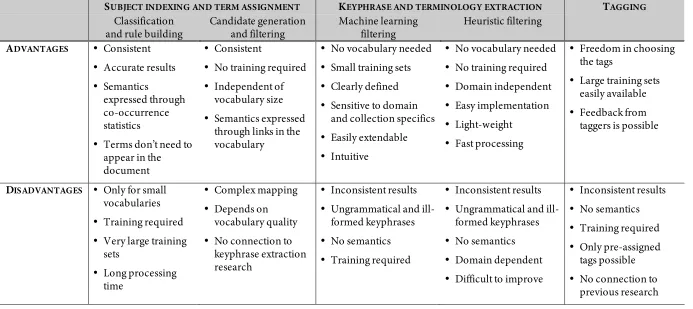
Table 3.2 Advantages and disadvantages of approaches to topic indexing ...50
Table 4.1 Size of thesauri used in this thesis ...58
Table 4.2 Number of topics assigned by indexers to each FAO-30 document...61
Table 4.3 Inter-indexer consistency for FAO-30 ...63
Table 4.4 Indexing performance and characteristics for the human teams for WIKI-20 ...70
Table 4.5 Top 20 tags assigned to documents in CiteULike-180 ...74
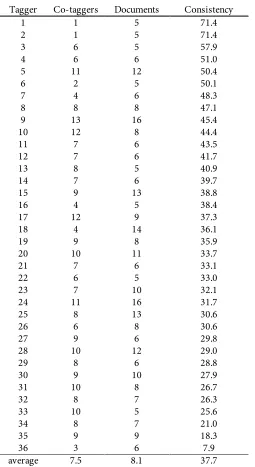
Table 4.6 Consistency of the best taggers in CiteULike-180. ...75
Table 5.1 Candidate generation results on FAO-780, NLM-500, CERN-290 ...82
Table 5.2 Number of candidate topics per document using different stemmers ...82
Table 5.3 Examples of keyphraseness values ...84
Table 5.4 Disambiguation results on 100 Wikipedia articles...87
Table 5.5 Candidate generation results on WIKI-20 ...88
Table 5.6 Candidate generation results on CiteULike-180 ...89
Table 5.7 AUC values for each feature in FAO-780, WIKI-20 and CiteULike-180 ...103
Table 6.1 Details of candidate generation for each topic indexing task...111
Table 6.2 Output of the Naïve Bayes classifier ...121
Table 6.3 Feature values and conditional probabilities for Yacc and Language....124
Table 6.4 Additional feature values for Yacc and Language...125
Table 7.1 Sequential addition of features on FAO-780 ...134
Table 7.2 Feature elimination with bagged decision trees on FAO-780...136
Table 7.5 Performance on French and Spanish documents ... 142
Table 7.6 Consistency with professional indexers on FAO-30 ... 143
Table 7.7 Inter-indexer consistency comparison of professionals and Maui... 144
Table 7.8 Per-document consistency on FAO-30 ... 145
Table 7.9 Performance on WIKI-20... 148
Table 7.10 Feature elimination on WIKI-20 ... 149
Table 7.11 Inter-indexer consistency comparison of student teams and Maui... 150
Table 7.12 Per-document consistency on WIKI-20... 151
Table 7.13 Performance on heterogeneous data sets... 153
Table 7.14 Performance on CiteULike-180... 154
Table 7.15 Feature elimination on CiteULike-180 ... 154
Figure 1.1 The legend of Maui ...7
Figure 2.1 Tasks related to topic indexing...16
Figure 2.2 Entry for Analgesics in the MeSH vocabulary ...18
Figure 2.3 Tag cloud of topics assigned to this thesis by its proofreaders...19
Figure 2.4 Popularity of tags NewYear and Christmas in blogs over time...20
Figure 2.5 Relation between the Rolling and Hooper consistency measures ...24
Figure 4.1 Entry for Epidermis in the Agrovoc thesaurus ...56
Figure 4.2 Term length distribution in different corpora...60
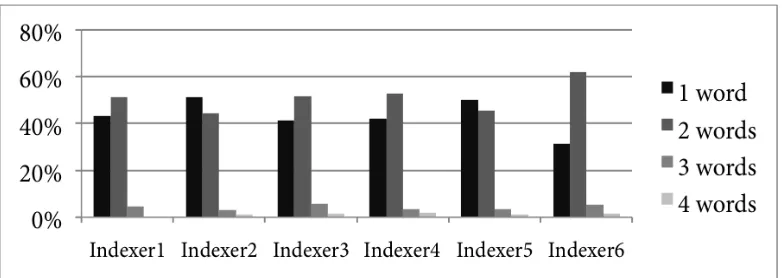
Figure 4.3 Length of terms assigned to FAO-30 documents...62
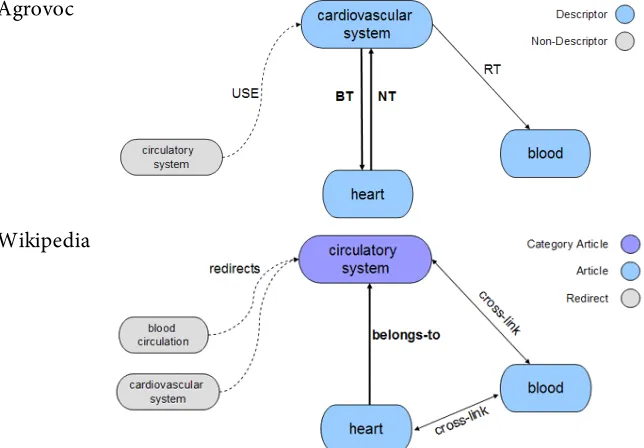
Figure 4.4 Structures in Agrovoc and Wikipedia ...65
Figure 4.5 Representation of the term Library in Wikipedia...66
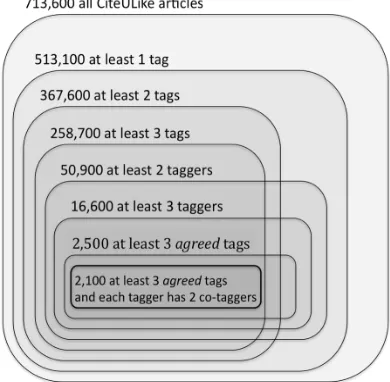
Figure 4.6 Imposing quality control on the CiteULike data ...73
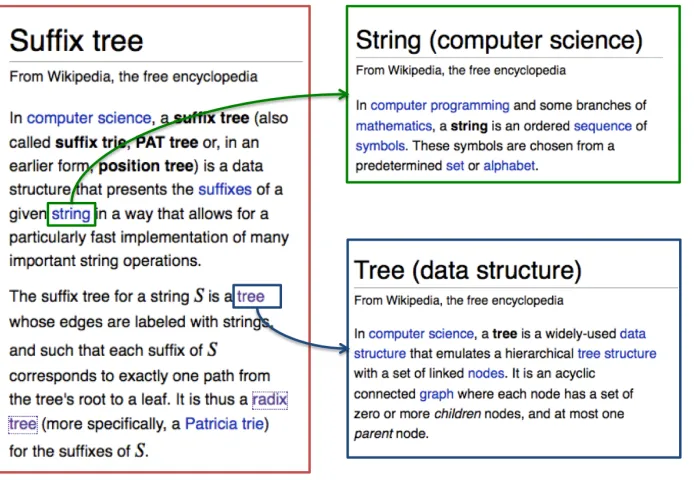
Figure 5.1 Link annotations in Wikipedia articles ...86
Figure 5.2 Distribution of term frequency and TF×IDF in FAO-780...92
Figure 5.3 Distribution of the first and last occurrence in FAO-780 ...93
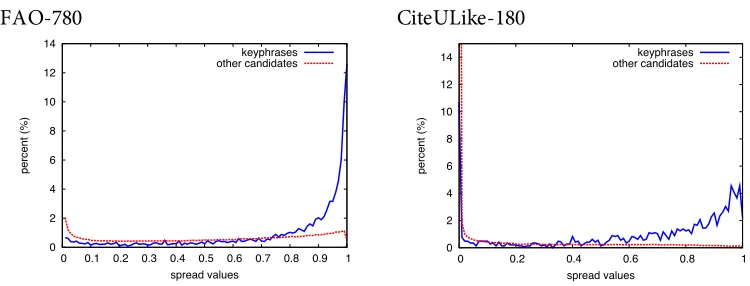
Figure 5.4 Distribution of occurrence spread in FAO-780 and CiteULike-180 ...93
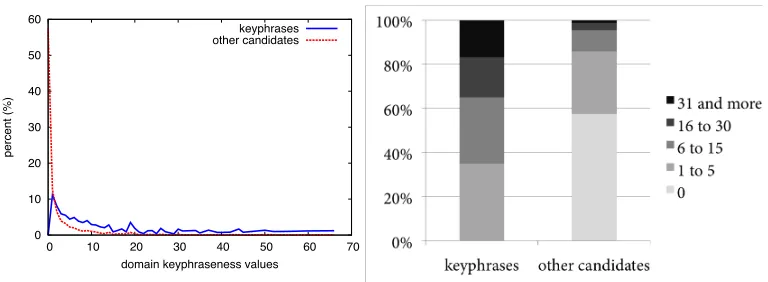
Figure 5.5 Distribution of domain keyphraseness in FAO-780...94
Figure 5.6 Distribution of Wikipedia keyphraseness in CiteULike-180 ...95
Figure 5.7 Distribution of inverse Wikipedia frequency and total Wikipedia keyphraseness in WIKI-20 ...96
Figure 5.8 Distribution of node degree, and the number of related terms in FAO-780 ...97
Figure 5.9 Distribution of semantic relatedness in FAO-780 and WIKI-20 ...100
Figure 5.10 Distribution of term length and generality in FAO-780...101
Figure 6.1 Operation of Maui...108
Figure 6.3 Algorithm for generating candidates in Maui... 110
Figure 6.4 Candidate generation for a sample document in CiteULike-180... 112
Figure 6.5 Candidate generation for a sample document in FAO-780 ... 115
Figure 6.6 Candidate generation for a sample document in WIKI-20... 116
Figure 6.7 Decision tree generated using WIKI-20 and three features... 122
Figure 6.8 Computing final class probabilities for Yacc and Language... 124
Figure 6.9 Using Maui from the command line... 126
Figure 6.10 Configuring Maui for French documents ... 128
Figure 7.1 Effect of training size on performance... 146
Figure 7.2 Example topics assigned to FAO-30 ... 147
Figure 7.3 Example topics assigned to WIKI-20 ... 152
Figure 7.4 Distribution of F-measure on CiteULike-180... 157
Chapter 1
Introduction
The exciting idea that one day computers will understand human language re-mains an elusive dream, far from reality. Tasks that require understanding natural language, such as machine translation and text summarization, have been re-searched for many decades, but rarely solved at a level comparable to human per-formance. Researchers must deal not only with the incredible complexity of our language, but also with the highly subjective nature of the tasks. Judging whose translation is more accurate or whose summary is better is sometimes even harder than producing one.
Topic indexing is different. It is an easier task. The question “What is this document about?” does assume some understanding of natural language, but re-stricts the answer to a handful of phrases that describe the document’s main topics. Deep understanding is not necessarily required: even human indexers tend to skim the text rather than read and understand it. Topic indexing is also easier to evaluate. Those topics on which the majority of people agree must surely be the right ones. Multiple votes transform a subjective view into an objective answer.
1.1 Motivation
In physical and digital libraries, professional indexers are employed to organize documents based on their main topics in a way that facilitates access by users. Categories and subject headings are used to describe topics. They most commonly originate from a pre-defined controlled vocabulary, where equivalent phrases refer-ring to the same concept are grouped under the same “topic”. When no controlled vocabulary is used, topics are expressed as freely chosen keywords and keyphrases. The tasks involving selecting appropriate topics according to pre-defined catalogu-ing rules (if such exist) can be summarized under the term topic indexcatalogu-ing.
Ideally, professional indexers should see the document as a whole, understand the emphasis of its parts, and know its potential readers (Bonura, 1994). Topic in-dexing is a labor-intensive and time-consuming process that became infeasible with the explosion of electronically available information, offline and on the web. The majority of electronic holdings in any document repository lack subject head-ings andkeyphrases. They remain restricted to basic metadata like author and title. Retrieving all documents on a particular topic simply by searching through authors and titles is hardly possible, countless searches would be required to capture poten-tial ways of how this topic may be expressed in a title—and many documents would remain undiscovered because their titles are too figurative. The need for subject headings and keyphrases is apparent. Nowadays libraries spend more money on employees than on new books or journal subscriptions (Hilberer, 2003) and would clearly benefit from methods to automate the indexing process.
Tagging is a recent attempt to address web search from a different angle, using metadata contributed by users. It originates in the traditional subject indexing per-formed in libraries. Tags, like keyphrases, are single words and phrases that describe the main topics of websites, blogs, research papers, as well as multimedia content. Tags can be assigned by the authors themselves or, collaboratively, by readers. The multitude of tags represents a “folksonomy” that, like a catalog in a library, allows users to browse through topics of the collection.
Tag folksonomies are useful but have several limitations. They are inconsistent, because there is no control over what terms may be added and what are the pre-ferred tags to describe certain topics. They are unstructured, because relations be-tween individual tags are not encoded. Browsing is driven by co-occurrence of tags within the same tag sets and items, rather than by their topical relatedness. Tagging is popular in domains like blogs and file sharing, where users are moti-vated and active, but tags would be highly useful in many other areas. However, tagging is not yet widespread, because the assignment of tags is not an easy task. Automatic tag suggestion tools are believed to improve the efficiency and consis-tency of human tagging (Brooks and Montanez, 2006), which might facilitate the spread of this useful approach to web search.
A document’s main topics are not only an important form of metadata in li-braries and on the web; they also have a variety of indirect uses. Keyphrases im-prove the performance of tasks such as text clustering and categorization (Jones and Mahoui, 2000), content-based retrieval and topic search (Arampatzis et al., 1998), automatic text summarization (Barker and Cornacchia, 2000), thesaurus construction (Paynter et al., 2000), search results representation (Hulth, 2004), and navigation (Gutwin et al., 1998). The effectiveness and utility of these tasks depend not only on the availability of keyphrases, but also on their quality. Ide-ally, topics should be provided by human experts or be of comparable quality.
keyphrases would provide a highly informative semantic dimension in document representation that would benefit new applications.
1.2 Thesis statement
This thesis claims that
With access to domain and general semantic knowledge, computers can index as well as humans.
Computer systems will hardly ever be able to compete with human performance in tasks that require understanding the meaning of human language. However, in-dexing tasks potentially do not require deep understanding. Our main goal is, given a document, to find a handful of concepts that describe its topics. The depth of the intermediate analysis is not important as long as the results are competitive with human performance.
The main topics of a document are usually expressed as noun phrases that may consist of a single or a multi-word noun (e.g. biology or computer science). More specific topics may be expressed with a modifying adjective (e.g. theoretical com-puter science) or a prepositional phrase (e.g. biology of gender). Topics are referred to by different names depending on the task. The classical names used by librari-ans are subject headings, index terms and descriptors, all of which are synonyms. In digital libraries, keywords and keyphrases are more common, the former refer-ring to single words and the latter to multi-word phrases. The main difference to subject headings is that keyphrases are freely chosen, whereas subject headings are derived from a controlled vocabulary. Recently, a new synonym for keyphrases has been created—tags, perhaps to be in line with other new English one-syllable words like web and blog. Chapter 2 investigates different types of topic indexing and their applications in more detail.
speed. Speed comparisons are expected to favor algorithms; therefore, the more interesting question is whether the algorithms can achieve the same quality as hu-mans.
Analysis of indexing performed by professionals shows that the correctness of assigned topics is very subjective (Chapter4). Therefore, instead of relying on the judgments of one human, multiply indexed documents are used, where topic choices of several indexers are available. The goal of the algorithm is to match top-ics on which these indexers have agreed. The gold standard is the average indexing consistency within a group of human indexers, computed using traditional meth-ods (Section 2.2). In these terms, an algorithm that matches or outperforms hu-man consistency on a wide variety of data sets indexes as well as huhu-mans.
People acquire indexing skills through training and work experience. In an algo-rithm this process can be simulated using machine learning. If manually specified topics are given, the document collection serves as a training set and all the docu-ments’ candidate topics are seen as positive and negative examples. A supervised learning scheme is applied to analyze values of properties that distinguish manu-ally assigned topics from other document phrases. Then these observations are ap-plied to new, unseen documents. It is essential to determine a useful set of such properties, also called features. In this thesis, properties are chosen to represent dif-ferent types of knowledge about topics, which are typically chosen by human in-dexers.
Buckley, 1988) identify terms that are frequently used across an entire collection and those that are specific for a particular document.
Semantic knowledge is required to understand the meaning of a document’s concepts and their linguistic characteristics. This knowledge is not specific to a par-ticular domain or document collection. For example, semantic relatedness is im-portant when deducing the meaning of ambiguous words by relating them to the context. Furthermore, concepts that are semantically related to other concepts in the document are more likely to represent the main topics. An algorithm can de-rive such knowledge from various sources, including controlled vocabularies used for indexing, which contain manually encoded semantic relations between terms. Linguistic resources like WordNet (Fellbaum, 1998) can also be used for the same purpose. Large corpora or the entire web can be mined for semantic data such as co-occurrence statistics.
A popular source of linguistic knowledge is the online encyclopedia Wikipedia (Medelyan et al., 2009). Apart from being an easily accessible subset of the web and a large multi-lingual corpus of clearly formulated definitions, it exhibits struc-tural elements that bear useful semantic knowledge. Individual articles correspond to common language concepts and named entities, disambiguation pages list meanings of ambiguous words, and hyperlinks between pages indicate semantic relatedness. Wikipedia’s hypertext can be mined for words that are likely to scribe certain concepts. Chapter 5 describes how different types of knowledge de-rived from Wikipedia, manually encoded thesauri, and corpora can be used in automatic topic indexing.
1.3 History
features. The outcome was Kea++, an extension of Kea for indexing agricultural documents with topics from a domain-specific thesaurus.
The aim of the Master’s thesis was to answer three questions. First, can keyphrase extraction be improved by using a controlled vocabulary? Indeed, mapping document phrases to terms in a controlled vocabulary covered just as many manu-ally assigned topics, while avoiding significant noise. Second, can semantic knowledge enhance indexing performance? In fact, a new feature based on se-mantic relations encoded in the vocabulary resulted in performance gain. Third, can automatic keyphrase indexing perform as well as professional indexers? The final algorithm performed worse than human indexers, and thus, unlike the first two, this third hypothesis remained unproven.
This PhD work builds on the positive outcomes of the Master’s thesis. It is deeper, in that it investigates the potential of controlled indexing and semantic features in a more systematic way, and broader, because it explores two additional areas. First, we devise ways of applying controlled indexing in cases where no con-trolled vocabulary is available. Here Wikipedia serves as a source of indexing ter-minology and semantic relations. Second, we investigate keyphrase extraction in the context of collaborative tagging, which offers a solid but as yet unexplored ba-sis for testing indexing techniques. Third, we substantiate the third hypotheba-sis of
Maui is an algorithm for multi-purpose automatic topic
indexing. It is named after the Polynesian mythological hero and demi-god, known in the Māori mythology as Māui.
Māui is famous for fishing out the North Island of New Zealand with a hook made out of his jaw-bone. The logo of the algorithm (left) depicts this fishing hook, a shape that is commonly used in traditional jewelry carving. Māui sometimes would transform himself into different kinds of birds to perform many of his exploits. Similarly, the Maui algorithm assimilates two software tools named after New Zealand native birds Kea and Weka.
the Master’s thesis by creating a new algorithm that indexes as consistently as hu-mans.
This new algorithm is called Maui, after the Polynesian mythological hero. Fig-ure 1.1 explains the origins of the name. With access to domain and background knowledge, Maui performs three kinds of topic indexing—indexing with a con-trolled vocabulary, indexing with Wikipedia terms and automatic tagging—at a similar performance level as humans. Maui is open source and is distributed under the GNU General Public License through Google Code.1 Additional information
about Maui, its usage and application can be found in Chapter 6 and Appendices E and F.
Maui supports graphical visualization of automatically computed topics. It out-puts plain-text graph descriptions using Wikipedia Miner (Milne, 2009) for identi-fying semantic links between topics. The GraphViz software2 can then be used to
plot the resulting graphs. Each chapter begins with a visualization of its main top-ics, automatically identified by Maui and shown as a semantically connected graph generated with GraphViz (see Section 6.6).
1.4 Research questions
The thesis’ hypothesis can be formulated as a research question: Is it possible to perform automatic indexing at the same level as humans do? Instead of tackling this question head on, we follow the divide and conquer principle by identifying smaller research problems that together enable theunderstanding of the hypothesis and its solution.
1. How can the indexing performance be measured?
Topic indexing can be performed at qualitatively different levels, which means that some topics are more “correct” than others. Since indexing is a subjective task and even professionals disagree on their topics, it is necessary to abstract over the meaning of “correct” in this context. Multiply indexed document collections can
be used to compare humans against each other and to determine the topics agreed on by a majority. This thesis employs such data sets where possible.
With the increasing popularity of collaborative tagging platforms, simultaneous human judgments of important topics for the same document emerge naturally. We acquire examples of such data from the web and show how the algorithm can be evaluated against the most prolific and consistent taggers.
2. What is the performance of human indexers?
Know thine enemy! Before committing to a competition as challenging as topic indexing, it is necessary to investigate the task from the perspective of human in-dexers. How well do people perform indexing? How does the performance of professional librarians differ from that of amateurs indexers or taggers, who index for their own benefit? This thesis addresses this question by analyzing manually indexed collections, some created specifically for the purposes of this thesis and others obtained from a collaboratively tagged bookmarking service on the web.
3. How can a computer understand document concepts?
Given the document terminology and that of a prescribed indexing vocabulary, we need to identify phrases that mean the same thing in order to bridge the gap between the author’s language and that of his colleagues, as well as current and future readers. Ambiguity and synonymy in human language are the main obsta-cles. Where one speaker is more accustomed to peppers, another prefers to call them capsicums; and while both might mention apple, one refers to the fruit and the other to the computer company.
While analyzing a text, phrases need to be linked to corresponding concepts. These can originate from controlled vocabularies—manually created domain-specific thesauri. Such vocabularies are useful, but they are expensive to create and maintain and not always available. A solution to this problem is investigated in the next question.
collection. They are used for browsing the collection and “getting the feel” for its content. In automatic indexing, controlled vocabularies serve as sources of seman-tic knowledge that improves performance (Section 1.2). However, creating and maintaining such vocabularies is problematic, particularly for swiftly changing domains such as politics, business, current affairs, entertainment, and new tech-nologies. Unfortunately, these are the most broadly covered domains on the web.
Recently, Wikipedia has been discovered as the largest available source of topics in many languages (Milne et al., 2006). It creates an opportunity for controlled indexing in situations where manually constructed vocabularies are not available. This thesis investigates how to utilize Wikipedia as a vocabulary and how to effi-ciently map document terms onto Wikipedia articles—a non-trivial task given the millions of articles. Furthermore, we also mine Wikipedia for semantic features that improve automatic topic indexing.
5. How can
main
concepts be identified automatically?
Once the concepts that are mentioned in a text are known, we need to determine the most significant ones for that text. Professional indexers follow instructions about specificity and exhaustiveness of the topics, but how they make the final de-cisions can only be guessed. Section 1.2 noted that human indexers fall back upon their knowledge of the domain and of the controlled vocabulary (if one is used). They also reason about the meaning of a document using linguistic knowledge about language concepts. These processes can be simulated by statistical analysis of document collections and by employing manually encoded knowledge bases and linguistic resources such as Wikipedia. Each meaningful property of a manually assigned topic can be taken as a cue by the machine learning algorithm. The goal is to identify such properties, or features, and compute their individual contribu-tion, as well as the impact of using them combined.
6. How much training is necessary?
tweak-ing. The disadvantage is the dependence on the training data. Since generating manually indexed documents is expensive, it is instructive to investigate how much data is required to produce good results. By gradually adding more manually indexed documents into the training set and re-assessing the algorithm’s perform-ance, the effect of increasing the training size can be evaluated.
7. Can an indexing algorithm be domain and language independent?
The Master’s thesis preceding this PhD tested the automatic indexing technique on agricultural documents written in English, but suggested that the proposed ap-proach is domain and language independent. This thesis investigates this assump-tion experimentally by testing the algorithm on various data sets, including com-puter science technical reports, physics, medical and scientific publications, as well as collections in languages other than English.1.5 Contributions
The thesis makes the following research contributions:
1. Survey of the task
An array of highly related research problems emerging in different fields has re-sulted in a confusion of terminology. Chapter 2 surveys the nature of tasks related to topic indexing and brings them together into a single picture, while Chapter 3 reviews existing methods of topic indexing and identifies their potential gaps in this field. The thesis also offers a glossary of terms related to topic indexing in Ap-pendix A, and a collection of relevant web resources in ApAp-pendix G.
2. New evaluation method
3. New techniques
New features for automatic topic indexing are proposed and evaluated. These are derived statistically from the corpus and from external resources like Wikipedia (Section 5.2). Additionally, a new method is proposed for performing controlled indexing in the absence of a controlled vocabulary, using Wikipedia article titles (Section 5.1).
4. New tools
Two new pieces of open-source software were produced for this thesis:
• Kea-5.0 – A new version of the keyphrase extraction algorithm Kea
(Wit-ten et al., 1999; Frank et al., 1999) that can be used for two tasks: key-phrase extraction and term assignment with any controlled vocabulary in a predefined format. It is an extension of Kea++, the algorithm in my Mas-ters thesis, which was restricted to term assignment for agricultural docu-ments only.
• Maui – A multi-purpose topic indexing algorithm that offers all the
func-tionality of Kea and also permits the use of Wikipedia as a controlled vo-cabulary. Maui implements new features and a new classifier, which sig-nificantly improve the performance of topic indexing tasks compared to Kea. The Maui algorithm is described in Chapter 6, whereas Appendices E and F list details of its usage.
5. New data
Two multiply indexed collections were generated for this thesis:
• In a user experiment, 15 teams consisting of two students each assigned
topics from Wikipedia to 20 computer science articles. The teams were competing against each other by trying to match topics picked by other teams, ensuring high quality of the assigned topics.
• Given collaboratively tagged data on the bookmarking web site
the first available multiply indexed data set of this size created in a natural setting.
6. Publications
This PhD research resulted in articles in the Journal of American Society for Infor-mation Science and Technology and the International Journal of Human-Computer Studies, and nine articles published in proceedings of peer-reviewed national and inter-national computer science research conferences and workshops. A full list of publi-cations, including succinct summaries, appears in Appendix B.
1.6 Thesis outline
Chapter 2 provides background knowledge about topic indexing. Section 2.1 sur-veys different topic indexing tasks and groups them based on commonalities. It also specifies the three tasks addressed in this thesis: term assignment, keyphrase extraction and tagging. Section 2.2 surveys methods used to evaluate the quality of topics assigned by humans and algorithms.
Chapter 3 categorizes and reviews existing approaches to automatic term as-signment, keyphrase extraction and tagging. Section 3.4 identifies gaps at inter-sections of these fields and discusses how these gaps are addressed in this thesis.
Chapter 4 provides statistical analysis of experimental data sets, including an in-depth analysis of topics assigned by people. Section 4.1 compares vocabularies used in traditional term assignment. Section 4.2 answers research question 4 (Section 1.4), namely how term assignment is possible when vocabularies are unavailable. Section 4.3 demonstrates how a high-quality multiply indexed collection can be automatically extracted from a collaboratively tagged bookmarking site. This chapter also tackles research question 2—how well humans perform topic index-ing—and specifies the gold standard for the algorithm’s performance.
Sec-tion 5.2 surveys typical properties of candidate topics used to determine the most prominent ones. These properties reflect statistical, semantic, domain and back-ground knowledge required for the algorithm to succeed in the topic indexing task.
Chapter 6 brings the individual indexing steps together into the single algorithm Maui. It explains how Maui selects the main topics in a document by retrieving candidate topics, computing their properties and analyzing examples of indexing performed by humans.
Chapter 2
Scope of the thesis
Topic indexing has received much attention in all areas where large document col-lections are created, collected, stored and regularly accessed by users. Traditionally, libraries have been employing professional indexers to identify the main topics of the documents, as well as to record other metadata such as author name and publi-cation type. However, libraries are no longer the only institutions where a the-matic overview of the holdings is needed. Nowadays, companies, organizations and even individuals own extensive collections. It is no longer cost-effective to employ professionals for the topic indexing task. Instead, collection owners rely on search technologies to efficiently access and manage their data. A variety of algorithms have been developed to automate or semi-automate topic indexing. Recently, on the web, users have been encouraged to create topical metadata themselves.
2.1 Types of topic indexing
Tasks related to topic indexing can be broadly organized according to two criteria:
• source of the terminology used to refer to a document’s concepts;
• number of topics assigned per document.
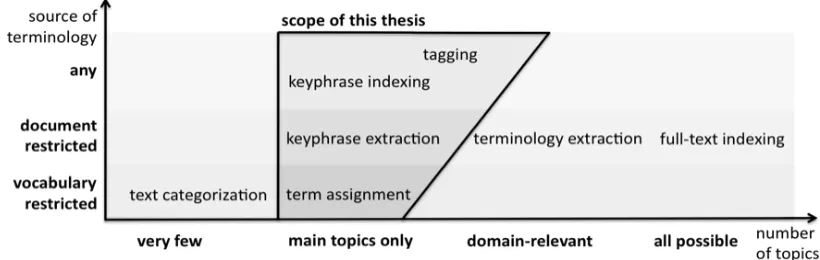
Figure 2.1 plots the relevant tasks using these criteria as dimensions. The “number of topics” axis ranges from a few topics to as many as possible, where the number is implicit in the task’s definition. The “sources of terminology” axis lists possible sources of topics such as a vocabulary, the document itself or any possible source.
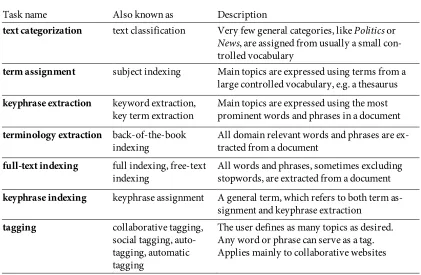
The diagram places closely related tasks next to each other, because they share similar characteristics. For example, keyphrase extraction is similar to terminology extraction but extracts fewer topics per document. Table 2.1 briefly describes each task in the Figure. Four tasks are grouped in the trapezoidal area representing the scope of the thesis. In the following, these tasks are discussed in more detail.
2.1.1 Term assignment
Term assignment expresses the main topics in a document using terms from a pre-defined controlled vocabulary, e.g. a domain-specific thesaurus. These terms do not necessarily appear within the document. Subject indexing is a more common term for the same task in the context of library science.
A controlled vocabulary lists concepts relevant to a given domain using two sets of terms: descriptors and non-descriptors. Descriptors are the preferred terms for referring to the concepts. Non-descriptors, also called entry terms, are usually
synonyms for the corresponding descriptors. Using descriptors in indexing im-proves consistency. Non-descriptors are helpful when searching for a concept (Wright and Budin, 2001). The availability of descriptors and non-descriptors is the main property of a controlled vocabulary, which may also define semantic re-lation of hierarchical and associative character between pairs of descriptors.
An example of term assignment can be found in PubMed, an online database maintained by the U.S. National Library of Medicine, which provides access to millions of citations via the Medical Subject Headings (2005) or MeSH.1 The
MeSH vocabulary contains over 24,000 descriptors and a further 141,000 non-descriptors (called entry terms) associated with them. Figure 2.2 shows an excerpt from the MeSH hierarchy focusing on the descriptor Analgesics. The broader terms and the Scope Note tell us that Analgesics are chemical agents that affect the nervous system and are used to relieve pain. Below the Scope Note, four Entry Terms are associated with this descriptor (e.g. Analgesic Agents). Another example of a controlled vocabulary is shown in Section 4.1.1.
1http://www.nlm.nih.gov/mesh/
Task name Also known as Description
text categorization text classification Very few general categories, like Politics or News, are assigned from usually a small con-trolled vocabulary
term assignment subject indexing Main topics are expressed using terms from a large controlled vocabulary, e.g. a thesaurus keyphrase extraction keyword extraction,
key term extraction Main topics are expressed using the most prominent words and phrases in a document terminology extraction back-of-the-book
indexing All domain relevant words and phrases are ex-tracted from a document full-text indexing full indexing, free-text
indexing All words and phrases, sometimes excluding stopwords, are extracted from a document keyphrase indexing keyphrase assignment A general term, which refers to both term
as-signment and keyphrase extraction tagging collaborative tagging,
social tagging, auto-tagging, automatic tagging
The user defines as many topics as desired. Any word or phrase can serve as a tag. Applies mainly to collaborative websites
Returning to Figure 2.1, text categorization appears to the left of term assign-ment. The controlled vocabulary used in text categorization contains general categories rather than specific concepts and is usually relatively small (from around ten up to a few hundreds categories). For example, Reuters news—a common data set in text categorization—contains just over 100 categories (Dumais et al., 1998). Categories are used to organize documents thematically into broad areas like Poli-tics or Entertainment, whereas subject headings describe specific topics like U.S. Presidential Elections or Academy Awards.
Most documents belong to one general category, just as newspaper articles are organized into distinct sections like Politics, Fashion, Sport, Ads. Articles that be-long to two or more categories are unusual. A category can be assigned based not only on the document’s content, but also on its style. For example, articles in the category Ads are characterized by short sentences, abbreviations and numbers. Automatic text categorization lies outside of the scope of this thesis because it re-quires a different approach than automatic term assignment. However, some text categorization methods have been employed for term assignment, as discussed in Section 3.1.1.
2.1.2 Keyphrase extraction
Moving upwards in the scope of the thesis area, Figure 2.1 lists keyphrase extrac-tion and keyphrase indexing. The general task here is to define document topics.
Chemical Actions and Uses Pharmacologic Actions Physiological Effects of Drugs Peripheral Nervous System Agents Sensory System Agents
Analgesics
Scope Note: Compounds capable of relieving pain without the loss of Consciousness Entry Terms: Analgesic Agents, Analgesic Drugs, Anodynes, Antinociceptive Agents See Also: Anesthetics
Unique ID: D000700
Analgesics, Non-Narcotic Analgesics, Opioid Narcotics
Anesthetics, Local Narcotic Antagonists
Figure 2.2 Entry for Analgesics in the MeSH vocabulary
Broader terms
Narrower terms
However, unlike term assignment, a controlled vocabulary is optional. Keyphrase extraction usually refers to a task performed by an algorithm that selects promi-nent phrases appearing in a document. Keyphrase indexing refers to a more gen-eral task than keyphrase extraction and term assignment, where the source of ter-minology is not restricted. For example, academic publishers encourage their authors to assign freely selected keyphrases. These phrases may or may not appear in the text.
Two tasks that are similar to keyphrase extraction are terminology extraction (further right in Figure 2.1), where every domain-relevant phrase needs to be ex-tracted from a document, and full-text indexing (far right), where the entire vo-cabulary of the document is transformed into an index. These tasks lie outside the scope of the thesis. However, terminology extraction can be addressed with key-phrase extraction methods, as discussed in Section 3.2.
2.1.3 Tagging
Finally, Figure 2.1 places tagging approaches between the “main topics only” and “domain-relevant” columns. Like keyphrases, tags can be chosen freely. There are no formal guidelines. Users decide which terms and how many terms should be assigned and perform the assignment principally for their own benefit.
Tagging is encouraged on websites that host user-generated content, such as blogging platforms, online bookmarking services and file sharing sites. Often sev-eral users tag the same object and their tags are merged into a single set. The entire
algorithm automatic automatic tagging automatic topic indexing
auto-tagging artificial intelligence computer science
controlled vocabularies document categorization document topics domain-specific knowledge encyclopedic knowledge human-competitive human indexing
indexing
indexing methods kea keyphrase extraction
machine learning natural language processing
tagging
tag hierarchies taxonomies term assignment topic indexing topic assignment topicssemantic supervised learning statistical
wikipedia
set of tags assigned by all users of a given website is called a folksonomy. The proc-ess of producing a folksonomy is known variously as collaborative tagging, social tagging and social indexing.
Some services represent folksonomies as tag clouds like the one in Figure 2.3, depicting tags assigned independently to this thesis by its proofreaders. The tags are ordered alphabetically and the font size reflects the relative number of taggers who agreed on the tag. Note how similar topics were expressed with different tags: automatic tagging and tagging, topic assignment and topic indexing.
Web services like technorati.com, del.icio.us and flickr.com use tags to organize and provide access to user-supplied data. Technorati.com also uses tags to identify discussion trends and their change over time just as Google Zeitgeist2 generates
trends from search queries. Figure 2.4 depicts the popularity of Christmas and NewYear tags from November 2008 to February 2009.
Recently, researchers began developing methods to assign tags automatically (Section 3.3). Such methods can provide suggestions that can facilitate tagging and encourage more users to supply tags. Automatic tagging, or autotagging, de-rives tags from varying sources, including the terminology of the document itself, other documents owned by the users (e.g. located on their desktop), and tags pre-viously assigned to similar documents.
2 http://www.google.com/zeitgeist
2.1.4 Index terms, keyphrases and tags
Topic indexing tasks discussed in this section share the same goal: producing con-tent-based metadata for document collections. This metadata is named differently depending on the task. In term assignment topics are subject headings, index terms and descriptors; in keyphrase extraction they are keywords and keyphrases; in tagging they are simply tags. In fact, these are all essentially the same thing and therefore in this thesis are often referred with the generic term topics.
There are slight differences between different kinds of topics. Subject headings originate from a controlled vocabulary, whereas keyphrases and tags are unre-stricted. Subject headings and keyphrases tend to be domain-specific, whereas tags reflect everyday language and commonly used expressions. For example, as of February 2009, technorati.com shows over 400 posts tagged with painkillers, and less than 50 tagged with analgesics. Both WordNet and Wikipedia list these terms as synonyms, but the MeSH vocabulary only contains analgesics and does not mention painkillers. This example indicates that MeSH terms are targeted at pro-fessionals.
Three types of topic indexing are addressed in this thesis: term assignment, key-phrase extraction and tagging. The Maui algorithm applies the same general strat-egy for solving these tasks and only requires minor adjustments. For example, in term assignment, Maui accesses a controlled vocabulary, whereas in tagging it does not. Maui uses machine learning in order to capture the indexing behavior of humans in each task, e.g. the specificity of indexing or word preferences. Its dexing performance is then compared directly to the performance of human in-dexers using evaluation techniques discussed below.
2.2 Evaluation methods
the semantic similarity of topics. This section discusses existing measures, their origins and applications. It also reveals interesting relations and missing links be-tween different them.
2.2.1 Inter-indexer consistency
Two sets of topics can be compared by measuring the number of matching topics relative to the sizes of the two sets. When topics sets are assigned by people, the result reflects the inter-indexer consistency, also called inter-indexer agreement or simply indexing consistency, between these people. Inter-indexer consistency is defined as “the degree of agreement in the representation of the (essential) infor-mation content of a document by certain sets of indexing terms selected indi-vidually and independently by each of the indexers” (Zunde and Dexter, 1969). Hooper (1965) quantifies this metric as
€
Hooper= C
C+M+N
where C is the number of terms two indexers have in common, and M and N re-spectively are the number of idiosyncratic terms that they assign.
Another measure was proposed by Rolling (1981):
€
Rolling= 2C A+B
where again C is the number of terms the indexers have in common and A and B
are the total number of terms they assign.
Both measures range from 0 when the two indexers assign disjoint sets to 1 when they assign identical sets. The result can be multiplied by 100 to express the percentage, as done in this thesis. The choice of the Hooper or the Rolling measure for a particular study seems to depend on the personal preference of the researcher.
Studies of indexing consistency show that the greater the indexing consistency is in a catalogue, the more reliable the indexing is and the more efficient the search is in this catalogue (Leonard, 1975; Saracevic and Kantor, 1988;Iivonen 1995).
2.2.2 Precision and recall
Surprisingly, inter-indexer consistency is rarely mentioned in the context of automatic indexing. Here, the standard information retrieval measures precision and recall are popular (van Rjsbergen, 1979). Given two topics sets, one assigned by an algorithm and another by a human, the human’s set is considered to be “correct”. This set serves as the gold standard against which algorithm’s topics are compared.
Precision (P) expresses the number of matching (“correct”) topics as a propor-tion of all algorithm’s topics and recall (R) is the proportion of human’s topics that are covered:
€
P=#correct extracted topics
#all extracted topics
€
R= #correct extracted topics
#manually assigned topics
The F-measure (Fβ) combines the two, and in its full generality involves a parame-ter β, which allows the evaluator to give more weight to either P or R (van
Rijsber-gen, 1979):
€
Fβ = 1+β 2
(
)
PRβ2P+R
In this thesis, F1 is reported (β = 1), which makes precision and recall equally important.
An algorithm’s topic sets are usually matched against manually assigned sets. Before applying the measures, the freely chosen keyphrases and tags can be first reduced to their base form using a stemmer (e.g. Porter, 1980). Achieving a 100% exact matching, i.e. P=1 and R=1, is practically impossible, because even humans disagree on the “correct” topics for a document. Non-matching terms may still be correct, yet are ignored by automatic evaluation.
2007). As long as the evaluation involves several human raters and their inter-rater agreement is reported, such evaluation methods are acceptable. However, if the study relies on the judgments of a single human, the evaluation results are just as subjective and unreliable as those using automatic matching against singly as-signed keyphrase sets.
2.2.3 Relations between the measures
The above measures compare the number of matching items in two sets, denoted as C, against the total number of items in these sets, A and B respectively. Express-ing all measures in these terms reveals that they are closely related.
Reformulating the Hooper measure shows that it is always smaller than Rolling, except for the two extremes 0 and 1, since
€
Hooper= C A+B−C =
Rolling 2−Rolling
Figure 2.5 plots this relationship. Before comparing inter-indexer consistency studies, their results need to be converted to the same measure.
Furthermore, the Rolling and Hooper consistency measures are the same as the Jaccard and Dice coefficients used to measure statistical similarity between sets A
and B (Manning and Schütze, 2002):
€
Jaccard= A∩B
A∪B=Hooper
€
Dice=2A∩B
A+ B =Rolling
Expressing precision and recall in the same terms as the inter-indexer consistency measures shows that the F-measure coincides with the Rolling measure:
€
F1= 2PR
P+R =
2C
A+B=Rolling
The Kappa statistic (Cohen, 1960) computes indexing consistency while taking into account the proportion of times the indexers would agree by chance. It addi-tionally uses the “negative” counts—that is, the number of possible topic choices that the indexers did not make. When no vocabulary is used in topic indexing, or the vocabulary is large, Kappa is the same as the F-measure (Hripcsak and Roth-schild, 2005).
For example, given two keyphrase sets {complex systems, network, small world} and {theoretical, small world, networks, dynamics}, the intersection, or the set of matching terms (after stemming) is {network, small world}. This gives the Rolling consistency of 2×2/(3+4) = 0.57. To compute precision and recall, one of the sets
needs to be seen as the gold standard. If the first set was assigned automatically, the precision is 2/3 = 0.66 and recall is 2/4 = 0.5. The F-measure is 2×0.66×0.5/(0.66+0.5) = 0.57, the same as Rolling.
2.2.4 Alternative evaluation methods
Some researchers argue that simple measures are not sufficient to assess indexing quality. Zunde and Dexter (1969) show that the degree of topics’ “correctness” varies. Given a document and four indexers, assume that they all agree on topic X, but only one assigns topic Y. It follows that topic X is four times less significant than topic Y. Zunde and Dexter propose a consistency measure based on fuzzy sets, which take into account the relative frequency of topics across all assign-ments.
However, the original inter-indexer consistency measure also considers the rela-tive significance of topics, indirectly and as long as three or more indexers are in-volved. If a human indexer, or an algorithm, has chosen a topic agreed on by many co-indexers, its overall consistency naturally increases. Fuzzy sets seem un-necessary.
computes the proportion of the correctly assigned terms out of all possible correct ones and is directly related to recall. Purity is the number of correctly rejected in-dex terms out of all those that should have been rejected. Soergel states that cor-rectness should be defined by the cataloguing rules. However, he agrees that meas-uring it is difficult and laborious.
Outside the library context, topic indexing rules are rarely specified. Academic authors are never given instructions when they are asked to provide keyphrases for their articles. In tagging, a user may add any tag as long as it makes sense (Golder and Huberman, 2006). Without strict rules and guidelines that eliminate subjec-tivity from the indexing, assessing the purity and completeness is hardly possible.
Many studies of indexing quality have noted the distinction between consis-tency at the terminological and conceptual levels (e.g. Markey, 1984; David et al., 1995; Iivonen, 1995; Saarti, 2002). Measures discussed in Section 2.2.1 evaluate terminological consistency, where topics must match exactly. Conceptual consis-tency allows matches that are semantically related such as abbreviations (NZ and New Zealand), synonyms (painkillers and analgesic), or terms of varying specific-ity (iPod and iPod Touch).
Markey (1984) and Iivonen (1995) count such cases as “correct” and then com-pute consistency as usual. In both studies, human evaluators assessed semantic re-latedness manually. The authors report that subjects’ conceptual consistency is higher than terminological one, but do not discuss the relative significance of ter-minological and conceptual matches, or their effect on retrieval effectiveness.
Current search interfaces rarely provide search based on concepts. If two docu-ments are indexed with conceptually related but different terms, they cannot be found using just one search query. Although conceptual consistency does reflect the actual agreement of indexers on what the document is about, this measure cannot be directly associated with high retrieval effectiveness in a way the termi-nological consistency does.
particu-lar document. Neither of the two sets match the manually assigned topics exactly. The first algorithm’s topics might be completely wrong, whereas the second algo-rithm’s ones might be semantically similar to those assigned by a human. Current precision and recall analysis would not be able to identify the second algorithm as the better one.
Barrière and Jarmasz (2004) suggest computing the average semantic similarity between automatically and manually assigned topic sets. The similarity between each pair of topics is determined using the Pointwise Mutual Information measure that compares their co-occurrence statistics in a large corpus.
Medelyan and Witten (2006) define an indexing consistency measure based on vector similarity of topic sets. The vector elements for matching terms are set to 1, and 0 for non-matching. For those terms that do not match but are related to a term in the other topic set, the vector element is set to a value between 0 and 1, reflecting the strength of the semantic relation. The relatedness is determined us-ing links in the controlled vocabulary.
These two studies show that with access to large corpora and controlled vocabu-laries, semantic similarity does not need to be assessed manually, as done in the studies by Markey and Iivonen. However neither of the methods have become generally accepted by other researchers.
2.2.5 Evaluation methods used in this thesis
The methods presented in this section differ in their complexity and application areas. Whereas indexing performance of people is assessed in large groups, algo-rithms are evaluated by matching their topics to those assigned by just one person. On the one hand, creating multiply indexed collections, particularly on a large scale, is costly. On the other hand, algorithm developers rarely mention that such collections are needed. There is not much cross-referencing between the studies of human and automatic topic indexing. Why else would there exist two identical formulas with different names like Rolling and F-measure?
keyphrase indexing and tagging) is evaluated using carefully created and analyzed multiply indexed collections described in Chapter 4. Although some of these col-lections are small, the evaluation is meaningful because it reflects the difficulty of indexing from the human perspective. Second, a new multiply indexed collection is created from scratch using assignments by 15 teams of students. The analysis of their performance reveals interesting factors affecting indexing consistency. Third, we propose a new method for extracting a large and accurate corpus of mul-tiply indexed documents from a collaboratively tagged corpus. These two new col-lections with several topic sets per document have been made available to other researchers.3
To provide an easy comparison to existing algorithms, the standard measures of precision and recall are computed using large data sets and the results are given alongside those produced using multiply indexed collections. However, it is the inter-indexing consistency analysis that provides a direct comparison of the algo-rithm to humans and shows whether the research hypothesis of this thesis can be proven.
Chapter 3
Related work
This thesis investigates topic indexing—discovering the main topics in a docu-ment. In Chapter 2, we noted that tasks sharing this activity differ in how the top-ics are selected. Indexing strategies vary radically depending on whether the toptop-ics originate from a controlled vocabulary, document text or terms assigned to similar documents. This chapter organizes and surveys the large number of published methods for automatic topic indexing in three major groups:
• Term assignment methods, which use a controlled vocabulary (Section 3.1);
• Keyphrase extraction methods, which derive topics from document text (Section 3.2);
• Tagging methods, which mine topics from any possible source (Section 3.3).
Each group shares a similar general strategy, but the individual realizations differ significantly. Nevertheless, techniques commonly used in one group are often
adopted in other groups. We identify the strengths and weaknesses of each method and, in Section 3.4, discuss how current limitations in topic indexing can be addressed by taking the best from existing approaches.
3.1 Assigning terms from a vocabulary
by mapping document phrases onto vocabulary terms and then analyzes their characteristics to determine the most significant ones.
3.1.1 Classification and rule building
Early methods recruited knowledge-engineering experts who created classification rules manually. Fuhr and Knorz (1984) describe a decision-making system that uses approximately 150,000 such rules to map physics documents to vocabulary terms. The rules have the form
IF <property> is identified in the document THEN <descriptor>,
where <property> is a word, phrase, or a physics formula that appears in the text.
During the 1990s, the focus shifted towards machine learning techniques (Sebas-tiani, 2002). Various inductive learning schemes have been applied to analyze the characteristics of manually classified documents and build classification rules automatically. Each rule is weighted with a confidence value ranging from 0 to 1. The algorithm uses a threshold to decide whether a particular document should be assigned to a given class or not. A classifier for the category interest might be:
if (interest AND rate) OR (quarterly), then confidence(interest) = 0.9.
In vector-based classification, training documents are first mapped into a vector space. Each word appearing in the collection serves as a dimension and documents are represented as vectors, where each element indicates the presence or absence of a particular word in a document, or a weight representing the importance of this word. A classifier analyzes the similarity of a new document to those manually as-signed to vocabulary terms and determines its topics.
If all words in a collection are used, the resulting vector space is high-dimensional and requires substantial computational resources. The number of di-mensions can be reduced by applying stemming, ignoring stopwords, and retain-ing only those words that are most useful for the classification, defined by a speci-fied function (Sebastiani, 2002).
Similar (vector-based), Decision Trees, Naïve Bayes, Bayes Nets and Support Vector Machines (SVMs). The SVM method achieves the best results, with an average ac-curacy of 87% for classifying news stories into 118 Reuters categories. In a similar study, Sebastiani (2002) successfully applies classifier committees, where the deci-sion is made by an ensemble of classifiers that can be combined in different ways.
In an experiment reported by Pouliquen et al. (2003), a much larger indexing vocabulary is used, which stretches the capacity of the vector space representation. Documents are automatically classified under 6075 descriptors from the Eurovoc thesaurus covering fields such as politics, law, finance, and sociology. To create a classifier for each descriptor in Eurovoc, a very large training set of 60,000 docu-ments is employed. Each word is weighted using the TF×IDF score (Section 5.2.1), and only commonly occurring words are included. Given a new document, a vec-tor is produced in the same way and compared to the descripvec-tor vecvec-tors using sev-eral similarity metrics. A human evaluator assessed topics automatically assigned to 160 documents, judging a topic as correct if it described the document well or was semantically related to a possible descriptor. The reported precision for the 8 top terms was 67%. To compute recall, human evaluators assigned 8 terms per docu-ment, which were then compared to automatically generated ones. Recall of 63% was reported. It is unclear whether the recall evaluation was performed after auto-matically assigned terms were assessed, which could have affected indexers’ choices. Pouliquen et al. report that on Spanish texts even better results were achieved.
There are two main issues with vector-based classification. First, a classifier needs to be created for each vocabulary term. Pouliquen et al. address this by using a large training corpus. Second, the multi-dimensionality of the resulting vector space is computationally expensive. Pouliquen et al. restrict the analysis to the most common words.