ISSN 2392-8042 (online) © Faculty of Management (SNSPA)
The Influence of Cultural Differences and Its Application in
Multinational Organizations
Mihaela VLAD
Certified Project Manager and Trainer 30A Expozitiei Blvd., Bucharest 012104, RO
Sergiu Octavian STAN Doctoral School in Management The Bucharest University of Economic Studies
11 Tache Ionescu St., Bucharest, RO [email protected]
Abstract. Multinational organizations have workforces that involve people from different countries, defined by linguistic, religious, and political backgrounds, in other words, people of different cultural backgrounds. Generally, differences related to culture are more evident and prominent than similarities and homogeneity. For multinational companies, it is a must to take cultural differences into account in their managerial practices. The goal of this research is to determine the managers’ perceptions of cultural differences in a multinational company and to explore the strategies at use to handle these differences. In this sense, the interview was used as a research method to collect data, which were further analyzed. The research focuses on an American software company, PTC Inc. operating in Romania, Japan, China, the USA, and Germany. Following the analysis of the interview results obtained new research directions were identified related to the influence of cultural differences and its application in global business.
Keywords: cultural difference; management of cultural difference; multinational organizations.
Introduction
Given that new work settings, individuals are required to adapt to changing environmental demands and opportunities to operate effectively.
Cultural differences can be named a phenomenon that no one can afford to ignore when facing the realities of today’s business world, regardless of where they are physically located, where they conduct their work, or what their specific discipline or function may be. However, given the ubiquitous nature of the concept of culture, its frequent use, and the similarity of terms used to define it, practitioners in the field of international and cross-cultural management need to critically examine the way in which they treat and use the concept of culture.
Most often, within multicultural organizations, the English language is used to standardize internal communication. English has evolved as the most commonly used corporate language, reflecting its more general position as a type of lingua franca for international business (Welch et al., 2001). However, achieving consistency in the use of English as the common organizational language is challenging. After all, when working in a multinational company it is a must to understand cultural specific factors as a manager, but also as an employee in order to achieve the benefits and the goals of a multicultural project. English should not be a barrier, but it does pose a challenge to achieving consistency.
Over the years, the research community was interested in finding out more on how multination company managers perceive cultural differences and in exploring what the strategies to manage them are. Therefore, papers on this topic do exist, but none analyzing a multinational company in Romania and making a comparison to the company’s foreign branches in order to explore how managers perceive cultural differences and also their strategies to manage them.
The perspective from which the theme is addressed is steady. The goal of the current research is to demonstrate how managers perceive cultural differences and which their strategies to manage them are. The objectives of the paper were: to have 15 managers complete the interviews, to quantify the results and analyze the answers in a qualitative way, and also to explore if there are any management strategies that managers adopted in order to manage cultural differences.
as effective or ineffective. Having this in mind, Lustig and Koeste(1999) suggest a set of intercultural competencies that are relevant to all managers operating in a global environment.
Multinational organizations have to understand that their managers need to always take into account cultural differences in their management practices. In a multinational organization where cultural differences are ignored, they can lead to a bad organizational climate and culture, whereas in multinationals where cultural differences are considered vital and well managed, this can lead to a culture of synergy (Aksu, 2008). In other words, cultural synergy means to blend all the differences together with the purpose of creating an effective system. In order to organize the effects of all these cultural differences to create synergy, it is important to first create cultural synergy. The organizations that are culturally synergic have a Multinational organizations and culture
Multinational organizations are the result of economic structures that adapt the global economy; these companies prefer to produce goods or services in foreign countries for many reasons, one of them being the financial one, as most of the time it is cheaper this way. Also, the labor force is cheaper and the resulting services and goods exceed expectations. Multinationals are structures that are multicultural, which on the other hand requires a different management concept because of the challenges that can and often arise from cultural differences (Palmer, 2003). Having this in mind, being multicultural is about being positive and open to the effects that are positive, and the interaction with other cultures, which develops significant methods of interaction (Connerley & Pedersen, 2005). The most important aspect of being multicultural is to have a positive perception of the cultural variety that can bring positive income to the organization.
Multinational companies are present in almost every sector of activity and they require management and employees from different cultural backgrounds. The assignment of managers, experts, and workers to countries with different legal, cultural and political structures on one hand, and also their relations with the workers from the host country, on the other hand, make the management of cultural differences something that cannot be avoided in these organizations. These organizations require not only management of production in a traditional sense, but, because of the employment of people that are from different cultures and beliefs, also to actually manage these differences. However, investment deals with different countries allow multinationals to act both alone and in partnership in foreign countries, which in return makes the cultural differences to inevitably show up. The activities of multinationals differ from those of the local ones because of the variety of nationalities of managers and employees, of different cultural backgrounds.
Due to the globalization, many companies have business interests in more than one country. Outsourcing and off-shoring are in the present common practices that require managers to organize methods and procedures that can be appropriately applied in different countries. Anyway, successfully transplanting managerial practices used in one country to another one implies challenges because of differences in business practices, communication styles, and cultural values. Schein
(1985), Trompenaars (1993), and Hofstede (1984), underline the need for
structure of organizational and managerial aspects that goes further than their individual cultures (Adler, 1997). Taking notice of cultural similarities and differences and afterward turning them into a competitive edge, this is the definition of the synergic approach.
Anyway, most studies on the influence of culture on actual behaviors in organizations focus on single cultural dimensions. These studies are therefore limited in that they only address a part of a more comprehensive construct (Earley, 2006). Most studies thus ignore the possibility of more complex interrelationships between different cultural dimensions and their effects on the subject matter in question. Tsui, Nifadkar, and Ou (2007) suggest that using single cultural dimensions to examine how culture influences what individuals do or intend to do does not provide informative insights. Accordingly, these authors recommend a configuration approach that captures the potential interrelationships between single cultural dimensions - an idea that has also recently been taken up and applied by Venaik and Midgley (2015). Many authors assume that cultures develop within countries as an artifact of national patterns of formative experiences (Derr & Laurent, 1989) and that national cultures are the chief predictors of employee intentions and behaviors (Schneider, 1989). However, comparative research shows that cultural differences do not necessarily equate with national differences (Easterby-Smith, Malina, & Yuan, 1995; Elenkov & Kirova, 2008). Hence, it is vital to clearly distinguish between cross-cultural and cross-national conceptualizations and to understand the concept of culture when studying its impacts.
It is known that cultural orientation can be described as a region, religion, economic status, affiliation or organization. As participants that interact with each other in a multicultural project or a team, cultural orientation can influence the process of the project. Participants that do not have experience working in the intercultural environment can have issues as misunderstanding or miscommunication. Negative outcomes may affect the team or cause poor performance that further on determines organizational conflict. Because of the fact that the global work is increasing, there are requirements for all the employees of a company to operate effectively independent of their cultural backgrounds.
It was revealed in many surveys the fact that teams composed of people from different cultures can be more effective in terms of resolving the business issues. They provide good performance and carry out their duties efficiently compared to groups of employees that have the same nationality. After all, it can be said that people from other culture have different perspectives, and their views can increase novelty in teams that are multicultural.
Cultural difference management strategies
together based on strategies and attitudes that have been influenced by their own culture.
Culture influences the individuals’ behavior and shapes group identity. Hofstede (2001) said that culture represented distinguishing members of one category from people of another, as well as a collective programming of the mind. Hofstede (2011) argued that there are geopolitical boundaries that contain culture or regional levels where different dimensions of culture, such as individualism, uncertainty avoidance, power distance index, masculinity, long-term orientation vs. short-term orientation, define a country or a specific area. On the other hand, there were different opinions related to the geopolitical boundaries that argued that any group of individuals can develop a cultural system (Scarborough, 1998). Connerley and Pedersen (2005) said that a culture was socially constructed on characteristics as status and demographics. On the other hand, Moosmüller and Schönhuth (2009) argued that a modern culture was involving systems that are bounded, there are structures with strong relational dimensions. Due to these complex views of culture and concepts, it can be said that a cultural system holds a lot of sources as differences and identity.
These normative categories are socially constructed and imbued with meaning (Chin & Sanchez-Hucles, 2007). As individuals from culturally normative groups interact with each other, the interaction forms an intercultural influence process (Spitzberg & Changnon, 2009). Individuals lacking experience operating in the intercultural process may encounter miscommunication, misunderstanding, and misinterpretation (Chin & Sanchez-Hucles, 2007). Possible negative outcomes from these effects may include team or organizational conflict (Ting-Toomey & Oetzel, 2001) and poor performance (Scarborough, 1998).
Managers from different cultures vary in their decision-making process. Understanding the specific culture is vital for the companies and managers, in order for them to be prepared to face the challenges related to other countries. Managing people is as important as managing other resources within organizations, resources such as equipment or other materials and finances. Ignoring the human aspect might lead to wasted resources and reduced productivity. Good organizations are those that can bring together different kinds of people to achieve their objectives and organizational goals.
Intercultural components include cultural awareness and capacity for self-assessment, an understanding of the world views of others, adaptability and adjustment to new cultural environments, a general openness toward intercultural learning and to people from other cultures, and adaptation to varying intercultural communication and learning styles (Deardorff, 2006). These examples of knowledge, skills, and attitudes for cultural difference enable people to prevent a cultural conflict through understanding other cultures and greater awareness (Byram, Nichols, & Stevens, 2001). Management of cultural differences means to create an environment that allows employees from different cultures to use their potential and to manage these differences. After all, it is about the activities to of directing and managing the behaviors and the attitudes of employees with a different cultural background in line with the organizational goals. It is about turning cultural differences into a competitive edge through organizational strategies and good management rather than by simply “melting” them into the organizational settings. Also, it includes the managerial and organizational activities relating to a multinational management, multicultural teams, and the creation of a multicultural structure that is meaningful for all these teams. There are the so-called “compositional models” (Deardorff, 2006; Ting-Toomey & Kurogi, 1998), which offer components as characteristics, attitudes, and skills that facilitate good interaction related to cultural difference (Spitzberg & Changnon, 2009). The frameworks (Arasaratnam, 2007) that were adapted provide a good approach that encourages the same adaptation in order to simulate competence (Spitzberg & Changnon, 2009). The “causal models” (Griffith & Harvey, 2000), on the other hand, provide ways for the individual’s concepts to achieve intercultural competences (Spitzberg & Changnon, 2009).
Because these many models are good in defying the comprehension, scope, and outcomes of intercultural competence and process they generally fail to take into account for the experience of difference and time. Models of intercultural competence focus on the disposition of relationships and social interactions (Spitzberg & Changnon, 2009). Bennett (1993) analyzed the ways individuals or even groups are developing skills during the time in order to transcend cultural difference and simulate intercultural competence. Bennett (1986) showed that when experiencing cultural difference individuals or even groups develop little acceptance of difference, recognition or acceptance of difference to a status of greater recognition. While working in an ethnocentric model a person can have issues related to feelings of isolation, separation, but also of degradation and superiority. Also in ethnocentric stages, individuals can treat acceptance and respect for difference adaptation and values and also integration as multicultural values. Progressing through each stage, individuals and also teams become aware of their own culture and consider their capabilities of how to assess the cultural background of others (Bennett, 2008). In addition to this, they develop affective, cognitive and behavioral skills to enable good communication in a multicultural environment (Bennett, 2008).
usually developed strategies based on heterogeneity, orientation toward the future and cognitive capabilities of the key decision makers (Bolisani & Bratianu, 2017). How cross-cultural factors influence the management of multinational groups is essential to the performance of international enterprises and should be taken into account by the managers of multinational companies.
On the other hand, if cultural diversity is not ignored it can bring a great meaning and significance to the multinational companies’ processes. In the recent years, a lot of research was made in order to know how cultural diversity can be managed in the multinational companies. For answering how cultural background can influence managers in the multinational companies House, Hanges, Javidan, Dorfman, and Vipin (2004) conducted a research where he included 62 countries and his conclusion was that cultural background is the primary key that drives the leadership style.
Domain and research problem
The domain of the current research is management. The research topic is that of how multinational companies’ managers perceive cultural differences and which their strategies for cultural difference management are.
Research goal
Due to an increasing number of organizations, more and more people that have different cultural backgrounds are working together, posing the question of how these cultural differences are to be managed, - a question that gains more and more significance. The current study primarily aims to reveal how multinational company’s managers perceive cultural differences and the strategies used to manage cultural difference. Studies along these lines are significant both for management literature and for managers who have to work with people of different cultures.
Sample data
The research focuses on the managers of PTC Inc., a software company that operates in China, Japan, USA, Germany, and Romania. PTC Inc. is an American software company that was founded in 1986 and delivers a technology platform and solutions to help companies design, manufacture, operate and service things for a smart, connected world. PTC Inc. is always prepared to change, its motto being: „If it is time to make a change, make it a great one”. Dealing with a company in a continual process of transformation represented a good opportunity to analyze how managers of a multinational organization perceive cultural differences and what their cultural difference management strategies are.
Research tool
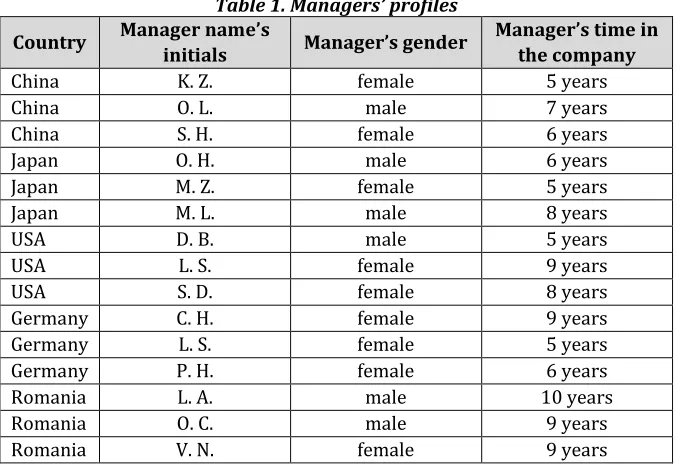
be the finance department, for their past experience to comprise management of cultural differences. The managers answered the designed questions, with their answers being afterward analyzed descriptively, with the focus on seeking out their perceptions of cultural differences and their strategies for managing these differences. The table below (Table 1) displays information on the managers that answered the questions, from China, Japan, the USA, Germany, and Romania.
Table 1. Managers’ profiles
Country Manager name’s initials Manager’s gender Manager’s time in the company
China K. Z. female 5 years
China O. L. male 7 years
China S. H. female 6 years
Japan O. H. male 6 years
Japan M. Z. female 5 years
Japan M. L. male 8 years
USA D. B. male 5 years
USA L. S. female 9 years
USA S. D. female 8 years
Germany C. H. female 9 years
Germany L. S. female 5 years
Germany P. H. female 6 years
Romania L. A. male 10 years
Romania O. C. male 9 years
Romania V. N. female 9 years
Research questions
In order to investigate the main goal regarding the perceptions of cultural differences and the strategies for managing these three research questions below were used:
Q1: Are managers well-informed that their employees have different cultural backgrounds?
A management strategy which takes different cultures into consideration has a vital importance in preventing conflicts because of the multicultural nature and also of the economic losses that might come out of these conflicts.
Global management needs not to ignore cultural differences. They need to turn cultural varieties into a competitive edge. A global competitive edge comes with the understanding and management of intercultural differences in multinationals.
Q2: Do managers see cultural differences as treasure?
Q3: Are managers in multinationals able to manage cultural differences?
Managers from multinationals need to understand and to be aware of the advantages and disadvantages that cultural differences can bring, take the advantages into account, and ensure that these differences are protected; respected and made use of Adler (1997) said that cultural difference is an asset to multicultural teams, especially when managers understand cultural difference.
On the other hand, team members that have a lack of intercultural competence often fail to facilitate an environment of flow and creativity, suppressing the conditions for managers. Having the ability to recognize and to operate in a multicultural environment, team members with high intercultural competence meet a lot of challenges that imply cultural difference and also stimulate positive multicultural team performance (Bennett, 1993; Deardorff, 2006).
Team members in multicultural teams are often characterized by high intercultural competence and overcome also the relational challenges to facilitate creative thinking. Multicultural team members characterized by high intercultural competence may overcome the social and relational challenges to facilitate creative thinking. By transcending cultural difference in teams, individuals with high intercultural competence can easily eliminate barriers and facilitate communication.
Analyses of data
For the first question “What is the importance you give to the multicultural elements in creating your managerial decisions?” 8 of 15 managers from all the countries, the US, Japan, Romania, China, and Germany answered high and 7 of them answered medium. 2 of 3 managers from China answered medium to this question. Managers from China offered insights from their relationship with other employees based in foreign countries, such as their lack of time management skills, the habit of postponing tasks and lack of willingness to work overtime. But by interacting more with other employees and managers based in other countries they can possibly develop a sustainable relationship with these in order to improve their work efficiency. It is the same case in Germany where 2 of 3 managers answered that the importance is medium related to the multicultural elements in creating their managerial decisions. German managers are often closed and trust more in German employees. They are focused more on what happens inside. Nevertheless, their work style is often consensual, collegial and loyal to one company and committed to its prospects.
The Romanian managers are aware of the multicultural elements, as working in a multinational company requires having soft and technical skills to be able to manage any situation that can occur with people management and also being in compliance with all the procedures that mostly apply abroad. For them, it is a must to successfully manage all the projects in scope.
As for the second question “What type of approach do you have when are you taking an important decision for a project involving participants from different cultural environments?” 12 of 15 managers answered that it is a favorable approach taking into consideration the importance of the culture. It is a favorable approach because it implies a lot of important factors such as the fact that they need to spend time to understand all cultures involved, their time zone, the way the participants can manage a project and if they are quick learners or not, their experience, the language and the way of they communicate, their values. All managers in Romania answered indifferent on the second question, due to their experience in the company and because they were involved with building a stronger relationship right from the beginning starting with the transition process. Although this is a new concept, they are doing it right from the beginning. All managers from the USA, China, Japan, Romania, and Germany are aware of their employee cultural backgrounds and capable to manage the differences and for sure all these can be seen in all IT and finance projects in PTC that were completed successfully with participants of different cultural background.
Related to the third question “When deciding to initiate a project with participants of different cultural environments, how important do you consider the problem posed by the linguistic barrier?” For 10 managers the problem of the linguistic barrier is very important. The most representative point of view came from a manager from Japan who said “Even though English is very popular in most of the countries of the world, I think that’s important if you could consider the problem of the linguistic barrier when you initiate a project because that’ll help you to think about approaches in different ways, which will help you more to get a better result.”
3 managers in China, Germany, and Romania think that it is of medium importance, a manager in Romania saying: “The project will not happen in 100 out of 100 cases if people do not have the ability to understand at least one common language. If not all the people know very well the common language it might become a problem, but not a blocker”. There were only 2 managers (1 from Germany and 1 from Romania) who said that the problem of the linguistic barrier is low. Nowadays English should not be a problem and everyone involved in a project with different participants from foreign countries should be able to communicate in English. Like in every project communication it is vital in order to build in a good understanding with all the participants involved in projects and also to be able to express what the expectations, the milestones, and the deadlines are. After all, it is a richness to have people from different countries that can come with new outcomes.
That’s helpful.” On the other hand, 2 of the managers (1 from Romania and 1 from China) said that “it depends on individuals, not only culturally specific factors”.
Conflicts are unavoidable on a daily basis in any organization and the problem of conflicts becomes pertinent as a result of diverse orientations to life, variations in communication styles, different concepts about reality, and rules of etiquette. Conflict occurs because of a weak understanding of cultural diversity, weak interaction between horizontal and vertical linkages. Understanding cultural diversity is an important step to develop harmonious intercultural relations, and cultural awareness needs to develop in multicultural organizations so that they can survive in the large cross-cultural environment. The development of intercultural competence requires cultural awareness. To have a good understanding of cultural differences would make it easier for managers to develop the interpersonal relationship between team members.
Due to the fact that most of the managers in the USA, Germany, Japan, China and Romania involved in the research think that the attitude of the employee in relation with work depends on culturally specific factors, meaning that managers are aware of their employees’ different cultural backgrounds and during their experience they adopted strategies for management of cultural differences. During the years, managers accumulate substantial knowledge on how to manage cultural differences and transform them in results in a high performance involving employees from different countries.
As for the fifth question “Have you encountered feasible and successfully implemented multicultural projects that worked in some countries but failed in other countries,” 8 of 15 managers responded positively, 6 of them negatively and only 1 manager was not sure. All the 3 managers in the US agreed that at some point in time they encountered feasibly and successfully implemented multicultural projects that worked in some countries but failed in other countries. Cross-cultural project teams can provide a diverse experience and innovative thinking for a project and offer a competitive position in the organization.
Moreover, if it is not managed correctly, cultural differences can change the successful completion of a multicultural project. For managers to achieve project goals and to avoid conflicts they need to be sensitive to cultural differences and to promote respect, motivation, creativity, respect, and good leadership. These are very important for the relations built between people, for motivational orientation attitudes through risk, time, context, control and the environment. Training and motivation of multicultural teams and implications for multicultural projects are vital. During the project, it is important to achieve technical, delivery, and operational objectives.
employees in one project with tasks and schedules reporting dictated by the organization; it may encounter numerous issues as an unchangeable schedule, no interest to provide motivation, a fearful attitude and no competition in sharing solutions, because of cascading failures. Multicultural teams can work smoothly if they have the same goal set by their managers. How multinationals function internally is less important, as long they are dealing with the laws of every country. All managers in each country adopt the latest methods and practices to be competitive. There is no need to tell them to be innovative.
For the sixth question “What do you consider the main risks when implementing multicultural projects (people, technology, management)?” 7 managers from all the countries answered that management is the main risk when implementing multicultural projects. The most representative answered was from a manager located in the US, who said: “Management should be prepared and aware of cultural differences”. Nevertheless, 7 managers said that people represent the main risk when implementing multicultural projects. Managers are aware of different cultural background related concerns, such as how much time people can be involved due to time zone, if they are committed to their work, if they are quick learners if they are able to work fast and to be proactive. One manager from Japan thinks that people, technology and management are important for a multicultural project to be successful. It is evident that managers recognize that cultural factors are vital for a multicultural project to succeed. Because of their managerial experience, they understand the cultural factors that can make or break a successful project. Due to this, managers have an active interpretation of their own cultural background.
However, by saying that management could be the main risk when implementing multicultural projects, they admit making a different adjustment during the period of the project. Managers understand also the cultural differences and the complexity in multicultural projects. They understand cultural diversity that includes individual differences and group behavior also different working and leadership styles. Differences can be encountered in the country where the project is developed as technological, knowledge and business practices. It needs that the managers be aware of the other cultures and the cultural background of each participant involved in the project. Also, they can be learned one step at a time.
The learning process of how to recognize and also understand cultural differences in a multicultural project often starts by ignoring cultural differences. Often this occurs accidentally. It is due to the fact that different situations are interpreted according to one’ culturally background. Managers tend to interpret different situations in a different way because of the cultural differences. The individuals trying to behave most familiar to the other participants involved in the multicultural project. In the time this happens the cross-cultural conflicts also begin to arise. Differences arising in multicultural projects are the difference in work practices, behavior and leadership styles. Because of that individuals and groups start to create generalized images of the behavior attributed to other national groups.
managers in multicultural projects recognize cultural differences they understand that people behave and react differently and that they also hold different values.
The seventh question of the questionnaire “In decision-making process have you used or do you do use elements of Artificial Intelligence?” 12 of the managers answered with “No” to this question, 1 manager on Romania having said that they “Unfortunately didn’t have the chance to use it”. There seem to be a need for the use of Artificial Intelligence in the management area, the managers wanting to use these elements, without having the chance to do so. 2 of the managers in Germany and the US responded with “Yes”, as they used or use elements of Artificial Intelligence and 1 manager from Japan said “I believe Artificial Intelligence is helpful when making decision”. The reason behind this affirmation being that Artificial Intelligence has the ability to provide a large quantity of information and also the fact that Artificial intelligence expertise can have an important impact on the decision process. Also, it can change the dynamics of many decisions.
The experts say that Artificial Intelligence can make people’s job easier and allow them to work more efficiently. Also, it can reduce waste of time of searching large sets of data and also it offers a way of recognizing strange patterns of behavior. Using software usually to do the same thing as humans but in many cases analyze large data that it is beyond the analytical capability of people. Artificial Intelligence plays an advisory role beyond traditional decision support systems in supporting decision making through assembling relevant data and also identifying questions that are pertinent and topics for policymakers and helping to generate a written advice. When managers have reliable data analyses using Artificial Intelligence they can make better choices for their employees.
A multinational should be seen in terms of its operation and its resources as integrating material, human, technical and financial resources. This can involve the implementing of the processes and tasks, including the planning, monitoring, forecasting, and evaluation of the work. On the other hand, the operational strategy of the company is based on the operational system, with its purpose being to have high quality and performance.
For the question number eight, “Do you consider the use of decision assistance software useful and efficient in the multicultural process?”, 11 of the managers answered “Yes” to the use of decision assistance software as useful and efficient in the multicultural process. A manager in Romania thinks that it is useful and efficient “but only as support”. 1 manager in China said “No” when answering this question and another manager in Germany said they “did not have exposure to that yet (or not sure what is implied by decision assistance software)”. Also, 1 manager in China and 1 in the US said it is not applicable. Making decisions include determination of what will happen if a decision is taken, when to be implemented and how to be implemented, what can happen if it is implemented. Managerial decisions are often made within an organizational context, including the organization’s own routine, culture, and operating procedures and practices. A support decision system needs to allow for the future influence of other traits and cultures to fit into the organizational structure.
multiple participants and requires conflict resolution and also involves a lot of information. Support for decision making requires an understanding of the problems and knowledge of the process problem leading to a decision. Managers have different perspectives and use multiple interpretations in solving problems. They can formulate decisions superficially and discard them before they are articulated. Usually, a manager can focus on only a few aspects at a time as seeing the big picture and can choose what they want or need to consider, is therefore rather balancing between analytic and holistic perspectives. Using decision software, as most of the managers agreed, can be useful to make the right decision. Visualization techniques, visual simulation, maps, and data aggregation can be used for a solution assessment.
The ninth question “When implementing multicultural projects have you identified problems that are specific to certain areas/countries whereas in other countries there were no such constraints?” 13 managers said “Yes”, they identified problems that are specific to certain areas/countries. A manager in Romania said “India dealing with ambiguity, China too much paper work”, also 2 managers in the US responded to this question, “Yes, language and time differences”, “Yes, and it is inevitable”. Most of the managers are aware of their employee’s different cultural backgrounds. As it is in Romania, too much paperwork, it is also in China. There are people from diverse cultures with different working procedures and ways of thinking. Dealing with these differences can be a big challenge for any manager. Managers in the USA are aware of the time difference, the language and the fact that it is inevitable. In handling differences during the implementation, any manager will often focus on regulatory, professional and framework, they will not pay attention to the management of different cultures and people. And because of this projects can be unsuccessful ones.
For the tenth question “Can you provide some advice regarding the efficient implementation of the projects that are carried in different cultural environments?” there are significant advice from all 15 managers who answered the questions. The managers in China stressed on feedback, good communication and research for cultural specifics before the implementation. A manager in China said, “You should be sensitive regarding cultural differences and promote motivation and creativity through flexible management, mutual respect for each other culture and reconciliation”.
Chinese keep in mind the final goal and start the project in small steps. By the end of each milestone, they check the status and if necessary adapt the project plan. Also, even the project goal can be adjusted according to the preliminary findings. The Chinese can give the impression that they are lacking concentration and consistency, however, this is because the difficulties to come to an agreement with all stakeholders. The advantage of the Chinese is a very fast reaction time. If necessary, Chinese can work non-stop and they expect an authoritarian leadership based on periodical controlling, especially in the early stages. The Chinese work philosophy is: “All is well that ends well”.
first all concept having all the necessary details. After the participants accepted the action plan the project will be completed methodically. All the participants know exactly what they need to do and work autonomously. The work schedule is treated seriously and strictly observed. Any modifications are not welcome. One of the factors that can make them possible is the quality issue. Germans work philosophy is: “Do the right thing from the start and it saves you trouble in the end”.
All Japanese managers’ advice regarding the efficient implementation of the project in different cultural environments is first of all teamwork, „mutual understanding, collaboration, together, bearing the risk together” and also good communication and leadership. It is very important for the Japanese managers to have a good relationship with the team and working together with them to achieve the best results but also the understanding of and collaborating with the members from others country is very important. The most representative answer is „Understand different cultures, learn the cross-cultural communication, think more us versus them”. Japanese are committed to their work and companies. They think more as us not them due to the cultural context. For them, it is important to harmonize employment security with other needs such as flexibility, good productivity, and acceptance by others in the company. It is also very important to make effective decisions.
The managers in Romania think that it is very important to communicate well, to explain the reason why and to be straight to the point. To know the others’ cultural limits is also a main factor in the efficient implementation of the projects carried in different cultural environments. Understand, being open and also transparent to other participants involved in the project is vital for a project to be a successful one. Also, the technical part is important “pay close attention to the difference in time zones, local customs like free days, limitations in access to technology (slow internet, old hardware)”. The main categories describing their working style are cleverness, hardworking multitasking, and creativity. The Romanians are known as people who work assiduously and invest a lot of effort to achieve their goals. Before they get into a project, the managers need to know the key details necessary to make a plan to know for sure that it will be a successful project. In general, Romanian managers communicate well, know best how to “sell” a project for you to join in. The desire to achieve more information, to develop their skills is important for all the managers working in multicultural environments.
Conclusions
The research findings suggest that more than a half of the managers based in all the countries think that multicultural elements are very important when they are taking their managerial decisions and that they are aware of their employees’ different cultural backgrounds. Managers said that they had a favorable approach when they are taking an important decision for a project that involves employees of different cultural environments; it can be said that the managers see cultural differences as richness, that the employees that are different can bring new ideas and can come with a new way of thinking in any problem that may appear during the project. The managers’ stress on linguistic barriers, but these should not be a challenge taking account that working in multinational English should not be a problem.
Also, as the research concludes, most of the managers think that the employee’s attitude in relation to work depends on culturally specific factors, which, if one is aware of, they are capable of managing cultural differences. For a business to be able to grow in a foreign country it is vital not to ignore cultural differences. Most of the managers in all the countries said that they encountered feasibly and successfully implemented multicultural projects that worked in some countries but failed in other countries due to some specific factors of the country such as technology, people or specific legislation. All the managers think that people and management are the main risks when implementing multicultural projects. Only two of the managers said that they used Artificial Intelligence in decision-making process, unfortunately, most of them said they did not, but that this would be helpful for them as a support. It is the same case regarding if they use decision software in multicultural processes. There are specific strategies adopted by the managers to handle cultural differences, based only on their own experience dealing with cultural differences.
In conclusion, managers are aware of their employees’ different cultural backgrounds and they see cultural differences as richness, they are able to manage cultural differences, but they don’t have strategies that involved support from a decision software to assist with managing cultural differences.
References
Adler, N.J. (1997). International dimensions of organizational behavior. Ohio: South-Western College.
Aksu, N. (2008), Örgüt Kültürü Bağlamında Farklılıkların Yönetimi ve Bir Uygulama. Retrieved from https://www.ulusaltezmerkezi.net/orgut-kulturu-baglaminda-farkliliklarin-yonetimi-ve-bir-uygulama/.
Arasaratnam, L. (2007). Research in intercultural communication competence. Journal of Intercultural Communication, 13(2), 66-73.
Bennett, M. (1986). A developmental approach to training for intercultural sensitivity. International Journal of Intercultural Relations, 10, 179-195.
Bennett, M. (2008). Transformative training: Designing programs for culture learning. In Moodian, M. (Ed.), Contemporary leadership and intercultural competence: Understanding and utilizing cultural diversity to build successful organizations (pp.95-110). Thousand Oaks, CA: Sage.
Bolisani, E., and Bratianu, C. (2017). Knowledge strategy planning: an integrated approach to manage uncertainty, turbulence, and dynamics. Journal of Knowledge Management, 21(2), 233-253.
Byram, M., Nichols, A., and Stevens, D. (2001). Developing inter-cultural competence in practice. Exeter: Cromwell Press.
Chin, J., and Sanchez-Hucles, J. (2007). Diversity and leadership. American Psychologist, 62, 608-609.
Connaughton, S.L., and Shuffler, M. (2007). Multinational and Multicultural distributed teams: A review and future agenda. Small Group Research, 38(3), 387–412. Connerley, M.L., and Pedersen, P. (2005). Leadership in a diverse and multicultural
environment: Developing awareness, knowledge, and skills. Thousand Oaks: Sage Publications.
Deardorff, D. (2006). The identification and assessment of inter-cultural competence as a student outcome of internationalization at institutions of higher education in the United States. Journal of Studies in International Education, 10, 241-266. Derr, C.B., and Laurent, A. (1989). The Internal and external career: a theoretical and
cross-cultural perspective. In Arthur, M.B., Hall, D.T., and Lawrence, B.S. (Eds.), Handbook of Career Theory (pp.454-471). New York: Cambridge University Press.
Earley, C.P. (2006). Leading cultural research in the future: a matter of paradigms and taste. Journal of International Business Studies, 37, 922–931.
Easterby-Smith, M., Malina, D., and Yuan, L. (1995). How culture-sensitive is HRM? A comparative analysis of practice in Chinese and UK companies. International Journal of Human Resource Management, 6, 31-59.
Elenkov, D., and Kirova, D. (2008). Are cultural differences in a small country important for international business? Journal of International Business & Economics, 8, 71-78.
Griffith, D., and Harvey, M. (2000). An intercultural communication model for use in global inter organizational networks. Journal of International Marketing, 9(3), 87-103.
Hofstede, G. (1984). Cultural dimensions in management and planning. Asia Pacific Journal of Management, 1, 81-99.
Hofstede, G. (2001). Culture's consequences: Comparing values, behaviors, institutions, and organizations across nations. Thousand Oaks, CA: Sage Publications.
Hofstede, G. (2011). Dimensionalizing Cultures: The Hofstede Model in Context. Online Readings in Psychology and Culture, 2(1), 3-26.
House, R.J., Hanges, P.J., Javidan, M., Dorfman, P.W., and Vipin, G. (2004). Culture, Leadership, and Organizations. The Globe Study of 62 Societies, London: Sage Publications
Ilgen, D.R., and Pulakos, E.D. (1999). Employee performance in today’s organizations. In Ilgen, D.R., and Pulakos, E.D. (Eds.), The changing nature of performance: Implications for staffing, motivation, and development (pp.21–55). San Francisco: Jossey-Bass Inc.
Miller, E. (1994). Diversity and its management: Training management for cultural competence within the organization. Management Quarterly, 35(2), 17-24. Moosmüller, A., and Schönhuth, M. (2009). Intercultural competence in German
discourse. In Deardorff, D. (Ed.), The Sage handbook of intercultural competence (pp.209-232). Thousand Oaks, CA: SAGE.
Noe, R.A., and Ford, J.K. (1992). Career building: learning from cumulative work experience. Career Development in Organisations, 7, 45-52.
Palmer, G. (2003). Diversity management, past, present and future. Asia Pacific Journal of Human Resources, 41(1), 13-24.
Pulakos, E.D., Arad, S., Donovan, M.A., and Plamondon, K.E. (2000). Adaptability in the work place: Development of taxonomy of adaptive performance. Journal of Applied Psychology, 85(4), 612-624.
Redmond, M., and Bunyi, J. (1993). The relationship of intercultural communication competence with stress and the handling of stress as reported by international students. International Journal of Intercultural Relations, 17, 235-254.
Scarborough, J. (1998). The origins of cultural differences and their impact on management. Westport, CT: Quorum Books.
Schein, E. (1985). Organizational culture and leadership: A dynamic view. San Francisco, CA: Jossey-Bass.
Schneider, S.C. (1989). Strategy formulation: the impact of national culture. Organization Studies, 10, 149-168.
Spitzberg, B., and Changnon, G. (2009). Conceptualizing inter-cultural competence. In Deardorff, D. (Ed.), The Sage hand-book of intercultural competence (pp.2-52). Thousand Oaks, CA: SAGE.
Ting-Toomey, S., and Oetzel, J. (2001). Managing intercultural conflict effectively. Thousand Oaks, CA: SAGE
Trice, H.M., and Beyer, J.M. (1993). The cultures of work organizations. Englewood Cliffs, NJ: Prentice-Hall, Inc.
Trompenaars, F. (1993). Riding the Waves of Culture: Understanding Diversity in Global Business. Chicago, IL: Irwin Professional Publishing.
Tsui, A.S., Nifadkar, S.S., and Ou, A.Y. (2007). Cross-national, cross-cultural organizational behavior research: advances, gaps, and recommendations. Journal of Management, 33, 426-478.
Venaik, S., and Midgley, D.F. (2015). Mindscapes across landscapes: archetypes of transnational and subnational culture. Journal of International Business Studies, 46(9), 1051-1079.
Welch, D.E., Welch, L.S., and Marchan-Piekkari, R. (2001). The persistent impact of language on global operations. Prometheus, 19(3), 194-209.