Journal of Education and Training Studies Vol. 3, No. 5; September 2015 ISSN 2324-805X E-ISSN 2324-8068 Published by Redfame Publishing URL: http://jets.redfame.com
195
Using Dynamic Geometry Software for the Intersection Surfaces
Timur Koparan1, Gül Kaleli Yılmaz21Ereğli Faculty of Education, Bülent Ecevit University, Zonguldak, Turkey. 2Bayburt Faculty of Education, Bayburt University, Bayburt, Turkey
Correspondence: Timur Koparan, Ereğli Faculty of Education, Bülent Ecevit University, Zonguldak, Turkey
Received: July 10, 2015 Accepted: July 30, 2015 Online Published: August 7, 2015 doi:10.11114/jets.v3i5.939 URL: http://dx.doi.org/10.11114/jets.v3i5.939
Abstract
The purpose of this study is to define prospective teacher views about using dynamic geometry software for intersection surfaces. The study was conducted as a case study. For this purpose, data collection tool was developed based on the opinion of two experts. The data collection tool consists of 4 open-ended questions related to the intersection surfaces. The research sample consisted of 42 prospective mathematics teachers. Semi-structured interviews were conducted with three prospective teachers to obtain more detailed information. The analysis process was performed within a descriptive-interpretative approach to reveal the effects of dynamics geometry software on prospective teachers’ opinion. Qualitative data was presented under various themes. The obtained data demonstrated that the prospective teachers had difficulties in determining the intersection surfaces, the intersections had been set incorrectly due to the incorrect drawings arising from the challenges in the visualization, and some conclusions had never gone beyond estimations. It was observed that the intersection surfaces were set easily in the learning environment supported by dynamic geometry software thanks to the visualization, cutting and moving features of the software. The obtained findings were supported by the snapshots of the prospective teachers’ answers taken from the dynamic drawings and interview sections before using the software and then. The conclusion was reached that dynamic geometry software contributed more to the prospective teachers in the setting of intersection surfaces than the process in which pen and paper were used. As a result, the dynamics geometry software, especially in the teaching of surface intersection was found to be an effective tool.
Keywords: dynamic geometry software, geometry teaching, intersection surface, prospective teacher
1. Introduction
Developments in technology have made it mandatory to use the proper tools and equipment to the needs of the era in education. It is undoubted that computers have the leading place among these technologies. Because of the fact that the objects in real life are three-dimensional, and computers allow the visualization of three-dimensional objects, computers attracted more interest in education over the last twenty year. Nevertheless the students cannot be successful in developing strong conceptual understanding in geometry that is an important part of mathematics (Mistretta, 2000). It has been demonstrated in several studies that various difficulties are experienced in the realization of the gains related to the three-dimensional geometry which are in the curriculum (Kösa, 2011). The challenges arising from the interpretation of the static views of the geometric objects lie at the root of these difficulties (Accascina & Rogora 2006; Kösa, 2011). Another difficulty arises when a three-dimensional shape is tried to be formed on a two-dimensional plane (Baki, Kösa, & Karakuş, 2008). Gürbüz and Gülburnu (2013) suggested that a teaching planning should be done in which the students can experience, make conclusions and generalization to improve their spatial and three-dimensional visualization skills. Otherwise, they stated that it will continue the challenge in the emergence student’s visual, aesthetic and intuitive sense. As it is known, the students who cannot find themselves in such a rich experience tend to memorize the rules, relationships, concepts and, when necessary, the proofs (Demir, 2010; Eryiğit, 2010; Özen, 2009). Therefore, studies are needed to create learning environments in which three-dimensional visualization and spatial skills can be improved.
Journal of Education and Training Studies Vol. 3, No. 5; 2015
196
Karataş (2003) describe dynamic geometry software presented by the information technologies as promising tools to achieve conceptual learning. Dynamic geometry software is actually a type of computer software used to analyze the geometry topics. This software is an important teaching tool that transforms geometry in a dynamic model by moving the shapes and is used to rebuild the shapes. According to Baki (2000), this software that embodies the concepts and relationships by visualization effects the teaching and learning in a positive way when used effectively and appropriately. This software has enabled to make assumptions about geometric objects and establish relationships between geometric objects, for it makes geometry, which is the visual perception center of the mathematics, dynamic on the computer screens by rescuing it from the static structure of the process in which pen and paper are used. Cabri 3 D, which is a three-dimensional dynamic geometry software, has an important potential for the visualization of the geometric objects and conceiving three-dimension (Accascina & Rogora, 2006). In Cabri 3D application, many structures (prisms, cylinders, pyramids, unit cubes, etc.) that cannot be seen, cannot be created (being complex) in the traditional environments (blackboard, etc.) or in the two-dimensional software, and need long time for being created, can easily be created in three-dimension, rotated, seen from different angles and their outer surfaces can be opened. Thus, the relationships between the structures that are formed similarly to the originals, features, generalization and calculation can easily be studied. In addition, the distinctive features of Cabri 3D software provide us with the opportunity to examine geometry topics dynamically that require three-dimensional spatial perception and depth. In this study, we focused on prospective teachers views related to the intersection surfaces in the learning environment supported by the dynamic geometry software. It was observed how prospective teachers made conclusions by making experiments and observations using the moving particularly and cutting features of Cabri 3D software; the way of thinking in the learning environment supported by Cabri 3D was examined from various angles.
2. Method
Within this study, it was aimed to investigate prospective teacher’ views about before and after using dynamic geometry software for intersection surfaces. In this study, case study approach was used. While collecting data for the research, semi-structured interview and open ended questions were used. These questions are shapeless questions. Some researchers suggest that teacher should use shapeless questions as far as shapely question and definition of geometric concepts (Karpuz, Koparan & Güven, 2014).
2.1 Participant
This research was carried out in a higher education institution in Turkey in 2014-2015 academic year. The sample group consisted of 42 prospective mathematics teachers in Bülent Ecevit University. Of the participants, 25 were females and 17 were males. In addition, interviews were conducted with three prospective teachers. The prospective teachers who were purposefully selected from the prospective teachers by taking the success levels into consideration. The three success levels of these prospective teachers were low, medium and high.
2.2 Implementation and Collection of Data
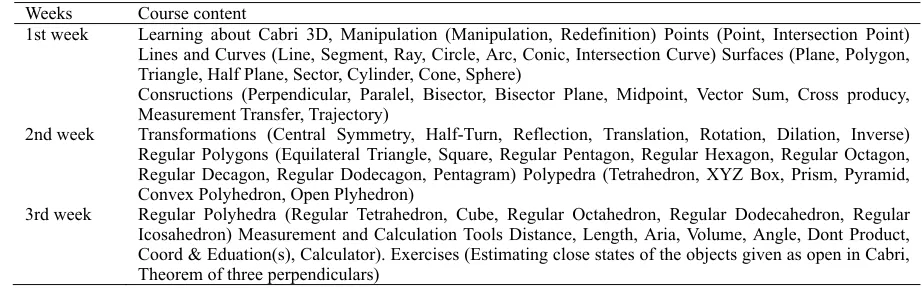
In this study, an assessment questionnaire consisting of four open-ended questions, observations, and semi-structured interviews were used in order to determine the conclusions of the prospective teachers related to the intersections. The questions to be asked in the interviews were determined before the study. The study was conducted on the “Teaching Technologies and Material Development Course". Within the scope of this course, physical and abstract materials for mathematics and geometry topics are developed. The program of the activities performed in the course for three weeks is shown below.
Table 1. The schedule of the course activities
Weeks Course content
1st week Learning about Cabri 3D, Manipulation (Manipulation, Redefinition) Points (Point, Intersection Point) Lines and Curves (Line, Segment, Ray, Circle, Arc, Conic, Intersection Curve) Surfaces (Plane, Polygon, Triangle, Half Plane, Sector, Cylinder, Cone, Sphere)
Consructions (Perpendicular, Paralel, Bisector, Bisector Plane, Midpoint, Vector Sum, Cross producy, Measurement Transfer, Trajectory)
2nd week Transformations (Central Symmetry, Half-Turn, Reflection, Translation, Rotation, Dilation, Inverse) Regular Polygons (Equilateral Triangle, Square, Regular Pentagon, Regular Hexagon, Regular Octagon, Regular Decagon, Regular Dodecagon, Pentagram) Polypedra (Tetrahedron, XYZ Box, Prism, Pyramid, Convex Polyhedron, Open Plyhedron)
3rd week Regular Polyhedra (Regular Tetrahedron, Cube, Regular Octahedron, Regular Dodecahedron, Regular Icosahedron) Measurement and Calculation Tools Distance, Length, Aria, Volume, Angle, Dont Product, Coord & Eduation(s), Calculator). Exercises (Estimating close states of the objects given as open in Cabri, Theorem of three perpendiculars)
Journal of Educ
the prospectiv dimensional o questions aske At the beginn Then they we teacher of the open-ended q Participants ar 1. What draw 2. What Expla 3. What by dr 4. What draw The participan dynamic geom 2.3 Data Anal In this study environment s study are the cylinder, verti problems they and in the pro These intervie Then created t
3. Results
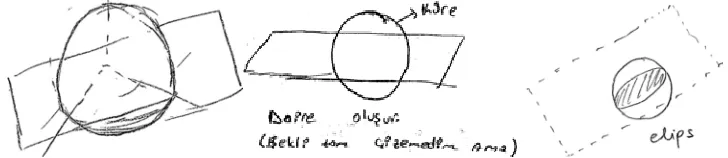
In this section after using dyn the questions context of a d the opinions o by direct quot 3.1 The Findin Within the sco occurs when prospective te drawings had was determine other answers Figure 1 show
Fig
cation and Train
ve teachers w objects with Ca
ed.
ning of the stu ere given cours e class during questions and re asked the fo t will the inte wing.
t will the inte ain by drawing t will the inter rawing
t will the inte wing
nts were asked metry software
lysis
y, the prospec supported by qualitative da ical cone, and y experienced ocess in which ews were recor themes were b
n, the answers o namic softwar
and the soluti data collection of the prospect tations from in ng Obtained fr ope of the stud a full sphere eachers gave t
not been mad ed that the pro s in which cor ws examples of
gure 1. Exampl
ning Studies
were introduced abri 3D, they h
udy, the prosp ses including C
the applicatio interview que ollowing questi rsection surfac ersection surfa g rsection surfac ersection surfa
d to answer the e at the end of t
ctive teachers’ dynamic geom ata derived fr d cube. The co and reasons w pen and paper rded and trans brought togethe
of the prospec re were examin
ions they did tool. In additi tive teachers r nterviews and v
rom the Interse dy, the prospec is cut with a the answer "ci de at all while ospective teac rrect drawings f answers befo
les of answers
d with Cabri had the basic s
ective teacher Cabri 3D activ on. At the end estions prepar ions;
ce, which occ
ace, which occ
ce, which occu
ace, which occ
e questions us the study.
’ views were metry software
om the questi onclusions of t were tried to be r were used. In cribed. Theme er and discusse
ctive teachers t ned. The findin
in Cabri 3D s on, the finding related to the a various themes ection of Spher ctive teachers a plane be lik ircular region"
some others h chers had mad
s but false ex re using softw
before using s
197 3D dynamic skills to be abl
rs answered th vities 4 hours d of the applic
red by the res
curs when a fu
curs when a v
urs when a ver
curs when a f
sing a pen and
examined re e. The finding ions related to the prospective e demonstrated n addition, inte es were tried to
ed.
to the open-end ngs were supp software. Resu gs derived from activities in a m s.
re and Plane were asked pr ke? Explain b ". When the an had been done
e predictions xplanations rel ware. software relate software. Bec le to make con
he questions w per week for t cation, the sam searchers wer
ull sphere is cu
vertical full cy
rtical full cone
full cube is cu
paper at the f
lated to the gs were evalua o the plane an e teachers rela d comparativel
erviews were c o be formed by
ded questions orted by the an ults were prese
m the interview more detailed
rimarily "Wha by drawing." nswers were e e but did not re
about the inte lated to the in
ed to the interse
cause participa nstructions rela
without using t three weeks. T me questions w re controlled b
ut with a plan
ylinder is cut
e is cut with a
ut with a plan
first stage of th
intersection s ated qualitative nd intersection ated to the int ly both in the d conducted with y examining th
in the data col nswers of the p ented as headi ws were prese way. These fin
at will the inter Before the ap examined it wa eflect the inter ersections. How ntersection sur
ection of spher
Vol. 3, No
ants worked o ated to the ope
the dynamic s The researcher were asked ag by an expert
ne be like? Ex
with a plane
plane be like?
ne be like? Ex
he study and C
surfaces in a ely. Basic data n of a sphere, tersection surfa
dynamic envir h prospective t hese transcript
llection tool be prospective tea ings in questio nted in order t ndings were su
rsection surfac pplication 76%
as observed th rsections. Ther wever, there w rfaces had bee
re and plane
o. 5; 2015
on three- en-ended
software. r was the gain. The as well. xplain by be like? Explain xplain by Cabri 3D learning a for the vertical aces, the ronments teachers. s deeply. efore and achers to on in the to reflect upported
Journal of Educ
After using s observed that, about the inte teachers after
Fi
As seen in Fi intersection su into error befo teachers with 3.2 The Findin In the study, occurs when a teachers relate in figure 3.
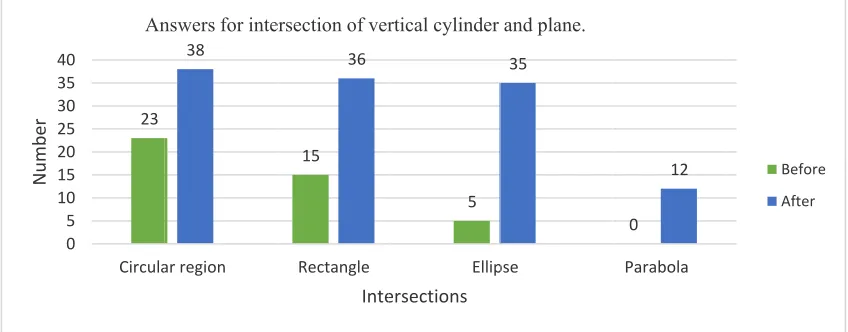
Fi As seen in Fi vertical cylind "ellipse" answ matter how th although the c this situation a
Figure 4. T
Some prospec given for the i shows exampl
Number
cation and Train
software, 98% , using Cabri 3 ersection by lo the application
igure 2. The ex
gure 2, the dr urface, no answ ore using softw
Cabri 3D affec ngs Obtained f
the prospectiv a vertical full ed to the inters
igure 3. Answe igure 3, about der and plane wers. Some pr
he cylinder is cylinder was cu
are shown in F
The examples o
ctive teachers m intersection of les of these wr 23 0 5 10 15 20 25 30 35 40 Circula An ning Studies
% of the prosp 3D, the prospe ooking at the t n are presented
xamples of dra
rawings made wer was given ware did not m cted their draw from the Inters ve teachers we cylinder is cu section of vert
ers for intersec t half of the p before using rospective teac cut by a plan ut by a plane p Figure 4.
of answers argu
misidentified t f solid vertical rong answers.
38
ar region nswers for inte
pective teache ctive teachers top view by m d in figure 2.
awings for the
after the appli n apart from "c make the same
wings and conc section of Verti ere asked the ut with a plane
tical cylinder a
ction of vertica prospective te
the dynamic chers argued th ne. Some pros
perpendicular
uing that the in
the intersection cylinder and p
15 36
Rectangle
Inte ersection of ver
198 rs gave the a
had formed in moving the sha
intersection of
ication were m circular region
mistakes after clusions related
ical Cylinder a second quest e, be like? Exp and plane befo
al cylinder and eachers gave " software. 15 p hat the interse spective teache to the cylinder
ntersection of v region. n, for they form plane such as c
5 Ellip ersections rtical cylinder answer "circul ntersecting sph ape. The exam
f sphere and pl
more realistic n". This shows r using softwar
d to the interse and Plane
ion as "What plain by drawin ore and after us
d plane before "circular regio prospective te ection would b ers gave "circu r and they drew
vertical cylind
med the shape circle, triangle
35
pse
and plane.
lar region" to here and plane mples of drawin
lane after usin
and understan that the prosp re. The experie ection surfaces
will the inter ng". The answ sing dynamic
using software on" answer for achers gave " be a circular r ular region" a w it correctly.
der and plane a
s incorrectly. I e, parallelogram
0 12
Parabola
Vol. 3, No
this question ; then they had ngs of the pro
ng software
ndable. Concer pective teacher ence of the pro s.
rsection surfac wers of the pro software are p
e and then. r the intersect
rectangle" and region in any answer for inte Sample answe
are always a cir
Incorrect answ m, rectangles.
Before
After
o. 5; 2015
n. It was d an idea ospective rning the rs falling ospective ce which ospective presented
Journal of Educ
Figure As seen in Fig In addition, i Therefore, the In the learning by moving th presented in F
Figure 6. None of the p activities with of vertical cyl
Figure 3.3 The Findin The answers dynamic softw
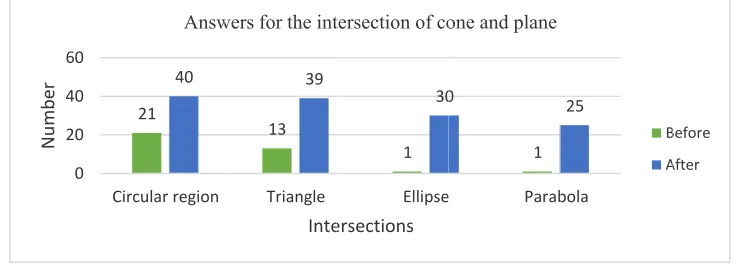
F As seen in Fig and plane befo prospective te to the cone b intersections.
cation and Train
5. Examples o gure 5, the inco it can be said e answers for th
g environment he shapes after Figure 6.
Examples of C prospective te h Cabri 3D, 12 linder and plan
e 7. Examples ngs Obtained F of the prospec ware are presen
igure 8. Answ gure 8, half of fore using the d eachers gave "t base or perpen Examples rela
0 20 40 60
Number
ning Studies
of given answe orrect drawing d that even if he intersection t supported by r they had dra
Cabri 3D draw eachers gave " 2 prospective t ne. Figure 7 pre
of answers for From the Inter ctive teachers nted in figure 8
ers for the inte f the prospecti dynamic softw triangle" answ ndicular to the ated to this situ
21 40
Circular region Answ
ers for the inter gs made in two the drawings ns did not go b y Cabri 3D, th awn cylinder a
wings of the pro "parabola" ans
eachers gave " esents exampl
r the intersecti rsection of Ver related to the 8.
ersection of ve ve teachers ga ware. Only one wer. It was obse e center of th uation are prese
13 39
Triangle
Inte wers for the int
199 rsection of ver o-dimensions l s are made co beyond predicti he prospective and plane. Th
ospective teach swer for the in "solid parabola es of the answ
ion of a vertica rtical Cone and e intersection o
ertical cone and ave "circular re student gave " erved that the
e cone base. ented in Figur
1 30
Ellipse
ersections tersection of co
rtical cylinder a ed to false con orrectly, the in
ions.
teachers tried e drawings m
hers for the int ntersection be a" answer for wers given after
al cylinder and d Plane
of vertical con
d plane before egion" answer "ellipse" and o
prospective te This situation e 9.
1 0
e Parab
one and plane
and plane after nclusions of th ntersections ca
d to identify th made by the pr
tersection of c fore the appli the questions r using softwar
d a plane after u
ne and plane b
using softwar r for the inters one gave "para eachers had dra n prevented th
25
bola
B
A
Vol. 3, No
r using softwa e prospective t annot be seen
he intersection rospective teac
ylinder and pl ication but aft asking the inte re.
using software
before and aft
re and then ection of verti abola" answer w
awn the planes hem from seein
Before
After
o. 5; 2015
re teachers. n clearly.
surfaces chers are
ane. er doing ersection
e
ter using
Journal of Educ
Figure 9 As seen in Fig intersection o objects in two In the learning by moving the presented in F
The answers dynamic softw
Figure 1 As seen in Fi successful aft realize also e majority of th less mentione observations. would be a tri 3.4 The Findin The answers o software are p
cation and Train
9. Examples of gure 9, some p of vertical con o dimensions a g environment e shapes after Figure 10.
Figure 10. of the prospe ware are presen
11. Examples o igure 11, draw ter using softw ellipse-shaped he prospective ed compared
Some prospec angle, and som ngs Obtained f of the prospec presented in fig
ning Studies
f the given answ prospective te ne and plane. s an intersectio t supported by
they had draw
Examples of C ctive teachers nted in figure 1
of given answe wings of the p ware. The use
and parabola teachers could to the others ctive teachers s me particularly from the Inters ctive teachers gure 12.
wers for the in achers gave an Some prospec on. This indica y Cabri 3D, th wn vertical con
Cabri 3D draw s related to the
11.
ers for the inte prospective tea
of the dynam a-shaped inter d notice inters s, for the pro said that when y mentioned th section of Cub related to the
200 ntersection of v
nswers such a ctive teachers ates that they h he prospective ne and plane. T
wings the inters e intersection
ersection of ver achers for the mic software h
rsections. It w ections other t ospective teac n the plane cut hat this triangle e and Plane
intersection o
vertical cone a as circle, triang
defined the c have incomplet teachers tried The drawings m
section of vert of vertical co
rtical cylinder intersection o helped the maj was observed than a parabol chers could n the cone perpe e would be an i
of cube and pl
and plane befor gle, trapezoid, common area
te knowledge d to identify th made by the pr
tical cone and p one and plane
and plane afte of vertical con jority of the p that after the la. It can be sa not make eno endicular to th isosceles trian
lane before an
Vol. 3, No
re using softwa parallelogram of the drawin about intersect he intersection rospective teac
plane
after using C
er using softwa ne and plane a prospective tea e implementat aid that a parab ough experime he center of the
gle.
nd after using
o. 5; 2015
are m, for the
ng of the tions.
surfaces chers are
Cabri 3D
are are more achers to tion, the bola was ents and e cone, it
Journal of Education and Training Studies Vol. 3, No. 5; 2015
201
Figure 12. Answers for the intersection of cube and plane before using the software, and then.
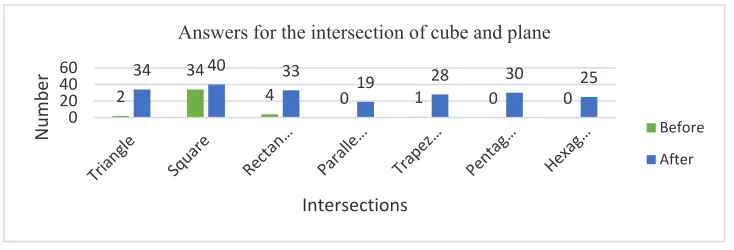
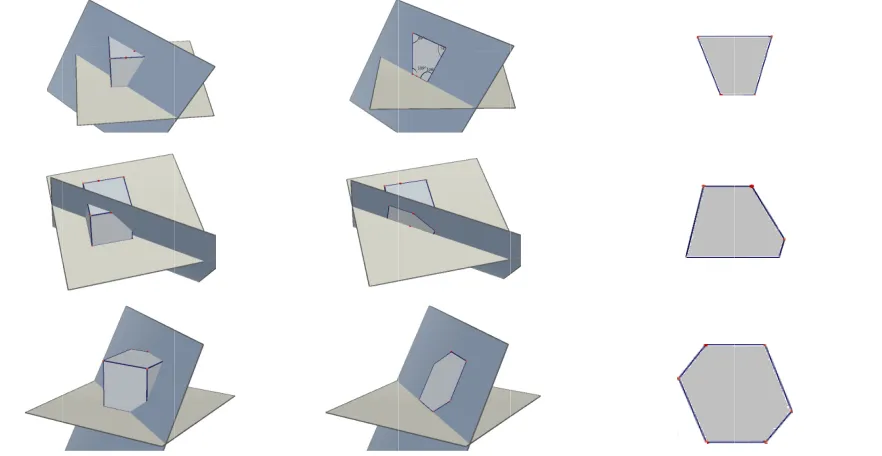
As seen in Figure 12, the "square" answer was mentioned most for the intersection of cube and plane before using the dynamic software. Four prospective teachers gave "rectangle" and two prospective teachers gave a "square" answer. The explanation of some prospective teachers as "When a cube is cut by a plane, the shape of the base will always be obtained" attracted attention. Examples of Cabri 3D drawings of the prospective teachers are presented in figure 13 for the intersection of cube and plane after using software. These figures are snapshots taken from the dynamic drawings with Cabri 3D.
2
34
4 0 1 0 0
34 40 33
19 28 30 25
0 20 40 60
Number
Intersections
Answers for the intersection of cube and plane
Before
Journal of Educ
Figure 1 It was found o dynamic softw identify the in drawings mad
Fi After the imp triangle while 3.5 Findings O In this section Similar consid mentioned as Software featu dynamics, cut
Kenan
paper. Thanks make p
cation and Train
13. Examples o out that the ma ware was used ntersection sur de by the prosp
igure 14. Exam lementation, t some particul Obtained from n, the views of derations have they told so th ures: It was o tting and recor
n: It was rathe Therefore, I ha s to the cutting predictions.
ning Studies
of Cabri 3D dr ajority of the p d. In the learn rfaces by using pective teacher
mples of given the majority of larly named th
the Interviews the prospectiv been grouped hat the view of observed durin ding features o er difficult for ad to make pre g feature of th
rawings of the rospective teac ning environm g the moving rs are presented
answers for th f the prospecti e intersections s
ve teachers abo d and analyzed
f the prospectiv ng the intervie
of the software r me to imagin edictions and w he Cabri 3D p
202 prospective te chers could no ment supported
and cutting fe d in Figure 14
he intersection ive teachers m s (equilateral tr
out the implem under specific ve teachers trie ews that the pr e. Interview se ne the intersec was not sure a program, the i
eachers for the otice that other d by Cabri 3D eatures after th
.
of cube and p mentioned that
riangle, isoscel
mentation proce c themes. The ed to be reflect
rospective tea ections related ctions and tur about them. Ca intersection ap
intersection of r intersections D, the prospec hey had drawn
plane after usin one of the int les triangle, sc
ess were inves sentences relat ted directly. achers emphas
to that are giv rn them aroun abri 3D has eli ppears directly
Vol. 3, No
f cube and plan
were formed w ctive teachers n cube and pla
ng software tersections wo calene triangle)
tigated and an ted to the them
ized the visua en below. d when I use iminated this d y. There is no
o. 5; 2015
ne. when the
tried to ane. The
ould be a ).
alyzed. mes were
alization,
Journal of Education and Training Studies Vol. 3, No. 5; 2015
203
Melda:We could see it/them/what? as three-dimensional on the computer and easily understand everything that we had not been able to see on the drawing made using a pen and paper. When I made drawing by hand, I drew an intersection surface for each question. However, I realized when using a computer that there were many other intersection surfaces that I had not been able to see before. Because planes are in different colors, shapes can be easily understood in Cabri 3D. I think it was very enjoyable.
Leyla:The drawings I made using a pen and paper prevented me from seeing three-dimensional. It was rather difficult to draw the situations left at the front or the back. If the shape is incorrect, then the answer will be incorrect, either. In addition, we cannot move the shape. This condition causes the illusion. Thus I could only think of simple cases. I found other intersections wrong. However, I could clearly see and understand the intersections by moving them with this program. The recording feature is also very good. Therefore, we do not need to re-draw. We can use repeatedly.
Changing views of the prospective teachers: It was observed that some changes had happened in the views of the prospective teachers after the implementation compared to those before the implementation. Some interview sections related that are given below.
Melda: I had found the intersection obtained when a cube had been cut by a plane as “square” as a result of my drawings made using a pen and paper. However, when I used the software, I realized that rectangular, trapezoid, pentagon, hexagon, parallelogram, triangle could be obtained. Beyond that, triangles can vary such as equilateral triangle, isosceles triangle and scalene triangle.
Leyla: When objects were cut with the plane on paper, only the situations in which it was cut horizontally and vertically came to my mind. Therefore, I could not see all intersections. However, we could see the other situations, for we could move the objects in the dynamic environment. When the plane is not vertical or horizontal to the surface, more different intersection surfaces can be obtained. I had found the intersection when a vertical cylinder had been cut by a plane as “triangle” by drawing using a pen and paper but when I used the software, I realized that rectangles and ellipse could be obtained as well. The subjects were embodied in the computer and settled better in my mind. I could obtain more intersections using a computer. I can say that Cabri 3D convinced us about intersections.
Kenan: I could not predict that such various intersections would be obtained particularly from a cube. I never thought that a triangle would be obtained from a cube. I had the opportunity to examine the shapes from different angles. If I had been told about the intersections obtained with Cabri 3D, I would not be convinced, and it would not stay in my mind. This software has changed our way of thinking. I think computer-aided training is very good, I gained a different perspective.
Drawing simplicity: Some prospective teachers compared the drawings made on the computer with the ones made using a pen and paper. Interview sections about this are given below.
Leyla: Figures are difficult to create with paper and a pen. Everyone can not make drawings. I drew and erased many times. It was still no good. It is different in Cabri 3D. You can create the drawing in a very short time with just a few keys from the menu.
Time-saving: Leyla stated that she could easily draw the shapes that were difficult-to-draw and time-consuming, using the software, and she saved time.
Melda: Drawings took a lot of my time when I used a pen and paper. Additionally, I had to erase several times. We could create drawing with Cabri 3D in a shorter time.
Usability: The interviewed prospective teachers shared the opinion that the use of the software in the course was beneficial. They stated that they could easily understand the topics that they had been unable to imagine thanks to the software. In addition, the interviewed prospective teachers stated that they found the software handy, and they would surely use it in their professional career. Interview sections about this are given below.
Melda: In my opinion, the fact that this software shows us the situations that are difficult to see helps us to imagine the situations to occur more easily. I think it is very useful for teaching geometry. I will use this software in my courses when I become a teacher.
Journal of Education and Training Studies Vol. 3, No. 5; 2015
204
Leyla: This program is a very useful program for handling the course. I think it would be better for teachers to show the various situations that they consider necessary to teach and that the students have difficulty to realize, using the program, instead of drawing on the board or referencing the objects in the classroom or using the geometric objects. Physical materials are sometimes not enough to teach some subjects and to show some situations. In these situations, it would be useful to show objects from different angles and to teach the situations by changing them.
4. Discussion
In this study, it was aimed to examine the conclusions of the prospective teachers related to the intersections in the environments in which the dynamic software is used and not used. For this purpose, the prospective teachers were asked to state the intersections to be obtained when sphere, vertical cylinder, vertical cone, and cube are cut by a plane. Before the application, it was observed that the prospective teachers tried to show answers of the questions by using a pen and paper. Despite various attempts, their explanations related to the intersection surfaces remained limited. The majority of the prospective teachers created planes in a way that it was parallel to the base of the vertical cylinder, the vertical cone, and cube, or it passed through the center of the base center. This situation prevented them from seeing other intersections. Thus, the intersection of a cylinder and a plane was generally named as a circular region and rectangle; circular region and triangle for the intersection of vertical cone and plane. It was observed that some prospective teachers made false conclusions related to the intersection due to incorrect drawings. It was also observed that some prospective teachers considered the intersection regions of two objects drawn in a two-dimensional plane as an intersection. This indicates that their learning related to the intersection is inefficient. Only a few stated that their drawings were not good and wrote their predictions. After the implementation, it was observed that the prospective teachers were more successful in determining intersections and drawing more realistically. Moreover, some prospective teachers did not only determine the intersection surface, but also made explanations about the intersections for special conditions (for example: If a cube is cut from the middle point of the edges meeting at the corner of the cube by a plane, then the intersection will be an equilateral triangle). In general, the prospective teachers stated that they had gained experience with Cabri 3D, and their way of thinking had changed. Likewise, Couco and Goldenberg (1996) stated that with computer-assisted mathematics, students developed a unique way of thinking, gained an idea about the mathematical results, and at the same time, it enabled them to behave like a mathematician when reaching mathematical conclusions. In this study, the prospective teachers suggested that this software would be useful to handle the course, particularly for topics related to three-dimensional objects. Moreover, the prospective teachers were observed to be willing to use three-dimensional software when answering the questions related to intersections. Indeed, it was demonstrated in the studies conducted before that the use of dynamic geometry software in geometry courses helps the students to create a positive attitude towards these courses (Güven & Karataş, 2003; Hazzan & Goldenberg, 1997). The prospective teachers experienced cutting objects in various shapes by moving the plane and observed the occurred intersection by moving the object when answering open-ended questions. Likewise, Arcavi and Hadas (2000) stated that dynamic geometry software contributed students by visualizing and experiencing, and they could make observations with these experiences. It can be said that in this study, the discovery and visualization offered by the software were applied successfully. Harel and Sowder (1998) demonstrated that when the moves and objects they saw on the computer screen were moved, it made a positive effect on their dynamic visualization skills that enabled them to make the same procedure more easily in their mind. Thus, they realized the mistakes they had made before using the software, and did not repeat them after using the software. Aşkar (1991) said that the best learning is that one realizes his mistakes, and it should not be forgotten that computers made this easier. Additionally, Laborde et al. (2006) concluded that the learning in the environments in which the dynamic geometry software was used, was not just a basic process in which the presented knowledge was taken, but it was a process in which they built and re-structured their geometry knowledge. In the light of this finding, it can be said that the individuals can restructure their own knowledge thanks to Cabri 3D dynamic software.
Journal of Educ
problems relat software that o
References
Accascina, G. Mathema Arcavi, A., & Compute Aşkar, P. (19 Paper pre Baki, A., Kö
Öğretmen Eskişehir Demir, V. (20 effect of master's t Eryiğit, P. (20 geometri software (Unpubli Gürbüz, R., &
Turkish J Güven, B., & Online Jo Harel, G., & S & Dubin Mathema Hazzan, O., &
environm http://dx. Karpuz, Y., K Compute Kösa, T. (201 students? Educatio Kösa, T., &
Procedia Mistretta, R. M Özen, D. (20
düzeyleri academic (Unpubli Scher, D. (199
This work is l
cation and Train
ted to the inter offers unique o
., & Rogora, E atics Education & Hadas, N. (2 ers for Mathem 91). Bilgisaya esented at Qua ösa, T., & Ka n görüşleri, P r.
010). Cabri 3D f cabri 3d dyn thesis).Marma 010). Üç boyu i dersine yöne in geometry t ished master's & Gülburnu M Journal of Com
Karataş, İ. (20 Journal of Educ Sowder, L. (19 nsky, E. (Eds atical Society. & Goldenberg ments, Intern .doi.org/10.100 Koparan, T., & er and Mathem 11). Ortaöğreti ? spatial skil nal Sciences, T
Karakuş. F. a-Social and Be M. (2000). Enh 009). İlköğret ine etkisi ve öğ c achievement ished master's 99). Problem s
icensed under
ning Studies
rsection of thr opportunities p
E. (2006). Usi n, 13(1), 11-22 2000). Compu matical Learnin
ar destekli öğr ality Improvem arakuş, F. (20 Paper presente
D dinamik geom namic geometr
ara Üniversity, utlu dinamik g elik tutumların teaching on 12
thesis). Dokuz . (2013). 8. sın mputer and Ma 003). Dinamik cational Techn 998). Student p
.) Research i
g, E. P. (1997 national Jou 07/BF0018261 Güven, B. (2 matics Educatio
im öğrencilerin lls] (Unpublis Trabzon.
(2010). Usin ehavioral Scie hancing geome
tim 7. sınıf ğrenci görüşle t level and the
thesis). Dokuz olving and pro
a Creative Co
ee-dimensiona particularly in
ng cabri 3D d 2.
uter mediated l ng, 5, 25-45. h retim ortamı, ment and Resea 008). Uzay ge
d at Internatio
metri yazılımın ry software on y, Istanbul. geometri yazılı na etkileri [Th 2th grade stud z Eylül Univer nıf geometri ö athematics Edu
geometri yazı nology, 2(2), 67
proof schemes in Collegiate
7). Students’ u urnal of C
18
014). Using F on,5(2), 108-1
nin uzamsal b shed doctoral
ng dynamic g ences, 2(2), 13
etric reasoning geometri öğr rinin değerlen e assessment o z Eylül Univer oof in the age o
ommons Attrib
205 al objects was
the three-dime
diyagrams for
learning: An e http://dx.doi.org [Orientation i arches in Educ eometri öğretim
onal Education
nın, geometrik n geometric th
ımı kullanımın he effect of ut dents, their aca
rsity, Izmir. ğretiminde ku ucation, 4(3), 2 ılımı Cabri ile 7-78.
s result from ex Mathematics
understanding Computers fo
Figure and Con 118. http://dx.d becerilerinin in dissertation)
geometry softw 85-1389. http: g. Adolescence retiminde dina
dirilmesi [The of the students rsity, İzmir.
of dynamic ge
ution 3.0 Licen
useful. In the ensional studie
teaching, Inte
example of an g/10.1023/A:1 in space: Com cation 1. Symp
minde 3D din nal Technolog
k düşünme ve hinking and ac
nın 12. sınıf öğ tilizing the thr ademic standin
ullanılan cabri 224-241.
geometri öğre
xploratory stu III (pp.
234-of the notion or Mathemat
ncept Knowled doi.org/10.169 ncelenmesi [A . Karadeniz
ware cabri 3D //dx.doi.org/10 e, 35(138), 365
amik geometr e effect of dyna s? opinions in
ometry, Micro
nse.
light of the ob es should be us
rnational Jour
n approach. In 100984181724 mputer-aided l posium, Istanbu
namik geomet gy Conference
akademik baş cademic achiev
ğrencilerinin a ree dimension ngs, their attitu
3D’nin kavram
enme: Öğrenci
dies, In A. Sch -282). Washin
n of function tical Learnin
dge in Geomet 949/turcomat.1 An investigation
Technical Un
D for teachin 0.1016/j.sbspro 5-379.
ri yazılımların amic geometry n geometry ins
omath, 15 (1), 2
Vol. 3, No
btained result, sed at each lev
rnal for Techn
ternational Jo 5
earning enviro ul.
tri yazılımı ku e, Anadolu Un
şarı üzerine etk vement] (Unp
akademik başa nal dyinamic g ude towards ge
msal öğrenmey
görüşleri. The
hoenfeld, A., K ngton, D.C: A
in dynamic g ng, 1(3), 2
try. Turkish Jo 6832
n of secondar niversity, Inst
ng analytic g o.2010.03.204
nın öğrenciler y softwares on
struction at 7t
24-30.
o. 5; 2015
dynamic vel. nology in ournal of onment]. ullanımı: niversity, kisi [The ublished
arıları ve geometry eometry] ye etkisi. e Turkish Kaput, J. American geometry 263-291. ournal of y school titute of eometry.