Exploring Grade Eight Students’ Development of
Geometric Reasoning in a Problem Solving Situation
Using Dynamic Geometry Software
by
OLGA NASSAR
B.S., Mathematic Education, Lebanese American University, 2000
Thesis submitted in partial fulfillment of the requirements for the Degree of Master of Art in Education/ Emphasis Math Education
Department of Education
LEBANESE AMERICAN UNIVERSITY June 2010
Plagiarism Policy Compliance Statement
I certify that I have read and understood LAU’s Plagiarism Policy. I understand that failure to comply with this Policy can lead to academic and disciplinary actions against me.
This work is substantially my own, and to the extent that any part of this work is not my own I have indicated that by acknowledging its sources.
Name: Olga Nassar
I grant to the LEBANESE AMERCIAN UNIVERSITY the right to use this work, irrespective of any copyright, for the University’s own purpose without cost to the University or its students and employees. I further agree that the University may reproduce and provide single copies of the work to the public for the cost of reproduction.
To my Mother and beloved son Mazen
ACKNOWLEDGMENTS
I would like to express my gratitude to Dr. Iman Osta for her continuous guidance, patience, support, and encouragement throughout my Thesis work. I would also like to thank Dr. Mona Nabhani and Dr. Samer Habre for their time, trust, and guidance.
Finally, I would like to thank my caring family especially my loving husband for his patience, support, and encouragement. My precious sister you were there when I needed you. Your trust in me made me able to stand on my feet and complete this work.
ABSTRACT
Mathematics educators consider proof as central to the discipline of mathematics. However, the use of Dynamic Geometry Software (DGS), which enables students to create many examples of a single figure, raises questions about the importance of deductive proof. The Lebanese curriculum does not explicitly integrate the use of DGS in geometry teaching. However, some schools are including DGS activities in geometry classes. This study aims at exploring Lebanese students’ development of geometric reasoning in problem-solving situations requiring proving, using dynamic geometry software. Participants are a conveniently accessible group of grade 8 students, at a reputable private school in Mount-Lebanon. The group consists of 35 students, 12 females and 23 males coming from middle socioeconomic background. The study involves several techniques: a semi-structured interview with the teacher, development of a math teaching unit integrating the use of Cabri-Geometer, paper-pencil problem-solving situations requiring proofs prior to unit implementation, implementation of the unit, problem solving situations in DGS context which require proving, and clinical interviews with selected groups of students while solving proof problems. The proofs produced by students using paper-pencil were compared with proofs produced in a DGS context. In addition, the mental models of geometric reasoning of students using paper-pencil were compared with the mental models in DGS context. Data collected was analyzed according to a classification framework developed for this purpose. The following results were found: students were able to produce more correct figures using DGS than when using paper-pencil. They were also able to better experiment and explore the problem. This made them understand the problem and the theorems and properties it involves. Students produced more correct conjectures. Moreover, DGS figures provided students with tools to prove so they did not give any conjecture with no proof. Though some of the proofs produced were empirical most of the proofs reflected more understanding of the concepts. Moreover, while students focused, in the paper-pencil quiz, on the format of proofs produced, they rather focused, in the DGS quiz, on the content and logic of proofs produced.
TABLE OF CONTENTS
Page AKNOWLEDGMENTS ……….vi ABSTRACT ...………....vii Chapter 1. INTRODUCTION……….………...11.1 Context of the Study………….………...………2
1.2 Purpose and Research Questions……….………...……….3
1.3 Operational Definitions……….…...………...3
1.4 Rationale and Significance of the study……...………..4
1.5 Organization of the Remainder of the study…...………….………5
2.LITERATURE REVIEW………...……….…………6
2.1 Proof………...………….………6
2.2.1 Role of proof in mathematics education……….7
2.2.2 The role that proof should play in math classes……….7
2.2.3 Difficulties that students face in proof………...8
2.2.4 Students’ ways of proving………..9
2.2.5 The ways students develop the notion of proof………13
2.2.6 Ways to enhance geometric reasoning……….14
2.2 Dynamic Geometry Software (DGS)………...15
2.2.1 Studies that recommend the use of DGS……….16
2.2.2 DGS and teaching proof………...17
2.2.2.1 Role of teachers in teaching proof in DGS environments….19 2.2.3 Ways students use DGS………19
2.2.3.1 Dragging………20
2.2.3.2 Active visualization………...20
2.2.4 Ways to develop geometric reasoning while using DGS……….21
2.2.4.1 Formality of proof………..…...21
2.2.4.3 Kind of activities to be used in DGS environment…………22
2.2.4.4 Classroom Culture……….23
2.3 Conclusion……….23
3. METHODS AND TECHNIQUES……….25
3.1 Participants…..………...25
3.2 Procedure………...26
3.2.1 Interview with the teacher……….26
3.2.2 Classroom observations……….27
3.2.3 Paper-pencil Quiz………..27
3.2.4 Development of the unit………...28
3.2.4.1 Preparatory stage with teacher………..28
3.2.4.2 Preparatory stage with students………29
3.2.4.3 Settings in the lab……….29
3.2.5 Implementation of the unit………...29
3.2.6 Problem solving session in the lab………...30
3.2.7 Clinical Interviews……….31
3.3 Instruments………...………...32
4. ANALYSIS AND RESULTS………...33
4.1 Interview with the teacher………...33
4.1.1 Role of proof in class………...34
4.1.2 Teacher’s view of ways to enhance proof abilities.……….34
4.1.3 Teacher’s strategies of teaching proof in the class…………...34
4.1.4 Difficulties that students face when they prove………...35
4.1.5 Teacher’s perception of proof in DGS environments………...36
4.2 Answer key of a quiz………...……….………….37
4.3 Class observation………...…………...37
4.3.1 Observation rubric………..……….38
4.3.2 Audio-taped data ………..………39
4.3.2.2 Teaching strategies……….………39
4.3.2.3 Method of teaching proof………39
4.3.2.3 Time limitation………40
4.4 Framework for analyzing students’ geometric reasoning……...…………..41
4.4.1 Process………..………41
4.4.1.1 Levels of reasoning……….……….41
4.4.1.2 Ways DGS was used in making Conjectures………...42
4.4.1.3 Reasons for incorrect conjectures………43
4.4.2 Product………..………44
4.5 Results………...…………...51
4.5.1 Paper-pencil Quiz………..…...51
4.5.1.1 Categories of Proof used by students in the Paper-Pencil Quiz..51
4.5.1.2 Conjecture Categories…….………56
4.5.1.3 Levels of reasoning of Incorrect Conjectures ……….57
4.5.1.4 Reasons for inducing incorrect conjectures ………...58
4.5.1.5 Proof Categories of incorrect conjectures …………...58
4.5.1.6 Format of Proofs in the Paper-Pencil Quiz ……….………60
4.5.2 DGS-Based Worksheet……….62
4.5.2.1 Categories of proof used in the DGS-based worksheet….……..62
4.5.2.2 Conjecture categories.……….66
4.5.2.3 Actions done to conjecture..…...……….68
4.5.2.4 Levels of reasoning in DGS worksheet………...69
4.5.2.5 Format of proofs in the DGS-based worksheet…………...……69
4.5.3 Clinical interviews………70
4.5.3.1Conjecture and proof categories………...70
4.5.3.2 Audio-taped data and Cabri files……….71
Constructing the parallelogram……….72
4.5.4 Comparison between the products produced and the processes used by
students in both paper-pencil quiz and DGS worksheet....…………...81
4.5.4.1 Comparison between students’ conjecture and proof categories produced in paper-pencil quiz and in DGS activities…………..81
Comparison of Proof Categories………...81
Comparison of conjecture Categories………...85
Comparison of formats of proofs………..86
4.5.3.2 Comparison of paper-pencil results with clinical interview……87
Constructing the geometric figure……….90
Experimentation and analysis of the problem………...90
Abstracting to conjecture and testing a conjecture…………90
Formulating generalizations and making inferences ……....91
Synthesizing, interpreting, and demonstrating ...91
Using models, facts, properties and relationships to explain one’s thinking ………..……….91
Follow logical arguments and judge their validity ….……..92
Formulate proofs or counterexamples ……….…….…92
Justify one’s answers and solution processes …….………..92
5. DISCUSION AND CONCLUSION ……….93
5.1 Research Question 1 ………...94
5.1.1 Students’ geometric reasoning before introducing the software ……...……….……94
5.1.2 Students’ geometric reasoning after introducing the software ………....95
5.2 Research Question 2………..96
5.3 Research Question 3………..97
5.4 Research Question 4………..98
5.6 Conclusion ………100
5.7 Limitations………...101
5.8 Perspectives for further research………...101
REFERENCES……….….103
APPENDICES……….………..111
APPENDIX 1 Questions of Semi-Structured Interview with Teacher……….112
APPENDIX 2: Rubric for observation in class……….113
APPENDIX 3: Paper-Pencil Quiz……….114
APPENDIX 4: Cabri Activities……….116
APPENDIX 5: DGS Worksheet 1……….123
APPENDIX 6: Problem Solved During Clinical Interview………..125
APPENDIX 7: Rubrics Filled with Number of Interactions……….126
APPENDIX 8: Table of Incorrect Conjectures Paper-Pencil Quiz………...128
APPENDIX 9: Table of Categorizing Proofs Paper-Pencil Quiz ...……….139
APPENDIX 10: Table of Conjecture Categories Paper-Pencil Quiz………141
APPENDIX 11: Table OF Proof Categories in DGS Worksheet………..143
APPENDIX 12: Table of Conjecture Categories in DGS Worksheet………...145
LIST OF TABLES
Page
1 Types of justifications……….………51
2 Frequency of proof categories paper-pencil quiz………53
3 Table of fragmented proofs paper-pencil quiz………54
4 Table of correct proofs paper-pencil quiz………...55
5 Categories of conjectures depending on their correctness………..56
6 Levels of reasoning of incorrect conjectures paper-pencil quiz………..57
7 Reasons for incorrect conjectures paper- pencil quiz………..58
8 Proof Categories of incorrect conjectures paper-pencil quiz ..………...59
9 Given format paper-pencil quiz………...………61
10 Required to proof format paper-pencil quiz………61
11 Frequency of Proof categories DGS………63
12 Table of fragmented proofs DGS worksheet…………...………65
13 Table of correct proofs DGS worksheet………..………66
14 Categories of conjectures DGS quiz………67
15 Ways students used Cabri software……….………68
16 Levels of reasoning in DGS quiz………69
17 Proof categories of clinical interviews………71
18 Proof categories comparison between paper-pencil quiz and DGS worksheet...82
19 Fragmented proofs comparison between paper-pencil quiz and DGS worksheet ………...84
20 Correct proofs comparison between paper-pencil quiz and DGS worksheet………...85
21 Conjecture categories comparison between paper-pencil quiz and DGS worksheet…….………86
22 Proof categories presented by members of Group Mody in paper-pencil quiz ………..………88
23 Conjecture categories presented by members of Group Mody in paper-pencil
quiz………88
LIST OF FIGURES
Page
1 Example of a No-Proof (NP) category………44
2 Example of FPNA category……….45
3: Example of FPR category………45
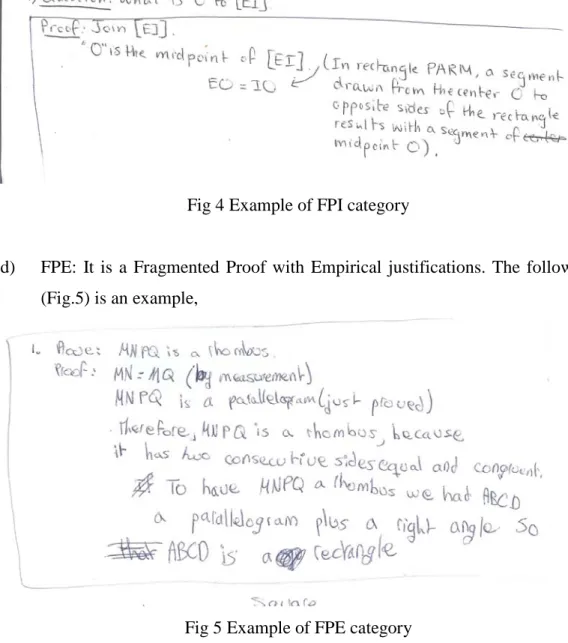
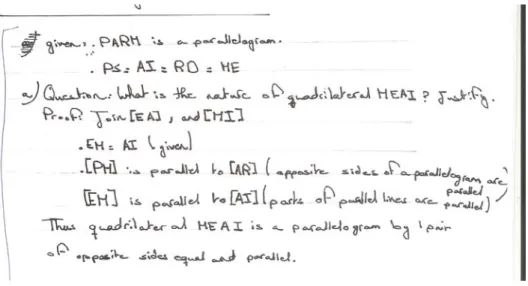
4 Example of FPI category……….46
5 Example of FPE category………46
6 Example of US category………..47
7 Example of CIP category missing one statement………48
8 Example of CIP category missing one reason……….48
9 Example of CIP correct conclusion……….48
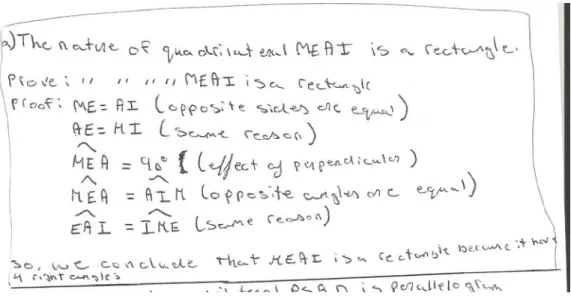
10 Example of CCPMD category……….49
11 Example of CCP category………...50
12 Example of CCPED category……….50
13 Path Cabri figure 1………..72
14 Mody Cabri figure 1………73
15 Mody Cabri figure 2………73
16 Path Cabri figure 2………...76
17 Path Cabri figure 3………...76
18 Path Cabri figure 4………...77
19 Mody Cabri figure 3………78
20 Mody Cabri figure 4………79
CHAPTER 1
INTRODUCTION
Many mathematics educators consider proof as central to the discipline of mathematics and the practice of mathematics (Knuth, 2002 b; Hanna, 1995; Hoyles & Jones, 1998; Wares, 2002). Since the establishment of mathematics as a major domain of human thought, deductive proof has been considered to be the most convincing and sometimes the only, way to verify that an argument is true. But with the introduction of software such as Dynamic Geometry Software (DGS), the importance of formal proof in school curricula is being questioned (Mariotti, 2001; Marrades, & Gutierrez, 2001). Indeed computers offer students an accurate construction of a figure, which makes them trust perceptive evidence. They can measure, check, and trace points. This is why they might be convinced of the truth of a statement and might find it useless to write a deductive proof. However, mathematicians and mathematics educators do not accept the verification of the truth of a conjecture with many numerical examples as a proof. Teachers as well still believe that deductive rigorous proof is needed to verify the truth of a mathematical conjecture. One of the major current concerns is to explore ways by which a teacher can convince students of the importance of deductive proof, even in situations where DGS is used.
On the other hand, the widespread use of DGS is changing the nature of teaching mathematical proof (Izen, 1998). Before the introduction of such software, teachers used to explain the theorem, its proof, and how to apply it, while students practice in order to memorize (Laborde, 1995). Nowadays, with the help of DGS the teacher can teach students how to generalize and reach theorems (Izen, 1998). Teachers can do that easily because DGS provides an environment in which students have the possibility of freely experimenting with geometric figures. They can easily check their intuitions or conjectures in the process of looking for patterns much as scientists would (Marrades & Gutierrez, 2000). They can easily construct simple or complex figures,
discover mathematical relationships, and learn to express their conclusions as theorems (Izen, 1998). However simply introducing DGS use with no change in the curriculum or in the teaching approaches might transform the software into a mere extension to paper and pencil. Teachers should change their teaching style and carefully design tasks on the software. Moreover, curriculum designers must change the emphasis in the curriculum by carefully considering new or alternative sequences of topics. Therefore, the main concern is the way the teacher can introduce this software in a way to enhance the teaching and learning of mathematical proof.
1.1 Context of the Study
In the Lebanese Curriculum mathematics, mathematical proof is considered to be “an ineluctable necessity to the life of societies and to their development” (Center for Educational Research and Development (CERD, 1997, p. 288). On the other hand, proof is perceived as a way to develop students’ critical thinking, rigor, and precision. However, experience in the field of mathematics teaching shows that students encounter major difficulties when faced with writing proofs, because they are doing proof as a procedure without understanding its meaning.
On the other hand, in the introduction of its official documents, the Lebanese curriculum emphasizes the individual construction of mathematics by the learner, rather than the adoption of ready-made mathematics. However, teachers face difficulties in creating an environment for students to construct their own geometric knowledge. Paper and pencil constructions are time consuming and not accurate.
Dynamic Geometry Software may alleviate the above problems, because it creates an environment where students can explore geometric relations, which would help them understand these relations as a step towards proof. It is a laboratory where students can experiment, conjecture, hypothesize, check their hypothesis, and generalize to reach a theorem. While some Lebanese schools have realized the importance and efficiency of DGS and actually integrated it in geometry classes, the majority did not.
1.2 Purpose
The present study aims at exploring Lebanese students’ development of geometric reasoning in a problem-solving situation using Dynamic Geometry Software. In order to fulfill this aim, the most suitable situation is a proving situation where students use the mental operations relevant to geometric reasoning.
In more specific words the research attempts to answer the following questions: Research question 1: Does the use of DGS enhance students’ geometric
reasoning abilities?
Research question 2: Does the use of DGS foster students’ movement from concrete experiences to formal levels of thinking? Research question 3: Do the proving processes used by students when using
DGS differ from the processes used when students use paper and pencil?
Research question 4: Are the proofs produced by students when they use DGS different from proofs produced by students in paper-pencil situations?
Research question 5: Does the use of DGS make students question the importance of proof? Or does it enhance the need for it?
1.3 Operational Definitions
Geometric reasoning is considered to be a cognitive activity involving rich mental models. Geometric reasoning has been addressed, defined and analyzed in many publications. Several math educators provided aspects and examples of the mental models and operations relevant to geometric reasoning. Following is a non-exhaustive list of such mental operations, compiled from several publications in the mathematics
education literature (NCTM, 2000; Maher & Martino, 1996; Belfort & Guimaraes, 2004, Evan 2000; Jones, 2000).
Representing a problem as a figure.
Observing and experimenting to analyze a geometric problem. Abstracting in order to make a conjecture and test the conjecture. Formulating generalizations and making inferences.
Synthesizing, interpreting, and demonstrating.
Using models, facts, properties and relationships to explain one’s thinking. Following logical arguments and judging their validity.
Formulating proofs or counterexamples.
The present study uses the above listed mental operations to investigate students’ geometric reasoning by analyzing the methods used by students while solving geometric problems.
1.4 Rationale and Significance of the study
Many studies have been conducted that explore proofs developed by students using paper and pencil (Polya, 1957; Bell, 1976 Van Dormolen, 1977; Balacheff, 1988). Other studies investigated proofs developed by students using DGS (Harel & Sowder, 1996; Marrades & Gutierrez, 2000; Recio & Godino, 2001; Reyes-Rodriguez & Santos-Trigo, 2007). However, to the researcher’s knowledge, few studies have compared proofs produced by students when they use paper-pencil with proofs produced by the same students using DGS. Moreover, some researches, to get meaningful data, decided to exclude students whose reasoning skills were judged to be very poor (Marrades & Gutierrez, 2000; Hoyles & Healy, 2000). However, the recent study included students without judging their reasoning skills.
In Lebanon, though some schools have started using DGS as a tool for additional activities, the use of such software is not integrated in the curriculum. Hence conducting such a study is advisable as it may bring remarkable results to the Lebanese
educational field. The research aims at a deeper understanding of the students’ development of geometric reasoning in two different contexts (DGS and paper-pencil). It will highlight the role that DGS can play in developing students’ reasoning in problem-solving situations. It will also provide teachers with a better understanding of the development of geometric reasoning and of the potentials of such software in geometry classes.
1.5 Organization of the Remainder of the study
This study is organized in three more chapters. Chapter two includes a review of the literature related to proof, dynamic geometry software, and proofs in dynamic geometry software. It also includes the theoretical background on which this study is based. Chapter three provides details about the participants of the study, the procedure, and instruments used to collect data. Chapter four includes the framework, under which proofs were categorized, and the analysis of data and the results. These results include proofs produced in paper-pencil quiz, DGS worksheet, and a comparison between them. It also includes the discussion of the results. The last part of the study includes the appendices and references used in the study.
CHAPTER 2
LITERATURE REVIEW
The present chapter includes a review of the literature available on proof in contexts where DGS is used. First, it discusses the role of proof in mathematics and mathematics education, and then addresses the role that proof plays in mathematics classes. Second, the chapter presents the difficulties students face when proving and the way students develop the notion of proof. Third, the importance of DGS in geometry classes and its effects on teaching proof and developing students’ geometric reasoning is presented. At the end, tips that teachers should take into consideration in order to improve students’ ways of proving while using any DGS are proposed.
2.1 Proof
For over 2000 years mathematics has been viewed as an indisputable source of knowledge. Proof is the central activity through which mathematics produces this knowledge (Oner, 2008a). According to Davis and Hersh, (1981) “the name of mathematics game is proof; no proof; no mathematics” (p.147) However, the argument of recent mathematicians is that mathematics is not only proof, it is a process of discovering, explaining, justifying, and elaborating (Davis & Hersh, 1981; Ernest, 1998; Rav, 2007 as referenced in Oner, 2008a). There is a growing emphasis on a doing
perspective in mathematics learning. It tends to stress experimentation and exploration of mathematical ideas, which is an important ingredient of proof activity. It resembles the work of expert mathematicians, thus making proof more meaningful and enabling students to work on their own intuitions and investigations (Oner, 2008b). It has not been possible to materialize this vision in the absence of powerful tools which would allow fast and accurate constructions, such as Dynamic Geometry (DGS) which
provides an environment where students can manipulate and control various objects to explore relations (Chio-Koh, 1999).
2.2.1 Role of proof in mathematics education
Mathematics educators suggest eight roles that proof plays in mathematics. (Bell, 1976; de Villiers, 1999; Hanna & Jahnke, 1996, Knuth, 2002b). First, the role of proof is to verify that a statement is true. This role is very essential, but mathematicians expect from a proof more than just a verification of the truth of a statement. They expect proof to explain why a statement is true. That is the second role of proof. Moreover, proof serves in debates as a way to communicate mathematics to other mathematicians. In addition, proof plays a very important role in the discovery of new mathematics. It also plays a role in incorporating well-known facts into a new framework. This way a mathematician can view facts in a fresh perspective. The
exploration of the meaning of a definition or the sequence of a theory may be the result of proof. Another role of proof is the construction of an empirical theory. The last role that proof plays in mathematics is its role in “systematization of results into a deductive system of definitions, axioms, and theorems” (Hanna, 2000).
All roles of proof should be taken into consideration in order to reflect the essence of proof. However, in school mathematics teachers usually consider only the first role of proof; that is to verify that a statement is true. As a consequence, students face many difficulties in proving and educators consistently advocate significant changes in the role that proof should play in mathematics classes (Knuth, 2002b; Reid, 1998).
2.2.2 The role that proof should play in math classes
Leonard (1997) defined proof as a way of convincing someone by offering arguments. Sometimes the correctness of proof can verify the truth of a statement, but
not necessarily convince. Complicated symbols are not necessarily the best way to convince someone. Sometimes an extreme general example or a counter example can convince more than a deductive formal proof. This is why we should take the role of proof, as convincing tool, more seriously in classes (Leonard, 1997).
According to Hanna (2000) proofs do not become legitimate unless they lead to mathematical understanding. Mathematical understanding is promoted by proofs that explain why a statement is true (Dobbs, 2001). Thus, educators should not waste time on technicalities of proof. They should rather emphasize proofs that lead to understanding or insight (Dobbs, 2001; Hanna, 1995). For instance, visual proofs and experimental methods are easier to grasp than formal proof (Hanna, 1995). Moreover, experimental methods aim at developing a multi-faced view of proof (Hoyles & Healy, 2000).
2.2.3 Difficulties that students face while proving
Many mathematics educators documented that students face difficulties with reasoning and justification (Galbraith, 1981; Fischbein, 1982; Martin & Harel, 1989; Chazan, 1993; Zaslavsky and Ron, 1998; Carpenter, Corbitt, Kepner, Lindquest, & Reys,1980; Crosswhite, Dossey, Swafford, Mcknight, & Cooney, 1985; National Assessment of Educational Progress, 1983 as referenced in Recio & Godino, 2001; Wares, 2002; Battista & Clements, 1995; Healy & Hoyles, 2000; Marrades & Gutierrez, 2000). For instance Bell (1976) reports that 48% of the participants in his study failed to construct correct proofs. Moreover, Recio and Godino (2001) found that only 39.2% of their sample participants were able to produce correct answers on two proof problems. Senk (1985) reports that only 30% of the students who studied a full-year geometry course were able to build formal arguments (as referenced in Oner, 2008a).
Moore (1994) presents a review of literature which shows that students have difficulties in learning to do proofs in the following areas:
1. Perception of the nature of proof (Balacheff, 1988; Bell, 1976; Galbraith, 1981; Lewis, 1987; Schoenfeld, 1985)
2. Methods of proving(Bittinger, 1969; Duval, 1991; Morgan, 1972, Solow, 1990)
3. Problem solving skills(Goldberg, 1975; Schoenfeld, 1985) 4. Mathematical language (Laborde, 1990; Leron, 1985; Rin, 1983)
5. Understanding of mathematical concepts (Dubinsky & Lewin, 1986; Hart, 1987; Tall & Vinner, 1981; Vinner & Dreyfus, 1989)
Facing one of these difficulties is enough to make students give up easily on long problems. They just stare the question. If they are unable to solve it with a single stroke, they seem unwilling or unable to stay with it (Fidler, 1999). In addition, they are asked to prove something that is already true and therefore proving it is something meaningless and purposeless (Coe & Ruthven, 1994).
Students do not perceive their mathematical knowledge as useful, so they don’t call upon it while doing proof (Coe & Ruthven, 1994). Balachef (1991) believes that students perceive proof as a solution for the teacher not as a way to convince themselves of the truth of an idea. So they act as a practical person not as a theoretician. This makes them produce practical solutions that are efficient and not necessarily rigorous. They produce solutions not knowledge. Moreover, Cobb (1986) believes that students seek goals different from those that the teacher thinks they are setting for the students. Students operate in a social context, while the teachers think students are operating in a mathematical context. (Cobb, 1986)
2.2.4 Students’ ways of proving
Through the years many math educators studied and categorized the types of proofs used by students. Examples of those categorizing systems are provided in this section:
Polya (1957) classifies proofs into five categories: (1) Complete proofs are those that do not leave any gap or uncertainty. (2) Logical systems are proofs where each proposition is linked to the definition or theorem.(3) Mnemotechnic systems are what hold together the logical systems. (4) Cookbook systems are detailed descriptions of procedures that cannot be considered proof. (5) Incomplete proofs that must be distinguished from complete proofs, and that are useful if they are used in their proper place. They are actually interesting for their presentation format.
According to Piaget (1983), abstractions can be made either directly from an object or from operations performed on the object. Abstractions can be one of three types depending on the degree to which the abstraction is tied to external objects. In other words abstractions can be empirical if they refer to external experiences. They can be pseudo-empirical if they refer not only to external experiences, but to operations the student carries out mentally. Reflective abstractions take into account the operations students are able to perform mentally.
Bell (1976) categorizes students’ proofs into two kinds: empirical justifications,
where examples are used as a way to convince, and deductive justifications,
characterized by the “decontextulization” of the argument used, where students base their justification on logical deductions to validate a conjecture. He further classifies empirical justifications into six categories depending on the degree of completeness of checking the statement. However, he categorizes deductive responses into seven categories depending on the degree of completeness of constructing arguments.
Van Dormolen (1977) provides a hierarchy of proof types used by students into three levels: Specific proofs which is proof for one particular instance, common properties in which an object is seen as representative of a class, and reasoning about reasoning, case in which a general argument is given using a particular object
Balacheff (1988) distinguishes between pragmatic and conceptual justifications.
Pragmatic justifications are the category of justifications that are based on the use of examples. On the other hand, conceptual justifications are based on abstract formulations of properties and relations among properties. Depending on the kind of
example, Balacheff (1988) further classifies each of the above types into subcategories: Pragmatic justifications are categorized into three types: Naïve empiricism is when students justify by selecting examples with no specific criteria. However, if the student selects an example that is as non-particular as possible and represents a certain class, then a crucial example is said to be used. On the other hand, if the example that students choose is seen as a characteristic representative of its class, then it is a generic example. In addition, generic example justifications include reference to abstract elements of the class represented by the example. As to conceptual justification, there are two kinds:
Thought experiment and formal deduction. When students justify deductively and use an example to help organize the justification, they are using thought experiment justifications. On the other hand, if they base their justification on mental operations without the help of a specific example, they are using formal deduction.
Marrades and Gutierrez (2000) believe that students sometimes make several jumps between deductive and empirical methods while solving the same problem. In a case study designed to investigate how DGS environments can help students improve their conception of proof, Marrades and Gutierrez found that secondary students cannot make a fast transition from empirical to abstract ways of conjecturing and justification.
Harel and Sowder (1996) suggest three categories of proof Schemes:
(1) External conviction proof schemes are based on something external to the student. This category is also divided into three kinds. First, authoritarian proof schemes are when conviction is due to the book, the teacher, or a knowledgeable person. Second, ritual proof schemes are when conviction is due to the form of the proof. Third, symbolic proof schemes are when conviction is due to use of symbols in the proof.
(2) Empirical proof schemes are proofs based on examples. This type of proof schemes is divided into two kinds. First, inductive proof schemes are when the conviction is based on two or more examples. Second, perceptual proof schemes are based on visual or tactile perceptions.
(3) Theoretical proof schemes are based on mental operations that may result in formal proof. Harel and Sowder (1996) further divide this kind into two categories. First
transformational proof schemes are schemes where the conviction is based on a deductive process. Second structural proof schemes are special transformational schemes that contain conjectures and facts representing situations from different realities, but share a common structure.
Marrades and Gutierrez (2000) suggest that a complete assessment of students’ justifications should consider both the outcome produced by students (the proof itself) and the process used by students to reach this outcome. They contend that categories provided by researchers in the literature describe the students’ outcomes only; they do not classify the process by which students reach such outcomes. This is why Marrades and Gutierrez (2000) devise the following classification scheme:
1. Based on the work of Balachef (1988), Bell (1976), and Harel and Sowder (1996), proof is divided into two main categories: empirical and deductive justification.
2. Empirical justifications are divided into a number of subcategories depending on ways students select the example. Each subcategory has different types depending on different ways students use the selected example.
3. Deductive justifications are divided into two subcategories depending on whether students use an example to help organize their justification or not. Each subcategory is divided into two kinds depending on the style of deductions made to organize justifications.
Recio and Godino (2001) classify proofs into five different categories: (1)
Deficient proofs are proofs that have no purpose. (2) Personal explanatory argumentation schemes are arguments that are intuitive with no validation. (3)
Empirical-inductive proof schemes are proofs where students check the proposition with examples. (4) Informal deductive proof is a deductive proof that is partially correct. (5)
2.2.5 The ways students develop the notion of proof
According to Piaget, developing the ability to construct proofs undergoes three stages (Piaget, 1983).
Stage one: The child’s thinking is non-reflective, unsystematic, and illogical. Students treat data that they collect or examples as separate and unrelated events. Students’ exploration is random with no plan. Students’ conclusions might even be contradictory.
Stage two: Students only use empirical results to make predictions, but they try to justify their predictions. They anticipate results in their search for information and think logically about premises they believe in.
Stage three: Students progress beyond a belief that something is simply always true to make a logical conclusion that it must necessarily be true. The student is capable of formal deductive reasoning based on any assumptions and so is capable of operating explicitly within a mathematical system.
In conclusion, Piaget suggests that thinking moves from being non-reflective and unsystematic, to being empirical, and finally to being logical-deductive.
As for the Van Hieles, they suggest five levels of development of students’ proving abilities: Visual, descriptive, abstract, formal deduction, and rigor. (Van Hiele 1984 (a); Van Hiele, 1984 b)
Level one: Visual: In this level, students reason about geometric shapes on the basis of their appearance and the visual transformations that they perform on images of these shapes.
Level two: Descriptive/ Analytic: Students do not depend any more on the appearance of shapes. They depend on the properties of shapes. They reason experimentally when they establish properties of shapes by observation, drawing, and making models.
Level three: Abstract/ relational: At this stage, students can form abstract definitions and distinguish between necessary and sufficient conditions for a property to be true. They can understand theorems and sometimes present logical arguments.
Level four: Formal Deduction: In this level, students are able to reason formally by logically interpreting geometric statements such as axioms, definitions, and theorems.
Level five: Rigor/ Mathematical: In this last level, students can reason formally about mathematical systems rather than just within them (Van Hiele, 1984b; Van Hiele, 1984a).
2.2.6 Ways to enhance geometric reasoning
Piaget and Van Hiele suggest that students must pass through lower levels of geometric thought before they can attain higher levels and this passage needs time (as referenced in Battista & Clements, 1995). Marrades and Gutierrez (2000) argue that it takes students in level two several years to reach level four in Van Hiele’s levels. Thus they suggest that instruction should help students gradually progress through lower levels of geometric thought before they begin proof-oriented study of geometry (Marrades & Gutierrez, 2000). Otherwise, formal proof will lead students only to confusion about the purpose of proof and attempts at memorizing (Battista & Clements, 1995).
According to Battista and Clements (1995), an alternative to the axiomatic approaches can be successful in moving students towards meaningful justification of ideas. They suggest that students should work cooperatively to make conjectures, resolve conflicts by presenting arguments, and formulate hypotheses to prove (Battista & Clements, 1995). Fidler (1999) depends on his years of experience as an honors geometry teacher, and agrees with Battista and Clements on dividing students into heterogeneous groups of two, three, or four and making them work cooperatively to solve geometrical proof problems. To keep the students’ frustration low, Fidler gives
students easy proofs with the harder ones. After investigating using DGS, each group presents their argument to the class. This way the teacher incorporates a variety of proofs into the classroom (Fidler, 1999). According to the NCTM (2000), “Classrooms in which students are encouraged to present their thinking, and in which everyone contributes by evaluating one another’s thinking provide rich environments for learning mathematical reasoning” (NCTM, 2000).
2.2 Dynamic Geometry Software (DGS)
According to Helen (2004), DGS serves as a flexible mathematics laboratory where students can make open-ended investigations and explorations of concepts. Figures can be manipulated in terms of their logical system of Euclidean geometry (Mariotti, 2000). Students can rapidly construct precise figures; can make measures and calculations to discover mathematical relations. They can therefore come up with thoughtful conjectures and check them on infinitely many examples (Jiang, 2002). Students observe and check relationships directly guiding their process of thinking towards the understanding of geometric relations. Understanding makes students able to explain why a statement is true, which involves constructing chains of reasoning (Hoyles & Jones, 1998).
Staesser (2001) believes that DGS offers easy access to “heuristic” strategies. Moreover, Choi-Koh (1999) believes that the process students follow while using DGS enhances the integration of problem solving with regular mathematics. It also offers alternative ways for students in hopeless situations, which makes them not give up easily on difficult problems. Another aspect is that students’ expressing their conclusions as theorems enhances their mathematical communication skills (Knuth, 2002a). In addition, the interactive environment that DGS provides has the potential to foster students’ movement from concrete experience with mathematics to more formal levels of abstraction (Choi-Koh, 1999). Therefore, the student will pass through the various stages of Van Hiele (Choi-Koh, 1999; Jiang, 2002). According to Jones (2001),
DGS proposes direct experience of geometric theory which breaks down the separation between geometric constructions and deduction. Moreover, it links the concrete with the abstract, resulting in a more meaningful idea of proof and proving, bridging the gap between inductive explorations and deductive reasoning. (Christou, Mousoulides, Pittalis, & Pitta-Pantazi, 2004; Helen, 2004)
2.2.1 Studies that recommend the use of DGS
Many research studies report results that confirm the usefulness of DGS use in geometry, and consequently recommend their use.
Marriotti (2000) conducted a study to investigate how the students’ views of geometry change from being intuitive to being theoretical. Results indicated that DGS fosters this transition, because it uses visualization, exploration, and heuristics.
Helen (2004) conducted a study on elementary pre-service teachers in DGS learning environment. Findings showed that software users outperformed non-software users even when prior knowledge variability was taken into consideration.
Hull and Brovery (2008) conducted a research in a public high school in Georgia with an enrollment of approximately 1800 students. Findings indicated that students were more convinced of their conjecture. Male students participating in the study had test scores higher than female students. However, when analyzing the data as a whole, results do not indicate any positive or negative impact of DGS on students’ scores.
Olivero (2006) conducted a study with students using DGS to solve open-ended geometry problems that require conjecturing and proving. Findings indicated that the “Hide / Show” tool available in Cabri (DGS) played a fundamental role in the development of the proving process.
Galindo (1997) worked with elementary students on kinds of proofs produced in DGS environment. The study showed that early in the academic year students preferred to work with paper-pencil and exhibited external, symbolic or authoritarian types of
proof. By the end of the academic year, the students used empirical inductive proof schemes.
Gillis (2005) presented a study that compared students’ abilities to formulate conjectures in two contexts, paper-pencil and DGS. Results indicated that few conjectures formulated by students using DGS were false. Conjectures in DGS context were more relevant, and students’ conviction of the correctness of their conjectures was higher. The difference was found to be statistically significant using linear regression analysis.
Reyes-Rodriguez and Santos-Trigo (2007) performed a research to document the proof schemes produced by secondary school teachers to solve problems using DGS. Results showed that the use of DGS enhanced the subjects’ ways of formulating conjectures. Moreover, with the use of DGS teachers can move from empirical and perceptual approaches to more deductive schemes.
2.2.2 DGS and teaching proof
Some researchers such as Chazan (1993) and Healy (2000) believe that using DGS to help students improve their ways of justification or proving is not effective. They believe that because DGS provides an environment for students where they can easily check for many different cases, they become convinced of the truth of their conjectures. This makes them feel that formal proof is not necessary (as referenced in Marrades & Gutierrez, 2000). Allen (1996) also believes that DGS blurs the distinction between illustrations and proof (as referenced in Oner, 2008). Moreover, Beida (2009), in a study conducted with middle school students in a proof-rich classroom, deduces that justifications and proof in DGS environment are not enough to develop conceptions of mathematics proof. Other researchers observe that teachers waste time on teaching students how to use DGS because students’ lack of experience makes them use wrong or naïve strategies. They also are not able to use these strategies in a familiar
environment (Parzysz, 1988; Laborde & Capponi, 1994 as referenced in Marrades & Gutierrez, 2000; Mariotti, 2000).
On the other hand, Weeden (2002) asserts that teaching students how to use DGS is not a waste of time; it is rather an investment for the future. Moreover, it sets the basis for students to move from the use of simple empirical justifications to more complex types. According to Galindo (1998), DGS, together with appropriate exploration tasks, helps in creating a classroom environment that promotes meaningful justifications. The use of DGS can assist students in making progress towards more mathematical explanation and thereby provides a foundation on which to build further notions of deductive reasoning in mathematics (Jones, 2001). Marrades and Gutierrez (2000) add that DGS lets students make empirical explorations before trying to produce a deductive justification. Therefore, they make meaningful representations of problems, while experimenting based on immediate feedback that they get (Marrades & Gutierrez, 2000).
Some researchers also believe that when students see the geometric object generated by the “Trace” feature in DGS, they are motivated to appreciate the need for a proof. Moreover, DGS helps students understand significant relationships embedded in geometric situations. Those relationships later form the building blocks of a proof (Galindo, 1998; Gorman, 1996; Jiang, 2009). To assert this, Hoyles and Healy (2000) conducted a research with 2,459 students aged 14/15 years at a high level of mathematics attainment. Although students lacked any experience with proof, they developed expertise in conjecturing, arguing, and explaining in everyday language. Moreover, students were aware that empirical arguments were not enough; analytic justification was needed; however, they simply did not know how to construct it.
Jones (2000) conducted another research to focus on the evolution of students’ ability to construct the family of quadrilaterals and students’ use of precise language. Jones (2000) found that DGS helped students in two important steps of constructing proof. First, students were able formulate reasonably precise statements about properties and relations, and second, they carried out correct deductions.
2.2.2.1 Role of teachers in teaching proof in DGS environments
The use of the software alone is not enough (Oner, 2008; Sinclair, 2003). The teacher plays a very important role in helping students go beyond empirical justifications to deductive ones (Mariotti, 2000; Hanna, 2000). Teachers should analyze, coach, re-voice questions back to students, and ask open-ended questions (Martin, Soucy, McCorne, Bower & Dindyal, 2005). Moreover, teachers should ensure that students use general mathematical language rather than Cabri-specific style (Jones, 2001). When teachers use these techniques they foster students’ construction of chains of reasoning and proof construction (Martin, Soucy, McCorne, Bower, & Dindyal, 2005). Teachers should also encourage students to focus on the relationships between geometric objects to make conjectures, and provide students with means to explain their actions and results (Hoyles & Jones, 1998).
2.2.3 Ways students use DGS
Arzarello, Micheletti, Olivero, and Robutti (1998) devised a theoretical model of phases that students pass through to move from conjecturing to proving. Phase 1: Students explore different data to check the validity of the conjecture. Phase 2: Students internalize the visual field and detach from exploration. They express their hypothesis as abduction. Abduction is a source of reversed deduction. In other words the student selects the pieces of knowledge that s/he believes to be right; the conditional form is virtually present: its ingredients are alive, but their relationships are still reversed, with respect to the conditional form. Phase 3: students switch from abductive modality to a deductive one. Phase 4: students implement logical connections to write a deductive proof.
Hollebrands (2007) reports three themes related to the role of DGS in students’ interpretation of geometric relations: Interpretations may be due to visualization. They may also be due to dragging, or to proactive or reactive strategies.
2.2.3.1 Dragging
Dragging is a property that makes DGS software display a universe of inquiries to which the user’s particular inquiry belongs. Students use dragging in three different modalities: Wandered dragging is when students drag in a random fashion with no goal in their mind; dragging test is used to check if a specific conjecture is true; and
messable lieu muet (dummy locus) is where students drag in a way that preserves some regularities (Arzarello et al, 1998).
2.2.3.2 Active visualization
Active visualization helps focus on a specific detail of complex problems. It is a tool that enhances students’ understanding of a problem and helps in explaining abstract properties of figures (Choi-Koh, 1999). Sinclair (2004) believes that to be useful, visual details should catch students’ attention. However, in regular geometry teaching, students are taught to ignore what they see in a diagram and stress on the given and deducible information.
Sinclair (2004) conducted a study with secondary students involving pre-constructed, web-based, dynamic, geometry sketches. Results indicated that students either did not realize or ignored the fact that the sketches are accurate. Others who recognized the accuracy of sketches lacked the tools to use visual evidence.
2.2.4 Ways to develop geometric reasoning while using DGS
Some educators attribute the difficulties that students face with proof to the fact that proof is usually limited to geometry teaching, so students have a limited contact with proof. Therefore, proof should receive a more prominent role throughout the entire mathematics curriculum (Knuth, 2002a).
2.2.4.1 Formality of proof
Takac (2009) believes that teachers should determine the degree of formality of proof that they can demand from students, depending on their grade and mental ability. Moreover, Battista & Clements (1995) suggest that the most effective way to include meaningful proof in classes is to avoid formal proof at the beginning; teachers should focus instead on justifying ideas based on visual and empirical foundations. They also believe that geometry curriculum should be appropriate for different levels of thought. It should permit students to use visual justification and empirical thinking because such thinking serves as a foundation for higher levels of geometric thought. Teachers should encourage students to refine their thinking gradually to understand the shortcomings of visual and empirical justification. This makes students discover, and begin to use, components of formal proof. Students should only use formal proof as a way to justify their ideas, but for them to study proofs meaningfully; they should use empirical and visual justification (Battista & Clements, 1995). Izen (1998) agrees that learning by deductive proof alone is complicated and inaccessible and that inductive geometry with DGS makes theorems become alive to students. However, Izen (1998) believes that learning by inductive reasoning alone is “surface learning” and that deductive proof should continue to be an essential part of geometry curricula (Izen, 1998). Dobbs (2001) agrees that computer-based discovery activities should be followed by rigorous proofs of the conjectures developed during those activities. The reason is that only through
deductive proof are students able to extend the concept that they study, beyond the use that they see in examples (Dobbs, 2001).
2.2.4.2 Time spent on teaching proof
Another factor that the teachers should take into consideration is the time they spend on teaching proof. As mentioned before, Marrades and Guttierrez (2000) argue that it will take students several years to progress from reasoning experimentally to reasoning formally (Marrades & Guttierrez, 2000). This is why secondary students need a considerable amount of time with DGS to feel confident with deductive justifications and formal proofs (Mariotti, 2000; Miyazaki & Yumoto, 2009).
2.2.4.3 Kind of activities to be used in DGS environment
Hadas, Hershkowitz and Schwartz (2000) suggest that students should be confronted with surprise and uncertainty to reflect and offer valid arguments. In other words students should find a contradiction to their conjectures. When they are confronted with a contradiction, students tend to resort to formal proof.
Laborde (1995) suggests new tasks when dealing with Cabri drawings. These tasks involve both interpretation of Cabri drawings in geometrical terms and their reconstruction by means of the geometrical primitives of the software. She calls these tasks black box tasks. A Cabri drawing is given to the students; they do not know how it was constructed. The task for the pupils is to reconstruct the same Cabri drawing (Laborde, 1995). This way the students recognize the commands available in the menu as theoretical properties, which make the construction procedure itself an external sign of a theorem (Mariotti, 2000).
According to Mogetta, Olivero and Jones (1999) tasks that motivate to prove in a DGS environment must be open-ended problems. Their statement should be short and should not suggest any particular solution or method for the solution. De Villier (1999)
suggests that teachers should vary mathematical problems (problems to find, problems to prove). They should also vary teaching questions.
2.2.4.4 Classroom Culture.
The perception of the value of proof may be influenced by the context in which students meet proof. By establishing an environment in which students may see and experience first-hand what is necessary for them to convince others of the truth or falsehood of the proposition, proof becomes an instrument of personal value which they will be happier to use or teach in the future (Knuth, 2002b; Kunimune; Fujita, & Jones, 2009). Schoenfeld (1998) agrees with Knuth and states that classroom culture plays a very important role in how students perceive and learn mathematics. He proposes that the daily practices and rituals of the classroom determine students’ beliefs of “what mathematics is really all about” (as referenced in McGivney & Defranco, 1995). For example, if teachers continuously praise the students for quick algorithmic solutions, students might conclude that success has more to do with speed and memorization than with reasoning. However, if teachers believe that mathematics should be “a sense making activity”, then the classroom culture should reflect this idea. Analyzing, conjecturing, debating, exploring, and reflective reasoning should be the everyday practices of the geometry classroom. Through student-teacher and student-student classroom conversation, students see and hear how others think through problems and how they design plans to problem solutions. Moreover, students are encouraged to participate in the debate (McGivney & Defranco, 1995).
2.3 Conclusion
In conclusion, teachers should view geometry, especially proof writing, as a problem solving activity. Students should act the same as mathematicians do by experimenting through DGS. Then they conjecture and convince themselves and others
of their conjectures. Finally, they provide a formal deductive proof. Through this process, teachers can pose questions that engage and challenge their students while encouraging them to reason, clarify, justify, and communicate their ideas (NCTM, 2000).
CHAPTER 3
METHODS AND TECHNIQUES
The present study is a qualitative analytic action research study aiming at a deeper understanding of grade eight students’ development of geometric reasoning in a DGS environment. For that purpose, a DGS based geometry curriculum unit is developed and implemented, which allows the investigation of students’ geometric thinking in such a context. The study uses several techniques, namely: a semi-structured interview, development of a unit, paper-pencil problem-solving situation prior to unit implementation, implementation of the unit, problem solving situation in DGS context, and clinical interviews with selected groups.
3.1 Participants
Participants are a conveniently accessible group of students, registered in a grade eight class at a reputable private school in Aley, a town in Mount-Lebanon. The group consists of 35 students, 12 females and 23 males coming from middle socioeconomic background.
The same class math teacher taught those same students in grades six, seven, and eight, so she was the one who introduced them to the notion of proof. She is a 37-year-old female. She graduated from the American University of Beirut in 1994 with a Teaching Diploma in mathematics. She has been teaching in Lebanese schools for fourteen years.
3.2 Procedure
The method of research encompasses six stages: a semi-structured interview with the teacher, observations of geometrical problem solving sessions in class, development of a curriculum unit on special quadrilaterals integrating the use of Cabri, a pre-test paper-pencil quiz that involves proof prior to the implementation of the unit, observation of a major problem solving session with Cabri during the implementation of the unit, and clinical interviews with selected students solving geometric proving problems using Cabri.
3.2.1 Interview with the teacher
A semi-structured interview is an interview not having a specific schedule. It is guided for some parts of the study without fixed wording or fixed ordering of questions. The content focuses on the crucial issues of the study (Burns, 2000). It is chosen for the following reasons:
• The teacher’s perspective is provided rather than the perspective of the researcher being imposed.
• The teacher uses language natural to her rather than trying to understand and fit into the concepts of the study.
• The teacher has equal status to the researcher in the dialogue.
Appendix 1 provides the questions that were addressed to the math class teacher in a semi-structured interview. The interview aims at providing insight about the teacher’s conception of proof: the role she thinks proof should play in a grade eight class and her views about the best ways to teach proof.
The interview assists in analyzing students’ strategies of proving in the pre-test, in class and in the Cabri sessions, because this teacher introduced the participating grade 8 students to the notion of proof in grade seven.
In addition, the interview helps in the preparatory stage because one can investigate the teacher’s perceptions of, and experience in, the use of technology while teaching. Moreover, it gives insights about the students’ conception of the use of technology in teaching geometry.
The interview was audio taped, then transcribed and analyzed.
In addition, a marking scheme that the teacher used to correct a quiz containing proof was collected. It provides an idea about what the teacher expects from students when proving, because most of the students write proofs according to the expectations of the teacher.
3.2.2 Classroom observations
Non-participant observations were conducted, in the back of the grade 8 classroom during two sessions in which geometric problems about parallelograms that include making proofs were solved. During observation, two tools were used: a rubric (Appendix 2) and a detailed observation log supported by an audiotape. Those data are analyzed to explore the teacher’s methods of teaching proof.
The rubric was constructed to observe the interactions between the teacher and students. A full statement was considered an interaction.
3.2.3 Paper-pencil Quiz
A base-line geometry test was conducted by the end of the chapter on “Parallelograms”, before any change in the way the class was taught. The quiz was done in class with a maximum time of 60 minutes where talking and asking questions were not allowed. The tools that students can use are the following: solution paper, scratch paper, geometric set (compass, protractor, ruler, set square), pen and pencil. The quiz was designed by the researcher and consisted of two problems composed each of more
than one part that involve making a conjecture then proving it (see Appendix 3). It starts with the following instructions to encourage students to show their thinking:
• Use only the scratch paper while thinking about the problem.
• If you want to modify your method or start over, do not cross out or erase your previous work. Draw a line and start another method.
• When you feel that you have completely solved the problem, write the complete solution on the solution paper.
The quizzes were analyzed and the proofs provided by each student were classified based on a proof hierarchical framework.
3.2.4 Development of the unit
The development of the unit passed through three stages. First, to agree on the unit implementation with the teacher a preparatory stage with the teacher was done. Second, a preparatory stage with students was done to prepare them on the use of Cabri. Third, the teacher divided students into groups and the researcher prepared the lab settings.
3.2.4.1 Preparatory stage with teacher
The researcher agreed with the teacher on the procedures of research and teaching approach. In addition, the researcher provided the teacher with lesson plans and activities (see Appendix 4). Those were discussed and agreed upon. It was also agreed that the researcher will teach the class during the implementation of the DGS integrated unit. Functions of Cabri were reduced by removing the ones not needed in this research, in order to make it less confusing to students and to avoid losing time in case students venture to use the Cabri functions randomly. Moreover, it took them less time to memorize the place of a command in a menu and less time to search for a command.
3.2.4.2 Preparatory stage with students
The researcher trained all the 35 students in using Cabri in the computer lab for two sessions. In the first session, she introduced them to the functions of Cabri in 30 minutes. Then she allowed them to discover Cabri for the remaining 15 minutes by playing around with its commands. In the second session, students solved activities aiming to train them in the use of the software.
3.2.4.3 Settings in the lab
The teacher divided students into homogeneous groups. Low achievers worked in groups of four students, middle achievers in groups of three, and high achievers worked in pairs. This way, students who need more help will be in a more resourceful group, which fosters low achiever students’ exchange of ideas. This group arrangement made it easier to observe the development of students’ geometric thought. They progressed together; no student will be ahead of others in the same group, dominating the work of the group.
3.2.5 Implementation of the unit
During the implementation of the unit students were acting as mathematicians by constructing their own knowledge. The researcher provided a worksheet of activities that serve as scaffolding for the construction of the students’ knowledge (see appendix 4). Students solved the activities on Cabri through which they discovered the properties and theorems of the chapter special parallelograms and had to write theorems.
The implementation of the unit was done in three sessions. Due to time limitation they were done in two-hour sessions on Saturdays. In the first session students as groups solved activities to discover properties of special parallelograms. At the end of the session there was a discussion between the researcher and students to put together the results students found out. In other words the researcher by questioning students summarized the properties of a rhombus, rectangle, and square. In the second session, students solved activities that made them discover how to prove a rhombus rectangle and square. Also at the end of the session the researcher and students put together the results students found out. In other words the researcher by questioning students summarized how to prove a rhombus, rectangle, and square. In week days students solved problems of particular parallelograms with their teacher as usual using only paper-pencil. In the last session which was one week later, the researcher chose two problems from the textbook where the dynamic feature of the figure serves as the key to their solution. Students solved these problems in the lab using Cabri. Students were divided into groups and the researcher was only passing around to help them if they have any questions and encourage them to discuss their ideas. At the end of the session one of the groups that were able to correctly solve the problem presented the solution to the class.
3.2.6 Problem solving session in the lab
The groups formed by the teacher solved worksheet 1 (see Appendix 5) using Cabri, with a maximum time of 60 minutes where only questions about the functions of Cabri were allowed. Worksheet1 contains instructions for students not to scratch or erase their work if they want to modify or start over. The researcher also encouraged them to write all the steps of their proofs. This would help in analyzing the students’ thinking.
Students saved their work every while under a new name, and the files were collected. The conversations within each group were audio taped. The dialogues,
arguments, and discussions made between the members of the group were analyzed. This helped in analyzing the way students formulated their conjectures. Moreover, the students’ solutions on the worksheets were collected.
Students’ Cabri constructions were analyzed by using the Cabri command “replay construction” on their files. The audiotapes and proofs provided by each group were also analyzed. Depending on these data, three groups were chosen for clinical interviews according to the following criteria:
The groups are homogeneous but belong to different levels of achievement (one low, one average and one high).
The group uses fluently the functions of Cabri.
The group members invested significantly in the two problems of worksheet 1.
All the group members participated in the solution of the problems.
3.2.7 Clinical Interviews
Because the researcher wishes to understand the thinking processes underlying the students’ conjecturing and proving tasks, clinical interviewing is the most suitable technique. It is appropriate because students are free to answer the way they want and are asked open-ended questions that require reflection (Hunting, 1997). In addition, they are prompted and encouraged to express their ideas.
Clinical interviews were done with the three selected groups while solving a problem (see Appendix 6) constructed with the same criteria as the two problems in worksheet1. At the beginning of the interview, the researcher explained for the group that she would ask many questions because she is interested in how they are solving the problem not because something might be wrong in their solution. Afterwards, the researcher assigned part one of the problem. Students were allowed freedom to choose their own ways of responding. While students were solving the problem, the researcher asked follow-up questions to reveal student’s ways of thinking. Examples of questions