Available online at:
http://ejournal.upi.edu/index.php/IJAL/article/view/ 12463 doi: 10.17509/ijal.v9i1.12463
108 * Corresponding Author
Email: [email protected]
Continuing Professional Development and teachers’
perceptions and practices - A tenable relationship
I.G.A. Lokita Purnamika Utami
1*, Sarah Prestridge
2, Ali Saukah
3, and Fuad Abdul Hamied
41
English Language Education Department, Language and Art Faculty, Universitas Pendidikan Ganesha, Jalan A. Yani, No. 67, Singaraja, Bali, Indonesia
2
School of Education and Professional Studies, Griffith University, 176 Messines Ridge Rd, Mount Gravatt QLD 4122, Brisbane, Australia
3
Jurusan Pendidikan Bahasa Inggris, Fakultas Sastra, Universitas Negeri Malang, Jalan Semarang 5, Malang, East Java, Indonesia
4
Department of English Eductaion, Faculty of Language and Literature Education, Universitas Pendidikan Indonesia, Jl. Dr. Setiabudhi No. 229 Bandung, West Java, Indonesia
ABSTRACT
Research on the impacts of Continuing Professional Development (CPD) on perceptions and practices has been conducted separately. This study attempts to investigate a relationship between the involvement of CPD and the alignment of teachers’ perceptions and practices about effective English teaching to draw a critical link between the relationship and the alignment. This study involved 6 teachers of English as a Second Language in Indonesia. Qualitative approaches of in depth interviews and observations were the primary data collection tools. The findings indicate a partial relationship between CPD involvement and the alignment of teacher’s perceptions and practices. Specifically, as part of CPD, teacher’s professional enthusiasm is an indicator for a closer alignment in teacher’s perceptions and practices. Implications drawn from this study suggest that greater conscious raising is required to enhance teachers’ professional enthusiasm since it leads to alignment between perceptions and practices of quality teaching.
Keywords: Continuing Professional Development; effective English teaching; teacher perceptions; teacher practices
First Received: 14 August 2018
Revised: 12 January 2019
Accepted: 12 April 2019
Final Proof Received: 27 May 2019
Published: 31 May 2019 How to cite (in APA style):
Utami, I.G.A.L.P., Prestridge, S., Saukah, A., & Hamied, F.A. (2019). Continuing Professional Development and teachers’ perceptions and practices - A tenable relationship. Indonesian Journal of Applied Linguistics, 9, 108-118. doi: 10.17509/ijal.v9i1.12463
INTRODUCTION
The goals of participating in continuing professional development (CPD) are to enable teachers to change their perceptions or conceptual understanding and classroom practices for better students’ learning outcomes (Guskey, 2002; Sagar, 2013; (Prestridge, 2017). Perceptions have long been known as part of cognition. In fact, perceptions are seen as ‘a legitimate and indispensable form of teacher knowledge’ (Hostetler, 2016, p.179) which is shaped through CPD
particularly in the field of English language teaching (e.g., Aliakbari & Bozorgmanesh, 2015; Sebina & Arua, 2017; Yulia, 2014).
Although reports on the alignment of English teacher’s perceptions and practices are available, the relationship between teachers’ perception and practices has not yet been defined. However, some research has investigated the relationship between CPD and teachers’ perceptions (Borg, 2011; Cahyono, 2013; Katuuk & Marentek, 2014), and separately, the impact of CPD on teachers’ practices (Banegas, Pavese, Velázquez, & Vélez, 2013; Martin-beltran & Peercy, 2014; Sumardi, 2012). Research that separates CPD from a perception-practice relationship foregrounds a disparate reality, i.e., something different from what reality suggests. What is required is an approach that brings these three elements together.
This study intends to draw a critical link between CPD and the alignment of perceptions about effective
teaching and actual practices. In particular, this study seeks for the relationship between a participant’s involvement in CPD and the alignment of his perceptions and practices. Thus, to enable understanding upon the findings presented later, a review on CPD literature and establishment of effective English teaching traits are provided in the following section.
Continuing Professional Development (CPD) involvement schema
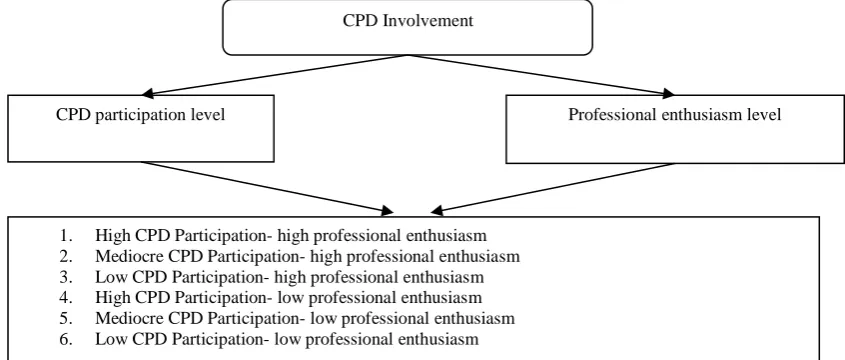
The term CPD involvement in this study was drawn from a previous study which investigated CPD involvement categories. In the previous study Utami, Saukah, Cahyono, and Rachmajanti (2017) constructed a CPD involvement schema which was derived from thematic coding analysis of interview transcripts in their study (see Figure 1). In this schema, CPD involvement is a combination of CPD participation level and professional enthusiasm level.
Figure 1. CPD Involvement level schema
The schema portrays that CPD involvement has 2 indicators, namely CPD participation and professional enthusiasm. CPD participation is categorized into three levels: high, mediocre and low depending on teachers’ breadth and the frequency of teachers’ participation on 5 predetermined CPD types, i.e., personally-initiated learning, organized professional development, publishing innovative works, upgrading qualification and more advanced role (see this 5 CPD types in more detail in Utami, Saukah, Cahyono, & Rachmajanti, 2017 or in Utami, 2017). Furthermore, professional enthusiasm is categorized into 2 levels: high and low depending on the motivation teachers have for their CPD participation. The interaction of these two indicators forms 6 levels of CPD involvement as mentioned in the bottom square of the schema in Figure 1.
The perceptions and practices of effective teaching components
Definition of effective teaching can be very complex. What is prevalent in effective teaching is the
complexities of a teachers’ knowledge and skills (Harris & Duibhir, 2011; Ko, Sammons, & Bakkum, 2016). Some empirical studies mention diverse aspects of effective teaching and traits of an effective teacher, which can be actually categorized into similar components. Park and Lee (2006) mention ‘subject-matter knowledge’, ‘pedagogical knowledge’, and ‘socio-affective skills’ (p. 239). Other scholars such as Shishavan and Sadeghi (2009), Anugerahwati and Saukah (2010), and Meksophawannagul (2015) point out different terms but essentially have the same meaning. For example, Socio-affective skills have similarities to social and personal competences and teacher disposition (Shishavan & Sadeghi, 2009; Korompot, 2012; Meksophawannagul, 2015) and professional knowledge or subject matter knowledge has the same meaning as professional competence by Anugerahwati and Saukah (2010).
Thus, effective teaching can be categorized into 3 components (see Figure 2): The Professional Component which relates to subject matter teaching, CPD Involvement
CPD participation level Professional enthusiasm level
The Pedagogical Component which relates to basic pedagogical principles and the Teacher Disposition Component which relates to teacher’s personality and attitude.
English teaching traits
To discuss the traits of Effective English teachers, one approach is to identify the international standards
Figure 2. Components of effective teaching
stemming from the English teaching test (The Teaching knowledge test-TKT) by Cambridge ESOL (2012). In this test, English teaching practice is measured by a teachers’ ability in (1) creating a positive learning atmosphere, (2) focusing on language: form, meaning and phonology and using activities to improve learners’ skill; (3) setting up, managing, and timing whole class and individual, pair or group activities, using materials, resources and aids effectively to deliver the planned lesson so that aims are achieved; (4) using English appropriately when explaining, instructing, prompting learners, eliciting, conveying meaning, praising; (5) monitoring learners, and providing correction or feedback on language and task including oral and written correction (Cambridge ESOL, 2012).
From a research perspective, English teachers should be able to teach English through exposure using communicative approaches and have good teaching skill such as providing constructive feedback (Harris & Duibhir, 2011). English teachers should be able to challenge the predominant approach to teaching students English through the native language (Shishavan & Sadeghi, 2009). Meksophawannagul (2015) found that students paid more attention to a teacher’s
disposition, i.e., teachers’ positive attitude such as being generous and caring than teacher’s ability to organize and prepare lessons. Effective English teaching is generally considered with regard to teacher’s mastery of English/content knowledge, teaching skills and disposition.
This literature review on CPD Involvement schema and teacher perception and practices of what is considered effective English teaching guides the development of methodological instruments for this study.
METHODS
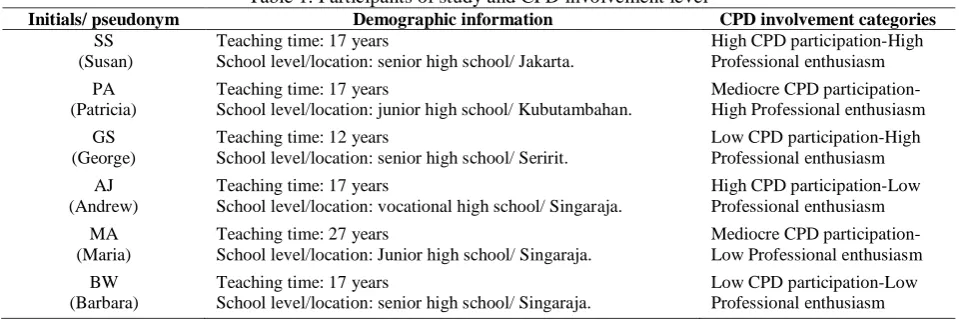
The study used a qualitative research approach through “Multi-case study” (Bogdan & Biklen, 2007) as it involved the study of more than one case in order to investigate a phenomenon or general condition. The study involved six English language teachers in Indonesia who represent six different CPD involvement categories. Each teacher was considered a case. Table 1 shows the participants’ pseudonyms, their demographic information and CPD involvement category which was identified in a previous study (Utami et al., 2017).
Table 1. Participants of study and CPD involvement level
Initials/ pseudonym Demographic information CPD involvement categories
SS (Susan)
Teaching time: 17 years
School level/location: senior high school/ Jakarta.
High CPD participation-High Professional enthusiasm
PA (Patricia)
Teaching time: 17 years
School level/location: junior high school/ Kubutambahan.
Mediocre CPD participation-High Professional enthusiasm
GS (George)
Teaching time: 12 years
School level/location: senior high school/ Seririt.
Low CPD participation-High Professional enthusiasm
AJ (Andrew)
Teaching time: 17 years
School level/location: vocational high school/ Singaraja.
High CPD participation-Low Professional enthusiasm MA
(Maria)
Teaching time: 27 years
School level/location: Junior high school/ Singaraja.
Mediocre CPD participation- Low Professional enthusiasm
BW (Barbara)
Teaching time: 17 years
School level/location: senior high school/ Singaraja.
Low CPD participation-Low Professional enthusiasm
Data collection
The data were collected by employing three data collection methods: developmental interviews (Patton,
2015), non-participant observation and document checking (Creswell, 2012). Each interview was conducted 5-6 times over 8-9 months, each of which
Effective teaching components
Professional component
took approximately for 1 hour. Non-participant observations were conducted 4 times. Then, document checking was done to support data from direct observations by checking the participants’ teaching documents (lesson plans, media, prepared materials and worksheets) prior to teaching practice observations. All the collected data (interview transcripts, observations forms, documents with annotations) were checked by
each teacher for verification and credibility (see Creswell, 2012).
Instruments
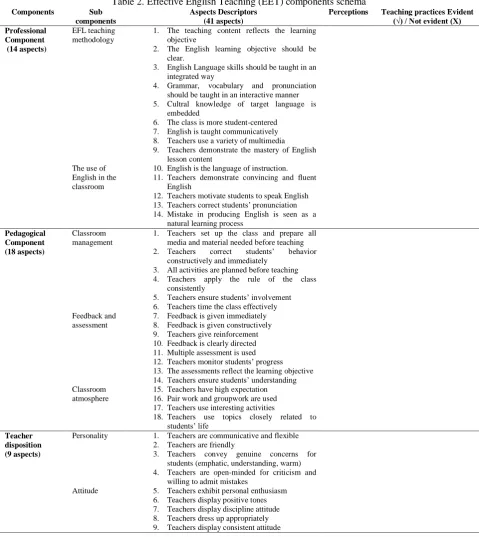
Prior to conducting the research two instruments were developed, content-validated, and revised by co-researchers. These instruments were an interview schedule and a schema for effective English teaching components containing 41 aspects of Effective English Teaching (see Table 2).
Table 2. Effective English Teaching (EET) components schema
Components Sub
components
Aspects Descriptors (41 aspects)
Perceptions Teaching practices Evident
(√) / Not evident (X) Professional
Component (14 aspects)
EFL teaching methodology
1. The teaching content reflects the learning
objective
2. The English learning objective should be
clear.
3. English Language skills should be taught in an
integrated way
4. Grammar, vocabulary and pronunciation
should be taught in an interactive manner
5. Cultral knowledge of target language is
embedded
6. The class is more student-centered
7. English is taught communicatively
8. Teachers use a variety of multimedia
9. Teachers demonstrate the mastery of English
lesson content The use of
English in the classroom
10. English is the language of instruction.
11. Teachers demonstrate convincing and fluent
English
12. Teachers motivate students to speak English
13. Teachers correct students’ pronunciation
14. Mistake in producing English is seen as a
natural learning process
Pedagogical Component (18 aspects)
Classroom management
1. Teachers set up the class and prepare all
media and material needed before teaching
2. Teachers correct students’ behavior
constructively and immediately
3. All activities are planned before teaching
4. Teachers apply the rule of the class
consistently
5. Teachers ensure students’ involvement
6. Teachers time the class effectively
Feedback and assessment
7. Feedback is given immediately
8. Feedback is given constructively
9. Teachers give reinforcement
10. Feedback is clearly directed
11. Multiple assessment is used
12. Teachers monitor students’ progress
13. The assessments reflect the learning objective
14. Teachers ensure students’ understanding
Classroom atmosphere
15. Teachers have high expectation
16. Pair work and groupwork are used
17. Teachers use interesting activities
18. Teachers use topics closely related to
students’ life
Teacher disposition (9 aspects)
Personality 1. Teachers are communicative and flexible
2. Teachers are friendly
3. Teachers convey genuine concerns for
students (emphatic, understanding, warm)
4. Teachers are open-minded for criticism and
willing to admit mistakes
Attitude 5. Teachers exhibit personal enthusiasm
6. Teachers display positive tones
7. Teachers display discipline attitude
8. Teachers dress up appropriately
9. Teachers display consistent attitude
The schema was devised from three sources: a professional English teaching questionnaire (Oder, 2014), the teaching practical criteria (Cambridge ESOL,
aspect of effective teaching components was developed (see Table 2).
Data analysis
This paper seeks to examine patterns and relationships between teachers’ CPD involvement and the alignment of their perceptions and practices with regard to effective English teaching. Each interview was content analysed. The analysis involved the process of data condensation, coding and categorizing (Erlingsson & Brysiewicz, 2017).
The analysis was done case by case. Each teacher was treated as a case. The interview transcriptions of each participant were studied independently. Each teacher’s 5-6 interviews were studied consecutively. Aspects of effective English teaching (41 aspects-Table 2) were used to guide the process of analysis. Segments of interview were selected to provide relevant evidence. In other words, in a process of analysing the interviews consecutively, any segments of transcription that was evidence of an aspect was tabled adjacently. Then, codes were assigned to selected segments of transcription to describe the aspect. By doing this, the
researcher identified the teachers’ perceptions in regard to professional knowledge, professional practice, and professional disposition.
The participants’ teaching practice analysis was completed in-situ during data collection. The researcher sat in the classroom observing aspects of effective English teaching (see Table 2). An observation sheet was used to record notes against aspects of effective English teaching. As each teacher was observed 4 times, data across different observation sessions were compared. A description of each teachers’ practice was created and then verified by the assigned teacher.
A representation of each teacher was formed after each teachers’ perceptions and practices data were analysed. An overall comment was put in Table 4, which represented their perceptions and practices. The trustworthiness of data interpretation of the aligned/not aligned aspects was assured through member checking. Participants were asked to see the objectivity of the interpretation (Creswell, 2012) and changes made based on the feedback given by the teachers.
Table 3. Example of perceptions and practice alignment analysis Name of participant: _______________
Aspects of effective English teaching
Perception Practices Alignment between
perception and practice 1. The teaching content
reflects the learning objective focusing on English language learning
2. The English learning objective should be clear.
….(continued until 41)
1. Consistent with this
2. Consistent with this
1. Evident
2. Not evident
1. Aligned
2. Not aligned
To provide evidence if there was a relationship between perception-practice alignment and CPD involvement, constant comparative analysis across the participants’ perception and practice alignment and CPD involvement was conducted (see Table 3). Hypothesis of pattern of relationships between the two variables was identified from two cases with extreme difference: Andrew case (high CPD participation-low professional enthusiasm) and George case (low CPD participation-high Professional enthusiasm). Then, this hypothesis was tested across the comparison of cases ( see Strauss & Corbin, 1994).
FINDINGS
The study indicated that all the participants’ perceptions on effective English teaching (EET) were consistent with 41 aspects of effective English teaching as previously identified.
As seen in Table 4, the teachers were categorized based on their professional enthusiasm as being high professional enthusiasts (Susan, Patricia and George) and low professional enthusiasts (Andrew, Maria and Barbara). Their CPD participation was evident as high,
medium and low across both categories. The distinguishing factor was level of enthusiasm which will now be discussed through the components of effective English teaching not evident in their practice.
Teachers with High Professional Enthusiasm
Susan, Patricia and George were teachers with high professional enthusiasm but each had different levels of CPD participation. Their high professional enthusiasm was indicated by their high professional motivation, positive perceptions toward their CPD experience and sustained CPD efforts. These teachers were mostly self-determined to improve their practices.
planning her lesson carefully and preparing interesting media and activities to motivate students’ learning. In addition, George said “When I have to teach different ability classes, it means I have to design different activities to suit with students’ ability”. His practices
reflected his perception, as he spent hours preparing different interesting activities for his classes. In short, these three teachers showed genuine excitement and demonstrated efforts to make their teaching effective.
Table 4. Perceptions-practices divergences
Participants/ CPD level Perceptions-Practices divergences
Professional Component (14 aspects)
Pedagogical Component (18 aspects)
Teacher Disposition Component (9 aspects)
HIGH professional
enthusiasm Susan
(High CPD participation)
13 evident
1 not evident which was:
- cultural knowledge was not
introduced
17 evident
1 not evident which was:
- students’ behaviour was not
controlled
9 evident 0 not evident
Patricia
(Mediocre CPD participation)
13 evident
1 not evident which was:
- cultural knowledge was not
introduced
16 evident
2 not evident which were:
- no rules were set or applied
- high expectation was not
expressed
9 evident 0 not evident
George
(Low CPD participation)
12 evident
2 not evident which were:
- learning objective was not
informed
- cultural knowledge was not
introduced
16 evident
2 not evident which were:
- effective time was not managed
- students’ understanding was not
ensured at the closing
9 evident
0 not evident
LOW professional
enthusiasm Andrew
(High CPD participation)
12 evident
2 not evident which were:
- Learning objective was not
clearly informed.
- Indonesian and English were
quite equally used.
13 evident
5 not evident which were
- Lesson was barely prepared
- effective time was not managed
- multiple assessments were not
facilitated
- No reviews were present atthe
closing
- No pairwork /groupwork was
assigned
7 evident
2 not evident whichwere:
- personal enthusiasm was not
displayed
- positive tone was not
displayed
Maria
(Mediocre CPD participation)
11 evident
3 not evident which were:
- cultural knowledge was not
introduced
- no media were given
- students were not motivated to
speak English
13 evident
5 not evident which were
- effective time was not managed
- reinforcement was rarely given
- students’ understanding was not
ensured at the closing
- high expectation was not
expressed
- interesting activities were not
provided
9 evident 0 not evident
Barbara
(Low CPD participation)
10 evident
4 not evident which were:
- cultural knowledge was not
introduced
- no media were given
- Indonesian and English were
used equally
- students were not motivated to
speak English
12 evident
6 not evident which were:
- students’ mischief behavior was
not corrected
- effective time was not managed
- multiple assessments were not
provided
- no reviews were present at the
closing
- no pairwork/groupwork was
assigned
- no interesting activities occured
9 evident 0 not evident
Teachers with Low Professional Enthusiasm
Andrew, Maria and Barbara had low professional enthusiasm and different levels of CPD participation. Their low professional enthusiasm was indicated by their low professional motivation, negative perceptions toward their CPD experience and lack of sustained CPD efforts. These teachers mostly participated in professional development activities more for obtaining
Andrew was found explaining concept in Indonesian. Maria did not motivate the students to speak English and Barbara frequently switched into Indonesian and let students speak Indonesian throughout the class.
Furthermore, as much as these teachers perceived the importance of preparing lesson and preparing interesting activities, these aspects were not found to be of concern. Andrew said “…teacher needs to plan their lesson before teaching” but in practice his impromptu or unprepared teaching was observed. Maria said “…we cannot teach only from the book, we need to be able to create interesting activities.” Barbara in similar voice said “teaching through games or other interesting activities is important to motivate students’ learning”. Different from their perception, both of them approached their classes through text-book based as the activities were mostly guided by the main English book. Their main goal seemed to be ‘finishing the material in the book.’ All teachers in this category did not align their perceptions and practices. In short, these three teachers showed less effort in assuring the effectiveness of their teaching practice
The relationship between Perception-practice alignment with CPD involvement
There are two indicators of CPD involvement. These are CPD participation level and professional enthusiasm level. Within the context of the observed participants, this study found that teachers with high professional enthusiasm were inclined to demonstrate more aligned aspects of perceptions and practices. However, their CPD participation level did not always indicate the extent of an alignment of perceptions-practices accordingly. To understand this more clearly, the following discussions compares teachers across different CPD involvement levels.
Comparison between CPD participation, professional enthusiasm and perception and practice alignment will be illustrated across cases. Each participant, representing one case, has different CPD
involvement categories. First, we started by comparing Andrew and George cases. Although Andrew had higher CPD participation than George, his aligned aspects of perception and practice were relatively fewer than George’s. This indicates that Andrew’s high CPD participation alone cannot guarantee a high alignment of perceptions and practices. Let us now consider further comparisons that show similar patterns:
Susan, Patricia and George have different levels of CPD participation, but all have high professional enthusiasm. They had a higher perception-practice alignment. Their high professional enthusiasm was reflected in their ideal teaching practice. Their practices were relatively more aligned with their perceptions which were consistent with what literature mentioned as effective English teaching aspects. Whereas, Andrew, Maria and Barbara performed practices which were relatively less aligned with their perceptions. Their practices were less consistent with what literature suggested as effective teaching. This comparison indicates that without high professional enthusiasm, perception-practice alignment is not so strong. Conversely, high professional participation does not ensure high perception-practice alignment.
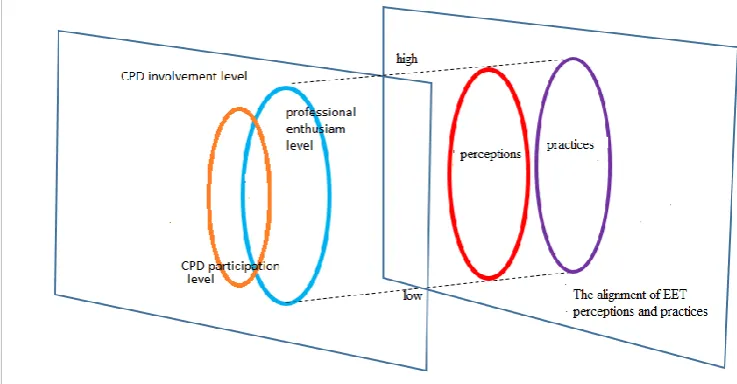
This study found a relationship between the participants’ professional enthusiasm and their perceptions-practices alignment. Among two indicators of CPD involvement: CPD participation level and professional enthusiasm level, only the latter was found as having a consistent pattern of relationship with the alignment of perceptions and practices.
Figure 3 illustrates the relationship between professional enthusiasm and the alignment between perceptions and practices in the context of the observed participants. The higher the participants’ professional enthusiasm, the higher their perception-practice alignment. Figure 3 also illustrates that CPD participation level does not indicate perception-practice alignment, in fact it sits outside this unique relationship.
DISCUSSION
The findings of this study emphasize that the role of affective factors, such as professional enthusiasm, are powerful factors additional to cognitive factors in the engagement of professional development. In previous studies, for example, teachers’ commitment and level of willingness (White, Mitchelmore, Branca, & Maxon, 2004; Maloney & Konza, 2011; Saka, 2013) as well as professional attitude (Varga-Atkins, Qualter, & O’Brien, 2009) have been found to influence the success of professional development in reaching its goal. This study observed the participants’ CPD participation level alone was not sufficient to support them in doing what they perceived as an effective practice. As shown in Susan, Patricia and George’s case, their perceptions and actual practices were influenced by their high professional enthusiasm.
Susan and Patricia’s CPD engagement was motivated by a desire to learn, and George’s was motivated by achieving effective teaching satisfaction. These desires to learn have been conceptualised by Evans (2011) as enacted professional development. Teachers who enact professional development are aware of their professional capacity and demonstrate autonomy and self-efficacy (Zwart, Korthagen, & Attema-Noordewier, 2015). The feeling of autonomy and self-efficacy drove Susan to continuously engage in various collaborative projects with teachers around the world and apply new ideas in her classes. She perceived effective English teaching as facilitating students through various learning experiences and, therefore, involved her students in virtual class sessions.
On the contrary, Andrew, Maria and Barbara, the participants with low professional enthusiasm, participated in demanded or requested professional development (Evans, 2011), as their CPD engagement was motivated by government regulation, obtaining rewards or career advancement opportunities. They claimed that they did not practice what they perceived due to several reasons such as their age, family responsibilities, heavy workload and insufficient time. Dealing with similar conditions, the teachers with high professional enthusiasm could demonstrate better perceptions-practices alignment. For example, Patricia, who had high professional enthusiasm, and Maria, who had low professional enthusiasm, were both dealing with a personal issue such as being more mature and having growing family responsibility. However, Patricia with her high professional enthusiasm could continuously provide her classes with challenging activities. Conversely, Maria’s teaching was heavily based on textbook content instead of involving challenging activities. Teachers with high professional enthusiasm like Patricia, have high commitment and willingness (Maloney & Konza, 2011), which strongly lead them to maintain professional performance despite difficult circumstances and challenges. In somparison, teachers with low professional enthusiasm are lack of commitment and willingness which causes them to give up easily.
The findings of this study support the findings of other studies (see Karabenick & Conley, 2011, Avalos, 2011, & Rzejak et al., 2014) that is, the quality of CPD motivation is crucial in determining teachers to change their practices. The participants with motivation to learn and to improve their practice were inclined to have high alignment of their effective teaching perceptions and practice. Thus this study supports Rzejak's et al (2014) findings indicating that the character of motivation plays a significant role in the effect of actioning perceptions into practice.
In drawing these findings together, this study presents idiographic knowledge related to the existence of a relationship between CPD involvement and the alignment of teachers’ perception and practices. This study, however, due to the limited number of participants, lacks generalization. Therefore, further study is suggested involving further sites and greater number of participants for generalization.
CONCLUSIONS AND IMPLICATIONS FOR CONTINUING PROFESSIONAL DEVELOPMENT
The comparative analysis across cases show the inclination of the relationship between professional enthusiasm level and effective teaching perceptions-practices alignment. Although, CPD participation contributes to learning opportunities to gain knowledge and experience, this practice alone will not assure teachers’ alignment of perceptions and practices. Hence, the combination of high CPD participation and high professional enthusiasm serves as the effective combination to help teachers shape their perceptions and willingness to put perceptions into action.
Putting cognitive factors aside, this study acknowledges how influential teacher professional enthusiasm is in teachers’ capacity to improve their practices. Therefore, this conscious raising of professional enthusiasm is a key ingredient of CPD that will lead them to shape their perception of effective teaching and put them into practice. Effective approaches to professional enthusiasm raising should be considered by teacher training colleges or induction programs to ‘educate’ prospective teachers. In addition, school leaders need to promote teachers’ professional enthusiasm by allowing opportunities for professional self-learning opportunities and provide the necessary facilities.
Furthermore, this study re-establishes the need for a shift of teacher professional development standard policy. Stillman and Anderson(2015) and Su, Feng, and Chang-Hui Hsu (2017) observe tension between the demand of professional standards and teachers’ professional development needs. Teachers were inclined to place more efforts and time in fulfilling the standard, instead of involving themselves in more strategic learning actions. Therefore, the focus of accountability should be replaced by evaluation on authentic processes.
for teachers’ to practice their perceptions, a call for a “ hearts and minds” approach is needed (Watson, 2001). Teachers’ CPD participation results in knowledge which shapes their ‘minds’ but only professional enthusiasm will move them beyond reframing thoughts and put them into action.
ETHICS STATEMENT
All data collected remains strictly confidential. All participants were assigned codes or pseudonyms used throughout the data analysis process and reporting. The team drew up an ethical strategy for confidential management of data, clearly listing stages of anonymization.
ACKNOWLEDGEMENTS
This research and publication were funded by The Ministry of Research, Technology and Higher Education of Indonesia through the BPPDN scholarship and the Enhancing International Publication/PKPI scholarship.
REFERENCES
Aliakbari, M., & Bozorgmanesh, B. (2015). Assertive classroom management strategies and students ’ performance : The case of EFL classroom. Cogent Education, 2(1012899).
https://doi.org/10.1080/2331186X.2015.1012899 Anugerahwati, M., & Saukah, A. (2010). Professional
competence of english teachers in indonesia: A profile of exemplary teachers. Indonesian JELT, 6(2), 107–119.
Avalos, B. (2011). Teacher professional development in teaching and teacher education over ten years. Teaching and Teacher Education, 27(1), 10–20. https://doi.org/10.1016/j.tate.2010.08.007
Banegas, D., Pavese, A., Velázquez, A., & Vélez, S. M. (2013). Teacher professional development through collaborative action research: Impact on foreign english-language teaching and learning. Educational Action Research, 21(2), 185–201. https://doi.org/10.1080/09650792.2013.789717 Bogdan, R. ., & Biklen, S. K. (2007). Qualitative
research for education. an introduction to theories and methods (5th ed.).boston: Allyn and Bacon. Borg, S. (2011). The impact of in-service teacher
education on language teachers ’ beliefs. System, 39(3), 370–380.
https://doi.org/10.1016/j.system.2011.07.009 Cahyono, B. . (2013). Indonesian EFL teachers studying
overseas: Feeling, expectations, and perspectives on professional development. CELT Journal, 13(1), 43–65.
Cambridge ESOL. (2012). TKT practical module teaching knowledge test: Handbook for teachers. University of Cambridge ESOL examinations. Retrieved from
http://www.cambridgeenglish.org/images/tkt-practical-handbook.pdf)
Creswell, J. W. (2012). Educational research: Planning, conducting and evaluating quantitave and qualitative research. Boston: Pearson Education, Inc.
Erlingsson, C., & Brysiewicz, P. (2017). A hands-on guide to doing content analysis. African Journal of Emergency Medicine, 7(3), 93–99.
https://doi.org/10.1016/j.afjem.2017.08.001 Evans, L. (2011). The “ shape ” of teacher
professionalism in England: Professional
standards, performance management , professional development and the changes proposed in the 2010 White Paper. British Educational Research Journal, 37(5), 851–870.
https://doi.org/10.1080/01411926.2011.607231 Gebru, B. (2008). Perception and classroom practice of
communicative language teaching by high school EFL teachers and learners: The case of some selected high schools in Addis Ababa. Retrieved from
http://etd.aau.edu.et/bitstream/123456789/2112/2/ Beyene Gebru.pdf
Guskey, T. R. (2002). Professional development and teacher change. Teachers and teaching: Theory and practice, 8(3/4), 381–391.
https://doi.org/10.1080/135406002100000512 Harris, J., & Duibhir, P. Ó. (2011). Effective language
teaching : A synthesis of research. Dublin: National Council for Curriculum and Assessment. Hostetler, K. D. (2016). Beyond reflection: Perception,
virtue, and teacher knowledge. Educational Philosophy and Theory, 48(2), 179–190. https://doi.org/10.1080/00131857.2014.989950 Karabenick, S. A., & Conley, A. (2011). Teacher
motivation for professional development. national science foundation. Ann Arbor: Math and Science Partnership - Motivation Assessment Program, University of Michigan.
https://doi.org/10.1177/019263658206645804 Katuuk, D., & Marentek, M. K. L. (2014). Indonesian
primary school teacher ’ s perception of
professional development programs: A case study. International Journal of Education and Research, 2(6), 629–634.
Ko, J., Sammons, P., & Bakkum, L. (2016). Effective teaching: A review of research and evidence. Hong Kong: CfBT Education Trust
Korompot, C. A. (2012). Giving teachers their voices: Indonesian EFL teachers ’ perspectives on professional teaching standards in the context of teacher certification programs in Indonesia (Unpublished doctoral thesis). University of New England, Australia.
Lee, I. (2009). Ten mismatches between teachers’ beliefs and written feedback practice. ELT Journal, 63(1), 13–22.
https://doi.org/10.1093/elt/ccn010
teachers ’ professional learning : Becoming a community of professional learning or not ? Issues in Educational Research, 21(1), 75–87.
Martin-beltran, M., & Peercy, M. M. (2014).
Collaboration to teach English language learners : opportunities for shared teacher learning. Teachers and teaching: Theory and Practice, 20(6), 721– 737. doi: 10.1080/13540602.2014.885704 McCray, C. (2016). Middle and high school teachers’
perceptions of professional development (Unpublished doctoral dissertation). Walden University , Minnesota, United States.
Meksophawannagul, M. (2015). Teacher and learner views on effective English teaching in the Thai context: The case of engineering students. English Language Teaching, 8(11), 99–116.
https://doi.org/10.5539/elt.v8n11p99
Oder, T. (2014). English language teachers’ perceptions of professional teaching. Teacher Development: An International Journal of Teachers’
Professional Development, 18(4), 482–494. https://doi.org/10.1080/13664530.2014.953253 Park, G., & Lee, H. (2006). The characteristics of
effective English teachers as perceived by high school teachers and students in Korea. Asia Pacific Education Review, 7(2), 236–248.
https://doi.org/10.1007/bf03031547
Patton, M. Q. (2015). Qualitative research & evaluation methods (4th ed.). Thousand Oaks, CA: Sage. Prestridge, S. (2017). Conceptualising self generating
online teacher professional development.pdf. Technology, Pedagogy and Education, 26(1), 85– 104. doi: 10.1080/1475939X.2016.1167113 Richter, D., Konter, M., Klusma, U., Lüdtke, O., &
Baumart, J. (2014). Professional development across the teaching career. In Teachers’ professional development. (p. 97–121.). New York, NY: Springer.
Rose, J., & Reynolds, D. (2007). Teacher’s continuing professional development: A new approach. 20th Annual Conference of the International Congress for School Effectiveness and Improvement (ICSEI). Retrieved from http://www.fm- kp.si/zalozba/ISBN/978-961-6573-65-8/219-240.pdf
Rzejak, D., Künsting, J., Lipowsky, F., Fischer, E., Dezhgahi, U., & Reichardt. (2014). Facets of teachers’ motivation for professional development–Results of a factorial analysis. Journal for Educational Research Online, 6(1), 139–159.
Sagar, H. (2013). Teacher change in relation to professional development in entrepreneurial learning (Unpublished doctoral thesis). University of Gothenburg, Sweden.
Saka, Y. (2013). Who are the science teachers that seek professional development in research experience for teachers ( RET’s )? Implications for teacher professional development. Journal Science Education Technology, 22, 934–951.
https://doi.org/10.1007/s10956-013-9440-1 Sebina, B., & Arua, A. E. (2017). From perception and
knowledge to classroom practice: Teaching listening comprehension to setswana speakers of English in junior schools in Botswana.
International Journal of Listening, 31(1), 33–50. https://doi.org/10.1080/10904018.2014.928212 Shishavan, H. B., & Sadeghi, K. (2009). Characteristics
of an effective English language teacher as perceived by Iranian teachers and learners of English. English Language Teaching, 2(4), 130– 143. https://doi.org/10.5539/elt.v2n4p130 Stillman, J., & Anderson, L. (2015). From
accommodation to appropriation: Teaching, identity, and authorship in a tightly coupled policy context. Teachers and Teaching: Theory and Practice, 21(6), 720–744.
https://doi.org/10.1080/13540602.2015.1044330 Strauss, A., & Corbin, J. (1994). Basics of qualitative
research. Newbury park, CA: Sage. Su, Y., Feng, L., & Chang-Hui Hsu. (2017).
Accountability or authenticity the alignment of professional development and teacher evaluation. Teachers and Teaching: Theory and pracTice, 23(6), 717–728.
https://doi.org/10.1080/13540602.2016.1255189 Sumardi. (2012). Efektivitas program revitalisasi
MGMP Bahasa Inggris sebagai media pembinaan profesionalisme guru. Retrieved from
https://robertsumardi.files.wordpress.com/2012/01/ efektivitas-program-revitalisasi-mgmp-bahasa-inggris-2.pdf
Utami, I. L. P., Saukah, A., Cahyono, B. Y., & Rachmajanti, S. (2017). Levels of involvement in the english teachers’ CPD (continuous professional development): The degree of professional
enthusiasm. The Journal of Asia TEFL, 14(2), 336–345.
Utami, I.L.P. (2017). Genuine involvement in
continuous professional development: How to see it? In 2nd International Conference on Innovative Research Across Disciplines (ICIRAD 2017). Advances in Social Science, Education and Humanities Research, volume 134 (pp. 210–215). Paris, France.: Atlantis Press, scientific publishing. https://doi.org/http://dx.doi.org/10.2991/icirad-17.2017.40
Varga-Atkins, T., Qualter, A., & O’Brien, M. (2009). School professionals’ attitudes to professional development in a networked context: Developing the model of “believers, seekers and sceptics”. Professional Development in Education, 35(3), 321-340.
https://doi.org/10.1080/19415250902846815 Watson, G. (2001). Models of information technology
(2004). Professional development: Mathematical content versus pedagogy. Mathematics Teacher Education and Development, 6, 41–51.
Yulia, Y. (2014). An evaluation of English language teaching programs in Indonesian junior high schools in the Yogyakarta Province. RMIT University. Retrieved from
https://researchbank.rmit.edu.au/view/rmit:160956 Zwart, R. ., Korthagen, F. A. J., & Attema-Noordewier,