INTRODUCTION
A growing interest in the use of titanium al-loys as biomaterials in medicine stems from their unique properties including [3, 5, 9, 12–13, 15–16, 28, 23]:
• low density;
• high tensile strength; • high corrosion resistance;
• optimum biocompability when compared to other metallic biomaterials;
• repassivation of surface damage in wet and oxygen-containing environment;
• higher elasticity than other biomaterials, which means that the implant-adjacent bone can con-tinue to perform its load-carrying functions; • promotes osseointegration;
• titanium implants can be used on a long-term basis (for 20 years at least);
• the possibility of monitoring titanium implants by resonant methods.
Given the general market availability of tita-nium and its alloys due to advanced metallurgical methods and machining techniques, titanium al-loys are widely used in orthopaedics, traumatol-ogy and dentistry for producing a variety of per-manent implants and medical tools, such as hip, knee and shoulder joint prostheses; bone plates; pacemaker casings; screws; nails (Fig. 1).
In orthopaedics, one of the most widely used titanium biomaterials is alloy Ti6Al4V ELI (Extra Low Interstitial) which is characterized by slight-ly higher hot-workability and brittle crack resis-tance than the commercial alloy Ti6Al4V owing
INVESTIGATION OF THE EFFECT OF FORGING TEMPERATURE
ON THE MICROSTRUCTURE OF GRADE 5 TITANIUM ELI
Anna Dziubińska1, Krzysztof Majerski2, Grzegorz Winiarski1
1 Lublin University of Technology, Mechanical Engineering Faculty, Department of Computer Modelling and Metal Forming Technologies, Nadbystrzycka 36, 20-618 Lublin, Poland, e-mail: [email protected] 2 Lublin University of Technology, Mechanical Engineering Faculty, Department of Materials Engineering,
Nadbystrzycka 36, 20-618 Lublin, Poland
Research Journal
Volume 11, Issue 4, December 2017, pages 147–158
DOI: 10.12913/22998624/76488 Research Article
ABSTRACT
The paper reports the experimental results of an investigation of the effect of forging temperature on the microstructure and hardness of Grade 5 titanium ELI. A grow-ing interest in the use of titanium alloys in implantology results from their unique properties. Grade 5 titanium ELI is widely used in medicine for producing a variety of implants and medical tools such as hip, knee and shoulder joints; bone plates; pacemaker casing and its components; screws; nails; dental materials and tools. In the first part of the paper the properties of Grade 5 titanium ELI are described and examples of medical applications of this alloy are given. In a subsequent section of the paper, forging tests performed on this biomaterial in a temperature range from 750°C to 1100°C are described. Following the forging process, the results of the titanium alloy’s microstructure and hardness are reported. The experimental results are used to determine the most suitable forging temperature range for Grade 5 tita-nium ELI with respect to its microstructure.
Keywords: grade 5 titanium ELI, biomaterials, metal forming, forging, microstruc-ture, hardness
to lower oxygen and iron content in its chemical composition. Ti6Al4V ELI alloys have high de-formation resistance and low thermal
conductiv-ity, which makes hot and cold working difficult
[1, 19]. Numerous works on forming titanium and its alloys were published in the last 10 years. However, due to discrepancies in the reported
re-sults, it is difficult to establish standard forging
conditions for this metal and determine the rela-tionship between the forging temperature and mi-crostructure quality. Most of the studies concern the commercial titanium alloy Ti6Al4V, primarily intended for the aircraft industry [6], while there
are significantly fewer publications on the form -ing of alloy Ti6Al4V ELI (Grade 5 ELI) used for medical applications [1, 4, 10–11, 14, 17–19, 22].
In light of the above, it seems justified to investi
-gate the effect of forging temperature on the mi -crostructure and hardness of titanium alloy grade 5 ELI. The results will be used to determine hot-working temperature that ensures obtaining opti-mum microstructure. It should be mentioned that the research addresses the problem signalled by medical products manufacturers concerning the forging of titanium alloy Ti6Al4V (Grade 5 ELI) on standard hydraulic presses, using electric fur-naces for preheating.
METHODS
The tests were performed on titanium alloy grade 5 (Ti6Al4V) ELI. This biomaterial is a
two-phase (α+β) martensitic alloy, and its chemi -cal composition is listed in Table 1. The
micro-structure of this alloy is a composition of α phase and 5 to 25% β phase. The phase change α+β-> β starts at approx. 887°C and end at 985°C [13].
The hot-workability of these alloys after heat
refining is higher than that of single-phase α al -loys [1, 19]. It should be mentioned that
proper-ties of two-phase α+β alloys depend on the kind
and percentage of impurities, alloying elements as well as the content of individual phases. Their
strength increases with increasing the β phase
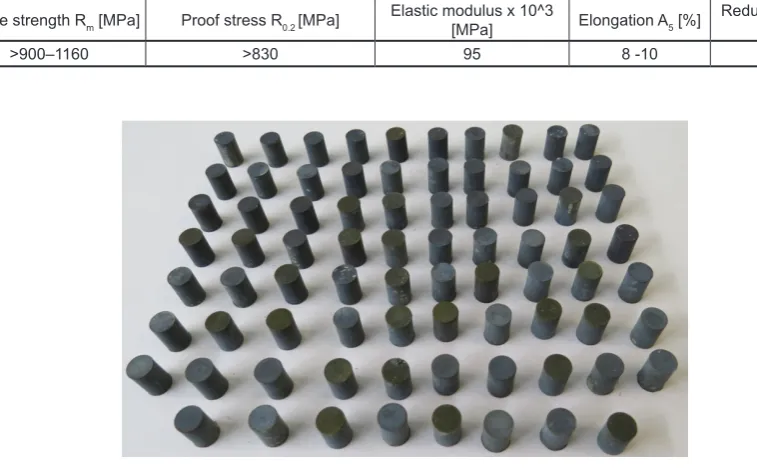
content. The mechanical properties of titanium alloy Ti6Al4V ELI are listed in Table 2. Shown in Fig. 2, test specimens had a diameter of 8 mm and a length of 10 mm and were subjected to com-mercial annealing for 60 minutes at a temperature of 800°C [20].
The study involved performing open die forg-ing of titanium alloy grade 5 ELI by the method described in the standard PN-H-04411:1983. This method is widely used for metal
prod-ucts and semi-finished prodprod-ucts, primarily to
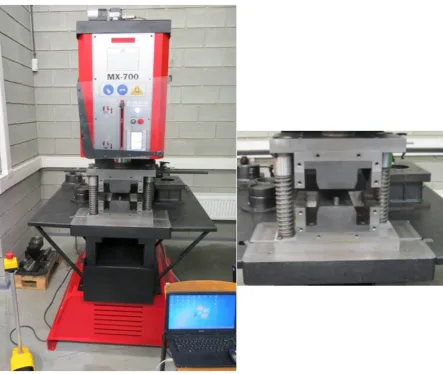
determine their workability in given thermal conditions and to detect surface and subsur-face defects during deformation. The range of forging temperature for Titanium Grade 5 ELI was selected based on an overview of the literature [1, 3–5, 11–19, 22–23] and set to 750°C÷1100°C. As recommended by the standard, the tests con-sisted in open-die hot forging of a batch of speci-mens (3 specispeci-mens per each temperature changed every 50°C) to 1/3 of their initial height in a spe-cially designed open-die upsetting device (Fig. 3) mounted in the hydraulic punching machine Nargesa MX-700.
The temperature of the dies was maintained at 200 °C and controlled with the Ebro TFI 650 infrared thermometer. The press was provided with a measuring system enabling determina-tion of variadetermina-tions in the force parameters during the forging process. The measuring system com-prised a measuring card, pressure and displace-ment sensors and was provided with the „Sam-ba” software. Pressure in the hydraulic unit was measured with the „Samba” controlled measur-ing card. The followmeasur-ing were measured durmeasur-ing the experiments: workpiece compression time, pres-sure and tool travel. The results were used to
de-termine relationships between yield stresses and equivalent strains [8, 24].
The experimental flow curves and curves ob -tained from the literature served for designing a model of titanium alloy Ti6Al4V ELI for nu-merical analysis. The nunu-merical modelling of up-setting titanium grade 5 ELI was performed us-ing the process simulation software Deform 3D [7]. The forging temperature was set to 750°C to simulate real process forging conditions.
To determine the effect of forging tem -perature on the microstructure of titanium alloy Grade 5 ELI, the reference specimens and those produced by open-die forging under the applied temperature ranges were subjected to microstruc-tural examination. To this end, metallographic specimens were prepared in accordance with the following procedure [2, 25]:
The specimens were cut along the symmetry line using the Struers Secotom with the application of water cooling and pre-treatment, i.e., test spec-imen grinding and mounting in Epidian 5 resin.
The mounted specimens were ground and polished using a Buehler grinder and polisher and
abrasive discs with three different gradations set
to 80, 200 and 400, respectively. Following the
Table 1. Chemical composition of Grade 5 Titanium ELI
Al V O C H Fe Ti
6.42 4.19 0.101 0.011 0.0052 0.198 Balance
Table 2. Mechanical properties of titanium alloy grade 5 ELI
Tensile strength Rm [MPa] Proof stress R0.2 [MPa] Elastic modulus x 10^3 [MPa] Elongation A5 [%] Reduction in area Z [%]
>900–1160 >830 95 8 -10 >25
grinding process, the specimens were subjected to polishing for 10 minutes with SiO2 suspension
using a 0.05 μm disc.
The specimens were subjected to etching by approx. 2 seconds with Kroll’s reagent.
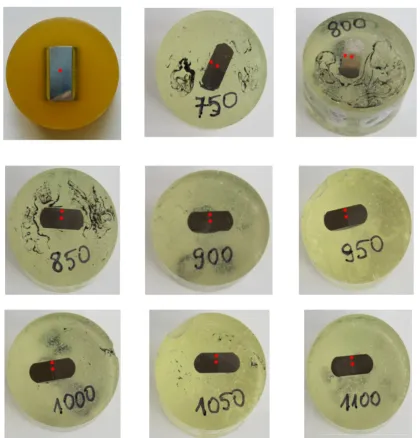
Figure 4 shows metallographic specimens for microstructural examination.
The examination of initial and post-forging microstructure of alloy Grade 5 specimens in the zones indicated in Fig. 4 was made by optical mi-croscopy. The microstructural examination was performed using the Nikon MA200 for capturing
images in brightfield mode.
Similarly to microstructural examination, the hardness of metallographic specimens was measured in the zones indicated in Fig. 4. The measurements were made using a Future-tech FM800 tester by the Vickers method in compli-ance with the methods described in PN-EN ISO 6507–1:2006, under a load of 98.07 N [21]. The main aim of the measurements was to determine
the effect of forging temperature on the hardness
of Titanium Grade 5 ELI.
RESEARCH RESULTS AND ANALYSIS
Following the upsetting process under vary-ing thermal conditions, the titanium Grade 5 ELI specimens had their surface visually in-spected. Specimens showing the presence of defects such as cracks, delamination and other signs of material coherence loss were rejected. Surface defects examined for their type or depth were then ground using an abrasive disk. Table 3 compares the results of visual valuation of se-lect specimens deformed in the temperature range 750°C÷1100°C in compliance with the standard PN-H-04411:1983, and provides a description of
defects on the end face and flank of upset speci -mens made of titanium grade 5 ELI.
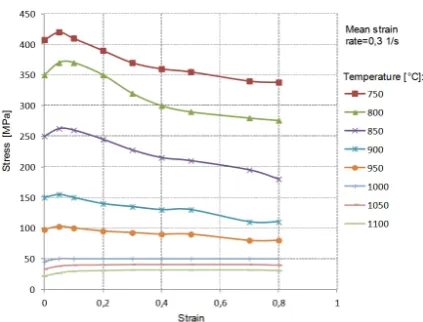
The results were used to determine the re-lationship between yield stresses and strains of titanium alloy grade 5 ELI for the applied tem-peratures; the relationship is shown in Fig. 5.
Analysing the experimental flow curves it can be
observed that the yield stresses decrease with an increase in the forging temperature.
Fig. 4. Metallographic specimens for microscopic examination; red colour marks zones examined for micro-structure quality and hardness
Table 3. Surface of titanium grade 5 specimens after upsetting
750°C 800°C 850°C 900°C 950°C
Correct specimens – no delamination, cracks or dye penetration.
1000°C 1050°C 1100°C
Rejected specimens – no delamination and cracks; visible white oxide spots on specimen end face and flank (caused by heavy oxidation of titanium alloy at elevated temperatures, this leads to a significant reduction in its fatigue strength, which is
Figure 6 illustrates the effective strains
and temperatures in the cross section of an up-set specimen deformed at a temperature of 750°C, obtained in the numerical simulations
by Deform 3D. The highest effective strains oc -cur in the centre of the upset specimen, while the
lowest values of effective strain can be observed
at the below workpiece-tools contact surface. Analysing the distribution of temperature in the deformed specimen it can be observed that the highest temperatures occur on the workpiece
flanks, where the metal flows freely and has no
contact with the tools. The lowest temperatures can be observed on the end face of the workpiece, where the metal undergoes cooling due to contact
with the much colder tools. The difference in tem -peratures in individual regions of the product can range 100÷160°C.
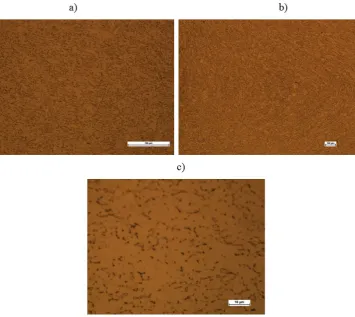
The microstructure of reference samples is shown in Fig. 7. The microstructure of the base
material is a composition of a reinforced α phase solution and a ≤10% β phase solution. After full
annealing, the material exhibits a globular
equi-axial microstructure with middle-size grain. The microstructure examination reveals the presence
of α phase grains and β phase grains predomi
-nantly on the boundary of the α phase grains.
The microstructure of the biomaterial sub-jected to forging at a temperature of 750°C is uni-form (Fig. 8). Figure 8a illustrates the direction
of metal flow during the forging process. It must be noted that the α phase that prevails in the mi -crostructure of titanium alloy grade 5 deformed at the temperature of 750°C, as can be seen in Figure 8c. On the other hand, Figure 8b reveals a
fine-grained structure (below 10 µm). After forg -ing and full anneal-ing, most grains in the central part of the specimen have equiaxial shape.
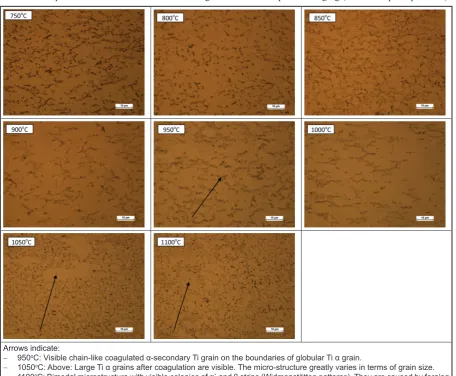
The microstructure of the specimens subject-ed to forging in the temperature range between 800°C and 900°C (Fig. 9÷11) can be described as similar to the microstructure obtained after the forging process at a temperature of 750°C. They are characterized by a relatively uniform,
fine-grained structure, primarily comprising the α phase with equiaxial globular grains. The use
Fig. 7. Microstructure of titanium Ti-6V-4Al ELI specimens prior to forging
Fig. 5. Yield stresses versus strains for titanium alloy grade 5 ELI in annealed state
Fig. 8. Microstructure of titanium Ti-6V-4Al ELI after deformation at 750°C and annealing (centre of specimen; 3 magnified images)
Fig. 10. Microstructure of titanium Ti-6V-4Al ELI after deformation at 850°C and annealing (centre of specimen; 3 magnified images)
of metal forming in conditions of the α+ β -> β
transformation temperature requires the applica-tion of higher forming forces, but the produced structure is homogenous to a large extent.
In the temperature range between 900°C and
1000°C the α grains gradually increase. At the
temperature of 1050°C one can observe a clear
coagulation of the α phase grains. The produced
microstructures are compared in Table 4.
At the temperature of 1100°C one can notice
big grains with a lamellar structure α and β that fill in the original β grains (Tab. 4). The nucle
-ation and growth of α grains are perpendicular to the boundary of the original β grain and perpen -dicular to the growing colony that forms
Widma-nstätten patterns. On the boundaries of former β grain one can notice chain-like α grains.
Figure 12 shows the microstructures of
titani-um Ti-6V-4Al ELI deformed at different temper
-atures below the tool-workpiece contact surface. The microstructure of specimens deformed in the temperature range 750÷1000°C is homogenous
and oriented at a direction of metal flow. The fig -ure shows an example of microstruct-ure deformed at a temperature of 750°C. After the forging pro-cess at 1050°C and 1100 °C and annealing, the region at the outer surfaces of the upset specimen is characterized by a coarse-grained structure.
The lamellar structures at the surface
consist-ing of alternately arranged α and β-phase lammel
-las fill the transformed grain of the β phase and significantly differ from the equiaxial structures
observed in the specimen centre. On the grain boundary one can observe quite big chain-like
re-lease of the α phase. The nucleation and growth of α grain is perpendicular both to the boundary of primary β grain and to the growing colony of
Widmanstätten patterns.
Table 4. Comparison of microstructure of titanium grade 5 after hot open-die forging (centre of upset specimen)
Arrows indicate:
− 950oC: Visible chain-like coagulated α-secondary Ti grain on the boundaries of globular Ti α grain.
− 1050oC: Above: Large Ti α grains after coagulation are visible. The micro-structure greatly varies in terms of grain size. − 1100oC: Bimodal microstructure with visible colonies of α` and β strips (Widmanstätten patterns). They are caused by forging
It should be mentioned that the globular struc-tures occurring in the temperature range from 750°C to 1050°C have higher strength and ductil-ity. On the other hand, the lamellar structures vis-ible at the temperature of 1100°C have a higher crack resistance. Increasing the temperature leads to a gradual growth of the grain. After the forg-ing process at a temperature higher than 950°C, we can observe considerable heterogeneity of the specimen structure. The central region of the specimens characterized by the highest degree of deformation is predominantly an equiaxial,
fine-grained structure, however the accompany
-ing coagulated α phase grains and the α +β lamel
-lar structure-filled transformed β grains reveal a
considerable structural heterogeneity in terms of grain size and shape. As a result of the
applica-tion of forging after annealing in the range α+β
and then annealing, the most homogenous and
fine-grained structure is produced if the forging
temperature does not exceed 850–900°C.
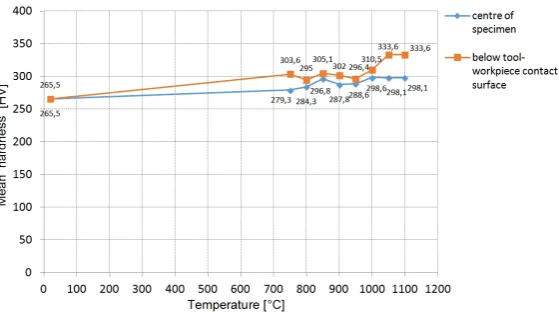
Figure 13 illustrates the relationship between hardness and temperature for two measuring zones of deformed titanium grade 5 ELI.
Analysing the hardness results by the Vickers method it can be observed that mean hardness be-low the tool-workpiece contact surface is higher than that occurring in the specimen centre where
the effective strains are the highest. This results
from the fact that the metal undergoes hardening below the tool-workpiece contact surface, which is caused by rapid cooling of titanium alloy due to contact with the colder tools and the presence of high friction forces.
CONCLUSIONS
The results have led to formulation of the fol-lowing conclusions:
• Following recrystallization annealing at the temperature of 800°C, the forging process in the temperature range between 750°C and 900°C and then stress relieving at 600°C, the microstructure of titanium alloy grade
5 ELI is fine-grained and homogenous
to a great extent. In the central,
highest-deformed region of the specimen, a
fine-grained equiaxial structure prevails. De-spite lower yield stresses, the microstructure of the titanium alloy specimens deformed at the temperature exceeding 950°C is considerably heterogeneous. The lamel-lar structures at the surface contained in the
transformed β-phase grains significantly differ
from those observed in the central region of the equiaxial specimens.
• The experimental results and literature sur-vey have revealed that the microstructure and hardness of titanium alloy grade 5 ELI
sig-nificantly depend on the forging temperature,
strain value and rate as well as the rate of cool-ing after deformation. The changes in the mi-crostructure and phase composition observed
in different regions of the upset product result
from high sensitivity of two-phase titanium alloys to deformation temperature, strain size and rate. By applying suitable values of these factors, i.e., by control of changes in the ther-mal and mechanical state of the deformation zone, it is possible to change and shape to a great extent mechanical and functional prop-erties of products made of this material.
• Due to low thermal conductivity of titanium alloys and the high friction factor between the tested titanium alloy and the dies, the pro-duced strains are not uniform; in addition, the structure and mechanical properties are not uniform either. The non-uniform distribution of the friction factor over the contact surface leads to the occurrence of zones of varied
de-formability in the workpiece. Specifically, a
limited deformability zone occurs under the surface of the dies, leading to production of a coarse grain structure with lower deformabil-ity and strength properties. The strains in other deformation zones are not uniform either, so the produced structure is heterogeneous. • The forging process brings about heat change
and thus an increase in the temperature of the
metal. The thermal effect is most visible in
the zones of intensive deformation (centre of
the workpiece). The difference in the temper
-atures of different regions of the workpiece
can amount to 100÷150°C, which
undoubt-edly affects the microstructure of the tested
titanium alloy.
• By establishing the relationship between yield stresses and strains of titanium alloy grade
5 ELI, we could determine the effect of the
forging temperature on the stress value. With increasing the forging temperature, the yield stresses decrease.
• The mean hardness of the deformed titanium alloy grade 5 ELI in the central region of the workpiece ranges 279.3÷298.6 HV, while on the surface it is 295÷333.6 HV. The increase in hardness of the deformed titanium alloy on the workpiece-tools contact surface is due to the fact that the metal undergoes rapid
ing as a result of contact with the much colder tools and the occurrence of high friction forc-es. Consequently, this region of the workpiece becomes harder.
REFERENCES
1. Adamus J. Analysis of forming of titan products by cold forming methods., (in Polish: Analiza kształtowania wyrobów tytanowych metodami ob -róbki plastycznej na zimno. Series of monographs, 174, Czestochowa University of Technology, Częstochowa, 2010.
2. Bienias J., Mania R., Jakubczak P. and Majerski K. The issues of manufacturing geometrically compli-cated elements using FML laminates. Composites theory and practice, 4(15), 2015, 243–249.
3. Brunette D.M., Tengvall P., Textor M. and Thomsen P. Titanium in medicine. Springer, Germany, 2001. 4. Ding R., Guo Z.X. and Wilson A. Microstructural
evolution of a Ti–6Al–4V alloy during thermome-chanical processing. Materials Science and Engi-neering A, 327, 2002, 233–245.
5. Donachie M.J. Titanium: A Technical Guide, 2nd Edition. ASM International, USA, 2000.
6. Dziubińska A., Gontarz A., Dziubiński M. and Barszcz M. The forming of magnesium alloy forg-ings for aircraft and automotive applications. Ad-vances in Science and Technology Research Jour-nal, 31 (10), 2016, 158–168.
7. Dziubinska A. and Gontarz A. Limiting phenom-ena in a new forming process for two-rib plates. Metalurgija, 3(54), 2015, 555–558.
8. Dziubinska A. and Gontarz A. A new method for producing magnesium alloy twin-rib aircraft brack-ets. Aircraft Engineering and Aerospace Technol-ogy, 2(87), 2015, 180–188.
9. Fujibayashi S., Neo M., Kim H.M., Kokubo T. and Nakamura T. Osteoinduction of porous bioactive titanium metal. Biomaterials, 25, 2004, 443–450. 10. Gontarz A., Winiarski G. Numerical and
experi-mental study of producing flanges on hollow parts by extrusion with a movable sleeve. Archives of Metallurgy and Materials, 3(60), 2015, 1917–1921. 11. Gupta R.K., Kumar A. V., Kumar P. R. Effect of
Variants of Thermomechanical Working and An-nealing Treatment on Titanium Alloy Ti6Al4V Closed Die Forgings. Journal of Materials En-gineering and Performance, 25 (6), 2016, DOI: 10.1007/s11665–016–2110–8.
12. Hermawan H., Ramdan D. and Djuansjah J. R. P. Metals for Biomedical Applications. Biomedical En-gineering – From Theory to Applications. Edited by Prof. Reza Fazel, Publisher InTech, 2011, 411–430.
13. Hirano T., Murakami T., Taira M., Narushima T. and Ouchi C. Alloy design and properties of new a + b titanium alloy with excellent cold workability, superplasticity and cytocompatibility. ISIJ Interna-tional, 47, 2007, 745–752.
14. Lampman S. Wrought Titanium and Titanium Al-loys. ASM Handbook, Properties and Selection: Nonferrous Alloys and Special – Purpose Materi-als, ASM International, USA, 1992.
15. Niinomi M., Nakai M., and Hieda J. Development of new metallic alloys for biomedical applications. Acta Biomaterialia, 8, 2012, 3888–3903.
16. Narushima T. Titanium and its alloys as biomate-rials. Journal of Japan Institute of Light Metals, 2005, 55, 561–565.
17. Rojas-Olmos D. C., López-Perrusquia N., Doñu-Ruiz M. A., Torres San Miguel C. R. Study Micro-structure and Mechanical Properties of Prosthesis of Forging. MRS Online Proceeding Library Ar-chive 1766, 2015, DOI: 10.1557/opl.2015.406. 18. Saitova L.R., Höppel H.W., Göken M., Semenova
I.P., Raab G.I. and Valiev R.Z. Fatigue behavior of ultrafine-grained Ti–6Al–4V “ELI” alloy for medi -cal applications. Materials Science and Engineer-ing: A, 503, 2009, 145–147.
19. Sińczak J. Advanced forging technologies high-melting materials (in Polish: Zaawansowane tech-nologie kucia materiałów wysokotopliwych). AR -BOR FP Kraków, Kraków, 2013.
20. Swic A., Draczew A. and Gola A. Method of achiev-ing accuracy of thermo-mechanical treatment of low-rigidity shafts. Advances in Science and Tech-nology Research Journal, 29(10), 2016, 62–70. 21. Szala M. and Kot E. Influence of repainting on
the mechanical properties, surface topography and microstructure of polyester powder coatings. Ad-vances in Science and Technology Research Jour-nal, 2(11), 2017, 159–165.
22. Tofil A., Tomczak J., Bulzak T. Comparative Anal -ysis of Forging Rolling and Cross-Wedge Rolling of Forgings from Titanium Alloy Ti6Al4V. Key Engineering Materials, 687, 2016, 141–148. 23. Wang K. The use of titanium for medical
applica-tions in the USA. Materials Science and Engineer-ing A, 213, 1996, 134– 137.
24. Wojcik Ł., Lis K. and Pater Z. Plastometric tests for plasticine as physical modelling material. Open Engineering, 1(6), 2016, 653–659.
![Fig. 1. Examples of medical applications of Grade 5 Titanium ELI [3, 12, 23]](https://thumb-us.123doks.com/thumbv2/123dok_us/8807024.1775128/2.595.168.427.72.382/fig-examples-medical-applications-grade-titanium-eli.webp)