Copyright © 2013 CTTS.IN, All right reserved
The Role of Demographics and Human Activities in the
Spread of Diseases
P.H. Bamaiyi
Department of Pathology and Microbiology, FPV, Universiti Putra Malaysia, Serdang 43400 Malaysia, [email protected]
Abstract — The population of the world is currently put at more than 7 billion humans on the planet. This is the highest number of humans at a particular point in time since man began to live on the planet. This population is not static but is rapidly increasing especially in developing countries already overburdened with endemic poverty and poor governance. By the year 2050 most of the most populous countries and cities in the world will be in the developing world which has less income power. With this rapidly growing population comes the challenge of different diseases plaguing man especially zoonoses. The human population plays a pivotal role in the maintenance and spread of diseases in the world. This role is usually played through many of the human activities such as global travel and tourism that promote the spread of disease from one location to another. In order to preserve humanity on the planet with the best possible public health, a holistic one health approach to disease control and prevention is advocated across the globe
Keywords — Activities, Demographics, Diseases, Human, Role, Spread.
1. I
NTRODUCTIONMany diseases have been here with man for thousands of years such as rabies but some others are just emerging and some are remerging after a short or long period of absence. [1–3]. The environment, human activity and exotic animals play significant roles in the epidemiology of disease worldwide especially infectious diseases [3–5]. For nearly 40 years there has been a celebrated decline in the death rate caused by infectious diseases and rightly so due to the many advances in preventive and curative medical science [6–8]. Some diseases such as small pox have been completely eradicated, some like polio have been drastically controlled and some diseases such as yellow fever have been eliminated from many regions of the world [2,5,9,10]. With this great victory over many diseases, many health professionals thought the era of infectious diseases would shortly be over [3,4,11] and indeed not a few mistakenly thought infectious diseases will no more be a concern for humanity [1]. But sadly this was not to be with the emergence of new diseases such as the Human Immuno-deficiency Virus (HIV) and the Severe Acute Respiratory Syndrome (SARS) and reemergence of previously controlled or eradicated infections such as tuberculosis and cholera [2–4,11–14]. With the emergence and reemergence of diseases around
the globe have also come the increased incidences of drug resistance by different strains of bacteria and other organisms [15,16]. Dr. Mark Woolhouse and co-workers at University of Edinburgh suggested that there are about 1709 known pathogens (from viruses and bacteria to fungi, protozoa and worms) and that 49% of these are zoonotic with zoonoses been three times more likely to be emerging diseases than non-zoonotic diseases [17]. The world has witnessed rapid technological and scientific developments with drastic changes occurring all over the world in the past 50 years leading to significant changes in the lifestyle of a vast majority of humans due to the increasing pressure of urbanization and globalization orchestrated by many social and demographic changes. These developments have led to practices such as deforestation and increased intensive farming hence exerting tremendous pressure on the environment and its resources which are often depleted in an attempt for a more urban environment. These practices in turn exposes man to the risk of vector-borne infections such as dengue, plague and malaria as man keeps encroaching into the natural habitats of the vectors [18– 20]. In addition to these, fast urbanization practices are sometimes associated with poor water treatment plants to cater for a vast growing urban population and poor sewage disposal systems which may give rise to water-borne infections such as cholera, leptospirosis and cryptosporidiosis [1,21–23].
2. T
HEI
MPACT OFD
EMOGRAPHICSCopyright © 2013 CTTS.IN, All right reserved the world live in urban areas compared to years ago and
by 2050 more than 6.3 billion will be living in cities [4]. This kind of population growths and urbanization comes at a high price as far as social amenities and other facilities are concerned since most of these countries are ill-prepared for the burden and demands of a rapidly urbanized population considering the poor economy and high poverty levels [26,28]. The result of all these is a population exposed to various water and food-borne infections due to overcrowded poorly sanitized environments.
The population in rural areas experiences a less direct route to emergence of disease as it is rural emigration that assists the urbanization of the cities. The deforestation of rural areas and the encroachment of the population to areas before now uninhabited by humans exposes the human population to vectors of disease and can lead to the cross transfer of animal diseases into the human population and a distortion of the balance of ecology of the environment [29,30].
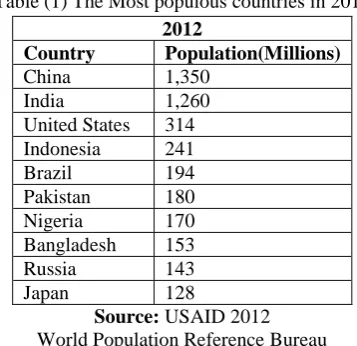
Table (1) The Most populous countries in 2012
2012
Country Population(Millions)
China 1,350 India 1,260 United States 314 Indonesia 241 Brazil 194 Pakistan 180 Nigeria 170 Bangladesh 153 Russia 143 Japan 128
Source: USAID 2012 World Population Reference Bureau
Table 2: The Most populous countries by 2050
2050
Country Population(Millions)
India 1,691 China 1,311 United States 423 Nigeria 402 Pakistan 314 Indonesia 309 Bangladesh 226 Brazil 213 Congo, Dem. Rep. 194 Ethiopia 166
Source: USAID 2012 World Population Reference Bureau
3. H
UMANA
CTIVITIESThe activities of humans play a role in the spread of zoonotic infectious diseases. Some of the human activities include the following:
3.1 Global Travel and tourism
A very important hall mark of the 21st century is the ability to travel around the world at a faster speed and within relatively shorter period of time compared to previous generations when travel was difficult and extremely time consuming. In medieval times man travelled from one location to another using such transport means as horses, donkeys, camels and mules or just trekked on foot. Such journeys could take many days and weeks to accomplish and so it took also a long time to be able to transport infection from one location to another and in fact many agents of such infections may not survive the harsh conditions of travel in some countries such as desert areas and many tropical countries with extreme heat. In modern times travel has been made extremely easy and it is possible for one man to go round the whole world in just a few days using air travel which is perhaps the commonest means of transport now. With increase ease of travel came increase frequency of travel and movement which has made the world become a “global village”. Unfortunately, this development has also made it much easier for infectious diseases to also move round the world rapidly with maximum ease [4,31,32]. Infectious diseases such as influenza can be moved easily from one location to another through travel [33,34] and infected air travelers are now a major source of transmission of infectious diseases worldwide as they travel [35,36]. For example, in a medical investigation 5 Japanese were found to be infected with Schistosomiasis which is not found in Japan but which they got after a trip to East Africa and 2 other Japanese travelers were infected with trichinellosis from a trip to Taiwan [37]. Many other infections such as leptospirosis, brucellosis, chikungunya have been found to be easily carried by infected individuals from one country to the other [38–41]. Similar reports are found around the world of such travel related diseases and already some nations are taking steps to control and prevent such travel related infections [42,43].
3.2 Desertification and deforestation
The process of removing trees without planting new ones to replace them by man destabilizes the ecosystem and exposes man to vectors and agents of infectious and non-infectious diseases such as Vitamin A deficiency that results from a destroyed natural environment [44].
3.3 Genetic engineering and other scientific research
Copyright © 2013 CTTS.IN, All right reserved curative drugs and new surgical procedures and the
development of vaccines to prevent certain infections, there is a growing fear of the misuse of this advancement in medical science for the development of potentially destructive pathogens by modification of their genes [45,46]. There is also the growing fear that some scientists may work in consonance with terrorists to make available bioweapons of terror [47,48].
3.4 Trade in exotic animals
With the spread of humanity all over the globe people want to modify their environment and bring with them certain animals they are used to in their previous environments. In order to achieve this, exotic animals are brought into countries non-native to them and forced to adapt. With the importation of exotic animals comes also the importation of exotic diseases many of which are zoonotic in nature and easily transmitted to man [49–51]. Sometimes humans enter into forests and jungles to dislodge wild animals for the gratification of man’s pleasure which leads to encounter with diseases that hitherto had been silently maintained in the sylvatic cycle but due to human interference some vectors may now be transmitted to man just like it was recently hypothesized concerning the medieval age plague [52].
3.5 Rapid urbanization
A rapid urbanization project which is a human activity at the detriment of the environment and economic empowerment in developing countries has led to the spread of diseases among the population. This is usually due to sanitation related factors as a result of people living in slums in many developing countries and the felling of trees to make room for gigantic buildings exposing people to vectors and pathogens of disease [53]. In developed economies and rapidly developing countries urbanization may lead to the so-called “diseases of affluence” such as hypertension and obesity [54]. The demographics of urban areas may favour rapid spread of infectious diseases [55].
3.6 War and conflicts
The unfortunate inevitable consequence of war and conflicts around the world is the displacement of people from their homes to places which were not initially made for human habitation such as jungles, make-shift refugee camps and other transient points which make humans more exposed to agents and vectors of disease in addition to disabilities and cases of poisoning by lethal chemicals of war [56,57]. There are many cases of rape during wars and conflicts which invariably are associated with transmission of HIV and other venereal diseases [58]. Such deleterious impacts upon humanity may last long even after the war is over causing untold hardships upon victims and the society. Another dimension of war is the use of disease agents as
weapons of war on human populations. This is known as biowarfare and bioterrorism when used by terrorists. Bioweapons have been used to fight enemies for centuries with devastating consequences resulting in the death of millions like in Europe between 1347 and 1352 about a third of Europe was wiped out by plague (Yersinia pestis) [59]. The Japanese used bioweapons of cholera, plague, typhoid and anthrax against opponents especially the Chinese during the Second World War resulting in the death of hundreds of thousands of people [60,61]. Another potent bioweapon is anthrax which caused a lot of scares some years back in the United States and some other nations around the world [47,48].
3.7 Poverty
Poverty is largely man-made due to unequal distribution of wealth and creation of classes among humans. Wars, conflicts, illiteracy, bad leadership and other hydra-headed factors may lead to poverty in many communities of people around the world [28]. Certain diseases like cholera are associated with endemic poverty in victims [62,63] and are usually largely a problem of the developing world.
4. C
ONCLUSIONWith the fast rate at which the world is undergoing industrialization and urbanization, demographics and human activities will continue to play a prominent role in the spread of many diseases in the world. Control and preventive measures must be put in place to ensure the survival of the human race and species upon the earth in the midst of many opposing factors mainly man-made. Medical science must continue to advance especially in the area of preventive medicine at a faster rate than the fast moving and evolving pathogens humanity has to contain with on a daily basis. Government policies properly implemented enforcing vaccinations, travel bans and quarantine of people especially travelers when infection is suspected may be helpful but is limited by challenges of implementation and breaching fundamental human rights of individuals. For best results in controlling and preventing diseases the one health concept and approach involving all medical, veterinary and allied professionals should be utilized because most diseases are zoonotic in nature and a holistic approach will be needed for effective combating of such infections.
5. R
EFERENCES[1] Olano JP, Walker DH. Agents of emerging infectious diseases. Biothreats and emerging infectious diseases, 2009, p. 1–20.
[2] Gomez-Lus R, Clavel A, Castillo J, Seral C, Rubio C. Emerging and reemerging pathogens. International Journal of Antimicrobial Agents 2000;16:335–9. [3] DaSilva E, Iaccarino M. Emerging diseases: a global
Copyright © 2013 CTTS.IN, All right reserved
[4] Alirol E, Getaz L, Stoll B, Chappuis F, Loutan L. Urbanisation and infectious diseases in a globalised world. The Lancet Infectious Diseases 2011;11:131–41. [5] Mangili A, Gendreau M a. Transmission of infectious
diseases during commercial air travel. Lancet 2005;365:989–96.
[6] Nelson JC, Jackson M, Yu O, Whitney CG, Bounds L, Bittner R, et al. Impact of the introduction of pneumococcal conjugate vaccine on rates of community acquired pneumonia in children and adults. Vaccine 2008;26:4947–54.
[7] Morse SS, Mazet J a K, Woolhouse M, Parrish CR, Carroll D, Karesh WB, et al. Prediction and prevention of the next pandemic zoonosis. Lancet 2012;380:1956– 65.
[8] Grijalva CG, Nuorti JP, Arbogast PG, Martin SW, Edwards KM, Griffin MR. Decline in pneumonia admissions after routine childhood immunisation with pneumococcal conjugate vaccine in the USA: a time-series analysis. Lancet 2007;369:1179–86.
[9] Hui EK-W. Reasons for the increase in emerging and re-emerging viral infectious diseases. Microbes and Infection / Institut Pasteur 2006;8:905–16.
[10] Weycker D, Sato R, Strutton D, Edelsberg J, Atwood M, Jackson L a. Public health and economic impact of 13-valent pneumococcal conjugate vaccine in US adults aged ≥50 years. Vaccine 2012;30:5437–44.
[11] Gurr S, Samalova M, Fisher M. The rise and rise of emerging infectious fungi challenges food security and ecosystem health. Fungal Biology Reviews 2011;25:181–8.
[12] Jeljaszewicz J. Editorial Emerging, Re-emerging and Drug-resistant Infections: A Global Threat. Zentralblatt Für Bakteriologie 1999;289:1–7.
[13] Shears P. Emerging and reemerging infections in africa: the need for improved laboratory services and disease surveillance. Microbes and Infection / Institut Pasteur 2000;2:489–95.
[14] Wilcox BA, Gubler DJ. Environmental change and new infectious diseases. The Environment Times 2013. [15] Sorci G, Cornet S, Faivre B. Immunity and the
emergence of virulent pathogens. Infection, Genetics and Evolution 2013;In Press, .
[16] Cheng J, Meziani MJ, Sun Y-P, Cheng SH. Poly(ethylene glycol)-conjugated multi-walled carbon nanotubes as an efficient drug carrier for overcoming multidrug resistance. Toxicology and Applied Pharmacology 2011;250:184–93.
[17] Enserink M. Malaysian researchers trace Nipah virus outbreak to bats. Science 2000;289:518–9.
[18] Patz JA, Olson SH, Uejio CK, Gibbs HK. Disease Emergence from Global Climate and Land Use Change. Medical Clinics of North America 2008;92:1473–91. [19] Khasnis A a, Nettleman MD. Global warming and
infectious disease. Archives of Medical Research 2005;36:689–96.
[20] Chang MS, Hii J, Buttner P, Mansoor F. Changes in abundance and behaviour of vector mosquitoes induced by land use during the development of an oil palm plantation in Sarawak. Transactions of the Royal Society of Tropical Medicine and Hygiene 1997;91:382–6.
[21] Schroeder E, Wuertz S. Bacteria. The handbook of water and waste water microbiology, Elsevier; 2003, p. 57–68.
[22] Ashbolt NJ. Microbial contamination of drinking water and disease outcomes in developing regions. Toxicology 2004;198:229–38.
[23] Ligon BL. Infectious diseases that pose specific challenges after natural disasters: a review. Seminars in Pediatric Infectious Diseases 2006;17:36–45.
[24] Velji A. Editorial: Transforming Global Health, Global Health Education, Infectious Disease, and Chronic Conditions in the 21st Century. Infectious Disease Clinics of North America 2011;25:485–98.
[25] Cook R, Karesh W. Emerging diseases at the interface of people, domestic animals, and wildlife. Zoo and wild animal medicine current therapy. 6th edition, Elsevier Inc.; 2008, p. 55–67.
[26] Petroni S. Seven billion and 31 gigatons. Contraception 2012;85:523–6.
[27] Lancet T. A world of 7 billion people. Lancet 2011;378:1527.
[28] Alsan MM, Westerhaus M, Herce M, Nakashima K, Farmer PE. Poverty, Global Health, and Infectious Disease: Lessons from Haiti and Rwanda. Infectious Disease Clinics of North America 2011;25:611–22. [29] Hasnain SE, Friedrich B, Mettenleiter T, Dobrindt U,
Hacker J. Climate change and infectious diseases--impact of global warming and climate change on infectious diseases: myth or reality? International Journal of Medical Microbiology : IJMM 2012;302:1– 3.
[30] Boender GJ, Meester R, Gies E, De Jong MCM. The local threshold for geographical spread of infectious diseases between farms. Preventive Veterinary Medicine 2007;82:90–101.
[31] Fricker M, Steffen R. Travel and public health. Journal of Infection and Public Health 2008;1:72–7.
[32] Hwang GM, Mahoney PJ, James JH, Lin GC, Berro AD, Keybl M a, et al. A model-based tool to predict the propagation of infectious disease via airports. Travel Medicine and Infectious Disease 2012;10:32–42. [33] Liao Y-J, Tsai C-P, Cheng M-C, Kao C-L, Cox N, King
C-C. Human influenza surveillance in areas with animal flu epidemics and China visitors in Taiwan. International Congress Series 2004;1263:402–6. [34] Perz JF, Craig a S, Schaffner W. Mixed outbreak of
parainfluenza type 1 and influenza B associated with tourism and air travel. International Journal of Infectious Diseases : IJID : Official Publication of the International Society for Infectious Diseases 2001;5:189–91.
[35] Chen LH, Wilson ME. The Role of the Traveler in Emerging Infections and Magnitude of Travel. Medical Clinics of North America 2008;92:1409–32.
[36] Budd L, Brown T. Of plagues, planes and politics: Controlling the global spread of infectious diseases by air. Political Geography 2009;28:426–35.
[37] Maeda T, Kawana A. Exotic imported travel-related infections in Japan. Travel Medicine and Infectious Disease 2011;9:106–8.
Copyright © 2013 CTTS.IN, All right reserved
[39] Pistone T, Ezzedine K, Schuffenecker I, Receveur M-C, Malvy D. An imported case of Chikungunya fever from Madagascar: use of the sentinel traveller for detecting emerging arboviral infections in tropical and European countries. Travel Medicine and Infectious Disease 2009;7:52–4.
[40] Memish ZA, Balkhy HH. Brucellosis and international travel. Journal of Travel Medicine 2004;11:49–55. [41] Di Pierdomenico ABs, Borgia SMsMD, Richardson
DM, Baqi MM. Brucellosis in a returned traveller. Canadian Medical Association Journal 2011;183:E690. [42] Leggat P A. Travel medicine: an Australian perspective.
Travel Medicine and Infectious Disease 2005;3:67–75. [43] Harrus S, Baneth G. Drivers for the emergence and
re-emergence of vector-borne protozoal and bacterial diseases. International Journal for Parasitology 2005;35:1309–18.
[44] Were MK. Ecological upheavals with special reference to desertification and predicting health impact. Social Science and Medicine 1989;29:357–67.
[45] Valk D. Genetic engineering. Biodiversity 2013. [46] Genetic Engineering. Britannica 2013.
[47] Laden O. Washington US anthrax scares prompt action on bioterrorism. The Lancet 2001;358:1435.
[48] Larkin M. US response to anthrax scare “ uncoordinated ” New combination drug to treat malaria. The Lancet Infectious Diseases 2005;5:267.
[49] Souza MJ. Bacterial and parasitic zoonoses of exotic pets. The Veterinary Clinics of North America Exotic Animal Practice 2009;12:401–15.
[50] Hernández-Jover M, Roche S, Ward MP. The human and animal health impacts of introduction and spread of an exotic strain of West Nile virus in Australia. Preventive Veterinary Medicine 2012;109:186–204. [51] Bamaiyi PH, Umoh JU, Abdu PA, Idris A. The
Prevalence of Cryptosporidium Oocysts in Birds in Zaria , Nigeria. Borneo Journal of Resource Science and Technology 2013;2:52–9.
[52] Hufthammer AK, Walløe L. Rats cannot have been intermediate hosts for Yersinia pestis during medieval plague epidemics in Northern Europe. Journal of Archaeological Science 2013;40:1752–9.
[53] Wang’ombe JK. Public health crises of cities in developing countries. Social Science and Medicine 1995;41:857–62.
[54] Van de Poel E, O’Donnell O, Van Doorslaer E. Urbanization and the spread of diseases of affluence in China. Economics and Human Biology 2009;7:200–16. [55] Zhang P, Atkinson PM. Modelling the effect of
urbanization on the transmission of an infectious disease. Mathematical Biosciences 2008;211:166–85. [56] Weinberg J, Simmonds S. Public health, epidemiology
and war. Social Science and Medicine 1995;40:1663–9. [57] Ghobarah HA, Huth P, Russett B. The post-war public
health effects of civil conflict. Social Science & Medicine (1982) 2004;59:869–84.
[58] Mukwege DM, Mohamed-Ahmed O, Fitchett JR. Rape as a strategy of war in the Democratic Republic of the Congo. International Health 2010;2:163–4.
[59] Zietz BP, Dunkelberg H. The history of the plague and the research on the causative agent Yersinia pestis. International Journal of Hygiene and Environmental Health 2004;207:165–78.
[60] Hilleman MR. Overview: cause and prevention in biowarfare and bioterrorism. Vaccine 2002;20:3055–67. [61] Artenstein AW, Martin T. Bioterrorism. The social ecology of infectious diseases, vol. 1945, 2008, p. 316– 50.
[62] Gaffga NH, Tauxe R V, Mintz ED. Cholera: a new homeland in Africa? The American Journal of Tropical Medicine and Hygiene 2007;77:705–13.