Editorial
Knowledge Mobilization in Canadian Educational Research: Identifying Current Developments and Future Directions
Snežana Ratković, Dolana Mogadime, and Terry Spencer p. 1
Articles
A Tool to Assess and Compare Knowledge Mobilization Efforts of Faculties of Education, Research Brokering Organizations, Ministries of Education, and School Districts
Amanda Cooper p. 5
Finding the Sweet Spot: Network Structures and Processes for Increased Knowledge Mobilization
Patricia Briscoe, Katina Pollock, Carol Campbell, and Shasta Carr-Harris p. 19
Research Use in Education: An Online Survey of School Practitioners
Larysa V. Lysenko, Philip C. Abrami, Robert M. Bernard, and Christian Dagenais p. 35
Exploring the Benefits of a Collaborative Inquiry Team in Education (CITE) Initiative to Develop a Research Community and Enhance Student Engagement
Maria Cantalini-Williams, Debra Curtis, Kimberley Eden-DeGasperis, Lauren Esposto,
Jenny Guibert, Heather Papp, and Carlos Roque p. 55
Collaborative Teacher Inquiry Into iPad Use in Grade 3 Classrooms: Mobilizing Knowledge Through a Long-term School-University Partnership
Ruth McQuirter Scott, Donna Dortmans, Cathy Rath, Nancy Meeussen, and Jennifer
Boin p. 73
Book Review
Knowledge Mobilization and Educational Research: Politics, Languages, and Responsibilities
Ghazala Ahmed p. 91
Editorial
Knowledge Mobilization in Canadian Educational
Research: Identifying Current Developments and Future Directions
Snežana Ratković
Special Issue Guest Editor Brock UniversityDolana Mogadime
Brock Education Editor Brock UniversityTerry Spencer
Special Issue Guest Editor
London District Catholic School Board
In an era of evidence-based praxis across disciplines and societies, knowledge mobilization has become a buzzword. This buzzword, however, remains elusive and ambiguous. The term knowledge mobilization (KMb) emerged in the late 1990s in the field of education. Since then, scholars have used numerous terms to describe research-to-practice driven activities, including dissemination, knowledge exchange, knowledge transfer, knowledge translation, knowledge utilization, and knowledge mobilization (Skinner, 2007).
In 2006, the Ontario Ministry of Education (OME) has launched the Ontario Education Research Symposium (OERS), an annual 3-day event at which “researchers, educators, and policy makers build networks and partnerships, gain insights into existing education research, identify gaps for future research, and share approaches for connecting research to practice” (OME, 2016). Building on the progress of the previous symposia, the 2016 Networking & Partnerships: The Core of Achieving Excellence in Education symposium focused on researcher-practitioner collaborations toward an accessible, integrated, and responsive education system.
Since 2006, Social Sciences and Humanities Research Council of Canada (SSHRC) has been committed to: (a) mobilizing research knowledge among researchers, and between researchers and practitioners; (b) facilitating the development of partnerships between researchers and practitioners; and (c) assisting researchers and practitioners in developing networks, tools and best practices through KMb (Kishchuk, 2013). As a result, SSHRC launched Knowledge Synthesis and Connection programs, and participated in the development of a Tri-Agency Open Access Policy on Publications to improve access to the results of Agency-funded research. According to SSHRC (2015), KMb is “the reciprocal and complementary flow and uptake of research knowledge between researchers, knowledge brokers and knowledge users—both within and beyond academia” (para. 15).
partnerships committed to fostering school-university relationships and improving classroom practice (Martinovic et al., 2012). Since 2008, SURE has focused on developing and sustaining an active collaborative relationship among universities and school districts in the London Region to inspire a culture of inquiry, advance research skills, and promote knowledge exchange related to education research. The SURE researchers received a SSHRC Public Outreach Grant: Dissemination and a Knowledge Network for Applied Education Research (KNAER) grant to enhance knowledge mobilization in Ontario.
Building upon the success of Canadian Society for the Study of Education (CSSE) KMb Days at CSSE 2012 (Wilfrid Laurier University and University of Waterloo) and CSSE 2013 (University of Victoria), the SURE collaborated with the CSSE 2014 conference organizing committee to facilitate another engaging KMb Day in May 2014 at Brock University (See https://csse2014kmday.wordpress.com/). The 2014 KMb event was sponsored by the SURE Steering Committee, the MISA PNC for the London Region, the Ontario Association of Deans of Education, and the Faculty of Education, Brock University. This special issue of Brock Education is an outcome of this KMb event. Expanding the KMb discourses initiated by OME, SSHRC, KNAER, CSSE, and SURE, we feature five journal articles and a book review addressing the following questions: How to assess KMb efforts across educational systems? To what extent do educators use research to inform their praxis? How to make KMb work?
Provincial, National, and International KMb Developments
Cooper’s article, “A Tool to Assess and Compare Knowledge Mobilization Efforts of Faculties of Education, Research Brokering Organizations, Ministries of Education, and School Districts,” discusses the national and international trends that have contributed toward conceptualizing knowledge mobilization as a field of study. Her work answers important questions such as what are the push and pull factors that inform knowledge mobilization research and inquiry. The article is informative because it builds on the work of researchers focused on the study of knowledge mobilization and practical because it provides insight for researchers, networks, and knowledge brokers searching for a measuring tool to assess their knowledge mobilization efforts across organizations. Cooper reports that “The need to develop tools to measure research use as well as KMb efforts and processes is commonly discussed across sectors,” and her KMb matrix tool fills this gap in the literature.
In their article, “Finding the Sweet Spot: Network Structures and Processes for Increased Knowledge Mobilization,” Briscoe, Pollock, Campbell, and Carr-Harris report on the KMb practices of 44 KNAER-funded projects that have mobilized research-based evidence across Ontario. The authors discuss the role of the network structures, processes, and structure-process alignments in building KMb networks’ capacity for increasing research use and improving student learning. The most successful KMb networks in this study were those networks that were able to strategically align their network structures and processes, and find a “sweet spot.” The authors offer insights into the complexities of KMb networks’ practices and guidelines for developing KMb capacity across provincial, national, and international networks.
number of challenges confronting educators when using research knowledge. The authors advance a number of recommendations for universities, school boards, and knowledge mobilization agents to undertake in order to increase research evidence use by educators. The paper represents an extension of a previous quantitative study (Lysenko et al., 2014), but is enhanced by an analysis of qualitative data provided by teachers, school administrators, and professional staff.
Why School-University Partnerships Work
The article, “Exploring the Benefits of a Collaborative Inquiry Team in Education (CITE) Initiative to Develop a Research Community and Enhance Student Engagement,” scrutinizes a collaborative inquiry process, facilitated by university faculty in an elementary school in Ontario. Cantalini-Williams et al. collected and analyzed self-study data over a 5-month period and found that “the collaborative inquiry process with enablers of time, flexibility, and support from university faculty increased research acumen among the participants and subsequently increased student engagement.” The CITE team “named, framed, and proclaimed” applied educational research, utilized and discussed effective KMb strategies, documented enhanced teacher and student engagement and learning, and provided a set of KMb strategies for teachers, school administrators, and university researchers.
McQuirter Scott, Dortmans, Rath, Meeussen, and Boin reported on a case study based on a long-term school-university partnership exploring iPad use in Grade 3 classrooms. This partnership resulted in an exchange of iPad implementation strategies among participants. Moreover, teachers enhanced their leadership skills while university researchers experienced a high degree of learning about digital pedagogy, and shared the lessons learned with their Pre-service Education classes. The authors argue for flexible, trusting, and long-term school-university partnerships and acknowledge the role of such partnerships in bridging “the current gap between theory and practice in technology-enhanced learning.”
Future Directions
Ghazala Ahmed concludes this special issue on knowledge mobilization in and for education with her review of the Fenwick and Farell’s (2012) edited book entitled KnowledgeMobilizationand EducationalResearch:Politics,Languages,andResponsibilities.Ahmeddescribesthisbookas a critical review of knowledge mobilization and an informative collection of works originating from diverse provincial, national, and international educational contexts. According to Ahmed, the book provides “accounts grounded in empirical studies, real events, and existing organizations,” scrutinizes knowledge mobilization activities and outcomes, and urges scholars and educators to further explore the role of KMb in educational research, policy, and practice.
Baumfield, V., & Butterworth, M. (2007). Creating and translating knowledge about teaching and learning in collaborative school-university research partnerships: An analysis of what is exchanged across the partnerships, by whom and how. Teachers and Teaching, 13(4), 411-427.
Cooper, A. (2012). Knowledge mobilization in education: A cross-case analysis of 44 research brokering organizations across Canada. Available at
http://www.amandacooper.ca/uploads/RBOs_Across_Canada_AMC_FINAL.docx Dewey, J. (1929). Experience and nature, New York, NY: Dover.
Fenwick, T. J., & Farrell, L. (2012). Knowledge mobilization: politics, languages, and responsibilities. New York, NY: Routledge.
Kishchuk, N. (2013). Evaluation of SSHRC’s knowledge mobilization: Final report. Sciencies and Humanities research Council of Canada.
Lysenko, L., Abrami, P., Bernard, R., Dagenais, C., & Janosz, M. (2014). Educational research in educational practice: Predictors of use. Canadian Journal of Education. 37(2).
Retrieved from http://www.cje-rce.ca/index.php/cje-rce/article/view/1477
Martinovic, D., Wiebe, N., Ratković, S., Willard-Holt, C., Spencer, T., & Cantalini-Williams, M. (2012). “Doing research was inspiring”: Building a research community with teachers. Educational Action Research, 20(3), 385-406.
Ontario Ministry of Education (2016). Research in education: Ontario Education Research Symposia. Retrieved from http://www.edu.gov.on.ca/eng/research/
Ratković, S., Spencer, T., & Mogadime, D. (May 25, 2014). Knowledge Mobilization Day CSSE 2014; Partnering for education: Benefits, challenges, and opportunities. Knowledge Mobilization Event, Brock University, St. Catharines, ON. Accessible at
https://csse2014kmday.wordpress.com/
Skinner, K. (2007). Developing a tool to measure knowledge mobilization exchange outcomes. The Canadian Journal of Program Evaluation, 22 (1), 49-73.
A Tool to Assess and Compare Knowledge Mobilization Efforts of
Faculties of Education, Research Brokering Organizations,
Ministries of Education, and School Districts
Amanda Cooper
Queen’s University
Abstract
There are few tools that exist to measure knowledge mobilization (KMb), the process of connecting research to policy and practice across diverse organizations and sectors. This article reports on a comparison of KMb efforts of 105 educational organizations: faculties of education (N = 21), research brokering organizations (N = 44), school districts (N = 14), and ministries of education (N = 26). This study used a tool that analyzed KMb efforts along two dimensions—research
dissemination strategies (e.g., products, events, and networks) and research use indicators (e.g., different types of strategies, ease of use, accessibility, collaboration, and mission)—using data
available on organizational websites. Findings show that research brokering organizations and faculties of education are producing stronger knowledge mobilization efforts than school districts and ministries of education; however, even faculties and research brokering organizations often have modest efforts. Most KMb efforts are product based, with network strategies usually being the weakest KMb strategy utilized.
Keywords: research use; K-12 education; knowledge mobilization
Amanda Cooper is an Assistant Professor of Educational Policy and Leadership in the Faculty of Education at Queen’s University in Kingston, Ontario. She is the Principal Investigator of RIPPLE - Research Informing Policy, Practice and Leadership in Education (www.ripplenetwork.ca) - a program of research, training, and knowledge mobilization aimed at learning more about how knowledge brokering can increase research use and its impact in public service sectors by leveraging multi-stakeholder collaboration.
Context: A Global Call for Evidence-based Policy and Practice
There is a global call to improve the integration of research evidence in policy and practice in public service sectors (Nutley, Walter, & Davis, 2007), efforts called knowledge mobilization (KMb) in education in Canada. The expectations around the use of research have changed markedly in recent years for all stakeholders. Policymakers in government are being pressured by the public to engage in evidence-based decision making and to be transparent about what sources of evidence inform their decisions (Burns & Schuller, 2007). Researchers are expected to increase the use and impact of their work, and practitioners are under pressure to use research evidence and data to inform their daily professional work. Funders all over the world are also beginning to require researchers to include KMb plans and summarize the potential impact of their work (Tetroe et al., 2008). Practitioners in school districts, including educational leaders and teachers, are also being pressured to increase data use at virtually all levels (Brown, 2015; Finnigan & Daly, 2014). Research brokering organizations (RBOs) (e.g., intermediary, third party organizations that connect researchers, policymakers, and practitioners) have arisen to help address these gaps between research, policy, practice, and impact (Coburn & Stein, 2010; Cooper, 2014a). I define RBOs in relation to two characteristics: 1) Target audience: RBOs connect research producers and research users (hence organizations that connect researchers to researchers only or practitioners to practitioners only are not RBOs by my definition); and 2) Mission statement: RBOs have explicit mission statements and/or mandates in relation to data use, research use and/or knowledge mobilization. While many organizations are involved in research brokering as one part of their organizational activities, RBOs primary function is connecting research producers and users in a particular area to increase KMb. My previous work has developed a typology of RBOs that exist across Canada differentiated by funding sources and location in the system (for further description and examples of RBOs, please see Cooper, 2013); major categories of RBOs include governmental RBOs, For-profit RBOs, Not-for profit RBOs, and Membership RBOs (where members of a
network actually fund the organization such as teachers’ unions). Meyer (2010) describes the role of knowledge or research brokers in relation to building connections between researchers and different potential target audiences:
Brokering involves a range of different practices: the identification and localization of knowledge, the redistribution and dissemination of knowledge, and the rescaling and transformation of this knowledge. Brokering knowledge thus means far more than simply moving knowledge – it also means transforming knowledge…knowledge brokering is
likely to look very different in the various brokering spaces…not least because the needs
and expectations of the knowledge users might differ substantially. (p. 120)
Despite these new expectations for policymakers, researchers, practitioners, and research brokering organizations, very little is known about the levels of KMb efforts occurring across the education system (e.g., who is engaging in KMb efforts and what kinds of KMb activities are occurring for what audiences). For example:
The scant literature that does exist indicates low levels of KMb efforts from universities (Sá, Li, & Faubert, 2011; Wilson, Petticrew, Calnan, & Nazareth, 2010);
7
There are low levels of research use and uptake in practice environments (Cooper & Levin, 2013; Cordingley, 2008); and
There are some empirical studies suggesting that intermediary research brokering agencies can improve and facilitate research use across research, practice, and policy organizations (Coburn & Stein, 2010; Cooper, 2014a).
Given these limitations it is also important to note that, until recently, there was no tool to measure KMb activities across different kinds of organizations and sectors (Qi & Levin, 2013). In this study, I apply the tool created by Qi and Levin (2013) to evaluate KMb efforts of 105 educational organizations in order to answer the following research question: How do the KMb efforts of faculties of education, ministries of education, research brokering organizations, and school districts in Canada compare?
Conceptualizing KMb From a Whole System Perspective
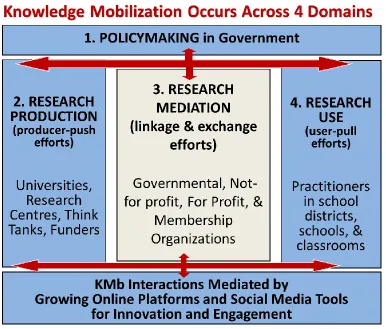
This study conceptualizes KMb as systemic efforts to increase research use in policy and practice, and involves many different kinds of organizations involved in the education sector. This whole-system perspective (Figure 1) includes policymaking, research production, research mediation, and research use, all of which are increasingly mediated by websites, online
platforms, and social media tools being utilized for innovation and engagement.
This model entitled “Knowledge Mobilization from a Whole-System Perspective” (KMb/
WSP) is adapted from Levin (2004); however, it separates the policymaking context from the practitioner context to address the very different purposes, types of work, and time frames for decision making of these two distinct groups, which often require different types of training and information that cater to their specific needs. Additionally, the conceptualization of KMb, which informs this study, acknowledges the changing nature of KMb efforts as they are increasingly mediated through online platforms such as websites and online communities as well as through social media outlets such as Twitter and Facebook (See Cooper 2014b for data on how RBOs are engaging with online dissemination and social media). My conceptualization of KMb in Figure 1 integrates Lavis et al.’s (2006) research utilization models with Levin’s (2004) model, articulating the research production domain as “producer-push efforts,” the research use domain as “user-pull
efforts,” and the research mediation domain as “linkage and exchange efforts.”
Justifying the Use of the KMb Matrix Tool
Before providing an overview of the tool created by Qi and Levin (2013), I would like to present my justification for selecting this tool. I think the major potential critique of this study might be problematizing the use of website data to assess KMb efforts rather than a different methodology (e.g., in-depth case studies of educational organizations). First, I was interested in assessing the KMb efforts of a hundred organizations and case study work was not a feasible methodology due to the size of the sample. Similarly, one of the strengths of this tool is that it can be used to compare a wide range of diverse organizations across sectors, countries, and types of organizations. Scores arising from this tool have since been used to sample top performing organizations in relation to KMb for in-depth case studies, another use for the tool. To use this tool on a smaller subset of organizations, I argue that this tool should be utilized in conjunction with deeper qualitative methodology (such as case studies) in order to provide a comprehensive view of organizational KMb efforts. These choices, of course, depend on the goals of the research—and the goal of this study was to provide a broad overview of how a large number of organizations in the education sector compare in relation to KMb efforts, rather than provide a more thorough exploration of a few organizations. Second, in the current societal context websites are often a primary vehicle to promote organizational activities. Duffy (2000) notes: “the advantages of the medium over
traditional communication formats in terms of flexibility, speed and reach make it an obvious route for research dissemination” (p.349). The recent demand to improve knowledge mobilization across
public service sectors has been accompanied by an increased use of websites and various other technologies to facilitate dissemination efforts (Chavkin & Chavkin, 2008). As a result, organizational websites have the potential to provide important insights in knowledge mobilization processes occurring across sectors. In addition to this fact, organizational websites often contain information that approximates face-to-face interactions. For instance, events listed on websites often have information about the types of stakeholders attending the event and the content of the event among other details. Similarly, websites often include information about networks of people working together on various projects or initiatives.
9 SSHRC defines research and related tools as vehicles that broadly facilitate research and related activities. Social science and humanities tools enable researchers to collect, organize, analyze, visualize, mobilize and store quantitative and qualitative data and creative outputs. Tools can be created as part of a research or related undertaking, or purchased off the shelf. (SSHRC, 2014)
This tool was created empirically from the evaluation of hundreds of different websites, prior to its application to the 105 I used in this study (for an overview of the first phase of the tool’s
development, please see Sá, Faubert, Edelstein, & Qi, 2012). The other strength of the tool is that it provides a systematic approach—strategy by strategy and element by element—to look at diverse organizations in a uniform way. While many organizations might be engaged in activities not posted on their websites or have activities on their websites that they no longer engage in, I still argue that when attempting to assess a hundred diverse organizations in the area of KMb where little is known, this study and the use of this tool (while imperfect) still make an important contribution to understanding the relative efforts occurring across the system by universities, ministries, RBOs, and school districts. In summary, I believe the benefits of the tool outweigh the potential limitations of its use. Potential uses for the tool include the following:
Specific organizations can use the tool to assess their KMb efforts in a systematic way across categories that the literature suggests increase research use and impact.
Diverse organizations across a sector or between sectors can use the tool to draw comparisons between KMb efforts. This is important because we currently do not know what levels of KMb are occurring across the system (e.g., in universities, in ministries, by RBOs, or in school districts), and identifying the relative intensity of these efforts at different parts of the system can inform system-wide improvement initiatives (e.g., low levels of KMb in particular areas represent opportunities to ramp up efforts in a particular area).
This tool provides baseline data on the types of KMb efforts led by different types of organizations; hence, organizations can use this data to benchmark their efforts.
High scores in particular areas of the tool provide exemplary examples and a systematic way to choose cases for further research. For instance, organizations with high network ratings could provide case studies of exemplary practices that others could try to increase their impact in this area.
An Overview of Qi and Levin’s KMb Matrix Tool
Research Dissemination Strategies
Resea
rch Use
Ind
ica
tors
Products Events Networks Balance,
Accessibility TOTAL POINTS Different
Types 3 points 6 points 6 points 5 points /20 points Ease of Use 2 points 6 points 2 points 4 points /14
points Accessibility 3 points 6 points 4 points 3 points /16
points Audience
Focus 4 points 2 points 4 points N/A /10 points Collaborative,
Mission N/A N/A 4 points 8 points /12 points TOTAL
POINTS /12 /20 /20 /20 /72 /72
Figure 2. KMb matrix tool to evaluate KMb efforts using data from organizational websites (Adapted from Qi & Levin, 2013).
Method
This study compares the KMb efforts of four types of organizations involved in the public education system: faculties of education (N = 21) where research is produced, ministries of education (N = 26) where decisions about K-12 education are made, school districts (N = 14) where educational research is applied, and RBOs (N = 44) where the adaptation and translation of academic research for practical use are facilitated. Data was collected using the KMb tool from each organizational website. Data Analysis included descriptive statistics (e.g., frequencies, percent scores, means, and standard deviation), Cronbach’s α, and independent-samples
Kruskal-Wallis tests (pairwise comparisons were conducted where results were significant), using SPSS. Reliability testing was conducted using Cronbach’s α to determine whether each of the
KMb indicator totals (e.g., types of strategies, ease of use, accessibility, audience focus, and other extra indicators) could be reliably aggregated as an overall indicator of KMb efforts. Cronbach’s
αresults range from 0 (no reliability) to 1 (high reliability). The statistical literature indicates that a value of 0.7–0.8 is an acceptable value for Chronbach’s α (Field, 2005). Cronbach’s α was calculated for the KMb indicators at .862; therefore, the five variable totals can be reliably combined into a KMb indicator total. The same reliability testing was conducted for KMb strategies (e.g., products, events, networks, and other strategies). Cronbach’s α for KMb strategies
11 Findings: Comparing KMb Efforts Across the System
This section reports on a comparison of KMb efforts of 105 educational organizations: faculties of education (N = 21), research brokering organizations (N = 44), school districts (N = 14), and ministries of education (N = 26). Across all organizations, the average score on the KMb matrix was 42%. Disaggregated by type of organization, research brokering organizations had the highest average score (M = 56.0%), followed by faculties of education (M =54.3 %), school districts (M = 30.4%), and ministries (M = 27.8%). Ministries are the most variable (SD = 13.2), followed by RBOs (SD = 12.3) and school districts (SD = 10.1), with universities having the lowest variability (SD = 6.6). An independent-samples Kruskal-Wallis test was conducted to evaluate differences among the four types of organizations—RBOs, faculties of education, school districts, and
ministries—on KMb efforts. Non-parametric statistical tests were conducted because the data from
the website tool are ordinal and not normally distributed. The test, which corrected for tied ranks,
was significant, χ2 (3, N = 105) = 42.31, (p <.001); therefore, there are significant differences in KMb efforts among diverse kinds of organizations. Kruskal-Wallis tests do not analyze which groups are different, but only that differences exist; therefore, follow-up tests were conducted to evaluate pairwise differences among the four types of organizations. RBOs and faculties of education perform similarly; school districts and ministries perform similarly; and there are significant differences between these two groups, with RBOs and faculties of education having stronger KMb efforts. Although they provide information about significance, these tests do not calculate effect size. As a result, descriptive statistics and raw scores were used in Figure 3 to show the magnitude of the differences.
Figure 3. Comparison of KMb efforts of RBOs, faculties of education, school districts, and ministries of education.
0 10 20 30 40 50 60 70 80 90 100 Typ es Ease of Use Acc essib ilit y Ta rge t A u d ien ce Ext ra Ind ic at or s Pro d u ct s Eve nts N et w o rks Ex tra St rat e gie s TOTA L INDICATORS STRATEGIES
Mean
(%)
KMb
Matrix
Categories
Intermediary RBOs (N=44)
Faculties of Education (N=21) School Districts (N=14)
RBOs and faculties of education perform similarly and score highest on KMb efforts while school districts and ministries perform similarly, scoring lower on KMb efforts; however, there are modest levels of KMb across organizations. With the exception of faculties of education, which scored best on the KMb events strategy, all of the organizations fared best at products followed by events; networks being the weakest of the KMb efforts. Scores on products and events were often much higher than scores on networks (twice as high in ministries of education, seven times higher in school districts, and one-and-a-half times higher in faculties of education). Faculties of education had the highest score on KMb events, with many research events, talks, and lectures listed on their websites. It is a common misconception that academic events, which allow researchers to push out their work by simply telling people about their research, will increase research use. The literature, however, suggests that much more active and interactive forms of research exchange are necessary if research is to be incorporated into daily practice by teachers and policymakers in a meaningful way (Nutley et al., 2007).
All four kinds of organizations scored the lowest on utilizing networks as a KMb strategy (although faculties and RBOs did better than school districts and ministries). Network strategies were assessed in relation to the diversity of existing network types and the frequency of activity and interaction within each network were assessed. Organizations that had a high score in this category circulated research-related e-bulletins to their networks, an example of a “producer push”
strategy. RBOs score highest on network activities and interactions, with scores on average almost 10% higher than faculties of education. RBOs often had diverse membership composition and range of various stakeholders. In most cases, the primary role of RBOs was networking among diverse organizations and groups. Very few organizations, including RBOs, had features on their websites that would allow two-way communication (exceptions to this are found in some RBOs: Canada Education Association, Research Impact from York University, People for Education, and The Learning Partnership). Even where interactive features were available on websites, there were usually low levels of actual activity (the only exception to this was People for Education, which included an active online forum and network of parents across the province).
Another area where faculties of education, school districts, and ministries fared poorly was in the collaborative category, which contained ratings for the collaborative nature of the network and also evaluated the mission statement of these organizations in relation to KMb. One area where school districts scored more closely to faculties of education and RBOs—and better than
ministries—was audience focus for their KMb products, events, and networks. School districts
often had resources tailored for teachers, students, and parents. This may be due to the increased emphasis on differentiated instruction and meeting the needs of diverse populations in education, which may have contributed to targeting their KMb efforts to the specific needs of different stakeholder groups.
13 Figure 4. Histogram of total scores on KMb efforts by organizational type.
Seventy-six percent of the organizations (80/105) scored less than 60% on the evaluative matrix. RBOs tended to score highest on the matrix, with 20 out of the 25 top organizations being RBOs.
Discussion and Implications
Research producers (faculties of education) and RBOs tend to be more engaged in KMb efforts than research users (ministries and school districts). Findings from this study suggest low levels of KMb efforts in school districts and ministries. The efforts of faculties of education and RBOs are moderate, with some organizations being extensively engaged in these efforts. Of the 13 organizations out of 105 that scored between 70% and 90% on their KMb efforts, 12 (92%) were RBOs; so, the top-performing organizations in terms of KMb efforts are RBOs. A potential explanation for this trend has to do with the priorities and focus of the different kinds of organizations. The primary focus of faculties of education is research; as a result, research and its dissemination is an important part of how universities function. Increasing the profile of research in society is important for faculties because it galvanizes the government funding and societal support necessary to keep operating. Given this reality, it is surprising that faculties of education still only score moderately on KMb efforts because research and its importance have perhaps been longer on their radar than on the radars of other kinds of organizations. It is difficult on most university websites even to ascertain what research is being done by whom (Sá et al., 2011), let alone what the implications of that research might be for sector stakeholders that might apply that knowledge.
Organizations such as ministries and school districts have not articulated their research priorities until recently; hence, their low levels of KMb efforts are not surprising and are consistent with the literature (Cooper & Levin, 2010; Nutley et al., 2007). These kinds of would-be user
0 10 20 30
0 to 9 10 to 19 20 to 29 30 to 39 40 to 49 50 to 59 60 to 69 70 to 79 80 to 89 90 to 100 Frequency (Number of Organizations)
Sc
or
e
on
KM
b
M
atr
ix
(%
)
Total
Scores
on
KMb
Efforts
by
Type
of
Organization
organizations focus on teaching, learning, and student outcomes. Only in the past few decades has the discussion about how to improve public services begun to revolve around evidence-informed decision making to support policies and practice. Despite the growing awareness of the need for research to better inform service delivery in the health and education sectors, these linkages are still far from explicit. This is true for a multitude of reasons: a lack of understanding of how to build these linkages, a lack of skills and capacity to do KMb work at the practitioner level (although this should not be construed as a lack of competence, intelligence, or willingness to do so on the part of frontline practitioners), and a lack of organizational and system-level processes to facilitate systematic KMb efforts across a large number of organizations and professionals.
RBOs focus explicitly on efforts to connect research to practice, so it is not surprising that the majority of the top-performing organizations in KMb are these organizations that have explicit mandates in relation to connecting research producers to research users. Strategies used by RBOs are not always consistent with the growing evidence on effective KMb strategies; often, passive strategies are being utilized such as creating and posting research summaries online rather than investing in long-term substantive network efforts. Explanations for this might include the cost and resources required to build and sustain networks rather than the one time investment of creating a product or hosting an event. Although there might not be extensive empirical evidence on KMb, what does exist is largely ignored, as shown by the focus on passive strategies such as posting research-based products on websites rather than investing in multi-stakeholder network strategies. Studies have shown fairly clearly since the 1960s that passive strategies are not effective and that when the content is focused and relevant, events and networks are more powerful change mechanisms; however, in the new age of Internet communication, organizations tend to spend most of their time creating research products and posting them online—a passive strategy that is
unlikely to increase uptake (for some data on the uptake of online research, please see Edelstein, Shah, & Levin, 2012).
15 The ultimate aim of the tool is to provide data to guide more focused investigations of the various partnerships, events, and products uncovered by the application of the KMb matrix to further investigate how these KMb strategies influence research use in education. The descriptive comments in the matrix, in conjunction with the quantitative assessment, provide organizations with ideas for how they might improve their communication of research using their website. Also, this study yields some examples of organizations doing well in various areas. The tool can be used to learn from organizations that score high in areas—for instance, exploring the organizations that score the best in the networks strategy might yield ideas and resources for other institutions to utilize in their KMb efforts.
This approach, as a way of mapping and comparing activity across a number of organizations, could be a first research phase in a variety of contexts, including schools, districts, ministries, and faculties of education. Using a website analysis for initial data collection provides the data necessary to construct detailed organizational profiles that can guide the development of more focused survey and interview instruments. This approach also reduced potential response bias; for instance, websites and annual reports provide more reliable data than that collected via self-reporting mechanisms such as asking individuals about the scope, resources, and staffing of their institution.
Conclusion
The field of KMb in Canadian education, as well as globally, is still in its infancy for the following reasons: (a) the modest levels of KMb efforts occurring across sectors, (b) the obscurity surrounding the various roles that different organizations can or should play, and (c) the lack of empirical work in virtually all areas. This is especially true regarding the lack of methodological approaches and tools to gauge KMb efforts and its impact. To move the field forward, development of methodological tools is necessary—alongside replication studies in which tools that do exist are
References
Brown, C. (2015). Leading the use of research and evidence in schools. London, England: Institute of Education Press.
Burns, T., & Schuller, T. (Eds.). (2007). The evidence agenda, In T, Burns and T. Schuller (Eds.), OECD, Evidence in Education: Linking Research and Policy (pp. 15-30). Paris, France: Centre for Educational Research and Innovation.
Chavkin, N., & Chavkin, A. (2008). Promising website practices for dissemination research on family-school partnerships to the community. The School Community Journal, 18(1), 79-92.
Coburn, C., & Stein, M. K. (Eds.). (2010). Research and practice in education: Building alliances, bridging the divide. Toronto, ON: Rowman & Littlefield.
Cooper, A. (2014a). Knowledge mobilization intermediaries in education: A cross-case analysis of 44 Canadian organizations. Evidence & Policy, 10(1), 29–59.
Cooper, A. (2014b). The Use of Online Strategies and Social Media for Research Dissemination in Education. Education Policy Analysis Archives, 22(70), 1-27. Available at
http://epaa.asu.edu/ojs/article/download/1369/1342
Cooper, A. (2013). Research mediation in education : A typology of research brokering
organizations that exist across Canada. Alberta Journal of Educational Research, 59(2), 181–207.
Cooper, A., & Levin, B. (2010). Some Canadian contributions to understanding knowledge mobilization. Evidence and Policy, 6(3), 351-369.
Cooper, A., & Levin, B. (2013). Research use by leaders in Canadian school districts. International Journal of Education Policy and Leadership, 8(7), 1-15.
Cordingley, P. (2008). Research and evidence-informed practice: Focusing on practice and practitioners. Cambridge Journal of Education, 38(1), 37–52.
Duffy, M. (2000). The Internet as a research and dissemination resource. Health Promotion International, 15(4), 349–353.
Edelstein, H., Shah, S., & Levin, B. (2012). Mining for data: Assessing the use of online research. International Journal of Humanities and Social Science, 2(9), 1–12.
Field, A. (2005). Discovering statistics using SPSS (2nd Ed.). London: Sage Publications Ltd.
Finnigan, K., & Daly, A. (Eds.). (2014). Using research evidence in education: From the schoolhouse door to Capitol Hill. New York, NY: Springer.
Landry, R., Amara, N., & Lamary, M. (2001). Utilization of social science research knowledge in Canada. Res Policy, 30, 333-349.
Lavis, J., Lomas, J., Hamid, M., & Sewankambo, N. K. (2006). Assessing country-level efforts to link research to action. Bulletin of the World Health Organization, 84(8), 620–628.
17 Meyer, M. (2010). The rise of the knowledge broker. Science Communication, 32(1), 118-127. Mitton, C., Adair, C. E., McKenzie, E., Patten, S. B., & Perry, B. W. (2007). Knowledge transfer
and exchange: Review and synthesis of the literature. The Milbank Quarterly, 85(4), 729-768.
Nutley, S., Walter, I., & Davies, H. (2007). Using evidence: How research can inform public services. Bristol: Policy Press.
Qi, J. & Levin, B. (2013). Assessing organizational efforts to mobilize research knowledge in education. Education Policy Analysis Archives, 21(2), 1- 24.
Sá, C., Faubert, B., Edelstein, H., & Qi, J. (2012). Understanding how organisations use the internet to mobilise knowledge: Findings from the field of education. International Journal of Management in Education, 6(1/2), 1–21.
Sá, C., Li, S. & Faubert, B. (2011). Faculties of education and institutional strategies for knowledge mobilization: An exploratory study. Higher Education, 61(4), 501-512. Social Sciences and Humanities Research Council (SSHRC) of Canada (2014). Guidelines for
Support of Tools for Research and Related Activities. Retrieved May 24, 2016, from
http://www.sshrc-crsh.gc.ca/funding-financement/policies-politiques/support_tools_soutien_outils-eng.aspx
Tetroe, J., Graham, I., Foy, R., Robinson, N., Eccles, M., Wensing, M., Durieux, F., Neilson, C., Adily, A., Ward, J., Porter, C., Shea, B. & Grimshaw, J. (2008). Health research funding agencies support and promotion of knowledge translation: An international study. The Milbank Quarterly, 86(1), 125–155.
Wilson, P., Petticrew, M., Calnan, M.W., & Nazareth, I. (2010). Does dissemination extend beyond publication: A survey of a cross section of public funded research in the UK. Implementation Science, 5(61), 1-8.
Appendix A: Matrix to Evaluate KMb Practices of Organizations Using Website Analysis Strategies &
Indicators Products Events Networks Balance, Accessibility Total Different
types 1 point (1-2 types ) 2 points (3-4 types) 3 points (5-6 types)
2 points (1-2 types) 4 points (3-4 types) 6 points (5-6 types)
2 points (1 type ) 4 points (2 types) 6 points (3 types)
1 point (1 strategy); 2 points (2 strategies); 3 points (2 strategies with a good balance ); 4 points (three strategies); 5 points (three strategies with a good balance)
/20
Ease of use 1 point (means provided to make comment on the main page)
2 points (means provided to make comments on specific products)
2 points (occasional follow-ups) 4 points (regular follow-ups)
2 points (events archived)
2 points (archived network
communication ) 1 point (1 searching tool) 2 points (2 searching tools) 3 points (3 searching tools) 4 points (4 searching tools)
/14
Accessibility 1 point (small portion) 2 points (large portion) 3 points (all)
2 points (conditions attached) 4 points (part of events with conditions attached) 6 points (no conditions attached)
2 points (once every 3 months or less)
4 points (more frequently)
1 point (low readability) 2 points (average readability)
3 points (high readability) /16
Focus of
audience 1 point (part of products) 2 points (part of products with clear application information)
3 points (all products) 4 points (all products with clear application information)
2 points (brief introduction) 2 points (general
introduction about who is involved in the network) 4 points (clear introduction about purpose, who is involved, and the contributions) /10 Collaborative nature of network; mission statement
Collaborative nature of the network
2 points (some indication) 4 points (strong indication)
Explicit KMb statement on the site
2 points (general statement ); 4 points (clear statement without overall plan);
6 points (strong statement loosely connected to org. overall plan); 8 points (strong directly connected to org. plan)
/12
Increased Knowledge Mobilization
Patricia Briscoe Niagara University
Katina Pollock Western University
Carol Campbell University of Toronto
Shasta Carr-Harris University of Toronto
Abstract
The use of networks in public education is one of many knowledge mobilization (KMb) strategies utilized to promote evidence-based research into practice. However, challenges exist in the ability to mobilize knowledge through networks. The purpose of this paper is to explore how networks work. Data were collected from virtual discussions for an interim report for a province-wide government initiative. A secondary analysis of the data was performed. The findings present network structures and processes that partners were engaged in when building a network within education. The implications of this study show that building a network for successful outcomes is
complex and metaphorically similar to finding the “sweet spot.” It is challenging, but networks
that used strategies to align structures and processes proved to achieve more success in mobilizing research to practice.
Keywords: networking, knowledge mobilization (KMb), network structure, network processes, network alignment, education.
Patricia Briscoe is an Assistant Professor, College of Education, Niagara University and former Knowledge Mobilization Network Manager of the KNAER.
E-mail: [email protected]
Katina Pollock is an Associate Professor of Educational Leadership, Western University and is the Director of the KNAER Secretariat
E-mail: [email protected]
Carol Campbell is an Associate Professor at OISE, University of Toronto, and is the Director of the KNAER Secretariat
E-mail: [email protected]
Shasta Carr-Harris is a PhD student at OISE, University of Toronto, and is the KNAER Knowledge Mobilization Manager.
Introduction
In the past few decades, discussions about how to improve public services have included attention to evidence-informed decision-making, policies, and practice. Despite growing awareness of the need for research to better inform the education sector, the ways in which academic research impacts education are still far from explicit (Cooper, 2012). Encouragement for stakeholders to generate discussions on strategies for connecting evidence-based research and practice to education is gaining momentum, and therefore, the notion of knowledge mobilization (KMb) is becoming a guiding principle (Bienzle et al., 2007). Although KMb has many interpretations, it can be broadly defined as intentional effort to increase the use of research evidence (data collected through systematic and established formal processes of inquiry from empirical work) in policy and practice in the education sector among and between individual, organizational, and system levels (Nutley, Walter, & Davies, 2007; Qi & Levin, 2011). KMb occurs through intricate social processes involving interaction among groups or contexts to improve the broader education system (Cooper, 2012). This suggests that a powerful avenue to change practice is through networks, as networks have the potential to create ongoing social contact (Gilchrist, 1995, 2000; Watson, Townsley, & Abbott, 2002).
The use of networks in public education is one of many KMb strategies utilized to promote turning evidence-based research into practice. There is ample evidence to suggest that school-to-school networks and partnerships are likely to be powerful ways to increase the means for education improvements (Castells, 2001; Church et al., 2002). School partnerships involving external networks with research-practitioner relationships are increasingly being seen as a means of facilitating KMb for increasing research use in practice (Ainscow, Muiji, & West, 2006; Chapman, 2008; Chapman & Fullan, 2007; Earl & Katz, 2007; Hargreaves, 2003; Organisation for Economic Co-operation and Development [OECD], 2000).
Currently, there is extensive research pointing to the importance of building network connections (Finnigan & Daly, 2014; Nutley et al., 2007). However, the idea of networks and networking can be adopted without an understanding of the complexity and challenges of effective KMb through external partnership networks. Continuously exploring means for increased KMb is a dedicated endeavour for all educational partners (Ontario Education Research Panel, [OERP], 2006). Nevertheless, evidence regarding how networks are established and operate in education systems to increase KMb is sparse (Best & Holmes, 2010; Provan, Fish, & Sydow, 2007). A clearer understanding is needed about what to emphasize in order to foster successful and productive networks in education. The purpose of this paper is to explore how structures and processes of networks are built within education for increased KMb of research-based evidence to practice. The paper presents a secondary analysis of findings from a qualitative study. This article is framed around concepts of network structure and processes with a focus on an alignment of the two. From these findings, leadership teams, researchers, project coordinators, intermediaries, and the like can gain a deeper understanding and know-how to mobilize research knowledge across their networks with the goal of improving education.
Networks
medium for sharing knowledge and effecting change (Daly, 2010; Degenne & Forsé, 1999; Kilduff &Tsai, 2003), they are also difficult to build and maintain (Gowdy, 2006).
Networks can be formal, informal, or a combination of both (Ávila de Lima, 2010; Bate & Robert, 2002; Brass, Galaskiewicz, Greve, & Tsai, 2004), and they can exist in the private and public sector, industry, government, and not-for-profit organizations. Networks in education are
described as “groups or systems of interconnected people and organizations (including schools)
whose aims and purposes include the improvement of learning and aspects of well-being known to
affect learning” (Hadfield, Jopling, Noden, O’Leary, & Stott, 2006, p. 5). Networks can occur
within and across different levels of a sector (Borgatti & Foster, 2003). Involvement in some networks can be time-consuming or with ad hoc groups; others require less involvement. Participation may be face-to-face in real time or virtual by asynchronous or synchronous means.
Network Purpose
Network purposes can vary drastically. Many educational networks exist at a macro level where the overall purpose is improving student and school learning or achievement. However, other purposes may require networks at a meso level (e.g., investigating how various norms of workplace behavior vary across professions) or micro level (e.g., an examination of “the self”)
(Borgatti & Foster, 2003). In this article, we consider a specific kind of network: networks for KMb.
Education Networks for the Purpose of Knowledge Mobilization
The networks explored in this article focuse on utilizing KMb strategies to connect bodies of evidence-based research to education practice. They are engaged in specific KMb efforts to:
push and pull knowledge,
build capacity among professionals,
create KMb professional development tools based on research-based evidence, and
act as knowledge brokers.
These networks are complex. We wanted to know how these networks were structured and what network processes were utilized.
Alignment of Structures and Processes in Networks to Mobilize Evidence-based Education Research
Networks that mobilize evidence-based educational research into practice could be considered learning partnerships. According to Earl and Katz (2005), networks are complex interactions between structures that create and support the network and activities that are carried out. The ways in which the network stakeholders organize and interact are not always predictable or similar. Our conceptual framework consists of three concepts:
network structures,
networking processes, and
Specifically, we consider the manner in which network structures and their processes are aligned. Our overarching goal is to use this lens of aligning structures and processes to build or extend KMb networks in order to increase research use in the classroom and improve student learning.
Structure and Process
Networking draws on a complex mixture of structures and processes to bring people together in partnerships to generate and transfer new or existing knowledge. We frame this paper with the following definitions of network structure, processes, and alignment.
Network structure. Network structure is defined as coordination in the organizational design of a network to carry out interactions between partners. An organizational design creates a defined, manageable, and thus predictable flow of inputs and outputs through a network for performing strategies that achieve the desired result (Worren, 2012). Network structures also include supports that allow a network to function in an organized way. Supports can include formal and informal policies and practices such as formalized groups or roles, resources such as hired personnel and funding, or some infrastructure for communication such as a shared web platform.
Network processes. Network processes are purposeful and coordinated activities performed vertically and laterally within a network to interact with organizational partners. The intended outcome is to accomplish some goal(s). Typically two-way flow of processes is used in networks to disseminate and receive information. These processes focus on specific aspects for value creation and distribution such as activities for creating new products, providing services, interpreting research/data, and building relationships (Worren, 2012).
Alignment. Network structures and the processes they engage in can work independently. However, to achieve end goals, synchronization of both is necessary. This is known as alignment,
which stems from the idea to “match,” “align,” or “fit” resources or common goals to intended
outcomes (Andrews, 1971; Chandler, 1962; Venkatraman & Camillus, 1984). Overall, alignment
is “the degree to which the needs, demands, goals, objectives, and structure of one partner are
consistent with the needs, demands, goals, objectives, and/or structure of other partners” (Nadler
& Tushman, 1980, p. 40). For example, networks can engage in a process to co-produce audience-appropriate resources and have appropriate communication structures to disseminate the products.
the interdependency and interrelationships of structures and processes for creating synchronicity for effective KMb is a challenging endeavour.
Methodology
This article is based on a province-wide government initiative. The initiative was a unique, four-year KMb effort called The Knowledge Network for Applied Education Research (KNAER). The KNAER was a collaborative partnership between the Ontario Ministry of Education, the University of Toronto, and the University of Western Ontario. The goal was to support evidence-based, research-informed decisions connected to Ontario’s provincial education goals.
The KNAER funded 44 projects that focused on mobilizing research-based evidence throughout the province. The main findings and analyses presented in this study were generated from data collected for an interim government report investigating how best to support KMb networks within the KNAER projects. For the initial analysis and report writing, each primary investigator of a KNAER project was sent an invitation via email to participate in a virtual discussion about networking. Eight virtual sessions were scheduled within a three-week period. To accommodate as many participants as possible, options for face-to-face interviews, phone interviews, and written submissions were also included. In total, 21 people participated from 19 of the 44 projects, of which five people contributed to more than one session. In the end, the data were collected through eight web conferences using Blackboard interface, one face-to-face interview, one phone interview, and five written submissions. All sessions were recorded and transcribed for analysis. The data were collected between November 9 and December 3, 2012. Before the sessions, participants were provided with three main questions:
1. What networking strategies (e.g., relationship building, dissemination of knowledge products, network creation, and network expansion) are working well within your network?
2. Other than time and funding, what challenges are you experiencing with your networking? 3. How can we make connections to education organizations (e.g., schools, boards, professional associations, universities, and government) to access, share, understand, and use research-based knowledge?
From the initial data analysis of the challenges the participants encountered when supporting KMb networks and the best strategies they employed to overcome some of these challenges, we realized that KMb networks were complex and not only required linear cause and effect solutions, but also an exploration of the network composition. For this reason, the secondary analysis also included a document analysis of KMb plans, interim reports, and final project reports.
Data Analysis
the alignment of these structures and processes (Baker & Jones, 2008). The secondary analysis involved re-analyzing the data from the interim report, including the simultaneous re-coding of the raw data and the construction of categories and subcategories connected to network structures, processes, and the alignment of the two. Coding was assigned on two levels: identifying information about the data by designation of key words surrounding network structure or processes, and interpretive constructs related to the analysis (Merriam, 1998). Our findings are presented based on the two areas of our conceptual framework: (a) network structures for success and challenges and (b) processes KMb networks engaged in and challenges.
The document analysis phase included an analysis of the 44 KMb plans submitted at the commencement of the initiative, the 141 interim reports submitted during the initiative, and the 43 final project reports submitted at the end of the KNAER funding. Detailed KMb plans were submitted and provided general information such as:
an overview of the project,
budget request,
project lead,
partnership information and qualifications, and
relevant experience and expertise of those involved in the project.
Additionally, the KMb plans outlined a project work plan or action plan, which included a statement of objectives, focus/alignment with Ministry priorities, partnerships, and any connection to previous research.
The interim reports asked project principal investigators to report on the following:
accomplishments,
next steps,
challenges, and
success stories.
The final reports requested:
information about projects,
an outline of the action plan that included activity/output,
KMb products,
KMb events,
KMb networks,
additional impact measures,
KMb efforts,
challenges,
success stories/accomplishments, and
Findings
Several themes emerged about structures and processes for building new networks or expanding existing networks for KMb. In this study, network structures are framed as organizational designs to carry out interactions between partners within networks.
Network Structures for Success
Our analysis indicated the following components of successful networks:
similar goals and objectives to current government priorities,
inclusion of key people and organizations,
formal roles and responsibilities, and
organized methods of communication.
Network goals/objectives similar to current government priorities. All KNAER projects were required to indicate in their proposal their goal alignment with that of the provincial government. However, aligning goals within a written proposal and then establishing these in practice was not entirely the same. KMb networks that had explicitly similar goals and objectives to the current government priorities had a clear advantage over those networks that had goals that were more generally connected. The goals set by Terry’s (pseudonyms are used in this study) network are aligned with one of the four Ministry priority areas. Terry stated: “We have heard loud
and clear that our network goals have to align across the different branches: their messaging and
their focus.” KMb networks that did not clearly articulate to partners that their goals were central
to Ministry priorities appeared to encounter more difficulty in carrying their KMb plans to fruition.
As indicated by Paula, “some boards have found that it’s not a priority or people don’t understand what information is being disseminated.” Andy reiterates a similar message: “School boards tell me indirectly that’s a really good idea but ‘we’re not going there right now.’ The decision makers have decided they’re not going to, or they don’t want to become involved. It’s just not the right time.” We know that successful networks are those that have clearly defined goals. However, for
some KNAER project networks that had come together around agreed upon goals, this alone was not enough to gain momentum for making a meaningful impact. Participants’ feedback
demonstrates how, for KMb networks, the goals or objectives had to align with those of government priorities and be clearly communicated to partners. Otherwise, networks found they had limited influence.
Key people and organizations as members. KNAER networks were encouraged to create partnerships with different stakeholders. Within KNAER’s 44 projects, on average, each
project had four partners; in total, there were approximately 150 partners, including 60 partnerships with a community organization, 46 with school boards, 22 with universities, 10 with health organizations, and 8 with colleges. However, it was not necessarily the number or types of existed partnerships that created success, but whether the organizations or individuals chosen as partners possessed access to end users, or participated in top-level decision making at the district or provincial level. All members of the 21 projects represented in this study mentioned involving
strategic people and organizations as network members. As Sandra commented: “It’s not just
about diversity [of people within a network], but a diverse network made up of key strategic
network: “I was looking for people who weren’t just involved, but those who are very community
oriented and have done a lot of work for the community. It was a selective process…” In addition
to including strategic individuals, many KMb networks strategically developed partnerships with key organizations that could support their goals. For example, Robbie explained: “We had the Canadian Mental Health Association, different parents’ associations, and the health units….We
tried to develop a group of people that are actively passionate about this cause to get involved and then we can disseminate information further.” While some KMb networks were creating new working relationships with key organizations, others were relying on nurturing existing relations. Doug commented:
We established relationships with the teachers’ union eight years ago. It was valuable
because it gave us direct access to teachers that we couldn’t get any other way. We didn’t have to go through school boards for access. We went through the teachers’ union summer
institute list, so we had email and direct access to teachers across the province.
It is clear that multiple partnerships were an asset to successful KMb networks. However, when
access to key people was limited, challenges occurred. Haley stated: “There are people who are high up on the school board, and they haven’t attended our events, and so a challenge for us is to access these people.” Having key organizations and people involved meant that KMb networks
had opportunities for increased access to possible end users of any materials created, and increased access to additional communication and advertising outlets, to name but a few advantages.
Formal roles within networks. Many projects indicated that formal leadership roles were necessary. Some of these positions were held by individuals while others were a collection of individuals, such as steering committees. Andrea explained that her network had “five coordinators work within each of their three different school board partners.” Noah described how
his network utilized steering committees:
Prior to building our network, we formed a steering committee to help decide on goals, communication. We arranged to have meetings with the superintendents to discuss what the projects were about and then discuss setting up steering committees. The committee would be comprised of people that the school board and superintendents thought would be good representatives on behalf of the teachers.
As Noah stated, formal roles within the networks were established to help achieve the goals and objectives. Moreover, because KMb networks were complex with multiple partners, formal roles were assigned or responsibilities designated to established better organization.
Formal communication structure(s). Because of the level of complexity, KNAER networks that appeared to have some impact included specific, intentional, and often formalized ways for participants to communicate about network goals, and to disseminate, share, and co-produce knowledge. For example, Terri’s network produced a digital professional learning
paper that was publicly available to all those involved in the network. The content of the paper included the network goals and suggestions that allowed teachers to see how this might look within their classrooms.
place for an easy flow of communication. As Andy commented: “Clear communication structures
are crucial because they affect awareness and visibility of your network.”
KMb Network Processes
The participants in this study indicated when network structures were in place, they then began to engage in particular kinds of processes. Network processes are framed as purposefully coordinated activities performed within a network to interact with network partners in order to improve KMb. Our analysis indicated that many participants were describing processes or actions needed for KMb networks to achieve some success. These processes included: creating opportunities to collaborate and co-create KMb products, motivating and incentivizing, and strategic planning. Furthermore, it became evident that the processes described did not work independently of each other, but rather they occurred interdependently.
Creating opportunities to collaborate and co-create KMb products. One of the
KNAER’s goals was to facilitate the development and dissemination of advanced knowledge
through the application of applied education research to influence educational practices. It became clear that the networks that came together and were productive were those that intentionally operationalized their goals. These networks reported moving beyond notions of being a think tank or advisory group and provided opportunities for collaboration and co-creation. Approaches to outreach included different ways of collaborating and co-creating, such as engaging in communities of practice, developing and delivering workshops, and participating in online
forums. For example, Sara commented: “We’re running an Adobe Connect session after school for teachers to gain access to the knowledge. That way it’s things they can take back to their classroom.” Andy added: “We conducted six virtual sessions and created products from what other people have suggested.” The networks established the mediums of collaboration as a way to share
educational research with their partners. However, what was demonstrated by the more successful networks was that collaboration was a way of gaining information from participants to co-create products and generate ideas that were based on their needs rather than on predeter