3376 ISSN: 2278 – 7798 All Rights Reserved © 2015 IJSETR
Abstract— Pen with inbuilt inertial sensors” are new input instruments which may be used as an alternative to keyboard. These devices are used to capture human handwriting or drawing motions in 3D space in real-time and use the sensor data for recognition. Motion trajectory recognition is challenging because different users have different speeds and styles and orientations to write the characters or make gestures. Ultrasonic, infrared and optical sensing were the most popular technologies for obtaining data for recognition.
The “Inertial pen” as an input device is proposed for handwritten character and gesture recognition. Inertial consist of a inertial sensors (accelerometer gyroscope and magnetometer), microcontroller, and a wireless transmission module, for sensing and collecting movement data for writing alphabet or making gesture. The sensor data is received and given to the computer which has alphabet and gesture recognition algorithm. The recognition algorithm composes of the procedures of sensor data acquisition, signal pre-processing, feature generation, feature selection, and feature extraction and classification/ decision algorithm.
Character recognition accuracy depends mainly on the features selected and classification technics. Accuracy is evaluated by using two classification technics first Simple PNN classifier and second KNN classifier. KNN classifier gave better recognition accuracy of 82%.
.
Index Terms—inertial pen, KNN classifier, PNN classifier statistical features,
INTRODUCTION
Efforts are always made to find different methods for convenient human -machine interaction. Gesture recognition is emerging as desirable technology, as it allows more easy way of humans and machine interface.
There are two main types of gesture recognition approaches which are getting more focus from researchers, Vision based approach and capture of motion by sensors. As compared to sensor based approach Vision based approach is expensive, needs large data processing and slower dynamic response.
The character/alphabet recognition using inertial sensor is gaining attraction because of extremely reduced size of sensors and fusion software. Again already the smart phones are coming equipped with inertial sensors and its data pre-processing techniques.
For character /alphabet recognition due to minute variation and partial similarity in shapes of different alphabets for
Manuscript received Oct , 2015.
Mrs shaikh Jahidabegum K., D.Y.Patil College Of engineering Ambi, PUNE.
same user, and there is considerable variation in data for same character if it written by different users, recognition becomes challenging. Therefore to obtain quality motion data for character recognition, along with triaxle accelerometer, triaxle gyroscope to measure angular movement and magnetometer to measure direction of movements used.
I. LITERATURE REVIEW
An accelerometer-based digital was [1] proposed for handwritten digit and gesture trajectory recognition. The proposed trajectory recognition algorithm of consists of acceleration acquisition, signal preprocessing, feature generation, feature selection, and feature extraction. The algorithm first extracts the time- domain features from the acceleration signals and, then, further identifies the most important features by a hybrid method: kernel-based class separability for selecting significant features and linear discriminant analysis for reducing the dimension of features. The reduced features are sent to a trained probabilistic neural network (PNN) for recognition.
Simple gesture recognition model [5] for recognizing seven hand gestures, viz up, down, left, right, tick, circle, and
cross, received from 3-axes accelerometer was proposed. It
propose that the exact shape of the acceleration curves is not important , but only the alternate sign changes of acceleration on the axes are required to differentiate 7 gestures.
Offline recognition refers to recognition of the images of handwritten characters while online recognition recognizes the stroke trajectories of handwritten characters [3] .A dynamic time warping (DTW) algorithm is applied to align the accelerations and search class templates for each digit in the training stage. The average user-dependent and user independent recognition rates were 90.6% and 84.8%, respectively.
Use of combination sensors is increasing with the availability of high quality MEMS inertial sensor [5], [10], [12] to develop increasingly intelligent electronic devices. IMU, inertial measurement unit, is a term used in the MEMS industry to refer to a 6-axis or 9-axis combination with sensor fusion software. Sensor fusion software intelligently combines data from the individual sensors within the combination product for the purpose of improving application or system performance.
From literature survey highest gesture (4-6 gestures) and digit (0-9) recognition accuracy is obtained by using dynamic time wrapping algorithm which based on template matching.
Character Recognition System for Text Entry
Using Inertial Pen
3377 ISSN: 2278 – 7798 All Rights Reserved © 2015 IJSETR
But as the no. of gestures to be recognized increases and there is minute variation in patterns of different gestures, recognition accuracy with template matching reduces.
Therefore to implement the character recognition system based on gesture/pattern recognition, training and testing the classifiers with selected feature vectors approach.
Figure 1: Character Recognition System Block Diagram
II. HAND MOVEMENT ACQUISITION UNIT
In this project, we have designed an inertial signal acquisition device called “inertial Pen." The major components of the hardware implemented includes, the MPU-9150 as inertial sensor, ATmega8 a low-power CMOS 8-bit microcontroller and X-bee.
When the user draws some pattern on the paper by using the inertial pen, the inertial pen acquires the inertial signals. The microcontroller collects the digital accelerations, angular velocities, and magnetic signals, and transmits the inertial signals for further signal processing and analysis. This transmitted data is nothing but the X, Y and Z Directional signal produced by each sensor i.e. Accelerometer, Gyroscope and Magnetometer. Thus, there is a set of 9 values transmitted by the inertial pen hardware to the computer.
Figure 2: Data acquisition unit
III. SOFTWARESYSTEM
A signal processing analysis and software system built using MATLAB R2013a acquires those signals and recognizes the Software development is based on Pattern recognition. Pattern recognition is a part of machine learning, so that computer can identify or classify the objects. Two basic factors of pattern recognition are: Feature & Classifier. The basic components are preprocessing, feature extraction and selection, classifier design which are implemented to construct the character recognition system. The preprocessing is done for detecting the movement for writing letter and stationary pen, filtering for reducing redundant data, and normalization is done in this step. The preprocessing allows compact representation of the pattern.
A large number of techniques developed to generate feature from the received data. Time Domain Mathematical and Statistical Techniques Simple mathematical and statistical metrics can be used to extract features & have given best results [1]. The pattern recognition based on inertial sensor time domain statistical features have given best results. Statistical features represent spread of data in different ways. The Statistical features generated are mean, standard
deviation, variance, squared deviation and mean absolute deviation, Range, Zero crossings and RMS.
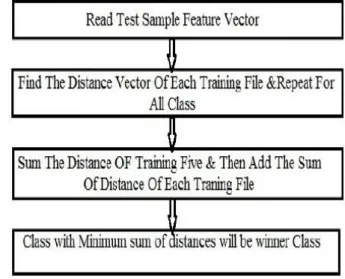
Figure 3: Flow chart of PNN classifier PNN Classifier:
PNN is a classification tool that compares the feature vector values of the input pattern with those of each trained alphabet pattern. Thus, we will first need to train the system by extracting and saving the features for the patterns we want to recognize. These feature values are used during classification stage.
Typically, the PNN consists of an input layer, a pattern layer, a summation layer, and a decision layer.
1) Layer 1: The first layer is the input layer, and this layer performs no computation. This layer convey the input features x to the second layer directly.
2) Layer 2: The second layer is the pattern layer. In this stage of the PNN, each feature value of the input feature vector is compared with the corresponding value of each pattern and comparison scores are the outputs of this layer.
3) Layer 3: The third layer is the summation layer. In this stage, the summation of the comparison scores for each pattern is done to form one value for each pattern (class). This summation represents the extent up to which the input pattern matches with each class.
4) Layer 4: The fourth layer is the decision layer. In this layer simply, the maximum of all the summation values obtained from previous layer is found. This value specifies the pattern with which the input pattern matches.
3378 ISSN: 2278 – 7798 All Rights Reserved © 2015 IJSETR
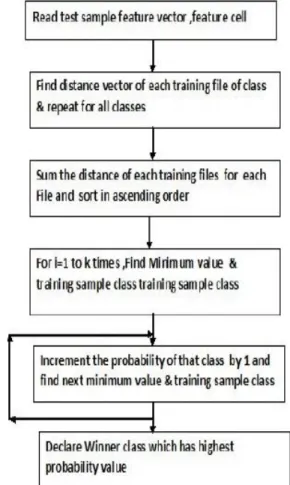
K-NN classifiers:
K Nearest Neighbor (KNN) is one of the algorithms that are very easy to understand and gives good results when no of classes to be classified are large. The algorithm has different behavior based on k, find the k nearest neighbor and do a majority voting.
1) Training data is stored as cell array of dimensions [1X Number of classes] called feature cell, during the training stage. Each element of feature cell array is a matrix of dimensions [Number of features X Number of training samples]. It is passed to classifier during testing of input sample, called test sample.
2) Test sample vector, training data from training stage, value of k are given as input the classifier. The value of K is mostly equal to the number of training samples. 3) The training data of each class contains feature vector
of all training samples. Take each class training data one by one & find the distance between each training sample of that class and test sample for all features. 4) Evaluate Sum of distance of each feature for the training
file. Repeat it for all training samples for that class. 5) Summation of distance with each training sample is
stored in column vector. Sort the vector in ascending order and store it in a distance cell array.
6) Repeat the steps 3, 4 and 5 for all classes.
7) Each element in a distance cell array is the distance vector of the classes. The first element in the distance vector is the smallest value of the distance between test sample and one of the training sample of that class. 8) Make a vector called „current array‟ that contains
elements which are smallest value of sum of distance of that class, i.e first element of distance vector. Find minimum value and index of minimum value (mininx). 9) Initialize one column vector called „class probability
count‟ to zero. Increment value of the element at index mininx.
10) During next iteration replace the minimum vaue of current array by next minimum distance value of that class. Find minimum value and index of minimum value (mininx). Increment the value of the element at index mininx in class probability count vector. 11) Repeat the step 10 for number of training sample times. 12) Find the value and index of maximum of class probability count. The value index gives the number of the class which has maximum probability the test sample belongs to.
IV. RESULTS
The important task is to prepare the database of sensor data For 26 alphabet. Each alphabet is written 10 times.
Figure 4: Flow chart of KNN classifier
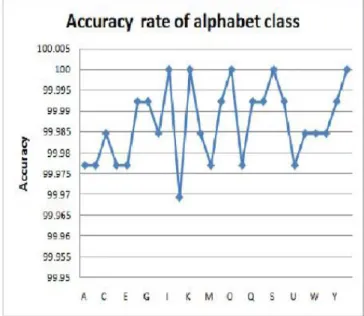
26X10=260 text file are generated. Out of ten, five sample files are used as training samples and five are used for testing. Recognition of five test sample using PNN and KNN classifiers are given in tables 1 and 2. For KNN classifier Feature vector is of 54 element. Some of the irrelevant features are nulled to increase the recognition accuracy.
3379 ISSN: 2278 – 7798 All Rights Reserved © 2015 IJSETR
Table 1: Recognition table for PNN classifier
Figure 5: Accuracy rate of each alphabet class Table 2: recognition table for KNN classifier
3380 ISSN: 2278 – 7798 All Rights Reserved © 2015 IJSETR
IV. CONCLUSION
Alphabet recognition is accomplished in two stages, first is training stage and second is testing stage. Each of 26 alphabet is written 10 times i.e.it gives 10 samples for each letter. Out of 10 samples for of each alphabet 5 samples are used as training samples and 5 are used for testing. Recognition
Accuracy is calculated for two classifiers, Simple PNN classifiers and KNN classifiers. KNN classifiers gave better recognition accuracy (82%) for 26 characters. Recognition accuracy highly depends upon, consistency in writing style and speed.
REFERENCES
[1] Jeen-Shing Wang, and Fang-Chen Chuang, “An accelerometer based Digital pen with trajectory trajectory Recognition Algorithm for Handwritten Digit and Gesture Recognition”, IEEE Transactions on Industrial Electronics, VOL. 59, NO. 7, JULY 2012.
[2] Thomas Deselaers, Daniel Keysers, Jan Hosang, and Henry A. Rowley, “GyroPen: Gyroscopes for Pen-InputWith Mobile Phones”, IEEE Transactions On Human-Machine Systems,: 2014.
[3] Online Handwriting Recognition Using an Accelerometer-Based Pen Device
Jeen-Shing Wang, Yu-Liang Hsu, Cheng-Ling Chu 2nd International Conference on Advances in Computer Science and Engineering (CSE 2013) [4] Yu-Liang Hsu, Cheng-Ling Chu, Yi-Ju Tsai, and Jeen-Shing Wang,” An Inertial Pen with Dynamic Time Warping Recognizer for Handwriting and
Gesture Recognition.”
Sensors Journal, IEEE Page(s): 154 – 163 Publication Year: 2014 [5] Ruize Xu, Shengli Zhou, and Wen J. Li, Fellow, IEEE “MEMS Accelerometer Based Nonspecific-User Hand Gesture Recognition.”, IEEE Sensors Journal, Vol. 12, No. 5, May 2012
[6] J. S. Wang, Y. L. Hsu, and J. N. Liu, “An inertial measurement-algorithm and its applications,” IEEE Trans. Industrial Electronics, vol. 57, no. 10, pp. 3508-3521, 2010.
[7] Ramzi, A. ; Zahary, A,. “Online Arabic handwritten character recognition using online-offline feature extraction and back-propagation neural network”, Publication Year: 2014 , Page(s): 350 - 355 ,IEEE Conference Publications . [8] Davide Figo ¢ Pedro C. Diniz ¢ Diogo R. Ferreira ¢ Jo˜ao M. P. Cardoso,”Preprocessing Techniques for Context Recognition from Accelerometer Data”, Personal and Ubiquitous Computing, vol.14, no.7, pp.645–662, 2010
[9] Renuka R, Suganya V & Arunkumar B,” Online hand written character recognition using digital pen for static authentication.”, Proceedings of IRAJ International Conference, 20th October 2013, Chennai, India
[10] J. S.Wang, Y. L. Hsu, and J. N. Liu, “An inertial-measurement-unit-based pen with a trajectory reconstruction algorithm and its applications,” IEEE Trans. Ind. Electron., vol. 57, no. 10, pp. 3508–3521, Oct. 2010.
[11] Y. P. Chen, J. Y. Yang, S. N. Liou, G. Y. Lee, and J. S. Wang, “Online classifier construction algorithm for human activity detection using a triaxial accelerometer,” Appl. Math. Comput., pp. 849–860, Nov. 2008.
[12] Z. Dong, U. C. Wejinya, and W. J. Li, “An optical-tracking calibration method for MEMS-based digital writing instrument,” IEEE Sens. J., vol. 10, no. 10, pp. 1543–1551, Oct. 2010.
[13] S.-H. P. Won, W. W. Melek, and F. Golnaraghi, “A Kalman/particle filter- based position and orientation estimation method using a position sensor/inertial measurement unit hybrid system,” IEEE Trans. Ind. Electron., vol. 57, no. 5, pp. 1787–1798, May 2010.
Shaikh j. k. Perusing M.E. in Vlsi and Embedded System from D.Y.Patil college of engineering ambi pune. Completed B.E. from Dr.J.J.Magdum College of engg. Jaysinpur. Working as lecturer in polytechnic.