Integrating Information Theory Measures and a
Novel Rule-Set-Reduction Tech-nique to Improve
Fuzzy Decision Tree Induction Algorithms
Nael Mohammed Abu-halaweh
Georgia State UniversityFollow this and additional works at:
https://scholarworks.gsu.edu/cs_diss
Part of the
Computer Sciences Commons
This Dissertation is brought to you for free and open access by the Department of Computer Science at ScholarWorks @ Georgia State University. It has been accepted for inclusion in Computer Science Dissertations by an authorized administrator of ScholarWorks @ Georgia State University. For more information, please [email protected].
Recommended Citation
Abu-halaweh, Nael Mohammed, "Integrating Information Theory Measures and a Novel Rule-Set-Reduction Tech-nique to Improve Fuzzy Decision Tree Induction Algorithms." Dissertation, Georgia State University, 2009.
by
NA’EL ABU‐HALAWEH
Under the Direction of Dr. Robert W. Harrison ABSTRACT Machine learning approaches have been successfully applied to many classification and prediction prob‐ lems. One of the most popular machine learning approaches is decision trees. A main advantage of deci‐ sion trees is the clarity of the decision model they produce. The ID3 algorithm proposed by Quinlan forms the basis for many of the decision trees’ application. Trees produced by ID3 are sensitive to small perturbations in training data. To overcome this problem and to handle data uncertainties and spurious precision in data, fuzzy ID3 integrated fuzzy set theory and ideas from fuzzy logic with ID3. Several fuzzy decision trees algorithms and tools exist. However, existing tools are slow, produce a large number oferated decision model un‐interpretable. In this research work, we proposed an improved version of the fuzzy ID3 algorithm. We also introduced a new method for reducing the number of fuzzy rules generated by Fuzzy ID3. In addition we applied fuzzy decision trees to the classification of real and pseudo micro‐ RNA precursors. Our experimental results showed that our improved fuzzy ID3 can achieve better classi‐ fication accuracy and is more efficient than the original fuzzy ID3 algorithm, and that fuzzy decision trees can outperform several existing machine learning algorithms on a wide variety of datasets. In addition our experiments showed that our developed fuzzy rule reduction method resulted in a significant reduc‐ tion in the number of produced rules, consequently, improving the produced decision model compre‐ hensibility and reducing the fuzzy decision tree execution time. This reduction in the number of rules was accompanied with a slight improvement in the classification accuracy of the resulting fuzzy decision tree. In addition, when applied to the microRNA prediction problem, fuzzy decision tree achieved better results than other machine learning approaches applied to the same problem including Random Forest, C4.5, SVM and Knn. INDEX WORDS: Decision tree, Fuzzy, ID3, Fuzzy ID3, FID3, Classification, Prediction, Rule‐set reduction, MicroRNA, Pre‐microRNA, Machine learning.
by NA’EL M. ABU‐HALAWEH A Dissertation Submitted in Partial Fulfillment of the Requirements for the Degree of
Doctor of Philosophy
in the College of Arts and Sciences Georgia State University 2010Copyright by Na’el Mohammed Abu‐halaweh 2010
by NA’EL ABU‐HALAWEH Committee Chair: Robert W. Harrison Committee: Yanqing Zhang Yi Pan Yichuan Zhao Electronic Version Approved: Office of Graduate Studies College of Arts and Sciences Georgia State University May 2010
To my Wife Saeda Mustafa,
To my Brothers Tawfiq, Zaki, Naser and Abdel‐jabbar Abu‐halaweh,
niques “Fuzzy Decsion Trees”. His support, guidance, encouragement and invaluable ideas led me to great achievements. I would also like to thank Dr. Yi Pan, a leading scientist in many fields including Bio‐ informatics and Machine Learning and Chairman of the Computer Science Department, Dr. Yanqing Zhang, a leading scientist in Data Mining, Computational Intelligence and Machine Learning, and Dr. Yi‐ chuan Zhao, a leading scientist in statistics and statistical modeling of fuzzy systems, for their comple‐ mentary scientific expertise, support and guidance throughout this research and for their invaluable ad‐ vices and critical reading of this dissertation. I am very thankful to the Computer Science Department at the Georgia State University (GSU), the GSU Molecular Basis of Disease Initiative (MBD), and the Georgia Cancer Coalition for supporting this research work. I would like to thank Dr. Raj Sunderraman for his support and invaluable advice. I would like also to thank my colleagues in Dr. Harrison’s lab for the useful discussions we have, especially, Mr. Amit Sab‐ nis. Finally, I would like to give my deep appreciation to my family, including my parents Mohammad and Somaya Abu‐halaweh, my wife Saeda Mustafa, and my brothers for their support and encourage‐ ment.
LIST OF FIGURES ... x
Chapter 1: INTRODUCTION...………..……….1
Chapter 2: BACKGROUND AND LITERATURE REVIEW………..………..7
2.1 Introduction...……….7
2.2 Literature Review....………..9
2.3 Information Theory Measures...……….13
2.3.1 Information Gain...………14
2.3.2 Classification Ambiguity...……….17
2.3.3 Gini Index....………..19
2.4 Interactive Dichotomizer 3 (ID3) Algorithm...………..21
2.5 Fuzzy ID3 Algorithm...……….22
2.6 Inference in Fuzzy ID3....……….26
Chapter 3: IMPROVED FUZZY ID3 ALGORITHM….…………..……….27
3.1 Improved Fuzzy ID3 Algorithm (IFID3)...……….28
3.2 Experimental Details....………30
3.2.1 Datasets..……….30
3.2.2 Datasets Preprocessing...………31
3.2.3 Data Fuzzification and Fuzzy Membership Functions...………..31
3.2.4 Experimental Setup and Results...………..40
3.3 Conclusion and Future Work...………44
4.2.1 A new Syntax for Fuzzy Rules...……….48
4.2.2 Object Propagation Threshold...……….49
4.2.3 Extended IFID3 Algorithm...………51
4.3 Experiments and Results...……….54
4.4 Summary and Conclusion...……….57
Chapter 5: PREDICTION AND CLASSIFICATION OF REAL AND PSEUDO MICRORNA PRECURSORS (PRE‐ MIRNA) VIA DATA FUZZIFICATION AND FUZZY DECISION TREES...……….59
5.1 Introduction and Background...………..60
5.2 Encoding the Pre‐miRNA Hairpin Structure...………..……….64
5.3 Algorithm for Classifying Real and Pseudo pre‐miRNAs...……….66
5.4 Experiments and Results...……….………..69
5.4.1 Datasets...……….………..69
5.4.2 Parameter Optimization and Fuzzy Model Selection...….………..70
5.4.3 Performance Evaluation Measures...………..……….71
5.4.4 Experimental Results...………..72
5.4.5 Discussion...………..76
5.5 Conclusions and Future Work...………78
Chapter 6: IDENTIFYING ESSENTIAL FEATURES FOR THE CLASSIFICATION OF REAL AND PSEUDO MICRORNA PRECURSORS USING FUZZY DECISION TREES.………80
6.1 Extended Triplet Elements Sliding Window Encoding Scheme...……….81
6.2 Method..……….82
6.3.3 Results and Discussion...………..84
6.4 Conclusions...………89
Chapter 7: FUZZY DECISION TREE SOFTWARE TOOL (FDT)……..………92
7.1 Introduction...………..92
7.2 FDT Features...……….92
7.3 File Format...……….95
7.3.1 Dataset File Format...………..95
7.3.2 Fuzzy Parameters File Format...………..96
7.3.3 Cluster‐Centers' File Format...………98
7.3.4 Fuzzy Rules File Format...………98
7.3.5 Example..……….99
7.4 Summary and Future Work...………..103
Chapter 8: SUMMARY, CONCLUSIONS AND FUTURE WORK………..………….104
8.1 Summary and Conclusions...………104
8.2 Future Work....……….106 REFERENCES………..111
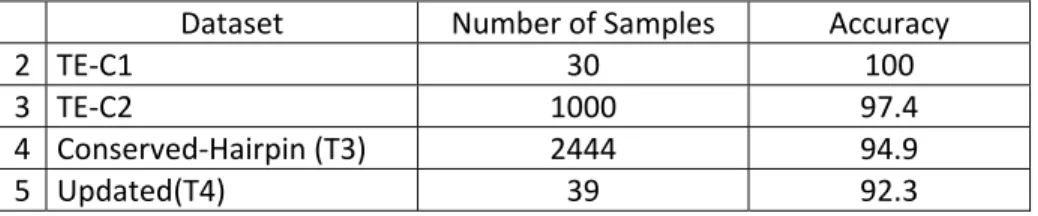
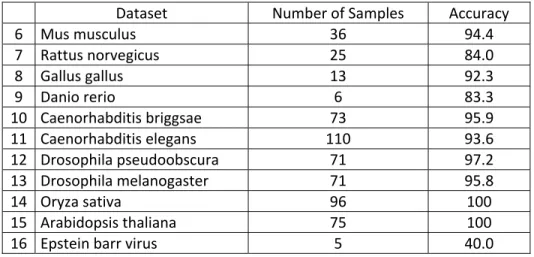
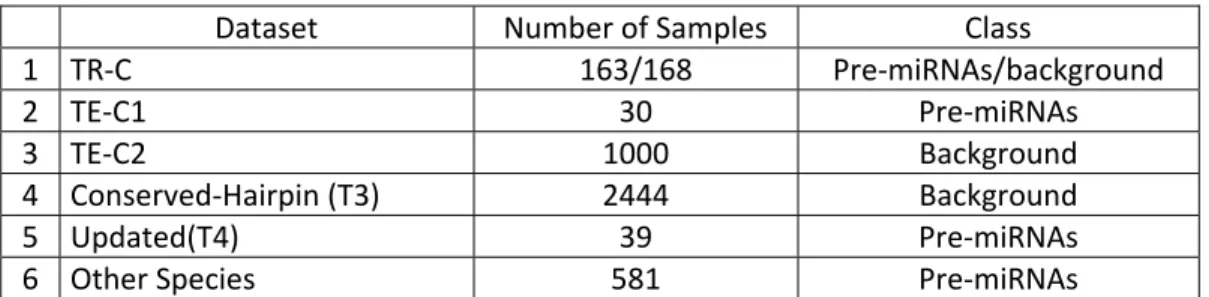
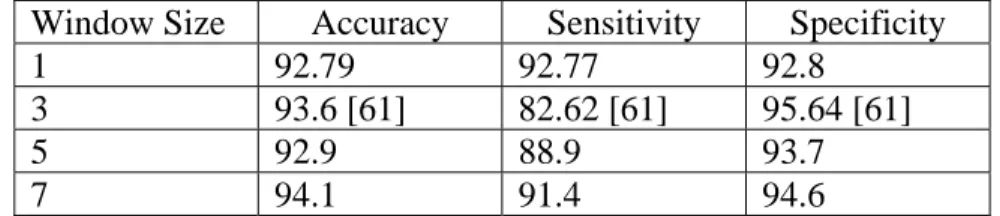
Table 4.1 A BreifDesctrition of Datasets Used During The Experiments 54 Table 4.2 IFID3 and Extended IFID3 Performance Comparison Based on The Nymber of Produced Rules and Accuracy 55 Table 4.3 Execution Times (In Seconds) for Extended IFID3 Algorithm and IFID3 Algorithm 57 Table 5.1 Summary of Datasets 70 Table 5.2 Overall Accuracy Achieved by Fuzzy‐Decision‐Tree Methotd Compared to Those Reported in the Litrature. Datasets 2 Through 16 73 Table 5.3 Fuzzy Decision Trees Versus Other Machine Learning Approaches. Datasets 2 Through 5 73 Table 5.4 Accuracy Achieved by FDT on Indivisual Human Datasets 2 Through 5 74 Table 5.5 Fuzzy Decision Trees Versus Other Machine Learning Approaches. Other Species: Datasets 6 Through 16 74 Table 5.6 Accuracy Achieved by FDT on Individual Datasets 6 Through 16 75 Table 6.1 Summary of Datasets 83 Table 6.2 Classification Results Achieved by FDT Using the Global Features Combinerd with The Local Features Extracted Using the Window Size Specified in The Table 85 Table 6.3 Classification Results of Different Machine Learning Tools When Applied to Datasets with Local Features Extracted Using The Sliding Window Scheme 86 Table 6.4 Classification Results Comparison: Local Features, Global Features and Combined Global and Local Features Otained Using the Triplet Elements 87 Table 6.5 Comapring Classification Results: The Six Global Features Selected By FDT, Global Features, and Global Features Combined with The Local Features Encoded Using The Triplet Elements 88
Figure 3.4 Calculated Trapezoidal Fuzzy Membership Functions Using {2, 5, 8, 11} as Cluster Centers 40 Figure 3.5 Summary of Experintal Results, Accuracy of IFID3 Versus Other Methods That Produce A Sin‐ gle Decision Tree 42 Figure 3.6 Confusion Matrices 44 Figure 4.1 The Effect of Using The Object Propagation Threshold On Fuzzy Membership Functions 50 Figure 4.2 Comparing The Number of Fuzzy Of Fuzzy Rules Produced By EIFID3 To Those Produced By the IFID3 Algorithm 56 Figure 5.1 MicroRNA Biogenesis 61 Figure 5.2 Triplet Elements Encoding Scheme 66 Figure 5.3 Flowchart for Classification of Real and Pseudo pre‐miRNA Using FDT 68 Figure 6.1 Sliding Window Scheme for a Window Size of 5 82 Figure 7.1 Sample Dataset File 96 Figure 7.2 Sample Fuzzy Parameters File with Associated Fuzzy Membership Functions 97 Figure 7.3 Sample Clusters' Centers File 99 Figure 7.4 Sample Rules' File 99 Figure 7.5 Example Training Dataset 100 Figure 7.6 Example Testing Dataset File 100 Figure 7.7 Fuzzy Parameters File 101 Figure 7.8 Constructed Fuzzy Decision Tree 101 Figure 7.9 Generated Fuzzy Rule File 102 Figure 7.10 Rule File Using the Rule Syntax Presented in Chapter 4 102
Chapter 1 INTRODUCTION In our daily life we always face situations where we have to make decisions. We often use our past experience to decide on current events. Past experience can be thought of as the experimental data. Some applications are very complex such that it is very hard for us to deduce good decision models based on our experience. Furthermore, experimental approaches to de‐ cide on new cases may be too expensive and time‐consuming. Machine learning represents an efficient and an automated approach to construct decision models from previously collected data (known cases) and apply the constructed models to unknown newly encountered similar cases to make a decision.
In the past, machine learning approaches have been successfully applied to many deci‐ sion support problems including classification and prediction problems. Machine learning ap‐ proaches utilize existing known cases to build a decision model that can be used to decide about unknown cases and thus saving time and reducing the experimental costs. Many machine learn‐ ing approaches exist, these include neural networks, Bayesian learning, decision trees and oth‐ ers. This dissertation focuses on decision trees specifically fuzzy decision ones as a classification and prediction tool.
Decision trees are one of the most popular machine‐learning techniques [3] [4] [5] [6] [29]; they are praised for their ability to represent the decision support information in a human comprehensible form [3] [8], however, they are recognized as a highly unstable classifier with respect to small changes in training data [28].
One of the most popular algorithms for building decision trees is Interactive Dichoto‐ mizer 3 (ID3) [12]. Generally trees produced by ID3 ‐ known as crisp decision trees‐ are sensitive to small changes in feature values, cannot handle data uncertainties caused by noise and/or measurement errors [2] [3]. To overcome these problems, the approximate reasoning offered by fuzzy representation was coupled with ID3 [3]. The result of this coupling is the Fuzzy ID3 al‐ gorithm [1] [2] [3]. The trees produced by the fuzzy ID3 ‐ known as fuzzy decision trees (FDTs) ‐ are more immune to data uncertainties caused by measurement errors, noise, missing and/or inconsistent information.
In the past, many researchers studied fuzzy decision trees [1] [2] [3] [4] [6] [7] [10]. In most cases the researchers concentrated on designing a good fuzzy representation of the target problem rather than on improving the quality and the performance of produced fuzzy decision tree. Furthermore, in most of the work addressing fuzzy decision trees, the proposed methods were applied to one or few small hypothetical examples. This limits the validity of these me‐ thods and the generality of the results obtained. Published fuzzy decision tree freeware tools take too long (3–4 weeks) to produce results in relatively large dataset (about 400 features), which limit the applicability of these tools to many of the classification applications such as
those arising in bioinformatics and security. In addition, since these tools lack the support for the automatic generation of fuzzy membership functions, they require intensive user involve‐ ment in determining the fuzzy models used to fuzzify collected data. Determining the fuzzy model is a very challenging task, it requires a high degree of experience and an excellent know‐ ledge in the target application area. In addition, some systems are very complex such that it is hard, even for an expert in the application field, to come up with a good fuzzy representation. In addition to being slow and lacking the support for the automatic fuzzification of input data, fuzzy decision tree applications produce a large number of rules. This sacrifices the interpretabil‐ ity of the produced decision models losing one of the main advantages of decision trees.
This research work focuses on finding solutions for the fuzzy decision tree tools’ short‐ comings mentioned above. Our research questions are: Can we improve the performance (both accuracy and running time) of fuzzy decision trees? Can we reduce the number of fuzzy rules produced by the Fuzzy ID3 algorithm? Can we automate the generation of fuzzy membership functions? Can we generalize the decision models produced by fuzzy decision trees in other words can we transfer decision trees from being weak learners to strong learners? Our main motivations for studying decision trees are:
• Decision trees produce a human‐interpretable decision model. Understanding the deci‐ sion model make it possible to verify its validity and enable a better understanding of the problem. In addition it helps in identifying the critical attributes needed for making the decision.
• Collected data always contain uncertainties due to measurement errors and/or noise. Fuzzy sets were proposed to deal with such uncertainties.
• Huge amounts of experimentally collected data are available. Fuzzy decision trees represent a data‐driven approach to extract fuzzy rules from previously collected data. This can be of great importance to the understanding of the problems and for designing fuzzy logic controllers for complex systems where it is hard for a human being even an expert in the target field to come up with a set of rules that map the system behavior. A successful approach should improve both the accuracy and the running time of the fuzzy decision tree. It should also improve the human comprehensibility of the produced fuzzy decision model by reducing significantly the number of generated fuzzy rules. In addition, a suc‐ cessful approach should reduce the user involvement by automating the generation of the fuzzy membership functions.
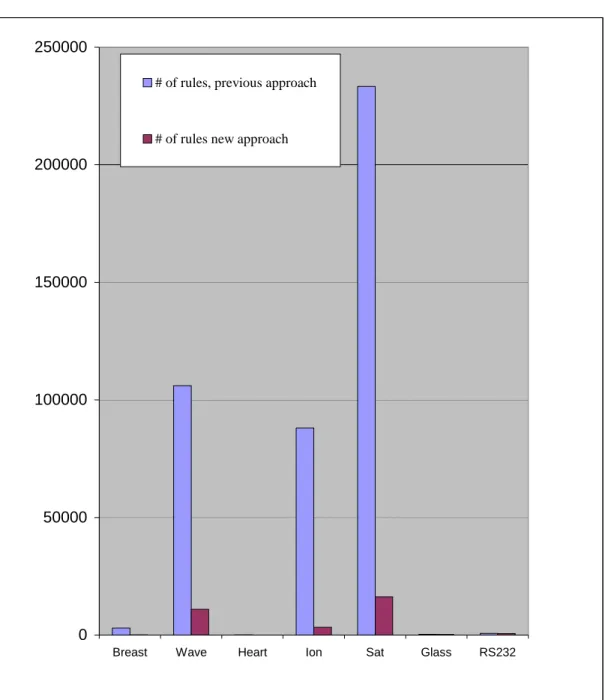
In this dissertation, we proposed an improved FID3 algorithm (IFID3), the IFID3 inte‐ grates classification ambiguity [2] and fuzzy information gain [1] to select the branching attribute. The IFID3 algorithm outperformed the existing FID3 algorithm on a wide range of da‐ tasets. We also introduced an extended version of the IFID3 algorithm (EIFD3). EIFID3 extends IFID3 by introducing a new threshold on the membership value of a data instance to propagate down the decision tree from a parent node to any of its children nodes during the tree construc‐ tion phase. Using the new threshold resulted in a significant decrease in the number of rules produced, an improved accuracy and a huge reduction in execution time. We also automated
the generation of the membership functions. To do this, we used two simple approaches, in the first approach the ranges of all numerical features in a dataset are divided evenly into an equal number of fuzzy sets. In the second one, the dataset is clustered and the resulted cluster centers are used to generate fuzzy membership functions. Finally we applied fuzzy decision trees to the microRNA prediction problem, our results showed that fuzzy decision trees achieved a better accuracy than other machine learning approaches such as Support Vector Machines (SVM) [30] and Random Forest (RF) [31]. Currently, we are working on tuning and optimizing the automati‐ cally generated fuzzy membership and designing a fuzzy decision forest algorithm. In addition, we are investigating fuzzy rule set reduction further.
The rest of this dissertation is organized as follows: In Chapter 2, we will review the lite‐ rature, present background information about decision trees and discuss the most common in‐ formation theory measures utilized by the different decision tree algorithms. In chapter 3, we present the improved Fuzzy ID3 algorithm (IFID3). The improved FID3 integrates fuzzy informa‐ tion gain and classification ambiguity to select the branching feature. The chapter discusses our experimental results and compares the performance of IFID3 with that of FID3 and other deci‐ sion‐tree‐based classification algorithms. In chapter 4, we introduce an extended version of IF‐ ID3. The new version utilizes a new threshold on the membership of a data instance to propa‐ gate down the tree from a parent node to any of its child nodes during the tree building step. The chapter compares the results achieved by EIFID3 with those achieved by the IFID3 algo‐ rithm. These results show that EIFID3 produces less fuzzy rules and achieves better accuracy than IFID3. In chapter 5, we apply the extended IFID3 to the classification and prediction of real
and pseudo microRNAs precursors (pre‐microRNAs) and compare our results with those of achieved by other machine learning tools reported in the literature. In chapter 6, we present an extension of the work presented in chapter 5. In this chapter we introduced an encoding scheme of pre‐microRNAs and their associated predicted secondary structure and we utilized extended IFID3 to identify the essential features for this classification problem. In chapter 7, we introduce the software tool developed during this work and discuss its features and capabilities. In chapter 8, we summarize the work presented in this dissertation, conclude it and present some future directions to improve this work.
Chapter 2
BACKGROUND AND LITERATURE REVIEW
2.1 Introduction
Decision trees are one of the common machine learning tools [3] [4] [5] [6] [29]. They are classified as weak learners [32]. A weak learner builds a strong classifier that fits the training data, but may produce very low accuracy when applied to unknown cases. ID3 algorithm pro‐ posed by Quinlan in 1979 [12] forms the basis of many decision tree algorithms. ID3 support only symbolic data [1]. Several ID3 extensions were proposed to handle continuous and multi‐ valued data [1] [5]. Some statistical approaches and tree pruning are used to overcome the problem of overfitting the training data and to improve the generalization of the decision model produced by decision trees.
ID3 partitions the training data recursively based on a test attribute [12]. To select the test attribute at a non‐leaf node, ID3 utilizes an entropy based measure called Information Gain. One of the problems of information gain is being biased toward selecting the attribute that re‐ sults in a larger number of branches [33]. To overcome this deficiency C4.5 [14] uses Informa‐ tion Gain Ratio [14] to select the test attribute. Trees produced by ID3 – known as crisp decision trees‐ cannot handle data uncertainties and spurious precision in the data. Fuzzy ID3 [1] (FID3) is an extension of the ID3 algorithm. It integrates ID3, fuzzy set theory and the approximate rea‐
soning offered by fuzzy logic [34] [37] [38] to overcome some of the deficiencies in ID3. Trees produced by the FID3 algorithm are known as fuzzy decision trees (FDTs). For a brief discussion of fuzzy sets and fuzzy logic, the user is referred to [3]. Generally, a fuzzy decision tree induction mechanism consists of the following four steps [1] [2] [3] [4] [5] [6] [7] [9] [10]: 1. Data fuzzification. 2. Building a fuzzy decision tree. 3. Converting the fuzzy decision into a set of fuzzy rules. 4. Applying the fuzzy rules to make classification and/or prediction (inference). The data fuzzification is applied to numerical data. The purpose of this step is to reduce the information overload in the decision support process [2]. Selecting the appropriate fuzzy membership function is crucial to the performance of fuzzy decision trees. The fuzzy member‐ ship functions may be provided by experts, or may be defined by some other means such as clustering. Common fuzzy membership functions are triangular, trapezoidal and Gaussian. The fuzzy decision tree building procedure is very similar to that of ID3 [1] [2] [4] [5] 6] [7]; the fuzzified training dataset is partitioned recursively based on the value of a selected split‐ ting (also called branching or test) feature (attribute). The splitting feature is selected such that a certain information measure of separating data belonging to different classes is maximized [7]. Several information measures exist in the literature, typical information measures used include: Information gain (IG) [12] [13], classification ambiguity (CA) [2] and gini‐index [35]. Existing fuzzy
ID3 algorithms use either information gain or classification ambiguity to select a branching fea‐ ture. A gini‐index based fuzzy decision tree algorithm was proposed recently in [36]. A node in the tree is considered a leaf node, when all the objects at the node belong to the same class, the number of objects in the node is less than a certain threshold, the ratio between objects’ mem‐ berships in different classes is greater than a given threshold, or no more features are available. Tuning these thresholds is crucial to the performance and the quality of the produced fuzzy de‐ cision trees. A feature can appear only once on any path from the root node to a leaf node in the tree. Unlike crisp decision trees where an object can propagate only to one child node, fuzzy decision trees allow a data item or an object to propagate to more than a child node. Inference in fuzzy decision trees starts at the root node; the tested object may fall into several leaves in the decision tree ‐ possibly with conflicting decisions ‐ with some certainty [1] [2]. To give a final decision on an object, several reasoning methods exist [1] [2] [3] [4] [6] [11]. Typical ones include applying the fuzzy rule with the maximum firing threshold, or using the sum of products (X‐X‐+) reasoning method found in fuzzy logic. Interpolation can be used to reason about test objects that fire no rules by manipulating adjacent fuzzy rules. 2.2 Literature Review Several fuzzy decision tree induction algorithms exist [4]. These algorithms differ in the information theory measure they use to select the branching attribute and/or the inference me‐
thod used to draw a final decision on a test object. In [1] a fuzzy ID3 (FID3) algorithm is pro‐ posed, the proposed algorithm utilizes a fuzzy version of information gain to select a test attribute. To build a fuzzy decision tree, the proposed algorithm uses a procedure similar to that of ID3. In [2], an FID3 algorithm is proposed, the proposed algorithm uses the same procedure as in [1] to build the fuzzy decision tree. However, the algorithm uses Classification Ambiguity instead of fuzzy information gain to select the test attribute. In [3] fuzzy decision trees issues including tree construction procedure, fuzzy set theory, fuzzy logic, interpolation and fuzzy rea‐ soning were discussed. In [4], a fuzzy decision tree induction method was proposed; the pro‐ posed method is the same as that in [1]. However, the proposed method utilizes a procedure called classwise element set to partition the range of discrete attributes. This procedure is used to overcome the information gain bias toward selecting discrete features with many possible values. In [6] a fuzzy decision tree induction freeware (FID3.4) was introduced. The tool imple‐ ments the same FID3 proposed in [1] except for using a priority queue data structure to unfold the recursion in FID3. The tool takes too long to run and may crash without producing results. In [7], the idea of fuzzy decision forest (FDF) was introduced. FDF extends FID3 by allowing the se‐ lection of more than one test attribute at a non‐leaf node. Selecting multiple test attributes is used to overcome noisy or missing values associated with any of the test attributes. In [9], a freeware FDF tool is introduced, the tool is an implementation of the idea presented in [7]. This tool proved to be unstable, and is currently unavailable for download with promises since 2004 to make it available in the future. In [10] a new matching method for fuzzy decision tree is pro‐
posed, the proposed method assigns each extracted fuzzy rule a truth degree, which is used as a weight during the decision process.
In the literature of fuzzy logic controllers, several methods exist to address rule set re‐ duction and the optimization of fuzzy membership functions. In [15], the authors studied two fuzzy membership functions tuning techniques; the two tuning techniques utilize genetic algo‐ rithms to optimize the membership functions by iteratively examining the dataset and fuzzy rule set base. By optimizing the membership functions the authors were able to achieve a slight re‐ duction in the fuzzy rule set base size. However, the approach assumes that the fuzzy rules exist before hand. In [16], the authors utilized genetic algorithms to develop a method for learning membership functions from the data. The main idea is to merge adjacent membership functions when their overlap is greater than a given threshold. Although the proposed method is capable of learning the membership functions from the data, however, it resulted in the generation of more fuzzy rules. In [17], the authors applied several multi‐objective evolutionary algorithms to reduce the number of fuzzy rules and to tune membership functions. In [18], the authors pro‐ posed an approach for adjusting the membership functions and for reducing the number of fuzzy rules. The proposed approach, first, generates a fuzzy rule for each data item in the data‐ set, and then the degree of similarity between rules is calculated. Based on the result of similari‐ ty calculations, initial membership functions are merged. The adjusted membership functions are then used to generate a new set of fuzzy rules. In [19], the authors reduced the fuzzy rule base by removing redundant and inconsistent rules. However, the time complexity of the algo‐ rithm is high, the authors defined redundancy and inconsistency measures that need to be cal‐
culated for each pair of rules. In [20], the authors used singular value decomposition to reduce the fuzzy rule base for a fuzzy filter that estimates motor currents. In [21], the authors combined the concept of fuzzy region and the piecewise Lyapunov stability criterion to reduce the fuzzy rule base size. The authors named their technique regional piecewise approach.
In the literature, fuzzy decision trees were applied to specific problems, to some hypo‐ thetical examples or to datasets with a relatively small number of features (< 10). Therefore the obtained results represent a proof of concept but may not be generalized. Existing fuzzy deci‐ sion tree induction applications like FID3.4 introduced in [6] takes a long time to run (a single run takes few weeks on a protein dataset with 450 extracted features). Taking into considera‐ tion the time needed to fine tune the FID3 parameters and the time needed to fine tune the fuzzy membership functions associated with each numerical feature in the data, running times of months are expected in order to generate an optimal fuzzy decision tree. Furthermore, exist‐ ing fuzzy decision tree algorithms produce a huge number of fuzzy rules. Reducing the number of resulting fuzzy rules is important for improving the falsifiability of the decision model and for reducing the computational time. In addition, reducing the number of rules improves the system interpretability, efficiency and the applicability of the resulting fuzzy systems to real time appli‐ cations. Although, several rule set reduction methods were proposed to reduce the number of fuzzy rules in fuzzy logic controllers. All these methods examine the existing fuzzy rule set base after they are generated, to either remove redundant and/or inconsistent rules or to adjust the initial fuzzy membership functions.
Using a forest of crisp decision trees has proved to be an effective approach for improv‐ ing the accuracy of decision‐tree‐based machine learning algorithms. Applying the same concept may improve the performance of fuzzy decision trees. The fuzzy decision forest proposed in [7] proved to be unstable, and therefore, further research is needed to come up with new efficient fuzzy forest algorithms. Another problem with fuzzy systems is the determination of the number of fuzzy sets and the optimal fuzzy membership functions. Most approaches in the literature assume the number of fuzzy sets for any given feature in dataset is known before hand and try to tune the membership functions by means of genetic algorithms. However, this assumption may not be valid for complex systems with huge number of features. For such systems, it is hard to come up with a good fuzzy representation. On the other hand, many of the humans per‐ forming the data processing and analysis may lack the experience in the target application field. Therefore, it is very important to derive methods that automate this task.
2.3 Information Theory Measures
At the heart of any decision tree algorithm is the selection of the branching attribute (al‐ so called test attribute and splitting attribute). Decision trees either select the test attribute randomly or utilize one of the information theory measures to select it. In this section we will introduce the most common information theory measures used in decision trees to select the branching attribute; these include information gain, classification ambiguity and gini‐index.
2.3.1 Information Gain
The most common information theory measure utilized by the ID3 algorithm and its fuzzy extensions is the Information gain measure. Information gain is an entropy based meas‐ ure. At each internal node in the tree, the information gain associated with each feature in the dataset is calculated, and the feature with the maximum information gain is selected as the splitting (branching) feature. As mentioned earlier, the Information Gain measure is an Entropy‐based measure. Equ‐ ation 2.1 below defines Entropy: 2
( )
i* log
i N iH S
=
∑
−
p
p
(2.1) Where pi is the ratio of examples belonging to class Ci in the set of training examples S = {x1, x2, x3, ..., xk} at a particular node in the tree and is defined by equation 2.2.|
|
k i ix
C
p
S
∈
=
∑
(2.2) Where |S| is the number of examples in the training dataset S. The information gain of an attribute A, is the measure of the reduction of the sample set entro‐ py after using A to divide this sample set and is given by equation 2.3.( )
|
|
( , )
( )
*
( )
|
|
v v v Values AS
G S A
H S
H S
S
∈=
−
∑
(2.3) Where|
|
|
|
vS
S
is the ratio of the number of samples with A = v in the sample data set S to the to‐ tal number of samples in the sample dataset S. Fuzzy ID3 utilizes a fuzzy version of the information gain measure. Given a data set D, with attributes A1, A2, …, AL and a classified class C = {C1, C2, …, Cn} and fuzzy sets Fi1, Fi2, …, Fim for the attribute Ai (each attribute may have a different value of m). Let be a fuzzy subset in D with class Ck, and let |D| be the sum of membership values in a fuzzy set of data D. Then, the information gain for an attribute Ai by a fuzzy set of D is defined as follows [1]: k C D( , )
i( )
( , )
iG A D
=
I D
−
E A D
(2.4) Where: 2 1( )
(
.log
)
n k k kI D
p
p
== −
∑
(2.5) 1(
,
)
(
. (
ij))
m i ij JE A D
p I D
==
∑
F (2.6)|
|
|
|
kC
k
p
D
D
=
(2.7) 1|
|
|
|
ij ij F ij m F jD
P
D
==
∑
(2.8) Finally, Since Information Gain (IG) is an Entropy‐Based measure; it has a strong bias to‐ ward selecting attributes that result in larger number of branches. In other words, it favors attributes with many values. For example, consider a dataset in which one of the features being used as an identifier, IG will pick this feature as the splitting feature, although this feature may be irrelevant to the classification process. To overcome this deficiency, information gain ratio is used instead of IG. The definition for the Information Gain Ratio (IGR) is given by equation 2.9.( , )
( , ) /
( , )
IGR S A
=
G S A
IV S A
(2.9) Where IV(S, A) is the gain ratio of splitting the sample dataset S using attribute A and is given by the following equation: 2| {
} |
| {
} |
( , )
* log (
|
|
|
|
n
S
n
S
IV S A
S
S
∈
∈
= −
∑
(2.10) Where n is the number of samples left in the class after testing on attribute A.2.3.2 Classification Ambiguity
Classification Ambiguity is another information theory measure used by some versions of the Fuzzy ID3 algorithm to select the splitting attribute at a given tree node. This section re‐ views some of the definitions and terms involved in the calculations of the attribute classifica‐ tion ambiguity. A fuzzy membership function (μ(x)) of a fuzzy feature Y defined on X can be interpreted as the possibility of Y taking the value x among all element in X. therefore π(x) = μ(x) for all xεX can be considered as a possibility distribution of Y on X. Let π = (π(x) | xεX) denote a normalized distribution of Y on X = {x1, x2, …, xn}, the possiblistic measure of ambiguity (also called nonspeci‐ ficity and U‐uncertainty) is defined as: * * 1 1
( )
( )
(
) ln
n a i i iE Y
g
π
π π
+i
==
=
∑
−
(2.11) where: * * * 1 2 { , , , } n *π π π π
= … iis the permutation of the possibility distribution π = {π(x1), π(x2), …, π(xn)} sorted so that * * 1 i
π π
≥ + for i = 1, 2, …, n, and * 1 0. nπ
+= based on the definition, an E a(Y) = 0 indicates no ambiguity and an Ea(Y) = ln(n) indicates the greatest ambiguity [2]. The fuzzy subsethood S(A, B) is defined as the degree to which A is a subset of B [2], and is given by equation 2.12. The fuzzy subsethood can be used to measure the truth degree of a fuzzy rule.min( ( ), ( )) ( ) ( , ) ( ) ( ) u U A B u U A u u M A B S A B M A u
μ μ
μ
∈ ∈ = =∑
∑
∩ (2.12)where μA and μB are the membership functions for fuzzy sets A and B respectively.
Fuzzy evidence is a condition fuzzy subset defined on the object space, and represents the linguistic values of one or more attributes, for example, “The Temperature is Hot and the Outlook is Sunny” [2]. Then given fuzzy evidence E, the possibility of an object to be classified as class Ci can be defined as:
( ,
)
(
| )
max ( ,
)
i i j jS E C
C E
S E C
π
=
(2.13)where S(E, Ci) is the truth degree of the classification rule: “IF E THEN Ci“ and is calculated by using the fuzzy subsethood definition, and π(C|E) = { π(Ci|E), i = 1, …, L} is a normalized possibili‐ ty distribution on the nonfuzzy label space C = { C1, …, CL} [2]. Finally the classification ambiguity associated with a single fuzzy evidence E, such as a particular value of an attribute is given by:
( )
( ( |
))
G E
=
g
π
C E
(2.14) The reader is referred to [2] for more details.2.3.3 Gini Index
Gini index (also known as gini impurity) is the information measure used in classification and regression trees (CART) [35] to select the branching feature. Given a dataset D with N ex‐ amples from n classes {c1, c2, …, cn}, the gini index, gini(D) is defined as follows: 2 1
(
)
1
n i iG in i D
p
== −
∑
(2.15) Where pi is the relative frequency of class Ci in D. If the dataset D is split into two subsets D1 and D2 with sizes N1 and N2 respectively, the gini in‐ dex of the split data is given by the following equation: 1 2 1 2(
)
(
)
(
)
s p litN
N
G in i
D
g in i D
g in i D
N
N
=
+
(2.16) For the general case where the dataset D is split into k subsets {D1, D2, …, Dk} with sizes {N1, N2, …, Nk} the gini index of the split data is given by the following equation: 1(
)
i(
)
s p lit i k iN
G i n i
D
g i n i D
N
==
∑
(2.17) The attribute with the smallest gini index is selected as the branching attribute at the tree node. The above definition of gini index works for crisp decision trees and need to be formu‐ lated using fuzzy terms in order to be use in fuzzy decision trees. Given a dataset D with N ex‐amples from n classes and fuzzy sets Fi1, Fi2, …, Fim for the attribute Ai (each attribute may have a different value of m). Let be a fuzzy subset in D with class Ck, and let |D| be the sum of membership values in a fuzzy set of data D. The gini index of D gini of D is defined as follows: k C D 2 1
(
)
1
|
|
|
|
k n kG i n i D
C
D
D
== −
∑ ⎜
⎛
⎞
⎟
⎝
⎠
(2.18) If the dataset D is split into two fuzzy subsets D1 and D2 then the fuzzy gini index of the split is given by: 1 2 1 2|
|
|
|
(
)
(
)
(
)
|
|
|
|
s p litD
D
G in i
D
g in i D
g in i D
D
D
=
+
(2.19) For the general case where the fuzzy set D is split into k fuzzy subsets {D1, D2, …, Dk} the gini in‐ dex of the split data is given by the following equation: 1|
|
(
)
(
)
|
|
i s p li t i k iN
G i n i
D
g i n i D
N
==
∑
(2.20)The fuzzy gini index information measure was derived by us following a derivation procedure similar to that used in the derivation of the fuzzy information gain.
2.4 Interactive Dichotomizer 3 (ID3) Algorithm
The Interactive Dichotomizer 3 (ID3) [21] algorithm is an efficient algorithm for building decision trees. It forms the basis for many decision tree algorithms and applications. ID3 was proposed by Quinlan in 1979. ID3 builds the decision tree from symbolic data [1]. Several revi‐ sions of ID3 were proposed to deal with continuous and/or multi‐valued data [1] [5]. ID3 con‐ structs the decision tree by the recursive partitioning of the training dataset based on the values of a selected attribute [2]. ID3 utilizes Information Gain measure to select the branching (test) attribute at a given tree node. It selects the attribute that maximizes the information gain as the split attribute. The recursive partitioning of the dataset continues until either all data instances at a particular node belong to the same class or no more test attributes are available. An attribute can only be used once along the path from the tree root node to particular leaf node. If a leaf node contains data instances belonging to different classes, the node is assigned the name of the majority class at the node. Following are the steps of the ID3 Algorithm: • ID3 (Data Sample, Target Attribute, Set of Attributes) Data Sample: refers to the training data samples at a given tree node. If this node is the root of the decision tree, then the Data Sample contains the entire training dataset. Target Attribute: Refers to the attribute whose value is be predicted by the tree (class) Attributes: Refers to the set of attributes to be tested. • Create a root node
• If all examples in the data sample belong to same class, then return the single‐node tree Root. Label = the name of the target attribute.
• If attributes is empty, then return the single‐node tree Root. Label = The name of the most common target attribute value in examples in the Data Sample.
• Otherwise Begin
1. Calculate the IG of each attribute in the attributes set and select the attribute that maximizes the IG. 2. for each value vi of the selected attribute (A) do • Add a tree branch below this tree node (A = vi) • Let Examplesvi be the subset of Data Sample with A = vi • If Examplesvi is empty then below this new branch add a leaf node with label = the most common target attribute value in the Data Sample. • Else, below this branch add the subtree ID3(Examplesvi , Target Attribute, Attributes – {A}) • END
2.5 Fuzzy ID3 Algorithm
Fuzzy ID3 is an extension of the existing ID3 algorithm; it integrates fuzzy set theory and ID3 to overcome the effects of spurious precision in the data, to treat uncertainties in the data and to reduce the decision tree sensitivity to small changes in attribute values. Fuzzy ID3 algo‐
rithm uses a very similar procedure to that of the original ID3 algorithm to build the decision tree, except that it selects the test attribute based on the fuzzy information gain rather than in‐ formation gain. Several fuzzy decision tree algorithms exist in the literature [4]. These algo‐ rithms differ slightly from each other.
Given a data set D, with attributes A1, A2, …, AL and a classified class C = {C1, C2, …, Cn} and fuzzy sets Fi1, Fi2, …, Fim for the attribute Ai (each attribute may have a different value of m). Let be a fuzzy subset in D with class Ck, and let |D| be the sum of membership values in a fuzzy set of data D. The algorithm to generate a fuzzy decision tree works as follows: k C D 1. Generate the root node with a fuzzy set of all training data with membership value of 1. 2. The node is a leaf node, if the fuzzy set of the data at that node satisfies any of the fol‐ lowing conditions: a. The number of objects in the node data set D is less than a given threshold; this threshold is called leaf control threshold θn. that is: |D| < θn.
b. The proportion of a data set of any class Ck | k C
D | in the node data set D is
greater than or equal to a given threshold. This threshold is called fuzziness con‐ trol threshold θr. That is:
|
|
|
|
k r CD
D
≥
θ
c. No more attributes are available.
3. The class name assigned to a leaf node depends on the inference method and is either the name of the class with the greatest membership value, or the node is assigned all class names along with membership values. (See below for more details)
4. If the node does not satisfy any of the above conditions then do the following:
a. For all attributes, calculate the fuzzy information gain (notice that the informa‐ tion measure depends on the version Fuzzy ID3, some versions may use other information theory measures such as classification ambiguity); select the attribute that has the greatest fuzzy information gain as the test attribute. b. Divide the fuzzy data set at the node into fuzzy subsets using the selected test
attribute, with the membership value of an object in a subset set to the product of its’ membership value in parent node dataset and the value of the selected attribute fuzzy term.
c. For each of the subsets, generate new node with the branch labeled with the fuzzy term of the selected attribute.
5. For each new generated node repeat recursively from step 2.
The reader is referred to [1] for more details. Assigning a class label to a leaf node can be achieved using one of the following methods:
• The node is labeled with the class label of the class that has the greatest membership value.
• The node is labeled by all class names along with their membership values.
The Fuzzy ID3 reviewed above is presented in [1]. The authors in [1] pointed out that the only difference between the preseneted fuzzy ID3 and the original ID3 algorithm is in the way the information gain is calculated. However, there is another important difference between the two algorithms. In ID3 an attribute that is selected prviously on a path from a node to the root node in the decision tree as a test attribute is excluded from information gain calculations at the node. On the other hand, in the fuzzy ID3 algorithm, the information gain is calculated for all attributes regardless whether the attribute was selected as a test attribute up the tree or not (refer to 4.a of Fuzzy ID3 description in in this section), it may be the case that the information gain calcualtion at the child node will lead to selecting a test attribute that is already selected previously up in the decision tree; since the algorithm does not allow using an attribute as test attribute more than once, it is not clear how to proceed in such a case. Two approahes can be used to deal with this case; in the first approach, if such case happens we designate the node as a leaf node and proceed. In the second approach, A procedure similar to that of ID3 is followed, that is 4.a of the fuzzy ID3 algorithm is modified as follows: For all attributes not selected so far
as a test attribute up in the path from current node to root of the tree, calculate the
information gain and select the attribute that maximizes the information gain as a test
attribute. Both option were implmented and found to achieve comparable performance. The
details of the experiments will be dicussed later in chapter 3.
2.6 Inference in Fuzzy ID3
Like inference in ID3, inference in Fuzzy ID3 starts at the root of the fuzzy decision tree. However, a data object may propagate across several paths down the tree falling into one or more leaf nodes with some certainty with possibly different classification decisions [1] [10]. In this section we will review two of the inference methods utilized by fuzzy decision tree induction tools. The first method corresponds to labeling the leaf node with the class that has the greatest membership value. And the second method corresponds to labeling the leaf node with all class names along with their membership values. For a brief description of the inference methods, the reader is referred to [3].
In the first method, as the object propagates down the fuzzy decision tree its member‐ ship value in all of the decision tree leaf nodes is calculated. Then the object is assigned the class label of the leaf node, in which it has the greatest membership value. In other words, it is as‐ signed the same label of the fuzzy rule with the maximum firing strength (max‐min).
In the second method, as the test object propagates down the decision tree; it will reach each leaf node with some certainty or membership value. However, since the leaf nodes are la‐ beled with all class names and their membership values, the certainties are multiplied by the class proportions in the leaf node. Then the certainties of each class are summed, and the test object is assigned the class label with the greatest certainty (In fuzzy logic this method is re‐ ferred to by X‐X‐+) refer to [1] for more details.
Chapter3
IMPROVED FUZZY ID3 ALGORITHM
There are several variations of the fuzzy ID3 algorithm [4]. All of these variations use similar procedures in building the fuzzy decision tree. However, they differ in the information theory measure they use to select the branching attribute. This section introduces an improved version of the Fuzzy ID3 [39]. The improved version utilizes both fuzzy information gain and clas‐ sification ambiguity to select the branching feature. At the root node of the tree, the algorithm uses classification ambiguity to select the branching feature. In the other non‐leaf tree nodes, the algorithm uses fuzzy information gain to select the branching feature. The modified algo‐ rithm achieved better accuracy than the original Fuzzy ID3 as well as crisp programs such C4.5 [22] on a wide range of datasets. From now on, we will refer to our modified version of fuzzy ID3 as the Improved Fuzzy ID3 algorithm. The rest of this chapter is organized as follows: In section 3.1 we will introduce our modified version of the fuzzy ID3 algorithm. In section 3.2 we will dis‐ cuss the data sets used to test the algorithm performance, we will also discuss the fuzzy mem‐ bership functions used during the experiments and the procedures to select the fuzzy member‐ ship functions for each of the datasets. In addition we will present the experimental setup. In section 3.3 we will present the experimental results and discuss them. And in section 3.4 we will present our conclusions and suggest ideas for future work.
3.1 Improved Fuzzy ID3 Algorithm (IFID3)
Improved fuzzy ID3 (IFID3) uses the same fuzzy decision tree building procedure as that of ID3 and Fuzzy ID3 algorithms discussed in chapter 2. It uses the classification ambiguity measure introduced in [2] to extend the Fuzzy ID3 algorithm presented in [1]. As mentioned ear‐ lier, IFID3 uses attribute classification ambiguity to select the branching attribute at the root node, and fuzzy information gain else where. Given a data set D, with attributes A1, A2, …, AL and a classified class C = {C1, C2, …, Cn} and fuzzy sets Fi1, Fi2, …, Fim for the attribute Ai (each attribute may have a different value of m). Let be a fuzzy subset in D with class Ck, and let |D| be the sum of membership values in a fuzzy set of data D. IFID3 works as follows: k C D 1. Generate the root node with a fuzzy set of all training data with membership value of 1 (This not necessary the case, membership values can be initialized manually, for exam‐ ple instances in the training dataset can be associated with weights). 2. The node is a leaf node, if the fuzzy set of the data at that node satisfies any of the fol‐ lowing conditions: a. The number of objects in the node data set D is less than a given threshold; this threshold is cold leaf control threshold θn. that is: |D| < θn.
b. The proportion of a data set of any class Ck | k C
D | in the node data set D is
greater than or equal to a given threshold. This threshold is called fuzziness con‐ trol threshold θr. That is:
|
|
|
|
k r CD
D
≥
θ
c. No more attributes are available for classification. 3. The class name assigned to a leaf node depends on the inference method and is either the name of the class with the greatest membership value, or the node is assigned all class names along with membership values.4. If the node does not satisfy any of the above conditions then do the following:
a. If this node is the root node of the decision tree, then calculate the Attribute classification Ambiguity for all attributes in the dataset and select the attribute with the minimum attribute classification ambiguity as the test attribute.
b. Else, the node is not the root node of the decision tree, calculate the fuzzy in‐ formation gain for all attributes; and select the attribute that has greatest fuzzy information gain as the test attribute. c. Divide the fuzzy data set at the node into fuzzy subsets using the selected test attribute, with the membership value of an object in a subset set to the product of its’ membership value in parent node dataset and the value of the selected attribute fuzzy term.
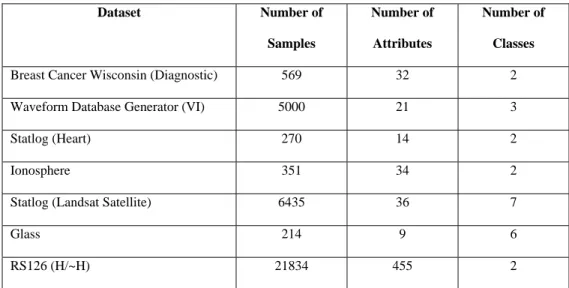
d. For each of the subsets, generate new node with the branch labeled with the fuzzy term of the selected attribute. 5. For each new generated node repeat recursively from step 2. 3.2 Experimental Details To evaluate the performance of the IFID3 algorithm, the algorithm was tested on several standard datasets, and its performance was compared to the performance of several decision tree algorithms. This section will introduce the datasets, discuss data preprocessing steps and the fuzzy membership functions used to fuzzify the datasets and other experimental issues. 3.2.1 Datasets To evaluate the performance of IFID3, we randomly selected six standard UCI‐machine‐ learning repository [42] datasets and one non‐standard dataset. The six standard datasets were selected to represent different application areas. These datasets include: Breast Cancer Wiscon‐ sin (diagnostic) [44] [45], Waveform Database Generator (V1) [35], Statlog (heart) [42], Ionos‐ phere [46], Statlog (Landsat Satellite) [42], and Glass [42] Datasets. The non standard dataset is an encoded version of the protein dataset RS126 [43] pertains to helices. The features of these datasets are described briefly in Table 3.1 [39].
Table 3.1: Datasets Description Dataset Number of Samples Number of Attributes Number of Classes
Breast Cancer Wisconsin (Diagnostic) 569 32 2
Waveform Database Generator (VI) 5000 21 3
Statlog (Heart) 270 14 2
Ionosphere 351 34 2
Statlog (Landsat Satellite) 6435 36 7
Glass 214 9 6 RS126 (H/~H) 21834 455 2 3.2.2 Datasets Preprocessing For experimental purposes, the datasets described in table 3.1 were divided into train‐ ing and testing datasets. During the experiments; if the obtained dataset is already divided into training and testing datasets, we use the existing partitions, otherwise the dataset is partitioned randomly into three folds, such that the ratio of objects belonging to different classes in the da‐ ta folds is the same as that in the original dataset.
3.2.3 Data Fuzzification and Fuzzy Membership Functions
All variations of fuzzy ID3 algorithm require both the training and testing datasets to be in a fuzzy form. Therefore if the datasets are not in a fuzzy form, continuous features in the da‐
tasets need to be fuzzified. To achieve this task, for each continuous feature in a given dataset, we need to determine the number of fuzzy sets to partition the feature range into, and the ap‐ propriate fuzzy membership function. Such information may be provided by experts in the field from which the dataset was obtained. However, such information is seldom available; therefore in our experiments two approaches were examined. In the first approach we divide all the con‐ tinuous features in the dataset evenly into an equal number of fuzzy sets, and the second ap‐ proach we utilized cluster center information to construct the membership functions for all con‐ tinuous features. In both approaches, adjacent fuzzy membership functions cross each other at a membership value of 0.5. We also assumed that the sum of membership values in all fuzzy sets associated with a given datum corresponding to a certain feature value is 1. To determine the optimal number of fuzzy sets, the number of fuzzy sets was treated as one of the parame‐ ters that need to be tuned.
To divide the range of a given feature evenly into n fuzzy sets with trapezoidal member‐ ship function, we need to calculate the four boundary points for each trapezoid. To do so the following algorithm was used: • n = number of Fuzzy Sets. • min = Feature Minimum Value (data in both the training and testing dataset are consi‐ dered for this purpose). • max = Feature Maximum Value (data in both the training and testing dataset are consi‐ dered for this purpose).
• Calculate the range of the feature using the following formula:
Range = max – min (3.1)
• Calculate the following value (HalfOverlap) using the following formula:
HalfOverlap = Range/(4 * n) (3.2)
• Set the trapezoid boundaries representing the fuzzy membership function of the first fuzzy set (most left) as follows: a. First Point = Second Point = min b. Third Point = min + (Range/n) – HalfOverlap c. Fourth Point = min + (Range/n) + HalfOverlap • For i = 1 to n – 2 a. 1st point of the (i+1)th Fuzzy Set = min + (i * Range/n) – HalfOverlap b. 2nd Point of the (i+1)th Fuzzy Set = min + (i * Range/n) + HalfOverlap c. 3rd Point of the (i+1)th Fuzzy Set = min + ((i + 1) * Range/n) – HalfOverlap d. Fourth Point of the (i+1)th Fuzzy Set = min + ((i + 1)* Range/n) + HalfOverlap
• Set the trapezoid boundaries representing the fuzzy membership function of the nth fuzzy set (most right) as follows:
a. First point = min + ((n ‐1) * Range)/n) – HalfOverlap b. Second point = min + ((n ‐1) * Range)/n) + HalfOverlap c. Third Point = Fourth Point = max
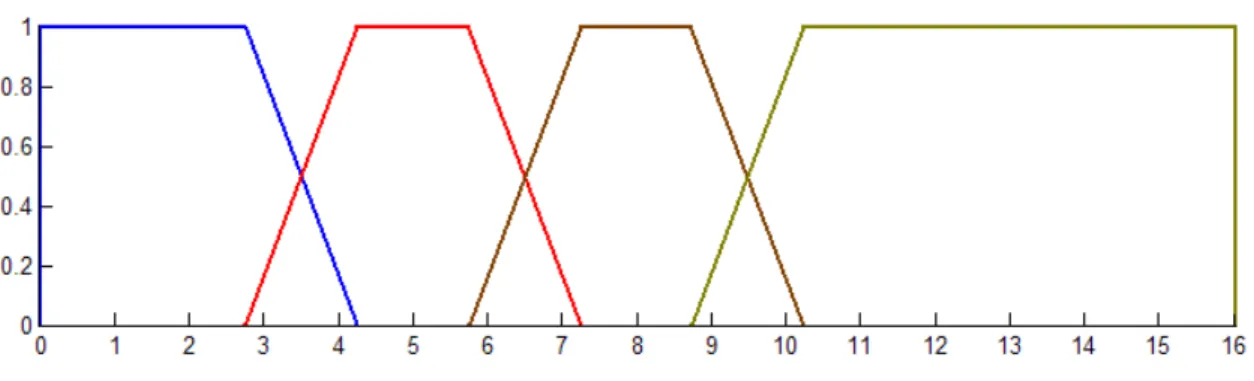
The following example illustrates the above procedure: Assume we have a feature which takes a minimum value of 0 and a maximum value of 16. Assume that we need to divide the
range of this feature into 4 fuzzy sets. First, we set n = 4, min = 0 and max = 16. Next we calcu‐ late the range = 16 – 0 = 16. Next we calculate HalfOverlap = 16/(4 *4) = 1. To generate the four points required for representing the membership function of the first fuzzy set, we set first point = second point = 0, third point = 0 + (16/4) – 1 = 3, fourth Point = 0 + (16/4) + 1 = 5. These are the x‐coordinates for the four points defining the corners of the trapezoid. Since the member‐ ship function value ranges between 0 and 1 we get the following four points {(0,0), (0,1), (3,1), (5,0)}. A similar procedure is used to calculate corners for the membership functions for the rest of the fuzzy sets. Figure 3.1 shows the resulting membership functions. Figure 3.1: Trapezoidal membership function for the feature in the above example To divide the range of a given feature evenly into n fuzzy sets with triangular member‐ ship function, we need to calculate the three boundary points for each triangle. We can also
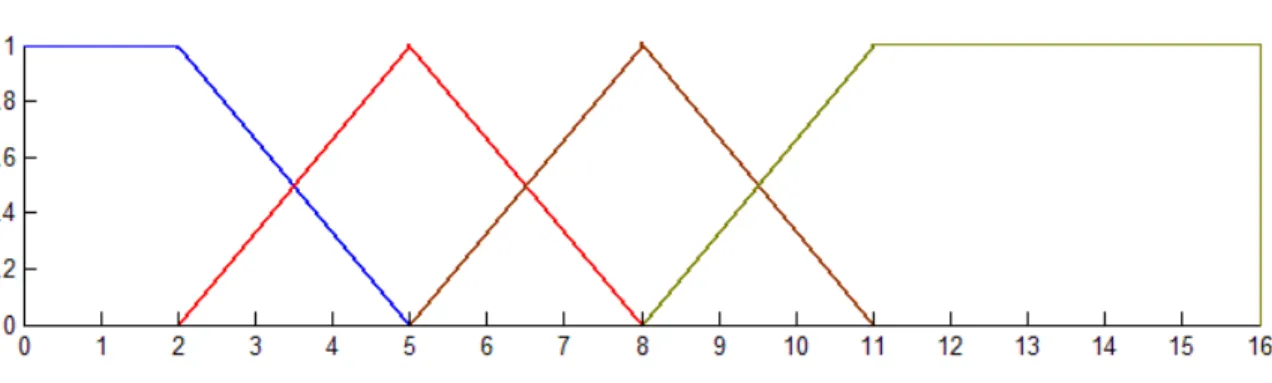
treat the triangular membership function as a special case of the trapezoidal membership func‐ tion with the length of the upper side = 0. The following algorithm was used to divide a feature range evenly into n fuzzy sets with triangular membership function (Notice that the membership function for the first and the last fuzzy sets is not triangular, this is because we wanted to keep the sum of the membership value of any data instance = 1): • n = number of Fuzzy Sets. • min = Feature Minimum Value • max = Feature Maximum Value • Calculate the range of the feature using the following formula:
Range = max – min (3.3)
• Calculate the following value (HalfOverlap) using the following formula:
HalfOverlap = Range/(n + 1) (3.4)
• Set the boundaries representing the fuzzy membership function of the first fuzzy set (most left) as follows: a. First Point = Second Point = min b. Third Point = min + HalfOverlap c. Fourth Point = min + (2 * HalfOverlap) • For i = 1 to n – 2 a. 1st Point of the (i+1)th Fuzzy Set = min + ((Range * i)/(n+1)) b. 2nd Point of the (i+1)th Fuzzy Set = min + ((
![Figure 5.1 [58]: MicroRNA Biogenesis](https://thumb-us.123doks.com/thumbv2/123dok_us/764605.2596721/74.918.140.785.417.997/figure-microrna-biogenesis.webp)
![Table 5.2: Overall Accuracy achieved by our method compared to those reported in the Literature. Datasets 2 through 16 SVM C4.5 kNN Ripper [68] Tri‐SVM 1 RF FDT Accuracy 93.1 88.9 88.9 87.2 89.1 90.7 93.6 1: Results achieved by](https://thumb-us.123doks.com/thumbv2/123dok_us/764605.2596721/86.918.156.764.333.389/overall-accuracy-achieved-compared-reported-literature-datasets-accuracy.webp)