American University in Cairo American University in Cairo
AUC Knowledge Fountain
AUC Knowledge Fountain
Theses and Dissertations2-1-2019
Generating large scale images using GANs
Generating large scale images using GANs
Mohamed Mohsen Mahmoud MohamedFollow this and additional works at: https://fount.aucegypt.edu/etds
Recommended Citation Recommended Citation
APA Citation
Mohamed, M. (2019).Generating large scale images using GANs [Master’s thesis, the American University in Cairo]. AUC Knowledge Fountain.
https://fount.aucegypt.edu/etds/724
MLA Citation
Mohamed, Mohamed Mohsen Mahmoud. Generating large scale images using GANs. 2019. American University in Cairo, Master's thesis. AUC Knowledge Fountain.
Generating Large Scale Images Using GANs
Mohamed Mohsen American University in Cairo, [email protected]
Advisor: Prof. Mohamed Moustafa
This thesis is submitted as a part of the requirements of the Masters of Science in Computer Science Program
Acknowledgements
I would first like to thank my thesis advisor Professor Mohamed Moustafa
for his continuous support throughout this thesis. Whenever I needed
guid-ance, he steered me in the right direction and bared with me the couple of
times we changed the thesis topic.
I would also like to thank my thesis committee for generously devoting
the time to provide the required support and guidance throughout the review
of this document.
I would also like to thank my managers and colleagues in Microsoft for
their flexibility and continuous support. They were always pushing me to
finish my thesis and gave me the time required to finalize my work when I
needed it the most.
I am especially thankful to my wife Sohair Osama, my parents Mohsen
Mahmoud and Basma Abdelrahman, my sister Heba Mohsen, my brother
Ahmed Mohsen, my aunt Iman Abdelrahman, my parents-in-law Osama
Alatroush and Mona Gamal and my friends for their continuous support
throughout my work on this degree. They gave me the push to finish this
work when I most needed it. This work would not have been possible without
them. Thank you.
Author
Contents
I Abstract . . . 1
II Introduction . . . 2
III Problem Definition . . . 4
IV Literature Survey . . . 5
IV.1 Generative Adversarial Networks (GANs) . . . 5
IV.2 Deep Convolutional GANs (DCGANs) . . . 6
IV.3 Laplacian Pyramid Approach (LAPGAN) . . . 6
IV.4 Deep Recurrent Attention Writer (DRAW) . . . 8
IV.5 Super-resolution GAN (SRGAN) . . . 10
IV.6 Image Denoising Networks . . . 11
V Proposed Solution: Combining Super Resolution with GAN . 14 V.1 Approach 1: Separate Training . . . 14
V.2 Approach 2: Joint Training . . . 14
V.3 Approach 3: Combined Network . . . 16
VI.1 Dataset Used . . . 18
VI.2 Evaluation Metrics . . . 18
VI.3 Baseline Approach . . . 19
VI.4 Approach 1: Separate Training . . . 21
VI.5 Approaches 2&3: Joint Training & Combined Network 26 VI.6 Comparison to Baseline . . . 30
VII Conclusion . . . 33
List of Figures
1 Deep Convolutional GAN . . . 7
2 Laplacian Pyramid Architecture . . . 8
3 Deep Recurrent Attention Writer in Action . . . 9
4 Super-resolution GAN Architecture . . . 10
5 Sample results for image hole filling . . . 11
6 Sample results for image denoising . . . 12
7 Block diagram for the separate training approach . . . 15
8 Block diagram for the joint training approach . . . 16
9 Block diagram for the combined network approach . . . 17
10 Baseline Generator architecture used . . . 20
11 Baseline Discriminator architecture used . . . 20
12 Generator architecture used . . . 21
13 Discriminator architecture used . . . 21
14 Samples from generator network . . . 22
16 64x64 pixel samples from the super resolution network
(scal-ing factor 2x) . . . 24
17 128x128 pixel samples from the super resolution network (scal-ing factor 4x) . . . 25
18 64x64 pixel samples from the combined networks . . . 27
19 128x128 pixel samples from the combined networks . . . 28
20 Sample results for the joint training approach . . . 29
List of Tables
1 Evaluation of super resolution network . . . 26
I
Abstract
Generative Adversarial Networks [1] have been used for the task of
im-age generation and has achieved impressive results [2][3]. There is always
a challenge to train networks that generate large scale images since they
tend to be huge and training needs a lot of data. In this work, we tackle
this problem by dividing it into two smaller parts. We first generate small
scale images using GANs then use a super resolution network to enlarge the
generated images resulting in large scale images. Using a super resolution
network helps in adding more details to the image which results in a better
quality image. This technique has been tested with a small amount of data
II
Introduction
In modern days, the amount of data available to train machine learning
algorithms is getting larger, however, the cost of labeling is expensive. Many
of the machine learning approaches require annotated data for training and
testing, therefore, the need for labeled data is growing. One of the solutions
for this problem is to use generated data for training instead of real data.
One of the prominent approaches for image generation is using the
Gen-erative Adversarial Networks [1]. Since GANs make use of two deep networks
that should be trained simultaneously, they are difficult to train. Work has
been done to try and regularize the GANs training [2][3]. However, the
images generated are still small in size (less than 128x128 pixels).
A different stream of work that is tackled using GANs is the image
super-resolution problem [4][5]. This is where the input is a low super-resolution image
and the output is the higher resolution version. This makes use of unlabeled
data. Where a large scale image is downsized and used for the input while
the large scale image is used as a reference for the output.
For this work, we will focus on the task of large scale image generation by
exploring the joint training of GANs along with a super-resolution network.
We explore the different ways of combining super-resolution networks with
generative networks. Our proposed system achieves better results over a
Section III provides a more detailed description of the problem tackled.
A review of current work is presented in section IV. The approach is
demon-strated in section V. Section VI describes the experiments performed and
their results. The conclusion is found in section VII and possible future
III
Problem Definition
Image generation is not an easy problem. Trying to generate large scale
images add complexity to the generation. Complex networks with high
dimensionality inputs and outputs are not easy to train. In this work, we
tackle this problem by providing a way to generate larger images. This is
done by exploring the different ways to integrate a super-resolution network
IV
Literature Survey
IV.1 Generative Adversarial Networks (GANs)
GANs offer a technique for data generation that is based on adversarial
learning [1]. This technique trains two networks simultaneously, a generator
and discriminator network are trained in parallel. The goal of the generator
is to fool the discriminator into thinking that a generated image is real.
While the goal of the discriminator is to identify real vs fake images. As
training progresses, the generator generates more real looking images and
the discriminator gets better at detecting fake images [1].
Training GANs is a very challenging problem because instead of only
training a single network, one has to train the generator and the
discrimina-tor networks simultaneously. Also, for the training to be successful, one has
to make sure that the generator and discriminator are trained at the same
speed i.e. the learning capacity of the networks is similar. If the
discrimi-nator learns faster than the generator, the whole process is affected and the
generator stops learning.
The inherited difficulty and complexity of GANs make them difficult to
IV.2 Deep Convolutional GANs (DCGANs)
Convolutional Neural Networks (CNNs) have shown remarkable results
in the different image classification problems. Work has been done to scale
up the learning capacity of GANs by making use of Deep Convolutional
Networks [2]. The authors came up with a set of architecture guidelines for
stable training of DCGANs [2]. They also suggest using the Adam optimizer
[6] for the training. This approach results in plausible image generation when
trained on the LSUN dataset [7].
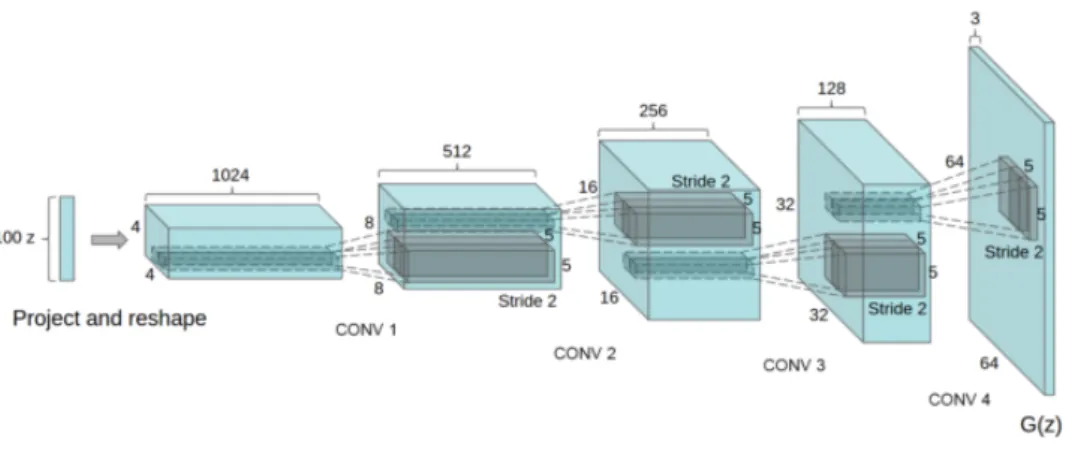
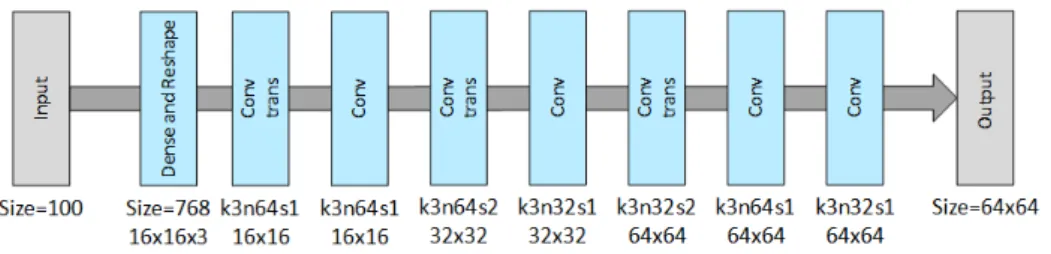
The network uses strided convolutions as shown in figure 1. There are
a total of 4 convolutional layers with a 100 dimensional input vector and
a 64x64 rgb output image. This work shows the power of using deep
con-volutional networks in GANs however, the images generated are not high
resolution images.
This approach increases the learning power of GANs and thus improves
the quality of output images generated by them. However, the deeper and
the more complex the network gets, the more tricky it is to train.
IV.3 Laplacian Pyramid Approach (LAPGAN)
One of the approaches to train GANs is to use a Laplacian pyramid
of Adversarial Networks [3]. This means divides the training problem into
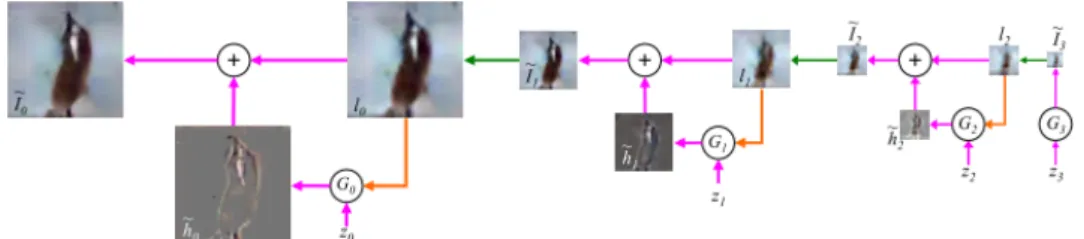
smaller subproblems. As shown in figure 2, a series of Conditional
Figure 1: Deep Convolutional GAN
The architecture of the DCGAN generator network. The input is a 100 dimensional vector and the generated images are 64x64 color images. Image adopted from [2]
layer learns the differential to add to the input image for refinement. The
refined image is then upscaled and moves on to the next CGAN block. The
first block is a normal GAN [1] that generates a small scale image with an
input of a noise vector.
This work makes use of the fact that each CGAN layer is only learning
the differential to add to the input image instead of learning to generate
the image from scratch. LAPGANs were tested on the CIFAR10 [9], STL10
[10] and LSUN [7] datasets and their results show an improvement over the
traditional GAN approach. Human evaluation was done to come with this
conclusion [3]. Images generated using this approach have a dimension of
64x64 pixels.
The success of this approach is due to the fact that it trains for the
differential to improve the image quality. This decreases the amount of data
Figure 2: Laplacian Pyramid Architecture
The architecture of the LAPGAN generator network. Green arrows represent the up-sampling of the images generated at a specific stage to form the input to the next stage. Image adopted from [3]
each layer easier. All of this leads to better quality output images.
IV.4 Deep Recurrent Attention Writer (DRAW)
When drawing, we humans tend to focus on a small part of the picture
at a time and then move on to the next part of the picture. This is modeled
using the attention mechanism [11]. The network chooses a small part of the
image to attend to at a time. A Gaussian kernel composed of a variational
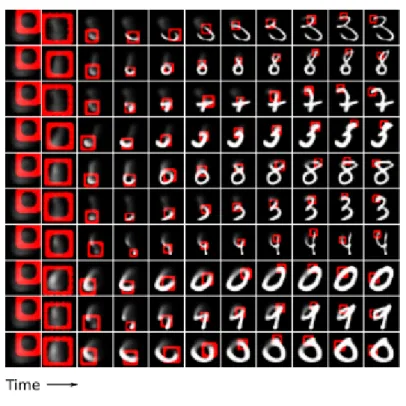
auto encoder is used to generate part under focus. Figure 3 demonstrates
the power of this algorithm in following lines and recursively refining images
generated from the MNIST data [12].
This whole operation is done in a recurrent fashion. Where the area
at-tended to keeps getting smaller as more details are added to the image. This
technique [11] is shown to work on generating MNIST [12] and SVHN [13]
data. However, when generation was tested with the CIFAR10 [9] dataset,
the images produced capture much of the shape structure but are blurred
The success of this approach in generating numerical images and it’s
failure to generate scenery is because of the fact that it focuses on a small
part of the picture at a time, this is good when it comes to tracing lines and
thus generating numbers. However, scenery images do not have the same
structure and thus this approach fails to generate acceptable images in this
scenery images.
Figure 3: Deep Recurrent Attention Writer in Action
The DRAW generator in action. The red squares represent the area of attention of the algorithm. As seen, the algorithm is good at following lines and recursively refining the image. This image is adopted from [11]
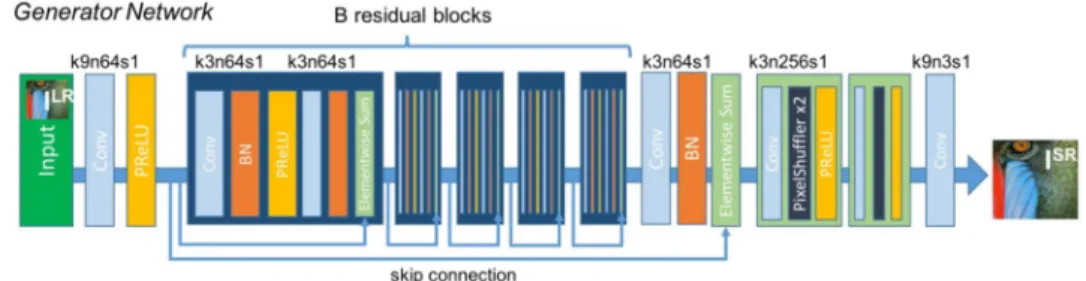
Figure 4: Super-resolution GAN Architecture
The architecture of the SRGAN generator network. As seen, the input images have a dimension of 64x64 pixels and are upscaled with a 4x factor to generate images of 256x256 pixels. Image adopted from [4]
IV.5 Super-resolution GAN (SRGAN)
The use of GANs for super-resolution is demonstrated by SRGAN [4].
This approach trains the discriminator on separating between the original
and fake high-resolution images. On the other hand, the generator takes in
a low-resolution image and generates the high-resolution version. Figure 4
shows the architecture of the SRGAN generator network.
In addition the output of the discriminator, the generator optimizes for
the VGG [14] features loss for the generated and original high-resolution
images. Using this loss function, the authors could successfully upscale
images with a 4x scaling factor.
This technique produces larger scale images (256x256 pixels) than the
previously described algorithms. However, it needs a low resolution image
(64x64 pixels) as input.
Since this approach uses a very deep and complex super resolution
Figure 5: Sample results for image hole filling
This picture shows a comparison between the use of typical convolution layer based networks vs partial convolution layers in solving the problem of hole filling. Image adopted from [15]
IV.6 Image Denoising Networks
Denoising is the problem of removing noise from images or filling in
holes in the image. This problem has been tackled by various learning and
non-learning techniques. In our scenario, we are more interested about the
learning techniques.
The use of partial convolution layers [15] has been explored and it has
shown great results in filling gaps in images. It has been testing by applying
arbitrary shaped hole masks to images and then try to fill in the gaps.
The partial convolution yielded far superior results when compared to the
convolutional networks an example is shown in figure 5.
Another approach that focuses on noise removal is presented in [16].
They have developed a convolutional network with skip connections to
elim-inate the noise and improve the image quality. A sample of the output is
shown in figure 6.
Figure 6: Sample results for image denoising
This picture shows sample outputs of the denoising network. The image on the left is the input image with noise and the image on the right is the corresponding enhanced version. Image adopted from [16]
in [16]. The main problem is that denoising systems expect the input and
output to be of the same resolution. As a workaround, the low resolution
image is upscaled and then fed in the denoising network. By doing this, the
overall system would be taking in a low resolution image and outputting a
V
Proposed Solution: Combining Super
Resolu-tion with GAN
Motivated by the ability of super-resolution networks to produce 8x
higher resolution images, we have explored the different ways to combine
a super-resolution network along with a GAN network. Super-resolution
networks need a pair or low-resolution and high-resolution images to train
where the GAN only needs a random vector. Below are the different
ap-proaches to combine the two systems.
V.1 Approach 1: Separate Training
The first way to combine the systems, is by separately training the
super-resolution network and the GAN on the same dataset. Where the GAN
would be trained to generate low-resolution images and the super-resolution
network would separately learn to enlarge low-resolution images from the
same dataset. Taking the output of the GAN and feeding it in the
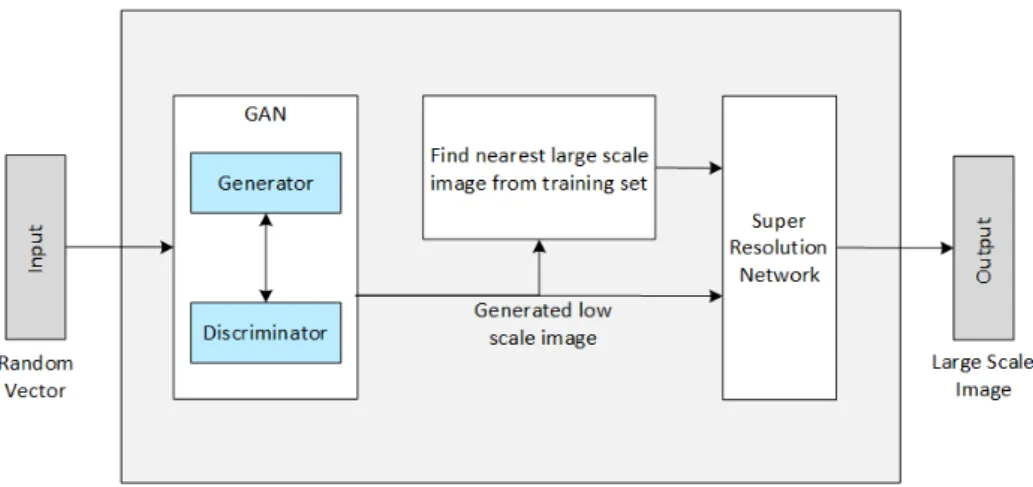
super-resolution network should produce high-super-resolution images. Figure 7 shows
a block diagram of this approach.
V.2 Approach 2: Joint Training
The second approach is to train the super-resolution network on the
Figure 7: Block diagram for the separate training approach
The GAN and Super resolution networks are trained separately and when generat-ing, the output of the generator network is fed in the super resolution network to obtain the large scale image.
approach. This approach aims at adapting the super-resolution network to
the images generated from the GAN. The training steps are outlined below:
1. Train the GAN to generate low-resolution images. This steps
makes use of the power of GANs in generating low-resolution images.
2. Find the closest image from the training dataset. Super-resolution
networks need pairs of low-resolution images along with their
high-resolution counterparts. The GAN already generated the low-high-resolution
version but we still need to find the corresponding high-resolution
im-age. Therefore, we search the training dataset to find the closest image
and use its high-resolution version.
3. Train the super-resolution network. Making use of the
counter-Figure 8: Block diagram for the joint training approach
After the GAN network is trained, training data for the super resolution network is created by generating random images and matching them with the nearest large scale corresponding image from the dataset.
part from the dataset, train the super-resolution network.
V.3 Approach 3: Combined Network
One further step in integrating the super-resolution network with the
GAN would be to train them together. The high level block diagram is
shown in figure 9. This approach makes use of the error from the
super-resolution network to train the generator of the GAN. The training steps
for each epoch are described below:
1. Generate a low-resolution image. Use the generator network from
the GAN to generate an image.
2. Find the closest image from the training dataset. Search the
Figure 9: Block diagram for the combined network approach
The error from the super resolution network is used by the generator network to adapt.
3. Enlarge image using super-resolution network. Use the super
resolution network to increase the image resolution.
4. Consume the error from the super-resolution network to train
the generator. This is the key step, error from the super-resolution
network should be fed back to train the generator as well as the
VI
Experiments
VI.1 Dataset Used
All training was done on the LSUN dataset[7] using the ‘church outdoor’
category. This is the smallest category in the dataset and contains:
• 126,227 training image
• 300 validation image
The images in the dataset do not have a uniform size. All samples
have their smaller dimension equal to 256 pixels or larger. The following
preprocessing steps were done in order to prepare the images:
1. Crop the largest center square of each image
2. Shrink the cropped portion to the required size
VI.2 Evaluation Metrics
Inception Score
Evaluating generative models is a very difficult task since there is no
ground truth to compare to. For that reason, researchers mostly rely on the
human perception of the generated image quality. Recent work proposed a
image quality. It has shown to correlate well with the human perception of
the image quality.
To evaluate the output of generative models, the inception score aims at
measuring two things:
1. The clarity of the objects in the generated images
2. The diversity of the generated images
A classifier model is pre-trained on the imagenet dataset [19] and is used
in the standard inception score calculation. This model is the core of the
calculation, the clarity and diversity of the objects in the generated images
are measured by measuring the output of the classifier for the different
classes of the classifier.
Structural Similarity
Structural similarity [20] computes the similarity between images by
us-ing groups of pixels instead of individual pixels. It takes into consideration
the luminance, contrast and image structure in the similarity computation.
This is one of the metrics that we have used to find the nearest image in the
training set given a generated image.
VI.3 Baseline Approach
Figure 10: Baseline Generator architecture used
The architecture of the generator network for the baseline approach. As seen, the input is a random vector of size 100. Multiple convolutional layers turn that input to an image of size 64x64.
Figure 11: Baseline Discriminator architecture used
The architecture of the discriminator network for the baseline approach. As shown, the input is a 64x64 pixel image and the output is a single value that indicates if the image is authentic or fake.
work, we will use an adapted version of the deep convolutional GAN [2] to
generate large scale images and compare them with the ones generated using
our proposed approaches. The generator network architecture is shown in
figure 10 and the discriminator network architecture is shown in figure 11.
This model is trained with a batch size of 512 images and using the
Adam Optimizer[6] with learning rate of 0.0005 for 50,000 epochs. Results
Figure 12: Generator architecture used
The architecture of the generator network used. As seen, the input is a random vector of size 100. Multiple convolutional layers turn that input to an image of size 32x32.
Figure 13: Discriminator architecture used
The architecture of the discriminator network used. As shown, the input is a 32x32 pixel image and the output is a single value that indicates if the image is authentic or fake.
VI.4 Approach 1: Separate Training
Generative Adversarial Network
A deep convolutional GAN is trained to generate 32x32 pixels images.
The architecture of the generator network is outlined in figure 12 and the
architecture of the discriminator network is outlined in figure 13.
After training various GAN models, it was noticed that the most
impor-tant thing to take care of while training is that the generator and
discrimi-nator networks need to be learning with the same speed. It is quiet easy to
Figure 14: Samples from generator network
Those are 32x32 image samples from the generator network. As noticed, the images do indeed look like churches and some of the samples can be mistaken as real images even by a human eye.
between fake and authentic images. However, such a discriminator results in
the generator not being able to keep up and thus it doesn’t learn anything.
Therefore, the size of the discriminator network is tweaked to maintain an
accuracy of 80% to 90% for the discriminator. This is the sign of a healthy
training.
The model is trained with a batch size of 512 images using the Adam
Optimizer[6] with a learning rate of 0.0005 for 50,000 epochs. A sample
output is shown in figure 14.
Super Resolution network
Different super resolution network architectures are tried out on the
training data and the one that produced the best SNR is the Denoising
Figure 15: Super resolution architecture used
The architecture of the denoising super resolution network used. As seen, the input is a 128x128 image and the output is also a 128x128 image.
The denoising network is initially meant to remove noise from images
without changing their size. To use a denoising network to enlarge images,
a preprocessing step is added to stretch the image using the bilinear
inter-polation before feeding it to the denoising network. Therefore, the whole
system would take in a 32x32 image and output the large scale image. The
same idea is presented in [16].
Training is done using a batch size of 1 and the Adam optimizer[6] with
a learning rate of 0.00001. The optimization function used is the mean
square error. The training evaluation is shown in table 1. Examples from
Figure 16: 64x64 pixel samples from the super resolution network (scaling factor 2x)
The top row is the 32x32 input image, the second row is a stretched version using bilinear interpolation for comparison. The third row is the 64x64 output of the network while the last row is the original large scale image. This network obtained a PSNR of -18.8 on the validation set.
Figure 17: 128x128 pixel samples from the super resolution network (scaling factor 4x)
The top row is the 32x32 input image, the second row is a stretched version using bilinear interpolation for comparison. The third row is the 128x128 output of the network while the last row is the original large scale image. This network obtained
Scaling factor Output Dimensions PSNR
2x 64x64 -18.8
4x 128x128 -22.24
Table 1: Evaluation of super resolution network
PSNR values are calculated on the validation set.
Combined Result
Feeding the output of the generator into the super resolution networks,
gives us 64x64 or 128x128 generated images depending on the super
resolu-tion network used. Figures 18 & 19 show samples of images that are
gener-ated using the combination of the GAN and the super resolution networks.
The super resolution network succeeds in clearly improving the quality of
the enlarged version over the bilinear interpolation by adding some missing
details to the images.
VI.5 Approaches 2&3: Joint Training & Combined Network
These approaches depends on generating images and then finding similar
images from the training set to train the super resolution network. We have
tried out different similarity and error metrics in order to find the nearest
image from the training set.
From the sample results shown in figure 20, we can notice that after
Figure 18: 64x64 pixel samples from the combined networks
The top row is the 32x32 image generated by the generator network. The second row is the stretched version using bilinear interpolation for comparison. The third row is the result of feeding the generator image to the super resolution network to generate a 64x64 version. As noticed, even tough a human eye can tell that those images are not real, they are of very good quality for machine generated images.
After some debugging, we found out that the problem is that the input and
output images used to train the super resolution network are not correlated.
Since we are using a very diverse training dataset, for each similarity metric
a certain type of images dominate the results. Therefore, the nearest image
from the training set is mostly not similar to the generated image. Example
output for the different similarity metrics is shown in figure 21. Without the
ability to really find the most similar image in the training set, approaches
Figure 19: 128x128 pixel samples from the combined networks
The top row is the 32x32 image generated by the generator network. The second row is the stretched version using bilinear interpolation for comparison. The third row is the result of feeding the generator image to the super resolution network to generate a 128x128 version. As noticed, even tough a human eye can tell that those images are not real, they are of very good quality for machine generated images.
Figure 20: Sample results for the joint training approach
The top row is the 32x32 image generated by the generator network. The second row is the stretched version using bilinear interpolation for comparison. The third row is the result of feeding the generator image to the super resolution network to generate a 128x128 version. As noticed, after the super resolution network is applied, the images loose all of their details and are extremely blurred. Those samples are computed using the normalized mean square error.
(a) (b) (c)
Figure 21: Similarity between generated images and training set
In each of the sub figures shown, the image on the left is a random generated image and the image on the right is the corresponding nearest image from the training set. Each of the sub figures, represents a different similarity/error measure sub figure 21a is computed using structural similarity [20] as the similarity measure. Sub figure 21b is computed using the normalized mean squared error as the error function. While sub figure 21c is computed using PSNR as the error measure.
VI.6 Comparison to Baseline
The baseline for this work is the quality of images generated using a
GAN network that is trained on the same dataset. To evaluate the baseline,
a GAN network of the same architecture outlined in figures 12 & 13 is trained
Training a network to generate 128x128 images using a single GAN is a
very compute intensive process that does not fit on the GPU memory. The
network will have to be stripped down for it to fit on a GPU which would
lead to a weaker network and thus misleading results. Therefore, we are
instead doing the comparison for 64x64 images.
For the sake of the comparison, the denoising super resolution network
shown in figure 15 is retrained to generate 64x64 images. In other words,
we needed to change the super resolution network scaling factor from 4x to
2x.
From the training difficulty point of view, the baseline requires a GAN
to generate higher dimensionality images and is thus much more difficult to
train. Using our approach, the network size is much smaller and thus the
training is much easier. Moreover, bigger networks require more data to
train. Therefore, our approach should work better with smaller datasets.
As noticed from table 2, our approach gives better inception score values
on average than the baseline. Which shows it is indeed better than the
Inception Score
Mean Standard Deviation
Baseline Convolutional GAN 3.041 0.110
Our Approach 3.564 0.220
Table 2: Comparison with the baseline
Calculated for a sample of 1024 generated image from each approach, the mean and standard deviation of the inception score are shown in the table.
VII
Conclusion
Based on the results obtained on this small dataset, combining a GAN
with a super resolution system proves more powerful in generating
bet-ter quality images in comparison to only using GAN. This is because the
proposed technique divides the problem into two smaller problems which
makes it more manageable. Also, since the problem is divided into smaller
problems, it is possible to use a very small training set of 126,227 images
VIII
Future Work
Although the current approach already achieved better results over the
baseline, there is room for improvement. An extension to the super
resolu-tion network is to train on more data e.g. the image net dataset[19] and then
adapt it to the domain. Also, noise should be added to the lower resolution
images used in training the super resolution network. This would resemble
the noisy images generated from the GAN which would lead to generating
Bibliography
[1] Ian J. Goodfellow, Jean Pouget-Abadie, Mehdi Mirza, Bing Xu, David
Warde-Farley, Sherjil Ozair, Aaron Courville, and Yoshua Bengio.
Gen-erative adversarial nets. In Proceedings of the 27th International
Con-ference on Neural Information Processing Systems - Volume 2, NIPS’14,
pages 2672–2680, Cambridge, MA, USA, 2014. MIT Press.
[2] Alec Radford, Luke Metz, and Soumith Chintala. Unsupervised
repre-sentation learning with deep convolutional generative adversarial
net-works. arXiv preprint arXiv:1511.06434v2, 2015.
[3] Emily L Denton, Soumith Chintala, arthur szlam, and Rob Fergus.
Deep generative image models using a laplacian pyramid of adversarial
networks. In C. Cortes, N. D. Lawrence, D. D. Lee, M. Sugiyama,
and R. Garnett, editors, Advances in Neural Information Processing
Systems 28, pages 1486–1494. Curran Associates, Inc., 2015.
Photo-realistic single image super-resolution using a generative
adver-sarial network. arXiv preprint arXiv:1609.04802v5, 2016.
[5] Wei-Sheng Lai, Jia-Bin Huang, Narendra Ahuja, and Ming-Hsuan
Yang. Deep laplacian pyramid networks for fast and accurate
super-resolution. arXiv preprint arXiv:1704.03915v2, 2017.
[6] Diederik P. Kingma and Jimmy Ba. Adam: A method for stochastic
optimization. InInternational Conference for Learning Representations
(ICLR), 2015.
[7] Fisher Yu, Yinda Zhang, Shuran Song, Ari Seff, and Jianxiong Xiao.
Lsun: Construction of a large-scale image dataset using deep learning
with humans in the loop. arXiv preprint arXiv:1506.03365, 2015.
[8] Mehdi Mirza and Simon Osindero. Conditional generative adversarial
nets. 11 2014.
[9] Alex Krizhevsky. Learning multiple layers of features from tiny images.
2009.
[10] Adam Coates, Andrew Ng, and Honglak Lee. An analysis of
single-layer networks in unsupervised feature learning. In Geoffrey Gordon,
David Dunson, and Miroslav Dudk, editors, Proceedings of the
volume 15 ofProceedings of Machine Learning Research, pages 215–223,
Fort Lauderdale, FL, USA, 11–13 Apr 2011. PMLR.
[11] Karol Gregor, Ivo Danihelka, Alex Graves, Danilo Rezende, and Daan
Wierstra. Draw: A recurrent neural network for image generation. In
Francis Bach and David Blei, editors, Proceedings of the 32nd
Inter-national Conference on Machine Learning, volume 37 ofProceedings of
Machine Learning Research, pages 1462–1471, Lille, France, 07–09 Jul
2015. PMLR.
[12] Y. Lecun, L. Bottou, Y. Bengio, and P. Haffner. Gradient-based
learning applied to document recognition. Proceedings of the IEEE,
86(11):2278–2324, Nov 1998.
[13] Yuval Netzer, Tao Wang, Adam Coates, Alessandro Bissacco, Bo Wu,
and Andrew Y. Ng. Reading digits in natural images with unsupervised
feature learning. In NIPS Workshop on Deep Learning and
Unsuper-vised Feature Learning 2011, 2011.
[14] Karen Simonyan and Andrew Zisserman. Very deep convolutional
net-works for large-scale image recognition. InInternational Conference on
Learning Representations (ICLR), 2015.
[15] Guilin Liu, Fitsum A. Reda, Kevin J. Shih, Ting-Chun Wang, Andrew
[16] Xiao-Jiao Mao, Chunhua Shen, and Yu-Bin Yang. Image restoration
us-ing very deep convolutional encoder-decoder networks with symmetric
skip connections. In Proceedings of the 30th International Conference
on Neural Information Processing Systems, NIPS’16, pages 2810–2818,
USA, 2016. Curran Associates Inc.
[17] Tim Salimans, Ian Goodfellow, Wojciech Zaremba, Vicki Cheung, Alec
Radford, and Xi Chen. Improved techniques for training gans. In
Pro-ceedings of the 30th International Conference on Neural Information Processing Systems, NIPS’16, pages 2234–2242, USA, 2016. Curran
As-sociates Inc.
[18] S. Barratt and R. Sharma. A note on the inception score. ArXiv
e-prints, June 2018.
[19] J. Deng, W. Dong, R. Socher, L.-J. Li, K. Li, and L. Fei-Fei. ImageNet:
A Large-Scale Hierarchical Image Database. In CVPR09, 2009.
[20] Zhou Wang, A. C. Bovik, H. R. Sheikh, and E. P. Simoncelli. Image
quality assessment: From error visibility to structural similarity. Trans.