World Inventia Publishers
J
ournal of
S
cientific
R
esearch in
P
harmacy
http://www.jsrponline.com/
Vol. 7, Issue 2, 2018 ISSN: 2277-9469
USA CODEN: JSRPCJ
Research Article
ASSESSMENT OF HEALTH RELATED QUALITY OF LIFE IN DIABETES – THE ASSOCIATION OF COMPLICATIONS
WITH EQ-5D SCORES
Dr. M. Pramod Kumar *, Ayyanki Anisha, Butti Karunya, Navab Sumathi, Pawar Avinash
Assistant Professor, Department of Pharmacy Practice, Pulla Reddy Institute of Pharmacy, Hyderabad, Telangana, INDIA.
Received on: 06-02-2018; Revised and Accepted on: 22-02-2018
ABSTRACT
Introduction: The term diabetes mellitus describes a metabolic disorder of multiple etiologies characterized by chronic hyperglycemia with
disturbances of carbohydrates, fat and protein metabolism resulting from defects in insulin secretion, insulin action, or both. Aim: The aim of this study is to describe how diabetic complications influence the health-related quality of life of individuals with Type 2 diabetes using the individual EQ-5D dimensions. Methodology: A prospective observational study conducted for period of six months. The data was collected by forms and analyzed using descriptive statistics.. P-value less than or equal to 0.05 was considered as significant. Clinical Findings: In the present study, it was found that the major complications seen in male and female diabetic patients are impaired vision followed by Anemia, Reduced kidney function, Neuropathy, Foot ulcer. MI and Amputation are the complications less seen in the study. Mobility problems, Pain/discomfort, Usual Activities are mainly seen in both males and females. Conclusion: Individuals with diabetic related complications had reduced Health related quality of life. Life style modifications like weight loss, regular physical activity and smoking cessation may reduce complications in diabetic patients. Regular intake of diabetic medications may improve HRQoL.
KEYWORDS: Type-2 Diabetes, Diabetic Complications, Health Related Quality Of Life, EQ-5D Scores.
INTRODUCTION
Definition:
The term "diabetes mellitus" describes a metabolic disorder of multiple etiologies characterized by chronic hyperglycemia with disturbances of carbohydrate, fat and protein metabolism resulting from defects in insulin secretion, insulin action, or both. The effects of diabetes mellitus include long–term damage, dysfunction and failure of various organs [1].
Types of diabetes:
Type 1 diabetes (T1DM): Usually develops in childhood and adolescence and patients require lifelong insulin injections for survival. Type 2 diabetes (T2DM): Usually develops in adulthood and is related to obesity, lack of physical activity, and unhealthy diets. This is the more common type of diabetes (representing 90% of diabetic cases worldwide) and treatment may involve lifestyle changes and weight loss alone, or oral medications or even insulin injections.
Complications of diabetes:
Diabetes complications are divided into micro vascular (due to damage to small blood vessels) and macro vascular (due to damage to larger blood vessels). Micro vascular complications include damage to eyes (retinopathy) leading to blindness, to kidneys (nephropathy) leading to renal failure and to nerves
*Corresponding author:
Dr. M. Pramod Kumar
Assistant Professor,
Department of Pharmacy Practice,
Pulla Reddy Institute of Pharmacy, Hyderabad, Telangana, INDIA.
* E-Mail: [email protected]
DOI: https://doi.org/10.5281/zenodo.1182746
(neuropathy) leading to impotence and diabetic foot disorders (which include severe infections leading to amputation). Macro vascular complications include cardiovascular diseases such as heart attacks, strokes and insufficiency in blood flow to legs. There is evidence from large randomized-controlled trials that good metabolic control in both type 1 and 2 diabetes can delay the onset and progression of these complications.
If not treated or properly managed, diabetes can result in a variety of complications, including:
Heart disease and stroke, Kidney disease, Eye disease, Erectile dysfunction (impotence), Nerve damage.
Euro-quality of life definition: [2]
EQ-5D is a standardized instrument for use as a measure of health outcome. Applicable to a wide range of health conditions and treatments, it provides a simple descriptive profile and a single index value for health status.EQ-5D is primarily designed for self-completion by respondents and is ideally suited for use in postal surveys, in clinics and face-to-face interviews. It is cognitively simple, taking only a few minutes to complete. Instructions to respondents are included in the questionnaire.
Health related quality of life definition:
Health-related quality of life (HRQOL) is a multi-dimensional concept that includes domains related to physical, mental, emotional, and social functioning. It goes beyond direct measures of population health, life expectancy, and causes of death, and focuses on the impact health status has on quality of life.
Aim of the study:
with diabetes. To investigate the impact of self-reported diabetes related complications on the EQ-5D dimension scores.
METHODOLOGY
A
prospective observational study conducted for period of six months from july-2017 to jan-2018.Based on inclusion criteria [Both genders above 20 years of age having diabetes] and exclusion criteria [pregnancy, lactating and cognitive deficits] the data was collected by forms and analyzed using descriptive statistics. The data collected from the participants was entered into Microsoft excel spread sheet and descriptive statistics were used. For descriptive statistics, we used means and standard deviations. The P values were calculated using graph pad prism, paired t test. P-value less than or equal to 0.05 was considered as significant.RESULTS
1.1. Percentage distribution of patients based on gender:
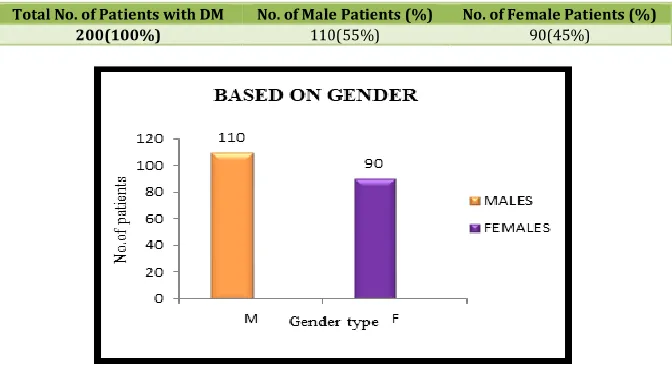
A total of 200 patients were enrolled in the study, the percentage distribution of the study population showed that 110(55%) males and females 90(45%) which are represented in Table-1.1, Figure-1.1.1.
1.2 percentage distribution of patients based on age group: Total distribution of patients with respect to age group shows that majority of patients were found in between the age group 50-59 years i.e. 67(33%), followed by 46(23.5%) in between the age group 60-69 years, 45(22.5%) in between the age group 40-49 years, 20(10%) in the age group ˃70 , 18(9%) in between the age group 30-39 years and
4(2%) in between the age group 20-29 years were represented in table-1.2, figure-1.2.1.
1.3percentage distribution of patients based on complications:
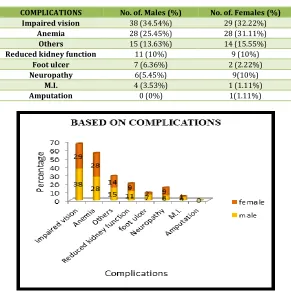
Males: Out of 110 male patients, 38 patients had impaired vision, 28 had
anemia, 11 had reduced kidney function, 7 had foot ulcer, 6 had neuropathy. 4 had M.I., 15 patients had other complications.
Females: Out of 90 female patients, 29 patients had impaired vision, 28
had anemia, 9 had neuropathy, 9 had reduced kidney function, 2 had foot ulcer,1 had M.I., 1 had amputation and 14 patients had other complications. These are represented in table-1.3, figure-1.3.1.
1.4 Calculation of EQ-5D Scores:
For male patients: Eq-5d scores were calculated, mean and standard
deviation for mobility, self-care, usual activities, pain/discomfort, anxiety/depression were found to be 36.66 and 24.54 respectively.
For female patients: Eq-5d scores were calculated, mean and standard
deviation for mobility, self-care, usual activities, pain/discomfort, anxiety/depression were found to be 30 and 10.44 respectively. These were represented in tables-1.4.1 & 1.4.2.
1.5 Calculation of eq-5d scores based on age groups:
Eq-5d scores with level 1(no problem), level 2(moderate problem), level 3(severe problem) based on age groups were calculated and they were represented intables-1.5, figure-1.5.1.
1.6 Association of complications with eq-5d scores: Each
complication is associated with eq-5d scores and represented in tables-1.6, figures-1.6.1.
Table No. 1.1: Percentage Distribution Based on Gender
Total No. of Patients with DM No. of Male Patients (%) No. of Female Patients (%)
200(100%) 110(55%) 90(45%)
Fig. 1.1.1: Percentage distribution based on Genders
Table No. 1.2: Percentage Distribution of Patients Based on Age Group
Age Group (years) No. of Male Patients with DM No. of Female Patients with DM Total No. of Patients (%)
20-29 4 0 4(2%)
30-39 11 7 18(9%)
40-49 29 16 45(22.5%)
50-59 34 32 66(33%)
60-69 23 24 47(23.5%)
˃70 9 11 20(10%)
Fig. 1.2.1: Based on Age Group
Table No. 1.3: Percentage Distribution of Patients Based on Complications
COMPLICATIONS No. of. Males (%) No. of. Females (%)
Impaired vision 38 (34.54%) 29 (32.22%)
Anemia 28 (25.45%) 28 (31.11%)
Others 15 (13.63%) 14 (15.55%)
Reduced kidney function 11 (10%) 9 (10%)
Foot ulcer 7 (6.36%) 2 (2.22%)
Neuropathy 6(5.45%) 9(10%)
M.I. 4 (3.53%) 1 (1.11%)
Amputation 0 (0%) 1(1.11%)
Fig. 1.3.1: Based on Complications
Table no 1.4.1: Calculation of eq-5d scores for Males
Table no 1.4.2: Calculation of eq-5d scores for Females
LEVELS MOBILITY SELFCARE USUAL ACTIVITIES PAIN/DISCOMFORT ANXIETY/DEPRESSION
1 50 63 62 45 87
2 60 46 35 58 12
3 0 1 13 7 1
LEVELS MOBILITY SELFCARE USUAL ACTIVITIES PAIN/DISCOMFORT ANXIETY/DEPRESSION
1 29 39 37 26 72
2 56 44 35 48 17
Table No. 1.5: Calculation of eq-5d scores based on age groups for Males and Females
AGE GROUPS LEVELS % in Male % in Female
20-29 1 13.63% 0%
2 3.63% 0%
3 0.90% 0%
30-39 1 2 18.18% 30% 34.4% 3.33%
3 1.81% 1.11%
40-49 1 2 31.81% 99% 58.88% 27.77%
3 0.90% 2.22%
50-59 1 2 81.09% 60% 87.77% 81.11%
3 5.45% 8.88%
60-69
1 40.90% 35.5% 2 58.18% 78.88% 3 5.45% 18.88%
˃70 1 2 16.36% 20% 31.11% 8.88% 3 5.45% 21.11%
Fig. 1.5.1: eq-5d scores based on age groups
Table No. 1.6: Association of complications with eq-5d scores For males:
levels Imp. vision (%) M.I. (%) Anemia (%) Rkd (%) F.ulcer (%) Neuropathy (%) Amputation (%)
1 94.34 1.81 78.18 13.63 8.18 3.63 0
2 76.36 6.36 50.90 31.81 22.72 20.90 0
3 6.36 0.90 3.63 4.54 0.90 3.63 0
For females:
levels Imp. vision (%) M.I. (%) Anemia (%) Rkd (%) F.ulcer (%) Neuropathy (%) Amputation (%)
1 68.88 1.11 52.22 0 1.11 4.44 0
2 80 4.44 75.55 0 10 31.11 5.55
3 12.22 0 27.77 0 0 14.44 0
Males Females
P-values for complications:
Table No. 1.7.1: P-values for complications
IMP MI ANG RKD F.ULCER NEU AMP OTHERS NONE
Males
NO. 76 13 49 18 8 30 4 15 0
Mean 15.2 2.6 9.8 3.6 1.6 6 0.8 2.6 0
SD ±9.905 ±2.966 ±5.403 ±2.302 ±0.894 ±4.472 ±0.836 ±2.70 0
Females Mean No. 12.6 63 5 1 7.4 37 1.6 8 1 5 4.2 21 0 0 3.6 18 0
SD ±7.436 ±1.414 ±5.77 ±0.894 ±1.224 ±1.923 0 ±2.966 ±0.447
P-Values 0.0011 (S) 0.29 (NS) 1.0 (NS) 0.53 (NS) 0.04 (S) 0.41 (NS) 0.36 (NS) 0.74 (NS) 0.0001
Table No. 1.7.2: P- Values for EQ-5D scores
MOBILITY SELF CARE USUAL ACTIVITIES PAIN/DISCOMFORT ANXIETY/DEPRESSION
Male Level 1 Level 2 50 60 63 46 62 35 45 58 87 12
Level 3 0 1 13 7 1
Female
Level 1 29 39 37 26 72
Level 2 56 44 35 48 17
Level 3 5 7 18 16 1
P-value 0.12[NS] 0.12[NS] 0.15[NS] 0.15[NS] 0.03[S]
DISSCUSSION
In this study, individuals with diabetic related complications had reduced Health related quality of life.
In the present study, it was found that the major complications seen in male and female diabetic patients are impaired vision followed by Anemia, Reduced kidney function, Neuropathy, foot ulcer. M.I. and Amputation are the complications less seen in the study.
More number of complications is seen in age group of 60-69 years followed by 50-59 and 40-49 in both males and females.
In the age group of 20-50yrs, fewer complications are seen. This showed that age is one of the factors influencing health related quality of life.
Eq-5d scores are calculated using 5 dimensions i.e. mobility, self-care, usual activities, pain/discomfort, anxiety/ depression.
Each dimension has 3 levels: level 1- no problem level 2- moderate problem
level 3- severe problem
Mobility problems, pain/discomfort, usual activities are mainly seen in both males and females.
P values are calculated using Microsoft excel sheet and graph pad using paired t test.
P-VALUES for both complications and eq-5d scores were found less than 0.05 considered as significant.
CONCLUSION
I
n this study of individuals with diabetes, by associating complications with eq-5d scores, it was found that the strongest determinants of reduced HRQOL were Impaired vision, anemia, reduced kidney function. Life style modifications like weight loss, regular physical activity and smoking cessation may reduce complications in diabetic patients. Regular intake of diabetic medications may improve HRQOL. Special care and education is needed to control glucose levels in diabetic patients and patient counseling is necessary to avoid complications and to improve HRQOL. More diabetic complications are seen in age group of 50-70 yrs. Therefore special care and patient education is needed to avoid complications. It is the responsibility of all health care professionals to educate the patients regarding lifestyle modifications, diabetic medications which improve the community health status.ACKNOWLEDGEMENTS
W
e would like to thank all those people who made this dissertation possible for us. It is a pleasant task to express our thanks to all those who contributed in many ways to the success of this study. We take this opportunity to express our deep sense of gratitude and respect to our esteemed teacher and guide Dr. M. PRAMOD KUMAR, Assistant Professor, Pulla Reddy Institute of Pharmacy, Hyderabad for his support, guidance and encouragement throughout this work. We would like to express our deepest sincere gratitude to Dr. D. K. SURESH, Head of Department, Pharm D Pulla Reddy Institute of Pharmacy for giving us a unique opportunity to work on such an important topic. We would like to express our heartfelt thanks for his constant moral support. With immense gratitude, we would like to thank our Principal, Dr. RAMA MOHAN GUPTA, Pulla Reddy Institute of Pharmacy, for providing help and support throughout the project. We are also extremely indebted to Management of Pulla Reddy Institute of Pharmacy, for their support throughout our course work.We take this opportunity to express our sincere thanks to, JNTUH for her encouragement.
REFERENCE:
1. World health organization Available at:
http://www.who.int/diabetes/actiononline/basics/en/index3.h tml. (Accessed on: 5/3/15)
2. Oddvar Solli, Knut Spaven, IS. Kristiansen. Health related quality of life in diabetes: The association of complications with EQ-5D scores. Health and quality of life outcomes 2010;8:18.
3. Grandy S, Fox K. EQ-5D visual analog scale and utility index values in individuals with diabetes and at risk for diabetes :findings from the study to help improve early evaluation and management of risk factors leading to diabetes(SHIED). Health and quality of life outcomes 2008;6:18
4. Euroqol Available at: http://www.euroqol.org/about-eq 5d. (Accessed on:8/3/15)
5. Brandly C, Todd C, Gorton T, Symandi E, Martin A. The development of an individualised questionarie measure of perceived impact of diabetes on quality of life. ADDQOL, Qual life Res 1999;8:77-91.
How to cite this article:
M. Pramod Kumar et al. ASSESSMENT OF HEALTH RELATED QUALITY OF LIFE IN DIABETES – THE ASSOCIATION OF
COMPLICATIONS WITH EQ-5D SCORES. J Sci Res Pharm 2018;7(2):18-23
.
DOI:
https://doi.org/10.5281/zenodo.1182746
Conflict of interest: The authors have declared that no conflict of interest exists.