Teaching and Learning Creativity
Bill Nicholl, University of Cambridge, England
Abstract
Creativity is not an easy phenomenon to define and hence understand. Perhaps this is partly the reason why there seems to be ‘issues’ in creativity and design and technology education. Some approaches to understanding creativity have focused on one area, for example the cognitive approach. There are however, a number of
researchers who suggest that there are many inter-related factors that seem to contribute towards understanding creativity. These have become known as multidisciplinary approaches.
This paper outlines one such approach to creativity, Csickszentmihalyi’s ‘Systems Perspective’ for studying creativity. A number of implications and issues will be explored with respect to the teaching and learning of creativity in design and technology (D&T). The teacher it is argued, has a significant role in increasing the likelihood of creativity in the D&T classroom.
This paper is limited to a small case study, but seeks to generate a debate in order to help demystify the phenomenon of creativity, how it may inform practice in the D&T classroom, and ultimately increase the likelihood of creativity for pupils studying D&T.
Key words: creativity, design and technology,
motivation, pedagogy, socio-cultural.
Creativity has become a much debated
phenomenon in both education generally in the UK and D&T in particular (e.g. NACCCE, 1999). I think few D&T teachers would argue that creativity is a desirable educational ‘goal’. The difficulty seems to be trying to define or understand the phenomenon of creativity and how this can inform D&T practice in the classroom and ultimately enable pupils studying D&T to be more creative when designing and making. Creative products can be summarised in broad terms as being novel, effective and ethically sound (Cropley, 2001). Defining creativity as a product however, fails to enable the teacher to understand all the factors that may have contributed to that product being acknowledged as creative. Arguably, this understanding or insight is crucial to the teacher, as this can inform their planning and the strategies they use in the classroom in order to enhance pupils creative potential. Sternberg and Lubart (1999) suggest that there have been six broad research approaches to understand the
phenomenon of creativity. These have tended to understand creativity by studying it from a single perspective or ‘uniperspective’, for example, a cognitive perspective (see Smith, Ward and Finke, 1995). The weaknesses with studying only single perspectives highlighted by Sternberg and Lubart (1999) is that they ignore all the other factors that might enhance creativity. Recent research suggests that there are other emerging approaches, referred to as ‘confluence theories.’ These approaches consider that creativity is a phenomenon that is developed through various ‘multidisciplinary’
approaches. One such theory, is Csikszentmihalyi’s (1999) Systems View of Creativity, which suggests that creativity is as much a cultural and social event as it is a psychological one. I will provide a brief outline of this theory and discuss the implications it has for creativity and D&T. I will also highlight the important role of the teacher within this creative system, by drawing on theories of teaching and learning and a small-scale case study.
The systems approach to creativity developed by Csikszentmihayli (1999) consists of three
components; the domain, the field, and the individual. I will define a simplified version of his systems approach for the purposes of this paper. The domain is the subject area, in this case design and technology. Each domain has a symbolic system and natural language. Traditionally the symbolic language was based in the handicrafts, namely woodwork and metalwork, where the emphasis was on developing knowledge of materials and practical skills. The symbolic language has since been based on the D&T National Curriculum (QCA, 1999) Programmes of Study (PoS), where the emphasis has changed. Although, creativity does not feature explicitly in the PoS itself, there is a reference to creativity in the National Curriculum (DfES, 1999:15). The
document claims that pupils studying D&T, ‘learn to think creatively,’ and that pupils become, ‘creative problem solvers.’ Furthermore, pupils think divergently by, ‘developing a range of ideas,’ have an ‘understanding of aesthetics,’ and ‘become innovators ‘. In the author’s experience this rhetoric does not match the reality of the classroom. There are many reasons for this and these have been reported previously (see Kimbell, 2000; OFSTED, 2001;Barlex 2003).
The Field consists of people who decide what is acceptable within a domain. They are the ‘gatekeepers,’ as they sanction what should be included in the domain. At a micro level, these could be classroom teachers of D&T. Csikszentmihalyi (1999) suggests that teachers make judgements about the pupils’ work, their portfolios and products and by implication what is accepted or sanctioned into the domain. It could be argued that teachers of D&T have a say in what creativity means, and therefore is accepted as creative in the domain of D&T. Czikszentmihalyi (1999) maintains that true creativity will not take place unless it has been accepted by the field. In other words, a pupil’s work can be original, but not truly creative unless it has been ‘socially validated’ or accepted by the field into the domain. This has implications for D&T and I shall return to these in due course.
The third component of Csikszentmihalyi’s systems approach is the individual. Individuals in D&T are the pupils who study the subject. Crucially, he argues that for true creativity to take place, these individuals need access to the domain and want to learn and perform according to it’s rules. It implies that motivation (discussed later) and cognitive factors, such as divergent thinking (see Guildford 1967) are important, but what is usually ignored is how these aspects of the individual interact with the state of the domain and the field. This,
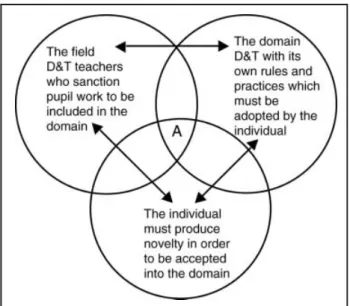
Csikszentmihayli (1999) maintains, is where the wider social and cultural (socio-cultural) factors as well as cognitive factors in the individual are needed in order for true, meaningful creativity to occur. Creativity is likely to occur at the intersection of the domain, field and the individual (see Figure 1).
Figure 1: Simplified from Csikszentmihalyi systems view of creativity, (1999: 315).
Although the domain is set out in the PoS, teachers can quite rightly interpret the domain, and also decide on the teaching strategies they want to use in order for pupils to access and understand the domain. It could be argued that D&T teachers’ interpretation of the domain is shaped by, among other things, their values, beliefs, attitudes and understanding of designing and creativity. Teachers literally hold the creative key, to the creative door, through which pupils access the creative aspects of the domain. Csikszentmihalyi (1999) suggests that pupils’ work is only accepted into the domain if it is accepted by the field, the teachers of D&T. This then, has implications for enhancing creativity in D&T. This is another important factor and will be discussed in due course.
An important aim of D&T teachers is to transform knowledge of their subject into what Shulman (1986) termed pedagogical content knowledge.
Pedagogical knowledge is developed through planning, preparing and teaching lessons and is ‘that special amalgam of content and pedagogy that is uniquely the province of teachers, their own special form of professional understanding’ (Shulman, 1987:8). It goes beyond simply having good subject knowledge. In D&T teaching it encompasses effective planning in response to an understanding of common learning difficulties which pupils have with D&T concepts, an awareness of the intuitive ideas already held by pupils before they encounter school D&T, and an ability to access existing resources and materials to teach the subject. This pedagogical framework, sometimes referred to as craft knowledge, helps teachers ‘develop their repertoire of responses,
understandings and magical tricks.’ (Grimmett and MacKinnon, 1992: 441).
Traditionally, the pedagogy associated with the handicrafts has involved the teacher transmitting his/her knowledge of skills and processes often via instructing pupils through whole class
demonstrations. Pupils produced their version of the teachers ‘blueprint’ and accuracy and quality of craft finish were highly valued. Murphy & McCormack’s (1997, 2003) research findings reported a similar pedagogy exists in D&T classrooms today. They describe the current pedagogy as, ‘authoritarian,’ that learners are, ‘passive receivers of information, knowledge and skills.’ Furthermore, pupils problems with learning, ‘rest with the learner and not the teacher,’ and that motivation to learn is, ‘not an attribute of pupils.’ One could argue that these traditional pedagogies and the creative aspects of the domain are not complementary. Perhaps alternative pedagogical frameworks are necessary in order to increase the likelihood of creativity.
Although the three components outlined in Csikszentmihayli’s System (1999) are inextricably interwoven, he maintains that the field has a crucial influence on the domain and hence creativity. To effect most change in his system, Csikszentmihayli argues one should start at the field and not with the individual. Based on my own school experience I agree with the importance Csickszentmihayli gives to the field, and the teacher of D&T and the potential impact this has on enhancing creativity:
‘...how much creativity there is in any given time is not determined just by how many original individuals are trying to change domains, but also by how receptive the fields are to innovation. It follows that if one wishes to increase the frequency of creativity, it may be more advantageous to work at the levels of fields than at the level of individuals.’
(Csikszentmihalyi, 1999: 327)
In order to exemplify this, a small case study
approach will be used to suggest that the field was a significant factor in the production of creativity in an 11-18 inner city comprehensive school. The author was head of department at school X. The
department had a reputation for creative and innovative work (see appendix A). Three teachers and ten ex pupils were interviewed by email. Participants answered one open-ended question, ‘What made D&T work at school X?’ All the
participants’ responses were followed up with further questions asking them to clarify, explain further, or give examples of their original responses. Pupils were selected by convenience sampling and
included pupils who had studied D&T at GCSE level only, A’ level, AS level and GNVQ. No
generalisations are inferred by the author.
The domain ‘presupposes a community of people who share ways of thinking and acting-who learn from each other and imitate each others actions’ (Csikszentmihalyi, 1999: 316). The domain is ultimately made up of both teachers and pupils. However, the pupils access the information in the domain and ultimately their work is accepted into the domain via the teachers in the first instance. It is important therefore, that not only teachers share the same set of values and beliefs, but ultimately the ‘system’ allows the pupils to have access to, and ultimately share and practice, the same set of values and beliefs. The department members at school X, comprised a traditional ‘maker’, and one product-interior-graphic and 3D designer. We passionately believed in both design and technology. We also believed that a product should function, as well as have visual and sensory qualities. Creativity was important to all of us:
‘Teaching both design (emphasised) and practical work was most important ‘ (Teacher CM).
As a materials ‘team’, we had a diverse and complementary range of subject knowledge and skills. Each teacher knew their strengths, or areas of expertise, but also their weaknesses. Teachers worked in collaboration to help each other and ultimately, the pupils, regardless of the pupils individual teachers taught. There was mutual respect for each other in the department and all members had something to offer the subject, with respect to the domain’s knowledge and skills, and this included sharing teaching strategies and resources:
‘I felt a valued member of the team which needed all the team players to function well’ (teacher AC).
We not only had a passion for the subject, but also for teaching D&T. It was interesting to note that two of the teachers used the same type of language when talking about the collegiate approach of the department:
‘All staff were from the same school of thought,’ (teacher CM)
and,
‘Everyone was singing from the same hymn sheet’ (teacher DS).
All pupils who were interviewed spoke of teacher expertise, values and the passion they, the teachers, had for the subject and how this was noticeable to them as pupils. It is important that teachers value and have positive attitudes towards creativity, in order for pupils to access the culture of the domain. Csickszentmihayli (1999) argues that it is these very attitudes and beliefs, that society (the field) affects the incidence of creativity: Pupils commented:
‘Sometimes there would be six and seven not necessarily discussing our own work but an area, a movement and what we thought about design and this added to the atmosphere.’ (Pupil, LP)
‘The motivation lay largely in your [the teachers] enthusiasm for your subject. This was infectious and, I think, always is in a teacher, for their love of the subject is passed on to the students and inspires them with a desire to achieve in the particular subject. Thus is kindled a readiness to attempt difficult and ambitious tasks, for the enthusiasm of the teacher assures them that they are able to achieve such tasks.’ (Pupil, LMP)
‘The natural enthusiasm and passion for their [teachers] subject was clearly evident, which reflected in the marks and attitudes of the students and made the subject enjoyable and inspiring!’ (Pupil, SM)
As well as having shared beliefs and positive attitudes towards creativity, the role of the teacher is to try and transform subject knowledge into
pedagogical content knowledge. We attempted to teach pupils how to design, as well as develop the practical skills and technological knowledge necessary to realise their creative ideas and solve creative design problems. To exemplify this, I will discuss two interrelated problems we found many pupils have when designing. Firstly, we found pupils did not have the necessary drawing skills and thus could not articulate their thinking. Developing drawing skills was important as they provided pupils with the necessary ‘tools’ in order to articulate their thoughts, although it is by no means the only way of doing this. We developed these skills throughout Key Stages 3 and 4:
‘Simple things you taught me to add to my designs really lifted the drawings off the page and made me feel like my work wasn’t completely lagging behind everyone else,’ (Pupil, PF).
Mastering drawing skills however, does not overcome another problem we found pupils encountered when designing, namely, using these skills to generate original and novel design ideas. It is this that I would like to discuss with respect to pedagogical content knowledge, creativity and Csikszentmihalyi’s systems model.
Faced with a blank piece of paper pupils would often copy football club or corporate logos, or products from the Argos catalogue (see figure 2). This, we felt, stifled creative or divergent thinking that favours multiple answers (or design ideas), the production of novelty, and ideas that do not already exist (see Guildford, 1967). Perhaps pupils did not know any different, or the task we had set them, to generate many ideas, was too difficult for them to do on their own:
‘You really wanted to try and come out with something new and original but this can be quite difficult,’ (Pupil, GP).
One teacher observed‘:
Many pupils use design clichés/logos/cartoon characters and call them ideas. This stops original thought stone dead.’ (Teacher, D).
The difficulty with this type of ’task’ is exemplified by Krathwohl’s (2002) revision of Bloom’s Taxonomy (Bloom et al,1956) where he suggests that to ‘create’ is the highest order cognitive process. We banned the Argos catalogue as a means of research and form of inspiration. We knew, however, that we had to replace the catalogue with other creative thinking strategies and ‘scaffold’ (Woods, Bruner, Ross, 1976), these to enable pupils to think more divergently.
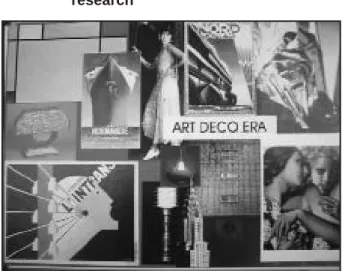
Alexander defines teaching as, ‘the act of using method x to enable pupils to learn y’ (Alexander, 2000:323). We developed a number of creative thinking ‘methods’, one of which was to use mood boards (see figure 4 and 5) to help pupils analyse design problems and products, to gain an
understanding and appreciation of historical and contemporary design history and culture, and to appreciate the work of eminent designers. Natural forms and materials were also used as sources for inspiration. Mood boards are ‘assemblages of images and, less frequently, objects which are used to assist analysis, creativity and idea development in design activity,’ (Garner & McDonagh, 2000: 57). These mood boards were sometimes developed by the teacher but often developed by the pupils themselves.
Strategies such as developing mood boards were complemented with other strategies and these too played their part in the pupils’ socio-cultural learning environment and, ultimately, helped develop their creative potential. Many pupils spoke of the ’freedom,’ they had with respect to choosing to do their own or materials and processes:
‘We could produce more or less what we wanted.’ (Pupil, LMP).
Pupils were encouraged to think laterally by taking ‘sidesteps or detours’ (de Bono, 1991), to go down avenues they wanted to explore or were interested in:
‘Being encouraged to look for alternative methods and materials was great.’ (Pupil, KC).
Many of the pupils referred to the teachers as being, ‘very approachable,’ and,’easy to talk to.’ All the pupils commented on the ‘supportive environment,’ and how helpful the teachers were when they were designing and making:
‘All the teachers were extremely willing to help which meant the students felt encouraged and didn’t go into projects on their own without the teachers guidance. Students knew they could have an idea and go over it with a teacher and they would guide them through,’ (Pupil, GP).
Another student commented: ‘Our ideas were always helped to their full potential by the teacher,’ (Pupil, LMP). These are some of the necessary characteristics Csikszentmihalyi (1996) calls a ‘congenial’ environment and stresses the importance of the social support system. Both Alexander (2000) and Vygotsky (1978) believe that dialogue and social interaction, (both peer to peer and teacher and pupil), are important for effective learning to take place. The following pupil observations are particularly poignant:
‘If we came up with a crazy idea you wouldn’t say, “ No Louisa, don’t be ridiculous you can’t do that. That is too ambitious.” We would find ways of getting around it and producing it and that was great. You didn’t feel either you were crazy or that you were asking too much, or that you were a stupid student and no one looked down on you. We just kind of fitted what we wanted to do to the syllabus and that was great! It wasn’t a “No!” ‘(Pupil, LP)
‘When I say faith you had in me I mean when my self confidence was low and I thought I would fail you would encourage me and have complete faith in me.’ (Pupil, PF).
All of these strategies helped pupils to avoid a ‘linear design’ process (Atkinson, 2002) that
arguably promotes more conventional thinking which can be described as sequential and logical (Cropley, 2001). These strategies allow designers to think simultaneously (Lawson, 2002) or in parallel (de Bono 1994). Pupils commented how teachers used strategies that: ‘Continuously layered our
understanding of design, and teaching new skills and ideas’. (Pupil, JA). Another pupil commented:
‘Lots of help in learning the different stages of designing, worksheets and layout ideas and key words to help you analyse, gave pupils the confidence they need in their own work to begin developing their own style and way of working and as this confidence grew the learning aids lessened.’ (Pupil, SM).
Figure 2: Pupil work showing Argos catalogue research
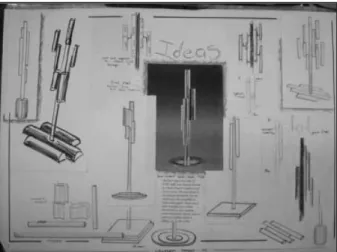
Figure 3: Pupil work showing ideas based on research
Figure 5: Drawings from a pupil’s mood board
Projects and tasks within projects, were described as, ‘challenging,’ ‘interesting, ‘’exciting,’ and,
‘motivating’. Pupils also liked the fact that they were ‘trusted’ and given ‘responsibility, for their own learning,’ as this made them feel like adults. These factors, the pupils expressed, really motivated them. Amabile (1983, 1996) research findings suggests that motivation, and in particular intrinsic motivation, plays a significant role in the high levels of creativity within a subject domain. Intrinsic motivation comes from within and is defined as the ‘motivation to engage in an activity primarily for it’s own sake, because the individual perceives the activity as interesting, involving, satisfying or personally challenging.’ (Collins & Amabile, 1999:299).
Conclusions
Creativity is a difficult phenomenon to study and therefore, to define and understand. This paper has tried to outline a multidisciplinary approach to
creativity and raises some of the implications this has for the teaching and learning of D&T in secondary schools in England. The teacher, it is argued, has an important role to play within this system. Firstly, teachers of D&T must attempt to understand, value and have positive attitudes towards creativity. Only then, it is argued, can pupils access and eventually become part of the creative D&T domain, as it is the teachers who ‘sanction’ creative work. This has implications for the teaching and learning of D&T. Pedagogical content knowledge, that is, the teaching and learning strategies used to enhance creativity in the classroom, need to be developed, and this should consider the learning difficulties and misconceptions pupils have with the more creative D&T concepts. These may be developing creative thinking strategies such as de Bono’s thinking skills, but also includes the more social and cultural strategies that seem to be important factors for creating an environment that is conducive to the
teaching and learning of creativity. This paper has limitations, but aims to contribute to the on-going debate and ultimate educational goal of developing the creative potential in pupils who study D&T in schools in England.
References
Alexander, R. (2000), Culture and Pedagogy:
International Competition in Primary Education,
Blackwell Publishing, Oxford.
Amabile, T.M. (1983), The Social Psychology of
Creativity, Springer-Verlag, New York.
Amabile, T.M. (1996), Creativity in context: Update
to Social Psychology of Creativity. Boulder, CO:
Westview.
Atkinson, S (2002), ‘Does the need for high level performance curtail the development of Creativity in Design and Technology Project work?’ in Owen-Jackson G. (ed) Teaching Design and Technology in
Secondary Schools, RoutledgeFalmer, London.
Barlex, D. (2003), Creativity in Crisis Design and
Technology at KS3 and KS4: DATA Research Paper No 18, Design and Technology Association,
Wellesbourne.
Bloom, B.S., Englehart, M.D., Furst, E.J., Hill, W.H., and Krathwohl, D.R. (1956), Taxonomy of
Educational Objectives: The Classification of Educational Goals. Handbook 1: Cognitive Domain,
David Mackay, New York.
Collins, M. A. and Amabile, T.M. (1999), ‘Motivation and Creativity,’ in Sternberg, R.J (ed), Handbook of
Creativity, Cambridge University Press, Cambridge.
Cropley, A. J. (2001,) Creativity in Education and
Learning: A Guide for Teachers, Kogan Page
Csikszentmihalyi, M. (1996), Creativity: Flow and the
Psychology of Discovery and Invention, Harper
Collins, New York.
Csikszentmihalyi, M. (1999) ’Implications of a Systems Perspective for the Study of Creativity’ in Sternberg, R.J (ed) Handbook of Creativity, Cambridge University Press, Cambridge.
de Bono, E. (1991) Handbook for Positive
Revolution, Viking, New York.
de Bono, E. (1994) Parallel Thinking, Penguin, London.
DfES (1999), Design and Technology The National
Curriculum for England and Wales, DfES/QCA,
London.
Garner & McDonagh, (2000), ‘Problem interpretation and resolution via Visual Stimuli: The Use of ‘Mood Boards’ in Design Education, International Journal of
Art and Design Education , 20, 1.
Grimmett, P and MacKinnon, A. (1992), ‘Craft Knowledge and the Education of Teachers’ in
Review of Research in Education, 18, 385-456.
Guildford J.P. (1967), The Nature of Human
Intelligence, Mcgraw-Hill, New York.
Kimbell, R. (2000) ‘Creativity in Crisis’, in R. Kimbell (ed), The Journal of Design and Technology
Education, Vol. 5, 3, 206-211.
Krathwohl, D. R. (2002), ‘A Revision of Bloom’s Taxonomy: An Overview’ in Theory into Practice, Vol 41, 4, 213-218.
Lawson, B. (2002), How Designers Think: The
Design Process Demystified Third
Edition,.Architectural Press.
Murphy, P. & McCormack, R. (1997), ‘Problem Solving in Science and Technology Education’, in
Research in Science Education, 27, 3, 461-481.
Murphy, P. & McCormack, R. (2003), ‘The Place of Pedagogy’, in D Barlex (ed) Creativity in Crisis,
Design and Technology at KS3 and KS4, Research Paper No 18, Design and Technology Association,
Wellesbourne.
NACCCE (1999), All Our Futures (National Advisory Committee on Creative and Cultural Education). DfEE, Suffolk.
OFSTED, (2001/2), Ofsted Subject Reports
Secondary Design and Technology. Retrieved 28th
April 2004 from the World Wide Web: www.dfes.org.uk
QCA (1999) The National Curriculum for England:
Design and Technology, DfEE/QCA, London.
Shulman, L. (1986), ‘Those Who Understand: Knowledge Growth in Teaching’ in Education
Researcher, 30, 7, 3-9.
Shulman, L. (1987), ‘Knowledge and Teaching: Foundations of the New Reform’, in Harvard
Educational Review, 57, 1, 1-22.
Smith, S. M., Ward, T.B., and Finke, R.A. (eds) (1995), The Creative Cognition Approach, MIT Press, Cambridge, MA.
Sternberg, R.J. and Lubart, T.I. (1999), ‘The
Concepts of Creativity: Prospects and Paradigms’ in Sternberg, R.J (ed), Handbook of Creativity,
Cambridge University Press, Cambridge.
Vygotsky, L. (1978), Mind in Society: the
Development of Higher Psychological Processes.
Harvard University Press, Cambridge, MA.
Wood, D., Bruner, J., and Ross, G. (1976), ‘The Role of Tutoring in Problem Solving,’ in Journal of
Psychology and Psychiatry, 17, 89-100.
Appendices
Appendix A
Appendix C
Appendix D
Appendix E