University of North Dakota
UND Scholarly Commons
Theses and Dissertations Theses, Dissertations, and Senior Projects1-1-2011
A Case Study: Transitioning From A Five-Day
School Week To A Four-Day School Week
Brian Duane DuchschererFollow this and additional works at:https://commons.und.edu/theses Part of theEducation Commons
This Dissertation is brought to you for free and open access by the Theses, Dissertations, and Senior Projects at UND Scholarly Commons. It has been accepted for inclusion in Theses and Dissertations by an authorized administrator of UND Scholarly Commons. For more information, please contact
Recommended Citation
Duchscherer, Brian Duane, "A Case Study: Transitioning From A Five-Day School Week To A Four-Day School Week" (2011).Theses and Dissertations. 1193.
A CASE STUDY: TRANSITIONING FROM A FIVE-DAY SCHOOL WEEK TO A FOUR-DAY SCHOOL WEEK
by
Brian Duchscherer
Bachelor of Science, Minot State University, 1987 Master of Education, Northern State University, 1994 Education Specialist, North Dakota State University, 2003
A Dissertation
Submitted to the Graduate Faculty of the
University of North Dakota in partial fulfillment of the requirements
for the degree of Doctor of Education
Grand Forks, North Dakota December
TABLE OF CONTENTS
LIST OF FIGURES ... viii
LIST OF TABLES ... ix
ACKNOWLEDGMENTS ... xi
ABSTRACT ... xii
CHAPTER I. INTRODUCTION ...1
Purpose of the Study ...5
Research Questions ...5
Researcher’s Background ...6
Significance of the Study ...7
Delimitations ...10
Definitions...10
Acronyms ...11
Organization of the Study ...11
II. REVIEW OF LITERATURE ...12
Introduction ...12
Constructive Controversy Theory ...12
Alternative School Schedules ...17
Online School...18
Alternative School ...19
History of the Four-day School Week ...20
Concerns of the Four-day School Week ...24
Childcare ...24
Longer School Day ...25
Academic Concerns ...26
Politics and Community ...28
Benefits of the Four-day School Week ...30
Financial ...30
Educational ...32
Employee ...34
Reasons to Change to a Four-day School Week ...37
Reinvestment in Transitioning ...40
Conclusion ...41
III. METHODOLOGY ...42
Subjects ...43
The North Central School District ...44
Data Collection Method ...45
Reliability ...46
Data Analysis ...46
IV. DATA RESULTS ...50
Analysis of Interview Data ...50
Analysis of Public Documents ...61
Analysis of Public Meeting Questions ...61
Analysis of Public School Board Meeting Minutes ...65
Analysis of Administrator Documents...65
V. SUMMARY, DISCUSSION, CONCLUSIONS, LIMITATIONS, AND RECOMMENDATIONS ...69 Summary ...69 Discussion ...70 Teachers ...73 Classified Personnel ...73 Parents ...74 Students ...74 Expected Outcomes ...75 Unexpected Outcomes ...75 Conclusions ...77 Limitations ...78
Recommendations for Educators ...79
Recommendations for Further Study ...79
APPENDICES ...81
Appendix A: Department of Education Application Requirements ...82
LIST OF FIGURES
Figure Page
1. Cooperative context of constructive controversy theory
LIST OF TABLES
Table Page
1. Interview Question #1: What do you believe led the district
to transition to a four-day school week? ...51 2. Interview Question #2: What was the decision making
process for your district to transition from a five-day school
schedule to a four-day school schedule? ...52 3. Interview Question #3: What was different during the transition
than what your research indicated to you? ...53 4. Interview Question #4: Describe the teachers’ response to
the change ...54 5. Interview Question #5: Describe the classified personnel
response to the change ...54 6. Interview Question #6: Describe the parents’ response
to the change ...55 7. Interview Question #7: Describe the students’ response
to the change ...55 8. Interview Question #8: What unexpected problems have
developed that you were not anticipating? ...56 9. Interview Question #9: Describe the unexpected benefits
or positive experiences that you were not anticipating ...57 10. Interview Question #10: If you could, what would you
do differently throughout the transition process? ...57 11. Interview Question #11: What would you recommend to
other school districts contemplating this move to a
12. Interview Question #12: Have you thought about returning
to a five-day school week and why? ...59 13. Interview Question #13: What were the resources used
to guide your transition? ...60 14. Interview Question #14: What curriculum changes were made? ...61
ACKNOWLEDGMENTS
The University of North Dakota cohort program has been a great experience for me. I have met other educational leaders from the states of Minnesota and North Dakota. I would like to thank the other cohorts in the program for challenging me and making me a better educational leader. I would also like to thank the faculty of the University of North Dakota for providing a quality educational experience.
I would like to thank the faculty committee members (Dr. Sherryl Houdek, Dr. Gary Schnellert, Dr. Pauline Stonehouse, Dr. Kari Chiasson, and Dr. David Yearwood) for guidance and willingness to serve on my committee. I would especially like to thank my advisor, Dr. Sherryl Houdek, for her support and advice throughout my doctoral program and during my dissertation study. I would also like to thank Sharon Fields for editing and Sandy Krom for formatting my dissertation.
I would like to thank the North Central school district and the administrative team for their willingness to be involved in the case study research. I would especially like to thank the superintendent of the North Central school district for working closely with me on this study.
ABSTRACT
For over a century, most PK-12 schools across the United States have been using the same format of five days of school a week for approximately 9 months a year. The discussion of a four-day school week is being considered as many school districts try to balance their budgets each school year. Some schools in the past 30 years have begun changing to a four-day school week. The four-day school week can create controversy within a community, concerns among parents and students, and benefits for the school district as well as for parents and students. The researcher studied one rural school district transitioning from a five-day school week to a four-day school week. The
purpose of the study was to identify what made a rural school district decide to transition to a four-day school week, how the school district accomplished this new delivery of PK-12 education, and to identify perceptions regarding this transition.
The case study was completed with one rural Minnesota school district. The researcher conducted on-site interviews with school administration and one school board member, and gathered school district data from the past three years to review and identify how the school district changed to a four-day school week.
The results from the data collected indicated the school district transitioned to a four-day school week because of financial reasons. The school district did not want to reduce educational opportunities for students by eliminating class offerings or cutting teaching positions. The data indicated, after experiencing the four-day school week, most
students, parents, and teachers favored the new four-day school week compared to the previous five-day school week. The main concerns identified by the participants and data reviewed were younger students adapting to the longer school day, extracurricular
adjustments, upset classified personnel, how much money would the district save, and tired employees at the end of the four-day week.
CHAPTER I INTRODUCTION
The discussion of a four-day school week is being considered in states as school districts try to balance their budgets each school year. State legislatures and state education departments across the country are being asked by local school boards and school superintendents for legislation or approval to allow school districts to move from the traditional five-day school week to a four-day school week. Twenty-three states currently do not allow school districts to change to a four-day school week because the law requires students in those states to attend a minimum number of days (“The Four-day School,” 2009). Six states (Delaware, Idaho, Montana, Nebraska, Oregon, and South Dakota) measure instructional time in hours not days (Zaleski & Colasanti, 2008). School districts in 17 states are already running four-day school week schedules. The supporters of changing to a four-day school week from the traditional five-day school week believe the four-day school week will save money, the current school calendar is an outdated schedule from the turn of the 20th century, and current laws do not have to be as restrictive (Hupp, 2008). The four-day school week opponents have concerns that the longer school day will cause students to become fatigued during the day. Opponents also state students with special needs will have difficulty retaining material during the extra day off. “There appears to be concerns for high risk students and students with
student misses school (Gaines, 2008). Parents of young children have concerns about finding childcare on the off days with the four-day schedule. “Christina Long, a mother of three girls, said she will have to rethink her career plan because of the new four day academic calendar” (Gaines, 2008, p. 5).
The change from a traditional five-day school week to a four-day school week is based on a minimum number of school day hours in a school year instead of the number of days in the school year. A student would go to school for 1,038 hours (138.5 days x 7.5 hours per day) per school year, instead of 173 school days equaling 1,038 hours (173 days x 6 hours per day). The 1,038 hours would be covered in fewer days than the current traditional system (Hupp, 2008). The instructional time has stayed the same for decades, while expectations for what students must learn have increased in this same time period (Dillon, 2010).
There is a need to study the four-day school week initiatives because school districts are being asked to do more with less funding (Gaines, 2008). School districts are experiencing increased educational costs with steady or sometimes declining revenue. School districts are cutting jobs, reducing student programs, increasing class sizes, and asking taxpayers for increased funding (Ray, 2003). Also, the four-day workweek is being discussed and utilized within the business sector.
The four-day workweek is becoming popular in the shift work and construction trade due to the economy. For example, the window company Pella is exploring an alternative to layoffs, instead of laying off workers; the manufacturing company is changing to a four-day workweek for about one third of its employees (Kharif & Coy,
2008). Similar to the private sector, school districts are also looking for ways to prevent laying off teachers and creating larger class sizes.
There are three different models of the four-day school week (Donis-Keller & Silvernail, 2009):
1. 4-day week in winter months only: Closing school on the fifth day allows for additional energy savings during the most energy-intensive (cold) months. This model has been used in some districts in New Mexico, Michigan, and Pennsylvania.
2. 4-day week every other week: Lengthened instructional days are held for nine consecutive school days with the tenth day off. This model was used in Maine in the early 1970s.
3. 4-day week during the entire school year: Each week consists of four lengthened instructional days with the fifth day off. This model is used in Minnesota.
Resources on the four-day school week included daily news media, education journals, and internet websites. This case study, based on one rural Minnesota school district, studied the transitioning from the traditional five-day school week to a four-day school week currently being used in 17 states.
The first public school to use a four-day school week in the United States was in South Dakota in the 1930s. The more recent modern era of the four-day school week emerged in the 1970s in Maine and New Mexico primarily because of the cost savings due to the energy crisis (Dixon, 2011). Lean economic times had led local school districts and state legislatures to implement budget cuts toward education spending.
State legislatures are passing funding bills and policies to allow local districts the latitude or flexibility to change their school calendar. Once again, in 2010 with the economic and energy issues similar to 1970s the focus is to explore the cost savings of a four-day school week (Dixon, 2011). The Webster County school district in Kentucky saved more than $250,000 in the first year of the four-day school week. The savings were in the areas of fuel costs, less substitute teacher pay, and decreased pay for classified personnel (Weldon, 2008).
School districts claim the four-day school week does more than save money. Webster County school district had a decrease in teacher and student absenteeism, fewer disciplinary referrals, and gains in student achievement. From 2003 to 2008, Webster County improved their state ranking from 111th to 53rd on standardized tests. Similar to Webster County, Peach County school district in Georgia also reported lower
absenteeism and improvements in student behavior and achievement (Dixon, 2011). School districts use the money saved using the four-day school week to reinvest back into the school system. The school districts are not having to eliminate educational programs such as all day kindergarten or high school elective classes to balance the budget. School district leaders believe they are not hurting academics, but are saving academics with the four-day school week. School district leaders believe there is another academic benefit by using the off day during the week to hold professional development training and planning sessions for teachers. These sessions can have a positive impact on student achievement (Weldon, 2008).
in Carrington, North Dakota, has 12 possible weeks of four-day weeks for the school. The calendar has 24 weeks of five days of school for the week (Carrington Public School, 2010). The majority of parents, teachers, and students like three-day weekends. Parents do not complain about supervision or childcare concerns with the current school breaks that currently create a four-day school week. Expanding this concept to cover the entire year for financial savings to the district is a concept needing to be considered.
Purpose of the Study
For over a century, most PK-12 schools across the United States have been using the same delivery for school with five days of school a week for approximately 9 months a year. Some school districts have begun changing to a four-day school week. The purpose of the study was to identify what made a rural school district decide to change, how the school district accomplished this new delivery of PK-12 education, and to identify views and perceptions of this change. The researcher studied one rural Minnesota school currently transitioning from a five-day school week to a four-day school week. The researcher studied the leaders’ decision making process to transition a school district to a four-day school week, and identified their perceptions of the transition to a four-day school week.
Research Questions
The following research questions guided this case study:
1. What were the reasons the school district transitioned from a five-day week to a four-day week?
2. What was the decision making process for this transition, and by identifying the process, how may it help other school districts considering a four-day school week?
3. What were school district leaders’ perceptions, regarding the four-day school week, of teachers, classified personnel, parents, and students, as perceived by the North Central superintendent, principals, athletic director, and one board member?
4. What has the school district leadership identified as expected and unexpected outcomes of the change to the four-day school week?
Researcher’s Background
The field of education has been the focus of my life for the past 24 years. I have been a classroom teacher for 11 years, high school principal for 2 years, and a
superintendent for 11 years. The experiences gained in these years are considered in the analysis and interpretation of the qualitative interviews. As a current administrator, I make decisions daily, regarding school scheduling needs, which may influence my voice in Chapter V. These experiences and views may unintentionally come through in the final description.
As a current school superintendent, I became interested in this topic because of the references to a four-day school week on educational websites and discussion with colleagues. I read articles regarding how school districts were saving money, how the majority of the parents liked the new four-day schedule, and, as a superintendent, I wanted to find out more about this delivery model.
In discussion with a colleague, I discovered a superintendent in a school district who was in the planning stages of changing from a traditional five-day school week to a four-day school week. The colleague arranged for me to contact the superintendent and discuss with the superintendent about his school district’s change in education delivery. When asked, the superintendent agreed to work with me regarding how they transitioned from a traditional school calendar to a four-day school calendar.
Significance of the Study
Research on the four-day school week in educational journals has been limited; this case study may add to the limited research available. This case study provides an inside perspective to the decision making process and perceptions on transitioning from a five-day school week to a four-day school week.
States require different minimum amounts of instructional time in days or hours per year. North Dakota has minimum numbers of days required. Minnesota does not have a state required minimum number of days or hours per year (Zaleski & Colasanti, 2008). The state of Minnesota has 11 school districts using the four-day school week with the start of school in the fall of 2010 (Keaton, 2010).
North Dakota currently does not have a K-12 school district using a four-day school week schedule. The Killdeer public school applied to the North Dakota
Department of Public Instruction to change to a four-day school week in February 2006. This application was denied by the state because the state Department of Public
Instruction did not believe that the Killdeer application met all the legislative requirements (Briggs, 2006).
North Dakota Century Code (2001) addresses the requirements for a North Dakota school district to reconfigure the number of instructional days within a school district in section 15.1-06-04. North Dakota law grants authority to the state
superintendent of public instruction to approve a school district’s application to reconfigure the required number of instructional days in accordance with the school district meeting requirements set forth by the legislature (North Dakota Century Code, 2001).
The North Dakota requirements for approval require:
1. The school district to make available to each elementary student at least nine hundred fifty-one and one half hours of instruction and make available to each high school student at least one thousand thirty-eight hours of instructional time.
2. Encourage innovation.
3. Provides improved educational opportunities or enhanced academic opportunities for the students.
4. Provides for greater flexibility in the use of a school by current students. 5. Provides for greater flexibility in the use of a school by individuals or groups
other than current students.
6. Results in significant cost savings for the district.
North Dakota requires a school district to demonstrate how educational opportunities and enhancement for students with a four-day school week would be similar to a five-day school week. North Dakota requires that the student education
program must be improved with the new four-day schedule, and cost savings are secondary in the approval process.
According to the Flexible Learning Year Application Review (Minnesota Department of Education, 2011), a requirement must be met by the school district applying for a four-day school week schedule (see appendix A). The school district, in accordance with Minnesota state statute 124D.124, must hold public hearings before implementation; the state statute reads as follows:
before implementing a flexible learning year program in any facility of the
district, the board must negotiate with the teachers, principals, assistant principals, supervisory personnel and employees to the extent required by the Public
Employment Labor Relations Act, and must consult with the parents of pupils who would be affected by the change, and with the community at large. These procedures must include at least three informational meetings for which the board has given published notice to the teachers and employees and to the parents of pupils affected.
As school districts struggle to pay for transportation and other energy costs, school districts are looking to reduce expenses of operating the district. Schools are expected to provide the best education product possible at the lowest cost (Streich, 2010). Some schools have seen a decrease in dropout rates, discipline referrals, and improved morale since changing to the four-day school week (Delisio, 2006). Thus, this change may be one cost saving opportunity, while continuing to provide a quality education. The case study identifies the reasons and process, which led one rural Minnesota community
and school district away from the current system that has been operating for over a century.
Delimitations
The study focused on one rural Minnesota school district that recently switched from a five-day school week to a four-day school week. The researcher gathered data from the Minnesota school district as well as the perceptions of the leadership team. The data were limited to interviews, administrator notes, and public documents. Since 1990, research on the four-day school week in educational journals has been limited.
Definitions
The following words and phrases are defined to aid the reader:
Classified personnel – Employees of the district who do not need a teaching license for their position. These employees would include secretaries, custodians, bus drivers, teacher aides, and kitchen personnel.
Four-day school week – Students will be in class four days a week for
approximately 145 days per year. Each day has approximately seven and one half hours of instructional time.
Leadership team – Individuals including the school superintendent, high school
principal, elementary principal, athletic director, and school board member.
Off day – In a four-day school week, the day of the week when there is no school. This day is usually a Monday or Friday.
School administrators – Individuals including the school superintendent, high school principal, elementary principal, and athletic director and used interchangeably
Traditional school calendar – Students will be in class five days per week for approximately 175 days per year. Each day has approximately six hours of instructional time.
Acronyms
The following list of acronyms is provided to assist the reader: AYP – Adequate Yearly Progress
FTE – Full Time Equivalent
MACCRAY – Minnesota school district made up of the cities of Maynard, Clara City, and Raymond
NDCC – North Dakota Century Code
K-12 – Kindergarten through 12th-grade education PK-12 – Pre-Kindergarten through 12th-grade education
Organization of the Study
The dissertation is organized into five chapters. Chapter I included the
introduction and overview of the case study. Chapter II provides the review of literature. Chapter III describes the methodology for the case study. Chapter IV provides the data results, presented by research questions and identified categories emerging from the data. Chapter V includes discussion, summary, conclusions, limitations of the study, and recommendations for educators and suggestions for future research.
CHAPTER II
REVIEW OF LITERATURE Introduction
This chapter includes different concepts of a school yearly calendar and the effects of using a four-day school week. The four-day school week can create
controversy within a community, concerns among parents and students, and benefits for the school district as well as for parents and students. This chapter includes these topics along with the history of the four-day school week and the reasons why school districts across the country have changed to this schedule. The chapter will also address the concerns and benefits of the four-day school week.
Constructive Controversy Theory
Constructive controversy theory describes a process where intellectual conflict is used to create a positive outcome by having conflicts among ideas, theories, or
conclusions. This conflict leads to uncertainty and curiosity, which leads to refined conclusions. Constructive controversy can be between individuals, groups, businesses, schools, communities, or any situation where intellectual conversations and conflict can occur (Johnson & Johnson, 2009).
Constructive controversy can be part of the transitioning to a four-day school week. School leaders hope this conflict does not lead to damaged relationships, hostility, and sometimes distrust (Johnson & Johnson, 2009). Public debate is not always bad if
opposing sides of an issue can be explored. If stakeholders involved remain professional with the discussion, even though they may disagree, one could classify this as
constructive controversy. The aim is not to win the debate, but to reach a mutual agreement of being less adversarial and more collaborative (Johnson & Johnson, 2009).
Constructive controversy is a process for learning more about the opposing side’s point of view, with the conflict being described as either cooperative or competitive. A cooperative context is an open minded inquiry in the discussion of opposing views. Each side listening to the other’s position, willing to hear more about their position and to gain a better understanding of the issue. A competitive context is a closed minded view, with a rejection of the opposing side’s ideas and information. There is no moving from one’s original position and the person becomes almost an advocate for their argument. A controversy in competitive context can be aggressive and take on a personal tone toward the opposing view (Johnson & Johnson, 2009).
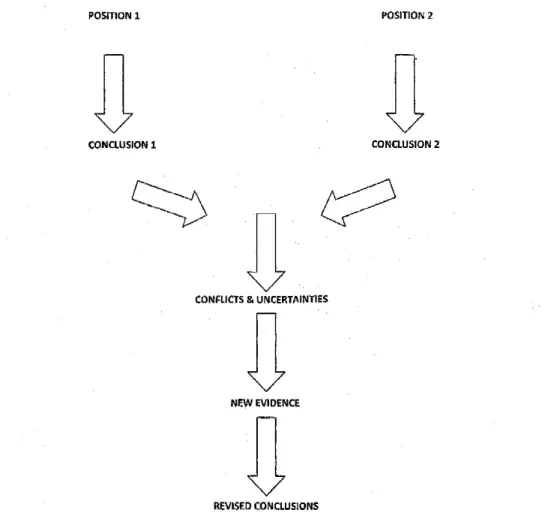
The following diagram (Figure 1) from Stonehouse (2009) shows how controversy in action, when opposing views, can result in new conclusions. Two opposing views had already determined their conclusion to an issue. Using the
cooperative context of constructive controversy theory, both sides were open minded and listened to the opposing position and conclusion, thus identifying evidence that was not considered in their own earlier position, which leads to a new conclusion that may be acceptable to both parties.
School administrators sometimes find themselves trying to manage a public meeting with a controversial topic. Administrators need to find ways to keep the public
Figure 1. Cooperative context of constructive controversy theory (Stonehouse, 2009). meeting productive and keep all involved from becoming competitive in their views. Participants need to be reminded it is acceptable to disagree, but it is not acceptable to be disruptive.
Parents, politicians, and educators have questioned why schools continue to follow an agrarian calendar, even though such a small percentage of students attending school are currently needed on a farm (Darden, 2008). With emphasis on educational systems to produce students to compete in a global economy, the need is to have an
educational calendar designed for the 21st century. The current traditional school calendar has no educational advantages than it did many decades ago (Chaika, 2005).
The agricultural need to have students available to help on the farm is not the same as in the past. The vast majority of students in school are not associated with agricultural or the agrarian calendar. The school year could be extended to a 10-month school calendar with more instructional days for students. The calendar could include additional professional development days to help educators stay current with technology and explore different teaching methods to engage and empower the 21st century student. Today, in the state of Minnesota and 16 other states, there is a discussion about school districts transitioning from school five days a week to having school only four days a week. This change is controversial because it appears to affect children the most. For example, at an April 2010 community meeting in Le Sueur, Minnesota, parents emphasized that further discussion needs to take place in regard to the four-day school week schedule and other options need to be explored before their school board makes a decision to change to a four-day school week for the 2010 school year (Kent, 2010). The change process of transitioning to a new school schedule is difficult and emotional for parents, communities, and school personnel. Individuals will look at how does this change affect their personal situation as an employee or parent. If the change has a negative affect on them, they may be against the idea.
School administrators sometimes do not want to change to a four-day school week, but they believe there is no other option remaining (Spengler, 2011).
Administrators and school boards have been cutting their district budgets for years, leading up to the discussion regarding a four-day school week. The school district is at
the point of trying to deliver educational services that are as effective or more effective than in the past (Spengler, 2011). New Ulm, Minnesota, school superintendent Harold Remme summarizes the discussion of a change to a four-day school week by stating, “Personally, I would much prefer moving in the opposite direction of transitioning to a year-round school setting, incorporating more, not less, student days of instruction, but I don’t think that is very feasible at this time” (Spengler, 2011, para. 5-6).
Current economic problems with state and national budgets have placed education and school budgets in a difficult situation. School districts are looking at alternative ways to balance their budgets due to the lack of revenue to support current programs. According to Streich (2010), the following cost cutting measures have been or will be implemented in schools:
Going to a four-day instructional week Laying off teachers and increasing class sizes
Eliminating planning periods and assigning more classes Phasing out foreign language classes
Consolidating bus transportation routes Postponing textbook purchases
Increasing class sizes
Cost cutting measures are currently being implemented in school districts; a change to a four-day school week is one schedule change option being implemented. School districts have also changed the school week or schedule for reasons other than the four-day school week.
Alternative School Schedules Year Round
School districts are looking at different ways that schools can operate. Two innovative concepts being explored in the 1970s were the year round school calendar and the four-day school calendar. The year round schedule used a continuous cycle schedule of 45 days of instruction and then 15 days of break. The students still attended the same number of days of instruction as the traditional calendar, the difference being that there is no longer a long summer vacation (Koki, 1992). There are also other year round school schedule patterns, such as 60 days of instruction and 20 days of break for three terms or 60 days of instruction and then 15 days of break for three terms (Dixon, 2011).
The advantage of year round school is you have shorter but more frequent breaks; students and teachers get a three-week break every nine weeks. There is a belief students benefit from the shorter breaks because they do not have to re-learn material after a long three-month summer break. One disadvantage of this schedule is that the school schedule does not coordinate well with other schools on a traditional schedule. The schedule conflict with other school districts may cause problems with sharing interactive television classes between schools, sharing education specialists, and the scheduling of start times for after school sports contests between schools (Whiting, 2010).
The year round school schedule has two types of schedules: a balanced calendar of 45 days on and 15 days off throughout the year or a staggered calendar schedule of different groups of students starting the school year at different sessions of the year when other groups of students are on vacation. There are four groups with each group
of schedule allows schools to accommodate more students and relieve overcrowding in comparison to a traditional school schedule (“Year-round Schools,” 2007). As of 2005, year round school calendars were being used in 37 states, an increase from 1995 when 29 states reported year round school calendars (Silva, 2007). Technology can also lead to innovative concepts in delivering educational services.
Online School
Recently, school districts have seen the increase in the demand for online classes by students. According to Christensen, Horn, and Johnson (2008), the demand for
computer online classes increased from a public education enrollment in online classes of 45,000 in the year 2000 to almost one million today. As graduation requirements
increase and school accountability for graduation rates are emphasized, there is a need for another style of education delivery. The online computer based delivery of classes will fill a void in the area of advanced placement in rural and urban schools, credit recovery for students who must retake courses, home school students, and students who have special needs or different learning styles.
According to a University of Michigan professor of education, Elizabeth Birr Moje, “‘there are . . . advantages’ to online high schools, including [learning at] an
individualized pace and better access to multimedia content” (Glader, 2009, p. A17). The disadvantage is the student does not learn to work with other people (Glader, 2009). Online schools can also specialize their curriculum or mission. The all-girls
Holton-Arms school realized no one was offering a single gender education class online, where only girls could be enrolled for the online class, and thus started online in the fall
of 2009. The National Catholic Schools K12 Virtual was also started in 2009 to offer online Catholic faith based education (Glader, 2009).
Alternative School
Another type of flexible school schedule is used in an alternative school. States are trying to meet the needs of students who are not meeting the desired educational requirements and standards in the traditional education setting. Schools are hoping the alternative school will prevent students from dropping out of school and provide an alternative delivery system than the traditional school setting. Alternative schools are not a new concept; they have been used for over 40 years (Lehr, Lanners, & Lange, 2003). States have different definitions and enrollment criteria for alternative schools, with most alternative schools being in a separate building from the traditional school (Lehr et al., 2003).
Alternative schools are more common in urban or large school districts. School districts with high minority student enrollment and districts located in high poverty areas are more likely than other districts to have alternative schools. Alternative school programs are offered to students in grades 9-12. Few rural school districts have alternative schools (Kleiner, Porch, & Farris, 2002).
There are different types of alternative schools. According to Raywid (1994), there are three types of alternative schools:
1. Popular Innovations: Type I alternatives seek to make school
challenging and fulfilling for all involved. Type I alternatives virtually always reflect organizational and administrative departure from
2. Last Chance Programs: Type II alternatives are programs to which students are sentenced – usually as one last chance prior to expulsion. Type II programs focus on behavior modification, with little attention to modifying curriculum.
3. Remedial Focus: Type III alternatives are for students who are presumed to need remediation or rehabilitation – academic, social, or both.
History of the Four-day School Week
The first recent example of a school changing to the four-day school week occurred in the early 1970s in the United States (Gaines, 2008). The concept started in the western part of the United States in small rural school districts in the states of New Mexico, Colorado, Oklahoma, Utah, and Oregon. The school districts were looking for a means to reduce energy costs or decrease the amount of time students were riding the bus in a week (Gaines, 2008).
The concept continued to grow and is no longer just a rural western United States idea. During the 1990s, the southern part of the United States started experimenting with the four-day school week. The state of Arkansas passed legislation in 1997 allowing local school boards to establish a four-day school week without having to obtain State Department of Education prior approval. In 1997, Arkansas was the only state in the country to grant such authority to the local community. In June 1997, Saratoga, Arkansas, was the first school district to use the local control option and changed to a four-day school week. Unlike other United States western school districts that changed
approach to increase student achievement. The school district believed if you keep doing things the same way you will probably continue getting the same result; thus, the district tried something new (Johnston, 1997).
Beauregard Parish school district in southeast Louisiana, with an enrollment of 6,600 students, established a longer school day to improve student performance. The students would have longer class periods each day, allowing teachers more time to help students or to answer student questions. The school district planned to use its off day as a voluntary tutoring day for students as well as a practice day for standardized tests
(Johnston, 1997).
Another academic benefit created by the four-day school week is better attendance by the teachers. The decrease in the need to hire substitute teachers was a financial savings, and fewer substitute teachers had an academic improvement result. Students had their regular classroom teacher more often and this resulted in more teacher-student contact time (Johnston, 1997).
There is one state that goes even further than just allowing local school districts the option of changing; the state of Hawaii mandated the change to a four-day school week. Hawaii has implemented “Furlough Fridays” (Engelhart, 2009). Hawaii has changed all schools to a four-day school week as part of a statewide cost cutting measure. Hawaii now only requires schools to have 163 school days each year. This means the state of Hawaii has the shortest PK-12 academic calendar in the United States. As a result of fewer school days, parents scrambled to find supervision for the 17 days reduced from the school calendar and protested against the controversial school calendar. Hawaii
has a projected deficit of $1 billion and the parent protest did not change the decision to implement a four-day school week in Hawaii (Engelhart, 2009).
Hawaii is not the norm; generally, most state laws prohibit school districts from implementing a four-day school week because the language is usually stated in a minimum number of instructional days required in a school year. For example, a state may require a school district to have 175 days that would discourage a school district from adjusting their school calendar to a four-day school week (Gaines, 2008). As of 2008, eight states do not set a minimum number of instructional days; the states measure the student instruction in number of minutes (Zaleski & Colasanti, 2008).
The number of minutes in a school year is the focus of the four-day school week, not the number of days. But these minutes need to be well planned and organized. School districts in Utah started to abuse the alternative schedule by adding blocks of minutes in no structured way to the school calendar in an attempt to meet the required yearly minutes. Utah demonstrated time needs to be added to the school day on a structured and consistent basis, to keep the integrity of educational programs (Reeves, 1999).
Along with the western and southern states, Midwest school districts are currently discussing transitioning to a four-day school week or already had changed. In Minnesota, several school districts have already made the change within the last two years.
MACCRAY school district, which includes the cities of Maynard, Clara City, and Raymond, made the change three years ago. The school districts of North Central, Ogilvie, and Blackduck made the change in the fall of 2009 (Koumpilova, 2010). As of
the school year started in the fall of 2010 (North Central Superintendent, personal communication, January 17, 2011). Six other Minnesota school districts (Crookston, Norman County East, Rush City, Yellow Medicine East, Le Sueur-Henderson, and Southland) recently studied the idea and decided not to change their current school schedule (Fitzgerald, 2010b).
When a school district starts the discussion about transitioning from a traditional five-day school week, it is almost certain to cause a controversy, not only within the school district but also in the community. One reason for this controversy is the vast majority of the community, parents, students, and teachers have no experience with a four-day school week. The Custer (South Dakota) school district adopted, as a pilot school, the four-day school week in 1995. The district saved money with the move but it was controversial at the time. The controversy settled down within a few years after the state extended the pilot program allowing the school district to continue using a four-day school week (Johnston, 1997).
Concern is expected within the community when you change a school calendar. You cannot expect to change a practice that has been going on for over a century and not have parents and other community members concerned. At times, the changing of the school calendar and schedule can even involve state officials, as in 2002, when then Minnesota Governor Jesse Ventura was against the change to a four-day school week by two Minnesota school districts that stated they were exploring the option because of financial difficulties (Angelo, 2002). After exploring the change, the school districts of Elk River and Osseo did not implement the four-day school week. This was largely due to both districts dealing with concerned parents, along with local and state officials who
were against the change (Angelo, 2002). Similar to each constructive controversy, which has its positives and negatives to the issue, the four-day school week has some concerns and benefits to the school schedule.
Concerns of the Four-day School Week
The issues causing most concern with parents are those associated with childcare, younger children having to attend a longer school day, academic concerns, and at risk students. There are also other concerns associated with the four-day school week, such as the current emphasis on increased school time for students and working within union contracts (Donis-Keller & Silvernail, 2009). There are concerns from the business sector about the four-day workweek; packing 40 hours into four days is not efficient or good for the employee (Weiss, 2008). According to superintendent Donna McGee of Lake Arthur School District, in New Mexico, teachers are drained by the end of the school day
(Delisio, 2006).
Childcare
Parents are concerned with what to do with young children on the fifth day or off day during the school week. School districts acknowledge this could be a problem, but the school will also counter this issue by training high school students to be babysitters (Donis-Keller & Silvernail, 2009). The finding of childcare is not the only issue parents are upset about; the cost of the extra day of childcare is also a problem for parents (Kingsbury, 2008). A North Branch, Minnesota, parent will reconsider her career plans, due to their school district changing to a four-day school week, and childcare concerns on the off day (Herring, 2011).
For some parents it was about self-interest, rather than their child. It was noted some parents who did not work, or work their own four-day week, did not want to have to share their free day with their children. Parents wanted the day for themselves to catch up on other items by themselves (Reeves, 1999).
School districts that use the four-day school week calendar for several years believe the childcare concern is a non-issue. Parents prefer having to find childcare for one day, instead of childcare every day. The longer school day eliminates the every day childcare need (Donis-Keller & Silvernail, 2009).
Longer School Day
The issue of a longer school day is another concern for parents; parents worry their children will not have the attention span or energy for the longer school day. The concern is an eight-hour school day is too much for young children. A study by Sagness and Salzman (1993) found 42% of students in grades 1-3 believed the school day was too long and they got tired by the end of the school day. The longer school day is a concern of the four-day school week, but at the same time there is also a push for longer school days within the traditional school calendar (Quaid, 2009).
The Obama administration believes students spend too little time in school (Quaid, 2009). President Obama wants longer school days and longer school years. Secretary of Education Arne Duncan uses the same argument proponents of the four-day school week use when discussing changing the school day: “Our school calendar is based upon the agrarian economy and not . . . many . . . [students] are working [in the] fields today” (Quaid, 2009, para. 5).
A concern associated with the longer school day, addressed by parents, is for students participating in extracurricular sports programs after school. These students will now be getting home even later than before from practice, allowing less family time in the evening and less time to complete homework assignments (Swanson, 2010).
Teachers also raised concerns regarding the transition from a five-day schedule to a four-day schedule about the school day being too long. The teachers believed the day would be tiring for younger children. The longer school day did not prove to be a problem (Yarbrough & Gilman, 2006). Many schools previously only ran half-day kindergarten programs, but now it is common to run yearlong, full-day kindergarten programs along with after school programs for the students. The longer school day with the four-day school week schedule has reduced some childcare issues for families after school is dismissed for the day (Yarbrough & Gilman, 2006).
At the primary elementary grade level, teachers need to keep their environment flexible so they can utilize the extra time for a better quality lesson. Most elementary schedules have more breaks and activities in the afternoon (Rouse, 2006). Schools also believe they cover more material with the longer school day. The Custer school district in South Dakota indicated they cover 20% more material with the longer classes, but do not mention if the quality of learning is the same. The quality of the education received with the four-day school week is an unknown (Kingsbury, 2008).
Academic Concerns
Student achievement is one of the main concerns of parents and educators when a school district is discussing the possibility of changing the school schedule. Even with
academic coverage is still a concern for parents and others about the four-day school week (Kingsbury, 2008). School districts are starting to present data identifying that academic concerns from parents may not be a valid concern. A 1990 New Mexico study found the mean test scores, from 10 different school districts using a four-day school week over an eight-year period, were slightly higher than districts with a five-day school week. Even though these scores were not significantly higher, this was a positive sign for supporters of the four-day schedule (Yarbrough & Gilman, 2006).
Even though there are limited studies on the affects of student achievement when using a four-day schedule, one study in 1984 of the Iowa Test of Basics Skills conducted with five rural Colorado school districts (Daly & Richburg, 1984) found there was no affect on student achievement as measured by standardized tests over a two-year span after using a four-day school week. A 2009 report by the Idaho Department of Education indicated there was no evidence recognized by standardized tests that student
achievement was affected positively or negatively by the four-day school week (Herring, 2011). A 2006 Colorado Department of Education review of the four-day school week indicated they were also uncertain if student performance was affected by the four-day school week (Herring, 2011).
A study by Hewitt and Denny (2010) of 45 schools in Colorado showed no statistical difference in overall student academic performance between students on a four-day week and students on a five-day week. The study was in the areas of reading, writing, and math at the elementary, middle school, and high school levels. The study did reveal slightly higher student performance in some grades for students on a five-day school week, but the conclusion of the study stated the issue of student academic
performance should not be a concern in the policy decision to implement a four-day school week (Hewitt & Denny, 2010). Another Colorado study in 2009 stated “little difference between four and five day [school] weeks in terms of status as reflected in percent proficient and advanced regardless of content area” (Lefly & Penn, 2009, p. 7).
Teacher preparation is a challenge within the four-day school week. Each day teachers must be prepared to teach a lesson and a half during the four-day week extended class period. Although teachers will have to change their instructional methods to
accommodate for the longer classes, it has been shown teachers make the similar adjustments as to teaching on a block schedule of 90-minute periods in the high school (Reeves, 1999). Teachers and students both find they apply themselves more efficiently by staying on task because they realize they have only four days in the week to complete the work or project (Grau & Shaughnessy, 1987). According to superintendent Gary Brogen of Grace School District in Idaho, the change to a four-day school week has kept students in school more; student time in school was a bigger benefit than saving money (Ellis, 2010).
Politics and Community
The state of Minnesota conservative public policy has put some school districts between a rock and a hard place. The policy has been shifting educational cost from the state to the school district for the past seven years (Van Hecke, 2010). According to John Van Hecke, the executive director of MN2020 Journal, this trend is slowly sliding
Minnesota education to mediocrity of the four-day school week (Van Hecke, 2010). He is critical of the four-day school week: “Cash-strapped school districts are increasingly
talented and skillful school administrators are suddenly rationalizing an educational policy shift undermining the pillars of their professional educator’s identity” (para. 6).
The four-day school week is not popular with some individuals; they believe students need to be in school more time or days, not less. Some educators, parents, and politicians believe school should be five days a week and year round (Chen, 2008). There has been some concern by superintendents that the benefits the school districts were expecting to happen with a four-day school week did not materialize. One of the concerns mentioned was the school did not experience additional productive class time and there was no increase in student test scores. The financial savings are not substantial enough or did not meet the project saving anticipated going into the four-day school week. Several schools experienced teacher and student burnout by the end of the day of the longer school day, which created an unproductive learning time. In Arkansas, one district returned to the five day a week schedule after six years of being on the four-day schedule (Delisio, 2006). The disadvantages were outweighing the advantages and the schedule was taking a toll on the students (Delisio, 2006).
Before a school district makes a change in their school schedule, the school needs to have community support. If the district does not have a super majority of 75% of the patrons, then the district should not consider changing from its traditional five-day schedule to a four-day schedule (Delisio, 2006). The school district should spend at least a year of planning to make the change before trying to implement this new schedule. This planning time will allow for community discussion and meeting with all
stakeholders affected (Delisio, 2006). The discussion of the change to a four-day school week can divide communities. The emotions can be strong about this issue. Even though
the instructional time in minutes will be the same with either schedule, there is a
perception of students and employees not attending school an adequate amount of time. There is a negative reaction to attending fewer days of school, especially when the current political push is for students to attend more days of school (Dam, 2006). The message being sent by shortening the school week is not what some political leaders want happening. The politicians and other educational reformers want to have longer school days and more instructional days in the school calendar (Chamberlin & Plucker, 2003). One concern from the private sector about a four-day workweek is that working 40 hours in four days is not an efficient way to work, the concern being that the
productivity of the employees decreases toward the end of a 10-hour day (Weiss, 2008). The same productivity is a concern for opponents of the four-day school week. Students and teachers will be fatigued and will not productively use the extra time provided each day during the longer school day (Schank & York, 2009).
Benefits of the Four-day School Week Financial
The switch to a four-day school week is in most cases a financial decision. This financial decision is based on saving school districts money on employee salaries, energy costs, and transportation. With transportation being one of the main issues, the school no longer has to run buses as many days as it previously had to during the five-day school week. With the cost of fuel, bus driver salaries, and repairs to the school buses, this is an actual savings for the district (Yarbrough & Gilman, 2006). The cost of fuel is such a concern; school districts are looking at alternatives to save on fuel costs. Districts have
area Northside Independent School District purchased 16 buses, which use propane instead of diesel (Miners, 2008). The busing issue also saves the rural students from having to ride the bus so many hours in a week. If a student rides two hours a day and you reduce the calendar by 30 days, the child has reduced his or her bus riding time by 60 hours a year, which is appreciated by rural parents. The majority of parents, surveyed after they have experienced the use of the four-day schedule, liked the change. The parents believe it gives them more family time on the weekends and children have more time to help with other duties at home (Grau & Shaughnessy, 1987).
Another financial benefit is substitute teacher pay. Since most of the schools using the four-day schedule are rural schools, teachers and students must travel long distances for medical appointments usually resulting in an entire day of school being missed. The off day allows for both teachers and students to schedule appointments and not miss school (Grau & Shaughnessy, 1987). With the four-day school week it has shown there is better work attendance by teachers (Chamberlin & Plucker, 2003). Teacher absences fell by more than 50% in a school district. Teachers are making their personal appointments on the off days and the chance of the teacher being sick on a school day has been reduced by 20% (Reeves, 1999). A Colorado survey found that over 90% of secondary and elementary teachers, using the four-day schedule, favored the new schedule over the traditional schedule (Culbertson, 1982). Teachers liked the schedule for their own personal reason of having an extra weekend day for family and taking care of personal business (Culbertson, 1982).
The financial benefit can also be realized in the use of less energy. If school buildings can reduce the heating temperature of the rooms over three consecutive days, it can save money on this energy expense (Reeves, 1999).
The financial situation in one school district was such a concern; the school board changed to a four-day school week during the middle of the school year. Barnsdall school district in Barnsdall, Oklahoma, a rural school district with 462 students faced with several budget problems, changed to a four-day school week with little planning. The school board voted to change to a four-day school week at a December school board meeting, with the change to start when classes resume at the beginning of January after the holiday break. No parents attended the meeting to express concerns about the change (Gamallo, 2009).
School districts in Montana changed due to financial reasons, but according to a 2008 survey by the Montana Office of Public Instruction, all districts did save money, but not as much as they had anticipated. The school districts did discover other benefits in nonacademic areas, which may help student performance. The survey indicated an improvement in student and staff morale (Montana Office of Public Instruction, 2009). As previously mentioned, the four-day school week was primarily a fiscal savings idea with possible educational benefits.
Educational
Some districts have experienced improved student attendance, decreased student disciplinary referrals, and fewer dropouts. These educational benefits were realized when the schools were primarily concerned about saving money (Yarbrough & Gilman, 2006).
savings is no longer the main reason the districts use this alternative schedule. The alternative schedule promotes more of an academic focus, with fewer disruptions and most of the sports activities are on the off day and weekends (Delisio, 2006). The
schedule has improved student participation in extracurricular activities, because students no longer miss classes due to travel when the event is scheduled on the off day of the four-day week (Durr, 2003). The educational benefit of students missing less school, fewer classroom disruptions due to student-athletes leaving class for an activity, and an increase in students being on task for a long class period has been an unexpected benefit (Marx, 2007).
Some schools in Minnesota are seeing educational benefits of the four-day school week. Parents are providing anecdotal evidence by stating their children’s grades are going up since their district has changed to a four-day school week (“4-day Makes Mark,” 2011). The MACCRAY school district is reporting less student absenteeism and the school district is making Adequate Yearly Progress (AYP) on the mandated state tests, except in the category of students on free and reduced meals (Schmidt, 2010). The district has saved money and has been able to save program cuts and staff positions (Schmidt, 2010). The MACCRAY school district is having a good experience with the four-day school week with parents telling the school not to go back to the five-day school week schedule (“4-day Makes Mark,” 2011).
A 2003 Colorado state education department study found student achievement did no worse on a four-day schedule than on a five-day schedule (Kenworthy, 2004). The same study found students, parents, and teachers were overwhelmingly in favor of the four-day schedule. The research suggests that once a school district changes to a
four-day school week the controversy settles down and the majority supports the change (Kenworthy, 2004). The Victor School District in Montana has been on the four-day school week for three years; the district believes the students have better attendance and most importantly the students are demonstrating better academic performance
(Chapman, 2009). The Colton School District in Oregon believes the four-day school week does not hurt a student’s academic performance; the district has been on the four-day school calendar for five years, and the student test scores in math, science, and reading are higher than the state average (Chapman, 2009). The school does not
acknowledge if the test scores were higher in percentage according to the state average, before the change to the four-day school week. Secondary teachers also believe they could provide more help with a student’s homework and they could also assign a more in-depth assignment for over the long weekend (Culbertson, 1982).
The Fort Valley (Georgia) school district made the change to the four-day school week because of the poor financial position of the district, according to school
superintendent Susan Clark (Turner, 2010). What they experienced was an unexpected increase in test scores. The district also had an increase in attendance by both the students and the teachers, saving money on having to hire substitute teachers (Turner, 2010). The benefits of a four-day workweek are not only to the school as the employers, there are also benefits to the employees.
Employee
The superintendent of Bear Lake County School District in Idaho, Cliff Walters, believes “the morale in our school district is better because of the four-day school week”
2010). There are personal benefits for employees that were not realized on a traditional workweek. The new schedule allows employees more consecutive days for family time. Employees can plan for three days of leave without having to use a day of personal leave or vacation leave. Employees can also save money because they will have one less day of travel to work and less of other costs associated with the workday. Employees in the private sector are realizing a better work-life balance with a four-day workweek (Parker, 2008). The four-day work schedule is not only in the private sector and K-12 education system; it is now in the post-secondary system.
Two community colleges have also changed to the four-day school week: Brevard Community College in Florida and Southern West Virginia Community and Technical College (Meyer, 2008). The university system does not have to address the K-12 concern of childcare on the off day. The off day is a benefit to both the university student and university employee. The fast pace world seems to have created an extra day of the week. At the university level the biggest surprise has been the improvement in employee morale, according to college president James Drake (Meyer, 2008). The college
president has indicated employees at Florida’s Brevard Community College have come forward to proclaim their approval and talk about the positive effect it has had in their lives (Meyer, 2008). The college had a decrease in sick days used by employees, a decrease in staff turnover, and an increase in applications for job openings at the college. The college students also liked the schedule with 8 out of 10 students experiencing a positive or no effect toward the four-day week schedule, and the student enrollment increasing since the implement of the schedule (Meyer, 2008).
At Western Carolina University during the summer, employees work four 10-hour days instead of the five 8-hour days. This allows the university to set the thermostat at a higher temperature for three consecutive days and saves on cooling cost. These four-day workweeks also save employee transportation cost by eliminating one travel day per week (Mangan, 2008).
Similar to some private sector businesses, public schools, community colleges, the four-day workweek is also being used by city government. City government is experiencing higher worker morale and productivity when they use the four-day work schedule (Wapshott, 2008).
The state of Utah mandated a four-day workweek for most state employees (Walsh, 2009). The state closed offices on Fridays in an effort to reduce energy cost. The state employees worked four 10-hour days. The state of Utah found it reduced its energy cost by 13% and the response from the state employees was overwhelming in favor of the new four-day week with 82% of the state workers saying they liked the schedules. The state found the new schedules did not lead to worker burnout, and employees used fewer sick days on the new schedules. The private sector business General Motors has also started a four 10-hour day at several of their plants (Walsh, 2009).
The environmental effect with the four-day workweek is also a factor. Traveling to work one day less a week, while the heating and cooling of buildings can also be adjusted, is an important issue for some businesses and employees. Going green and using less energy is an environmental benefit of the four-day schedule. With energy
prices currently being stable, the current reason for businesses is employee morale, productivity, and environmental effects (Catlin, 1997).
Reasons to Change to a Four-day School Week
What factors are causing school districts to consider the four-day school week? Some of the reasons stated by school administrators and school board members is
declining enrollment, flat funding from the state, and failure of the local school district to provide an operating levy (Fitzgerald, 2010a). All three reasons are financial related. The school districts are having difficulty in balancing their budgets even after years of reducing expenditures on transportation, administration, teachers, and para-educators. School boards and administrators believe they can no longer reduce expenditures by cutting back on supplies, maintenance, reducing employees, and eliminating programs. School districts are considering one additional way of reducing expenditures and the four-day school week is one of their choices. The main cause is money, and in most cases the only reason why they are making the change (Fitzgerald, 2010a).
According to superintendent Tamara Usselman of Perham-Dent, Minnesota, school district, “it [four-day school week] works until inflation outgrows it. What do you do then after a four day week, go to a three day week?” (Bergen, 2011, para. 13). With school districts not having many options after years of cutting in most areas,
superintendents believe this forces the school district to weigh a new schedule against other options of cutting programs; perhaps the four-day school week is their only option (Bergen, 2011).
For the fiscal year 2010-2011, 42 states are looking at a budget shortfall
the local school districts. Schools are being forced to make decisions such as going to a four-day school week to reduce expenditures or to cut academic course offerings and increase class size. The state of Georgia legislature is considering shortening the school year (Stover, 2010). This could mean school districts might decrease the number of professional development days for teachers so they do not have to decrease the amount of contact days between teachers and students (Stover, 2010).
With most state budgets not being able to increase or sustain the current PK-12 funding levels the past few years, school districts are starting to lay off employees and close school buildings. The Kansas City school district recently decided to close 29 schools (Stover, 2010). The tough times for school districts may even get worse. Many districts used stimulus funds from the federal American Recovery and Reinvestment Act to fund teaching positions and to sustain the current school programs. These stimulus funds were only one-time federal payments to schools and only delayed having to solve the financial budget problems (Stover, 2010).
According to Bruce Hunter, associate executive director for the American
Association of School Administrators, during a presentation to the North Dakota Council of Educational Leaders conference in June 2010, 275,000 education jobs are going to be eliminated in the 2010-2011 school year. Hunter’s presentation indicated 13% of school districts in the country will be considering a four-day school week due to the lack of school funding, and the education business is going to eliminate student programs, reduce teachers and administrators, reduce the numbers of para-educators, and create larger class sizes due to the lack of funding (B. Hunter, personal communication, June 15, 2010).