6
Student Engagement
Kathy Harrington, Sandra Sinfield and
Tom Burns
Chapter overview
This chapter explores:
• staff engagement as an agency for student engagement
• the educational landscape of engagement: barriers and levers
• benefits of engagement for students and teachers
• principles and practices to foster engaged teaching and learning
• examples of engagement within and alongside the curriculum
Introduction
There is extensive international literature on student engagement, comprising conceptual and theoretical approaches, empirical research, policy initiatives and numerous case studies of student engagement practice in a wide variety of contexts. This chapter draws on data from this substantial and diverse field to chart a path of particular relevance to any university teacher who takes an interest in thinking about and finding fresh ways to enable students’ engagement with learning, both within and alongside the curriculum, with all of the benefits and chal-lenges this brings within the social, cultural and economic complexity
of contemporary higher education (HE). This chapter works with a broad understanding of ‘curriculum’ to encompass content and struc-tures of a study programme as well as the dynamic and emergent processes of interaction between students and staff that enable relevant and meaningful learning (Fraser and Bosanquet 2006), comprising aca-demic, personal and professional dimensions. You may be involved with student peer mentoring, volunteering or community service learning programmes or with organising other co-curricular learning activities, alongside (face-to-face or virtual) classroom teaching and personal tutoring responsibilities. Models and principles of good engagement practice, as well as illustrative examples from across UK HE, are offered to enable you to reflect on, evaluate and take steps towards developing your own practice in thoughtful, manageable and fruitful new ways.
A central aim of this chapter is to encourage you to value the role of the teacher, as well as that of subject specialist. Other chapters in this book consider important aspects of the facilitation of students’ learning in some depth. The focus here is more directly on the interface between teaching and learning, and on the relationship between teachers and students as a vehicle for engagement in all its diversity. The process of teaching involves a relationship of engagement: with students, with the subject matter, with oneself. The ways in which we as teaching staff approach this relationship can have an important influence on the nature and quality of students’ engagement with their own learning and emerging academic and profes-sional identities. Maintaining a reflective awareness of our own roles, beliefs and identities – as well as our limits – as teachers places us in a better position to make full use of ourselves as a resource that can contrib-ute beneficially to students’ experiences of HE.
Bryson (2014), influenced by Fromm (1978) and the idea of ‘being’ as more important than ‘having’, suggests that a notion of ‘becoming’ perme-ates a relational model of student engagement (Solomonides et al. 2012), and he connects this to Barnett’s (2007: 70) notion of the ‘will to learn’ as foundational to a students’ ability to engage ‘without a self, without a will to learn, without a being that has come into itself, her efforts to know and to act within her programme of study cannot even begin to form with any assuredness’. We suggest that an understanding of student engagement as proposed in this chapter can help us to transcend a focus on the transmis-sion of information and instead take an interest in processes that enable students to experience this more collaborative, complex and nuanced ver-sion of education, which at its heart is about engagement as learning, and learning as becoming.
Student engagement: what is it and why does it matter?
As many scholars have noted (Bryson, 2014; Nygaard et al., 2013; Kahu, 2013), ‘student engagement’ is a broad and variously defined concept and collection of practices in HE, with the definition depending on the position one occupies in the educational system as well as one’s motivating interests. For example, we can speak of student engagement with the process of learning and enquiry; with teaching enhancement and curriculum develop-ment; with fellow students and colleagues, including through peer mentoring and collaborative learning; with representational structures, institutional planning and policy development; with extra-curricular and community programmes; and with the socio-political process of the transformation of HE itself. Student engagement has been linked to a sense of belonging and academic and social integration, leading to retention and success (Thomas, 2012; Tinto, 2003); learning gains and improved educational outcomes (Kuh et al., 2008); critical thinking and grades (Carini et al., 2006); transforma-tional learning (Bryson, 2014); employability and professional development (Montesinos et al., 2013; Summers et al., 2013); and preparedness for the complexity of the workplace and participation in civic life (Moxley et al., 2001). There are also benefits for staff of successful ‘student engagement’, not least with respect to a sense of reward and enjoyment in the work of teaching and transformations in our own understandings and professional practice as teachers in HE (Cook-Sather et al., 2014).
Graham Gibbs (2014) has recently suggested that ‘student engagement’ has become the latest educational buzzword, providing a catch-all phrase for ‘so many different things that it is difficult to keep track of what people are actually talking about’. In this chapter, we take an approach to student engagement that encompasses students’ academic and professional develop-ment as well as their social integration, and focuses specifically on the role that teaching staff can play in fostering students’ engagement with the expe-rience of learning both within and alongside the curriculum. Engagement from this perspective is a complex interplay of factors, including affective, cognitive and behavioural dimensions (Kahu, 2013; Wimpenny and Savin-Baden, 2013), for both students and teachers. It is contextual and situated, influenced by institutional structures, local cultures of practice and the wider socio-political climate, as well as shaped by the motivations, expectations, life experiences, attitudes and behaviours that both students and staff bring to HE and the processes of (facilitating) learning (Bryson, 2014).
Given the diversity of students and staff and the complexity of contem-porary HE, there is no one method for fostering student engagement that will suit all contexts equally. Nevertheless, and particularly where differ-ences amongst students are pronounced, such as with respect to family
background, age, ethnicity, mother-tongue, prior educational and other experiences, assumptions and expectations of HE, it can be helpful to think about engagement from the perspective of inclusive teaching practices that value and actively work with such differences, and which avoid reinforcing an often unspoken yet powerful, and problematic, notion that ‘difference’ (and problem) resides with some students and not others. Embedding attentiveness to student diversity within curriculum design, particularly on courses where students come from a range of non-traditional academic backgrounds and may be more likely to struggle emotionally and practi-cally, has been shown to lead to universally beneficial outcomes (Warren, 2002). (See Chapter 7: Embracing Student Diversity.)
The contemporary educational landscape: barriers and levers
to engagement
As outlined in the introduction to this book, substantial changes in the policy landscape of UK HE, including new funding structures that shift the fee bur-den much more towards individual stubur-dents, an increase in providers and competition for students, and an overall trend towards greater marketisation, are linked to the growth of a consumerist approach to engaging with learn-ing (Kandiko and Mawer, 2013). In this context, teachlearn-ing staff committed to working in creative and innovative ways to support and challenge students academically can feel constrained by a sense – and a reality – that such work, which inevitably involves risk-taking and an openness to unpredictable learning experiences for both students and staff, is undervalued because it is not perceived as able to produce the kind of pre-determined, quantifiable educational outcomes that managers and fee-paying, employment-focused students (it is often assumed) expect. Under such pressure, it can be hard to resist the temptation to frame students as the ‘problem’, as seen, for example, in commonly heard complaint-explanations that ‘students these days don’t read’, ‘they can’t write’, ‘they want to be spoon-fed’.
An alternative way of thinking about the current situation is to consider the academic terrain navigated by students before they enter HE, with a view to understanding the nature of the role they are often given within larger social and educational systems, and to consider the impact of this on student attitudes towards learning once they reach HE. For some students, the landscape of formal education will be experienced as a hostile one, in which they must learn to swim in swift educational currents shaped by powerful narratives of measurement and hierarchical comparison, embod-ied in standardised aptitude tests, league tables, school inspections and rankings, alongside moral panics about plagiarism and the ‘dumbing-down’
of education. Many students, perhaps particularly those who do not bring with them much of the cultural capital traditionally recognised and affirmed by academia (Bourdieu and Passeron, 1979), can find themselves as if set up to fail from the outset, and they can struggle to negotiate successfully through what is experienced as hazardous and punishing foreign territory (Sinfield et al., 2004; Leathwood and O’Connell, 2003). Thinking about (some) stu-dents’ experiences from this perspective, we should not be surprised to discover that, particularly amongst those deemed ‘weakest’, contemporary students may strive to employ instrumental and strategic study practices that keep them afloat as a primary objective, which simultaneously, and deleteri-ously, prevent them from taking the risks to engage more meaningfully, creatively and unpredictably with their own learning at university.
Staff, too, swim in strong currents of monitoring and control, embodied in national benchmarking and league tables, quality codes, professional body requirements, research audits, and government and institutional policies and strategies that formally shape the direction and content of learning, teaching and assessment practice in the classroom. The sheer volume of paperwork and time spent preparing for quality and research audits alone has substan-tially undermined the academic’s autonomy and capacity to engage with their students’ learning and developing the quality of their teaching (Morgan, 2010). The role of the teacher can be experienced as disempowering by academics who may be accomplished and respected in their disciplinary or professional contexts but remain novices in areas of curriculum design, assessment and teaching development. Being a teacher, as well as an aca-demic, is exposing: it makes us vulnerable to judgements from students as well as peers and managers; we regularly confront the unexpected in the classroom; and we are subject to the unrelenting and perhaps unforgiving gaze of our students as they demand value for money and expect their some-times naive or conservative notions of ‘good’ teaching be fully met. Although successful teaching and learning encounters often contain elements of the messy, risky and unpredictable (Healey et al., 2014), especially for new teachers this can feel chaotic, unprofessional and very much like ‘failure’. In this context, teachers can easily learn to see the fearful, recalcitrant or demanding student as the ‘other’, the one that creates an unsuccessful peer review, a poor probation year or inadequate module performance.
Acknowledging this tricky terrain is not to negate the potential for ‘engagement’ but to invite a focus on the relationship between staff and students as the site where engagement can be nurtured. Taylor (2012) examines prevalent notions underlying the way ‘student engagement’ is used in current discourse and suggests that there are three dominant, partly incompatible, ways of understanding it: ‘student engagement’ is
variously about: 1) teaching and learning, and the means for enhance-ment, 2) accountability and transparency, or 3) dialogic and participatory practice. The first and, to an extent, the third meanings highlight the impor-tance of the nature of the learning encounter between students and teachers, and the potential in this encounter for a transformational educational expe-rience. The use of ‘learning encounter’ is understood to refer broadly to a relationship of learning and teaching, which can be between teachers and students but also between students where individual peers variously take on the different roles of ‘teacher’ and ‘student’. Transformation could take the form of new understanding of a subject area, or a change in one’s identity and self-knowledge, or a more differentiated awareness of others’ perspec-tives and one’s position in relation to them within a wider sphere of academic or disciplinary endeavour. However the transformation is manifest, the focus is on learning and on the co-created possibility for this through a relationship of engagement between teachers and students.
Models of engagement
As a way into thinking about our own teaching and changes we may wish to implement with the aim of making it more engaging, it can be helpful first to reflect and take stock of how we are currently working. Informed by research into engagement amongst students with disabilities by May and Felsinger (2010), the UK National Union of Students (NUS) and Higher Education Academy (HEA) have developed a student engagement ‘ladder of participa-tion’ (2011) that conceptualises different forms and processes of engagement as qualitatively different from one another, which can assist not only the evaluation of current practice but also identifying new ways of working that may feel more congruent with one’s personal teaching values and goals.
Forms of student engagement
• Consultation – opportunities are provided for students to express individual opinions, perspectives, experiences, ideas and concerns.
• Involvement – opportunities are provided for students as individuals to take a more active role.
• Participation – decisions are taken by students to take part or take a more active role in a defined activity.
(Continued)
• Partnership – there is a collaboration between an institution/faculty/ department and student, involving joint ownership and decision making over both the process and outcome.
(Adapted from NUS and HEA 2011)
Within the realm of curriculum development, consultation often takes the form of a ‘feedback’ mode of engagement, where students are asked for their thoughts about how they have experienced the teaching and learning pro-cesses designed and implemented by staff. While there are clear advantages to listening to student experiences in this way, so that where possible changes can be made to improve students’ future learning experiences, the disadvantage of this approach is that too often it can feel, and in practice become, a predominantly managerial and superficial box-ticking exercise, for both students and staff. At the level of ‘involvement’, as defined by NUS and HEA, students are again invited by staff to participate, but the roles taken up involve a higher degree of agency and active participation in determining the shape of their learning experiences, for example in the roles of course rep-resentative or ambassador, where students are engaged with processes of curriculum review and enhancement and the induction of new students.
Participation involves a greater degree of student agency as decisions are taken by students about whether and the extent to which they wish to be involved, both within and alongside the curriculum. At this level of engage-ment, students may, for example, partake of a range of extra-curricular activities, including those designed and run by themselves and where par-ticipation is seen as enhancing their voice and authority to contribute meaningfully to their own learning processes (Sinfield et al., 2010). Engagement at the level of partnership works on the premise that staff and students actively engage with each other in a collaborative process that values the different perspectives and contributions each party brings to a shared activity.
The HEA foregrounds partnership as central to an understanding of stu-dent engagement and its potential benefits for enhancing both learning and teaching, with ‘partnership’ defined as:
a relationship in which all involved – students, academics, professional ser-vices staff, senior managers, students’ unions, and so on – are actively engaged in and stand to gain from the process of learning and working together.
Partnership is essentially a process of engagement, not a product. It is a way of doing things, rather than an outcome in itself. (Healey et al. 2014: 12)
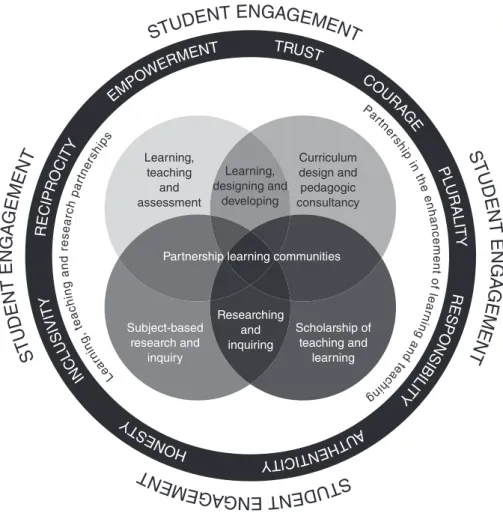
This understanding of student engagement acknowledges the importance of teachers and students as different but equally valuable members of an inter-relational and transformational learning experience for all partici-pants. The HEA offers a conceptual model for working with students as partners in learning and teaching, covering four overlapping areas (see Figure 6.1) of learning, teaching and assessment; subject-based research and enquiry; curriculum design and pedagogic consultancy; and scholar-ship of teaching and learning where teachers and students are variously
Figure 6.1 Students as partners in learning and teaching in higher education – an overview model
Learning, teaching
and assessment
Partnership learning communities
Subject-based research and inquiry Researching and inquiring Scholarship of teaching and learning Learning, designing and developing Curriculum design and pedagogic consultancy EMPO WERM ENT RE CIP RO CITY IN C LU S IV IT Y H O NE S T Y A U T H E NT IC I TY R E S P O N SI BI LI T Y P LUR AL ITY CO UR AGE TRUST STU
DEN
T EN
GA
GE MEN
T S TU
D
EN
TE
NG
A
GEM
E
N
T ST
UD
EN
T E NG
A
G
EM
E
N
TSTU
DE
NT
ENGAGEMEN
TP artn er sh ip in th e enh an ce m e n t o f l e a r nin g a nd t ea c h i ng L ea rn i ng , te a ch in g a n d r ese arc hp artn ersh ips
involved in relationships of co-learning, co-designing, co-developing and co-researching (Healey et al., 2014). It is through the development of ‘partnership learning communities’, at the heart of the model, that princi-ples and values of partnership – such as authenticity, honesty, inclusivity, reciprocity, empowerment, trust, courage, plurality and responsibility (HEA, forthcoming) – can be embodied and sustained in practice and lead to engaged learning and teaching.
Developing an ethos and culture of partnership in one’s teaching prac-tice requires adopting a questioning, reflective stance and a willingness to consider and challenge one’s own assumptions and existing ways of think-ing and workthink-ing. Below are some principles to prompt reflection on attitudes and behaviours that can promote engaging practice.
Principles for engagement
You may wish to reflect on the extent to which and in what ways you already put the following into practice, as well as areas you would like to prioritise and embody more strongly in your teaching. How can you make realistic and meaningful changes within the practical constraints of available time, class size and the turnaround time you have in which to get marking done?
• Get to know your students; for example, their cultural and family
backgrounds, prior educational and other life experiences, expecta-tions, understandings of the subject and learning generally.
• Find out how students perceive you, your role and their
expecta-tions of you.
• Recognise and value difference, and different ‘ways of being a
stu-dent’ (Bryson, 2014), and let this influence the design and approach of your teaching.
• Engage with your students wherever they are in their learning process
and provide the scaffolding to enable next steps (Vygotsky, 1978).
• Foster a relationship of trust and mutual respect that values agency,
creativity, authenticity, critical dissent and collaboration.
• Facilitate dialogue and actively seek experiences of learning with
and from students.
• Reflect on how knowledge is created in your discipline and the
created/reproduced in your teaching practice and the learning environments you create.
• Use the opportunity to see teaching not as second class to research
but as an equally valuable though different aspect of the larger aca-demic enterprise of inquiry.
• Be responsive to the moment of encounter.
• Maintain an openness to surprise and discovery.
• Create spaces for risk-taking – and take risks!
Putting principles into practice
There is a wealth of existing case studies and other illustrative examples easily accessible in the public domain, and we point readers towards some of those we find most useful and current in the list of further resources below. There can be a tendency to regard ‘student engagement’ as if it were the sum of a collection of practices, across an institution or a department, for example; however, as Rachel Wenstone (NUS, 2012) persuasively argues, it is the how of the practices – the underlying principles, attitudes, ethos and ways of working – rather that the what, which enables practices to engage and benefit students in transformative and sustainable ways. Nevertheless, we hope offering some examples will help you to imagine possibilities for new ways of working and fostering engagement in your own context, and we draw attention to a selection below.
Learning and enquiry
In her international review of research into student engagement, Vicky Trowler (2010) found that engagement with learning is enhanced by active participation, both in and out of class (see also ‘Co-curricular activities’ below); collaborative activity (see ‘Peer mentoring and collaborative learn-ing’ below); and student involvement in the design, delivery and assessment of their learning (see ‘Curriculum development’ below). With respect to encouraging active participation, teaching and learning in a twenty-first century (virtual or physical) classroom is likely to include a mix of more traditional modes, such as lectures and seminars, alongside more participatory and experiential learning activities, such as role plays and simulations; inquiry and problem based learning; rich pictures and drawing-to-learn activities (see: http://systems.open.ac.uk/materials/T552/
accessed 23.9.15); and research projects, including in partnership with academic staff (Healey and Jenkins, 2009). In addition, engaging teaching can include digital artefact development, blogging and other social net-work activities.
The underlying rationale for diversifying learning and teaching methods is to model purposive academic endeavour and create opportunities for students to engage actively in meaningful and authentic ways with the sub-ject of their studies as well as their own learning processes (Davies, 2011). A flipped classroom approach – whereby subject matter traditionally deliv-ered through lecturers is provided as preparatory work and in-class time is devoted to collaborative and highly participatory learning activities – can be an effective way to foreground and reap the unique benefits of experiential learning (Gerstein, 2012). The ‘Student as Producer’ initiative at the University of Lincoln takes this process of active, discovery-based learning further by positioning students as collaborators in the production of knowledge, creat-ing opportunities for engagcreat-ing with real research and the development of disciplinary and academic identities as guiding principles of the undergrad-uate curriculum (http://studentasproducer.lincoln.ac.uk/).
Peer mentoring and collaborative learning
There are many peer mentoring and collaborative learning models operating in HE today, both as extra-curricular programmes and embedded within the formal curriculum and teaching timetable, from peer-assisted learning (PAL) and peer-assisted study sessions (PASS) (Keenan, 2014), to mentoring spe-cifically in academic writing (O’Neill et al., 2009), to pastoral mentoring designed to support first-year students through the transition to HE (Andrews and Clark, 2011), to mainstream modules where mentoring principles are taught and opportunities to gain experience and practical skills are built into the formal curriculum (Abegglen et al., 2015). When done well, mentoring can aid students in building communities of practice, where mentor and mentee work together to articulate and grapple with academic questions. In this model, a reciprocal relationship (Kossak, 2011) between mentor and mentee is fostered, where each is encouraged to learn with and from the other, working to support each other’s academic achievement as well as per-sonal and social growth within new disciplinary and professional spheres.
Personal tutoring
As with peer mentoring, personal tutoring offers a relationship that facili-tates a sense of connection with the university or department and provides
a supportive space that fosters students’ engagement with their academic discipline as well as their own learning and development. In her final report from the multi-institutional What Works? Student Retention & Success programme, Thomas (2012: 43–4) found personal tutoring to be an impor-tant strategy for supporting students’ engagement and belonging, and that when effective it displays the following characteristics:
• proactive rather than relying on students finding and accessing tutors; • early meetings with students;
• students have a relationship with the tutor and the tutor gets to know the students;
• structured support with an explicit purpose;
• embedded into the academic experience and based at school or faculty level; • strong academic focus;
• identifying students at risk and providing support and development; • linked to student services, students’ union and peer mentoring or similar
peer scheme to provide pastoral and social support and referring stu-dents for further support where appropriate.
While there are times when the provision of specific information and advice is helpful (e,g, about assessment deadlines and extensions or other support services available), at its essence the personal tutoring relationship is one which empowers the student to set the agenda, explore concerns and questions they wish to bring, develop their own thinking and discover ways of responding that work best for them (Wisker et al., 2008).
Curriculum development
Engaging students in processes of designing and enhancing the curriculum can feel risky and uncomfortable for both students and staff because it chal-lenges traditional roles and expectations (Healey et al., 2014; Cook-Sather, 2013). While the degree and nature of student involvement will vary accord-ing to the teachaccord-ing context, level of study, different attitudes and prior experiences as well as the influence of professional bodies (Bovill, 2013) – and there also are times when it may not be desirable or possible to work in a (fully) collaborative, co-creative way (Bovill and Bulley, 2011; Weller and Kandiko Howson, forthcoming) – there is nevertheless evidence that involving students in the design, delivery and assessment of their learning can have a beneficial effect on engagement with their course and the expe-rience of learning in HE generally, as well as providing challenge, reward and transformation for teachers themselves (Cook-Sather et al., 2014).
Sambell and Graham (2011), for example, describe an assessment part-nerships model in which students on a Health, Community and Education Studies programme not only study the philosophy and principles of Assessment for Learning (AfL) but also produce enhancement materials which have then been used by staff and students to both interrogate and improve their own assessment and learning practice. An increasingly com-mon model of student involvement in curriculum development is when they act as course design and pedagogic consultants to improve teaching and learning within specific modules, courses or departments ( Jensen and Bagnall, 2015; Sheffield Hallam University, 2013; University of Sheffield, 2013). Some universities have implemented a partnership approach to educational change and development as a fundamental way of working across the institution, enabling students to lead and co-develop local pro-jects that have resulted in improved teaching practice, re-designed curricula, new learning resources, enhanced graduate skills, as well as changes to policy and practice at strategic levels (Birmingham City Students’ Union, 2015; Nygaard et al., 2013; Dunne and Zandstra, 2011; Dunne and Owen, 2013).
Co-curricular activities
Engaging co-curricular activities can include service and community-based learning, volunteering and internships, all of which are identified as high-impact activities that have the potential to enhance student retention and performance (Kuh et al., 2008). Student development weeks, festivals and student-led conferences can also offer opportunities for engagement with learning and wider academic life, where the crucial ingredient is that student contributions to the design and delivery of such activities are valued by stu-dents as well as staff. In many institutions such activities may be initiated by ‘third space’ professionals such as widening participation or employability teams, or by institutional centres for academic development, learning and teaching. Where there are clear connections with the academic curriculum and discipline-based staff are actively involved in the support and implemen-tation of such initiatives, students can be more likely to regard the activities as contributing to their academic development as well as the enhancement of civic responsibility and interpersonal skills (Hébert and Hauf, 2015). Increasingly, HE institutions are adopting processes such as the Higher Education Achievement Report (www.hear.ac.uk/ accessed 21.9.15) to for-mally recognise the valuable contributions co-curricular experiences can have on the quality of students’ learning, development and employability.
Conclusion
There are numerous avenues for improving student engagement, and ultimately responsibility for doing so lies with each party: student, teacher, institution and the government (Kahu, 2013). This chapter has focused on the responsibility of the teacher set within the context of the contemporary landscape of HE. We have sought to place emphasis on the lived experience of being a teacher – the unique perspectives, chal-lenges, limits and potential capacities of the role – and to heighten awareness of how engaging with the complexity of the learning relation-ship can open up possibilities for reducing barriers to students’ meaningful engagement with their learning. The underlying assumption is that student engagement is fundamentally linked to staff engagement: with students, with the process of teaching and with oneself as a teacher; and furthermore, that the way in which we as teachers engage, or do not, with students has a significant influence on how students engage with us and with their learning.
Questions for reflective practice and professional
development
1 Think of a particularly engaging learning experience you have had as a student. What made it so engaging? Now ask yourself, how engaged am I with my current teaching? What barriers and oppor-tunities are there to develop my practice?
2 How well do I know my students? How can I find out more about them, and how can I build this knowledge into my teaching and stu-dent support so as to encourage an inclusive and engaging learning environment?
3 How can I design curricula and assessment in ways that foster stu-dents’ increased engagement with their learning, with each other, with my teaching?
4 How can I enable students to play an active role not only in their own learning, but also in the process of curriculum and assessment design as well as the development of course content?
5 How can I foster an environment of active enquiry, where my stu-dents and I work together as partners in the pursuit of learning and new knowledge, within and alongside the curriculum?
Useful websites
Higher Education Academy – students as partners webpages
www.heacademy.ac.uk/workstreams-research/themes/students-partners (accessed 28.7.15)
Engagement Through Partnership: students as partners in learning and teaching in higher education
Scholarly publication including conceptual model, examples of partnership, identification of tensions and challenges.
www.heacademy.ac.uk/engagement-through-partnership-students-partners-learning-and-teaching-higher-education (accessed 28.7.15).
Framework for Partnership in Learning and Teaching in Higher Education Short guide to inspire practice.
www.heacademy.ac.uk/students-partners-framework-action (accessed 28.7.15).
Student Engagement Guidance in UK Quality Code for Higher Education (Chapter B5), Quality Assurance Agency
www.qaa.ac.uk/en/Publications/Pages/Quality-Code-Chapter-B5.aspx#. VbfF7VRwbIU (accessed 28.7.15)
Active Learning Case Studies, University of Gloucestershire
http://insight.glos.ac.uk/tli/resources/toolkit/resources/alcs/Pages/default. aspx (accessed 28.7.15).
RAISE (Researching, Advancing and Inspiring Student Engagement)
Network of academics, practitioners, advisors and students in higher educa-tion discussing, researching and disseminating good practice in student engagement
http://raise-network.ning.com/ (accessed 28.7.15).
References
Abegglen, S., Burns, T. and Sinfield, S. (2015) ‘Voices from the margins: Narratives of learning development in a digital age’, The Journal of Educational Innovation, Partnership and Change, 1 (1). Available at https://journals.gre.ac.uk/index. php/studentchangeagents/article/view/148 (accessed 28.7.15).
Andrews, J. and Clark, R. (2011) Peer Mentoring Works! How peer mentoring enhances student success in higher education. Birmingham: Aston University. Available at www.heacademy.ac.uk/resources/detail/what-works-student-retention/Aston-What_Works_Final_Reports-Dec_11 (accessed 10.7.15).
Barnett, R. (2007) A Will to Learn: Being a student in an age of uncertainty. Maidenhead: Open University Press and Society for Research in Higher Education.
Birmingham City Students’ Union (2015) ‘Student engagement: A state of mind’. Avail-able at www.bcusu.com/learning/academicpartnerships/saps/ (accessed 10.6.15). Bourdieu, P. and Passeron, J. C. (1979) Reproduction in Education, Society and
Culture. London: Sage.
Bovill, C. (2013) ‘Students and staff co-creating curricula: An example of good practice in higher education?’, in E. Dunne and D. Owen (eds), The Student Engagement Handbook: Practice in Higher Education. Bingley: Emerald, pp.461–75.
Bovill, C. and Bulley, C. J. (2011) ‘A model of active student participation in cur-riculum design: Exploring desirability and possibility’, in C. Rust (ed.), Improving Student Learning (18), Global theories and local practices: Institutional, discipli-nary and cultural variations. Oxford: Oxford Centre for Staff and Learning Development, pp.176–88.
Bryson, C. (ed.) (2014) Understanding and Developing Student Engagement. Abingdon: Routledge.
Carini, R., Kuh, G. and Klein, S. (2006) ‘Student engagement and student learning: Testing the linkages’, Research in Higher Education, 47 (1): 1–32.
Cook-Sather, A. (2013) ‘Student–faculty partnership in explorations of pedagogical practice: A threshold concept in academic development’, International Journal for Academic Development,18 (1): 1–12.
Cook-Sather, A., Bovill, C. and Felten, P. (2014) Engaging Students as Partners in Teaching and Learning: A guide for faculty. San Francisco, CA: Jossey-Bass. Davies, J. (2011). Don’t Waste Student Work. Video. Available at http://tedxtalks.
ted.com/video/TEDxOttawa-Jim-Davies-Dont-Wast (accessed 28.7.15).
Dunne, E. and Owen, D. (eds) (2013) The Student Engagement Handbook: Practice in higher education.Bingley: Emerald.
Dunne, E. and Zandstra, R. (2011) Students as Change Agents: New ways of engag-ing with learnengag-ing and teachengag-ing in higher education. Bristol: University of Exeter/ESCalate/Higher Education Academy. Available at http://escalate.ac. uk/8064 (accessed 10.4.15).
Fraser, S. and Bosanquet, A. (2006) ‘The curriculum? That’s just a unit outline, isn’t it?’, Studies in Higher Education, 31 (3): 269–84.
Fromm, E. (1978) To Have or to Be? London: Jonathan Cape.
Gerstein, J. (2012) ‘Flipped classroom: The full picture for higher education’. Available at https://usergeneratededucation.wordpress.com/2012/05/15/flipped-classroom-the-full-picture-for-higher-education/ (accessed 10.4.15).
Gibbs, G. (2014) ‘Student engagement, the latest buzzword’. Times Higher Education
(online). Available at www.timeshighereducation.co.uk/news/student-engagement-the-latest-buzzword/2012947.article (accessed 10.4.15).
Healey, M. and Jenkins, A. (2009) Developing Undergraduate Research and Inquiry. York: Higher Education Academy. Available at www.heacademy.ac.uk/node/3146 (accessed 163.15).
Healey, M., Flint, A. and Harrington, K. (2014) Engagement Through Partnership: Students as partners in learning and teaching in higher education. York: Higher
Education Academy. Available at www.heacademy.ac.uk/sites/default/files/ resources/Engagement_through_partnership.pdf (accessed 16.3.15).
Hébert, A. and Hauf, P. (2015) ‘Student learning through service learning: Effects on academic development, civic responsibility, interpersonal skills and practical skills’, Active Learning in Higher Education, 16 (1): 37–49.
Higher Education Academy (forthcoming) Framework for Partnership in Learning
and Teaching in Higher Education. York: Higher Education Academy.
Available at www.heacademy.ac.uk/students-partners-framework-action (accessed 28.7.15).
Jensen, K. and Bagnall, D. (2015) ‘Student teaching and learning consultants: Developing conversations about teaching and learning’, Journal of Educational Innovation, Partnership and Change, 1 (1). Available at https://journals.gre. ac.uk/index.php/studentchangeagents (accessed 1.3.15).
Kahu, E. R. (2013) ‘Framing student engagement in higher education’, Studies in Higher Education, 38 (5): 758–73.
Kandiko, C. B. and Mawer, M. (2013) Student Expectations and Perceptions of Higher Education: Final report. London: King’s Learning Institute.
Keenan, C. (2014) Mapping Student-led Peer Learning in the UK. London: Higher Education Academy. Available at www.heacademy.ac.uk/node/10208 (accessed 16.3.15).
Kossak, S. (2011) Reaching In, Reaching Out: Reflections on reciprocal mentoring. Bloomington, IN: Balboa.
Kuh, G., Cruce, T., Shoup, R., Kinzie, G. and Gonyea, R. (2008) ‘Unmasking the effects of student engagement on first-year college grades and persistence’, The Journal of Higher Education, 79 (5): 540–63.
Leathwood, C. and O’Connell, P. (2003) ‘“It’s a struggle”: The construction of the “new student” in higher education’, Journal of Education Policy, 18 (6): 597–615.
May, H. and Feslinger, A. (2010) Strategic Approaches to Disabled Student Engagement. York: Equality Challenge Unit and Higher Education Academy. Available at www.heacademy.ac.uk/resources/detail/inclusion/Disability/ StrategicApproachesFinalReport (accessed 8.4.15).
Montesinos, I. A., Cassidy, D. and Millard, L. (2013) ‘Student employment and the impact on student motivations and attitudes towards university’, in C. Nygaard, S. Brand, P. Bartholomew and L. Millard (eds), Student Engagement: Identity, motivation and community. Faringdon: Libri.
Morgan, J. (2010) ‘Audit overload’, Times Higher Education (online). Available at www.timeshighereducation.co.uk/features/audit-overload/410612.article [accessed 287.15).
Moxley, D., Najor-Durack, A. and Dumbrigue, C. (2001) Keeping Students in Higher Education. London: Kogan Page.
NUS (2012) A Manifesto for Partnership. London: National Union of Students. Available at www.nusconnect.org.uk/campaigns/highereducation/partnership/a-manifesto-for-partnerships/ accessed 16.3.15).
NUS and HEA (2011) Student Engagement Toolkit. York: National Union of Students and Higher Education Academy. Available at www.nusconnect.
org.uk/campaigns/highereducation/student-engagement/toolkit/ (accessed 84.15).
Nygaard, C., Brand, S., Bartholomew, P. and Millard, L. (eds) (2013) Student Engagement: Identity, motivation and community. Faringdon: Libri.
O’Neill, P., Harrington, K. and Bakhshi, S. (2009) Training peer tutors in writing: A pragmatic, research-based approach, Zeitschrift Schreiben. Available at www. zeitschrift-schreiben.eu/cgibin/joolma/index.php?option=com_content&task=vi ew&id=75&Itemid=32 (accessed 10.4.15).
Sambell, K. and Graham, L. (2011) ‘Towards an assessment partnership model? Students’ experiences of being engaged as partners in Assessment for Learning (AfL) enhancement activity’, in S. Little (ed.), Staff-student Partnerships in Higher Education. London: Continuum, pp.31–47.
Sheffield Hallam University (2013) ‘Course design consultancy’. Available at www. heacademy.ac.uk/resources/detail/resources/detail/change/11_12_case_study_ forms/SAP_09_SHU (accessed 10.6.15).
Sinfield, S., Burns, T. and Holley, D. (2004) ‘Outsiders looking in or insiders look-ing out? Widenlook-ing participation in a post-1992 university’, in J. Satterthwaite, E. Atkinson and K. Gale (eds), The Disciplining of Education: New languages of power and resistance. Stoke on Trent: Trentham Books.
Sinfield, S., Burns, T., Holley, D., Hoskins, K., O’Neill, P. and Harrington, K. (2010) ‘Raising the student voice’, in J. Hilsdon, C. Keenan and S. Sinfield (eds),
Learning Development in Higher Education. London: Palgrave.
Solomonides, I., Reid, A. and Petrocz, P. (eds) (2012) Engaging with learning in higher education. Farringdon: Libri.
Summers, P., Pearson, D., Gough, S. and Siekierski, J. (2013) ‘The effects on stu-dent engagement of employing stustu-dents in professional roles’, in C. Nygaard, S. Brand, P. Bartholomew and L. Millard (eds), Student Engagement: Identity, motivation and Community. Faringdon: Libri.
Taylor, C. A. (2012) ‘Student engagement, practice architectures and phronesis-praxis in the student transitions and experiences project’, Journal of Applied Research in Higher Education, 4 (2): 109–125.
Thomas, L. (2012) Building student engagement and belonging in higher education at a time of change. Final report from the What works? Student retention & suc-cess programme. York: Higher Education Academy. Available at www. heacademy.ac.uk/workstreams-research/themes/retention-and-success/what-works-student-retention-and-success-change (accessed 9.6.15).
Tinto, V. (2003) ‘Learning better together: The impact of learning communities on student success’, Higher Education Monograph Series. Syracuse, NY: Syracuse University.
Trowler, V. (2010) Student Engagement Literature Review. York: HEA. Available at www.heacademy.ac.uk/resources/detail/evidencenet/Student_engagement_ literature_review (accessed 13.6.15).
University of Sheffield (2013) ‘Student ambassadors for learning and teaching’. Available at www.sheffield.ac.uk/als/students/salt (accessed 17.6.15).
Vygotsky, L. (1978) Mind and Society: The development of higher psychological processes. Cambridge, MA: Harvard University Press.
Warren, D. (2002) ‘Curriculum design in a context of widening participation in higher education’, Arts and Humanities in Higher Education,1 (1): 85–9. Weller, S. and Kandiko Howson, C. B. (forthcoming) ‘Defining pedagogic expertise:
Students and new lecturers as co-developers in learning and teaching’, in
Teaching & Learning Inquiry, special issue on students as co-inquirers.
Wimpenny, K. and Savin-Baden, M. (2013) ‘Alientation, agency and authenticity: A synthesis of the literature on student engagement’, Teaching in Higher Education,18 (3): 311–26.
Wisker, G., Exley, K., Antoniou, M. and Ridley, P. (2008) Working One-to-one with Students: Supervising, coaching, mentoring and personal tutoring. London: Routledge.