1877-0428 © 2010 Published by Elsevier Ltd. doi:10.1016/j.sbspro.2010.03.573
Procedia Social and Behavioral Sciences 2 (2010) 3687–3692
WCES-2010
The compare of self regulated learning strategies between
computer - based and print - based learning students
Mehran Farajollahi
a, Mahdi Moenikia
b*
aPayame Noor University, Tehran, IranbPayame Noor University, Ardabil, Iran
Received October 29, 2009; revised December 7, 2009; accepted January 15, 2010
Abstract
The present research was done to compare self regulated learning strategies (SRLS) between computer-based and print-based learning students. To do so, 53 participants as experimental group and 50 participants as control group from Payame Noor University were selected randomly. The experimental group was taught via computer and control group was taught via printed materials for 8 weeks. In order to gathering the data of self regulation learning strategies and its components, the (SRLS) questionnaire modified by Zimmerman and Pons (1986) were used. In present research the reliability of questionnaire computed via Chronbach's Alpha (Į=0.93). Research method was quasi experimental. Data analyzing was done by using univariate analysis of variance. Some of the most important results are: The rate of SRLS in computer-based group was higher than rate of SRLS in print-based group.
Keywords: Self regulated learning strategies; caomputer-based; print-based.
1. Introduction
Distance education is growing rapidly. This method of education is neither a recent nor new phenomenon. Distance education provides access to individuals in different geographical locations, individuals unable to attend classes on campus, and individuals who prefer to control the timing and pace of their learning (Latanich, Nonis, & Hudson, 2001; Moore, 1989; Willis, 1995). Today, Computer- mediated communications and the internet have resulted in rapid and explosive interest in distance education (Larreamendy, & Leinhardt, 2006). The adventage of computer-mediated communication (CMC) into the formal education setting has heightened the emphasis placed on participation as an important dimension of the teaching–learning process in open and distance learning.
In recent years in Iran, Payame Noor University is one of the greatest universities that established distance education, so day to day, in the total process of students' registration, learning material, delivery and evaluation and then process of students' graduating use computer- mediated communications On the one side in order to success of students in distance education, need to some circumstances e.g. students' psychological characteristics, and on the
* Mahdi Moenikia. Tel.: +989126188582; fax: +98-021-22454988
E-mail address: [email protected].
© 2010 Elsevier Ltd. Open access under CC BY-NC-ND license.
other side, learning environment effects on students' psychological characteristics. One of these characteristics is self regulated learning strategy.
In the other word as computer- mediated and online distance learning has grown as self- regulated learning is important (Boekaerts, Pintrich, & Zeidner, 2000). Some researches showed that the importance of the environment and its influence on personal factors is in Keeping with social cognitive views of self- regulation (Artino, 2008; Pintrich, 2000).
The term self-regulated can be used to describe learning that is guided by metacognition (thinking about one's thinking), strategic action (planning, monitoring, and evaluating personal progress against a standard), and motivation to learn (Butler, & Winne, 1995; Perry, Phillips, & Hutchinson, 2006; Pintrich, 2000). In summary self-regulated learning is one of several strategies that learners can apply. It refers to students who can (Zimmerman, 1990):
"... approach education tasks with confidence, diligence, and resourcefulness. They are aware of when they do or do not know something. They seek out information when needed and follow the necessary steps to master it. When they encounter obstacles such as poor study conditions, confusing teachers, or abstruse text books they find a way to succeed."(4)
Through the use of SRL strategies, people are able to navigate unstable and unfamiliar environments often created by a revolving door of policies, students, and technologies within the school system (Moenikia, & Abtin, 2006). Researches support the idea that self-regulation skills can be taught, and once used, will be predictive of academic success (Pintrich, & De Groot, 1990; Schunk, 1991; Zimmerman, 1990).
Skills which lead to SRL are not innate personality traits and can therefore be learned through experience and self-reflection. Boekaerts, Pintrich, and Zeidner (2000) assert that although SRL can be complex, it can be taught. Although self-regulation does not occur overnight, there are numerous strategies instructors can use to promote effective self-regulation in learners. Pintrich (2000) proposed a theoretical framework based on a socio- cognitive perspective; its objective is to classify and analyze the different processes which play a part in self- regulated, as asserted by scientific literature. In this model, regulatory processes are organized according, to four phases: a) planning; b) self- monitoring, c) control; and d) evaluation. Within each of these phases, self- regulation activities are in turn structured into four areas: cognitive, motivational/ affective, behavioral and contextual. For Pintrich, these four phases represent a general sequence which the steps through as he or she carries out the tasks, but they are not hierarchically or linearly structured. The phases can occur simultaneously and dynamically, producing multiple interactions among the different processes and components included therein. Furthermore, Pintrich indicates that not all academic tasks explicitly involve self- regulation: sometimes, the performance of certain tasks does not require the student to strategically plan, control and evaluate what he or she is going to do; rather, the execution can be performed more or less automatically (or implicitly), as a function of the students, prior experience with the same (Pintrich, Wolters, & Baxter, 2000).
Many other authors mentioned that one of the other most important models about self- regulated learning strategy belong to Zimmerman and Martinez-Pons (1986).Their model summarized in Table 1:
Table 1. Component of self regulated learning strategy (Zimmerman & Martinez-Pons, 1986)
Categories/ Strategies Definitions
1-Self – evaluating Statements indicating student – initiated evaluations of the quality or progress of their work
2-Organizing and transforming Statements indicating student – initiated overt or covert rearrangement of instructional materials to improve learning 3-Goal- setting and
planning
Statements indicating student – setting of educational goals or sub goals and planning for sequencing, timing, and completing activities related to those goals
4-Seeking information Statements indicating student – initiated efforts to secure to secure further task information from nonsocial sources when undertaking an assignment
5-Keeping records and monitoring Statements indicating student – initiated efforts to record events or results
6-Environmental structuring Statements indicating student – initiated efforts to select or arrange the physical setting to make learning easier 7-Self- consequating Statements indicating student arrangement or imagination of rewards or punishment for success or failure 8-Rehearsing and memorizing Statements indicating student – initiated efforts to memorize material by overt or covert practice
9-11. Seeking social assistance Statements indicating student – initiated efforts to solicit help from peers (9). Teachers (10), and adults (11)
12-14. Reviewing records Statements indicating student – initiated efforts to reread notes (12), tests (13), or textbooks (14) to prepare for class or further testing
The effectiveness of each of the fourteen self-regulated learning strategies described in Table 1, can be explained on the basis of the proposed triadic model. The purpose of each strategy is to improve students' self-regulation of their (a) personal functioning, (b) academic behavioral performance, and (c) learning environment. For example, the strategies of organizing and transforming, rehearsing and memorizing, and goal setting and planning focused on optimizing personal regulation. Strategies such as self-evaluation and self-consequences were designed to enhance behavioral functioning. The strategies of environmental structuring, seeking information, reviewing, and seeking assistance were intended to optimize the students' immediate learning environment.
Finally, students who are self-regulated learners believe that opportunities to take on challenging tasks, practice their learning, develop a deep understanding of subject matter, and exert effort will give rise to academic success (Dweck, 2002; Perry, et al 2006).
The other type of environmental influence on student self-regulated learning that will be considered is the structure of the learning context, particularly such elements as the academic task and setting. According to social cognitive theory (Winters, Greene, Costich, 2008), human learning remains highly dependent on the social environmental context from which it sprang. Changing an academic task to increase the difficulty level or changing the academic setting from a noisy to a quiet place to study ore changing delivery tools is expected to affect self-regulated learning.
Each of the environmental influences just described is assumed to be reciprocally interactive with personal and behavioral influences. When learners become self-directed, personal influences are mobilized to strategically regulate behavior and the immediate learning environment. Self-directed learners are assumed to understand the impact of the environment on them during acquisition and to know how to improve that environment through the use of various strategies.
Zimmerman and Martinez-Pons (1986) found evidence of students' use of fourteen types of self-regulated learning strategies that were very similar to strategies that had been studied in laboratory research. Students' use of these strategies was found to be highly correlated with their achievement indices and with teachers' ratings of their degree of self-regulation in class. For example, students' reports of using these self-regulated learning strategies accounted for 93% of the variance (R = . 96) of their achievement track placement in school, and 13 of the 14 strategies discriminated significantly between students from the upper achievement track and students from lower tracks. Lee (2008), Lee and Lee (2007) found that the relation between self- regulated learning strategy and real record performance is significantly.
Distance Education students are a special group. They are separated from the institution. They are working in a learning environment that is different that what they may see as comfortable. There are two specific groups which appear in this category. The first group is made up of adult learners. They have been trained for traditional face-to-face lecture style of learning. Many have been away from the school system for a long time. Their learning skills may be rusty and they may be unfit for a new style of learning. Usually their motivation level is high. They have a will to learn, a desire to improve job or social standing, and possess a craving for knowledge.
In distance education students do not have the same support systems as institution-based learners. They do not have a face-to-face instructor. They may not have other immediate classmates, or a tutor. Those who work or live in isolated settings may have only themselves to rely upon. This is where the importance of self-regulated learning is an important issue. Not only do they have to be made aware of how to become successful they often have to develop these skills independently.
Many studies imply that traditional learning environments do not prepare students for the high degree of self regulated learning in comparison of computer-based ore web-based environments (Hartley, & Bendixen, 2001). Self regulation learning strategies are strongly associated with motivational factors. One of the advantages of computer- based instruction over traditional environment is its potential to allow students to study the program at their own rates. For students a technology-based environment is a suitable learning environment to take charge of their own learning since they can control their own learning process. Applying technology to improve learners, motivation has been mentioned by a number of researchers (Chen, 2002).
Change and Lehman (2002) evaluated the relevance on learners, motivation in a multi-media based language learning instruction. The outcomes demonstrated that the group with higher level of motivation had the highest score on motivation perception. As the internet gained popularity and acceptance, the focus on self-regulation research shifted from the context instruction to computer-based and web-based instruction (Hodges, 2005). MoeniKia and Abtin (2006) found that in secondary schools, students who used ICT highly, had self regulated learning strategy
more than students who didn’t use ICT. In this research sited that females' self regulated learning strategy is more than males significantly. Winters and et al (2008) found that students, self regulatory learning strategy mediate the positive relations between computer- based learning and academic performance. DeBorgh (2002) describes that online course systems promote self regulated learning strategies.
Summarily, researches have mentioned self- regulated learning strategies and components is important element for success in e-learning such as computer-based, web-based and online learning; and these instructional tools and such environments promote the students' self regulated learning strategies.
In present research, self regulated learning strategies between computer-based and print-based learning students were compared.
2. Method
2.1. Participants
The population of this study consisted of Ardabil Payame Noor University in academic year 2008-2009, both print-based and web-based students. Among these students 53 subjects (28 females and 25 males) as experimental group and 50 subjects (27 females and 23 males) as control group were selected randomly.
2.2. Materials
The instrument of this research was the self regulated learning strategies (SRLS) questionnaire modified by Zimmerman and Pons (1986). Reliability of questionnaire computed via chronbach's Alpha (Į=0.93). According to scoring model, maximum mean score fore every component were 4 and minimum was 1. In several researches the validity of the questionnaire was confirmed (MoeniKia, Abtin, 2006).
2.3. Procedure
Because of the inability to controlling some variables, research method was quasi experimental.The experimental group was taught via computer and control group was taught via printed materials for 8 weeks and then subjects filled up the questionnaire. Gathered data analyzed by using univariate analysis of variance via SPSS software.
3. Results
According to Levine's Test of Equality of Error variance F (3, 99) = .93, P > .05 showed that the variances of groups is equal.
Table 2. Description of self regulated learning strategies among groups
male Female Total
Group N Mean Std. Deviation N Mean Std. Deviation N Mean Std. Deviation
Experimental 25 2.18 .753 28 3.28 .62 53 2.78 .87
Control 23 2.27 .78 27 2.23 .75 50 2.25 .76
Total 48 2.22 .76 55 2.76 .86 103 2.51 .86
Experimental: computer-based group control: print-based group
According to Table 1, the mean score of self regulated learning strategies within experimental female group (3.28), within control female group (2.23), within experimental male group (2.18), and finally within control male
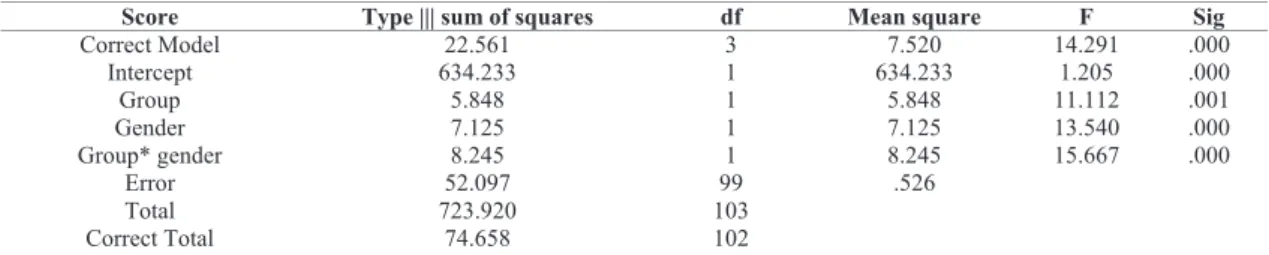
Table 3. Test of between subjects effect.
Score Type ||| sum of squares df Mean square F Sig
Correct Model Intercept Group Gender Group* gender Error Total Correct Total 22.561 634.233 5.848 7.125 8.245 52.097 723.920 74.658 3 1 1 1 1 99 103 102 7.520 634.233 5.848 7.125 8.245 .526 14.291 1.205 11.112 13.540 15.667 .000 .000 .001 .000 .000
Table 3, indicated that in comparing of two groups, F (1, 99) = 11.112, P < .01 showed that there was difference between experimental and control groups statistically significant. So self regulated learning strategies within computer-based group (2.78) was more than print-based group (2.25).
As well as, according to Table 3, compare of females and males group showed that F (1, 99) = 13.540, P < .01. It means that self regulated learning strategies within females (2.76), was more than self regulated learning strategies within males (2.22) statistically significant.
Finally, based on Table 3, computed F (1, 99) = 15.667, P < .01 demonstrated that interaction between group and gender was statistically significant. Interaction between group and gender could be seen in Figure 1:
Figure 1. SRLS based on interaction between groups and gender
The components of SRLS in which computer-based group was significantly more than print-based group (both male and female) contain: Self evaluation, F(1,99)= 9.66 , P<0.01; seeking information, F(1,99)= 18.06, P<0.01; organizing and transforming, F(1,99)= 12.66, P<0.01; seeking social assistance (teachers), F(1,99)= 12.2, P<0.01; seeking social assistance (Peers), F(1,99)=12.18, P<0.01.
In the opposite of, the components that print-based group was significant more than computer-based group (both male and female) contain: Rehearsing and memorizing, F(1,99)= 10.43 , P < .01; reviewing records (text books), F(1,99)= 18.16, P < .01; keeping records and monitoring, F(1,99)= 14.16, P < .01.
Differences between two groups in other components (goal setting and planning, environmental structuring, self-consequating, seeking social assistance from adults, reviewing records to tests and to prepare for class) is not significantly (P > .05). SRLS and its total components among female are more than male both CBT group and PBT group significantly (P < .01).
4. Conclusion
As earlier mentioned, findings showed that students who taught via computer mediated had self regulated learning strategies more than students who taught via print based materials. This finding is in compliance with the findings of Boekaerts, et al (2006); Change and Lehman (2002); Chen (2002); Deborgh (2002); Moenikia and Abtin (2006); Orhan (2007); and Perry, et al (2006). In cited researches in compliance with present research instructing
3.28 2.23 2.18 2.27 1 1.5 2 2.5 3 3.5 males females experimental control
and learning based on computer, promotes self regulated learning strategies. In justify this finding could be said that students feel autonomy in computer-based learning environments, so their SRLS promote.
Also findings reflected that SRLS of females was more than males. This finding was confirmed by some researches in Iran (MoeniKia and Abtin, 2006). The Components of SRLS: Self evaluation, seeking information, organizing and transforming, seeking social assistance (teachers), and seeking social assistance (Peers) among computer based learners is higher than Print based learners. Inverse the Components of SRLS: Rehearsing and memorizing, reviewing records (text books), and keeping records and monitoring among Print based learners is higher than Print based learners. Circumstance of learning in e-tools mediated environments effect on students' seeking information, organizing and transforming, and seeking social assistance especially from peers and teachers. But these environments don’t promote characteristics such as reviewing records (text books), and keeping records.
Researchers suggest that in distance education based on e-tools, students should be empowered for working with computer and web, and promote their ability in goal setting and planning, environmental structuring, self- consequating, seeking social assistance from adults, reviewing records to tests and to prepare for class.
References
Artino, A.R. (2008). A conceptual model of self- regulation online. Academic Exchange Quartery,12 (4), 41-54. Boekaerts, M., Pintrich, P.R., & Zeidner, M. (Eds.). (2000). Handbook of self-regulation. San Diego: Academic press.
Butler, D. L., & Winne, P.H. (1995). Feedback and self-regulated learning: A theoretical synthesis. Review of Educational Research, 65, 245-281.
Chang, M.M. and Lehman, J.D. (2002). Learning foreign language through an interactive multimedia program: An experimental study on the effects of the relevance component of the ARCS model. CALIGOJ, 20(1), 81-98.
Chen, C.S., (2002). Self-regulated learning strategies and achievement in an introduction to information systems course. Information Technology, Learning and Performance Journal, 20(1), 11-25.
DeBourgh, G. A. (2002, June). Simple elegance: Course management systems as pedagogical infrastructure to enhance science learning. The Technology Source. Retrieved May 1, 2009, from http://ts.mivu.org.
Dweck, C. S. (2002). Beliefs that make smart people dumb. In R. J. Sternberg (Ed.), Why smart people do stupid things. New Haven: Yale University Press.
Hartley, K., & Bendixen, I. (2001). Educational research in the Internet age: Examining the role of individual characteristics. Educational Research, 39(9), 22-26.
Hodges, C. B. (2005). Self regulation in web- based courses: A review and need for research. The quarterly Review of Distance Education, 6(4),
375- 383.
Larreamendy, J., & Leinhardt, G. (2006). Going the distance with online education. Review of Educational Research, 76, 567-605.
Latanich, Gary, Nonis, Sarath A. & Hudson, Gail I. (2001). A profile of today's distance learners: An investigation of demographic and individual difference variables of distance and non-distance learners. Journal of Marketing For Higher Education, 11(3), 1 — 16
Lee, J.K. (2008). The effects of self- regulate learning strategies and system salisfaction regarding learner,s performance in e- learning environment. Journal of instructional pedagogies. Retrieved June 1, 2009, from http://www.aabri.com.
Lee, J.K., & Lee W.K., (2007). The relationship of e-learner,s self-regulatory efficacy and perception of e-Learning environmental quality.
Computers in Human Behavior, Available online at: www. sciencedirect. com.
Moenikia, M. and Abtin, J. (2006). Relationship between using of ICT and psychological characteristics in Ardabil secondary schools' students. Iran, Ardabil, educational organization.
Moore, M. G. (1989). Distance education: A learner’s system. Lifelong Learning, 2(8), 8-11.
Orhan,f. ( 2007). Applying self regulated learning strategies in a blended learning instruction. World Applied Sciences, 2(4), 390-398.
Perry, N.E., Phillips, L., & Hutchinson, L.R. (2006). Preparing student teachers to support for self-regulated learning. Elementary School Journal, 106, 237-254.
Pintrich, P.R. (2000). The role of goal orientation in self-regulated learning. In M. Boekaetrs, P.R. Pintrich, & M. Zeidner (Eds), Handbook of self-regulation (pp.451-502). San Diego: Academic.
Pintrich, P. R., & De Groot, E. (1990). Motivational and self regulated learning components of classroom academic performance. Journal of Educational Psychology, 82, 33-40.
Pintrich, P.R., Wolters, C., & Baxter, G. (2000). Assessing metacognition and self-regulated learning. In G. Schraw and J. Impara (Eds.), Issues in the measurement of metacognition (pp. 43-97). Lincoln, NE: Buros Institute of Mental Measurements.
Schunk, D.H.(1991).Self-efficacy and academic motivation. Educational Psychologist, 26, 207-231.
Willis, B. (1995a). Distance education: An overview. In Distance Education at a Glance: Guide#1. University of Idaho, Engineering Outreach. [On-line] Available at: http:// www. uidaho. edu/ evo/dist1. Html.
Winne, P.H. and Perry, N.E. (2000). Measuring self-regulated learning. In P. Pintrich, M. Boekaerts, & M. Seidner (Eds.), Handbook of self-regulation (p. 531-566). Orlando, FL: Academic Press.
Winters, F.I., Greene, J.A., Costich, C.M. (2008). Self- Regulation of learning within computer- based Learning environments: A critical analysis. Educational psychology Review, 20(4), 26-38.
Zimmerman, B. J. (1990). Self-regulated learning and academic achievement: An overview. Educational Psychologist, 25, 3-17.
Zimmerman, B. J., & Martinez-Pons, M. (1986). Development of a structured interview for assessing student use of self learning strategies.