Theses and Dissertations 2017
Emotional intelligence and teacher leaders
Emotional intelligence and teacher leaders
Emily IsenseeFollow this and additional works at: https://digitalcommons.pepperdine.edu/etd Recommended Citation
Recommended Citation
Isensee, Emily, "Emotional intelligence and teacher leaders" (2017). Theses and Dissertations. 787. https://digitalcommons.pepperdine.edu/etd/787
This Thesis is brought to you for free and open access by Pepperdine Digital Commons. It has been accepted for inclusion in Theses and Dissertations by an authorized administrator of Pepperdine Digital Commons. For more information, please contact [email protected] , [email protected].
EMOTIONAL INTELLIGENCE AND TEACHER LEADERS ___________________________________
A Research Project Presented to the Faculty of
The George L. Graziadio School of Business and Management
Pepperdine University
_____________________________________ In Partial Fulfillment
of the Requirements for the Degree Master of Science in Organization Development ________________________________________ by Emily Isensee April 2017
ii
EMILY ISENSEE
under the guidance of the Faculty Committee and approved by its members, has been submitted to and accepted by the faculty of The George L. Graziadio School of Business and Management in partial fulfillment of the requirements for the degree of
MASTER OF SCIENCE
IN ORGANIZTION DEVELOPMENT Date: April 2017
Faculty Committee
Committee Chair, Terri Egan, Ph.D. Committee Member, Julie Chesley, Ph.D.
Deryck J. van Rensburg, DBA, Dean The George L. Graziadio
iii
The purpose of this study was to understand principals’ perceptions and perceived attributes of strong teacher leaders, determine how these attributes link to emotional intelligence and learn how these attributes are developed. In this study, emotional intelligence will be defined as “the abilities to recognize and regulate emotions in ourselves and in others” (Goleman, 2001, p.14). This study summarizes data collected through semi-structured interviews with 11 school principals and assistant principals from a variety of schools, school districts and across multiple states. Overall, this study lead to three main discoveries: 1) top perceived attributes of teacher leaders are closely connected to EI skills 2) teacher leader development strategies that best support EI are comprehensive, job-embedded, sustained over time, peer-focused, goal-focused, differentiated for teacher’s needs and leverage a variety of practices and tools, and 3) teacher leaders with high EI have a positive impact on their schools.
Keywords: Emotional Intelligence, Teacher leaders, Leadership Development, Professional Development, Relationship-Building
iv
Abstract ... iii
List of Tables ... vii
List of Figures ... viii
Chapter 1: Introduction and Purpose ... 1
Emotional Intelligence and Educators... 2
Research Purpose ... 3
Importance of Study ... 3
Thesis Outline ... 3
Chapter 2: Review of Relevant Research ... 5
Existence and Importance of the Problem... 5
Teacher Leader Development ... 9
Emotional Intelligence and Leadership ... 11
School Leaders and Emotional Intelligence in the Classroom ... 14
The Benefits of Emotional Intelligence ... 17
Developing Emotional Intelligence ... 18
Summary of Themes and Implications for Developing EI in Teacher Leaders ... 23
Chapter 3: Research Design ... 25
Research Methodology ... 25
Research Design ... 25
v
Data Analysis Procedures... 28
Chapter 4: Data Analysis and Research Findings ... 29
Attributes of Teacher Leaders Key Themes ... 29
Child centeredness. ... 29
Continuous self-improvement. ... 32
Relationship building with students’ families ... 33
Relationship building with colleagues ... 34
Perceived Attitude. ... 36
Focus on school mission, vision and values. ... 37
Influence on Colleagues ... 38
Barriers that Get in the Way of Teacher Leaders ... 38
Lack of relationship building skills ... 39
Fear & Insecurities... 40
Teacher Leader Development Strategies... 41
Administrator Recognition, Encouragement & Empowerment ... 42
Collaborative and Peer-Focused. ... 44
Coaching and mentoring. ... 44
Differentiated Support and Development. ... 45
Job Embedded Opportunities... 46
Summary ... 47
Chapter 5: Summary, Conclusions, Limitations, Recommendations ... 49
vi
Relationship Building and Influence on Colleagues ... 52
Teacher Leadership Development Strategies. ... 53
Administrator Recognition Encouragement and Empowerment. ... 53
Collaborative and Peer Focused Development ... 54
Coaching and Mentoring. ... 55
Goal Setting and Differentiated Development. ... 55
Implications for Practice ... 56
Comprehensive, Job-embedded, Long-Term Programs. ... 57
Systems that Support Differentiated Development. ... 57
Structured Peer Learning & Collaboration ... 58
Recommendations and Limitations ... 58
Conclusion ... 60
vii
Table 1: Starting Interview Questions……….…….28
Table 2: Attributes of Teacher Leaders Key Themes………...30
Table 3: Barriers to Effective Teacher Leadership Key Themes………..39
Table 4: Teacher Leader Development Strategies……….41
Table 5: Goleman’s Four Domains of Emotional Intelligence with overlay of Attributes of Teacher Leaders Key Themes………...………50
viii
Figure 1: The Optimal Process for Promoting Emotional Intelligence in Work
Organizations……….20 Figure 2: Interviewee Population and Type of School………...……...27
Chapter 1: Introduction and Purpose
The U.S. education system is often under attack for the poor quality of education, ineffective teachers, low graduation rates, and a host of other issues. Multiple reform efforts, coming from federal, state and local governments as well as private
organizations, have led to little improvement in education. Key to improving education are highly competent teachers, since they are widely acknowledged as the most important school-related factor influencing student achievement (Markow & Pieters, 2011). All teachers need to be leaders in their classrooms and schools to increase student
achievement and school performance. Teachers recognize this and are asking for leadership development opportunities to increase their skills and competence. These opportunities look different in each school district, ranging from nothing to robust programs reserved for only the best teachers. A study by the Bill and Melinda Gates Foundation and the Boston Consulting group found that $18 billion is spent annually on professional development and a typical teacher spends 89 hours per year on professional learning activities. However, this report also found that by many measures, including the views of the principals and teachers involved, current professional development efforts are not effective.
Emotional Intelligence (EI) focused on self-awareness, self-management, social awareness, and relationship management is one model widely used for leadership development in the business world (Goleman, 2004). Leveraging their EI, great leaders have developed effective ways to understand and interpret their own emotions as well as those of others. These leaders are able to positively influence the emotions of those around them, bringing out everyone’s best version of themselves (Goleman, 2013).
Teachers could significantly benefit from the opportunity to develop their EI. When teachers are able to recognize how they feel throughout the day, they are better able to express themselves inside and outside of the classroom (Ciarrochi, 2013). By
understanding how they and those around them express their emotions, they are better able to regulate their own emotions, empathize with their students, provide counsel to their peers, and lead other teachers.
Emotional Intelligence and Educators
Research has shown the benefit EI development has for school teachers and administrators (e.g., Brackett & Katulak, 2007; Goleman, 2013). For example, the Emotionally Intelligent Teacher Program, used by schools across the US, helps teachers “enhance their ability to apply EI skills” to their work (Brackett & Katulak, 2007, p. 2). Other studies show that schools with leaders who display strong EI skills perform better. For instance, in a study done in the U.K., 69% of headmasters of high performing schools displayed four or more emotion-linked leadership attributes, while two-thirds of the headmasters at low performing schools displayed only one to two similar leadership attributes (Goleman, 2013). While evidence shows that emotionally intelligent school leaders are successful, research is limited on how EI training can be used specifically for the leadership development of teachers. Questions that need to be researched are:
• What are the top attributes of teacher leaders and how are these connected to EI skills?
• How could EI be leveraged to help teachers develop leadership skills?
• What impact could more teachers with higher EI have on their students, peers, and schools?
Research Purpose
The purpose of this study is to understand principals’ perceptions and perceived attributes of strong teacher leaders, determine how these attributes link to EI and learn how these attributes are developed. In this study, EI will be defined as “the abilities to recognize and regulate emotions in ourselves and in others” (Goleman, 2001, p. 14). Importance of Study
As school administrators understand the impact of leadership development programs incorporating EI, they will be more likely to implement them in their school systems. As teachers learn more about EI, they will better be able to use the EI skills that they already possess.
Teachers face a variety of challenges in their daily work life. In their classroom they balance teaching to a prescribed curriculum, handling behavior issues, and creating a positive learning environment. At the same time, they are dealing with school budget cuts which lead to teacher and staff layoffs, as well as, reductions in programs and services. Additionally, professional development opportunities are limited or ineffective and time for collaboration with fellow teachers is minimal. All of these conditions means teaching is a very stressful profession, with job satisfaction low and high burn out (Brackett & Katulak, 2007; Markow & Pieters, 2011). EI provides skills for teachers to assess, manage, and express their emotions through these factors and better manage the stress that comes with their profession.
Thesis Outline
Chapter 1 provided an introductory look at teacher professional development and teacher leadership and EI. It also described the need for and the importance of this study,
and outlined the purpose of the study. Chapter 2 provides a review on existing literature and research on teacher professional development, teacher leadership, EI, and best practices for developing EI. Chapter 3 outlines the methodology used to gather data from school administrators, defines the sample, and explains how the data will be analyzed. Chapter 4 describes the findings of the study and presents key themes. Chapter 5 summarizes conclusions of the study and provides insights and recommendations for developing EI skills in teacher leaders.
Chapter 2: Review of Relevant Research
The purpose of this study is to understand principals’ perceptions and perceived attributes of strong teacher leaders, determine how these attributes link to EI and learn how these attributes are developed. This chapter shares existence of the problem, examines how teacher development is currently happening, defines teacher leadership, considers applicable theoretical frameworks of EI, reviews the research on effective ways to develop and improve one’s EI, and explores how these EI interventions can build teachers’ leadership capacity and improve student performance.
Existence and Importance of the Problem
Research suggests current teacher professional development efforts are not
improving teacher effectiveness or student success (e.g., TNTP, 2015; Boston Consulting Group, 2014). In 2015, the New Teacher Project (TNTP) conducted a study of three large school districts with over 10,000 teachers and 500 school leaders. TNTP (2015)
discovered that school districts are making large investments in teacher development in time (19 school days a year) and money (almost $18,000 per teacher per year), yet the data shows teacher performance has not improved substantially from year to year. The study also found that school districts are not helping teachers understand how to improve or that they have a need to improve. Teachers continue to get satisfactory ratings, while student outcomes are not meeting the expectations. Performance improvements were seen in teachers’ first few years in the classroom, but then leveled off after an average of five years of teaching, showing that teachers often plateau before they master core
TNTP (2015) found no clear patterns among the development experiences of the teachers who did improve. Improvement was an individualized process which varied from teacher to teacher. One factor that did show a slight relationship to teacher growth was the consistency of the teacher’s perception of their own teaching effectiveness with their formal evaluation ratings, that is, they had an accurate self-awareness. Additionally, the teachers in the study appeared to have elevated self-perceptions. 83% of the teachers gave their classroom instruction a four or five on a five point scale and only 47% agreed that they have any weaknesses in their instruction (TNTP, 2015). This could imply that a teacher’s self-awareness plays a part in their ability to improve their instructional skills. Also, the majority of teachers did not feel the development opportunities offered to them helped them build new skills or improve their instruction. Finally, the types of
development which they did find helpful, such as follow-up support and observing excellent teachers, are only offered infrequently (TNTP, 2015).
A study funded by the Bill and Melinda Gates Foundation and executed by the Boston Consulting Group surveyed over 1,300 teachers, professional development leaders, education agencies, and principals (Boston Consulting Group, 2014). The study found that teachers want professional development that is relevant, interactive, sustained over time, delivered by someone who understands the teacher experience, and treats teachers like professionals. The teachers recognized the value of collaboration to improve their skills, but many are not experiencing strong, well-structured collaboration models. If the environment is right, these collaborative programs have the potential to build trust in schools, increasing teaching effectiveness. Studies show that coaching also improves
teachers’ competence, but must be offered consistently for them to implement new instructional skills (Boston Consulting Group, 2014).
In both TNTP (2015) and Boston Consulting Group (2014) research, teachers report limited choice in their existing professional development activities, yet when they do have options, they are much more satisfied with the learning experience. Teachers in both reports also indicated that the development opportunities provided are not
customized to the content they teach or the skills they want to develop. They also find little continuity between each professional development experience. Research is starting to emerge on professional development design elements that seem to be effective such as coaching, continuous feedback, collaboration, and personalized methods, however, it is unclear which models are most effective under what conditions (Boston Consulting Group, 2014; TNTP, 2015). Overall this data shows that teacher development is often lacking and opportunities for improvement exist, beginning with the design elements that are proving to be most effective.
While work still needs to be done to determine the best overall models for teacher professional development, trends are emerging in the literature on effective design. A review done on 111 teacher professional development articles published in Teaching and Teacher Education between 2000 and 2011 examined trends in the personal processes involved in the various formats used for teacher learning and models of teacher professional learning. The underlying theme in all the studies was “a recognition that teacher learning and development is a complex process that brings together a host of different elements… but also, that at the center of the process, teachers continue to be both the subject and objects of learning and development” (Avalos, 2011, p. 17). The
review found that longer interventions were more effective than shorter ones and that a combination of tools and reflective experiences create a better learning experience. Avalos (2011) also discovered that the casual conversations teachers are having with each other could be leveraged in powerful ways as a strategy for co-learning. The approach “starts with informal exchanges in school cultures that facilitate the process, continues in networking and interchanges among schools and situations and is strengthened in
formalized experiences such as courses and workshops that introduce peer coaching or support collaboration and joint projects” (Avalos, 2011, p. 17).
Other problems surrounding teacher professional development are teacher burnout and educators leaving the profession. Stress, working conditions, and low pay are the top three reasons teachers cite for leaving the field (Darling-Hammond, 2001). These factors seem to affect new teachers the most, with nearly 30% of teachers leaving within their first five years, with even higher rates in disadvantaged districts (Darling-Hammond, 2001). A survey done by MetLife in 2011 of 1,001 U.S. K-12 public school teachers, reported these issues are becoming more dire. The study found teachers’ job satisfaction decreased by 15 points since the same survey had been completed two years earlier. It also found a large increase in the number of teachers indicating they are likely to leave teaching for another occupation (Markow & Pieters, 2011). On a positive side, the data showed that teachers with high job satisfaction reported having more professional development and time to collaborate with other teachers. This indicates that enriched professional development programs for teachers have the potential to increase overall teacher job satisfaction.
The studies about teacher professional development programs referenced above show that some designs seem to be working well, but also many opportunities for improving these programs exist as well. Since the focus of this research study is professional development specifically for teacher leaders, the following sections will define teacher leadership and explore which professional development strategies are most helpful for them.
Teacher Leader Development
Teachers emerge as leaders in their classrooms and among their peers in many ways. Accomplished teachers are often promoted to school administrator jobs or tapped for other district-wide leadership roles. Teachers who are recognized for excellence in the classroom consider themselves teacher leaders and believe others see them as leaders as well. They engage in leadership roles that include conducting professional development opportunities for colleagues, developing curriculum, serving as department chairs or team leaders, and mentoring new teachers. However, they are often not provided with training or skill-building to help them be successful in these leadership roles. They are usually expected to have the necessary skills or to develop them on the job (Dozier, 2007).
Teachers can step into leadership roles at their schools in many small ways, ranging from choosing textbooks and instructional materials, to shaping curriculum, to setting standards for student behavior, to selecting new teachers or administrators. Former principal and teacher Roland Barth believes “if schools are going to become places in which all children are learning, all teachers must lead” (Barth, 2001, p. 445). Based on his research with over 100 teacher leaders in the Rhode Island Sizer Fellowship Program, Barth (2001) believes all teachers have leadership capacity which is waiting to
be unlocked and put to use to improve their schools. When teachers take on leadership roles within their schools, they, their students and their principals all benefit. One study found that in more democratic schools, where teachers took leadership roles in selecting text-books, designing curriculum, and choosing their colleagues, student achievement rates were higher than in schools which were less democratic in governance and decision making (Barth, 2001). When teachers take on leadership roles at their schools, they can shape the future of that school, helping to create their own destiny as an educator.
Leadership roles give teachers more variety in their daily schedules and keeps them better engaged which ultimately helps with retention (Barth, 2001). Principals benefit by
enlisting teachers to help with the leadership responsibilities of running a school which, in turn provides the principal greater capacity to support the teachers and students.
Part of teacher leadership is acknowledging that all teachers have leadership potential and in order for schools to be successful, all teachers must lead. Brown (2012) defines a leader as, “anyone who holds her- or himself accountable for finding potential in people and processes” (p. 185). According to this definition, successful teacher leaders will look for the potential in their students and the processes that govern their school.
Barth (2001) found three elements which help teacher leaders succeed: having a goal, being persistent, and enjoying the incremental changes along the way. EI skills can help build these three elements necessary for teacher leader success. Strong support from the principal is also key to cultivate and develop teacher leaders. Principals should expect leadership from their teachers, relinquish control and power, empower and build trust with teachers, plus protect teacher leaders when they put themselves at risk. They should also give credit for success, yet share responsibility for failure (Barth, 2001). A study
conducted on 123 teachers in three secondary schools in Kent, England found that
emotion-regulation ability, one of the four dimensions of EI in the Mayer/Salovey model, positively impacts job satisfaction and personal accomplishment. This impact was even higher when principal support was also present (Brackett & Katulak, 2007).
The most successful programs for retaining teachers past the five-year mark are induction programs that assign new teachers an expert colleague as a mentor. Teachers who begin their career with this type of support have attrition rates two-thirds lower than their new colleagues who are not in such programs. In addition, new teachers who are mentored become competent faster than teachers who are left to learn from trial and error (Darling-Hammond, 2001)
The above research shows the impact teacher leaders can have on their schools, elements that make teacher leaders successful and the importance of principal support and mentoring in developing teacher leaders. EI is a particularly important set of skills for teacher leaders and, as mentioned above, these skills align with elements that make teacher leaders successful. The next section will explore the role EI skills play in leadership and the impact EI employees can have on an organization.
Emotional Intelligence and Leadership
Goleman (2004) argues that “emotional intelligence is the sine qua non of leadership” (p. 82). Goleman (2004) continues, “without it a person can have the best training in the world, an incisive, analytical mind, and an endless supply of smart ideas, but he [or she] still won’t make a great leader” (p. 82). Goleman (2011) presents four domains of EI needed to achieve emotional mastery in leadership roles:
1. Self-awareness: deeply understanding one’s emotions, strengths and limitations, as well as one’s values and motives. Associated competencies include: emotional self-awareness, self-assessment, and self-confidence.
2. Self-management: the self-regulation of internal states of mind, emotions and impulses, that is, emotional control. Associated competencies include: self-control, transparency, adaptability, achievement, initiative, and optimism. 3. Social awareness: Empathy and an awareness of other people’s feelings in the
moment. Associated competencies include: empathy, organizational awareness, and service orientation.
4. Relationship management: Leveraging the first three domains to show up
authentically, and skillfully responding to other people’s emotions to move people in the right direction. Associated competencies include: inspirational leadership, influence, developing others, change catalyst, team player and collaboration. (p. 51)
Mayer, Salovey, and Caruson (2004) define EI as “the capacity to reason about emotions, and of emotions to enhance thinking. It includes the ability to accurately perceive emotions, to access and generate emotions so as to assist thought, to understand emotions and emotional knowledge, and to reflectively regulate emotions so as to
promote emotional and intellectual growth” (p. 197). Mayer and colleagues (2004) have also developed an EI four-branch model that is focused on the abilities which an
emotional intelligent person possesses. The four branches are:
1. Perception of emotion: the ability to perceive emotion in oneself and others. 2. Use of emotion to facilitate thinking: the ability to leverage emotions to focus
attention, communicate feeling, or engage in other cognitive processes (i.e. reasoning, problem solving, and decision making).
3. Understanding of emotions: the ability to understand the causes of emotions, appreciate emotional patterns over time, and analyze how feelings combine, progress and change.
4. Management of emotions: The ability to be open to feelings and use them effectively to promote personal understanding and growth.
(p. 199)
Goleman’s (2011) four domains of EI are inter-related and cumulative, so are the facets of Mayer and colleagues (2004) model. Proficiency in one skill influences mastery
in other areas, and proficiency in the first three abilities culminates in proficiency in the fourth.
In an analysis of psychology-developed leadership competency models of 188
companies, Goleman (2004) grouped competencies into three categories: technical skills, cognitive ability (or IQ), and EI. Goleman (2004) observed that, “emotional intelligence proved to be twice as important as the other [competencies] for jobs at all levels” (p. 84). In the same study Goleman (2004) found that when high performing leaders were
compared to average ones, “nearly 90% of the difference in their profiles was attributable to emotional intelligence factors rather than cognitive abilities” (p.84).
A study of 60 managers at a large pulp and paper company found that emotional intelligence is associated with transformational leadership, specifically idealized influence, inspirational motivation and individualized consideration (Barling, Slater, & Kelloway, 2000). Emotional intelligent leaders who know and can manage their emotions are better role models, which, in turn, inspires trust and respect in their followers. Leaders with high EI know how much they can raise their followers’ expectations, a key
component of inspirational motivation. Leaders with good empathetic and relationship management skills understand their employees’ needs and interact accordingly,
exhibiting the transformational leadership concept of individualized consideration. Overall, the study found that employees see supervisors with higher EI as better leaders, once again suggesting the important role that EI plays in effective leadership.
EI also fosters servant leadership, which focuses on the needs and development of others (Barbuto, Gottfredson, & Searle, 2014). A study of the servant leadership and EI of 75 civic leaders found that “a leader’s ability to monitor the feelings, beliefs, and
internal states of self and others plays an important role in the leader’s efforts to lead with a servant leader ideology” (Barbuto, Gottfredson, & Searle, 2014, p. 321).
School Leaders and Emotional Intelligence in the Classroom
Classrooms all over the U.S. are starting to integrate Emotional Intelligence using the term “Social-Emotional Learning” (SEL) (Goleman, 2001). The research shows students’ social-emotional competence is key to success in school and in life (Elias, O’Brien, & Weissberg, 2006). Teacher and student proficiency in EI influences effective communication, management of stress, maintenance of a positive school environment, as well as academic and workplace success (Brackett & Katulak, 2007). Integrating SEL into a school or district takes strong leadership and significant commitment from both the school or district administrator. Since teachers’ jobs require them to be in tune with their own emotions, along with those of students, parents, colleagues and school administrators every educator would benefit from becoming aware of their EI strengths and
shortcomings as well as developing their EI skills. School leaders can foster teachers’ EI by providing support and accountability structures for this (Elias et al., 2006). When individual teachers’ EI and the collective EI of the school improves, relationships between the adults and students in the school will also improve (Elias et al., 2006). For successful integration of SEL into a school or district, “leadership must be distributed, and ideally each staff member will see that the mantle of leadership touches everyone who is entrusted with the care of the students” (Elias et al., 2006, p. 13). This once again supports the concept that all teachers are leaders and EI can help these teachers develop their leadership skills. It also shows that teachers stepping into leadership roles within their schools is essential to fully integrate SEL into a school.
Teachers who struggle regulating their own emotions tend to have students who experience more negative emotions in the classroom (i.e., sadness, shame, and guilt) (Sutton & Wheatley, 2003). With better EI skills teachers can address this problem by creating a more stable, supportive, and productive learning environment (Brackett & Katulak, 2007). This suggests that not only is EI beneficial for developing leadership skills in teachers, but also in developing classroom management skills.
The Emotionally Intelligent Teacher Workshop is one program that provides teachers with the support to create a safe, satisfying, caring and productive school environment. Focusing on leadership and professional development for teachers and school leaders, the workshop helps participants improve relationships with students and colleagues, as well as provide coping mechanisms to deal with the stress teachers face on a daily basis (Brackett & Katulak, 2007). The day long workshop has three objectives: (1) provide in-depth information about EI skills, (2) create a knowledge base of how EI skills play an integral role in academic learning, decision making, classroom management, stress management, interpersonal relationships, team building, and overall quality of life, and (3) teach innovative strategies and practical tools for teachers to increase their own EI skills and integrate them into their classrooms (Brackett & Katulak, 2007). The workshop activities and strategies are based on Mayer and Salovey’s work, and are designed to help educators develop one of the four EI abilities in their model. One of the tools provided is the EI Blueprint, a four-question process based on scientific theory that helps teachers effectively handle emotional experiences before or after they occur. The questions correspond to the four EI skills in Mayer and Salovey’s model, beginning with perception of the emotion and ending with management of the emotion. They are: “How
may/was each person feel/feeling?,” “What may/were you and the other person
think/thinking about as a result of these feelings?,” “What may cause/caused each person to feel the way he/she does/did?,” and “What may/did you and the other person do to manage these feelings?” (Brackett & Katulak, 2007). This activity, as well as the others presented in the workshop, are simple exercises, that when practiced regularly, have potential to foster lifelong skills that are essential for professional and personal success. Like the Blueprint tool, many of the workshop activities have participants reflect back on how they and others around them were feelings during past events. Often these
reflections are written down at first. After practiced repeatedly through writing, the activities then become mental ones that can be used as needed (Brackett & Katulak, 2007). As a result of this workshop, school administrators report an improvement in the way they conduct meetings with their staff, peers and parents. They attribute this to a better understanding of how emotions affect interpersonal relationships, as well to the meeting planning tools taught in the workshop. Teachers report being able to pay
attention to their emotional biases and the emotional states of their students when lesson planning or reacting to student behavior (Brackett & Katulak, 2007).
Management in the education sector is both a science and an art. The school leaders and principals have to balance the drive for results with fostering relationships, since the human side of their work is so important. The school leader does this effectively by being adaptive, flexible, cooperative, moderate and self-conscious - essentially by leading with EI. This was demonstrated through a study conducted by the Athens University of Economics. To determine the key leadership and EI qualities that primary school principals possess, the university surveyed 301 educators and 36 principals from
Athens. Their questionnaire measured EI according to the “Emotional Quotient-Inventory” and assessed the leadership role of principals (Brinia, Zimianiti, & Panagiotopoulos, 2014). The study found that EI is linked to leadership factors. The majority of the principals were rated high on key factors related to intrapersonal skills linked to EI. For example, 80.1% of teacher respondents stated that “the principal feels confidence in most situations,” 80.4% agreed that principals could communicate to others their anger with them, 87.2% agreed that “the principal likes helping people,” and 77.2% agreed that the principals are clear with what they want to achieve in their lives.
Respondents also stated that principals had strong EI on an interpersonal level. For example, 83.6% of respondents agreed that “the principals attentively listen to the ideas of their teachers, even when they disagree” and 51.3% agree that “it is easy for the principal to make friends,” (Brinia et al., 2014). Ultimately the study found “the absences of such an emotional foundation will not allow the principal to adopt innovation, to activate his or her colleagues, to manage and develop the team nor to incorporate the teachers within the culture and the objectives of the school,” (Brinia et al., 2014, p.40). While this study specifically looked at the school leader or principal, many EI skills can be beneficial to the teacher leader in the same way they are essential to the principal’s success.
The Benefits of Emotional Intelligence
As mentioned earlier, the research indicates a current problem area for the education profession is low teacher job satisfaction (Markow & Pieters, 2011). A study done on 187 food service workers, found a strong correlation between high EI and high job satisfaction (Sy, Tram, & O’Hara, 2006). Employees with high EI are better able to
appraise and regulate their own emotions than employees with low EI. They also may be more aware of the factors that trigger positive and negative emotions for themselves, and in turn take appropriate action to mediate those triggers or navigate the emotions. For example, employees with high EI are better able to identity frustration and stress and then regulate those emotions to reduce the stress. These employees often are more resilient because they are able to discover the cause of the stress and develop strategies to deal with its negative consequences (Sy, Tram, & O’Hara, 2006). Another study of 44 analysts in a Fortune 400 company found similar links between high EI and job
performance, job satisfaction, mood, and stress tolerance (Lopes, Grewal, Kadis, Gall, & Salovey, 2006).This study also found links between high employee EI and interpersonal facilitation as ranked by colleagues. Lopes and colleagues (2006) believe that EI
contributes to high job performance and satisfaction because EI skills help people to regulate their emotions to cope effectively with stress, perform well under pressure and adjust to organizational change.
Developing Emotional Intelligence
While researchers debate whether emotional intelligence is genetic or developed, studies and practice show that EI can be improved (Cherniss, Goleman, Emmerling, Cowan, & Adler, 1998). Even though EI increases with age, some mature people need help to enhance their EI (Goleman, 2004). Many traditional training programs do not improve EI because they focus on cognitive learning as opposed to emotional learning (Cherniss et al., 1998). Cognitive learning, which involves fitting new data and insights into existing frameworks, focuses purely on the neocortex where cognitive abilities are based (Cherniss et al., 1998). EI emerges from neurotransmitters in the brain’s limbic
system, which governs feelings, impulses, and drivers. Emotional learning requires retuning the limbic circuit through training that helps people break habits and then establish new ones. This involves a long learning process that can be difficult for the learner and involves significant practice (Cherniss et al., 1998; Goleman, 2004). After surveying the available EI research, Cherniss and Adler (2000) developed an optimal process for developing EI, which is summarized in Figure 1.
Figure 1 shows four phases that make up the process: secure organizational support; prepare for change; train and develop; and encourage, maintain, and evaluate. The first phase secures leadership buy-in and develops an approach that meets the needs of the organization. This phase, which is more focused on the organization than the individual, sets the organization up for a shift in employee behavior which is essential for success. The next three phases focus on the individual and motivation is key in each of these. Since developing one’s EI requires the hard work of change, the preparation phase is critical for creating the motivation for change. Motivation continues to be important in the training phase and is enhanced by a strong relationship between the trainer and the learner. The encourage and maintenance phase is particularly challenging for learners since old habits will be reinforced when they return to their normal work environments. The tasks of the encourage and maintenance phase help create an organizational
environment that supports the new learning. The evaluation task leads to the continuous improvement of the training program as effective components are used again and less-effective ones are improved (Cherniss & Adler, 2000)
Figure 1
The Optimal Process for Promoting Emotional Intelligence in Work Organizations
Note. From Promoting Emotional Intelligence in Organizations (64), by C. Cherniss & M. Adler, 2000, Alexandria, VA: ASTD. Copyright 2000 by the American Society for Training & Development. Reprinted with permission.
One study looking at EI development followed two groups of fully-employed business students (Groves, McEnrue, & Shen, 2008). It found that the group that participated in an 11-week intensive EI training program had statistically significant EI gains in pre/post EI assessment. The second group, which took an undergraduate management course that did not address EI or emotion-related topics, did not show any significant pre-/post-test difference in their EI assessment. The EI training program was designed around the four dimensions of Mayer and Salovey’s model. Groves and colleagues (2008) chose this model because it focuses on EI skills and abilities as
opposed to personalities type, personal characteristics, or competencies, which are harder to change. The training program was individualized to focus on the goals participants set for themselves and emphasized behavior change. It included five self-assessments (including tools and surveys to gauge both current EI ability and readiness to engage in EI development), creation of a self-development plan, peer coaching, interviews, ongoing feedback from classmates and coworkers, readings on EI models, interim progress
reports, meetings with the instructor, weekly journaling, and a post-training EI assessment (Groves, McEnrue, & Shen, 2008). The EI Self-Description Inventory (EISDI), based on Mayer and Salovey’s model, was used for the study’s pre-/post assessment of EI abilities. Groves and colleagues (2008) designed and tested this
inventory specifically to evaluate leadership development application and organizational phenomena. Even though this study did not look at the maintenance of EI skills past the 11 weeks, many students used their skills on the job in their self-development plans.
McKee (2015) emphasized that EI cannot be developed unless a person is invested in changing their behaviors. However, getting a person to this place of
investment cannot be required or incentivized. Individuals need to find a deep and
personal vision of their own future, then realize that their current ways of operating might need adjustment to realize this future (McKee, 2015). People take the first step towards this by reflecting on what’s important in life and hopefully coming up with a vision of powerful and positive relationships with family, friends and coworkers. Once this vision is established, individuals need to gather feedback from trusted family, friends and colleagues on the current state of their EI. This can be done in a variety of ways, from informal conversations to formal 360-degree feedback instruments. After the current state and desired future are established, a gap analysis is done and a plan is made to close the gap (McKee, 2015).
These methods of developing EI can be applied to teacher leaders. The Emotionally Intelligent Teacher Workshop provides tools and structures to take participants through all phases of the model illustrated in Figure 1. The first phase of securing organization support happens when a principal or teacher identify the need for EI skills and the principal approves this development opportunity. The prepare for change phase is when teachers and administrators opt in by signing up for the workshop. Ideally, the staff would choose to attend this workshop because they want to improve their EI. The workshop itself is the train and develop phase. In the workshop, participants learn about the four EI abilities and have the opportunity to try these out through various exercises. The encourage and maintain phase happens when the participants take the strategies and activities they have learned back to their classrooms and schools and use them there. The evaluation portion of the final phase takes place through the
Summary of Themes and Implications for Developing EI in Teacher Leaders
The research shows two major problems in the education profession right now: 1) Many of the professional development activities for teachers are not effective and 2) Teacher stress, burn out, job dissatisfaction are at an all-time high, causing more and more educators to leave the profession (e.g., TNTP, 2015; Boston Consulting Group, 2014; Sy et al., 2006; Lopes et al., 2006). To counter these issues, a growing body of research shows high levels of EI correlate with less stress, job satisfaction and reduced burnout. Additionally, researchers, adult learning experts, and experienced educators are developing and testing an increasing number of programs to help professionals improve their EI.
Existing research provides insights into the study questions for a limited
population. There appears to be some trends when it comes to developing EI. Effective EI development efforts are individualized, continuous and consistent, and supportive (eg., Groves et al., 2008; Boston Consulting Group, 2014, Cherniss et. al., 1998). Small positive behavior changes along the way need to be recognized and rewarded. The most common first step in the EI development process is data gathering and goal creation (eg., Barth, 2001; McKeee, 201; Groves et al., 2008). Data collection happens in a variety of ways: an informal gathering of feedback from friends, family, and colleagues; a formal 360 feedback assessment; an EI self-assessment, such as the EQ-I; or an EI behavior assessment such the MSCEIT. Once data is collected, the most effective programs have individuals use it to create a goal or vision for success based on this data and the shifts they want to make. This goal leads to an action plan with exercises to intentionally build EI skills. A myriad of activities can be used for this. Most EI development programs
include learning about EI through reading or workshops, reflecting on what is learned, receiving coaching, collecting regular feedback, and practicing new EI skills. This process takes place over several weeks and months and benefits from support by family, peers or supervisors. Many formal EI training programs end with a post-assessment to measure improvement in EI skills. However, the process of developing one’s EI is a continuous practice.
Teachers with high EI are better able to manage their emotions and the emotions of those around them (eg., Sy et al., 2006; Barling et al., 2000). As a result, they have improved relationships with their students, colleagues, parents and principals; are able to create a more positive and supportive learning environment; and promote academic success in the classroom and school.
While there is general agreement that EI is linked with successful leadership in all industries, most studies in the education sector are focused on principals (eg., Brinia et al., 2014; Barth, 2001). Significantly less research examines EI as a leadership
development tool for teachers. While workshops such as The Emotionally Intelligent Teacher are used with teachers across the US, an opportunity remains to learn more about how programs that teach EI also contribute to improved teacher leadership capacity. This research addresses that gap and focuses on how schools and districts across the U.S foster teachers’ EI skills and develop their leadership capacity. In the next chapter, the
researcher outlines the methodology used to gather data from school administrators about current teacher leader development efforts, defines the interviewee sample, and explains how the data will be analyzed.
Chapter 3: Research Design Research Methodology
The purpose of this study was to understand principals’ perceptions and perceived attributes of strong teacher leaders, determine how these attributes link to EI and learn how these attributes are developed. Specifically, the researcher was interested in
understanding how many of these attributes can be linked to EI skills, what methods have been most effective in boosting these teacher leader attributes, and what impact strong teacher leaders have on those they interact with on a daily basis. This chapter supports the study’s purpose by outlining the research methodology, which includes research design, sampling methodology, data measurement and the data analysis procedure. This study was designed to further explore the research questions: What are the top attributes of teacher leaders? How are these attributes connected to EI skills? How is EI leveraged to help teachers develop leadership skills? What is the impact of teacher leaders’ EI skills on students, peers and schools?
Research Design
Part of the research design was driven by analyzing the literature and to come up with emerging themes related to teacher leaders, EI training methods and teacher leader professional development. The researcher also investigated these topics through
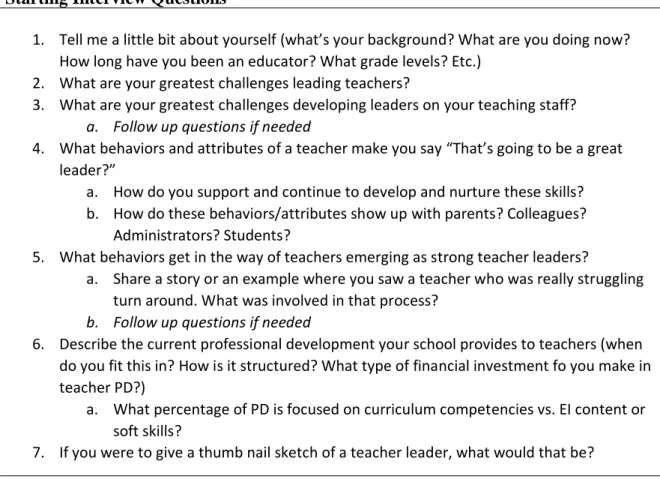
professional networks and connections in the education space. This study collected qualitative data by interviewing principals and assistant principals who are supporting EI development in their schools. The interviews were semi-structured with a core set of questions (see Table 1 below), that allowed flexibility for follow up questions and exploring the topics that principals and assistant principals wanted to discuss. The
researcher used the data collected to demonstrate how the perceived attributes of strong teacher leaders are directly related to EI skills, as well as to show trends of the impact these teacher leaders have on their schools, students, and peers. Additionally, the data showed how EI is effectively used in leadership development for teachers. The researcher’s design was approved by an Institutional Review Board, and all training required by the Institutional Review Board was completed prior to conducting field research.
Sampling Methodology
The researcher conducted interviews with principals and assistant principals who supervise teachers from a variety of schools, school districts, and across multiple states. The researcher used convenience sampling (Maxwell, 2012) where participants were selected based on productive relationships the researcher had established through professional connections in the education field. The researcher interviewed eleven principals and assistant principals who had been identified as fostering strong teacher leaders and EI development among the teachers at their school. Through this sampling methodology, the researcher collected qualitative data from the administrator
(principals/assistant principals) perspective on the development of strong teacher leaders and the impact they have on their schools.
These principals and assistant principals came from a variety of schools, districts and states. Six of these interviewees were principals or heads of schools, four were assistant principals, and one was a school district director of professional development and former principal. Theses participants live in six different states. Eight of them work at public schools, two work at private schools, and one works at a charter school.
Figure 2
Interviewee Population and Type of School
Data Collection
In an effort to collect qualitative data, the researcher used a variety of questions in the initial interviews. Since these were semi-structured interviews, at times questions were re-ordered and new ones added during the interview. The questions were designed to understand how those who supervise teachers perceived great teacher leadership and what the key attributes were. The questions also explored current teacher leader
professional development programs and how EI is included in these programs.
Additionally, the questions were designed to understand the barriers and challenges to teacher success and the best ways to help overcome these. The interview questions are listed in Table 1. Principal or Head of School 55% Assistant Principal 36% Other 9%
Interviewee Population
Public 73% Private 18% Charter 9%Type of School
Table 1
Interview Questions
Starting Interview Questions
1. Tell me a little bit about yourself (what’s your background? What are you doing now? How long have you been an educator? What grade levels? Etc.)
2. What are your greatest challenges leading teachers?
3. What are your greatest challenges developing leaders on your teaching staff? a. Follow up questions if needed
4. What behaviors and attributes of a teacher make you say “That’s going to be a great leader?”
a. How do you support and continue to develop and nurture these skills? b. How do these behaviors/attributes show up with parents? Colleagues?
Administrators? Students?
5. What behaviors get in the way of teachers emerging as strong teacher leaders?
a. Share a story or an example where you saw a teacher who was really struggling turn around. What was involved in that process?
b. Follow up questions if needed
6. Describe the current professional development your school provides to teachers (when do you fit this in? How is it structured? What type of financial investment fo you make in teacher PD?)
a. What percentage of PD is focused on curriculum competencies vs. EI content or soft skills?
7. If you were to give a thumb nail sketch of a teacher leader, what would that be?
Data Analysis Procedures
The researcher conducted a content analysis of the research participants’ responses. This process involved reviewing the data, generating categories and themes, coding the responses, and creating diagrams to show the common themes. A second coder reviewed the researcher’s coding system to verify the content analysis. Key perceptions and perceived attributes of teacher leaders, best practices around teacher leader development and the impacts teacher leaders have on their schools were summarized and can be found in Chapter 4.
Chapter 4: Data Analysis and Research Findings
This chapter summarizes the content analysis of the qualitative data collected through the interviews. Interview questions were designed to examine principal and assistant principal’s perceived attributes of top teacher leaders as well as their perceptions of the challenges and barriers teacher leaders face in professional development. While no questions were asked directly about EI, the intention was to see how often principals and assistant principals referenced attributes related to EI. Three key themes emerged as part of a content analysis of the 11 interviews conducted: 1) common attributes of teacher leaders, 2) barriers that impede teacher success and 3) development strategies. The below tables and content outline the key themes in each of these three areas.
Attributes of Teacher Leaders Key Themes
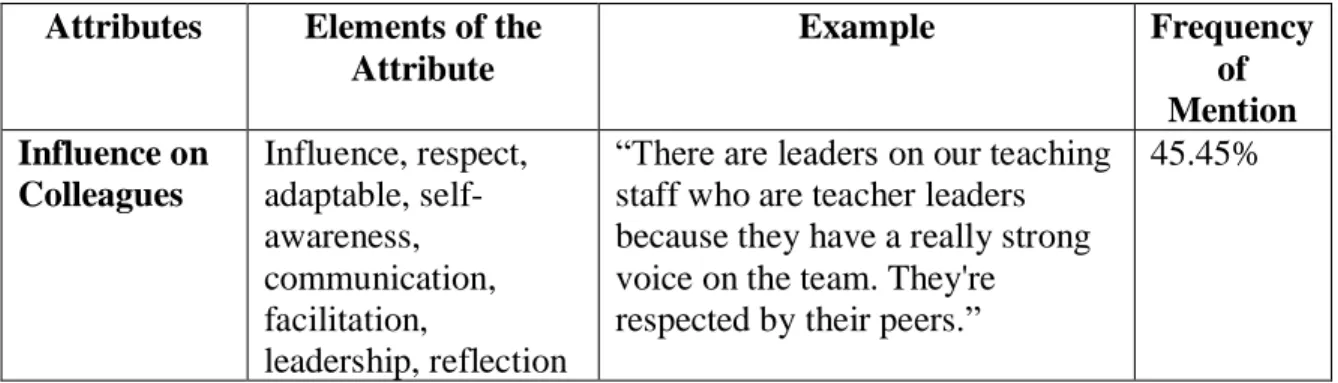
Each interviewee brought a diverse set of perspectives, views and opinions about the top attributes of teacher leaders, however, several clear themes emerged among the interviews. The overarching themes include: child-centeredness; continuous self-improvement; relationship building with students’ families; relationship building with colleagues; perceived attitude; focus on school mission, vision, and values; and influence on colleagues. Table 2 outlines these key attributes with illustrative quotes.
Child centeredness. One of the most referenced attributes of a great teacher leader was child-centeredness. Principals and assistant principals seem to see this as the critical component for their best teacher leaders, as reflected in their statements that came up in every one of the 11 interviews. One interviewee explained:
Table 2
Attributes of Teacher Leaders Key Themes
Attributes Elements of the Attribute Example Frequency of Mention Child-centeredness Passion, kindness, service-focused, intentional, relational, communicative
“They've got the heart for the kids. They care for the kids. They're making decisions based on what's best for kids even though it might be uncomfortable for them. It's always in the best interest of our kids.” 100% Continuous self-improvement Growth mindset, open minded, curious, reflective, introspective, self-awareness
“True master teachers intuitively don't ever think they're done growing” 100% Relationship building with students’ families Community-focus, kind, communicative, connected, relational, authentic, trust-building
“Teacher leaders are deeply connected with parents in a real way. They know them. They know them well. They know what's going on, not just in the child's life, but the parent’s life.”
100% Relationship building with colleagues Connected, adaptive, communicative, collaborative, teamwork, trust-building, self-control
“the first things that a leader has to do and keep at the forefront of everything they do is building relationships with each and every teacher.” 100% Perceived Attitude Optimistic, hopeful, positive, confident, driven, passionate, empathetic
“A teacher that is always looking outside of the box, and jumps in, that has that positivity, that has hope. A person… always
[pushing] for more, those people are the leaders…it's the
characteristics in their personality.” 90.91% Focus on school mission, vision and values Service-focused, passionate, aligned, sense of self
“Aligning well with the mission of the organization you're serving is crucial because if you don't believe in what they believe in that rub will show itself continually throughout your practice.”
Table 2 (Continued) Attributes Elements of the
Attribute Example Frequency of Mention Influence on Colleagues Influence, respect, adaptable, self-awareness, communication, facilitation, leadership, reflection
“There are leaders on our teaching staff who are teacher leaders because they have a really strong voice on the team. They're respected by their peers.”
45.45%
“They have to have passion for being child-centered, doing what's best for the kids. When you're doing what's best for kids, sometimes you have to do things that are selfless and maybe not necessarily easy. You have to put the kids at the forefront of everything that you do.”
Another interviewee had a similar opinion, emphasizing the importance of being able to communicate well with the students:
“I want to make sure that I have the best individual in there who is going to make sure that they know their kids…continue to get to know them throughout the year, have that great contact with them, communicate with them.”
One interviewee explained she believed focusing on the children was more important than being charismatic or having a dynamic personality:
“A teacher leader can be dynamic. They could be charismatic, but if they don't have any results behind that, they're not a teacher leader. They haven't yet figured out how to translate that passionate energy into kids learning. A teacher leader doesn't leave any kids behind.”
Another interviewee acknowledged that teacher leaders cannot possibly be good at everything the job requires, but “…what you can be good at is loving kids and putting learning at the center of the work that you do.”
A few participants explained how they keep themselves and their teachers child centered. One interviewee shared:
“…one of the best pieces of advice a professor ever gave me was that if every day you do your job and you go home and you can say, ‘The decisions I make, were they in the best interest of the student, of the
children?’ If you can honestly answer that yes, then you should be able to sleep that evening.”
Also common were comments about the importance of tying every decision that is made in a school back to the students:
“…they're making instructional and assessment decisions based on what's best for kids. I think that paramount for any leader in any position, it should always be about the kids. When we're having staff meetings or smaller group discussions, when I hear it come back to the very essence of why we're all here, that to me is someone who gets it.”
Another underlying theme was a need for the teachers to be able to develop relationships with the child, to meet them where they are and provide the best learning environment. For example, one interviewee shared:
“every kid doesn't have to end in the same place, but they have to all end up further down the path than when they showed up…[Teachers need to have the attitude that] I'm here to serve your spirit and your learning, and I'm worried about that first. If that means I have to stay outside of the office hours, I'm going to do that. If it means I'm willing to eat at my desk with you…and have a conversation that helps further your learning, I'm going to do that. I do what it takes to make you have the best learning environment.”
As these statements show being child-centered is an essential attribute that teacher leaders possess and that administrators look for in emerging teacher leaders.
Continuous self-improvement. A second common attribute of teacher leaders was an individual focus on learning. All 11 interviewees mentioned this trait in their stories and sharing about great teacher leaders, using such descriptors as a growth-mindset, open mindedness, and curiosity. Other related comments were about being reflective, self-aware and a desiring to continue to develop one’s self. According to the principals and assistant principals, teacher leaders who continuously worked on self-improvement, inspired a passion for learning in their students. For example, one interviewee explained: “Because it doesn't matter where you are, if you're not a learner
and you don't enjoy learning, how are you going to communicate that to others?” Another shared a story of a teacher who:
“...had not deliberately and intentionally paid attention to the importance of their own learning and their own changing, and how they have to model it, because you can't give kids what you don't already have. This person was not realizing that they were expecting growth and learning in kids, but not demonstrating it for kids in their own practices.”
Several other interviewees emphasized the importance of continuous self-improvement to take risks and be more innovative. One principal explained: “…to evolve, to grow, to change, to meet the needs of students, requires teachers to take great risks and learn new things.” Another stated:
“It's really a growth mindset. If somebody sees that we don't have to do things the way that we've always done them, then we can be thinking about options, we can blow the doors off. We don’t do this in education, but look at other industries, and other venues, and other places where things are happening that are innovative and exciting, and we need to say, how do we apply that to our work.”
Reflection and self-awareness were also mentioned as elements of a learning mindset focused on self-development. One principal explained that is what he looked for when searching for strong teacher leaders:
“I begin to look at what have they done to do self-development? Are they constantly reflecting or refining their practice? Reflection, I think, is a key indicator of a teacher who's going to be successful or a great teacher leader, are they constantly in that reflective state?”
As these interview excerpts demonstrate, administrators placed great emphasis on teacher leaders being focused on continuous self-improvement.
Relationship building with students’ families. Another key attribute of teacher leaders was relationship building with students’ families. This included building trust with parents, supporting the student by being in tune with the family, expressing empathy, exhibiting strong communication skills and having tough conversations with parents. In all 11 interviews, participants shared the importance of teachers building
relationships with families through care, kindness, communication, connection, and authenticity. One interviewee outlined how relationship building with parents should come first:
“They [parents] have to know that you care about them. From the minute you walk in [to the classroom], you're asking about their children, who they are, what they like. You're getting to know the parents as people, what their family stories are that are important to them, the history of the community. You have to do your homework and I think you have to go in building relationships before you do anything else because they're not going to eye anything you're showing unless they know you care about them.”
One principal referenced the work of Rick Ackerly, a speaker, educator and author, when explaining the importance of the teacher/parent relationship in supporting the student. The principal stated:
“Ackerly says all students need a rational advocate, and an irrational advocate. Parents are the irrational advocate. They think their kids can do no wrong. Teachers are the rational advocate. They love the kids, and they see their flaws, and the partnership that the teacher and the parent builds is about slowly developing a rapport and a relationship that allows them to tell the truth about those things so that we're seeing all sides of the student.”
Another principal explained how strong teacher leaders have the needed relational and communication skills to form a partnership with parents:
“…the ones that are able to have really positive conversations with parents, even about a not so great issue. They’re the ones who are able to say that the child is having difficulties in their class, or there's a behavior concern. They're the ones that are able to bring the parents in as part of a team. A parent might come at them with some criticism and they're able to take it. They're able to explain things and to really communicate well that they have the child's best interests in mind.”
As the above quotes show, teacher leaders have the skills and knowledge needed to build relationships with families.
Relationship building with colleagues. Besides building relationships with families, strong teacher leaders also built strong relationships with their colleagues. All
11 interviewees discussed how these relationships led to a variety of positive impacts among teachers such as teamwork, collaboration, communication, and trust. One administrator explained:
“…the first things that a leader has to do and keep at the forefront of everything they do is building relationships with each and every teacher. That is challenging. You have people who take more of your time than others and you cannot forget that every teacher, every person in that building, teacher, paraprofessional, cafeteria person, custodian, they all matter.”
Another principal explained how good relationships with a teacher’s colleagues sets a great teacher leader apart from a great teacher:
“What's most important if you're talking about teachers, they have to have the respect of their colleagues, and sometimes really strong teachers don't always have that for one reason, whether it's jealousy or maybe they've rubbed people the wrong way.”
. Ten of the 11 interviewees talked about the importance of teacher leaders having strong communication skills, an important element for building strong peer relationships. For example, one principal shared:
“In a meeting, they are the ones that, even if they have something more critical to add, do it in a respectful way. They know how to communicate appropriately, they’re approachable. It doesn't just mean being Susie Sunshine all the time, but if they disagree with something they're able to express it in a way that doesn't create tension, but moves you along toward looking for a solution.”
Another principal explained that teacher leadership:
“…has to show up in the way we communicate with each other, there's an expectation for graciousness, for kindness, for collegiality, and
collaboration. For a flow of ideas, for a way to have hard conversations if things do come up, and they do.… there should be [relationships and structure] in place, so when that push comes, it isn't about that person being a leader or not, we are right back to how do we share ideas, and how do we share direction of where we want to go.”
As the excerpts above show, principals and assistant principals view the commitment to and skills for building strong relationships as an essential attribute for successful teacher leaders.
Perceived Attitude. Ten of the 11 principals and assistant principals discussed the attitudes and resulting behaviors they perceived in their top teacher leaders. These attitudes included optimism, positivity, hope, passion, drive, confidence, and empathy. One principal referred to these attitudes as “the fire in our belly.” Another principal referred to them as “non-cognitive skills,” which are “building things like empathy, and wit, and all that other kind of stuff.” An assistant principal described a teacher with a passionate attitude as “fabulous, confident, knew what she was doing, did not need a lot of guidance from me, a real self-starter kind of person.” Confidence came up in several other interviews as an important attitude teacher leaders possessed that is a helpful component in classroom management. One principal explained the need to support your leaders so “that they can begin to build self-confidence. With confidence, comes
competence or the other way around, with competence, comes confidence.” Interviewees also talked about how these attitudes showed up in teachers’ interactions with colleagues, students and colleagues and their impact. One principal commented, “If a teacher is confident in what they're doing and what they know, but they are humble and vulnerable with parents, then they've really integrated that parent into the classroom… teacher leaders are deeply connected with parents in a real way.” Another principal explained how these attitudes are important in the way teachers interacted with their students, stating:
“That's where it comes back to positivity, energy, passion, hopefulness. They believe in the potential of every child. I think then as a teacher leader…you need to believe in the potential, the greatness of the people that you work with and serve. If you don't, you will not grow them.” These attitudes are also linked to continuous self-development. One principal explained how these attitudes motivated teachers to find the time for self-development