Telecom Operations Map
Telecom Operations Map
Telecom Operations Map
Telecom Operations Map
GB910
Approved Version 2.1
March 2000
Page ii Telecom Operations Map
Notice
The TeleManagement Forum (“TM Forum”) has made every effort to ensure that the contents of this document are accurate. However, due to the inherent complexity in the design and implementation of protocols, no liability is accepted for any errors or omissions or for consequences of any use made of this document. Under no circumstances will the TM Forum be liable for direct or indirect damages or any costs or losses resulting from the use of this specification. The risk of designing and implementing products in accordance with this specification is borne solely by the user of this specification. This document may involve a claim of patent rights by one or more TM Forum members, pursuant to the agreement on Intellectual Property Rights between TM Forum and its members, and by non-members of TM Forum.
This document is a copyrighted document of TM Forum, and if reproduced in any manner shall clearly acknowledge the authorship of TM Forum.
Direct inquiries to the TM Forum office: 1201 Mt. Kemble Avenue
Morristown, NJ 07960 USA Tel No. +1 973 425 1900 Fax No. +1 973 425 1515
Page iv Telecom Operations Map
Acknowledgements
Telecom Operations Map 2.1
Contributors
The release of the Telecom Operations Map Approved Version 2.1 is due to the work of many people:
Ø Don Batorsky, Telcordia Technologies (team lead)
Ø Debbie Deland, TM Forum
Ø Karen Shepherd, TM Forum
Ø Hilary Small, CASEwise
Ø Telops Map Team
• Mike Kelly, Nortel Networks UK
• Peter Huckett, TTC
• John Reilly, MetaSolv
• Peter Flynn, TTC
• Veli Kokkonen, Sonera Ltd.
• Ron Hirst, MSAF
• Charlie Byrne, Telcordia Technologies
Ø Mobile Management TMF Project Team, particularly:
• Ian Best, Orange PCS,
• Dave Raymer, Motorola,
• Steffen Weichselbaum, Mannesmann Mobilfunk GMBH,
• Michael Truss, Motorola
• Matjaz Blokar, SMART COM, Slovenia
Ø Elizabeth Adams, Rational Management Group, Inc., past CEO of TMF
and Service Management and Business Process Model Developer
Their expertise and involvement in providing contributions and participating in discussions are greatly appreciated. A special thanks to Don Batorsky, Telcordia, who gave a lot of his personal time. His commitment, thoughtful input and ideas were and are invaluable. We appreciate that Bob Lewis, Telcordia, has made Don available to lead the Telecom Operations Map team. We also appreciate the Corporate Renaissance Consulting contribution of Business Process Mapping Methodology, with thanks to John Feather and Gene Jachera.
Page vi Telecom Operations Map
Document Life Cycle
The Telecom Operations Map is being issued as Approved Version 2.1. The TeleManagement Forum ("TM Forum") expects to update it to reflect:
Ø Comments from implementation experience
Ø Additional member comment and public comment
Ø Enhancements or companion documents based on work currently in
progress in the TM Forum
The Telecom Operations Map Version 2.1 supersedes the NMF Service Management Business Process Model and the TM Forum Telecom Operations Map Evaluation Version 1.0 and 1.1 in their entirety.
All documents approved by the TM Forum (as well as those previously approved by NMF) undergo a formal review and approval process. This document was approved by vote of TM Forum members.
This document will continue under change control. Supporting work will be issued as companions or appendices to this document. A document of this type is a “living document,” capturing and communicating current knowledge, views and practices. Further updates will be made because of detailed work ongoing in the TM Forum and the industry.
Individuals or companies who are not members of the TM Forum are encouraged to provide comments on this document. However, in order for their comments to be considered, a signed waiver must be on file with TM Forum pertaining to intellectual property rights. To obtain this form, please contact the TM Forum.
Time Stamp
This version of the Telecom Operations Map can be considered valid until June 30, 2001.
How to obtain a copy
An electronic copy of the Telecom Operations Map can be downloaded at the TM Forum Web Site (www.tmforum.org) at Publications or through a link to Publications from the specific team’s public project area.
Page viii Telecom Operations Map
GB910 v2.1 TeleManagement Forum 2000
If you would like a paper version of this document, please order via the TM Forum Web Site or contact the TM Forum office. If you are not a member, please contact the TM Forum office on +1 973-425-1900.
How to comment on the document
Comments must be in written form and addressed to the contacts below for review with the project team. Please send your comments and input to:
Don Batorsky, Telcordia TelOps Map Team Lead
Debbie Deland, TMF TelOps Map Team Sponsor
Document History
Version Date Purpose
Evaluation Version 1.0
10/98 Evaluation Version released to public for comment Supercedes Service Management Business Process Model
Evaluation Version 1.1
4/99 Update to Public Evaluation Version for member
comments and work validation of all input/output diagrams. Evaluation
Version 2.0
11/99 TOM 1.1 Member and Public Comment Updates Updates to input/output diagrams
Language update to be inclusive of IP, Mobile, Wireless Introduction of e-business direction
Indication of 3 TOM Application Note Addenda: -GIA
-Mobile/Wireless Performance Mgt., Fraud and Roaming Agreement Mgt.
-Process Re-engineering and Development Simple Methodology Steps
Supercedes TOM 1.1 Approved
Version 2.1
3/00 Approved by Members Some editing updates
Some updates and corrections on spiders Change from Evaluation Version to Approved Supercedes Evaluation Version 2.0
Summary of changes in this version
Changes from Telecom Operations Map Evaluation Version 2.0
The TOM spiders (input/output diagrams) were reformatted for consistency and a few corrections or additions. The document was also updated to reflect its change in status from evaluation to approved version.
It supercedes Evaluation Version 2.0 of the Telecom Operations Map in its entirety.
Changes from the Telecom Operations Map Evaluation Version 1.1 to Version 2.x
Significant changes were made in the Telecom Operations Map between Version 1.1 and Version 2.x, as follows:
Ø Introduction of Telecom Operations Map Addenda for Application Notes.
These analyses will cover a variety of purposes, e.g., how to apply the map for various services, for service specific considerations, for actual end-to-end process flows, to provide more detail or understanding of a critical area, etc.
Ø For Telecom Operations Map 2.x, we introduce the following Application
Notes as Addenda to the TOM:
• IP Services: Global Intranet Access Service
• Mobile Services—Performance Management, Fraud and
Roaming Agreement Management
• Process Re-engineering, Development and Management
Simple Methodology Steps Ø Initial introduction of e-business direction
Ø Additions and corrections to input/output diagrams
Ø Updates for the multiple comments from members and public
This list of changes does not include format or edit changes made to improve clarity. For detailed changes, please refer to the Telecom Operations Map working team disposition summaries (available only to members of TM Forum at the TelOps Map Team area on the TMF Collaboration Center).
Expectations for Future Additions
The Telecom Operations Map (TOM) is a living document and member expectations for continued development of the map are high. Future releases may reflect some or all of the following:
Page x Telecom Operations Map
GB910 v2.1 TeleManagement Forum 2000
Ø Assessment and update for e-Business considerations, possibly:
• Defining need for one virtual or physical data source for all customer information, interactions, analysis, etc.
• Integration of Customer Care Processes to create a Customer
Relationship Management Process
• Assessment of and additions for empowering and enabling the
customer through the Customer Interface Management Process
• Development of Selling Chain Management process or
considerations due to the requirement to integrate and automate with other processes
• Development of Supply Chain Management process or
considerations due to the requirement to increase speed of service
• Preliminary Draft Available to members
Ø Process and interaction additions for the Business Management layer of
the TMN Model due to the requirement to understand and closely integrate with core enterprise, business processes—included in preliminary draft that reflects e-business changes.
Ø Providing and supporting connection or synergy of the TOM with the New
Generation OSS systems work. Underway within TM Forum
Ø Consider updating the simple Business reference Model in the TOM with
a more complex value chain model.
Ø Further definition of specific considerations for varying services, e.g., Broadband Services, IP Services, Mobile/Wireless Services
Table of Contents
Notice... iii
Acknowledgements... v
Telecom Operations Map 2.1 Contributors ...v
Document Life Cycle ... vii
Time Stamp... vii
How to obtain a copy ... vii
How to comment on the document... viii
Document History ... viii
Summary of changes in this version...ix
Changes from Telecom Operations Map Evaluation Version 2.0...ix
Changes from the Telecom Operations Map Evaluation Version 1.1 to Version 2.0 ...ix
Expectations for Future Additions...ix
Table of Contents ... xi
Table of Figures ... xiii
Preface... 1
TeleManagement Forum... 1
The TM Forum Approach ... 1
Telecom Operations Map... 3
Chapter 1- TOM Objectives ... 5
Define Common Terminology ... 6
Consensus Tool ... 6
Using This Document ... 6
Intended Audience ... 7
Relationship to Standardization Activities... 8
Terms and Definitions... 8
End User... 8
Customer... 8
Service Provider... 8
Network Operator... 9
Other Provider... 9
End-to-End Process Flow... 9
Quality of Service (QoS)... 10
Service Level Agreements (SLAs)... 10
Chapter 2 – The TMN Model... 13
Chapter 3 – Business Drivers ... 15
The Business Challenge ... 15
The importance of service ... 15
Linking objectives and requirements ... 16
Business process models... 17
Chapter 4 - The Business Relationship Reference Model ... 19
Management value chain ... 19
Page xii Telecom Operations Map
GB910 v2.1 TeleManagement Forum 2000
Establishing common specifications ...21
Chapter 5 – Telecom Operations Process Model...23
Telecom Operations Map Dimensions...25
Business Management Views ...25
End-to-End Process Flow...26
‘FAB’ End-to-End Process Flows ...27
3-D Telecom Operations Map ...28
Service and Technology Specific Dimensions ...29
Business Relationships with Suppliers and/or Other Providers Views ...30
Service Provider TOM Application ...31
Chapter 6 – Examples of FAB Process Flows ...33
Process Interactions...33
A Service Fulfillment Process Flow Instance...34
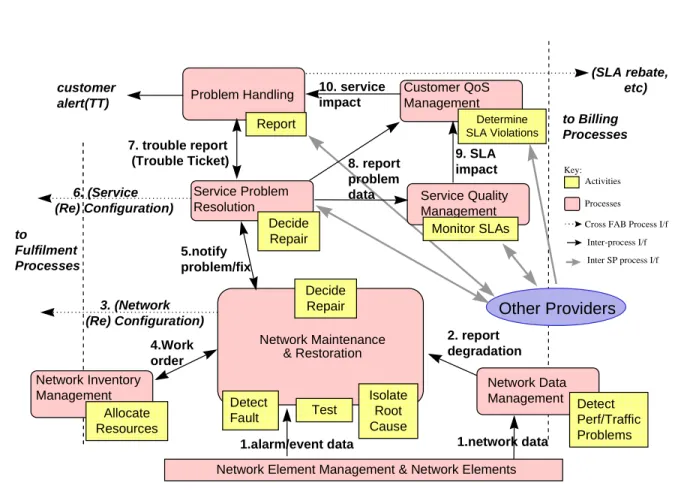
A Service Assurance Process Flow Segment...36
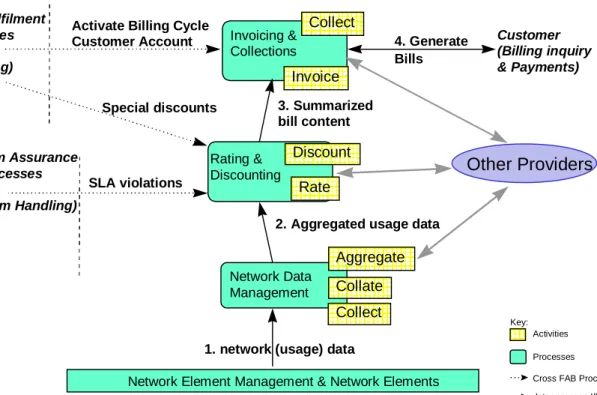
A Service Billing Process Flow Instance...38
Chapter 7 - The Operational Processes ...41
Customer Care Processes ...41
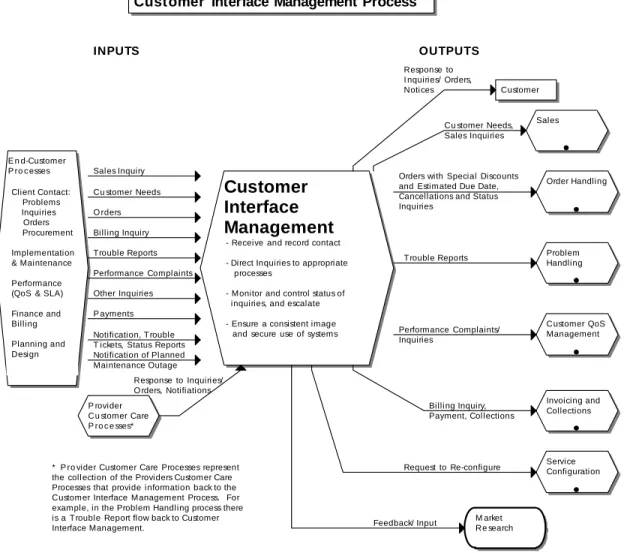
Customer Interface Management Processes...42
Sales Process...44
Order Handling Process ...46
Problem Handling Process ...48
Customer Quality of Service (QoS) Management...50
Invoicing and Collection Process ...52
Service Development and Operations Processes ...54
Service Planning and Development Process ...55
Service Configuration Process ...57
Service Problem Management Process ...59
Service Quality Management Process...61
Rating and Discounting Process ...63
Network and Systems Management Processes ...65
Network Planning & Development Process...66
Network Provisioning Process...68
Network Inventory Management Process ...70
Network Maintenance & Restoration Process...72
Network Data Management Process...74
Chapter 8 - Using the Telecom Operations Map...77
Evaluation Framework ...77
Communicating results ...78
A basis for discussions...78
Important Ways the Map is used...79
Identifying automation opportunities...79
Supporting documentation ...80
References ...81
Related or Source Documents ...81
Table of Figures
Figure P.1: TeleManagement Forum Approach Components 2
Figure 2.1: Basic TMN Model 13
Figure 4.1: The Business Reference Model 20
Figure 5.1: Telecom Operations Map, Business Process Framework 24
Figure 5.2: ‘FAB’ End-To-End Process Breakdown 27
Figure 5.3: ‘FAB’ End-To-End and Flow-through Process Flows 28
Figure 5.4. “3-D” Approach to Mapping--Service Level Agreements 28
Figure 6.1: Rough Example of Fulfillment Process Flow Instance 35
Figure 6.2: Rough Example of Assurance Process Flow Segment 37
Figure 6.3: Rough Example of Billing Process Flow Instance 39
Figure 7.1 Customer Interface Management Processes 43
Figure 7.2: Sales Process 45
Figure 7.3: Order Handling Process 47
Figure 7.4: Problem Handling Process 49
Figure 7.5: Customer Quality of Service Management 51
Figure 7.6: Invoicing and Collection Process 53
Figure 7.7: Service Planning and Development Process 56
Figure 7.8: Service Configuration Process 58
Figure 7.9: Service Problem Management Process 60
Figure 7.10: Service Quality Management Process 62
Figure 7.11: Rating and Discounting Process 64
Figure 7.12: Network Planning & Development Process 67
Figure 7.13: Network Provisioning Process 69
Figure 7.14: Network Inventory Management Process 71
Figure 7.15: Network Maintenance & Restoration Process 73
Preface
TeleManagement Forum
The TeleManagement Forum is an international non-profit organization serving the information services and communications industry. Its mission is to help service providers and network operators automate their business processes in a cost- and time-effective way. Specifically, the work of the TM Forum includes:
Ø Establishing operational guidance on the shape of business processes Ø Agreeing on information that needs to flow from one process activity to
another
Ø Identifying a realistic systems environment to support the interconnection of operational support systems
Ø Enabling the development of a market and real products for integrating
and automating telecom operations processes
The members of TM Forum include service providers, network operators and suppliers of equipment and software to the information services and communications industry. With that combination of buyers and suppliers of operational support systems, TM Forum is able to achieve results in a pragmatic way that leads to product offerings (from member companies) as well as paper specifications.
The TM Forum Approach
TM Forum uses a business and customer services driven approach to achieving end-to-end automation using integrated Commercial Off-the-shelf (COTS) software. It enables product availability, along with development specifications needed to produce management systems that can work together to produce the operational results needed by service providers and network operators. TM Forum makes use of international and regional standards when available, and provides input to standards bodies whenever new technical work is done.
The TM Forum focus is on providing pragmatic solutions to business problems and is based on the business layering principles articulated in the ITU-T layered TMN model (See Chapter 2 for brief discussion of TMN model).
The TM Forum approaches automation from both a business context and a systems context. Through the work in business context areas, members define the business
Page 2 Telecom Operations Map
GB910 v2.1 TeleManagement Forum 2000
process, requirement models and both technology-neutral information models, as well as technology-specific information models. This work is directly related to key market segment issues. The projects that develop the business context work can be both Process Automation (requirement and information modeling focused) projects and catalyst (implementation focused) projects.
The systems context work is done under the umbrella of TM Forum’s drive to create a New Generation of Operations Systems and Software (NGOSS™) that more truly delivers Plug and Play environments. NGOSS™ is driven by the business context work and requirements for systems infrastructure. It includes business case development for NGOSS™, the development of detailed requirements for NGOSS™, the development of the application component design and the infrastructure into which applications can plug and unplug. The NGOSS™ infrastructure is being developed as a technology-neutral architecture with associated technology-specific architectures and technology selections.
NGOSS™ work and frameworks also drive TM Forum projects, e.g., projects that develop contract specifications and catalyst (implementation focused) projects. The most valuable TM Forum projects are those projects that combine solid modeling work or use of common objects and both a business and systems context in a catalyst implementation.
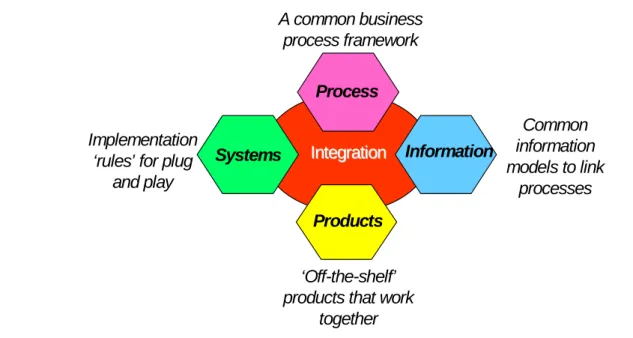
Figure P.1 provides a simplified view of the TM Forum approach.
Figure P.1: TeleManagement Forum Approach Components
Integration Integration Process A common business process framework Information Common information models to link processes Systems Implementation ‘rules’ for plug
and play
‘Off-the-shelf’ products that work
together
Telecom Operations Map
The Telecom Operations Map serves as the blueprint for process direction and the starting point for development and integration of Business and Operations Support Systems (OSS). Now, it also helps to drive TM Forum members work to develop NGOSS™. For service providers, it provides a neutral reference point as they consider internal process reengineering needs, partnerships, alliances, and general working agreements with other providers. For suppliers, the Telecom Operations Map outlines potential boundaries of software components, and the required functions, inputs, and outputs that must be supported by products. It consists of:
Ø A description of the role of the Telecom Operations Map
Ø A high-level view of Communications Operations processes,
sub-processes and activities that is top down, customer-centric, and end-to-end focused
Ø A high-level identification of the primary end-to-end processes of
fulfillment, assurance, and billing, and sub-processes within each Ø Illustrative examples of process flows that show end-to-end process
Ø A more detailed view of the functions of each sub-process, including
activities of each sub-process box, as well as its inputs and outputs to other sub-process boxes
Ø Uses of the map
The basic model continues to be stable even as the Telecommunications industry continues to change, largely because the Telecom Operations Map:
Ø Uses a high level and generic approach Ø Reflects a broad range of operations views
Ø Reflects the way service providers run and are architecting their
businesses Ø Is widely used
Page 4 Telecom Operations Map
Chapter 1- TOM Objectives
Whether incumbent providers or new entrants, service providers continue to urgently require well-automated operations processes, since they are faced with ever-increasing competition and a market experiencing dramatic change at an unprecedented rate. Many are struggling to move from a manual-intensive, inconsistent, inflexible environment to one that provides significant improvement in customer focus, service quality, costs, and time to market. They have to pervasively do business electronically with trading partners, suppliers and wholesale and retail customers. For the growing Mobile, Wireless and IP Services markets, these SPs are focused on quickly provisioning new customers and supporting service quality issues. For all service providers, the drive to introduce both new value added services and dramatic improvements in customer care is intense.
For the full range of service providers and network operators, the leading focus of the TM Forum’s mission is to enable end-to-end process automation of telecommunications and data services operations processes. The Telecom Operations Map is the framework for accomplishing this mission.
The purpose of the TOM is to continue to set a vision for the industry for competing successfully through the implementation of process driven approaches to operations management. This includes ensuring integration among all vital operations support systems concerned with service delivery and support. The focus of the Telecom Operations Map document is on the business processes used by service providers, the linkages between these processes, the identification of interfaces, and the use of Customer, Service, Network, and other information by multiple processes. Exploitation of information from every corner of the business will be essential to success in the future. The objectives of the Telecom Operations Map are to continue the progress made in establishing:
Ø An ‘industry owned” common business process model.
Ø Common definitions to describe processes of a service provider.
Ø Agreement on the basic information required to perform each process,
sub-process and process activity, i.e., sufficient high level information to serve as the starting point for business requirements and information model development, and the satisfaction of those requirements through industry agreement and products.
Ø A process framework for identifying which processes and interfaces are in most need of integration and automation, and most dependent on industry agreement.
This document describes the processes and their points of interconnection that make up the end-to-end process flows for Fulfillment, Assurance and Billing across the process layers of the Telecom Operations Map. It identifies the major processes and
Page 6 Telecom Operations Map
GB910 v2.1 TeleManagement Forum 2000
interfaces that make up an end-to-end process. Service providers need this common map of processes to enable doing business efficiently and effectively with other entities and to enable the development and use of third-party software without the need for major customization.
Define Common Terminology
The TOM document also provides the definition of common terms concerning operations processes, sub-processes and the activities performed within each. Common terminology makes it easier for service providers to negotiate with customers, third party suppliers, and other service providers.
Consensus Tool
The TM Forum produced the TOM initially as a consensus tool for discussion and agreement among service providers and network operators. Its broad consensus of support continues to grow. The map enables:
Ø Focused work to be carried out in TM Forum teams to define detailed
business requirements and information agreements (exchanges between applications or systems) and to review those outputs for consistency Ø Relating business needs to available or required standards
Ø A common process view for equipment suppliers, applications builders
and integrators to build management systems by combining 3rd party and in-house developments
The anticipated result is that the products purchased by service providers and network operators for operational management of their networks and services will integrate better into their environment, enabling the cost benefits of end-to-end automation. Furthermore, a common industry view on processes and information will facilitate operator-to-operator and operator-to-supplier process interconnection, which is essential for rapid service provisioning and problem handling in a competitive global environment.
Using This Document
A service provider’s specific process architecture and organization structure is highly proprietary, since both are critical aspects of a provider’s competitiveness. However, the Telecom Operations Map is a common view of operations processes that can easily translate to an individual provider’s internal approaches. The document is not
intended to be prescriptive about how the tasks are carried out, how a provider or operator is organized, or how the tasks are identified in any one organization.
The TOM is expected to be the starting point of detailed work that leads to an integrated set of specifications that will provide real benefit to both suppliers and procurers in enhancing industry operational management capability. This document is not a specification. It is a snapshot of industry views expected to continue to evolve based on changes in the industry. It is not intended to be too detailed, more a directional statement for the industry.
Intended Audience
The Telecom Operations Map aims at a wide audience of professionals in the Telecommunications and IT Industry. For experienced Telecommunications professionals, the Telecom Operations Map proves to be intuitive; a strong, common model of operations processes. Through TM Forum Catalyst projects and other work, it has been initially verified that the model has strong application for IP Services and Mobile/Wireless Services.
The TOM is aimed at service provider and network operator decision makers who need to know and input to the common business process model used to enable operations automation in a cost efficient way. It is also an important framework for specialists across the industry working on operations automation. The document or model supports, and is consistent with, many efforts under way in the industry supporting the dire need to accelerate business and operations automation in the communications and data services market.
It continues to give providers and suppliers a common model for discussing complex business needs in a complex industry with complex technologies. For both service providers and network operators additional complexities arise from:
Ø Moving away from developing their own operations systems software, to
a more procurement and systems integration approach.
Ø New business relationships between service providers and network
operators
The creation of new business relationships and the move away from developing internally are a reaction to market forces. These market forces require service providers and network operators to reduce time to market for new services, increase speed of service, as well as to drive down systems and operational costs.
The TOM is also aimed at service provider and network operator business process re-engineering, operations, procurement and other staffs for:
Ø Understanding the common business process model being used to drive
integration and automation
Ø Getting involved in providing inputs, priorities and requirements
The Telecom Operations Map is also aimed at designers and integrators of operational management systems software and equipment suppliers. They can benefit from understanding how management processes and applications need to work together to deliver business benefit to service providers and network operators.
An equally important and related audience is suppliers of management applications, management systems, and networking equipment, who need to understand the deployment environment for their products and solutions.
Page 8 Telecom Operations Map
GB910 v2.1 TeleManagement Forum 2000
Relationship to Standardization
Activities
Much of the management infrastructure upon which systems will be built is expected to be based on standard interfaces. Relating business needs to available, or necessary standards is a primary goal of the TM Forum in promoting a standards-based approach to communications services management. Where applicable, the TM Forum uses industry standards in its work to promote the acceptance of standards and to minimize redundant work. People active in management standardization (in the broadest sense) will find the TOM useful in setting a top down, customer-centric context of how management specifications need to work together.
TM Forum uses existing standards as much as possible. As a result of implementation experience through Catalyst projects, TM Forum provides feedback to appropriate standards bodies.
Terms and Definitions
End User
An end user is in the domain of the customer. An end user is interested in using communications and data services, e.g., Telecom, Internet/Intranet, Mobile/Wireless, etc.
Customer
The customer purchases communications and or data services from a service provider and/or network operator.
Service Provider
In the TOM, the term service provider refers to companies who provide communications and/or data services as a business. Service providers may operate networks, or they may integrate the services of other providers to deliver a total service to their customers.
Providing communications services to any customer may involve multiple service providers and/or network operators, where one provider may "sub-contract" with other providers to fulfill the customer's needs. When necessary to account for this relationship, the term service provider is used in this document to describe the company responsible to provide service to a customer. The term other provider is used to denote companies which have a sub-contractual responsibility.
Network Operator
An organization that operates a communications network, network or data services capability, acting basically as a wholesaler. A network operator is a service provider. A service provider may provide the network operator role or may subcontract this role.
Other Provider
Other providers include service providers and network operators who are subcontracted by the customer’s service provider to deliver the original customer request fully or as a component of the request.
End-to-End Process Flow
TM Forum uses the term ‘end-to-end process flow’ to include all sub-processes and activities, and the sequence required to accomplish the goals of the process. An end-to-end process has a beginning and an end with specific result expectations. TM Forum uses the term flow-through to mean automation across an interface or set of interfaces within an end-to-end process flow. TM Forum’s focus is on top down, meaning customer point of view, end-to-end processes that deliver the required result to the customer with flow-through between the customer and the network elements.
Other definitions in this document that may be useful in relation to processes are:
Process
A systematic, sequenced set of functional activities that deliver a specified result. In the TOM, process is used to refer to the overarching processes of Fulfillment, Assurance and Billing, as well as the process ‘boxes’ on the TOM Framework.
Sub-Process and Activity
Each process in the TOM framework consists of a set of activities and/or sub-processes that must be executed for the overall process to deliver the desired result. An activity is used to refer to the action required by the specific process and is usually fairly focused. A sub-process is a collection of activities or an interface for a specific set of work activities that are required to accomplish the desired results from the process. A process in the TOM Framework can be a process in one case and a sub-process in another. There are overlay sub-sub-processes that must be accomplished to support the customer. These overlay sub-processes are a set of activities that may need to be supported in multiple processes within the TOM framework, e.g., SLA Management, Fraud Prevention and Management. All of the processes in the TOM framework are made up of a set of sub-processes. The following examples should help to clarify.
Page 10 Telecom Operations Map
GB910 v2.1 TeleManagement Forum 2000
Ø The Service Planning and Development Process has several
processes, e.g., Capactiy Planning and Service Development are sub-processes.
Ø The Network Inventory Management process has several sub-processes,
e.g., Installation in the Physical Network and Managing Spare Parts are sub-processes.
Ø Process: Sales
• Activity: Review prices with customer
• Activity: Issue Service Request to Order Handling
• Sub-process: Initiate and gain commitment to provide new service
feature through Service Development. Service Development acts as a sub-process in this case.
Ø Process: Order Handling
• Activity: Issue Order
• Sub-process: Reserve Number through Service Configuration.
Service Configuration acts as a sub-process in this case
Ø Process: Service Problem Management
• Activity: Provide Performance Data
• Sub-process: Request reconfiguration through Service Configuration.
Service Configuration acts as a sub-process in this case.
Quality of Service (QoS)
Quality of Service is the measure of service quality defined for a service and provided to a customer. Quality of Service is the definition of the performance parameters used to assess service quality. The parameters are usually associated with a specific service or service type. Traditionally, the term QoS is used to refer to performance related parameters. Some use QoS to mean the quality of service for all aspects of the service, e.g., network performance measures and Completion On Time, Call Pick-up Time, etc. QoS can be subjective, e.g., is a call easy to hear? for voice, or objective, e.g., Cell Error Ratio for ATM. Defining QoS is easiest with digital circuits. QoS for IP Services is getting a lot of attention, since it is a connectionless service that is hard to measure and since QoS for IP Services came from the IT arena, i.e., the “best effort” delivery model. In the TOM, QoS is used to mean all the measures of service quality.
Service Level Agreements (SLAs)
A Service Level Agreement can be considered part of contract with the customer. In many cases, it is part of or an addendum to the contract with the customer. The SLA is a negotiated agreement between a customer and a service provider, defining the service provided and the set of metrics to be used to measure the level of service committed against the level of service provided. Such service levels might include network performance metrics, installation completion on time metrics and intervals for new orders, availability, call pick up times at a work center, maximum periods of outage, average and minimum throughput, etc. The SLA also frequently defines
trouble reporting and escalation procedures, reporting requirements and the general responsibilities of both parties.
For term and acronym definitions not explained within this document, please refer to the TeleManagement Forum Glossary. The TeleManagement Forum Glossary can
Chapter 2 – The TMN Model
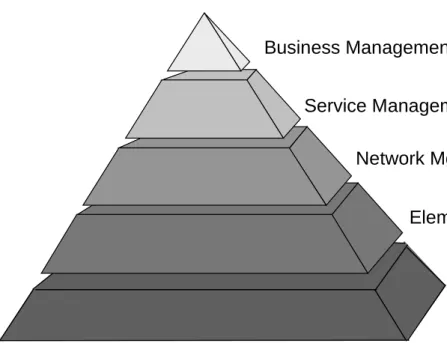
The communications industry has embraced the Telecommunications Management Network (TMN) model as a way to think logically about how the business of a service provider is managed. The TMN model consists of five layers, usually arranged in a triangle or pyramid. Business Management is at the apex, Service Management is the second layer, Network Management is the third layer, and Element Management the fourth layer with the physical network elements is represented in the bottom layer. The concept is that management decisions at each layer are different but interrelated. For example, detailed information is needed to keep a switch operating (at the element management layer), but only a subset of that information is needed to keep the network operating (e.g. is the switch operating at full capacity). Working from the top down, each layer imposes requirements on the layer below. Working from the bottom up, each layer provides capabilities to the layer above.
Figure 2.1: Basic TMN Model
The TMN model is simple, although its implementation is complex. The sheer number of standards now available that address the various interfaces between management systems sometimes makes it difficult to see and appreciate the big
picture. ITU-T Recommendation M.3400, TMN Management Functions, provides a
structure and decomposition of functions for all of the layers. However, those ITU-T
Business Management Layer
Service Management layer
Network Mgmt. Layer
Element Mgmt. Layer
Network Element
Layer
Page 14 Telecom Operations Map
GB910 v2.1 TeleManagement Forum 2000
standards that specify information models and interfaces have been mainly concentrated on the management and connection of resources to the Network Element Layer. Until recently, little attention has been given to interface specifications and information models within the TMN. Consequently, it is difficult to apply the standards to a complete business case, such as for the procurement of a specific Operations Support System. It is also difficult to apply a customer centric focus on the processes that respond to the satisfaction of customer needs.
The Telecom Operations Map, using the TMN model as a foundation, addresses operations support and management for any communications service from a top down, end-to-end process and customer oriented standpoint.
Chapter 3 – Business Drivers
The Business Challenge
The communications industry is rapidly changing with new rules, new competitors, new customers, unprecedented demands and the emergence of requirements for e-business. Service providers worldwide all face similar challenges, risks, and struggles to remain profitable in the face of more competition, higher customer expectations, falling market share, and price pressures. As the providers face these challenges, their suppliers must find innovative ways to deliver value or they may also risk going out of business.
Service providers face very different regulatory environments and their business strategies and approaches to competition are quite distinct. In general however, service providers share several common characteristics:
Ø Heavily dependent upon effective management of information and
communications networks to stay competitive
Ø Adopting a service management approach to the way they run their
business and their networks
Ø Moving to more of an end-to-end Process Management approach
developed from the customer’s point of view
Ø Automating their Customer Care, Service and Network Management
Processes
Ø Need to integrate new OSSs with legacy systems
Ø Focusing on data services offerings and
Ø Focusing on total service performance, including customer satisfaction
Ø Integrating with current technology (e.g. SDH/SONET and ATM) and new
technologies (e.g., IP, DWDM)
Ø Emphasizing more of a “buy” rather than “build” approach that integrates systems from multiple suppliers
The importance of service
The core of a service provider’s success is rapid response to the service needs of the customer. As the market develops the key objectives are ‘more for less’ -- faster service introduction, improved quality of service at a lower cost. Achieving these objectives requires automation of Customer Care and the supporting Operations
Page 16 Telecom Operations Map
GB910 v2.1 TeleManagement Forum 2000
Management Processes, a strong automated linkage between the management of customer service offerings and the underlying networking assets, as well as automated linkage with Enterprise applications. The level of automation and integration in the current environment of almost all service providers, existing and new entrants, is lower than what providers need to remain competitive. Many existing service providers that are facing new competitive pressures or facing restructuring are now actively engaged in re-engineering their business processes to integrate and automate, thereby decreasing costs and improving customer perceived value and performance. New entrants are developing operational processes based on automation of critical processes while planning to increase automation and integration as the business grows.
Some service providers choose to operate their own network infrastructure, while others choose to outsource this segment of their business. The effective exploitation of this network infrastructure, whether directly operated or outsourced, is an integral part of the service delivery chain and directly influences the service quality and cost perceived by the end customer. Service providers will need to become skilled at assessing outsourcing opportunities whether in network infrastructure areas or other areas and then, be skilled at integrating and managing any outsourcing arrangements.
With the growth of data services, it is becoming evident that the end customer perception of quality requires service providers to expand traditional measures of quality and to move more to proactive Service Management and interactive Customer Care. Customer applications now inherently provide sophisticated measures of quality. Service providers have to go beyond network-centric views of Quality of Service and support to meet customers expectations. It means pushing the limits of service and Customer Care processes performance.
Keeping up with quickly escalating customer service expectations, requires integrated and flexible process and system architectures that allow more off the shelf solutions and reduced dependence on customized solutions.
Linking objectives and requirements
Making a link between communications business objectives and the requirements typically stated for operations management systems is a challenge. Systematic process models are an essential source of solutions to this challenge. They can be used to positively influence a service provider’s organization in many ways such as:
Ø Simplifying internal communications and communications with suppliers
or other outside parties
Ø Revealing the way the organization performs, particularly from a customer point of view
Ø Identifying process, sub-process and process activity interfaces,
particularly at or supporting all points of contact between the service provider and its customers
Ø Identifying control points and critical performance metrics Ø Targeting productivity and quality improvements
Ø Providing a framework to assess automation opportunities Ø Allowing less experienced staff to be quickly effective
Ø Maintaining gains and enabling continuous improvement
Operations management systems and third party applications, becoming available in the market place today, are maturing in terms of their ability to support these business process models and needs.
Business process models
The use of systematic business process models, like the TOM, also makes it easier to evaluate and improve the processes themselves. Employing business process modeling techniques contributes to the goals and profitability of service providers. Using consistent modeling techniques for business development and information system development brings noticeable efficiency improvements and removes barriers within those organizations and across cooperative, inter-corporation projects.
Service providers that use systematic business process modeling to manage and improve their businesses have a much greater chance of success in today’s and tomorrow’s marketplace.
Chapter 4 - The Business Relationship
Reference Model
The global nature of today's emerging telecommunication services is not only multi-national, but is also becoming multi-corporation as companies extend their reach to serve larger geographical areas or to increase the range of services they can offer to their customers. Although one route to accomplish this extended reach is through direct expansion of networks and development of new service capabilities, another route is via formal or informal relationships with other providers.
Management value chain
With emerging e-business requirements and the structural transformation it requires, the demands on the service provider enterprise for automation and integration in processes and applications will be an ongoing concern. The relevant business relationships of a simplified Business Relationship Reference Model are between:
Ø Customers and Service Providers
Ø Service Providers and Service Providers Ø Service Providers and their Suppliers
The process interfaces inherent in these relationships are part of the ‘management value chain’ from supplier to network operator and service provider through to customers. These automation and integration requirements involve the total depth and breadth of the service providers’ business, including:
Ø Enterprise Management
Ø Customer Relationship Management
Ø Selling Chain Management
Ø Service Management
Ø Supply Chain Management
Ø Procurement Management.
Ø Network and Element Management
A Business Reference Model
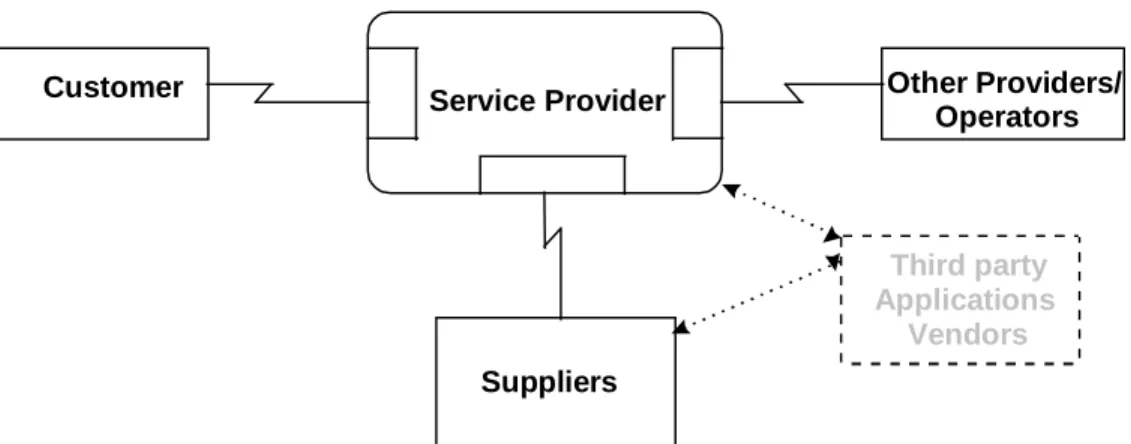
The Business Reference Model shown in Figure 4.1 is the foundation for the management value chain and illustrates the principal points of contact between a service provider, its customers, its suppliers and other service providers. A wide range of automation and integration opportunities exists among the business roles and relationships shown. Each has a specific business objective dictating the level
Page 20 Telecom Operations Map
GB910 v2.1 TeleManagement Forum 2000
and type of management information exchanged, the robustness required of the management interface, and the priority with which industry agreements are pursued in the area concerned.
Customer Service Provider
Suppliers Other Providers/ Operators Third party Applications Vendors
Figure 4.1: The Business Reference Model
There are many implications of this business model. In the past, there was a singular relationship: between the service provider and the customer. With this current view, there are more relationships and there is more complexity:
Ø The interfaces to suppliers, third party applications vendors and other providers/operators are external. These are initially ‘procurement’ interfaces, but after deployment, become an integrated part of a service provider's service delivery and support.
Ø To effectively manage the value chain, standardized internal interfaces and functions to support common or widely implemented management capabilities will be required.
Ø From the perspective of system software life cycle costs, it is not enough just to outsource custom development. Applications such as trouble ticketing provide opportunities to share a common system model for use within the enterprise versus developing a custom trouble ticketing system for use within the enterprise. It has the added benefit of simplifying the management of trouble ticketing across interfaces to external entities of the management value chain.
The business model interfaces are the points at which different applications vendors’ software need to be able to exchange information. This may involve agreeing to a common applications component infrastructure, within which the applications will reside, as well as agreeing on the information to be exchanged. There are potential benefits to all by agreeing upon an open set of processes and information flows. For the service provider, it reduces development cost, enlarges the source of potential suppliers and the product functionality available. For the supplier, it creates a larger potential customer base for their products.
Establishing common specifications
Today, the exchange of management information still has significant manual elements or involves proprietary, low-level interactions. There is a continuing need to establish common specifications and agreements to allow providers, their customers, and their suppliers to work together more effectively than is currently possible. Achieving this goal depends first on identifying the business objectives and the business process framework related to the value chain.
Today, the processes of most service providers remain very manual. No one has fully automated end-to-end processes across the majority of the functions depicted on the Telecom Operations Map, or has fully automated for all the services a service provider offers. Some processes may never be candidates for extensive automation. For example, the Service Development Process, except for Project Management aspects, will likely have a minimum of automation and is based on highly proprietary processes.
Chapter 5 – Telecom Operations
Process Model
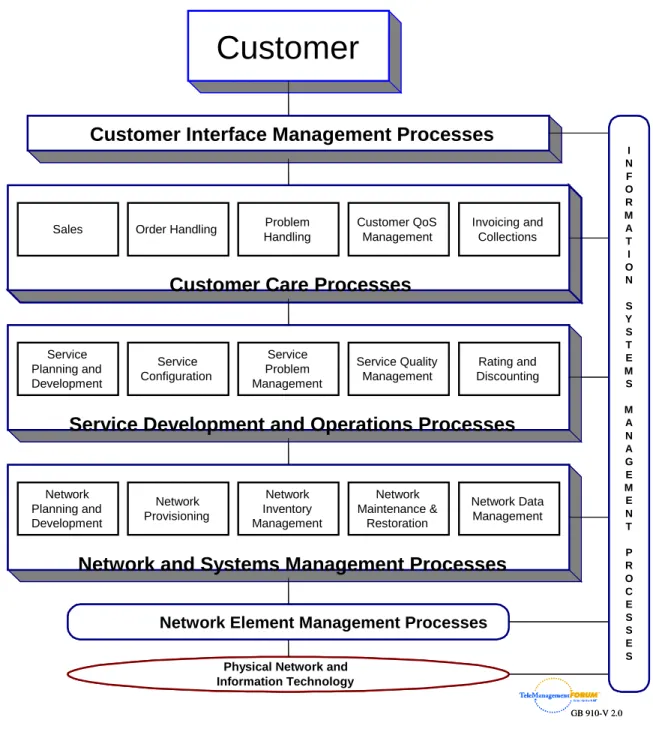
Service providers must apply a customer-oriented and service management approach, using business process management methodologies, to cost effectively manage their businesses and deliver the service and quality customers require. To manage within a service provider’s value chain, a common process framework is required. Figure 5.1 shows the Telecom Operations Map, the communications industry’s common process framework for understanding the relationships among individual process flows.
Page 24 Telecom Operations Map
GB910 v2.1 TeleManagement Forum 2000
Figure 5.1: Telecom Operations Map, Business Process Framework The Telecom Operations Map uses the layers of the ITU-T TMN model to organize core business processes, but divides the Service Management layer into 2 parts: Customer Care and Service Development and Operations Processes. In the simplest sense, the division reflects differences between processes triggered by individual customer needs from those applied to a group of customers subscribed to a single service or service family. It also reflects the accountability for direct customer contact handling in Customer Care Processes and the critical need to focus on integration and automation of and in support of Customer Care Processes.
Customer
Customer Interface Management Processes
Customer Care Processes
Physical Resource and Information Technology
Resource Element Management Processes Sales Order Handling Invoicingand
Collections Customer QoS
Management Problem
Handling
Service Development and Operations Processes
Rating and Discounting Service Quality Management Service Problem Management Service Configuration Service Planning and Development
Resource and Systems Management Processes
Resource Data Management Resource Maintenance & Restoration Resource Inventory Management Resource Provisioning Resource Planning and Development I N F O R M A T I O N S Y S T E M S M A N A G E M E N T P R O C E S S E S GB 910-V 2.0
Customer
Customer Interface Management Processes
Customer Care Processes
Physical Network and Information Technology
Network Element Management Processes
Sales Order Handling Invoicingand Collections Customer QoS
Management Problem
Handling
Service Development and Operations Processes
Rating and Discounting Service Quality Management Service Problem Management Service Configuration Service Planning and Development
Network and Systems Management Processes
Network Data Management Network Maintenance & Restoration Network Inventory Management Network Provisioning Network Planning and Development I N F O R M A T I O N S Y S T E M S M A N A G E M E N T P R O C E S S E S GB 910-V 2.0
Depending on the provider, Customer Interface Management may be managed from within the individual Customer Care processes or, in combination across one or more of the Customer Care processes. As Web-based interfaces continue to emerge and e-business concepts are implemented, the integrated Customer Care interface is an essential service differentiator. For this reason, Customer Interface Management is also separately delineated and represents the customer interfacing functions (e.g., integrated customer contact management, Voice Response Units, ACDs, Web interface support) that are supported by Customer Care Processes.
The Telecom Operations Map can be used to describe both current processes and
future processes. The TOM process framework is organization, technology and
service independent.
Telecom Operations Map Dimensions
Operations Management is complex with many dimensions that must be managed. The beauty of the Telecom Operations Map is in its simplicity to represent the multiple dimensions of Operations Management:
Ø Business Process Framework (Figure 5.1).
Ø Business Management
• End-to-End Process Flows
• Service or Technology, e.g., Broadband, IP, Mobile/Wireless
• Business Management sub-process or use case
• Sub-processes or function
Ø Information Exchange
Ø Business Relationships with suppliers and/or other providers
Ø Systems/Application and Data Architecture that supports the Business
Processes
This document is not intended to capture every possible view involved with
operations processes. Its intent is to provide a common process framework that can be aligned with how an individual service provider develops and performs their processes. Each service provider develops and updates their processes according to their business mission and strategies, including the business rules and policies that apply.
The Business Process Architecture Framework was highlighted in Figure 5.1 earlier in this chapter. The input and output diagrams in Chapter 7 provide more detail on the Business Process Framework and provide an initial view of sub-processes, process activities and information exchange. In the remainder of this Chapter and Chapter 6, selected Business Management Dimension Aspects are highlighted.
Business Management Views
Business Process Management is the systematic design and definition of a company’s processes and information, including the supporting data and systems structure, to meet its mission, goals and customer requirements. Business Process
Page 26 Telecom Operations Map
GB910 v2.1 TeleManagement Forum 2000
Management starts with a Business Process Architecture designed to accomplish a specific company’s objectives. A company will then define the detail of its end-to-end processes to deliver to customers and to meet its business requirements. The aspects of Business Management highlighted here provide direction on applying the Telecom Operations Map to support process management.
End-to-End Process Flow
The objective of service providers is to automate their processes to deliver value to their customers. Therefore, the most critical process work is the design and definition of the end-to-end process flows for providing services to customers. The Telecom Operations Map approaches this as three basic end-to-end processes common to any service oriented business:
Ø Service Fulfillment (timely and correct provisioning of what the customer ordered)
Ø Service Assurance (maintaining the service--timely response and
resolution of customer or network triggered problems, tracking, reporting, managing and taking action to improve performance for all aspects of a service)
Ø Service Billing (timely and accurate bills, knowledgeable and responsive Billing Inquiry support, including timely adjustment handling and payment collections)
Figure 5.2 shows a broad breakdown of the TOM framework into the three customer focused activities identified. The purpose is to show in more detail the predominant processes that need to be involved—integrated and automated to support the end-to-end, customer support processes.
The Network Inventory Management and Network Data Management boxes are split to display their significant role, more than an information input or output function, in both end-to-end processes depicted. For example, Network Inventory Management, which includes physical implementation activities in the network, is important to both the Fulfillment and Assurance processes for final installation of the service and restoration and repair of a service.
Figure 5.2: ‘FAB’ End-To-End Process Breakdown
(Fulfillment, Assurance, Billing)
Note: The interface to element management systems and the physical network are
removed from this diagram for simplicity. Interaction to element management and the physical network support all three overarching processes.
‘FAB’ End-to-End Process Flows
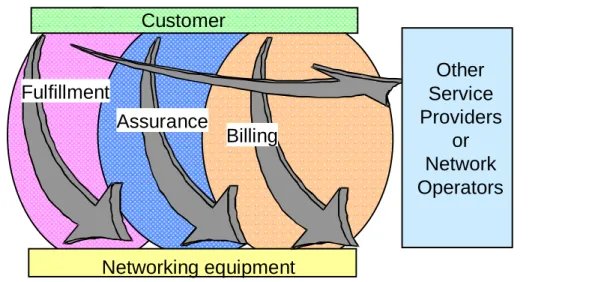
The ‘FAB’ end-to-end process breakdown in Figure 5.2 does not get across the dynamic, end-to-end process flow required to support Service Fulfillment, Assurance and Billing. Figure 5.3 shows the three essential flow elements:
Ø Between the customer interface and support in a network element Ø From sale through billing
Ø Between other providers and network operators
The vertical arrows represent the process interactions between the customer interface and the network elements, i.e., process flow through. The overlapping balloons are meant to show that Fulfillment, Assurance, and Billing predominantly include specific processes from the framework. However, all three end-to-end processes have interfaces among many processes across the map. The directionality of these three vertical arrows all shows end-to-end flow. As shown, the customer predominantly initiates the Fulfillment process. However, the Assurance process can be triggered by the customer or network elements and Billing is predominantly from data collection in the network to bills presented to the customer. The horizontal arrow shows the process flow interfaces required with other providers
Order Handling
Sales Invoicing/
Customer Care Processes
Service Development and Operations Processes
Network and Systems Management Processes
Collections Fulfillment Assurance Billing
Service Planning and Development Customer QOS Management Service Configuration Service Problem Management Service Quality Management Problem Handling Rating and Discounting Network Planning and Development Network Provisioning Network Inventory Management Network Maintenance & Restoration Network Data Management ^ GB 910-V 2.0 Order Handling Sales Invoicing/
Customer Care Processes
Service Development and Operations Processes
Network and Systems Management Processes
Collections Fulfillment Assurance Billing
Service Planning and Development Customer QOS Management Service Configuration Service Problem Management Service Quality Management Problem Handling Rating and Discounting Network Planning and Development Network Provisioning Network Inventory Management Network Maintenance & Restoration Network Data Management Network Maintenance & Restoration Network Data Management ^ GB 910-V 2.0 GB 910-V 2.0
Page 28 Telecom Operations Map
GB910 v2.1 TeleManagement Forum 2000
and network operators. All three aspects of process flow are required for integration and automation.
Customer
Networking equipment
Fulfillment
Assurance
Billing
Other
Service
Providers
or
Network
Operators
Figure 5.3: ‘FAB’ End-To-End and Flow-through Process Flows
3-D Telecom Operations Map
Certain activities and sub-processes are required for business management processes or are functional sub-processes that must support or be supported by the Fulfillment, Assurance and Billing Processes. The business management sub-processes and the functional sub-sub-processes or set of process activities can be represented in a ‘3-D’ overlay diagram. Overlay diagrams show that these sub-processes are supported or support the framework sub-processes. One diagram example is shown Figure 5.4 for Service Level Agreement Management.
Order Handling
Sales Invoicing/
Customer Care Processes
Service Development and Operations Processes
Network and Systems Management Processes
Collections
Fulfillment Assurance Billing
Service Planning/ Developm ent Custom er QO S Managem ent Service Configuration Service Problem Resolution Service Quality Managem ent Problem Handling Rating and Discounting Network Planning/ Developm ent Network Provisioning Network Inventory Managem ent Network Maintenance & Restoration Network Data Managem ent
SLA Negotiation SLA Reporting
SLA Engineering SLA Monitoring
The service provider needs to meet market demand for service quality and procedures for assuring contracted service quality. The Service Level Agreement (SLA) is a statement of the contracted quality of service levels between the service provider and the customer. The Management of the SLAs must consider all the business activities from identifying and defining SLA parameters, release management, configuring of the operational processes and systems to support and report life-cycle management of the agreements.
The SLA is part of the service offering and, therefore, is developed in the Service Development Process, as shown by the SLA Engineering overlay box. In some cases, a customer sale negotiation may result in a new SLA requirement. In that case, the Service Development Process is employed to establish the new requirement, if appropriate for the business.
To support existing SLA offers, the SLA Engineering box also indicates that the Service Configuration Process may need to be involved. Once the specific SLA offer is available, the Fulfillment Process triggers the Assurance process to manage SLA performance through monitoring and reporting. An SLA may include measures for performance, pricing, installation intervals, billing timeliness, time to repair, call handling and other metrics or requirements.
This overlay approach can also be used to look at functional sub-processes or capabilities required across the map. Test Management is an example of a functional sub-process that must support several framework processes, e.g., Service Configuration during Fulfillment, Problem Handling in Assurance, Rating and Discounting as part of Billing, Network Maintenance and Restoration as part of Assurance or Billing. Test Management capability support is managed either within the specific process or as a competency/capability function available to any process.
Service and Technology Specific Dimensions
Common processes across services and technologies are essential to:
Ø Deliver to process cost targets and process performance improvement
Ø Provide a consistent customer service experience Ø Enable cost effective and fulfilling people management Ø Enable cost effective process automation
Services are differentiated in the common processes by differences in process activities and information required to support the specific service. Although the TOM at the framework level is technology and service independent, it is meant to be applied to real life services and technologies. The processes, flows and basic information will be consistent across two different technologies or services, but the detailed information will have differences. Certain activities or sub-processes may be required for one service or technology and not another. A Service Provider’s business rules may dictate a different sequence of activities due to the nature of specific service or customer requirements.
Page 30 Telecom Operations Map
GB910 v2.1 TeleManagement Forum 2000
There is a constant influx of new services and technologies in the telecommunications and data services industry that bring new process requirements or bring a new perspective to existing process requirements. Mobile/Wireless Services provide examples for both of these cases:
Ø Roaming Management--new process requirements
Ø Fraud Management extended to address new requirements in support of
roaming capabilities--a new perspective on existing sub-process requirements
Roaming Agreement Management is an important aspect of Mobile Services. Roaming is a service provided by mobile service providers, where customers of a home service provider may use the infrastructure of another. To make this happen, the home service provider and the serving service provider negotiate and enter into a contractual relationship, called a roaming agreement, either directly or through a clearinghouse. The development and implementation of this contractual arrangement is managed as part of the Service Planning and Development Processes. The management of roaming agreements and the associated operational processes is complex, consisting of interfaces across all layers of the map.
Fraud and all activities to detect and prevent fraud are common to most networks. Mobility and roaming add to the complexity and difficulty of detecting and preventing fraud and are crucial considerations for managing Mobile Services.
For those interested in application of the Telecom Operations Map to specific services, with this release of the Telecom Operations Map, two service-related documents have been issued:
Ø “TOM Addendum IP Services: Global Intranet Access Service,” which
provides a view of TOM application by process for this IP Service
Ø “TOM Application Addendum: Mobile Services: Performance
Management, Fraud and Roaming Agreement Management Special Considerations,” which provides a review of these special considerations for Mobile Services and SLA Agreement.
Business Relationships with Suppliers and/or Other Providers Views
Joint service arrangements are increasingly becoming the norm to support interconnection due to the huge growth in partnerships, alliances, mergers/acquisitions, new entrants--competitive access providers, and regulatory requirements. To provide service, one service provider will need to interface with one or more service providers and/or network operators. Service providers may interface with different functions at multiple layers of the Telecom Operations Map, when providing a joint service or subcontracting services. For example, the interface points vary depending on:
Ø The degree of process automation of the service providers involved Ø The service or technology being supported
Ø Whether an SP is acting on behalf of their network infrastructure or in support of a specific customer service instance
Increasingly a service provider’s processes have to be viewed as part of an overall value chain and, therefore, it is critical to understand the interfaces required with suppliers, other providers and network operators. Since many processes that have been internal may now have external aspects, it is critical now to also understand the relationships of a service provider’s internal processes. The onset of e-business demands it.
Service Provider TOM Application
The service and network management structure and the process design of a service provider depends on their corporate mission, target markets and strategies. The basic operational functions identified within the Telecom Operations Map are process blocks that can be applied to various service providers’ infrastructures and organizations. It is important to recognize that the specific process boundaries shown in the model do not correspond to organizational boundaries. In one service provider, a single work group may have responsibility for order taking and receipt of problem notification from a customer. Another work group might be responsible for tracking the progress of an order/trouble and reporting its completion. Another company might conduct all customer contact through one group, with all other processes providing input and taking instruction from that group. In each case, the basic function being executed is similar. To succeed a service provider must incorporate critical aspects from the views highlighted above, and effectively translate business mission, goals and strategies into a Business Process Management architecture along with an organizational structure. The Process Architecture must be supported by an integrated and automated Systems/Application and Data architecture, as well as an operational environment that executes these processes with high quality.
As we have discussed in this chapter, the TOM has put in place the Business Process Framework and identified aspects that support Business Process Management. Each service provider needs to evaluate the Telecom Operations Map Framework processes and identify how they perform each process internally, including the business rules and policies that they apply. In Chapter 6 examples of a Service Fulfillment, Assurance and Billing end–to-end process are depicted. Chapter 7 provides input and output detail for each the processes in the Framework.
Chapter 6 – Examples of FAB Process
Flows
Process Interactions
Figures 6.1 through 6.3 (the FAB process diagrams) provide rough illustrations of the principles of process flow by depicting segments of a process or one instance of the application of the process flow. Developing process flow diagrams is one of the first steps in Business Process Mapping showing the relationships of service provider business needs to the identification of information, requirements, and sequencing required to drive automation.
For those interested in understanding Business Process Management somewhat more, the “TOM Application Notes: Process Re-engineering, Development and Management—Simple Methodology Steps” document, issued with this release of the Telecom Operations Map, provides a high level view of process redesign and development steps. It also shows a brief view of the Business Process Mapping technique, which is a process flow technique that makes it easier to see