Brazil’s Belo Monte Dam:
Lessons of an Amazonian resource
struggle
Philip M. Fearnside
National Institute for Research in Amazonia (INPA), Av. André Araújo, 2936, Manaus, Amazonas, CEP 69067-375, Brazil, [email protected] Manuscript submitted: 6 April 2016 / Accepted for publication: 24 March 2017 / Published online: 27 September 2017
Abstract
The struggle to stop Brazil’s Belo Monte Dam, whose reservoir was filled in December 2015, has lessons for other resource struggles in Amazonia and beyond. Among the impediments that failed to halt the dam were the resistance efforts of both indigenous and indigenous victims of the dam’s impacts, as well as the non-governmental organizations and other actors supporting their cause. The pro-dam side had massive political and financial support from the top levels of the Brazilian government, including vigorous involvement of the country’s president. At the same time, achievements of the anti-dam side, particularly the local grassroots organizations, have provided inspiration for resource struggles elsewhere (although the victories of the resis-tance are significantly less definitive than was thought by many at the time).
D I E E R D E
Journal of the Geographical Societyof Berlin
Zusammenfassung
Die Auseinandersetzungen um einen Stopp des Belo Monte Staudamms in Brasilien, dessen Stausee im Dezem-ber 2015 geflutet wurde, beinhalten Lehren für andere Ressourcenkonflikte in Amazonien und darüDezem-ber hinaus. Zu den Kräften, denen es letztendlich nicht gelungen war, den Staudammbau aufzuhalten, gehörten vor allem die Widerstandbemühungen der indigenen und nicht-indigenen direkt vom Staudammbau Betroffenen, die von Nicht-Regierungsorganisationen und anderen Akteuren in ihrer Sache unterstützt worden waren. Die Befür-worter des Staudammbaus konnten ihrerseits auf die massive politische und finanzielle Unterstützung höchs-ter Kreise der brasilianischen Regierung zählen, inklusive der energischen Einmischung der Präsidentin des Landes. Allerdings wirkten die Errungenschaften der Staudammgegner, insbesondere der lokalen Basisbewe-gungen, durchaus inspirierend für andernorts stattfindende Ressourcenkonflikte (auch wenn die Erfolge des Widerstandes deutlich weniger klar ausfallen als zunächst von Vielen gedacht).
Keywords Hydropower, indigenous peoples, hydroelectric dams, Amazonia, social movements, development impacts
DOI: 10.12854/erde-148-46
Philip M. Fearnside 2017: Brazil’s Belo Monte Dam: Lessons of an Amazonian resource struggle. – DIE ERDE 148 (2-3): 167-184
1. Introduction
Brazil’s 11,233-MW Belo Monte Dam (Fig. 1) now blocks the Xingu River, displacing approximately 25,000 people in the city of Altamira and 18,000 tra-ditional riverside dwellers (ribeirinhos) along the stretch of this Amazon tributary that is flooded by the reservoir (Villas-Bôas et al. 2015: 12-13). When all of the turbines are installed in 2019 a 100-km stretch of river below the main dam will lose 80% of its wa-ter flow, destroying the livelihoods of the ribeirinho population that depends on fishing in this area as well as indigenous people in two “indigenous lands” in this “reduced-flow” stretch and one on the Bacajá River, a tributary of the Xingu. Officially denied plans for ad-ditional dams upstream of Belo Monte would flood vast areas of indigenous land. Environmental impacts
will also be great. Logical, legal and ethical arguments were cast aside as the Belo Monte construction pro-ject advanced (Fearnside 2017).
Local actors and a wide range of outside support groups struggled against the Belo Monte plans but were unable to convince the Brazilian government to change course. Amazonia and other developing areas face many resource struggles, of which hydroelectric dams represent one important example. Such strug-gles are likely to become even more common with continued expansion of society’s appetite for resources and of its capacity to extract them. Learning lessons from the Belo Monte struggle is therefore relevant to a wide variety of development issues. The present pa-per examines the Belo Monte struggle and its lessons.
#
*
#
*
50°W 50°W 55°W 55°W 5° S 5° S 10° S 10° S 0 75 150 300kmBelo Monte Dam Babaquara (Altamira) Dam
#
*
Ipixuna Dam#
*
Kakraimoro Dam#
*
Iriri Dam#
*
Jarina Dam´
Indigenous land Fig. 1Dams and outlines of reservoirs originally planned for the Xingu River basin. Indig-enous areas are crosshatched. The ques-tion of whether dams upstream of Belo Monte will later be built, which Brazilian government authorities currently deny, is a critical part of the debate. Source: Own elaboration
2. A brief history of the Belo Monte struggle Planning for a series of dams on the Xingu River be-gan in 1975 during Brazil’s 1964-1985 military dicta-torship. In 1975 this author was living in one of the Transamazon Highway colonization areas 50 km from Altamira (Fearnside 1986). In a visit to the Altamira office of the National Institute for Colonization and Agrarian Reform (INCRA) I was given a map showing the areas to be flooded by the Babaquara (later re-named “Altamira”) Dam, the first planned upstream of Belo Monte. That some of the colonization area would be flooded provoked understandable dismay among colonists in the agrovila (planned agricultural village) where I lived, but during the dictatorship any sort of objection or protest was out of the question.
An inventory of the Xingu River Basin proposed six large dams (Fig. 2), including “Kararaô” (now Belo Monte) (e.g. Sevá Filho 1990). Viability studies were prepared (CNEC 1980), and environmental studies (Brazil, ELETRONORTE nd [2002]) were done by the National Consortium of Consulting Engineers ( Con-sórcio Nacional de Engenheiros Consultores = CNEC), a consulting firm in São Paulo that, during the course of the study, was bought by Camargo Corrêa, the main construction firm preparing to build the dams.
Field studies on environmental impacts began in 1985, for which the CNEC consulting firm that had done the viability study was contracted (Saracura 2015). Aca-demics from various universities and research insti-tutions were hired as consultants to collect data for
! . ! . !. !. ! . ! . # * # * # * # * # * # *#* # * # *#* 50°W 50°W 60°W 60°W 70°W 70°W 10°N 10°N 0° 0° 10°S 10°S 20°S 20°S 30°S 30°S # * Planned dam # * Existing dam ! . Cities Rivers Highways 0 250 500 1000km Rondônia Pará Amazon River 2 Transa mazon Highwa y BR -364 H igh way Belém 1 Santarém Altamira 7 3 São Fran cisc o River Tocantins River Xingu Rive r Tapa jós R iver Made ira R iver Uatumã River 45 Porto Velho Cuiabá 9 10 8 6 Manaus
´
Fig. 2Locations mentioned in the text. Dams: 1.) Belo Monte 2.) Balbina 3.) Tucuruí 4.) Jirau 5.) Santo Antônio 6.) Cachoeira Riberão (Guajará-Mirim) 7.) Babaquara (Altamira) 8.) Chacorão
9.) São Luiz do Tapajós 10.) Jatobá
use by CNEC in drafting the report. The consultants signed contracts committing themselves to secrecy, which has been a serious limitation since the begin-ning of such reports (see Fearnside 2001; Pinto 2002: 56). Problems also included pressuring researchers regarding the content of their submissions (Assis and Forline 2004).
In 1987 Brazilian Electrical Centers (Centrais Elé-tricas Brasileiras = ELETROBRÁS), a Brazilian gov-ernment holding company, produced the “2010 Plan” listing dams expected to be built by the year 2010 as well as other dams without a limit on the date of planned construction (Brazil, ELETROBRÁS 1987). The report was released only after it had leaked to the public. The complete list indicates 79 large dams in Brazil’s Legal Amazonia region, with a total area of 10 million hectares (see Fearnside 1995). Kararaô (Belo Monte) was indicated for construction by 2000 and Babaquara (Altamira) by 2005 (Brazil, ELETROBRÁS 1987: 153–154). Brazil’s finances have not permitted dam construction at anything like the rate expected in the 2010 Plan. The 2010 Plan sparked a storm of criticism, and the Brazilian government never again released its complete plans for Amazonian dams inde-pendent of the expected year of construction, releas-ing instead only “ten-year plans” (planos decenais) for the dams to be built in the subsequent 10 years, and occasional medium term plans such as the 2015, 2020 and 2030 plans.
Brazil’s October 1988 constitution included provi-sions that development projects affecting indigenous peoples required approval by both houses of the Na-tional Congress (Article 231, Paragraph 3) and that “Removal of indigenous groups from their lands is prohibited, except (….) in cases of catastrophe or epi-demic that put the population at risk, or in the inter-est of the sovereignty of the country (….), [but,] in any event, an immediate return is guaranteed as soon as the risk ceases” (Article 231, Paragraph 5). This did not result in any immediate change of plans for the Xingu dams, including both the plan at the time for Kararaô (now Belo Monte) that would have directly flooded indigenous land and the upstream dams that would flood much larger indigenous areas. In prac-tice, there is a two-step process, where behavior re-mains unchanged while actors wait to see what new requirements will actually be enforced. This is a long tradition in Brazil dating from colonial times (Rosenn 1971).
The year 1989 saw the creation of the Brazilian In-stitute for the Environment and Renewable Natural Resources (Instituto Brasileiro do Meio Ambiente e dos Recursos Naturais Renováveis = IBAMA), giving more institutional capacity for the licensing process, including vetting the Environmental Impact Study (Estudo de Impacto Ambiental = EIA) that had been a requirement for projects like dams since 1986. How-ever, proponents of Amazonian development projects were still testing the limits as to how little they could get away with considering in these reports, and some major development projects were even going forward without the required EIA (Fearnside 1989a).
The year 1989 also saw the release of the Portu-guese-language version of a book edited by Cultural Survival and the Pro-Indian Commission of São Pau-lo showing the disastrous impacts that the Xingu dams would have on indigenous peoples (Santos and de Andrade 1990). In February of the same year the “Altamira demonstration” (officially the “First En-counter of the Indigenous Peoples of the Xingu”) was held, led by the Kaiapó, with significant national and international press coverage. The event was marked by Tuíra, a Kaiapó woman, brandishing a machete in the face of the head of the government electrical com-pany Electrical Centers of Northern Brazil (Centrais Elétricas do Norte do Brasil = ELETRONORTE) while shouting the war cry “Tenotã-mõ!” (Sevá-Filho and Switkes 2005). Following the Altamira demonstra-tion, ELETRONORTE changed the name of “Kararaô” to “Belo Monte” and made an announcement that was interpreted by many as cancelling the plans for the upstream dams. In reality, this was not the case: ELETRONORTE was only promising to remove these dams from the 2010 Plan and to conduct a “resurvey of the fall” of the Xingu River, meaning that additional studies would modify the plans to place dams in dif-ferent locations along the river, which does not imply that the same indigenous lands would not be flooded. The notion that the upstream dams had been defini-tively cancelled was widespread. As late as 1994 one of the Kaiapó leaders gave a speech at a conference claiming a conclusive victory over these dams (per-sonal observation). However, as the Kaiapó are now well aware, this was not (and is still not) the case. Nev-ertheless, the impact of the Altamira demonstration may have served as inspiration for non-governmental organizations (NGOs) and development victims else-where (both in Brazil and abroad) to take action in opposing major construction projects that otherwise would have been considered unstoppable.
One of the effects of the Altamira demonstration is believed to have been its influence on international lenders. The World Bank had been expected to fund Belo Monte, either directly or indirectly as part of a sector loan (Chernela 1988). However, the World Bank pulled out while the first (2002) EIA was under preparation, and the lack of international finance is believed to have motivated the Brazilian government to place Belo Monte on hold (Hochstetler 2011: 358). The loss of the World Bank as a focus of the anti-dam campaign changed the political context, diminishing the campaign’s leverage in pressuring the Brazilian government (e.g. Carvalho 2006: 260). This change eliminated the “boomerang” strategy, where a local group in a place like Amazonia has its greatest effect on the national government by inducing changes in projects and policies of international institutions like the World Bank, which, in turn, have a strong influ-ence on the national government’s actions (Keck and Sikkink 1998).
A windfall for dam proponents was provided by Bra-zil’s 2001 “Apagão,” a major energy crisis with uncon-trolled blackouts in almost all of Brazil followed by a series of controlled blackouts and electricity ration-ing measures. The crisis was mainly caused by mis-management (Rosa 2001). Public discontent made it easy to argue that Amazonian dams were needed to save the country from future blackouts. The same op-portunity was presented by the 2014-2015 São Paulo drought. As a result of the 2001 Apagão, the National Council on Energy Policy (Conselho Nacional de Políti-ca EnergétiPolíti-ca = CNPE) was created. This body is most-ly composed of ministers in the federal government. Representatives of civil society and of the scientific community were supposed to be included, but these members have never been appointed. The CNPE would later play a key role in facilitating Belo Monte by fore-stalling any criticism of the upstream dam plans. In March 2002, a new plan for the design of the Belo Monte reservoir was announced in order to avoid flooding any indigenous land. Throughout the almost 14 years that had elapsed since the 1988 constitution had created a barrier to flooding indigenous land, the companies had been investing in a design that called for indigenous lands to be flooded. This illustrates the impunity that the dam proponents were expect-ing and the gradual process of adjustment. The dam was moved upstream from its former position, thus decreasing the area and volume of the reservoir. The design was also changed to divert most of the river’s
flow through canals to a powerhouse below the Big Bend of the Xingu, rather than following the normal pattern of generating all power at the foot of the dam itself. This new design significantly increased the ver-tical drop that could be used for power generation, but it would leave the Big Bend with greatly reduced flow, thus creating a different kind of impact on the indig-enous people downstream of the new dam location. The EIA that was prepared in 2002 (Brazil, ELETRONORTE nd [2002]) was never formally sub-mitted to IBAMA. Legal decisions in 2001 and 2002, which accepted some of the arguments in a Civil Pub-lic Suit (Ação Civil Pública = ACP) brought by the Fed-eral Public Ministry (MPF), resulted in suspension of the licensing process (SeváFilho 2014). Upstream dams were entirely omitted from this first EIA, al-though the viability study for the one-dam plan ex-plains that considering only Belo Monte is the result of political considerations, and that Belo Monte’s output would be much greater with upstream dams (Brazil, ELETRONORTE 2002: 6-82). Despite this disclaimer, studies for the upstream dams were continuing. The second EIA (Brazil, ELETROBRÁS 2009) would also omit consideration of upstream dams.
The 1988 constitutional requirement that the Nation-al Congress approve any projects with impacts on in-digenous peoples was seen as an almost unsurmount-able barrier to proposing dams that would flood indigenous lands. This was the reason for the 2002 revision of the Belo Monte design to avoid flooding indigenous land. Then everything changed in 2005, when the National Congress approved Belo Monte in record time under a special “urgent” regime that limits debate. Former president José Sarney was the person in charge of modifications to the bill (the “ rela-tor”) in the Senate, facilitating Senate approval only three days after the House of Deputies approved the measure, producing Legislative Decree No. 788 of 13 July 2005 (Calheiros 2005). This decree, authorizing initiation of the Belo Monte licensing process, was ap-proved by both houses in only 15 days, providing a re-vealing contrast with the 17 years that the indigenous people had been waiting for the National Congress to enact laws for their protection as specified in the 1988 constitution (Graeff 2012: 273). The indigenous peoples were not consulted prior to approval of the measure by the National Congress, as required by the constitution. This legislative event sent a signal for the subsequent surge in Amazonian dam proposals (see Fearnside 2012).
On 31 October 2007, ELETROBRÁS released a Power-point presentation (Brazil, ELETROBRÁS 2007a) of a new inventory of the Xingu River (although not the in-ventory itself: Brazil, ELETROBRÁS 2007b). Three al-ternatives were considered, two with four dams (but with differing water levels in the three that would be upstream of Belo Monte) and the third alternative with only Belo Monte. The inventory and presenta-tion assert that the third alternative, with only Belo Monte, was selected. The inventory indicates that the upstream dams would be financially attractive based on the unitary reference cost of dams to be built in the ELETROBRÁS ten-year plan at the time, but that weighting by factors for environmental impact made the one-dam choice more attractive overall (Brazil, ELETROBRÁS 2007b, Vol. 1, Tome 2: 5-115). The two alternatives with upstream dams would flood, in ad-dition to Belo Monte, 2283 and 3004 km2,
respective-ly, including Altamira/Babaquara. The 2007 invento-ry calls for fewer dams and about one-sixth the total area to be flooded, as compared to the inventory in the 1980s that is represented by the 2010 Plan ( Bra-zil, ELETROBRÁS 1987). However, substantial areas of indigenous land would still be flooded. The assump-tion that the opassump-tion announced as “selected” (i.e., only Belo Monte) is what would take place in practice is central to the entire discussion and struggle sur-rounding Belo Monte. Subsequent developments up-stream could follow the two other alternatives given in the 2007 inventory, or they could (as has occurred elsewhere) evolve with water levels being raised (and flooded areas consequently being expanded) beyond what is initially announced.
One of the indications suggesting that an option with upstream dams might be the real one is that the 11,000-MW installed capacity of the main powerhouse at Belo Monte remains unchanged in the scenarios with and without upstream dams. The electrical au-thorities had earlier floated plans for Belo Monte with the total capacity reduced to 5500, 5900 or 7500 MW (Pinto 2003), which would have been more consistent with an unregulated flow of the Xingu River.
The one-dam plan became the official scenario on 3 July 2008 when the National Council on Energy Policy (CNPE) issued its Resolution No. 6, stating that Belo Monte would be the only dam on the Xingu River. The claim that only one dam would be built on the Xingu River is what is known as the “institutionalized lie” by dam opponents (Nader 2008; Salm 2009a). Noth-ing prevents the CNPE from changNoth-ing its mind at
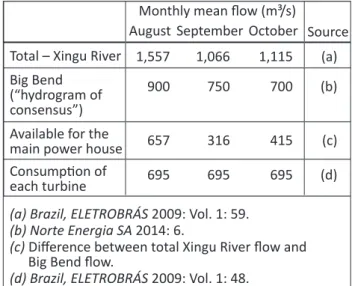
some future date and allowing the construction of upstream dams. The logic of this change is apparent from data on the flow of the Xingu River: the average flows in the months of August, September, October, minus the amounts that the consortium is required to pass through the Big Bend in these months according to the “hydrogram of consensus” to which it agreed, mean that the amount of water that can bypass the Big Bend through the adduction canal in these months is insufficient for even a single turbine in the main powerhouse (Table 1). In a fourth month (November) only one turbine would have adequate water, and the full 20 turbines would only be used at the peak of the flood season. Turbines can function at partial capac-ity, but with reduced output.
Monthly mean flow (m³/s) Total – Xingu River
Big Bend (“hydrogram of consensus”) Available for the main power house Consumption of each turbine August 1,557 900 657 695 September 1,066 750 316 695 October 1,115 700 415 695 (a) (b) (c) (d) Source
(a) Brazil, ELETROBRÁS 2009: Vol. 1: 59. (b) Norte Energia SA 2014: 6.
(c) Difference between total Xingu River flow and
Big Bend flow.
(d) Brazil, ELETROBRÁS 2009: Vol. 1: 48.
Table 1 Xingu River flow at Belo Monte in critical months
The economic unviability of Belo Monte without up-stream dams to store water for use during the dry sea-son has been interpreted as implying that there will be a “planned crisis” after Belo Monte is complete and it is suddenly discovered that the water flow is insuf-ficient (de Sousa Júnior and Reid 2010; de Sousa Júnior et al. 2006). Lúcio Flávio Pinto (2002: 25, 69) dubs Belo Monte a “Trojan horse of concrete” and points out that “On the Tocantins, for example, ELETRONORTE was able to sell its controversial project for the Tucuruí Dam to public opinion based on the assumption that it would be the only dam on the Tocantins River in Pará” (an obvious falsehood, given that plans called for all of the river above Tucuruí being converted into a contin-uous chain of reservoirs; see Junk and de Mello 1990). A strong indication that public opinion is being pre-pared for the Altamira/Babaquara Dam was provided by a speech by President Dilma Vana Rousseff (known simply as “Dilma”) in June 2013 asserting a need for
dams with “large reservoirs” rather than continuing to build run-of-river dams like Belo Monte (Borges 2013).
In September 2009 a public hearing (audiência públi-ca) was held in Altamira, as required for discussion of the second EIA (i.e., Brazil, ELETROBRÁS 2009). The hearing was held to discuss the EIA only two days af-ter this massive document had been released to the public, contributing to the hearing’s lack of verisimili-tude as an informed debate (Salm 2009b). These hear-ings have limited real public participation, partly be-cause they are held in venues with inadequate space to accommodate many of the affected people and be-cause the first several hours of the hearings are occu-pied by engineers from the dam consortium making long technical presentations, while statements from the public are only allowed at the end, usually in the dead of night. The hearings were also accompanied by an overpowering police and military presence. Indig-enous participants were present at the beginning of the session, but then left so as not to allow their pres-ence to be interpreted as agreeing with the dams, and especially as having been “consulted.”
In 2009 a representative of the National Indian Foun-dation (Fundação Nacional do Índio = FUNAI) made presentations in indigenous villages in which he ex-plicitly stated that the gatherings were not “oitivas” (consultations as required by International Labor Organization (ILO) Convention 169 and by Brazilian Constitution Article 231), as shown in a video of the presentation in one of the villages made by the indig-enous participants (Medialivre 2011). On 14 October 2009 FUNAI submitted a formal opinion (parecer) to IBAMA on the indigenous component of licensing Belo Monte (Brazil, FUNAI 2009). The opinion states (p. 14) that FUNAI would be willing to “accompany … new consultations [novas oitivas],” implying that the presentations they had made in the villages were, in fact, consultations. The coverletter from the head of FUNAI states that the agency considers the dam to be “viable” so long as a list of conditions is met, and states explicitly that “With regard to the carrying out of con-sultations with indigenous peoples [oitivas indígenas], this Foundation considers that it has fulfilled [its du-ties under] Legislative decree 788/05, in the course of the licensing process” (Guapindaia 2009). When indig-enous people invaded the FUNAI office in Altamira in 2010 they discovered a collection of DVDs recording the 2009 presentations in the villages, labeled as “ oi-tivas indígenas” (Xingu Vivo 2011a). In February 2011
FUNAI released a public note also claimed that these presentations represented a “consultation” and that FUNAI had thereby fulfilled its duties in the licensing process (Xingu Vivo 2011a). The deception these inci-dents revealed has been a particularly sensitive issue in increasing distrust of FUNAI and other government agencies.
Indigenous people are aware that they need to take care not to have their participation in meetings in-terpreted as a “consultation.” Required consultations with indigenous peoples represent one of the only tools these people have to prevent a project from go-ing forward. Their option is not to participate in the consultation, as this would only result in the box be-ing checked off that the consultation had been con-ducted, thereby allowing the project to move forward. Refusal to participate is their only real option. Obvi-ously, deep reform of the system is needed for this re-ality to change.
“Consultation,” as the term is used in ILO Convention 169, implies a voice in the decision on whether to build or not to build the infrastructure in question (that is, not just to modify the compensation or mitigation measures), and the consulted population must have, at the least, a “realistic” chance of affecting the deci-sion that is made (ILO 2005). Some interpretations go further, holding that the consulted population has a clear right to say “no” (Esteves et al. 2012). By contrast, the public hearings (audiências públicas) required in the licensing process for all major projects, whether or not they affect indigenous peoples, provides a plat-form for affected people to voice their concerns, but their influence is limited to suggestions for adjust-ments in mitigation programs rather than question-ing the existence of the project as a whole.
Formation of the Belo Monte “Panel of Specialists” in 2009 was a step that provided alternative infor-mation in the discussion of the EIA. This group of 40 academics (of which this author was one) was brought together to read the approximately 20,000 pages of the 2009 EIA and prepare commentary in record time in order to have input to the approval deliberations within the timetables required in the licensing pro-cess. The report (Magalhães and Hernández 2009) was delivered to IBAMA in September 2009. The dam pro-ponents went to considerable lengths in attempts to disqualify the report and some of its authors ( Hernán-dez and Santos 2011). However, when the IBAMA technical staff issued their 345-page formal opinion
(parecer) on 23 November 2009 (Brazil, IBAMA 2009) recommending against approval of a Preliminary Li-cense for Belo Monte without an extensive revision of the EIA, some of the information they used to substan-tiate their conclusion was derived from the Panel of Specialists report.
The year 2009 ended with a setback for the anti-dam struggle in the loss of Glenn Switkes to cancer on 21 December (McCully 2009). He headed the Brazilian branch of International Rivers and was tireless oppo-nent of Belo Monte; his ashes were committed to the waters of the Big Bend of the Xingu River. Another im-portant opponent of the dam would later succumb to the same disease: Arsenio Oswaldo Sevá Filho of the State University of Campinas (UNICAMP) on 28 Feb-ruary 2015.
On 26 January 2010 the IBAMA technical staff issued another technical opinion (Brazil, IBAMA 2010) op-posing approval of a preliminary license. Neverthe-less, the full preliminary license (No. 342/2010) was issued on 1 February 2010 with 40 preconditions that were supposed to be met before an installation license would be granted to actually build the dam. The direc-tor of IBAMA’s licensing secdirec-tor was replaced before the preliminary license was granted (Agência Brasil 2011).
In April 2010, bidding to own and operate Belo Mon-te was won by NorMon-te Energia, Sociedade Anônima, or NESA (http://norteenergiasa.com.br/site/). This group was made up of 10 companies, mostly govern-ment entities. The close ties between NESA and the government are illustrated by the head of the ad-ministrative council of NESA being a former head of ELETROBRÁS, and by many of the companies included in NESA now being investigated by the Lava-Jato cor-ruption probe (Sassine and de Souza 2016).
Media attacks on dam opponents escalated as the li-censing process progressed in 2010 (e.g. Leite 2010; see replies: Medeiros 2010; Fearnside 2010). ELETRO-BRÁS and NESA increased their advertising of Belo Monte in print media and television, and ELETROBRÁS mounted an advertising campaign in all of Brazil’s major airports. In his June 2010 speech in Altamira, President Luiz Inácio Lula da Silva (known simply as “Lula”) called those who question Belo Monte “a half-dozen well-intentioned young people who, if they had the patience to listen, would learn what I have already learned…” (InternationalRivers 2010: 1). This
pater-nalistic tone has been identified as a “strategically crafted” turning point in the government discourse on Belo Monte by minimizing the opponents as naïve and uninformed (Bratman 2014: 274; 2015: 72). The discourse had long been aggressive: in 2006 President Lula listed indigenous peoples and environmentalists as “obstacles” (“entraves”) to growth (Glass 2006: 1), and in 2009 Brazil’s minister of mines and energy declared that Belo Monte was being impeded by “de-monic forces” (“forças demoníacas”) (Lima 2009: 1). A key tactic of the pro-dam side has always been to portray the dam as inevitable, and, therefore, at-tempts to change the decision to build it as completely delusionary. As the licensing process progressed this argument naturally gained ever more force. The per-ception of opposing Belo Monte as a “losing battle” was an important factor in various local opponents, including indigenous groups, dropping opposition to the dam in favor of pressing for more generous mitiga-tion programs (Bratman 2015: 74). Creating a percep-tion that a dam project is inevitable was effectively used by proponents in Belo Monte just as this strategy has been used by the government in previous Ama-zonian struggles, such as that surrounding the “ir-reversible” Balbina Dam (Fearnside 1989b). However, the outcome is never foreordained.
NESA contracted a consortium of ten construction companies to build the dam: the Consórcio Construtor Belo Monte (CCBM) (https://www.consorciobelomon-te.com.br/). The arrival of this consortium in Altami-ra at the beginning of 2011 was a key factor in local perceptions regarding the inevitability of the dam. Dilma became president of Brazil on 1 January 2011. On 12 January, the head of IBAMA resigned rather than sign an installation license for the Belo Monte construction site (Hurwitz 2011). On 26 January 2011, the new head of IBAMA issued an installation license for the construction site and for access roads and other infrastructure, but excepting the dam itself (No. 770/211). Partial licenses do not exist in Brazil-ian legislation. Issuing the license was summarized succinctly by the Federal Public Ministry (Ministério Público Federal – MPF, a public prosecutor’s office for defending the interests of the people) in Belém as “to-tally illegal” (Miotto 2011).
In January 2011, Avaaz (2011) launched an internet petition against Belo Monte that received 760,000 sig-natures internationally and in Brazil. Another
cam-paign in December 2011 received 68,000 signatures, while subsequent campaigns in 2012 received 47,000 and 34,000 signatures, respectively. There were also telephone and e-mail campaigns, as well as street demonstrations.
In March 2011 President Dilma was enraged by the finding by the Inter-American Commission on Human Rights (IACHR) of the Organization of American States (OAS) that the downstream indigenous groups were indeed directly impacted by Belo Monte and were en-titled to free, prior and informed consent thorough a consultation (Folha de São Paulo 2011; Siciliano 2011). She ordered the withdrawal of Brazil’s ambassador from the OAS and suspended Brazil’s payments of dues to the organization, creating a diplomatic crisis. In 2012 the ILO would also find that Convention 169, which had been signed and ratified by Brazil, required consulting the downstream groups (Justiça Global Brasil 2012; see also Puentes and Vieira 2015).
As the Belo Monte licensing process progressed to-wards a full installation license, international groups made renewed appeals to President Dilma ( Ama-zon Watch and InternationalRivers 2011). A petition signed by 500,000 people was delivered to authorities in February 2011 (Hance 2011) and a Brazilian peti-tion with 1.3 million signatures from the “Drop of Wa-ter” (Gota d’Água) initiative by television soap-opera stars was delivered in December 2011 (Rapoza 2011). The IBAMA technical staff opposed issuing the in-stallation license for the dam itself on the grounds that most of the conditions had not been met (Brazil, IBAMA 2011). Nevertheless, the license was granted by IBAMA on 1 June 2011 (No. 795/2011) with only 5 of the 40 preconditions having been met according to the NGOs and 16 according to IBAMA. Note that granting preliminary licenses with preconditions rep-resents a relatively recent practice, having begun only in 2003 – that is, coincident with the beginning of the Workers’ Party (Partido dos Trabalhadores = PT) presi- dential administration under Lula and Dilma – and the use of this expedient to speed license approval has steadily increased ever since (Bratman 2015: 69). The precedent of granting an installation license without fulfilling all preconditions was a legacy of licensing the Madeira River dams in 2008, an event that raises the question of what value a precondition has if licenses can be obtained without fulfilling them (Fearnside 2014a).
The head (“president”) of IBAMA had supported the technical staff in insisting on fulfilling the precon-ditions prior to approving an installation license for Belo Monte. He was removed and replaced by an IBAMA employee who was on the verge of retirement, and who promptly signed the license (No. 795/2011). Soon afterwards, he gave an interview to Australian television in which he invoked the history of Australia’s aborigines as an apology for contemporary killing of Amazonian indigenous people (Xingu Vivo 2011b). Construction of Belo Monte began on 23 June 2011. Some local academics opposing the dam fell silent af-ter construction started in 2011, given the significant potential personal cost of continuing to speak out. Lo-cal opponents continued to be harassed as construc-tion progressed.
In June 2012 the main Belo Monte construction site was invaded by various indigenous groups, with par-ticularly active participation of a group of about 20 Munduruku warriors who had come from the Tapajós River, where their land is threatened by planned dams (see Bratman 2015: 74). The Munduruku vandalized the company offices at the construction site of the main dam (“Sitio Pimental”), but the Xingu indigenous groups and the non-indigenous individuals and or-ganizations that were present did not participate (I have been told this by both indigenous and non-indig-enous participants). Nevertheless, 11 non-indignon-indig-enous activists were charged with crimes (Bratman 2015: 74). On the strength of this incident, in March 2013 the consortium obtained a legal order from a Pará state magistrate in Altamira that would automati-cally fine two non-indigenous NGOs each R$50,000 (~US$25,000) per day if any other invasions occurred (MAB 2013). The organizations were the Xingu Alive Forever Movement (Movimento Xingu Vivo para Sem-pre = Xingu Vivo) and the Movement of Dam-Affect-ed People (Movimento dos Atingidos por Barragens = MAB). Indigenous people invaded the construction site of the main powerhouse (“Sitio Belo Monte”) in June 2013, after which the site was physically forti-fied with formidable walls and fencing (Agência Públi-ca 2014). Construction continued through 2014 and 2015, with the exception of brief interruptions from disturbances, strikes and court orders.
Harassment of local opponents continued. In February 2013 an employee of the dam consortium infiltrated a meeting of Xingu Vivo and was caught recording the proceedings with an apparatus disguised as a large
ballpoint pen. When confronted by the others at the meeting, his confession was filmed and posted online (Xingu Vivo 2013).
On 10 September 2015 the IBAMA technical staff is-sued a 242-page formal opinion listing a series of con-ditions that were still pending that the proponents would have to fulfill before an operating license could be granted (Brazil, IBAMA 2015). Nevertheless, on 24 November 2015 IBAMA issued the operating license despite most of the conditions not having been met (see Villas-Bôas et al. 2015). Filling the reservoir be-gan on 12 December 2015. On 21 December 2015 the Inter-American Commission on Human Rights (IA-CHR) opened case against Brazil for human rights vi-olations related to the Belo Monte Dam (AIDA 2016). 3. Lessons
The Belo Monte struggle brought together an impres-sive coalition of actors in questioning and resisting the dam project. Noticeably more domestic and inter-national attention was focused on this case than, for example, the dams on the Madeira and Tapajós Rivers. The Panel of Specialists, repeated major demonstra-tions, over 60 legal suits and many other events and campaigns surpass what has been seen elsewhere. Yet in the end, these efforts and the facts they revealed about the unviability and illegality of the project and the magnitude of its impacts did not impede the jug-gernaut from reaching its planned goal in the form of the dam that blocks the Xingu River today.
The struggle at the local level is necessarily the key to events at all other levels. This struggle, carried out by local indigenous and non-indigenous groups, has been the focus of a long series of studies applying sociologi-cal methods to analyzing their discourse and use of the media (e.g. Andrade 2015; Bingham 2010; Castro 2012; da Silva 2011; Fleury and Almeida 2013; Guzmán nd [C. 2011]; Jouberte and de Mello 2014; MacLeod nd [C. 2014]; McCormick 2006, 2007, 2011). However, what really distinguishes these local groups is that they do not just represent or support the victims of Belo Monte – they are the victims. They are neces-sarily focused on the impacts of this particular dam, rather than migrating from one issue to the next as can sometimes happen with environmental and hu-man-rights groups located in distant urban centers. When the activists themselves have their homes and livelihoods under immediate threat there is less
rel-evance to discussions of the theoretical or philosophi-cal underpinnings of their actions or to the very real connections of local events to such general concerns as social justice, environmental sustainability and a democratic political system functioning under a state of law.
Xingu Vivo in particular has, in addition to its own grassroots membership, been able to enlist the sup-port and collaboration of a wide range of other actors, such as national and international NGOs, academics, journalists and celebrities. The various supporting groups and individuals should have a measure of hu-mility with respect to their overall importance in the struggle at Belo Monte and in other resource conflicts. While outside groups tend to move on to the next cri-sis now that the Belo Monte Dam has actually been built and filled, it should be remembered that Belo Monte is only the beginning of the “Altamira Complex” and the damming of the rest of the Xingu River. Both local and distant groups are sure to have important roles as these developments play out.
While the struggle at the local level is naturally fo-cused on the dam proposed at the place in question, the struggle at more distant venues also tends to fo-cus on the urgent demands of the environmental and human-rights crisis represented by each dam project. The visibility and concreteness of these projects is es-sential to understanding what they imply. However, it is not enough to fight each dam: the question must be addressed as to whether Brazil needs a massive dam-building program in Amazonia. The answer to this is no (e.g. Baitelo et al. 2013; Moreira 2012).
Along with reforming how electricity is produced and used, institutional changes are needed in how deci-sions are made on dam projects. The environmental studies, public hearings and consultations with tra-ditional peoples need to take place before the initial decision on dam construction is made. Today these decisions are made behind closed doors by a handful of technocrats and political appointees, long before any information on the environmental and social im-pacts of the project have been gathered let alone pub-lically debated. What is needed is a reform of decision-making, not just a reform of licensing (Fearnside 2007, 2014a,b, 2015a,b; Fearnside and Graça 2006).
Another essential battlefield is to repeal security sus-pension laws in Brazil (Fearnside 2015a). These laws allow any judicial decision to be reversed if it would
cause “grave damage” to the public economy. Since any hydroelectric dam is important for the economy, security suspensions can be invoked to override any decision based on violation of environmental regula-tions and protecregula-tions of human rights (e.g. Prudente 2013, 2014). Security suspensions were created dur-ing Brazil’s 1964-1985 military dictatorship (Law 4348 of 26 June 1964) but are still in force today (laws 8437 of 30 June 1992 and 12,016 of 7 August 2009). By 2014 they had been used at eight times in the case of Belo Monte and 12 times in the case of the Tapajós Dams (Palmquist 2014; see also Garzón et al. 2015). Important as academic studies are as providers of in-formation in struggles such as this, one is reminded of Gandhi’s statement that the freedom of India would not be won by a few lawyers in Bombay (Fischer 1964 [2010]). It is a country’s people who bring about change. In the case of improving decision making on Amazonian dams, any change requires that the im-pacts of dams and the deficiencies of the system that leads to them be understood beyond the rural people in the Amazonian interior who are the main victims of these dams. In Brazil 85% of the population is urban. The Belo Monte case has similarities with dam contro-versies elsewhere in Brazilian Amazonia. At Belo Mon-te, the proponents succeeded in keeping the “institu-tionalized lie” concerning plans for upstream dams out of the discussion inside Brazil. It is virtually com-pletely absent from the Brazilian mainstream press. The 2008 resolution by CNPE was useful in further deflecting attention from impacts of upstream dams and insuring that these would not delay approval of the licenses for Belo Monte itself. Similar scenarios are playing out in other cases. While licensing process for the Madeira River Dams was underway, this au-thor asked the head engineer of Odebrecht (the main construction firm planning to build the dams) in Por-to Velho about plans for the Guajará Mirim Dam (also known as “Cachoeira Riberão”), planned for construc-tion upstream of the two dams that have now been built – Santo Antônio and Jirau (PCE et al. 2004). The reply was that discussing the upstream dam was for-bidden until after the first two dams were approved. The third dam would be necessary for a major water-way (hidrovia) for transporting soybeans (Fearnside 2014a). Construction of the third dam is now under negotiation with Bolivia, which shares this stretch of the Madeira River.
A similar case is the planned Chacorão Dam on the
Ta-pajós River (see Fearnside 2015a, b). This dam would flood 11,700 ha of the Munduruku Indigenous Land (see Fearnside 2015a). It appears in various plans (e.g. Brazil, PR 2015; CNEC Worley Parsons Engenharia S.A. 2014a), but is not mentioned in the EIA for the first Tapajós Dam (CNEC Worley Parsons Engenharia S.A. 2014b) nor in the ELETROBRÁS ten-year plans (e.g. Brazil, MME/EPE 2015: 393). However, it would be needed to make the river navigable for the Tapajós Waterway (Brazil, MT 2010), which is a top priority in the “transportation axis” of the PAC. The parallel with Babaquara (Altamira) and other planned dams upstream of Belo Monte is clear: omitting discussion of associated dams with major impacts facilitates ap-proval of the first dams on a river, and, when the time comes, the approval of the subsequent dams can be expected to be facilitated by the existence of the dams that have already been built. In the case of Babaquara (Altamira), when this was openly included in the plans it was to come on line seven years after completion of Belo Monte (Brazil, ELETROBRÁS 1998: 145).
Now that Belo Monte exists as a physical reality on the Xingu River, it is important to remember that the struggle there is far from over. Holding the dam con-sortium to account for the many unfulfilled promises for resettlement and for a wide variety of measures to mitigate the dam’s environmental and social impacts is a major effort on which very little progress has been made (ISA 2014; Villas-Bôas et al. 2015). Of course, the likely unveiling of plans for disastrous upstream dams is an ever-present factor now that Belo Monte is physically present.
Lessons of history are evident for the case of the up-stream Xingu River dams. Building of dams in series to regulate streamflow and increase the output of downstream dams is well known in hydropower de-velopment worldwide; it is illustrated by the dam-ming of Brazil’s Tocantins River beginning with the Tucuruí Dam, with parallels to the upstream Xingu dams that were evident from Tucuruí’s inception (Fearnside 1999). This author has long contested the Belo Monte proponents’ portrayal of the dam’s ben-efits without considering the impacts of the planned upstream dams (Fearnside 1996). Denying these plans fits into a pattern shown by past the history of Brazil’s Amazonian dams.
One parallel is the filling of the Balbina Dam ( Fearn-side 1989b), where an official statement released just two weeks before the dam was closed promised
to fill it only to a level 46 m above sea level (Brazil, ELETRONORTE 1987a), but instead it was filled direct-ly to a level 50 m above sea level – a plan that was, in fact, in place the entire time as shown by docu-ments obtained while the reservoir was filling (Brazil, ELETRONORTE 1987b). The second case is the Tucu-ruí-II project, which was built without an EIA on the basis of a promise not to raise the water level in the reservoir beyond the 70 m-above-sea-level mark in the Turucuí-I project (Indriunas 1998), but instead the level was quietly raised to 74 m, as originally planned, when the water was needed to run the Tucuruí-II tur-bines (see Fearnside 2006). There is no reason to be-lieve that these were isolated incidents by rogue em-ployees – instead they are best explained as part of an institutional culture that systematically employs “disinformation.” Both the indigenous people whose land would be flooded by dams on the Xingu River upstream of Belo Monte and those whose land would be flooded by the Chacorão Dam on the Tapajós River are well aware of how history is likely to play out as a result of the initial downstream dams (Belo Monte on the Xingu River and São Luiz do Tapajós and Jatobá on the Tapajós River), despite official silence on plans for upstream dams. Never has the century-old observa-tion of George Santayana been more relevant “Those who cannot remember the past are doomed to repeat it” (Santayana 1905: 95).
Acknowledgements
The author’s research is supported exclusively by academic sources: Conselho Nacional do Desenvolvimento Científico e Tecnológico (CNPq: Proc. 305880/2007-1; 304020/2010-9; 573810/2008-7; 575853/2008-5), Fundação de Amparo à Pesquisa do Estado do Amazonas (FAPEAM: Proc. 708565) and Instituto Nacional de Pesquisas da Amazônia (INPA: PRJ15.125). Marcelo Augusto dos Santos Júnior prepared the figures. I thank Paulo Maurício Lima de Alencastro Graça for comments.
References
Agência Brasil 2011: Ibama concede licença ambiental para Hidrelétrica de Belo Monte. – Gazeta do Povo, 1 Febru -ary 2010. – Online available at: www.gazetadopovo.com. br/economia/ibama-concede-licenca-ambiental-para-hi -dreletrica-de-belo-monte-dhifis54m89b4jf13oy3l2dse – accessed 03/03/2016
Agência Pública 2014: Cala-boca em Belo Monte. – Agência
Pública, 5 September 2014. – Online available at: http:// terradedireitos.org.br/2014/09/05/agencia-publica-ca -la-boca-em-belo-monte/ – accessed 03/03/2016 AIDA (Interamerican Association for Environmental Defense)
2016: IACHR opens case against Brazil for human rights violations related to Belo Monte Dam. – Amazon Watch, 7 January 2016. – Online available at: http://amazon- watch.org/news/2016/0107-iachr-opens-case-against-bra-zil-for-human-rights-violations-related-to-belo-monte-dam
– accessed 03/03/2016
Amazon Watch and International Rivers 2011: Brazilian government pressured over human rights resolution on Amazon dam. – International Rivers, 17 May 2011. – On-line available at: www.internationalrivers.org/resources/
brazilian-government-pressured-over-human-rights-resolu-tion-on-amazon-dam-3716 – accessed 03/03/2016
Andrade, R. 2015: The political ecology of large dams in Bra -zil and China: Power to the people? A comparative analy -sis of public participation in Belo Monte and Three Gorges Dam. – Master’s thesis in public management, Univer -sity of Potsdam, Potsdam, Germany. – Online available at: www.talktoricardo.com/15/images/pdf/Andrade_ MPM_2014-15_Thesis.pdf – accessed 03/03/2016 Assis, E. and L. Forline 2004: Dams and social move
-ments in Brazil: Quiet victories on the Xingu. – Prac -ticing Anthropology 26 (3): 21-25, – doi: 10.17730/ praa.26.3.j0212654302007m6
Avaaz 2011: Stop Belo Monte – No mega-dam in the Amazon. – Avaaz. – Online available at: www.avaaz.org/en/ama -zon_under_threat/?rc=fb – accessed 03/03/2016 Baitelo, R., M. Yamaoka, R.Nitta and R. Batista 2013: [R]
evolução energética: A caminho do desenvolvimento. – Greenpeace Brasil, São Paulo, SP, Brazil. – Online avail-able at: www.greenpeace.org/brasil/Global/brasil/im -age/2013/Agosto/Revolucao_Energetica.pdf – accessed 08/03/2016
Bingham, B. 2010: Discourse of the dammed: A study of the impacts of sustainable development discourse on indig -enous peoples in the Brazilian Amazon in the context of the proposed Belo Monte hydroelectric dam. – POLIS Journal 4 (Winter 2010). – Online available at: www.po -lis.leeds.ac.uk/assets/files/students/student-journal/ ma-winter-10/bingham-e.pdf – accessed 03/03/2016 Borges, A. 2013: Dilma defende usinas hidrelétricas com
grandes reservatórios. – Valor Econômico, 6 June 2013. – Online available at: www.valor.com.br/brasil/3151684/ dilma-defende-usinas-hidreletricas-com-grandes-res -ervatorios – accessed 03/03/2016
Bratman, E.Z. 2014: Contradictions of green development: Human rights and environmental norms in light of Belo Monte dam activism. – Journal of Latin American Stud -ies 46 (2): 261–289, – doi: 10.1017/S0022216X14000042
Bratman, E.Z. 2015: Passive revolution in the green econ -omy: activism and the Belo Monte dam. – International Environmental Agreements: Politics, Law and Economics 15: 61-77, – doi: 10.1007/s10784-014-9268-z
Brazil, ELETROBRÁS (Centrais Elétricas Brasileiras) 1987: Plano 2010: Relatório geral, Plano Nacional de Energia Elétrica 1987/2010 (Dezembro de 1987). – ELETROBRÁS, Rio de Janeiro, RJ, Brazil
Brazil, ELETROBRÁS (Centrais Elétricas Brasileiras) 1998: Plano Decenal 1999-2008. – ELETROBRÁS, Rio de Janei -ro, RJ, Brazil
Brazil, ELETROBRÁS (Centrais Elétricas Brasileiras) 2007a: Atualização do Inventário Hidrelétrico da Bacia do rio Xin -gu. 31 de outubro de 2007. –Ministério de Minas e Energia, Brasília, DF, Brazil. – Online available at: www.eletrobras. com/elb/services/DocumentManagement/FileDown - load.EZTSvc.asp?DocumentID=%7B6B67D0FD-76F2-4F75-AD53-8FECD90119B7%7D&ServiceInstUID=% 7B5947E09B-BDF0-4A21-A48F-518B42072401%7D – accessed 03/03/2016
Brazil, ELETROBRÁS (Centrais Elétricas Brasileiras) 2007b: Atualização do Inventário Hidrelétrico da Bacia do Rio Xin -gu Consolidação dos Estudos Realizados. Relatório Geral. Processo Aneel Número: 48500.004313/05-47 8892/00-10-Rl-0001-0. Outubro/2007. – ELETROBRÁS, Rio de Janeiro, RJ, Brazil. 3 Vols. – Online available at: http:// philip.inpa.gov.br/publ_livres/Dossie/BM/BELO% 20MONTE.htm – accessed 03/03/2016
Brazil, ELETROBRÁS (Centrais Elétricas Brasileiras) 2009: Aproveitamento hidrelétrico Belo Monte: Estudo de im -pacto ambiental. Fevereiro de 2009. – ELETROBRÁS, Rio de Janeiro, RJ, Brazil. 36 vols. – Online available at: http:// philip.inpa.gov.br/publ_livres/Dossie/BM/BELO%20 MONTE.htm – accessed 03/03/2016
Brazil, ELETRONORTE (Centrais Elétricas do Norte do Brasil) 1987a: Esclarecimento público: Usina hidrelétrica Balbi -na. Modulo 1, Setembro 1987. – ELETRONORTE, Brasília, DF, Brazil
Brazil, ELETRONORTE (Centrais Elétricas do Norte do Brasil) 1987b: UHE Balbina: Enchimento do reservatório, consid -erações gerais. BAL-39-2735-RE. – ELETRONORTE, Bra -sília, DF, Brazil
Brazil, ELETRONORTE (Centrais Elétricas do Norte do Bra-sil) 2002: Complexo hidrelétrico Belo Monte: Estudos de viabilidade, relatório final. –ELETRONORTE, Brasília, DF, Brazil. 8 vols. – Online available at: http://philip.inpa. gov.br/publ_livres/Dossie/BM/DocsOf/LP/Licenca%20 previa%20Belo%20Monte.pdf – accessed 03/03/2016 Brazil, ELETRONORTE (Centrais Elétricas do Norte do Brasil)
nd [2002]: Complexo hidrelétrico Belo Monte: Estudo de impacto ambiental - EIA. Versão preliminar. – ELETRO -NORTE, Brasília, DF, Brazil. 6 vols. – Online available at: http://
philip.inpa.gov.br/publ_livres/Dossie/BM/BELO%20 MONTE.htm – accessed 03/03/2016
Brazil, FUNAI (Fundação Nacional do Índio) 2009: UHE Belo Monte – Componente Indígena, Parecer técnico nº 21/ CMAM/CGPIMA-FUNAI, Parecer Técnico nº 21 – Análise do componente indígena dos estudos de impacto ambi -ental. – FUNAI, Brasília, DF, Brazil. – Online available at: www.ibama.gov.br/licenciamento/index.php – accessed 03/03/2016
Brazil, IBAMA (Instituto Brasileiro do Meio Ambiente e dos Recursos Naturais Renováveis) 2009: Parecer Técnico No. 114/2009 – COHID/CGENE/DILIC/IBAMA, de 23/11/2009, Assunto: AHE Belo Monte. Ref: Análise técnica do Estudo de Impacto Ambiental do Aproveitamento Hidrelétrico Belo Monte, processo n° 02001.001848/2006-75. IBAMA, Brasília, DF, Brazil – Online available at: www.ibama.gov. br/licenciamento/index.php – accessed 03/03/2016 Brazil, IBAMA (Instituto Brasileiro do Meio Ambiente e dos
Recursos Naturais Renováveis) 2010: Parecer Técnico No. 06/2010-COHID/CGENE/DILIC/IBAMA de 26 de ja -neiro de 2010. Assunto: Análise técnica das complemen -tações solicitadas no Parecer nº 114/2009, referente ao Aproveitamento Hidrelétrico Belo Monte, processo n° 02001.001848/2006-75. – IBAMA, Brasília, DF, Brazil. – Online available at: www.ibama.gov.br/licenciamento/ index.php – accessed 03/03/2016
Brazil, IBAMA (Instituto Brasileiro do Meio Ambiente e dos Recursos Naturais Renováveis) 2011: Parecer No 52/2011AHE Belo Monte-COHID/CGENE/DILIC/IBAMA. Ref: Análise da solicitação de Licença de Insta -lação da Usina Hidrelétrica Belo Monte, processo No 02001.001848/2006-75. – IBAMA, Brasília, DF, Brazil. Online available at: www.ibama.gov.br/licenciamento/ index.php – accessed 03/03/2016
Brazil, IBAMA (Instituto Brasileiro do Meio Ambiente e dos Recursos Naturais Renováveis) 2015: Parecer No. 02001.003622/2015-08. UHE Belo Monte - COHID/IBAMA. Ref.: Análise da solicitação de Licença de Operação da Usina Hidrelétrica Belo Monte, processo n° 02001.001848/2006-75. – IBAMA, Brasília, DF, Brazil – Online available at: www.ibama.gov.br/licenciamento/index.php – accessed 03/03/2016
Brazil, MME/EPE (Ministério de Minas e Energia, Empresa de Pesquisa Energética) 2015: Plano decenal de expansão de energia 2024. MME/EPE, Brasília, DF, Brazil – Online avail -able at: www.epe.gov.br/PDEE/Relatório%20Final%20 do%20PDE%202024.pdf – accessed 03/03/2016
Brazil, MT (Ministério dos Transportes) 2010: Diretrizes da política nacional de transporte hidroviário. – Secre -taria de Política Nacional de Transportes, MT, Brasília, DF, Brazil. – Online available at: http://bibspi.plane -jamento.gov.br/bitstream/handle/iditem/217/Diretriz
-es%20da%20Pol%c3%adtica%20Nacional%20de%20 Transportes%20Hidrovi%c3%a1rios.pdf?sequence=1 – accessed 03/03/2016
Brazil, PR (Presidência da República) 2015: Empreendimen -tos do PAC. – PR, Brasília, DF, Brazil. – Online available at: www.pac.gov.br/pub/up/relatorio/73e4de1070842b 5d33484d68d6f57544.pdf – accessed 08/03/2016 Calheiros, R. 2005: Decreto Legislativo Nº 788, de 2005. -
Diário Oficial da União 142 (134): Section 1, 14 July 2005. – Online available at: http://legis.senado.gov.br/legis -lacao/ListaTextoIntegral.action?id=231371 – accessed 08/03/2016
Carvalho, G.O. 2006: Environmental resistance and the poli -tics of energy development in the Brazilian Amazon. – Journal of Environment and Development 15: 245-268, – doi: 10.1177/1070496506291575
Castro, G.C. 2012: “A favor de outro desenvolvimento”: O Movimento Xingu Vivo para Sempre, Belo Monte e suas manifestações na World Wide Web. – Somanlu 12 (2): 221-242. – Online available at: www.periodicos.ufam. edu.br/index.php/somanlu/article/view/449/280 – ac -cessed 08/03/2016
Chernela, J.M. 1988: Potential impacts of the proposed Al -tamira-Xingu hydroelectric complex in Brazil. – Latin American Studies Association Forum 129 (2): 1, 3-6. – On -line available at: http://ufdc.ufl.edu/UF00091288/00010 – accessed 08/03/2016
CNEC (Consórcio de Engenheiros Consultores) 1980: Estudo de inventário hidrelétrico da bacia hidrográfica do Rio Xin -gu. – Ministério das Minas e Energia, ELETRONORTE and CNEC, São Paulo, SP, Brazil
CNEC Worley Parsons Engenharia, S.A. 2014a: Estudo de via -bilidade do AHE São Luiz do Tapajós. – CNEC (Consórcio Nacional dos Engenheiros Consultores). São Paulo, SP, Brazil
CNEC Worley Parsons Engenharia, S.A. 2014b: EIA: AHE São Luiz do Tapajós; Estudo de impacto ambiental, aproveita -mento hidrelétrico São Luiz do Tapajós. CNEC (Consórcio Nacional dos Engenheiros Consultores), São Paulo, SP, Brazil. – Online available at: http://licenciamento.ibama. gov.br/Hidreletricas/São%20Luiz%20do%20Tapajos/ EIA_RIMA/ – accessed 08/03/2016
da Silva, J.S. 2011: Movimento Xingu Vivo para Sempre e o discurso da contestação contra Belo Monte. – Paper pre -sented at the II Conferência Sul-Americana e VII Confer -ência Brasileira de Mídia Cidadã, 20-22 October 2011, Belém, PA, Brazil. – Online available at: www.unicentro. br/redemc/2011/conteudo/mc_artigos/Midia_Cidada_ Silva.pdf – accessed 08/03/2016
de Sousa Júnior, W.C. and J.Reid 2010: Uncertainties in Ama -zon hydropower development: Risk scenarios and envi -ronmental issues around the Belo Monte dam. – Water
Alternatives 3 (2): 249-268
de Sousa Júnior, W.C.,J. Reid and N.C.S. Leitão 2006: Custos e benefícios do Complexo Hidrelétrico Belo Monte: Uma abordagem econômico-ambiental. – Conservation Strat -egy Fund (CSF), Lagoa Santa, MG, Brazil. – Online avail -able at: http://conservation-strategy.org/sites/default/ files/field-file/4_Belo_Monte_Dam_Report_mar2006.pdf – accessed 08/03/2016
Esteves, A.M., D. Franks and F. Vanclay 2012: Social im -pact assessment: The state of the art. – Im-pact As -sessment and Project Appraisal 30 (1): 34-42, – doi: 10.1080/14615517.2012.660356
Fearnside, P.M. 1986: Human carrying capacity of the Brazil -ian rainforest. – New York, NY, U.S.A.
Fearnside, P.M. 1989a: The charcoal of Carajás: Pig-iron smelting threatens the forests of Brazil’s Eastern Ama -zon Region. – Ambio 18 (2): 141-143. – Jstor: www.jstor. org/stable/4313548
Fearnside, P.M. 1989b: Brazil’s Balbina Dam: Environment versus the legacy of the pharaohs in Amazonia. – Envi -ronmental Management 13 (4): 401-423, – doi: 10.1007/ BF01867675
Fearnside, P.M. 1995: Hydroelectric dams in the Brazil -ian Amazon as sources of ‘greenhouse’ gases. – Envi -ronmental Conservation 22 (1): 7-19, – doi: 10.1017/ S0376892900034020
Fearnside, P.M. 1996: Hydroelectric dams in Brazilian Ama -zonia: Response to Rosa, Schaeffer & dos Santos. – Envi -ronmental Conservation 23 (2): 105-108, – doi:10.1017/ S0376892900038467
Fearnside, P.M. 1999: Social impacts of Brazil’s Tucuruí Dam. – Environmental Management 24 (4): 483-495, – doi: 10.1007/s002679900248
Fearnside, P.M. 2001: Environmental impacts of Brazil’s Tu -curuí Dam: Unlearned lessons for hydroelectric develop -ment in Amazonia. – Environ-mental Manage-ment 27 (3): 377-396, – doi: 10.1007/s002670010156
Fearnside, P.M. 2006: Dams in the Amazon: Belo Monte and Brazil’s hydroelectric development of the Xingu River Basin. – Environmental Management 38 (1): 16-27, – doi: 10.1007/s00267-005-00113-6
Fearnside, P.M. 2007: Brazil’s Cuiabá-Santarém (BR-163) Highway: The environmental cost of paving a soybean corridor through the Amazon. – Environmental Manage -ment 39 (5): 601-614, – doi: 10.1007/s00267-006-0149-2 Fearnside, P.M. 2010: Belo Monte: Resposta a Rogério Cezar de Cerqueira Leite. – Globoamazonia, 7 June 2010. – Online available at: http://philip.inpa.gov.br/publ_ livres/2010/Belo%20Monte--GloboAmazonia-Respos -ta%20a%20Rogerio%20Cezar%20Cerqueira%20Leite. pdf – accessed 08/03/2016
Brazil’s dam building attack on Amazonia? – GWF Dis -cussion Paper 1210, Global Water Forum, Canberra, Aus -tralia. – Online available at: www.globalwaterforum. org/wp-content/uploads/2012/04/Belo-Monte-Dam-A-spearhead-for-Brazils-dam-building-attack-on-Amazo -nia_-GWF-1210.pdf – accessed 08/03/2016
Fearnside, P.M. 2014a: Brazil’s Madeira River dams: A setback for environmental policy in Amazonian development. – Water Alternatives 7 (1): 156-169. – Online available at: www.water-alternatives.org/index.php/alldoc/articles/ vol7/v7issue1/244-a7-1-15/file – accessed 08/03/2016 Fearnside, P.M. 2014b: Impacts of Brazil’s Madeira River
dams: Unlearned lessons for hydroelectric development in Amazonia. – Environmental Science & Policy 38: 164-172, – doi: 10.1016/j.envsci.2013.11.004.
Fearnside, P.M. 2015a: Amazon dams and waterways: Bra -zil’s Tapajós Basin plans. – Ambio 44 (5): 426-439, – doi: 10.1007/s13280-015-0642-z
Fearnside, P.M. 2015b: Brazil’s São Luiz do Tapajós Dam: The art of cosmetic environmental impact assessments. – Water Alternatives 8 (3): 373-396. – Online available at: www.water-alternatives.org/index.php/alldoc/articles/ vol8/v8issue3/297-a8-3-5/file – accessed 08/03/2016 Fearnside, P.M. 2017: Belo Monte: Actors and Arguments in
the Struggle over Brazil’s largest Amazonian Dam. – Die Erde 148 (1): 14-26, – doi: 10.12854/erde-147-18
Fearnside, P.M. and P.M.L.A. Graça 2006: BR-319: Brazil’s Manaus-Porto Velho Highway and the potential impact of linking the arc of deforestation to central Amazonia. – Environmental Management 38 (5): 705-716, – doi: 10.1007/s00267-005-0295-y
Fischer, L. 1964 [2010]: Gandhi: His Life and Message for the World. – New York, NY, U.S.A.
Fleury, L.C. and J.Almeida 2013: The construction of the Belo Monte hydroelectric power plant: Environmental con -flict and the development dilemma. – Ambiente & Socie -dade 16 (4): 141-158. – Online available at: www.scielo. br/pdf/asoc/v16n4/en_09.pdf – accessed 08/03/2016 Folha de São Paulo 2011: Dilma retalia OEA por Belo Monte
e suspende recursos. – Folha de São Paulo, 30 April 2011, p. B7
Garzón, B.R, R.S.T.do Valle and L. Amorim 2015: Por que a lei não se aplica a Belo Monte: A suspensão de segurança. – In: Vozes do Xingu: Coletânea de artigos para o Dossiê Belo Monte: Vozes do Xingu. Annex to: Villas-Bôas, A., B.R. Garzón, C. Reis, L.Amorim and L. Leite (eds.): Dossiê Belo Monte: Não há condições para a licença de operação. – Instituto Socioambiental (ISA), Brasília, DF, Brazil: 156-169. – Online available at: www.socioambiental.org/ sites/blog.socioambiental.org/files/dossie-belo-monte-site.pdf – accessed 08/03/2016
Glass, V. 2006: Entidades repudiam declaração de Lula so
-bre povos tradicionais. – Carta Maior, 24 November 2006.
– Online available at: www.cartamaior.com.br/?/Edito - ria/Meio-Ambiente/Entidades-repudiam-declaracao-de-Lula-sobre-povos-tradicionais/3/12236 – accessed 08/03/2016
Graeff, B. 2012: Should we adopt a specific regulation to pro -tect people that are displaced by hydroelectric projects? Reflections based on Brazilian law and the ‘Belo Monte’ case. – Florida A&M University Law Review 7 (2): 261-285. – Online available at: http://commons.law.famu. edu/cgi/viewcontent.cgi?article=1064&context=famu -lawreview – accessed 08/03/2016
Guapindaia, A.A.C. 2009: Ofício No. 302/2009/PRES-FUNAI. Assunto – Parecer Técnico. 14 de outubro de 2009. – Fundação Nacional do Índio (FUNAI), Brasília, DF, Brazil. – Online available at: www.ibama.gov.br/licenciamento/ index.php – accessed 08/03/2016
Guzmán, T.D. nd [C. 2011]: Writing indigenous activism in Brazil: Belo Monte and the Acampamento Indígena Rev -olucionário. – University of Miami, Miami, FL, U.S.A. – Online available at: http://acontracorriente.chass.ncsu. edu/index.php/acontracorriente/article/downloadSup -pFile/99/27 – accessed 08/03/2016
Hance, J. 2011: Half a million people sign petition against Belo Monte, Brazilian mega-dam. – Mongabay, 8 Febru -ary 2011. – Online available at: http://news.mongabay. com/2011/02/half-a-million-people-sign-petition-against-belo-monte-brazilian-mega-dam/ – accessed 08/03/2016 Hernández, F.M. and S.B.M. Santos 2011: Ciência, cientis
-tas e democracia desfigurada: O caso de Belo Monte. – Novos Cadernos NAEA 14 (1): 79-96. – Online avail -able at: www.periodicos.ufpa.br/index.php/ncn/article/ view/599/851 – accessed 08/03/2016
Hochstetler, K. 2011: The politics of environmental licens -ing: Energy projects of the past and future in Brazil. – Studies in Comparative International Development 46 (4): 349–371, – doi 10.1007/s12116-011-9092-1
Hurwitz, Z. 2011: IBAMA President resigns over Belo Monte licensing. – International Rivers, 13 January 2011. – On -line available at: https://www.internationalrivers.org/ blogs/258/ibama-president-resigns-over-belo-monte-li -censing – accessed 08/03/2016
ILO (International Labor Organization) 2005: Contribution of the ILO. International Workshop on Free, Prior and In -formed Consent and Indigenous Peoples (New York, 17-19 January 2005). PFII/2005/WS.2/4. – United Nations Department of Economic and Social Affairs, Division for Social Policy and Development, Secretariat of the Perma -nent Forum on Indigenous Issues, New York, NY, U.S.A. – Online available at: www.un.org/esa/socdev/unpfii/doc -uments/workshop_FPIC_ILO.doc – accessed 08/03/2016 Indriunas, L. 1998: FHC inaugura obras em viagem ao Pará.